Fundamentals of Corporate Finance 3e Test Bank
76.
When to harvest an asset: Cleveland Millicrum is considering when to harvest its moldy
bread supply for antibiotics. It has calculated that the current NPV dollars for harvesting the
bread are increasing according to the following schedule. When should the firm harvest the
bread? The cost of capital for the firm is 14 percent.
NPV increase if harvested next year over that of harvesting now 25%
NPV increase if harvested year 2 over that of harvesting year 1 20%
NPV increase if harvested year 3 over that of harvesting year 2 17%
NPV increase if harvested year 4 over that of harvesting year 3 13%
NPV increase if harvested year 5 over that of harvesting year 4 10%
A)
Harvest now
B)
Harvest year 2
C)
Harvest year 3
D)
Harvest year 4
Ans:
C
Fundamentals of Corporate Finance 3e Test Bank
77.
When to harvest an asset: Farmer Ag owns a special species of cotton-producing plant that, if
left unharvested, grows a bigger bowl of cotton through time. The NPV, at the beginning of the
year that harvesting takes place, is as follows. When should Farmer Ag harvest its cotton?
Assume a discount rate of 14 percent.
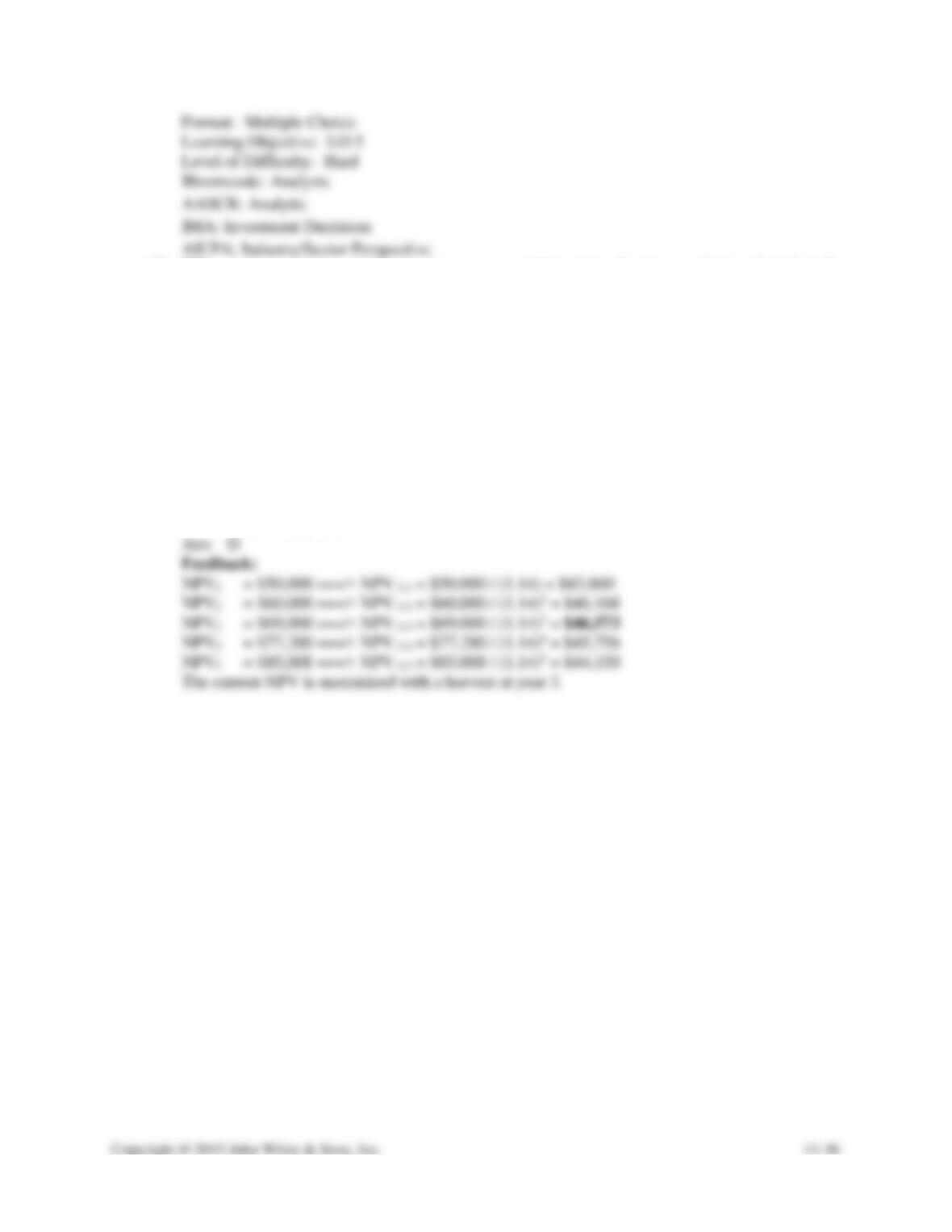
NPV1 = $50,000
NPV2 = $60,000
NPV3 = $69,000
NPV4 = $77,280
NPV5 = $85,008
A)
Harvest now
B)
Harvest in year 1
C)
Harvest in year 2
D)
Harvest in year 3
Ans:
D
Fundamentals of Corporate Finance 3e Test Bank
78.
When to replace an asset: Nemo Haulers is considering whether to purchase a new mini
tractor for moving furniture within its warehouse. Nemo calculates that its current mini tractor
generates $3,100 of cash flow per year. A new mini tractor would cost $3,000 and would
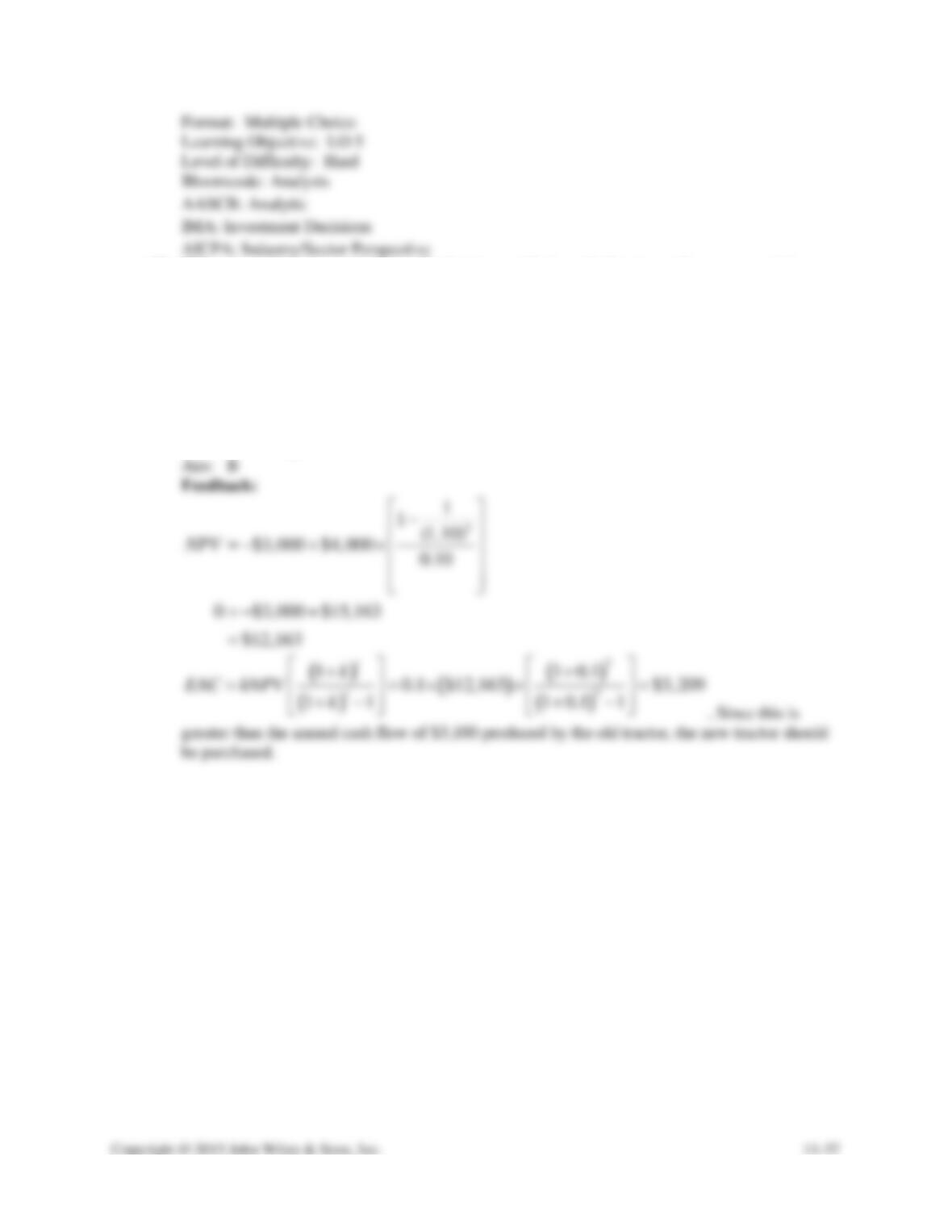
provide cash flow of $4,000 per year for five years. What is the equivalent annual cash flow for
the new mini tractor (round to the nearest dollar), and should Nemo purchase the new tractor?
Assume the cost of capital for Nemo is 10 percent.
A)
$3,000, do not purchase the new tractor
B)
$3,209, purchase the new tractor
C)
$4,000, purchase the new tractor
D)
$12,163, purchase the new tractor
Ans:
B
be purchased.
Fundamentals of Corporate Finance 3e Test Bank
79.
When to replace an asset: Burt’s Pizzas is considering whether to purchase an oven. Burt’s
calculates that its current oven generates $4,000 of cash flow per year. A new oven would cost
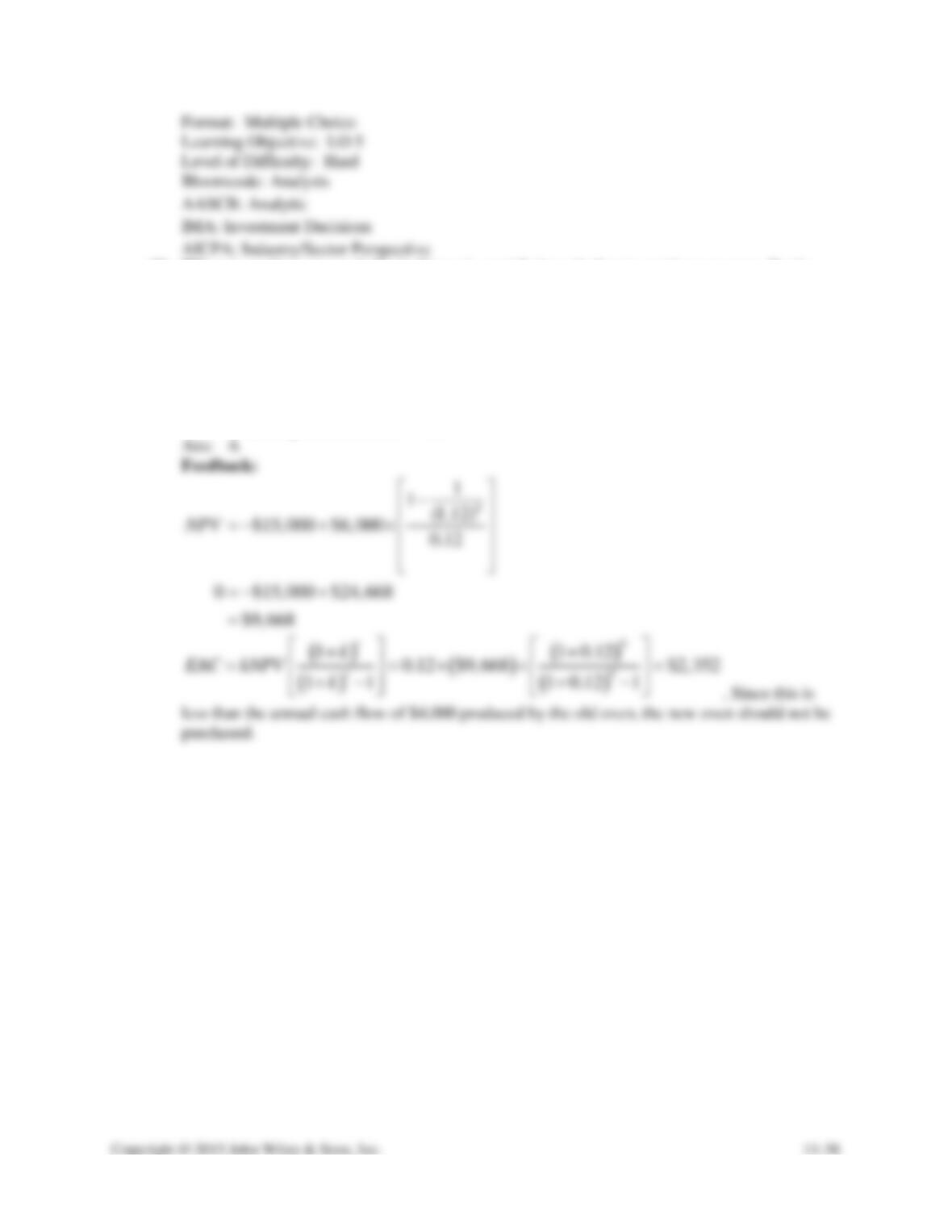
$15,000 and would provide cash flow of $6,000 per year for six years. What is the equivalent
annual cash flow for the new oven (round to the nearest dollar), and should Burt’s purchase the
new oven? Assume the cost of capital for Burt’s is 12 percent.
A)
$2,352, do not purchase the oven
B)
$6,000, purchase the oven
C)
$9,668, purchase the oven
D)
$24,668, purchase the new oven
Ans:
A
purchased.
Fundamentals of Corporate Finance 3e Test Bank
80.
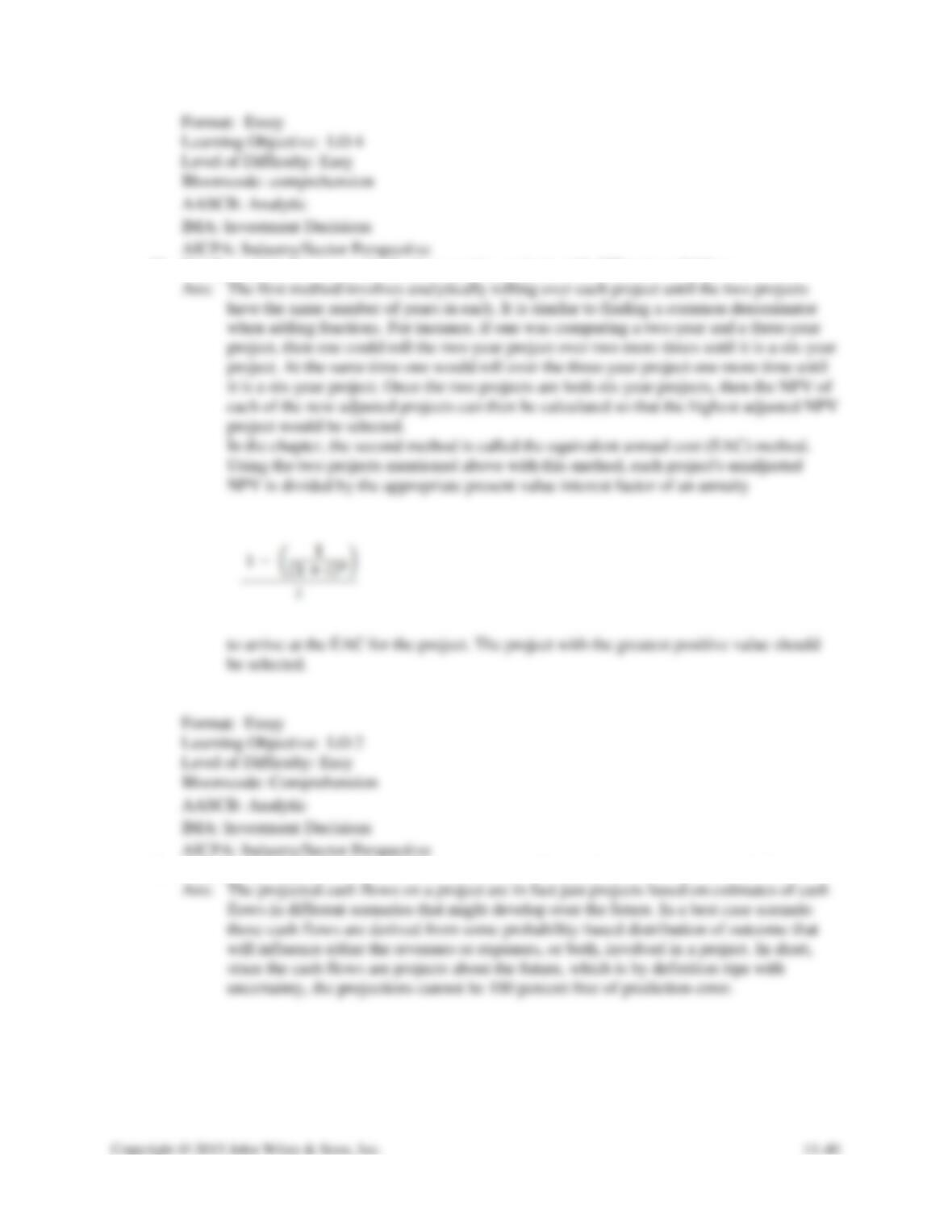
The cost of using an existing asset: Small Appliances, Inc., is considering starting a new line
of business with the excess capacity it currently has on its rivet machine. The current machine
is expected to last four years at the current rate of production. However, if a new line of
business is taken on, then the machine will have to be replaced in three years instead of four. A
new machine that will last four years would cost $50,000. What is the cost of taking on the new
line of business? Round to the nearest dollar and assume a 9 percent cost of capital.
A)
$11,917
B)
$12,500
C)
$15,433
D)
$50,000
Ans:
A
Fundamentals of Corporate Finance 3e Test Bank
81.
Briefly explain the two methods of comparing projects with different useful lives.
82.
Explain why in practice the cash flows associated with a project are not certain cash flows.
Fundamentals of Corporate Finance 3e Test Bank
83.
Why is depreciation and amortization added back when calculating free cash flows generated
by a project?
AICPA: Industry/Sector Perspective
84.
Which of the following statements is correct?
A)
Incremental net operating profits after-tax should include sunk costs associated with a
project.
B)
Incremental net operating profits after-tax should include the effects of financing costs
associated with a project.
C)
Incremental net operating profits after-tax should exclude the effects of depreciation
costs associated with a project.
D)
Incremental net operating profits after-tax should exclude the effects of financing costs
associated with a project.
Ans:
D

Fundamentals of Corporate Finance 3e Test Bank
85.
Which of the following statements is true?
A)
The calculation of free cash flow does not include the impact of income taxes.
B)
Accounting earnings are an unreliable measure of the costs and benefits of a project.
C)
The idea that we can evaluate the cash flows from a project independently of the cash
flows for the firm is known as the incremental principle.
D)
Depreciation expense should not be included in the calculation of incremental net
operating profits after-tax.
Ans:
B
Fundamentals of Corporate Finance 3e Test Bank
86.
General Mills just is undertaking an analysis on a new cereal. The firm realizes that if they
come out with a new product it would affect sales of existing products? What is the best course
of action for General Mills in this analysis?
A)
Treat the reduction of sales from existing cereals as a sunk cost.
B)
Account for the reduction of sales from existing cereals in the projection of cash flows
on the new product.
C)
Include the allocated costs of the new cereal in the sales of the pre-existing products.
D)
Ignore the fact that sales of other products will be affected.
Ans:
B
Fundamentals of Corporate Finance 3e Test Bank
87.
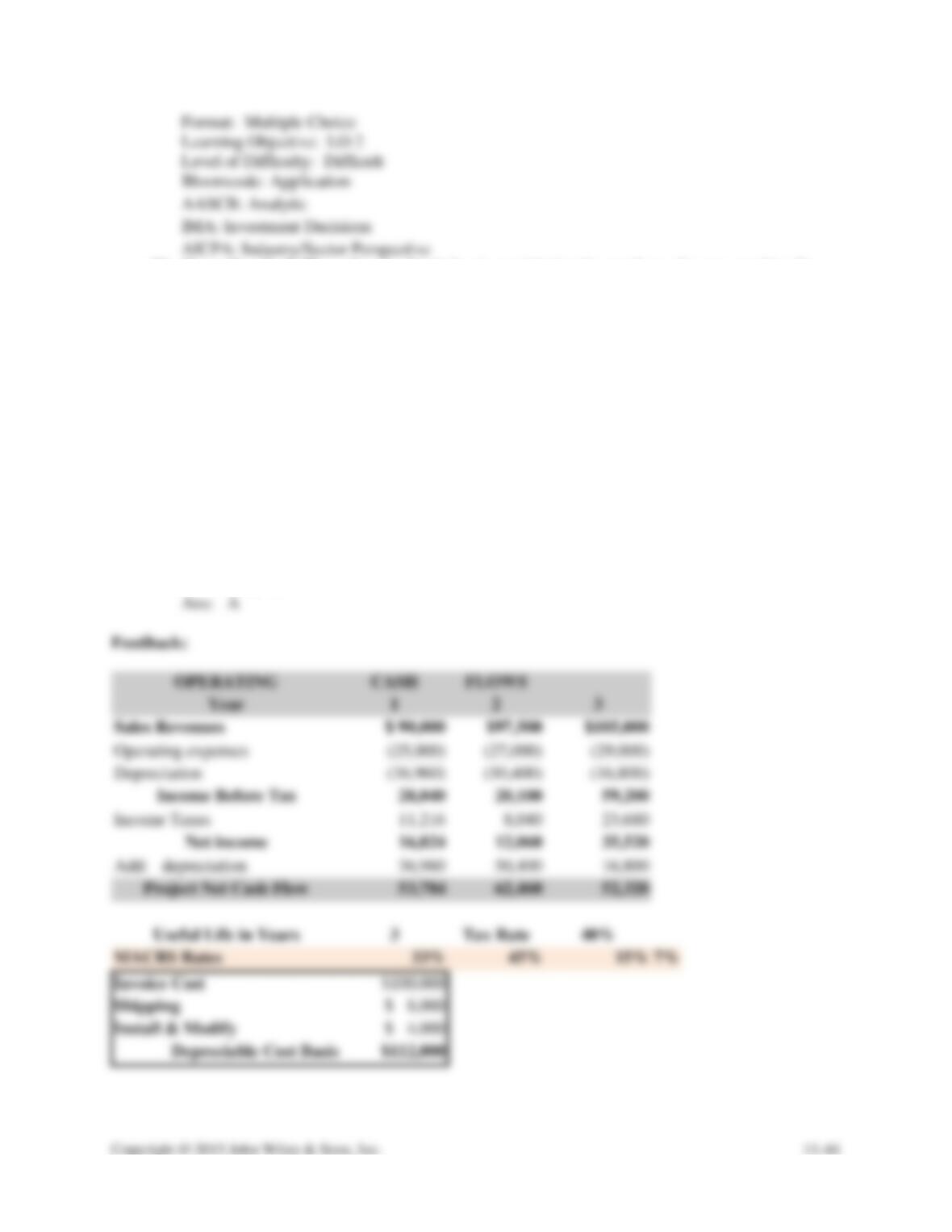
Operating Cash Flow: Premier Steel, Inc. is considering the purchase of a new machine for
$100,000 that has a useful life of 3 years. The firm’s cost of capital is 11.0% and the tax rate is
40%. This machine will be sold for its salvage value of $20,000 at the end of 3-years. The
machine will require an investment of $2,500 in spare parts inventory upon installation. The
machine will cost $8,000 to ship and $4,000 to install and modify it.
Sales are as follows: year 1 = $90,000; year 2 = $97,500; year 3 = $105,000. Operating
expenses are year 1 = $25,000; year 2 = $27,000; year 3 = $29,000. The investment in working
capital will be liquidated at termination of the project at the end of year 3.
MACRS Rates 33% 45% 15% 7%
Using MACRS, what is the operating cash flow in year 1?
A)
$53,784
B)
$35,238
C)
$86,999
D)
$42,512
Ans:
A
Fundamentals of Corporate Finance 3e Test Bank
88.
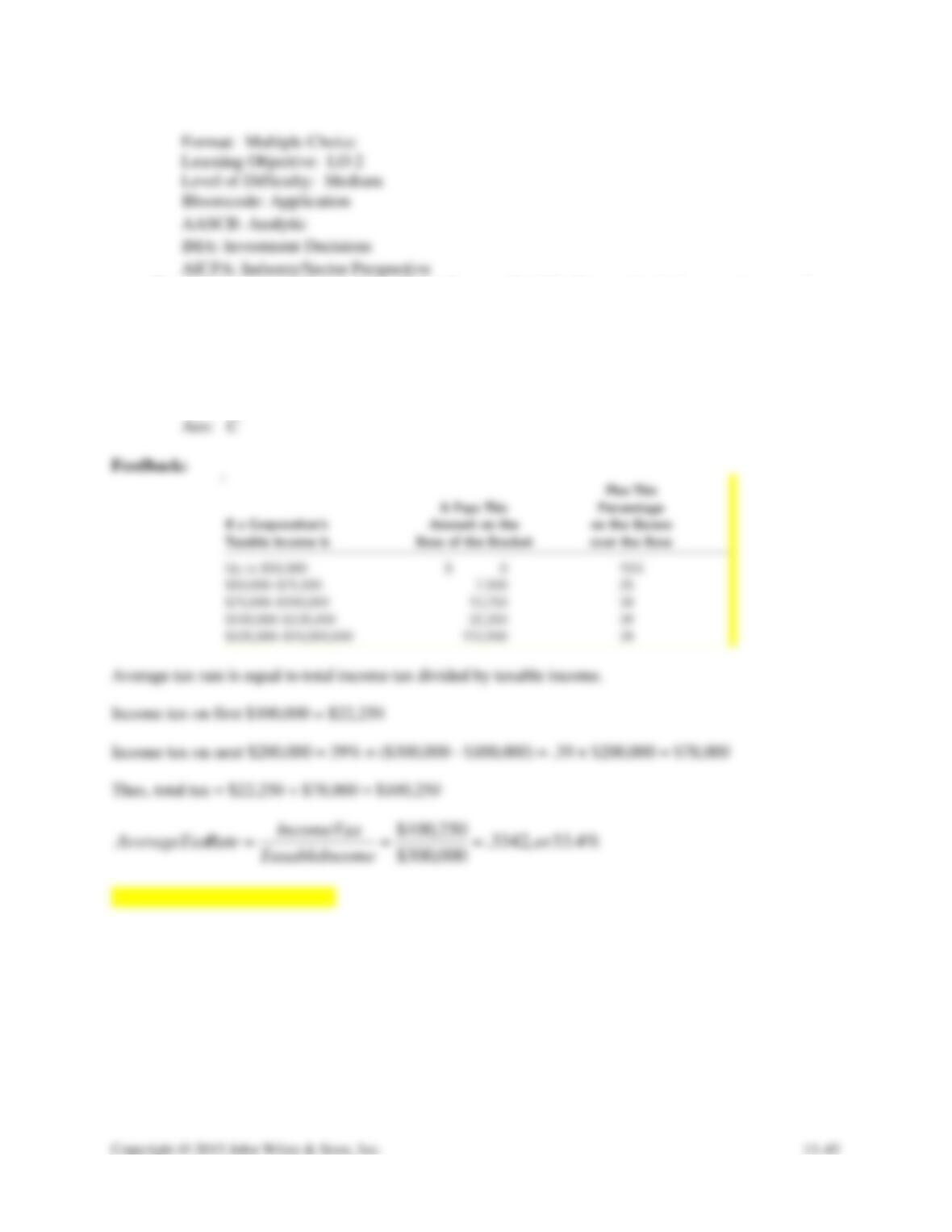
Average versus Marginal Tax Rate: Suppose Franklin Corporation had pre-tax income of
$300,000 in 2010 and that the firm would have paid $100,250.00 in federal income taxes. What
is Franklin’s average income tax rate? (Round off to the nearest 0.1%)
A)
39.0%
B)
34.7%
C)
33.4%
D)
38.6%
Ans:
C
Fundamentals of Corporate Finance 3e Test Bank
89.
Which of the following should not be included in a schedule of cash flows from operations
when evaluating a capital project?
A)
Fixed costs.
B)
Sunk costs.
C)
Depreciation and amortization.
D)
Variable costs.
Ans:
B
90.
Which of the following is an example of a fixed cost?
A)
Cost of equipment purchased for an assembly line to be used in the production of a new
product.
B)
Assembly costs associated with the production of a new product.
C)
Labor costs associated with the production of a new product.
D)
Shipping costs associated with the sale of a new product.
Ans:
A
Fundamentals of Corporate Finance 3e Test Bank
91.
Your firm is evaluating the merits of several different machines. Machine A has a useful life of
5-years, generates an NPV of $53,250, an IRR of 13.6% and an equivalent annual cost of
$10,316. Machine B has a useful life of 3-years, an NPV of $61,051, an IRR of 12.5%, and an
equivalent annual cost of $9,724. Machine C has a useful life of 4-years, generates an NPV of
$55,225, an IRR of 15.2% and an equivalent annual cost of $7,535 Machine D has a useful life
of 7-years, generates an NPV of $64,020, an IRR of 11.4% and an equivalent annual cost of
$8,885.
Which machine should be purchased and why?
A)
Machine C, because it has the highest IRR.
B)
Machine D, because it has the highest NPV.
C)
Machine A, because it has the most positive EAC
D)
Machine B, because it has the shortest useful life.
Ans:
C
92.
Equivalent Annual Cost: Your firm is considering an investment that will cost $750,000
today. The investment will produce cash flows of $250,000 in year 1, $400,000 in year 2, and
$600,000 in year 3. The discount rate that your firm uses for projects of this type is 11.75%.
What is the investment’s equivalent annual cost? (Round off to the nearest whole dollar)
A)
$163,613
B)
$225,008
C)
$68,888
D)
$92,845
Ans:
D
Fundamentals of Corporate Finance 3e Test Bank
93.
When is the appropriate time to harvest an asset?
A)
That point in time where harvesting the asset yields the largest internal rate of return.
B)
That point in time where harvesting the asset yields the smallest payback.
C)
That point in time where harvesting the asset yields the largest accounting rate of return.
D)
That point in time where harvesting the asset yields the largest net present value.
Ans:
D