Cost Accounting: A Managerial Emphasis, 6e
Chapter 11 – Decision Making and Relevant Information
Chapter 11 Decision Making and Relevant Information
11.1 Contrast relevant and irrelevant costs and revenues as well as quantitative and
qualitative information influencing decisions.
1) The purpose of evaluating performance in the decision process is to provide feedback.
2) Anticipated future costs that differ with alternative courses of action are known as relevant costs.
3) Divisional revenues which remain at the same level from year to year are known as relevant revenues.
4) The total cost difference between two separate alternatives in a decision making process is considered
to be its net relevant cost.
5) Each item included in the relevant-cost analysis should differ according to the alternative being
considered and be an expected future revenue or cost.
6) Quantitative factors are always expressed in financial terms.
Cost Accounting: A Managerial Emphasis, 6e
Chapter 11 – Decision Making and Relevant Information
7) If a manufacturer chooses to continue purchasing direct materials from a supplier because of the on–
going relationship that has developed over the years, the decision is based on qualitative factors.
8) When choosing between two alternatives, costs that do not differ between the two alternatives can be
considered to be irrelevant to that decision.
9) Management accountants help managers identify what information is relevant and what information
can be ignored.
10) Relevant information analysis is a key aspect of making decisions.
11) Cost items that do not change between the alternative choices involved in the decision are not
relevant to the decision to be made as they will be incurred no matter which alternative is chosen.
12) An expected value is the weighted average of the outcomes, with the probability of each outcome
serving as the weight.
Cost Accounting: A Managerial Emphasis, 6e
Chapter 11 – Decision Making and Relevant Information
13) The last step in the decision process is normally to
A) evaluate and explain outcomes.
B) make assumptions and predictions.
C) choose alternatives.
D) perform quantitative analysis.
E) gather information.
14) The feedback obtained in the decision process cannot affect
A) future predictions.
B) the prediction method.
C) the decision model.
D) implementation.
E) past performance.
15) The Gameshop manufactures specialized board games. Management is attempting to search for ways
to reduce costs and is considering two alternatives for an upcoming project of special games that must be
delivered to the customer in 12 months‘ time. Management agreed to the special project job as they have
an idle plant that is scheduled for demolition 18 months from now, and either alternative will easily meet
the delivery deadline.
Alternative 1 requires 10 machine operators and 2.5 individuals to handle direct materials. Employee pay
averages $17.50 per hour and will increase to $18.50 at the mid–point (July 1) of next year. Each employee
currently works 2,500 hours but will decrease to 2,400 hours if Alternative 2 is implemented. The second
proposal only requires 8.5 workers.
Which of the following items of information are relevant to this decision?
A) property taxes for the idle plant
B) hourly wage rates
C) the timing of the wage increase
D) the number of employees required in each alternative
E) the delivery deadline
Cost Accounting: A Managerial Emphasis, 6e
Chapter 11 – Decision Making and Relevant Information
16) Which of the following is false concerning relevant costs and relevant revenues?
A) Every decision deals with the future.
B) Nothing can be done to alter past costs or revenues.
C) Historical costs may be useful for predicting future costs.
D) Historical costs in themselves are irrelevant to a decision on future costs.
E) Total differential costs include both relevant and irrelevant costs.
17) Which of the following anticipated future costs always differ among alternative courses of actions?
A) direct labour costs
B) historical costs
C) relevant costs
D) direct materials costs
E) indirect costs
18) The variation in total costs between two alternatives is known as
A) differential cost.
B) analyzed cost.
C) irrelevant cost.
D) predictable cost.
E) expected cost.
19) Employee morale at Bedland Inc. is very high. This type of information is known as
A) a qualitative factor.
B) a quantitative factor.
C) a nonmeasurable factor.
D) a financial factor.
E) a numerical factor.
Cost Accounting: A Managerial Emphasis, 6e
Chapter 11 – Decision Making and Relevant Information
20) Ted owns a small body shop. His major costs include labour, parts, and rent. In the decision making
process, these costs are always considered to be
A) fixed.
B) qualitative factors.
C) quantitative factors.
D) variable.
E) relevant costs.
21) Which of the following represents a qualitative factor?
A) any nonfinancial factor
B) historical costs
C) relevant costs
D) the timing of variable costs
E) an outcome that cannot be measured in numerical terms
22) When making decisions, it is best to use
A) average costs.
B) fixed costs that would be incurred.
C) unit cost, rather than total cost.
D) variable costs that would be incurred.
E) relevant costs.
23) Sunk costs
A) are relevant.
B) are differential.
C) have future implications.
D) are ignored when evaluating alternatives.
E) are evaluated to determine if they are relevant or not evaluating alternatives.
Cost Accounting: A Managerial Emphasis, 6e
Chapter 11 – Decision Making and Relevant Information
24) A computer system installed last year is an example of a(n)
A) sunk cost.
B) relevant cost.
C) differential cost.
D) avoidable cost.
E) opportunity cost.
25) Which of the following costs are never relevant in the decision-making process?
A) fixed costs
B) historical costs
C) relevant costs
D) variable costs
E) opportunity costs
26) Jansen Industries is considering replacing a machine that is presently used in its production process.
The following information is available:
Old Machine
Replacement
Machine
Original cost
$25,000
$35,000
Remaining useful life in years
1
5
Current age in years
5
0
Book value
$5,000
Current disposal value in cash
$3,000
Future disposal value in cash (in 5 years)
$0
$2,000
Annual cash operating costs
$7,000
$4,000
Which of the information provided in the table is irrelevant to the replacement decision?
A) the annual operating cost of the old machine
B) the original cost of the old machine
C) the current disposal value of the old machine
D) the future disposal value of the replacement machine
E) the remaining useful life of the old machine
Cost Accounting: A Managerial Emphasis, 6e
Chapter 11 – Decision Making and Relevant Information
27) Expected value may be defined as
A) the probability that each outcome will occur.
B) the probability that each outcome will not occur.
C) the expected future benefit of selecting one alternative over another.
D) the average of all possible outcomes.
E) the weighted average of the outcomes with the probability of each outcome serving as the weight.
28) What would be the expected monetary value for the following data using the probability method?
Probability
Cash Inflows
0.20
$100,000
0.30
$80,000
0.15
$60,000
0.35
$0
A) $20,000
B) $94,000
C) $80,000
D) $53,000
E) $30,000
29) Lobster Liquidators will make $500,000 if the fishing season weather is good, $200,000 if the weather
is fair, and would actually lose $50,000 if the weather is poor during the season. If the weather service
gives a 40% probability of good weather, a 25% probability of fair weather, and a 35% probability of poor
weather, what is the expected value of the profit for Lobster Liquidators?
A) $500,000
B) $232,500
C) $267,500
D) $200,000
E) $217,000
Cost Accounting: A Managerial Emphasis, 6e
Chapter 11 – Decision Making and Relevant Information
Patrick Ross has three booth rental options at the county fair where he plans to sell his new product. The
booth rental options are:
Option 1: $1,000 fixed fee, or
Option 2: $750 fixed fee + 5% of all revenues generated at the fair, or
Option 3: 20% of all revenues generated at the fair.
The product sells for $37.50 per unit. He is able to purchase the units for $12.50 each.
30) Which option should Patrick choose to maximize income assuming there is a 40% probability that 70
units will be sold and a 60% probability that 40 units will be sold?
A) Options two and three are equivalent.
B) All options maximize income equally.
C) Option one
D) Option two
E) Option three
Cost Accounting: A Managerial Emphasis, 6e
Chapter 11 – Decision Making and Relevant Information
Answer the following question(s) using the information below.
Jim’s 5-year-old Geo Prizm requires repairs estimated at $3,000 to make it road worthy again. His friend,
Julie, suggested that he should buy a 5-year-old used Honda Civic instead for $3,000 cash. Julie estimated
the following costs for the two cars:
Geo Prizm
Honda Civic
Acquisition cost
$15,000
$3,000
Repairs
$2,900
—
Annual operating costs
(Gas, maintenance, insurance)
$2,280
$2,100
31) The cost NOT relevant for this decision is the
A) acquisition cost of the Geo Prizm.
B) acquisition cost of the Honda Civic.
C) repairs to the Geo Prizm.
D) annual operating costs of the Honda Civic.
E) annual operating costs of the Geo Prizm.
32) What should Jim do? What are his savings in the first year?
A) Buy the Honda Civic; $15,080
B) Fix the Geo Prizm; $2,820
C) Buy the Honda Civic; $180
D) Fix the Geo Prizm; $5,280
E) Buy the Honda Civic; $80
Cost Accounting: A Managerial Emphasis, 6e
Chapter 11 – Decision Making and Relevant Information
33) Chalet Ski & Patio manufactures a product that has two parts, X and Y. It is currently considering two
alternative proposals related to parts X and Y.
The first proposal is for buying part Y. This would free up some of the plant space for the manufacture of
more of part X and assembly of the final product. The product vice-president believes the additional
production of the final product can be sold at the current market price. No other changes in
manufacturing would be needed.
The second proposal is for buying new equipment for the production of part Y. The new equipment
requires fewer workers and uses less power to operate. The old equipment has a net disposal value of
zero.
Required:
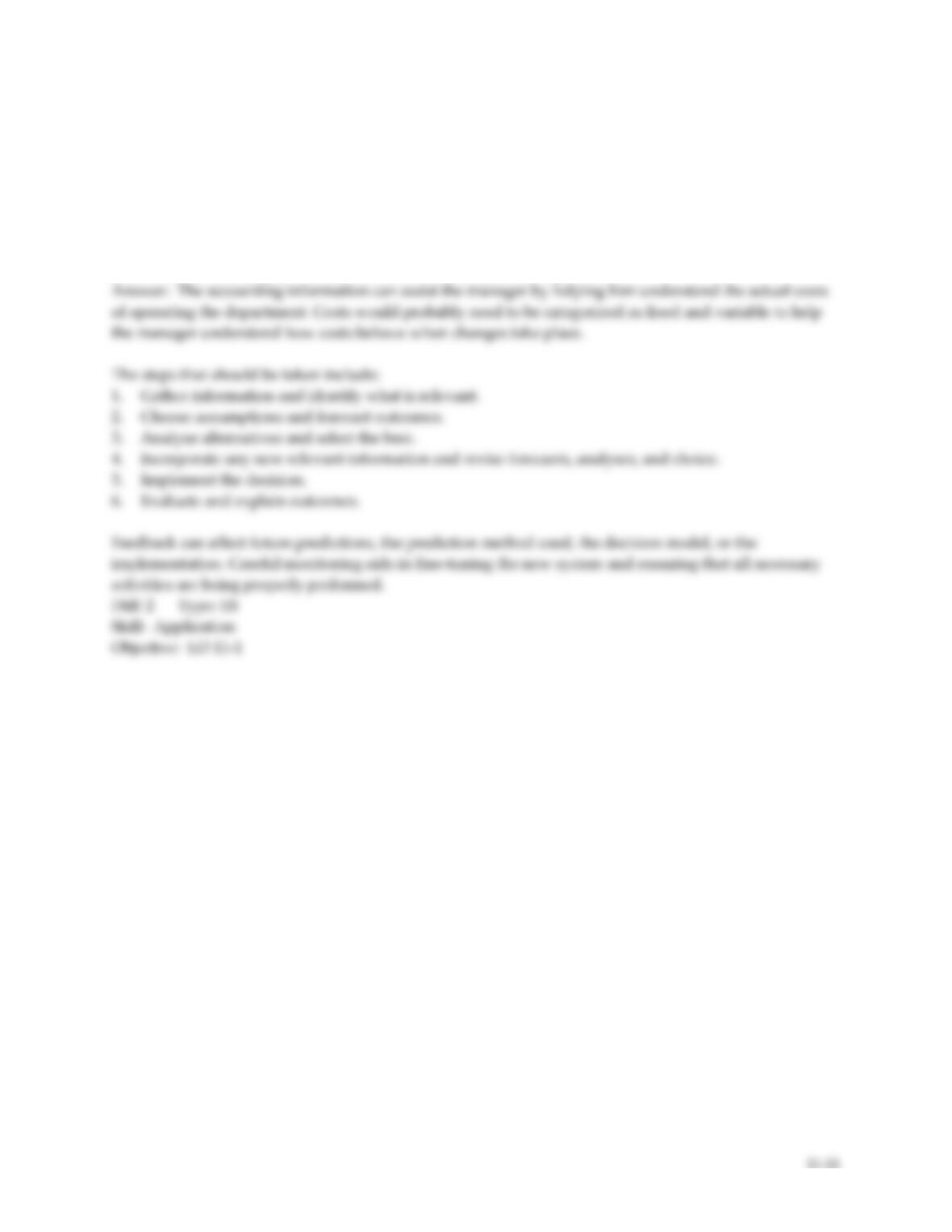
Tell whether the following items are relevant or irrelevant for each proposal. Treat each proposal
independently.
a. Sales revenue of the product.
b. Variable costs of assembling final products.
c. Direct manufacturing materials, part X.
d. Direct manufacturing materials, part Y.
e. Direct manufacturing labour, part X.
f. Direct manufacturing labour, part Y.
g. Variable manufacturing overhead, part X.
h. Variable manufacturing overhead, part Y.
i. Cost of old equipment for manufacturing Y.
j. Cost of new equipment for manufacturing Y.
k. Variable selling and administrative costs.
Cost Accounting: A Managerial Emphasis, 6e
Chapter 11 – Decision Making and Relevant Information
34) Scott is the new manager of the credit card department of a large bank. One of his first changes,
directed by the president, was to reorganize the activities of the department. He is reluctant to start the
reorganization without including a comprehensive report from accounting about the current costs of
operations and possible costs of changes.
Required:
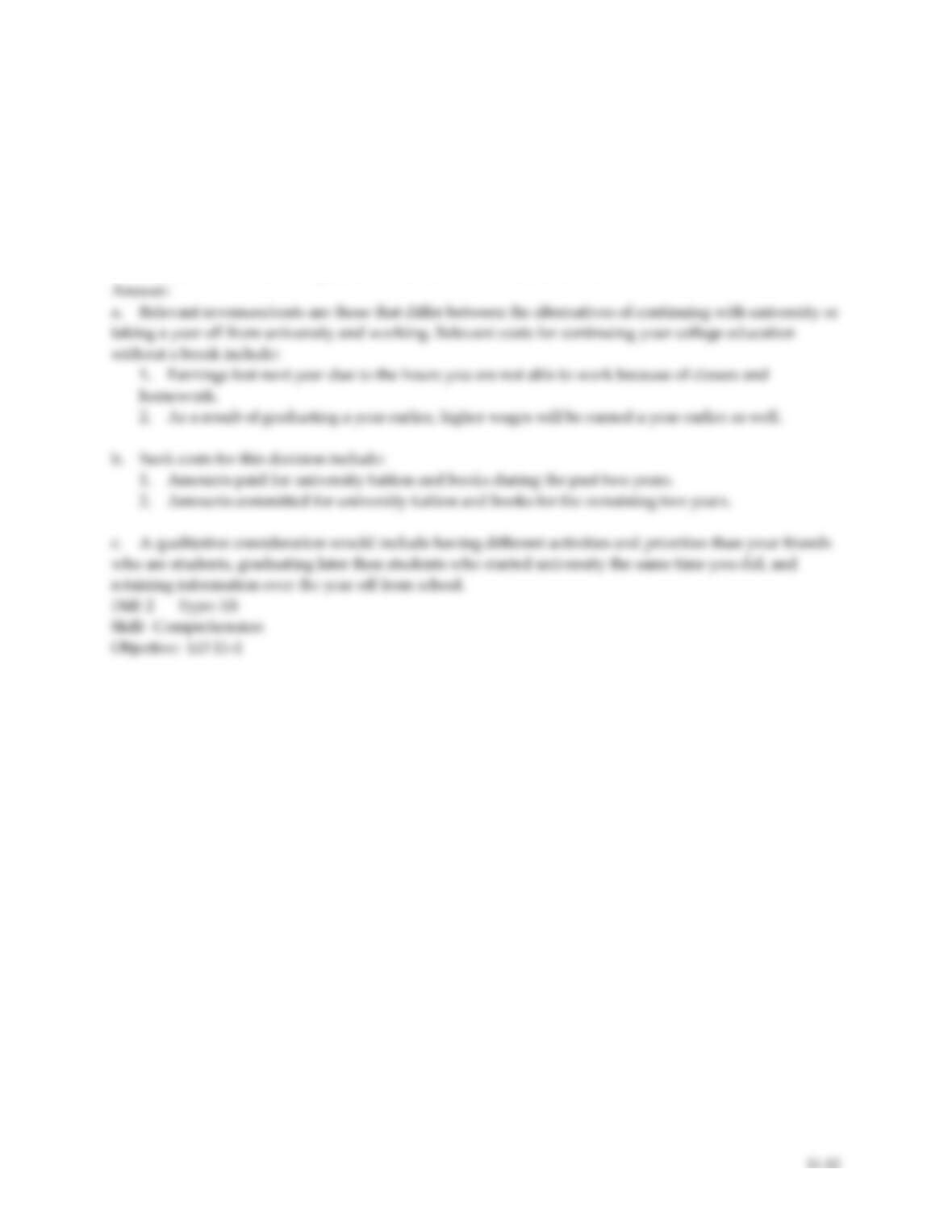
Explain how the decision process model can assist the manager and discuss the steps in the decision
process model that might be taken to ensure an orderly decision process.
Cost Accounting: A Managerial Emphasis, 6e
Chapter 11 – Decision Making and Relevant Information
35) A student is considering whether to finish their university program in four consecutive years, or take
a year off and work for some extra cash.
Required:
a. Identify at least two revenues or costs that are relevant to making this decision. Explain why each is
relevant.
b. Identify at least two costs that would be considered sunk costs for this decision.
c. Comment on at least one qualitative consideration for this decision.
Cost Accounting: A Managerial Emphasis, 6e
Chapter 11 – Decision Making and Relevant Information
36) A restaurant is deciding whether it wants to update its image or not. It currently has a cozy appeal
with loyal customers. The outdated décor that is still in good condition; menus and carpet need to be
replaced.
Required:
Identify for the restaurant management
a. those costs that are relevant to this decision;
b. those costs that are not differential;
c. and qualitative considerations.
Cost Accounting: A Managerial Emphasis, 6e
Chapter 11 – Decision Making and Relevant Information
37) Clinton Company sells two items, product A and product B. The company is considering dropping
product B. It is expected that sales of product A will increase by 40% as a result. Dropping product B will
allow the company to cancel its monthly equipment rental costing $100 per month. The other existing
equipment will be used for additional production of product A. One employee earning $200 per month
can be terminated if product B production is dropped. Clinton’s other fixed costs are allocated and will
continue regardless of the decision made. A condensed, budgeted monthly income statement with both
products follows:
Product A Product B Total
Sales $10,000 $8,000 $18,000
Direct materials 2,500 2,000 4,500
Direct labour 2,000 1,200 3,200
Equipment rental 300 2,600 2,900
Other allocated overhead 1,000 2,100 3,100
Operating income $4,200 $100 $4,300
Required:
Prepare an incremental analysis to determine the financial effect of dropping product B.
38) Explain what revenues and costs are relevant when choosing among alternatives.
Cost Accounting: A Managerial Emphasis, 6e
Chapter 11 – Decision Making and Relevant Information
11.2 Identify the differences among relevant costs for short-term and long-term
production output decisions.
1) All fixed costs are irrelevant in relevant-cost analysis.
2) All variable costs are relevant in relevant-cost analysis.
3) Insourcing is the process of producing goods and services within the firm rather than purchasing them
from an outside supplier.
4) An example of an outsourcing process is when a computer company purchases keyboards from
another company instead of producing the components internally.
5) For one-time-only special orders, variable costs may be relevant but not fixed costs.
6) Outsourcing is risk free to the manufacturer because the supplier now has the responsibility of
producing the part.
Cost Accounting: A Managerial Emphasis, 6e
Chapter 11 – Decision Making and Relevant Information
7) Which of the following terms represents additional costs required to obtain an additional quantity,
over and above existing or planned quantities of a cost object?
A) contract increase costs
B) contract pocket costs
C) contract expense
D) outlay costs
E) super variable costs
8) A one-time-only special order decision
A) should consider only long-term costs and benefits.
B) must still consider short-term and long-term costs and benefits.
C) allows a company to sell products at prices which only cover fixed costs.
D) should consider only short-term costs and benefits.
E) should only be undertaken if there is idle capacity.
9) Comics Plus has a current production level of 200,000 comics per month. Unit costs at this level are:
Direct materials
$0.125
Direct labour
0.200
Variable overhead
0.075
Fixed overhead
0.100
Marketing – Fixed
0.100
Marketing/distribution – Variable
0.200
Current monthly sales are 180,000 units. Printers Ltd. has contacted Comics Plus about purchasing 15,000
units at $1.00 each. Current sales would not be affected by the special order, and variable marketing/
distributing costs would not be incurred on the special order.
What is Comics Plus’ change in profits if the order is accepted?
A) $6,000 increase
B) $6,000 decrease
C) $7,500 increase
D) $9,000 increase
E) $3,000 increase
Cost Accounting: A Managerial Emphasis, 6e
Chapter 11 – Decision Making and Relevant Information
10) Northern Glass Manufacturing has a current production level of 200,000 glass jars per month. Unit
costs at this level are:
Direct materials
$0.345
Direct labour
0.400
Variable overhead
0.175
Fixed overhead
0.100
Marketing – Fixed
0.100
Marketing/distribution – Variable
0.200
Current monthly sales are 180,000 units. Canadian Hardware Ltd. has contacted Northern Glass
Manufacturing about purchasing 15,000 units at $1.00 each. Current sales would not be affected by the
special order, and variable marketing/ distributing costs would not be incurred on the special order.
What is Comics Plus’ change in profits if the order is accepted?
A) $4,800 increase
B) $4,800 decrease
C) $1,800 decrease
D) $300 decrease
E) $1,200 increase
11) Boyd Tool Company is a tool manufacturer. Production capacity is 3,000 units per month; however,
they are considering alternative ways to increase capacity to 3,500 units. One of the alternatives involves
purchasing new equipment. In this alternative, there are two choices: machine A will provide increased
capacity of 4,000 units per month, with unit costs of $14 at capacity; and, machine B will increase capacity
to 3,600 units per month with unit costs of $15 at capacity. Both machines are adequate since Boyd‘s does
not intend to go beyond the 3,500 units per month level for the foreseeable future.
Relevant information for this decision includes
A) whether other costs will change solely due to a capacity increase.
B) the different unit cost of production between the two machine at their capacity levels.
C) Boyd’s planned capacity utilization.
D) excess capacity of either machine.
E) the different unit cost of production between the two machines at Boyd’s planned capacity levels.
Cost Accounting: A Managerial Emphasis, 6e
Chapter 11 – Decision Making and Relevant Information
12) First Image has a plant capacity of 80,000 units per month. Unit costs at capacity are:
Direct materials
$2.00
Direct labour
3.00
Variable overhead
1.50
Fixed overhead
1.50
Marketing – Fixed
3.50
Marketing/distribution – Variable
1.80
Current monthly sales are 78,000 units at $12.60 each. Computer Output Management has contacted First
Image about purchasing 2,000 units at $12.00 each. Current sales would not be affected by the special
order. What is First Image‘s change in profits if the order is accepted?
A) $7,400 increase
B) $8,600 increase
C) $4,400 increase
D) $2,600 decrease
E) $3,600 decrease
13) Precision Sewing Company incorporates the services of Rosie’s Sewing. Precision purchases pre-cut
dresses from Rosie’s. This is primarily known as
A) insourcing.
B) outsourcing.
C) product needs analysis.
D) product specialization.
E) qualitative analysis.
14) Anchor Sign Company manufactures signs from direct materials to the finished product. This is an
example of which of the following?
A) insourcing
B) outsourcing
C) product needs analysis
D) product specialization
E) utilization of idle facilities
Cost Accounting: A Managerial Emphasis, 6e
Chapter 11 – Decision Making and Relevant Information
15) Omark Corporation currently manufactures a subassembly for its main product. The variable costs
per unit are $48, in addition to a $6 charge based on estimated selling expenses.
R-Corp has contacted Omark with an offer to sell them 5,000 of the subassemblies for $44.00 each. Omark
will eliminate $50,000 of fixed overhead if it accepts the proposal.
What is increase or decrease in profit from accepting the offer?
A) $50,000 increase
B) $100,000 increase
C) $170,000 increase
D) $50,000 decrease
E) $70,000 increase
16) When considering a project that will require production using otherwise idle resources, which of the
following are true?
A) Avoidable fixed costs are irrelevant.
B) Only the variable costs of the project are relevant.
C) Only financial factors should be considered.
D) The project should not be undertaken if total revenue from the project is less than the total costs of
production.
E) In the short run, even if revenue is less than the total costs of production, the project could help the
company’s overall operating income.
17) Northwoods is invited to bid on a one-time-only special order to supply 100 rustic tables. What is the
lowest price Northwoods should bid on this special order?
A) $6,300
B) $7,200
C) $10,800
D) $13,500
E) $9,000
Cost Accounting: A Managerial Emphasis, 6e
Chapter 11 – Decision Making and Relevant Information
Answer the following question(s) using the information below.
Welch Manufacturing is approached by a European customer to fulfill a one-time-only special order for a
product similar to one offered to domestic customers. Welch Manufacturing has excess capacity. The
following per unit data apply for sales to regular customers:
Variable costs:
Direct materials
$40
Direct labour
20
Manufacturing support
35
Marketing costs
15
Fixed costs:
Manufacturing support
45
Marketing costs
15
Total costs
$170
Markup (50%)
85
Targeted selling price
$255
18) What is the full cost of the product per unit?
A) $110
B) $170
C) $255
D) $95
E) $140
19) What is the contribution margin per unit?
A) $85
B) $110
C) $145
D) $160
E) $195