Chapter 11: Standard Costs and Variance Analysis
Learning Questions
True /
False
Multiple Choice
Matching
Exercises
Short
Answer
Problems
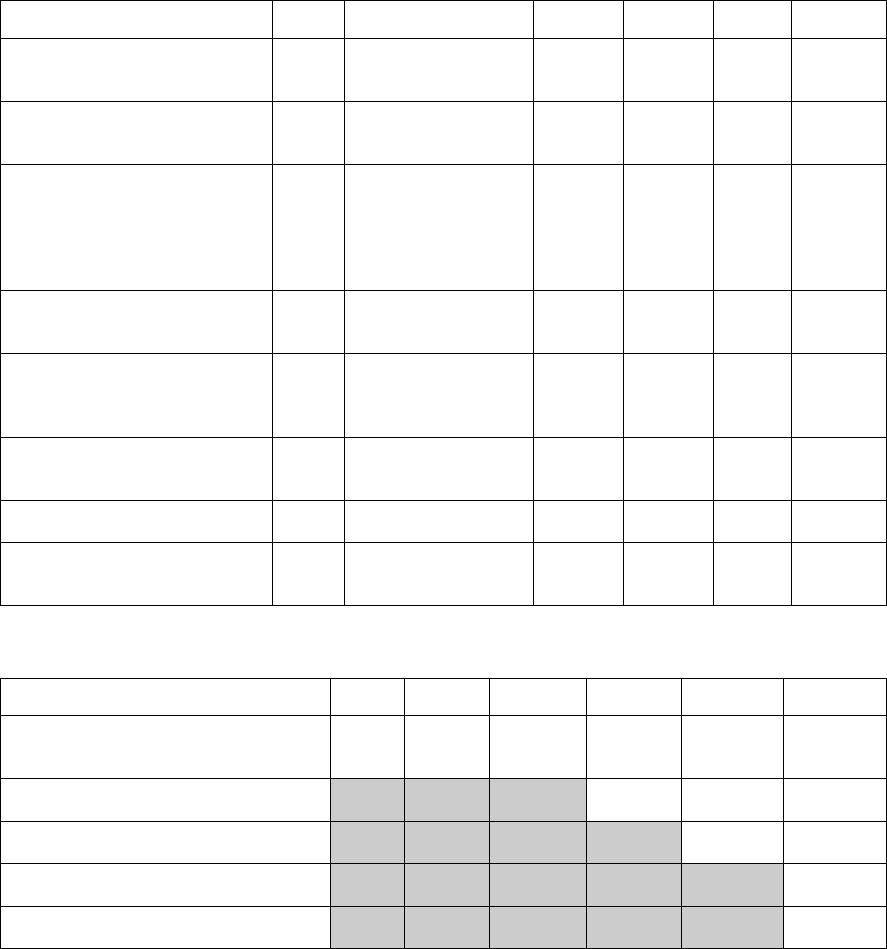
1. How are standard costs
established?
1-3
32-34, 39, 40
S: 96
W: 124, 132
8, 10
2. What is variance analysis,
and how is it performed?
4-7
42-46, 48-50, 52,
57–59
W: 129, 138
7
3. Which direct cost variances
are commonly analyzed?
8, 10
1-4, 13, 14,
19-21,24-27, 75-77,
79, 84-88, 92-95
S: 101-103, 119-122
W: 125, 127, 128,
137, 140-142
3
1, 3
1
2, 3
4. How is direct cost variance
information analyzed and
used?
9,
11–13
36-38, 47, 51, 53-56
S: 104, 105, 123
W: 139
1
3
2, 3, 5
5. Which variable and fixed
overhead variances are
commonly analyzed?
14–16
5-12, 15-18, 28, 35, 78,
80-83, 89-91,
S: 97-99, 107-109
W: 126, 135, 136
3
2, 3
1, 3
6. How is overhead variance
information analyzed and
used?
17
60–67
S: 106
W: 133
2
2, 3
3, 5
7. How are manufacturing cost
variances closed?
18–20
22-23, 29-31
W: 131
3
4, 9
8. Which profit-related
variances are commonly
analyzed? (appendix)
21–23
68–74
S: 100, 110-118
W: 130, 134
5, 6
4
S: Questions from the study guide
W: Questions from web quizzes on the student web site
Level of Complexity*
True /
False
Multiple
Choice
Matching
Exercises
Short
Answer
Problems
Foundation: Repeat or paraphrase
information; Reason to single correct
solution; Perform computations; etc.
All
All
All
All
4, 6, 9
1, 2, 4
Step 1: Identify the problem, relevant
information, and uncertainties
1, 2, 3, 8
1, 5
Step 2: Explore interpretations and
connections
5, 7, 10
2, 3, 4, 5
Step 3: Prioritize alternatives and
implement conclusions
Step 4: Envision and direct strategic
innovation
*Based on level in Steps for Better Thinking (Exhibit 1.10, textbook p. 16):
Note: Step 1, 2, 3, and 4 questions in this test bank are intentionally open-ended and subjective, giving students the
opportunity to demonstrate skills such as judgment, reasoning, identification of uncertainties, identification or analysis of
pros and cons, and so on. Therefore, student answers may not exactly match those shown in the solutions.

11-2 Cost Management
True / False
1. The total standard cost for a unit of output is the sum of the standard costs for the resources used in
production.
2. The standard cost of direct materials is computed as the standard price per unit of input times the
standard quantity per unit of input.
3. The cost categories that are measured and monitored in a given organization depend, in part, on the
costs that managers consider important.
4. Calculating variances is a necessary, but not sufficient, step for completing a variance analysis.
5. Variance analysis is used for monitoring and performance evaluation.
6. A standard cost variance is a difference between a standard cost and an actual cost.
7. Identifying the reasons for variances is usually a quick and easy process.
8. The direct materials price variance is often based on materials purchased, rather than on materials used.
9. The direct materials efficiency variance tells managers about the efficiency of the purchasing process.
10. The total direct labor variance can be broken down into two components: the efficiency variance and
the price variance.
11. Unreasonable standards may be the cause of direct materials variances, but not of direct labor
variances.
12. A contract with a new supplier may cause an unfavorable materials price variance.
13. Normal fluctuations in labor hours may cause a favorable direct labor efficiency variance.
14. The variable overhead budget variance is the difference between allocated variable overhead cost and
actual variable overhead cost.
15. The fixed overhead spending variance is normally zero because fixed costs are constant within a
relevant range of activity.
16. The fixed overhead budget variance can be broken down into two parts: the spending variance and the
production volume variance.
17. Errors in the accounting records related to actual production output could lead to a fixed overhead
production volume variance.
18. If the total variances in the accounting information system are favorable, accountants must adjust some
accounts by decreasing costs during the closing process.
19. If a variance is considered material, it should be allocated to work in process inventory, finished goods
inventory, and cost of goods sold.
20. If a variance is unfavorable, it should be closed directly to cost of goods sold.
21. Variance analysis can be used for both costs and revenues.
22. (Appendix 11A) The sales price variance is calculated as (actual price – standard price) X actual
volume sold.
23. (Appendix 11A) For organizations that sell multiple products, contribution margin and sales mix
variances are often useful for decision making.

Standard Costs and Variance Analysis 11-3
Multiple Choice
Use the following information for the next 4 questions.
Welch Company budgeted the following cost standards for the current year:
Direct materials = 1.40 pounds per unit @ $1.50 per pound
Direct labor = 0.75 hours per unit @ $6 per hour
Actual production and costs were as follows:
Units produced = 2,800
Direct materials used = 4,500 lbs.
Direct materials purchased = 5,000 lbs. @ a cost of $5,850
Direct labor incurred = 2,000 hours at a cost of $13,000
1. The material price variance for materials purchased was
a. $1,650 F
b. $870 U
c. $2,520 U
d. $780 F
2. The material efficiency variance was
a. $1,650 F
b. $870 U
c. $2,520 U
d. $780 F
3. The labor price variance was
a. $600 F
b. $400 U
c. $4,800 F
d. $1,000 U
4. The labor efficiency variance was
a. $600 F
b. $400 U
c. $4,800 F
d. $1,000 U
Use the following information for the next 4 questions.
Burkett Company uses a standard cost system. Indirect costs were budgeted at $200,000 plus $15 per direct
labor hour. The overhead rate is based on 10,000 hours. Actual results were:
Standard direct labor hours 9,000
Actual direct labor hours 10,000
Fixed overhead $190,000
Variable overhead $185,000
5. The fixed overhead production volume variance was
a. $15,000 F
b. $20,000 U
c. $10,000 F
d. $10,000 U
6. The variable overhead spending variance was
a. $10,000 F
b. $50,000 U
c. $35,000 U
d. $15,000 U

11-4 Cost Management
7. The variable overhead efficiency variance was
a. $10,000 F
b. $50,000 U
c. $35,000 U
d. $15,000 U
8. The over- or underapplied overhead was
a. $50,000 under
b. $10,000 over
c. $60,000 under
d. $20,000 over
Use the following information for the next 6 questions.
Hyteck, Inc. is a capital intensive firm. Indirect costs make up nearly 70% of the product costs. The company
has no direct material costs because customers provide the direct materials used for each job. To plan and
control such costs, the firm employs flexible budgets and standard costs. Overhead rates, based on direct labor
hours, are derived from the master budget.
Master Actual
Budget Results
Units produced 2,000 1,820
Direct labor hours 10,000 9,200
Fixed overhead $100,000 $98,000
Variable overhead $160,000 $150,000
Direct labor $100,000 $90,000
9. The fixed overhead spending variance was
a. $9,000 U
b. $2,000 F
c. $7,000 U
d. $2,800 U
10. The fixed overhead production volume variance was
a. $9,000 U
b. $2,000 F
c. $7,000 U
d. $2,800 U
11. The variable overhead spending variance was
a. $1,200 F
b. $2,000 F
c. $2,800 U
d. $1,600 U
12. The budget variance for variable overhead was
a. $2,800 U
b. $7,000 U
c. $4,400 U
d. $9,000 U
13. The direct labor price variance was
a. $2,000 F
b. $2,800 U
c. $1,000 U
d. $1,000 F
Standard Costs and Variance Analysis 11-5
14. The direct labor efficiency variance was
a. $2,000 F
b. $2,800 U
c. $1,000 U
d. $1,000 F
Use the following information for the next 4 questions.
Hogle Mfg. Co. uses a standard costing system. The standard time to produce one unit is 4 hours, and normal
production is 3,000 units monthly. Overhead costs were estimated to be $135,000. The standard variable
overhead rate is $5 per machine hour. During April the following results were recorded:
Units produced 3,100
Units sold 2,800
Machine hours required 12,800
Actual overhead costs $136,000
15. The combined fixed and variable overhead spending variance was
a. $1,000 U
b. $2,000 F
c. $7,000 U
d. $3,000 F
16. The variable overhead efficiency variance was
a. $8,000 U
b. $4,000U
c. $2,000 U
d. $4,000 F
17. The fixed overhead production volume variance was
a. $1,000 U
b. $2,500 F
c. $1,500 F
d. $5,000 U
18. The total overhead allocated was
a. $135,000
b. $139,500
c. $141,500
d. $137,000
Use the following information for the next 3 questions.
Baldwin, Inc uses a standard job cost system and purchased 25,000 lbs. of material at $6 per lb., and used it all.
The standard amount allowed for the output achieved is 22,500 lbs, and the standard price is $6.50 per lb. The
company also incurred 37,500 direct labor hours for $450,000. The standard hourly price was $11 per hour, and
39,000 hours were allowed at standard. Assuming all variances are immaterial, answer the following questions.
19. The entry to record the direct material price variance will include a
a. Debit to materials inventory for $150,000
b. Debit to account payable for $162,500
c. Credit to the price variance for $12,500
d. Debit to the price variance for $16,250
20. The entry to record the direct material efficiency variance will include a
a. Debit to work in process inventory for $146,250
b. Credit to the efficiency variance for $16,250
c. Credit to the efficiency variance for $12,500
d. Credit to materials inventory for $150,000
11-6 Cost Management
21. The entry to record the direct labor variances will include a
a. Credit to wages payable for $429,000
b. Debit to wages expense for $450,000
c. Debit to work in process inventory for $412,500
d. Credit to direct labor efficiency variance for $16,500
Use the following information for the next 2 questions.
Brodie Co. uses a standard job cost system and a denominator volume of 25,000 direct labor hours for allocating
overhead. The actual output was 12,000 units, which cost $185,700 for direct labor (23,000 hours), $27,525 for
variable overhead, and $136,400 for fixed overhead. The standard variable overhead per unit is $2 (2 hours @
$1 per hour), and the standard fixed overhead per unit is $10 (2 hours @ $5 per hour). All variances are
immaterial and are closed to Cost of Goods Sold at the end of the period.
22. The entry to close the variable overhead variances includes a
a. Credit to the variable overhead spending variance for $4,525
b. Credit to work in process for $24,000
c. Credit to the variable overhead efficiency variance for $1,000
d. Debit to Cost of Goods Sold for $5,525
23. The entry to close the fixed overhead variances includes a
a. Credit to work in process for $120,000
b. Debit to fixed overhead control for $125,000
c. Debit to Cost of Goods Sold for $16,400
d. Debit to the fixed overhead production volume variance for $5,000
Use the following information for the next 5 questions.
Mason, Inc. uses a standard costing system. Overhead costs are allocated based on direct labor hours. The
standard variable overhead and fixed overhead rates are $1 and $5 per direct labor hour, respectively. Data
relevant for the current period include:
Direct materials purchased 50,000 lbs. @ $12 per lb.
Direct materials used 50,000 lbs.
Standard quantity of direct materials
for actual production 45,000 lbs.
Direct materials standard price $13 per lb.
Direct labor costs incurred 75,000 hours @ $12 per hour
Standard direct labor hours for
actual production 78,000 hours
Standard direct labor cost per hour $11 per hour
Variable overhead costs incurred $77,070
Fixed overhead costs incurred $381,920
24. The purchase of direct materials would be recorded in direct materials inventory at
a. $540,000
b. $585,000
c. $600,000
d. $650,000
25. The cost of direct materials added to work in process would be
a. $540,000
b. $585,000
c. $600,000
d. $650,000
Standard Costs and Variance Analysis 11-7
26. The direct materials efficiency variance is
a. $60,000 Favorable
b. $60,000 Unfavorable
c. $65,000 Favorable
d. $65,000 Unfavorable
27. The direct labor price variance is
a. $30,000 Favorable
b. $30,000 Unfavorable
c. $75,000 Unfavorable
d. $78,000 Unfavorable
28. The variable overhead spending variance is
a. $930 Favorable
b. $2,070 Unfavorable
c. $33,000 Unfavorable
d. $33,000 Unfavorable
29. Given the following account balances at the end of the first year of operations:
Work in process inventory $ 90,000
Finished goods inventory 165,000
Cost of goods sold 495,000
Direct labor price variance 35,000 U
Direct labor efficiency variance 17,000 F
Assuming that variances are considered material, the entry and amount of direct labor variances
allocated to the Finished Goods Inventory is
a. Credit $3,740
b. Debit $2,160
c. Credit $770
d. Debit $3,960
Use the following information for the next 2 questions.
Given the following account balances at the end of the first year of operations:
Direct materials inventory $ 60,000
Work in process inventory 120,000
Finished goods inventory 180,000
Cost of goods sold 600,000
Direct material price variance 65,000 U
Direct material efficiency 195,000 F
30. Assuming that variances are considered material, the entry and amount of the direct material efficiency
variance allocated to work in process inventory is
a. Credit $26,000
b. Credit $24,375
c. Debit $17,333
d. Debit $8,125
31. Assuming that variances are considered material, the entry and amount of the direct material price
variance allocated to Cost of Goods Sold is
a. Debit $40,625
b. Debit $41,082
c. Credit $43,333
d. Debit $39,935
11-8 Cost Management
32. Expected costs per unit of input are called
a. Standard prices
b. Standard costs
c. Standard quantities
d. Standard ideals
33. The budget that reflects the level of activity management expects to attain is the
a. Flexible budget
b. Standard budget
c. Master budget
d. Expected budget
34. Standard costing allows management to
I. Measure performance
II. Identify inefficiencies
III. Control costs
a. I and II only
b. I and III only
c. II and III only
d. I, II, and III
35. For overhead variances, the difference between the flexible budget amounts and actual costs incurred is
called the
a. Efficiency variance
b. Budget variance
c. Favorable variance
d. Quantity variance
36. Which department is customarily responsible for an unfavorable material price variance?
a. Sales
b. Purchasing
c. Engineering
d. Production
37. Favorable price variances occur because of
a. Rising prices of finished goods
b. Increases in raw materials efficiency
c. Price decreases in raw materials
d. Efficiency in the production department
38. Which of the following is a possible cause of an unfavorable materials efficiency variance?
a. Using materials that do not meet specifications
b. Using a higher class of labor than called for
c. Using a higher quality of material than called for
d. Using fewer hours of labor than labor specifications call for
39. In a traditional manufacturing accounting system, the standard cost of a unit of output is the sum of the
standard costs of
a. Direct material, direct labor, and variable overhead
b. Direct material, direct labor ,and fixed overhead
c. Direct material, direct labor, and period costs
d. Direct material, direct labor, variable overhead, and fixed overhead
Standard Costs and Variance Analysis 11-9
40. Standard costs should be reviewed
a. Daily
b. Monthly
c. Annually
d. As often as managers and accountants deem necessary
41. The process of calculating variances and analyzing the reasons they occurred is called
a. Variance analysis
b. Budget analysis
c. Historical analysis
d. Activity-based analysis
42. Variance analysis includes which of the following processes?
I. Calculating variances
II. Analyzing the reasons variances occurred
III. Predicting variances in future periods
a. I and II only
b. I and III only
c. II and III only
d. I, II, and III
43. Managers investigate
a. All variances
b. All unfavorable variances
c. Variances they consider important
d. Variances that are reported in the financial statements
44. How do managers decide which variances are important enough to investigate?
I. By considering whether they are favorable or unfavorable
II. By calculating and investigating all possible variances
III. By considering whether it is large enough to justify investigation
a. I only
b. II only
c. III only
d. I and III only
45. Which of the following is not a typical step in variance analysis?
a. Calculate variances
b. Identify reasons for variances
c. Report variances in financial statements
d. Draw conclusions and take action
46. Variance analysis involves the steps listed below. In which order should the steps be performed?
1. Calculate variances
2. Choose variances for further investigation
3. Draw conclusions and take action
4. Identify reasons for variances
a. 1, 2, 3, 4
b. 2, 1, 3, 4
c. 2, 1, 4, 3
d. 1, 2, 4, 3
11-10 Cost Management
47. The production manager of CLR Corporation calculated a material and unfavorable variance of $4,000
with respect to the cost of direct materials. Which of the following is a likely next step for the
production manager?
a. Identify and discipline the responsible employee
b. Take actions to prevent the variance from recurring
c. Ascertain the cause of the variance
d. Switch suppliers for direct materials
48. If a variance is investigated and determined to be random, managers should
a. Write off the variance against cost of goods sold
b. Do nothing
c. Identify and discipline the employee(s) responsible
d. Write off the variance against work in process
49. If a variance analysis shows that operations are better than expected, managers should
a. Do nothing
b. Revise standard costs to make them harder to achieve
c. Distribute extra dividends to shareholders
d. Monitor quality to ensure it was maintained
50. Variances can be caused by
I. Out-of-control operations
II. Better-than-expected operations
III. Inappropriate benchmarks
a. I and III only
b. II and III only
c. I and II only
d. I, II, and III
51. Theft of raw materials is most likely to lead to
a. Direct materials price variance
b. Favorable direct materials price variance
c. Unfavorable direct materials efficiency variance
d. Favorable direct materials efficiency variance
52. Unattainable standards are likely to lead to
I. Errors in the accounting information system
II. Favorable variances
III. Unfavorable variances
a. I only
b. II only
c. III only
d. I and III only
53. At the end of 20x1, ELM Corporation’s production manager estimated direct labor overtime hours at
200 for the first quarter of 20x2. At the end of the first quarter, actual overtime hours totaled 180. This
difference is most likely to lead to
a. Favorable variable overhead spending variance
b. Unfavorable production volume variance
c. Favorable labor efficiency variance
d. Unfavorable labor efficiency variance
Standard Costs and Variance Analysis 11-11
54. Intentional worker damage is most likely to result in which type of variance?
a. Direct materials price variance
b. Direct materials efficiency variance
c. Direct labor price variance
d. Variable overhead spending variance
55. ELM Corporation introduced a new automated production process that has reduced the amount of labor
needed, but not affected the use of materials. The standard cost system has not been changed yet to
reflect this new process. Assuming the machinery is functioning properly and that workers were
properly trained in its use, which of the following variances is most likely to result?
a. Favorable variable overhead spending variance
b. Favorable direct labor efficiency variance
c. Unfavorable direct labor efficiency variance
d. Favorable direct materials price variance
56. LST Corporation entered into a new contract with one of its raw material suppliers. The new contract
required the supplier to deliver raw materials with a 24-hour notice from LST. This reduces LST’s
material handling costs, but has increased the cost of the raw materials delivered. Which of the
following variances is most likely to result?
a. Unfavorable direct material price variance
b. Favorable direct price variance
c. Unfavorable variable overhead spending variance
d. Unfavorable fixed overhead spending variance
57. A favorable variance in one area might be offset by
a. Favorable variance in another area
b. Unfavorable variance in another area
c. Increase in period costs
d. Decrease in period costs
58. Rewarding employees in one production department for meeting or exceeding standard cost
benchmarks can create new sets of problems for organizations. Which of the following is not one of
them?
a. An unfavorable efficiency variance because of rework needed on work from another department
b. Variances in another production department
c. Unmotivated employees in that production department
d. Poor quality finished goods
59. Which of the following statements regarding tradeoffs among variances is true?
a. Managers generally do not need to consider tradeoffs in variance analysis
b. Managers may sometimes make tradeoffs between favorable and unfavorable variances
c. Unfavorable direct material price variances often lead to unfavorable direct labor efficiency
variances
d. Favorable direct material price variances often lead to favorable direct material efficiency
variances
60. Accountants investigate manufacturing overhead spending variances to determine
a. Which specific overhead costs differ from expectations, and whether corrections are needed
b. Which specific direct costs differ from expectations, and whether corrections are needed
c. Which specific marketing costs differ from expectations, and whether corrections are needed
d. Whether the variance is material
11-12 Cost Management
61. During the middle of the fiscal year, AWR Corporation unexpectedly revised its estimate of a plant
asset’s life from 5 years to 7 years. That revision is most likely to lead to
a. No variance, since the plant asset’s cost is sunk
b. Fixed overhead spending variance
c. Fixed overhead production volume variance
d. Variable overhead spending variance
62. Fixed overhead costs are not expected to vary with production volumes. Therefore, production volume
variances
a. Do not exist in most organizations
b. Exist only if production volume is higher than anticipated
c. Exist only if production volume is lower than expected
d. Exist because of estimates in the calculation of the overhead allocation rate
63. Because managers use estimates in calculating overhead allocation rates, they are likely to experience
a. Fixed overhead production volume variances
b. No fixed or variable overhead variances
c. Direct labor price variances
d. Lower than expected profits
64. The production volume variance provides information about
a. Capacity utilization
b. Variable overhead costs which vary with volume
c. Fixed overhead costs which vary with volume
d. Sales levels
65. Variable overhead spending variances can result from unattainable variable allocation rates. In turn,
those rates may be caused by
I. Inappropriate allocation bases
II. Poor estimates of total overhead costs
III. Change in estimated life of depreciable assets
a. I only
b. I and II only
c. I and III only
d. I, II, and III
66. Overhead efficiency variances
a. Provide managers with useful information for cost management
b. Do not provide marginal information for cost management because they involve estimates
c. Do not provide new cost management information because direct cost efficiency variances provide
the same information
d. Provide useful information for financial reporting purposes
67. Which of the following variances is least likely to provide useful information for making decisions, if
calculated as part of a comprehensive set of variances?
a. Variable overhead spending
b. Production volume variance
c. Direct material price
d. Direct labor efficiency
Standard Costs and Variance Analysis 11-13
Use the following information for the next 7 questions.
Paris Perfumery sells two perfumes, L’Amor and Plaisir. The expected sales mix is one bottle of L’Amour to
five bottles of Plaisir. Planned sales and variable costs for last period were as follows:
L’Amour Plaisir Total
Sales (10,000 units) $600,000 (50,000 units) $400,000 $1,000,000
Variable costs 200,000 230,000 430,000
Contribution Margin $400,000 $170,000 $ 570,000
During the period there was an economic downturn. Sales of L’Amour dropped off, so Paris reduced its price.
Actual sales were as follows:
L’Amour Plaisir Total
Sales (7,500 @ $45) $337,500 (36,000 @ $8) $288,000 $625,500
Variable costs 165,000 153,000 318,000
Contribution Margin $172,500 $135,000 $307,500
68. (Appendix 11A) The revenue sales quantity variance for L’Amour was
a. $150,000 U
b. $150,000 F
c. $262,500 U
d. $112,000 U
69. (Appendix 11A) The contribution margin sales mix variance was
a. $11,330 F
b. $9,150 U
c. $9,150 F
d. $10,250 U
70. (Appendix 11A) The sales price variance for L’Amour was
a. $172,500 F
b. $172,500 U
c. $0
d. $112,500 U
71. (Appendix 11A) The contribution margin sales volume variance was
a. $204,500 U
b. $204,500 F
c. $147,600 U
d. $0
72. (Appendix 11A) The contribution margin budget variance was
a. $262,500 U
b. $262,500F
c. $ 0
d. $87,500 U
73. (Appendix 11A) The contribution margin variance was
a. $123,525 U
b. $115,000 F
c. $87,500 F
d. $114,900 U
74. (Appendix 11A) The contribution margin sales quantity variance was
a. $204,500 U
b. $156,750 U
c. $175.500 U
d. $204,500 F
11-14 Cost Management
More Difficult Multiple Choice
These multiple choice questions require more complex computations or present information differently than in
the textbook.
Use the following information for the next 3 questions.
Pardee, Inc. completed operations for the week and the accountant was preparing to make journal entries
necessary to prepare a set of interim financial statements. Unfortunately, he discovered some of the data
concerning direct materials had been lost. He was able to find the following:
Efficiency variance $4,500 Unfavorable
Standard price $10 per unit
Actual units purchased 9,000
Inventory decrease 1,000 units
Budget variance $900 Favorable
75. The actual direct materials price paid per unit was
a. $9.60
b. $9.40
c. $10.00
d. $10.60
76. The standard cost of the direct materials used was
a. $90,000
b. $95,500
c. $100,000
d. $94,000
77. The standard quantity of direct materials allowed for the month was
a. 10,450
b. 9,000
c. 10,000
d. 9,550
Use the following information for the next 6 questions.
Everett, Inc. budgeted $1,488,000 for total overhead. The standard variable overhead rate was $2 per direct
labor hour, or $6 per unit, based on an anticipated activity level of 600,000 direct labor hours. During the year
220,000 units were produced. Fixed overhead costs incurred were $300,000. The variable overhead budget
variance was $19,800 unfavorable, and the actual variable overhead rate was $2.10 per direct labor hour.
78. The actual variable overhead costs incurred were
a. $1,339,800
b. $1,320,000
c. $1,260,000
d. $1,300,200
79. The standard direct labor hours allowed were
a. 744,000
b. 600,000
c. 660,000
d. 545,600
80. The variable overhead efficiency variance was
a. $76,000 U
b. $63,800 U
c. $46,200 F
d. $44,000 F
Standard Costs and Variance Analysis 11-15
81. The standard fixed overhead rate per direct labor hour was
a. $0.48
b. $0.90
c. $0.50
d. $0.96
82. The fixed overhead budget variance was
a. $-0-
b. $12,000 U
c. $240,000 F
d. $69,600 F
83. The fixed overhead allocated was
a. $300,000
b. $316,800
c. $288,000
d. $330,000
Use the following information for the next 3 questions.
Dem Mfg. has gathered the following data in preparing to record their direct labor payroll costs for the week:
Actual hours worked 18,500
Standard hours allowed 20,000
Total direct labor variance $8,300 F
Direct labor price variance $3,700 U
84. The standard direct labor price was
a. $8.00
b. $8.20
c. $3.07
d. $3.05
85. The actual direct labor costs were
a. $144,300
b. $148,000
c. $160,000
d. $151,700
86. The actual direct labor price was
a. $8.00
b. $8.20
c. $9.10
d. $7.80
11-16 Cost Management
Use the following information for the next 5 questions.
During the period Richeleau produced 1,000 units of product. The flexible budget for standard costs is:
Direct materials $43,000
Direct labor 67,000
Variable overhead 30,000
Fixed overhead 25,000
Variances for the period are:
Direct materials price $ 400 U
Direct materials efficiency 500 F
Direct labor price 600 F
Direct labor efficiency 200 U
Variable overhead spending 300 F
Variable overhead efficiency 100 F
Fixed overhead spending 500 F
Fixed overhead production volume 1,000 U
87. The direct materials inventory increased during the period by 1,000 (at standard cost). What was the
actual cost of direct materials purchased during the period?
a. $41,900
b. $42,900
c. $43,100
d. $43,900
88. The actual cost of direct labor incurred was
a. $66,200
b. $66,400
c. $66,600
d. $67,400
89. The variable overhead allocated was
a. $29,600
b. $30,000
c. $29,900
d. $30,400
90. The budgeted fixed overhead was
a. $25,000
b. $24,000
c. $24,500
d. $23,000
91. The total under- or overapplied overhead for the period was
a. $400 overapplied
b. $500 underapplied
c. $900 overapplied
d. $100 underapplied

Standard Costs and Variance Analysis 11-17
Use the following information for the next 4 questions.
White, Inc. produces a chemical product whose primary component is purchased on credit and any discounts
are always taken. The following material and labor elements make up the costs of the product:
Purchase price for material $30 per gallon
Freight and handling $130 per 100 gallons
Each container of the chemical product contains 5.7 quarts of material. During the process 5% of the material is
lost due to waste. Each container of product also requires 1.2 hours of labor. Each day 2 hours are taken for
set-up, cleaning, and breaks. Also, the wage rate is $15 per hour and fringes/payroll taxes are 20% of wages.
Clients can take a 3% discount if they pay invoices within 10 days; otherwise, the entire invoice amount is due
within 30 days. 1 gallon equals 4 quarts.
92. The standard price per quart for materials is
a. $7.825
b. $7.50
c. $8.05
d. $7.60
93. The standard quantity of material per finished unit is
a. 6.0 quarts
b. 5.4 quarts
c. 5.7 quarts
d. 5.415 quarts
94. The standard rate per hour is
a. $18
b. $28.80
c. $12
d. $21.60
95. The standard hours per finished unit is
a. 1.2 hours
b. 1.5 hours
c. 1.6 hours
d. 1.45 hours
Multiple Choice from Study Guide
s96. The expected costs per unit of input are called
a. Standard costs
b. Standard prices
c. Standard quantities
d. Standard cost allowed
s97. The difference between actual capacity used and budgeted capacity is called
a. Direct labor efficiency variance
b. Fixed overhead efficiency variance
c. Variable overhead efficiency variance
d. Production volume variance
Use the following information for the next 2 questions.
Bellingham, Inc. incurred the following during a recent period:
Actual Standard
Machine hours 1,350 1,425
Units produced 570 570
Variable overhead costs $2,775 $2,850
11-18 Cost Management
s98. The variable overhead efficiency variance equals
a. $75 Favorable
b. $150 Favorable
c. $0
d. $75 Unfavorable
s99. The variable overhead spending variance equals
a. $75 Favorable
b. $150 Favorable
c. $0
d. $75 Unfavorable
s100. (Appendix 11A) Contribution margin sales volume variance can be further subdivided into
a. Contribution margin budget variance and contribution margin variance
b. Contribution margin variance and contribution margin sales mix variance
c. Contribution margin sales quantity variance and contribution margin sales mix variance
d. Contribution margin sales quantity variance and contribution margin budget variance
Use the following information for the next 3 questions.
Vashon Corporation had the following activity during a recent period:
Standard quantity of direct materials 9,000 pounds
Actual quantity of direct materials purchased and used 8,800 pounds
Efficiency variance $2,400 favorable
Total direct materials budget variance $200 favorable
s101. The standard price per pound was
a. $12.00
b. $12.25
c. $12.50
d. $13.00
s102. The actual price per pound was
a. $12.00
b. $12.25
c. $12.50
d. $13.00
s103. The direct materials price variance was
a. $2,200 unfavorable
b. $2,600 unfavorable
c. $2,000 favorable
d. $2,200 favorable
s104. A favorable direct materials price variance could be caused by
a. The purchasing manager acquiring an excessive quantity of direct materials
b. The purchasing manager acquiring materials of higher quality
c. The purchasing manager acquiring materials of lower quality
d. Either (a) or (c)
s105. The variance over which management probably has the least control is the
a. Direct labor efficiency variance
b. Direct materials price variance
c. Variable overhead efficiency variance
d. Production volume variance
Standard Costs and Variance Analysis 11-19
s106. Which of the following statements is false?
a. The actions of a purchasing manager can affect a production manager’s variances
b. The actions of a production manager can affect a purchasing manager’s variances
c. Inefficient use of the fixed overhead cost allocation base will cause an unfavorable production
volume variance
d. Inefficient use of the variable overhead cost allocation base will cause an unfavorable variable
overhead efficiency variance
Use the following information for the next 3 questions.
Anacortes, Inc. uses a standard cost system. At the beginning of the year, it budgeted $50,000 for fixed
overhead. The estimated variable overhead allocation rate was $3.30 per machine hour, and machine hours is
the cost allocation base for both variable and fixed overhead. The static budget was based on 16,000 units of
production and sales, and each unit was expected to use 2.5 machine hours. Actual total overhead was
$170,000, and Anacortes produced and sold 15,000 units during the year. Actual machine hours for the year
were 36,000.
s107. The variable overhead efficiency variance was
a. $4,950 favorable
b. $3,750 favorable
c. $1,200 unfavorable
d. $3,125 unfavorable
s108. The fixed overhead production volume variance was
a. $4,950 favorable
b. $3,750 favorable
c. $1,200 unfavorable
d. $3,125 unfavorable
s109. The combined fixed and variable spending variance was
a. $4,950 favorable
b. $3,750 favorable
c. $1,200 unfavorable
d. $3,125 unfavorable
s110. (Appendix 11A) The contribution margin sales mix variance will be unfavorable when the
a. Actual sales in total units is less than total unit sales in the static budget
b. Actual contribution margin is less than the static budget contribution margin
c. Actual sales mix includes a lower proportion of the product with the highest contribution margin
per unit than its proportion in the static budget sales mix
d. Actual average selling price is less than the average selling price in the static budget
s111. (Appendix 11A) The revenue sales quantity variance will be unfavorable when the
a. Actual sales in total units is less than total unit sales in the static budget
b. Actual contribution margin is less than the static budget contribution margin
c. Actual sales mix includes a lower proportion of the product with the highest contribution margin
per unit than its proportion in the static budget sales mix
d. Actual average selling price is less than the average selling price in the static budget
Use the following information for the next 7 questions.
A small accounting firm budgets 200 hours of billings for the next month, and 60% of these hours are expected
to be for tax return preparation services, with the remaining 40% for bookkeeping services. Tax work is billed
at $50 per hour, and bookkeeping work is billed at $40 per hour. The variable costs for both types of services
are $10 per hour. During the month 180 hours were billed, 90 of which were for tax work.
11-20 Cost Management
s112. (Appendix 11A) The revenue sales quantity variance was
a. $720 unfavorable
b. $540 favorable
c. $900 unfavorable
d. $180 unfavorable
s113. (Appendix 11A) The contribution margin sales mix variance was
a. $720 unfavorable
b. $540 favorable
c. $900 unfavorable
d. $180 unfavorable
s114. (Appendix 11A) The sales price variance was
a. $720 unfavorable
b. $540 favorable
c. $0
d. $1,200 unfavorable
s115. (Appendix 11A) The contribution margin sales volume variance was
a. $720 unfavorable
b. $540 favorable
c. $900 unfavorable
d. $1,200 unfavorable
s116. (Appendix 11A) The contribution margin budget variance was
a. $720 unfavorable
b. $540 favorable
c. $900 unfavorable
d. $1,200 unfavorable
s117. (Appendix 11A) The contribution margin variance was
a. $720 unfavorable
b. $540 favorable
c. $0
d. $1,200 unfavorable
s118. (Appendix 11A) The contribution margin sales quantity variance was
a. $720 unfavorable
b. $540 favorable
c. $0
d. $1,200 favorable
Use the following information for the next 2 questions.
Thurston Corp. uses a standard job cost system with the following standards:
Standard price per lb. of direct materials $4.80
Standard price per hour of direct labor $15.50
Standard quantity of direct materials allowed for actual output 2,100 lbs
Standard quantity of direct labor allowed for actual output 505 hours
Thurston actually used 2,000 pounds of direct material that cost $10,000 and 500 direct labor hours that cost
$7,500.
s119. The entry to record the usage of direct materials would include a
a. Debit to Work in process inventory for $9,600
b. Credit to Raw material inventory for $10,000
c. Debit to Work in process inventory for $10,500
d. Credit to Direct materials efficiency variance for $480

Standard Costs and Variance Analysis 11-21
s120. The entry to record the usage of direct labor would include a
a. Credit to Direct labor efficiency variance for $77.50
b. Debit to Work in process inventory for $7,500
c. Credit to Accrued payroll for $7,827.50
d. Debit to Direct labor price variance for $250
Use the following information for the next 2 questions.
Keyport, Inc. uses a standard job cost system. The standard price for direct material is $15 per ounce, and
Keyport used 60,000 ounces this period. The standard quantity allowed for direct materials this period was
58,000 ounces. The standard price for direct labor is $9 per hour, and Keyport used 5,000 direct labor hours, at
an actual cost of $10 per hour this period. The standard quantity allowed for direct labor this period was 5,200
hours.
s121. The entry to record the usage of direct materials would include a
a. Debit to Work in process inventory for $900,000
b. Debit to Direct materials efficiency variance for $30,000
c. Credit to Raw materials inventory for $870,000
d. Credit to Work in process inventory for $60,000
s122. The entry to record the usage of direct labor would include a
a. Debit to Direct labor efficiency variance for $1,800
b. Credit to Work in process inventory for $3,200
c. Debit to Direct labor price variance for $5,000
d. Debit to Accrued payroll for $3,200
s123. A credit to Direct materials efficiency variance indicates that
a. Actual usage was greater than the standard quantity
b. Actual price was less than the standard price
c. Actual usage was less than the standard quantity
d. Actual price was greater than the standard price
Multiple Choice from Web Quizzes (Available on Student Web Site)
w124 Standard costs are used to
a. Allocate support department overhead
b. Compare to actual costs for evaluation purposes
c. Compare to expected costs for evaluation purposes
d. Determine quality levels
w125 The direct materials price variance compares
a. The standard price for labor with the actual price paid
b. The standard price for direct materials with the actual price paid
c. How efficiently labor is used
d. How efficiently direct materials are used
w126 The fixed overhead spending variance measures
a. The difference between what was spent and what was expected to be spent on fixed overhead
b. The fixed overhead rate this period compared to the rate last period
c. The difference between the labor hours used to allocate fixed costs and actual labor hours used
d. The difference between actual and expected utilities costs
11-22 Cost Management
w127 The direct labor efficiency variance compares
a. The standard cost for direct labor and the actual cost
b. The labor hours used to allocate fixed overhead and the actual labor hours used
c. The standard direct labor hours used for the output produced and the actual labor hours used
d. Direct labor hours and the supervisor’s hours
w128 If more direct materials were used than expected at standard
a. The direct materials efficiency variance would be favorable
b The direct labor efficiency variance would be unfavorable
c. The direct materials price variance would be favorable
d. The direct materials efficiency variance would be unfavorable
w129 Variances are usually investigated when they are
a. Material in amount
b. Unfavorable
c. Favorable
d. Incurred, no matter how large or small they are
w130 (Appendix 11A) The contribution margin sales volume variance calculates
a. The effects of changes in contribution margins, given the actual level of sales
b. The effects of changes in units sold, given the standard contribution margins
c. The effects of changes in actual fixed costs, given the actual level of sales
d. The effects of changes in standard variable costs, given the actual level of sales
w131 At the end of the period
a. All variances are closed to cost of good sold if they are material
b. Variances are summed but they need not be recorded
c. Variances are prorated to inventory and cost of goods sold if they are material
d. Ignored if they are immaterial
w132 Standard costs are developed using
a. This period’s costs
b. Last period’s costs
c. Costs that have been updated for future expectations
d. Information obtained from tax authorities
w133 Fixed overhead production volume variances reflect
a. Normal fluctuation of volume of allocation base
b. Out of control costs
c. Some problem in production that needs to be corrected
d. Inefficient productivity
w134 (Appendix 11A) All of the following are profit related variances except
a. Sales price variance
b. Fixed overhead production volume variance
c. Contribution margin variance
d. Revenue sales quantity variance
w135 The variable overhead spending variance is calculated by comparing
a. Actual variable overhead cost incurred and the standard variable overhead rate times the actual
amount of allocation base used during the period
b. Actual variable overhead cost incurred and the fixed overhead cost incurred
c. Actual price of direct materials and the expected price
d. Actual direct labor hours used and the expected amount

Standard Costs and Variance Analysis 11-23
w136 Boulder Corporation uses a standard costing system. The following factory overhead and production
data were reported in September.
Standard fixed overhead allocation rate per direct labor hour $2
Estimated monthly direct labor hours 40,000
Standard direct labor hours for actual output in September 42,000
The fixed overhead production volume variance is
a. $4,000 overapplied
b. $4,000 underapplied
c. $80,000
d. $84,000
w137 The standard labor price is $10 per hour. The standard labor hours required per unit are 3. Last month
400 units were produced and 1,500 hours were used. Actual labor cost was $15,750. What are the
direct labor price and efficiency variances?
Price variance Efficiency variance
a. $3,000 U $750 U
b. $750 U $3,000 U
c. $750 F $3,000 F
d. $3,000 F $750 F
w138 When a large variance is investigated
a. Only unfavorable variances really matter
b. The standard is certainly wrong and must be corrected
c. An extraordinary event could have occurred
d. Managers are not concerned with quality issues related to the variance
w139 An unfavorable price variance may occur because
a. The price of direct materials increased
b. The price of direct materials decreased
c. The manufacturing process is more efficient
d. The manufacturing process is less efficient
Use the following information for the next 3 questions.
Cryolite uses a standard costing system to gauge results for their single product. 70,000 pounds of direct
materials were purchased for $385,000. Two pounds of direct materials are needed to produce one unit of
product. In March, the company produced 12,000 units. The standard cost allowed for direct material was
$120,000, and there was an unfavorable direct materials efficiency variance of $2,500.
w140 (CMA) Cryolite’s standard cost for one pound of direct material is
a. $5.00
b. $6.00
c. $10.00
d. $12.00
w141 (CMA) The pounds of direct materials used in March to produce output totaled
a. 12,500
b. 23,500
c. 24,500
d. 25,500
w142 (CMA) The direct materials price variance for March is
a. $25,000 favorable
b. $25,000 unfavorable
c. $35,000 favorable
d. $35,000 unfavorable

11-24 Cost Management
Matching
1. Determining the reasons for variances is an important part of the overall process of variance analysis.
Certain causes are commonly attributed to specific variances. Match each reason on the left with the
variance(s) it commonly creates. Each numbered item has one or more correct answer(s). Each lettered
item may be used once, more than once, or not at all.
____ 1. A change in the quality of materials
purchased
____ 2. A new supplier contract
____ 3. Error in the accounting records
____ 4. Change in proportion of spoiled
materials
____ 5. Unreasonable standard
____ 6. Unanticipated overtime hours
____ 7. A change in the
government-mandated minimum
wage
____ 8. Equipment malfunction
____ 9. A change in average worker
experience or training
A. Direct materials price
variance
B. Direct materials efficiency
variance
C. Direct labor price variance
D. Direct labor efficiency
variance
2. Determining the reasons for variances is an important part of the overall process of variance analysis.
Certain causes are commonly attributed to specific variances. Match each reason on the left with the
variance(s) it commonly creates from the list on the right. Each numbered item has one or more correct
answer(s). Each lettered item may be used once, more than once, or not at all.
____ 1. Unreasonable standard allocation
rate
____ 2. Change in depreciation method for
plant assets
____ 3. Change in wage rates for indirect
labor
____ 4. Changes in normal spoilage
____ 5. Errors in the accounting records
____ 6. Fluctuation in efficiency of the
allocation base
____ 7. Improved production processes
____ 8. Outsourcing hourly equipment
maintenance services
____ 9. Poor cost estimates
A. Variable overhead spending
variance
B. Variable overhead
efficiency variance
C. Fixed overhead spending
variance
D. Fixed overhead production
volume variance
E. Does not usually cause an
overhead variance

Standard Costs and Variance Analysis 11-25
3. VSL Corporation’s managers developed the following standards for producing a widget:
Direct materials 1.5 lbs. @ $4.00 per lb.
Direct labor 2.5 hrs. @ $12.00 per hour
Variable overhead $8.00 per direct labor hour
Fixed overhead $6.00 per direct labor hour
Generally, VSL uses 500 direct labor hours each month in producing widgets. In a recent month, VSL
produced 250 widgets and incurred the following costs:
Direct materials purchased & used 400 lbs. @ $4.25 per lb.
Direct labor 600 hrs. @ $12.50 per hour
Variable overhead $4,800
Fixed overhead $3,200
VSL calculates the cost variances listed on the left below. Match each variance on the left with the
correct item on the right, based on the data above. Each numbered item has only one correct answer.
Each lettered item may be used once, more than once, or not at all.
____ 1. Direct materials price variance
____ 2. Direct materials efficiency variance
____ 3. Direct labor price variance
____ 4. Direct labor efficiency variance
____ 5. Variable overhead spending variance
____ 6. Variable overhead efficiency
variance
____ 7. Fixed overhead spending variance
____ 8. Fixed overhead production volume
variance
A. $106.25 favorable
B. $300 favorable
C. $550 favorable
D. $750 favorable
E. $100 unfavorable
F. $300 unfavorable
G. $200 unfavorable
H. No variance
I. Some other amount
Exercises
1. Here is information about standard costs for Rusth Manufacturing:
Standard Cost per Unit
Direct materials (4 feet @ $6 per foot) $24
Direct labor (? hours @ $? per hour) ?
During the current period 3,500 units were produced. Rusth purchased 12,000 feet of material at a cost
of $81,000. The direct materials inventory decreased by 1,500 feet during the period. 5,000 hours were
used at a cost of $41,250. The direct labor efficiency variance was $2,000 favorable and the combined
price and efficiency variances for direct labor were $750 favorable.
a. Determine direct materials price and efficiency variances.
b. Determine the standard cost of direct materials for units produced.
c. Determine the direct labor price variance.
d. Determine the standard price per direct labor hour and the standard number of direct labor hours per
unit.

11-26 Cost Management
2. Solve for the missing amounts in the following data:
Actual direct labor hours worked
20,000
Standard direct labor hours for units produced
22,000
Actual variable overhead costs incurred
$24,000
Variable overhead spending variance
A
Variable overhead allocated
B
Variable overhead efficiency variance
$2,500 favorable
Standard variable overhead allocation rate per direct labor
hour
C
Actual variable overhead per direct labor hour
D
Actual fixed overhead costs incurred
$119,600
Budgeted fixed overhead costs
E
Fixed overhead denominator activity level (in hours)
F
Fixed overhead production volume variance
$5,500 unfavorable
Standard fixed overhead allocation rate per direct labor hour
G
Fixed overhead cost allocated
$121,000
Fixed overhead budget variance
H
Total underapplied or overapplied overhead
I
3. During the current period, Richeleau Company produced 1,000 units of product. The flexible budget
for standard costs for the 1,000 units is:
Direct materials $43,000
Direct labor 67,000
Variable overhead 30,000
Fixed overhead 25,000
Richeleau purchases only the amount of material required for production each period; it does not
maintain raw material inventories. Variances for the period are:
Direct materials price $400 U
Direct materials efficiency 500 U
Direct labor price 600 F
Direct labor efficiency 200 U
Variable overhead spending 300 F
Variable overhead efficiency 100 F
Fixed overhead spending 500 F
Fixed overhead production volume 1000 U
Prepare the journal entries necessary to record all variances and then to close them, assuming that they
are all immaterial.
Short Answer
1. List one similarity and one difference between price and efficiency variances for direct labor.
2. If we expect fixed costs to remain constant regardless of volumes, why would we calculate a fixed
overhead spending variance?
3. You are developing a variance report that focuses only on cost control for the production manager. List
the variances you would include, and give one reason that you included each one.
4. Explain why the variance accounts need to be closed at the end of each accounting period.

Standard Costs and Variance Analysis 11-27
5. (Appendix 11A) Why would managers want to develop and monitor standards for expected
contribution margins?
6. (Appendix 11A) How are the revenue sales quantity variance and sales price variance related?
7. Why would favorable variances be investigated?
8. Suppose you are an accountant in a plant that manufactures thermostats for homes and commercial
buildings. You have been asked to set up a standard cost system. Explain how you would determine a
standard cost for direct materials for each product line.
9. Explain how variances are closed at the end of a period. Also explain how materiality affects this
procedure.
10. Provide one pro and one con for building waste into cost standards.
Problems
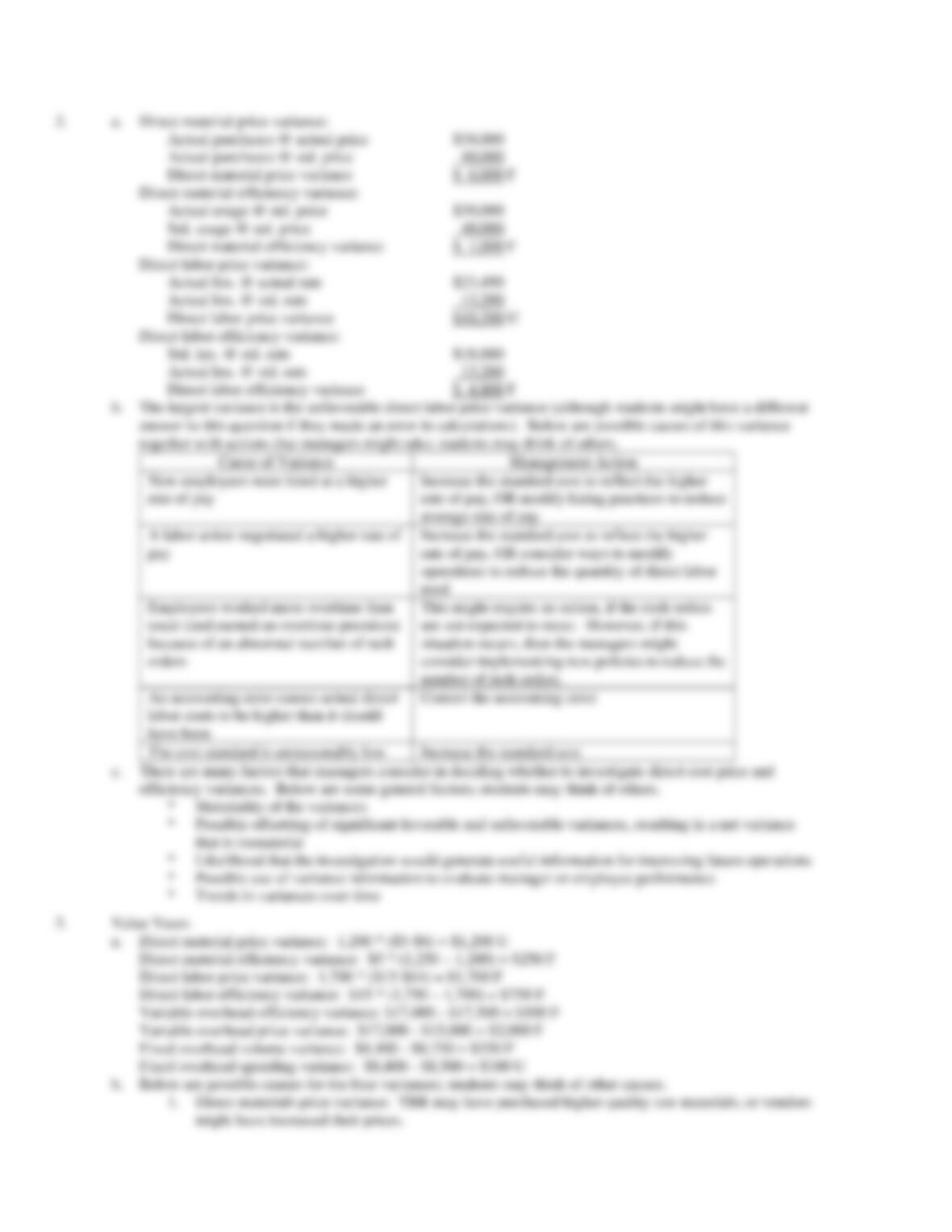
1. Henton, Inc. budgeted $270,000 for overhead. Based on a normal activity level of 6,000 units and a
standard of 3 machine hours per unit, the standard fixed overhead allocation rate is $12 per machine
hour. During the current period, 6,200 units were produced and 5,600 units were sold. Actual machine
hours were 18,000, and actual overhead was $272,000.
a. Calculate the combined variable and fixed overhead spending variance.
b. Calculate the variable overhead efficiency variance.
c. Calculate the fixed overhead production volume variance.
d. By how much was total overhead overapplied or underapplied?
e. Explain why actual overhead costs are usually different than budgeted overhead costs.
f. Explain why managers do not need to investigate a variable overhead efficiency variance,
regardless of its materiality.
2. Given the following data for LXG Corporation:
Standard direct materials per unit 4 oz.
Standard direct labor hours per unit 1.5 hours
Standard direct materials price $5 per oz.
Standard direct labor rate $6 per hour
Production (in finished or equivalent units) 2,000 units
Actual direct labor hours 2,200 hrs
Actual direct labor cost $23,490
Actual direct materials used 7,800 oz.
Units sold 1,400 units
Direct materials purchased 8,000 oz.
Cost of direct materials purchased $34,000
a. Calculate the direct material and direct labor price and efficiency variances.
b. Suggest two possible causes for the largest variance in part (a). For each cause you identify,
describe an appropriate action (if any) that managers should take.
c. Describe two general factors that managers should consider in deciding whether to investigate the
variances in part (a).

11-28 Cost Management
3. The accountants at Value Vases developed the following standards for producing exquisite vases from
a liquid silicate:
Direct materials 2.5 gallons @ $5 per gallon
Direct labor 3.5 hours @ $15 per hour
Variable overhead $10.00 per direct labor hour
Fixed overhead $5.00 per direct labor hour
Value’s volume of direct labor hours for normal costing is 1,680 each month. In a recent month, Value
produced 500 vases and incurred the following costs:
Direct materials purchased & used 1,200 gallons @ $6 per gallon
Direct labor 1,700 hours @ $14 per hour
Variable overhead $15,000
Fixed overhead $8,500
a. Calculate the following eight variances.
Direct material price variance
Direct material efficiency variance
Direct labor price variance
Direct labor efficiency variance
Variable overhead spending variance
Variable overhead efficiency variance
Fixed overhead spending variance
Fixed overhead production volume variance
b. Suggest one possible cause for each of the following variances calculated in part (a):
Direct material price variance
Direct labor efficiency variance
Fixed overhead spending variance
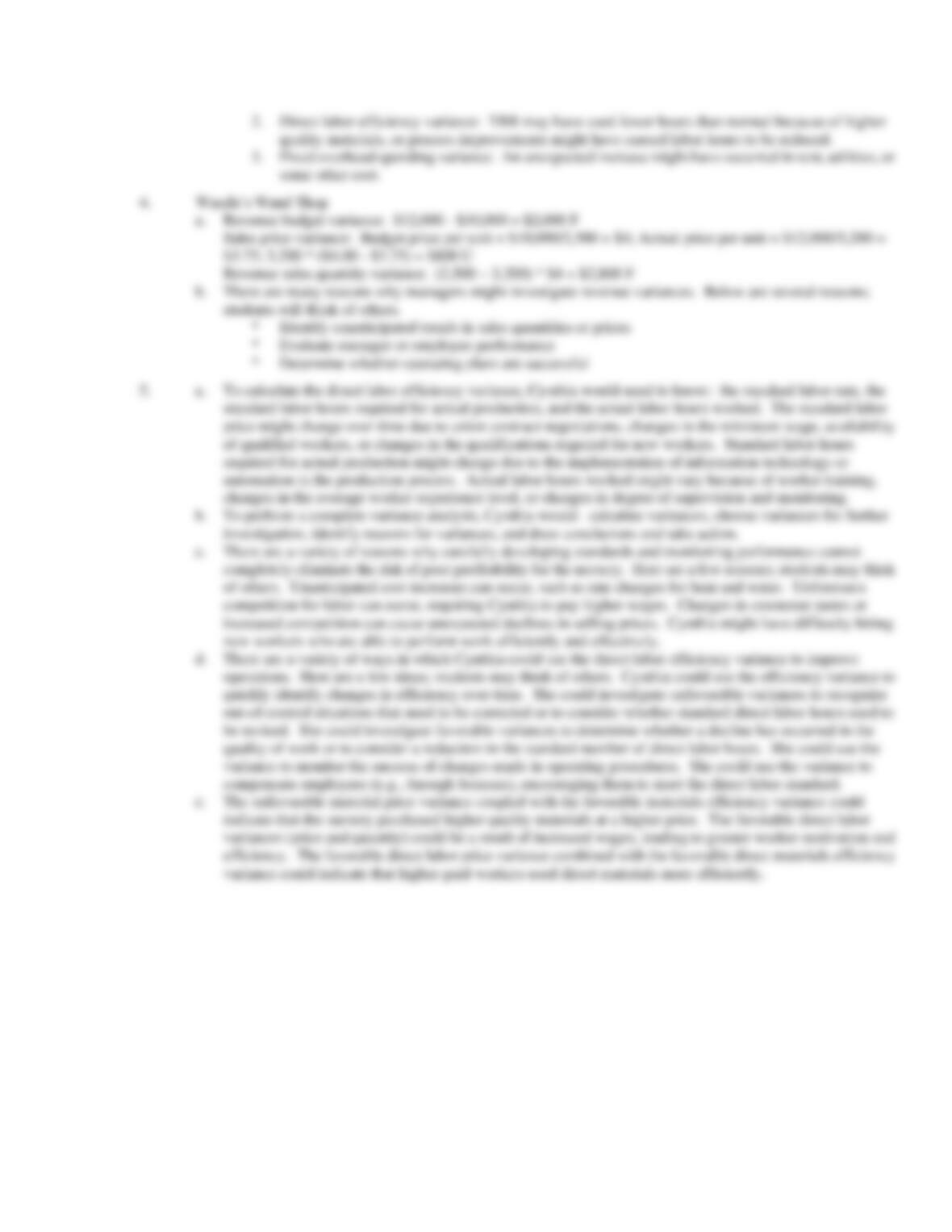
4. (Appendix 11A) Wanda’s Wand Shop sells a variety of magic wands. In a recent month, Wanda’s
accounting information system revealed the following information:
Budget Actual
Units 2,500 3,200
Sales revenue $10,000 $12,000
Variable product costs 1,200 2,000
Fixed manufacturing costs 800 700
Variable selling costs 1,500 1,400
Fixed nonmanufacturing costs 500 600
a. Calculate the following variances:
Revenue budget variance
Sales price variance
Revenue sales quantity variance
b. Suggest two reasons why managers might be interested in investigating one or more of the
variances in part (a).
5. Old Rose Nursery sells over 100 varieties of floribunda and hybrid tea roses. Old Rose’s accountant,
Cynthia, recently calculated several variances for the nursery. Results are shown below:
Direct materials price variance $500 unfavorable
Direct materials efficiency variance 300 favorable
Direct labor price variance 800 favorable
Direct labor efficiency variance 250 favorable
Variable overhead efficiency variance 150 favorable
Variable overhead price variance 230 unfavorable
Fixed overhead spending variance 120 unfavorable
Fixed overhead production volume variance 130 favorable
Standard Costs and Variance Analysis 11-29
a. Prior to calculating variances, Cynthia had to establish standard costs for each rose in the nursery.
List three types of information she would need to calculate the direct labor efficiency variance.
Also identify one reason why each type of information could vary over time.
c. Even though Cynthia carefully developed standards and monitored performance, Old Rose could
still experience poor profitability. Give two reasons why this could happen.
d. Describe one way that Cynthia could use the direct labor efficiency variance to improve operations
at the nursery.
e. Some of the variances in the table are related to one another. For example, a favorable direct labor
efficiency variance and a favorable direct materials efficiency variance could indicate that skilled
workers worked more quickly and used less direct material than was budgeted. Identify one other
possible relationship between variances in the table.
11-30 Cost Management
Answers
True / False
Multiple Choice
Standard Costs and Variance Analysis 11-31
11-32 Cost Management
Matching
Standard Costs and Variance Analysis 11-33
Exercises
11-34 Cost Management
Short Answer
Standard Costs and Variance Analysis 11-35
Problems
11-36 Cost Management
Standard Costs and Variance Analysis 11-37