
Chapter 11
WORK-LIFE CONFLICTS AND
OTHER DIVERSITY ISSUES
Test Bank Questions, 5e
MULTIPLE CHOICE QUESTIONS
1. To qualify for leave under the Family and Medical Leave Act (FMLA), an employee
must have worked:
a. at least 1250 hours during the previous 12 months
b. at least 625 hours during the previous 6 months
c. at least 2080 hours during the previous 12 months
d. at least 1040 hours during the previous 6 months
2. Which of the following is a “qualifying event” under the FMLA?
a. birth of a child
b. death of a parent
c. serious health condition of an employee’s grandparent
d. all of the above
e. none of the above
3. “Serious health conditions” include:
a. pregnancy, when it results in a period of incapacity
b. all conditions that require hospitalization
c. all conditions that require treatment by a health care provider
d. all of the above
e. a and b
4. Under the FMLA, employers have the right to:
a. require that employees provide documentation of any serious health condition
prior to being granted leave
b. cancel the leave of “key employees”
c. delay the start of leave for employees who fail to provide 30 days notice when the
need for leave is foreseeable
d. all of the above
e. none of the above
5. Under the FMLA, employees are entitled to:
a. have all benefits maintained under the same conditions as if the employee had not
taken leave

b. have only health benefits maintained under the same conditions as if the employee
had not taken leave
c. be restored to the exact same position they left if they are deemed a “key
employee”
d. a minimum of ½ salary during their leave
6. An employee who had taken periods of FMLA leave over a two year period was
terminated for poor attendance because of those absences. She brings suit under the
FMLA. What should the court rule?
a. the employer did not violate the FMLA because the employee was granted leave
b. the employer did not violate the FMLA because she was terminated for her
absences and not for having requested or taken FMLA leave
c. the employer violated the FMLA because all employees become eligible for up to
12 weeks of leave at the start of each new calendar year; “rolling” calendars are
illegal
d. the employer violated the FMLA because the employee was terminated based on
absences that qualified as FMLA leave
7. Under the FMLA:
a. employers may require that any paid leave available to an employee be used and
counted toward an employee’s FMLA leave
b. employers may require that the employee stay on leave longer than they need if it
satisfies an administrative purpose or convenience for the employer
c. employers may contact the employee at home by phone or e-mail with company
question but cannot require the employee to physically come to the premises
d. during a valid leave, the employee is protected or shielded from layoffs or
termination that would have occurred anyway
e. none of the above
8. Under the Pregnancy Discrimination Act (PDA):
a. employers are required to provide leave for childbirth and medical problems
related to pregnancy
b. employers are required to restore employees returning from pregnancy leave to
their former jobs or equivalent positions
c. employers are prohibited from establishing uniform requirements for when
pregnancy leave must begin or end
d. all of the above
e. none of the above
9. The Uniformed Services Employment and Reemployment Rights Act (USERRA)
requires that:
a. all persons returning from military service must be reemployed

b. employers must attempt to reinstate persons returning from military service into
the positions that they would have attained absent service, including any
promotions
c. employers continue to provide at least partial pay to employees serving in the
military for up to 24 months
d. all of the above
e. none of the above
10. Regarding the Pregnancy Discrimination Act, which of the following statements is NOT
true?
a. the PDA requires that employers grant leave for childbirth
b. the PDA has a significant influence on leave policies, especially because the
FMLA applies only to employers with 50 or more employees
c. the PDA requires that employers treat people with pregnancy-related conditions
the same as people with other medical conditions who are similar in their ability
or inability to work
d. neither a nor b are true
11. Legal protection against discrimination based on sexual orientation is found in:
a. Title VII of the Civil Rights Act
b. statutes in about twenty states
c. the U.S. Constitution, under which public employers must show that a
“compelling governmental interest” is served by the discrimination
d. Executive Order 11246
e. all of the above
12. “Hopalong” Jones was a cowboy working on a cattle ranch out west. He has worked at
the ranch for three years and done an excellent job. He is also a two time bull riding
champion at the state rodeo competition. He is fired when he admits to being gay.
a. Hopalong is protected under the protected sex classification under Title VII
b. since being a cowboy is such a macho job, being heterosexual is considered a
BFOQ
c. sexual orientation is a protected class in some states but not in others
d. Hopalong has no federal or state protection regarding his sexual orientation
13. The EEOC’s guidelines hold that broad English-only rules applied at all times are:
a. presumptively discriminatory
b. presumptively non-discriminatory
c. valid, if an employer can show a business necessity for a broad-cased, all-time
ban on other languages
d. invalid, because the employer can never show a business necessity for a broad-
based, all-time ban on other languages

14. The accent of an employee or job applicant can lawfully be taken into consideration
when:
a. the firm is using its affirmative action program to diversify its workforce
b. when few English-speaking applicants or employees are available
c. when communications are a significant part of the job in question, and the
person’s accent substantially interferes with the ability to communicate
d. when communications are a significant part of the job in question, and the
person’s accent interferes in some degree with the ability to communicate
15. The federal Jury System Improvements Act:
a. protects persons who serve on federal juries from discharge, intimidation or
coercion by their employers because of their jury service
b. applies a Title VII approach to selection of jurors
c. reduces the number of jurors on a standard jury from 12 to 6
d. requires that employers pay their employees at their regular rate of pay for the
time spent serving on a federal jury
16. Under the FMLA:
a. pregnancy is a “serious health condition” triggering the right to FMLA leave
b. pregnancy is not a “serious health condition” triggering the right to FMLA leave
unless there are complications
c. only a pregnant employee may receive leave under the FMLA
d. none of these
17. The Uniformed Services Employment and Reemployment Rights Act (USERRA)
requires that:
a. an employer must maintain the health insurance for an employee reporting to
military service for short stints of service (less than 31 days)
b. an employer must maintain the health insurance for an employee who serves in
the military for up to 24 months, if the employee pays the full cost of group
coverage
c. employers are not required to maintain health insurance coverage for their
employees in military service beyond a period of 30 days
d. all of these
e. a and b
18. In the event of the serious injury or illness of a service member incurred while on active
duty, the maximum period of leave under the FMLA during a 12 month period is:
a. six weeks
b. twelve weeks

c. twenty weeks
d. twenty-six weeks
19. You need to hire a new medical technician for the emergency room of your hospital. The
technician must have a thorough knowledge of medical terms and procedures, and will be
interviewing patients to determine the nature and extent of their problems before they are
routed to a doctor or to the waiting room. Most of the qualified candidates will be those
who comes from Asian countries, who have studied medicine in their home countries, but
whose MD degrees are not recognized by the U.S. Can you require that only English-
speaking candidates need apply?
a. yes, because most of the patients will be English speaking
b. yes, because communication will be an integral part of the job, and most often
communication will be required in an emergency situation
c. no, because under Title VII, English-only speaking requirements are
presumptively discriminatory
d. no, because most of the qualified candidates will be from countries for which the
first language spoken is not English
20. A very troublesome employee has just told you that he wants to apply for FMLA leave
because his wife is seriously ill. He has taken leave before because of her illness, and
depending upon how you calculate it, may have already taken the maximum amount for
the year. You know that if you use a “rolling 12 month period,” he will not qualify, and if
he is denied leave, he may actually quit, which would make many people happy.
However, your firm’s leave policy does not specify how leave taken will be calculated,
which means that if he sued and the case went to litigation, the court would apply a
“calendar year” calculation for the leave requested, since you’ve just begun a new
calendar year, and under that calculation, he would be entitled to leave. Of the following
choices, what should you do?
a. deny the leave, and take your chances; tell him that he’s already had the
maximum leave under the “rolling 12 month” calculation. He’s been far too
troublesome for the firm, and his leaving would be a good outcome
b. deny the leave, but tell him that it’s because has not been a productive employee,
and when he improves, you’ll consider more leave
c. grant the leave, and take your chances; maybe he’ll straighten out when he comes
back
d. grant the leave, and ask how he’s doing; tell him that when he comes back, you’d
like to sit down with him and see if you can help him resolve the trouble he’s
been having at work
ESSAY QUESTIONS
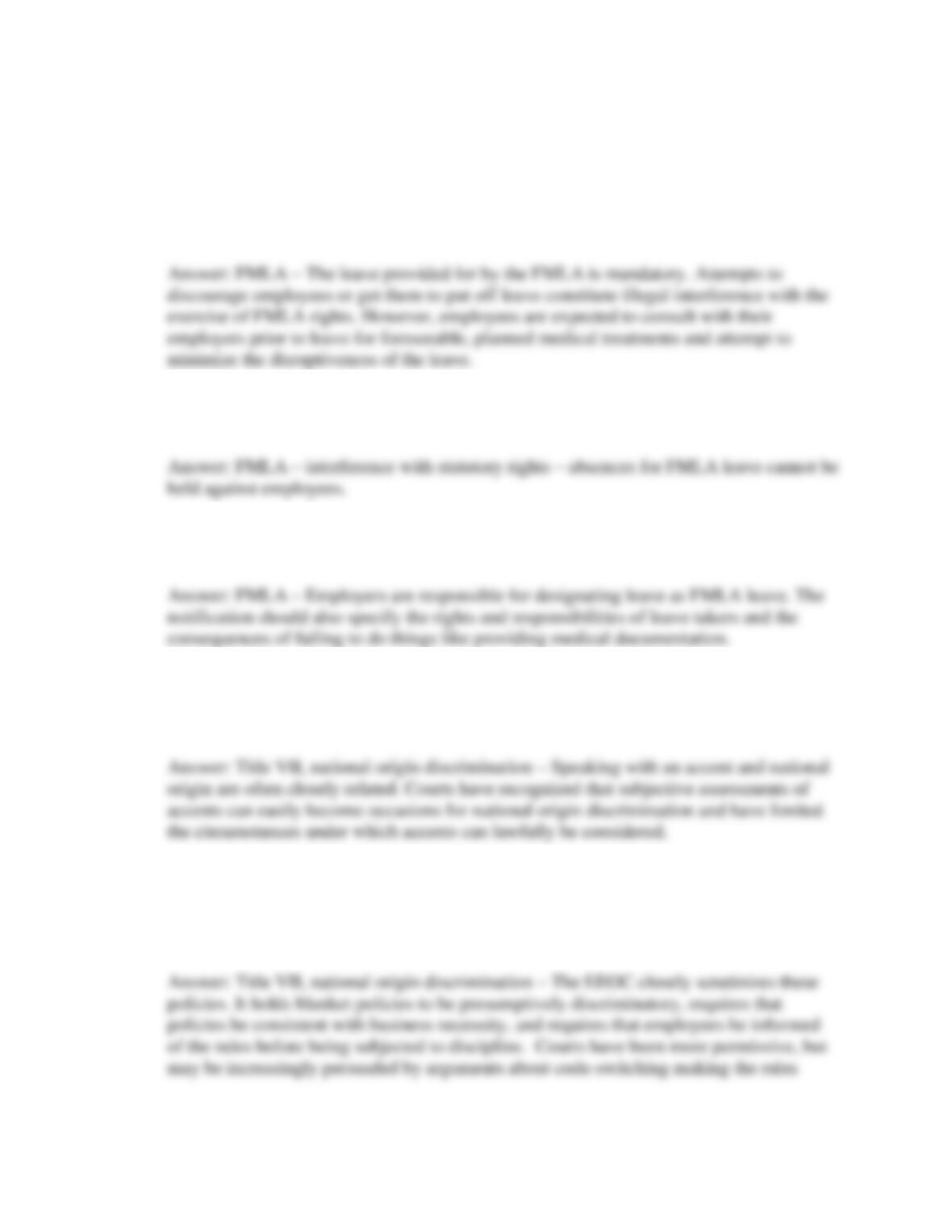
1. Why is each of the following good legal advice?
a. Employers must not attempt to discourage eligible employees from taking FMLA leave
or attempt to delay the taking of leave.
b. “No fault” attendance policies must be either discontinued or exceptions must be made
for employees on FMLA leave.
c. Employees should be notified promptly and in writing whether their leave qualifies as
FMLA leave.
d. Employer’s should consider an employee’s or applicant’s accent only to the extent that
communication is a significant part of the job in question and the individual’s accent
impedes communication.
e. Employers should generally refrain from adopting English-only rules. If they are used,
employees should be clearly informed that they are in effect, the rules should be no
broader than necessary to accomplish necessary business purposes, and enforcement
should not be rigid.
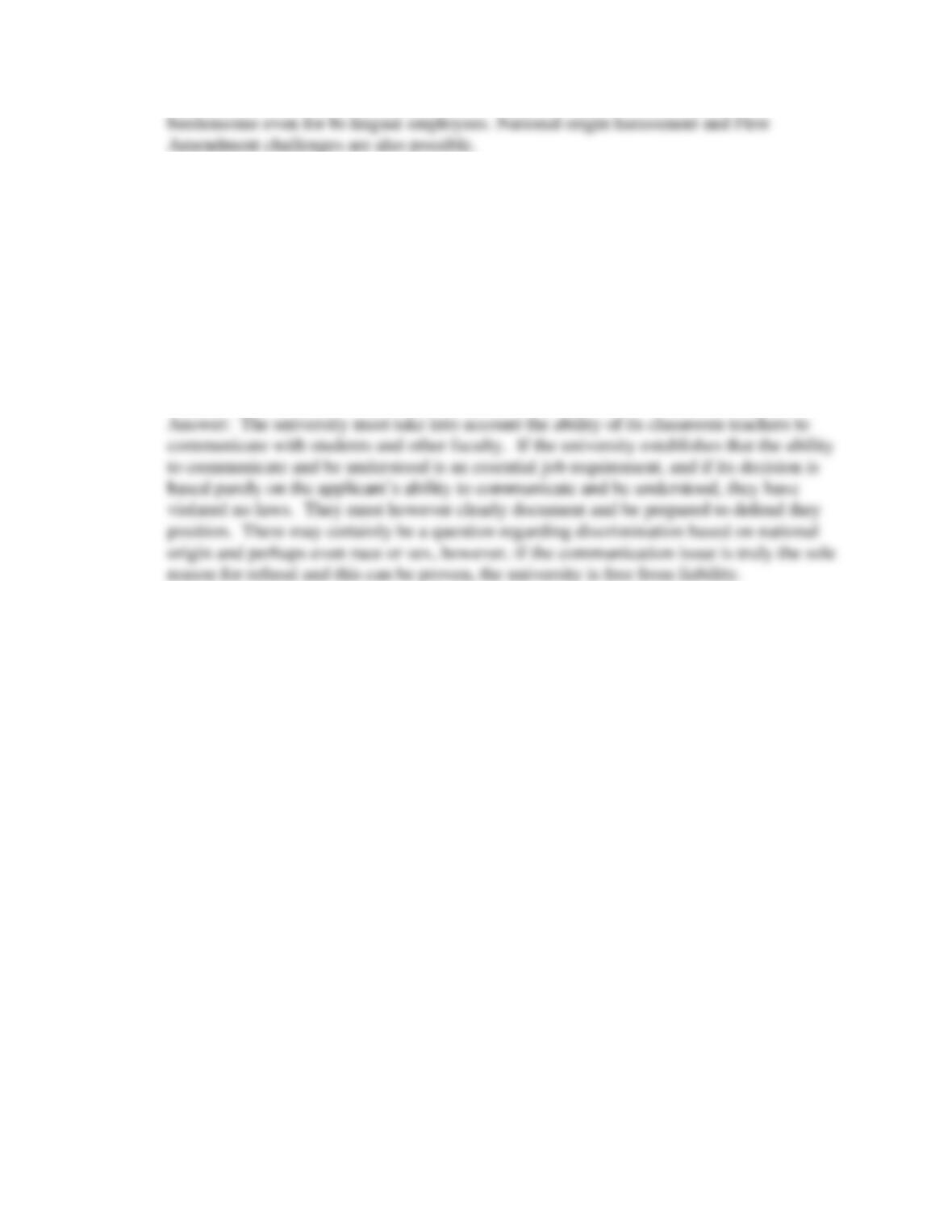
2. A major University has advertised for a non-research lecturer position in its Economics
Department. When they evaluate the applicants, one resume clearly stands out as
excellently qualified. When the applicant came in for an interview, she is asked to
complete a questionnaire with a number of open ended questions prior to the actual
interview. The questionnaire was extremely well answered and evidenced perfect
grammar, perfect penmanship and perfect spelling. The answers were lucid and well
thought out. Unfortunately, during the interview most in the department had trouble
understanding the candidate due to her extremely heavy Nigerian accent. If the
university hires someone else, has the university violated any discrimination laws?