Larson_Calculus_10e ch11sec01
MULTIPLE CHOICE
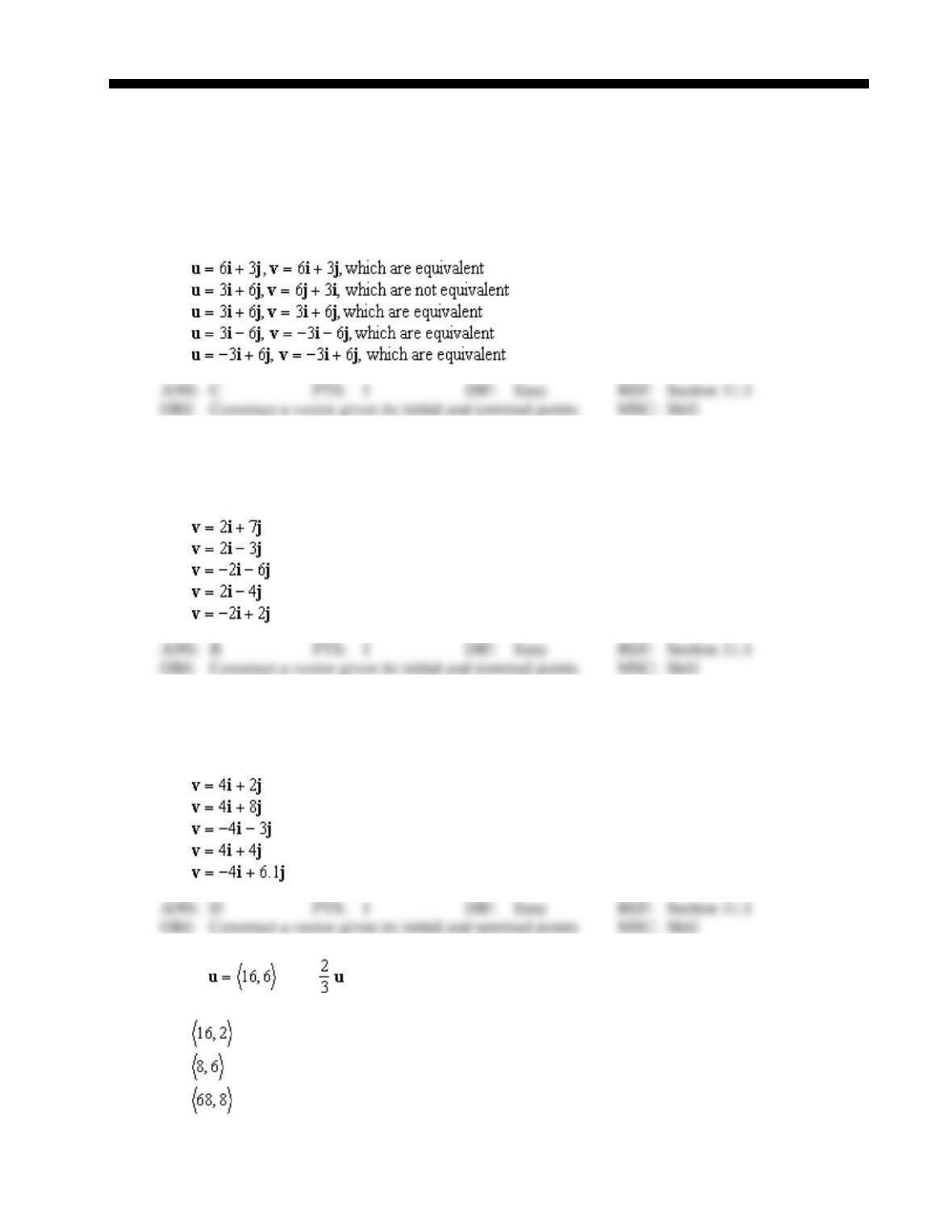
1. Find vectors u and v whose initial and terminal points are given. Determine whether u and v are
equivalent.
u: (6,5), (9,11) v: (3,–5), (6,1)
a.
b.
c.
d.
e.
2. Find the vector v whose initial and terminal points are given below.
(5,5), (7,2)
a.
b.
c.
d.
e.
3. Find the vector v whose initial and terminal points are given below.
(5.5,2.1), (9.5, 6.1)
a.
b.
c.
d.
e.
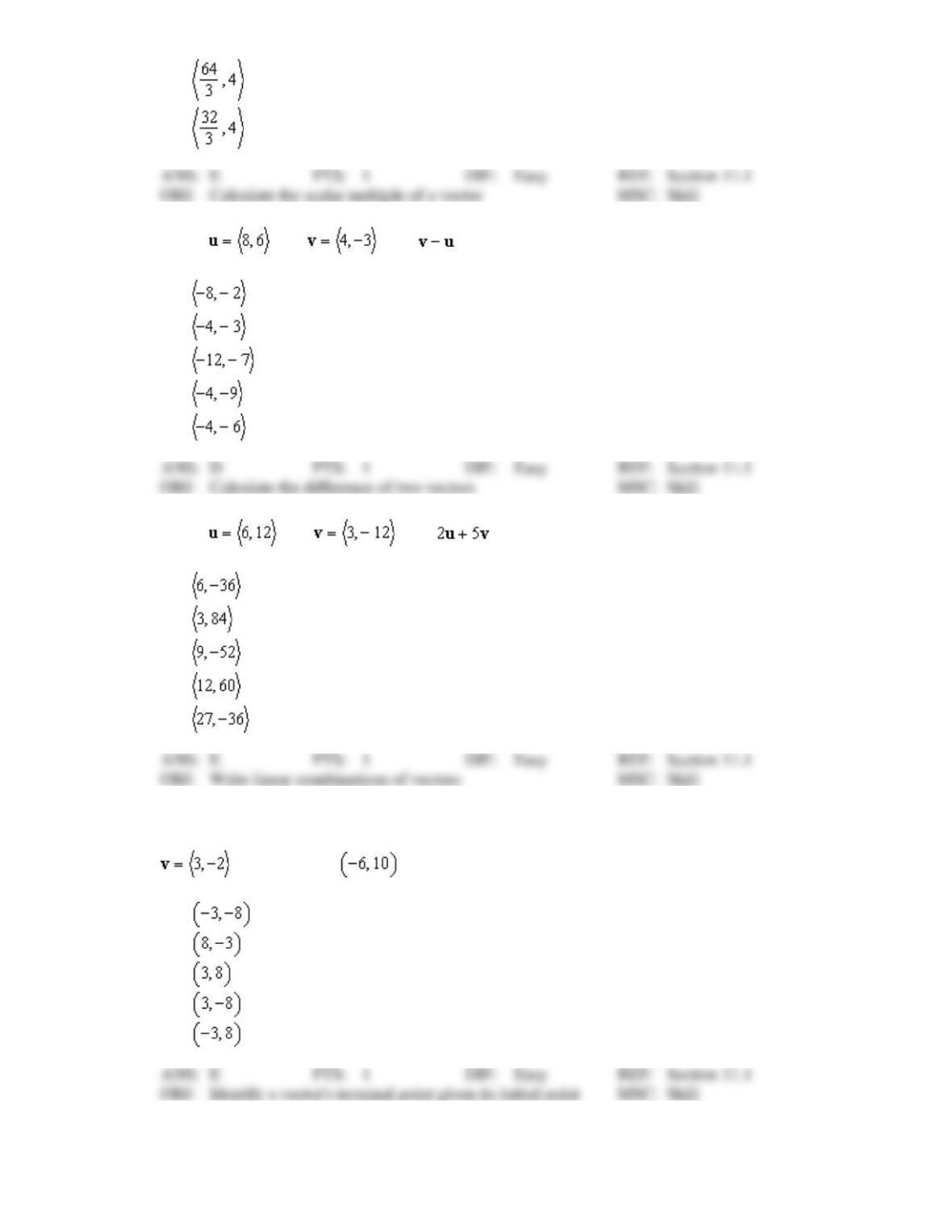
4. Given , find .
a.
b.
c.
d.
e.
5. Given and , find .
a.
b.
c.
d.
e.
6. Given and , find .
a.
b.
c.
d.
e.
7. The vector v and its initial point is given. Find the terminal point.
, initial point
a.
b.
c.
d.
e.
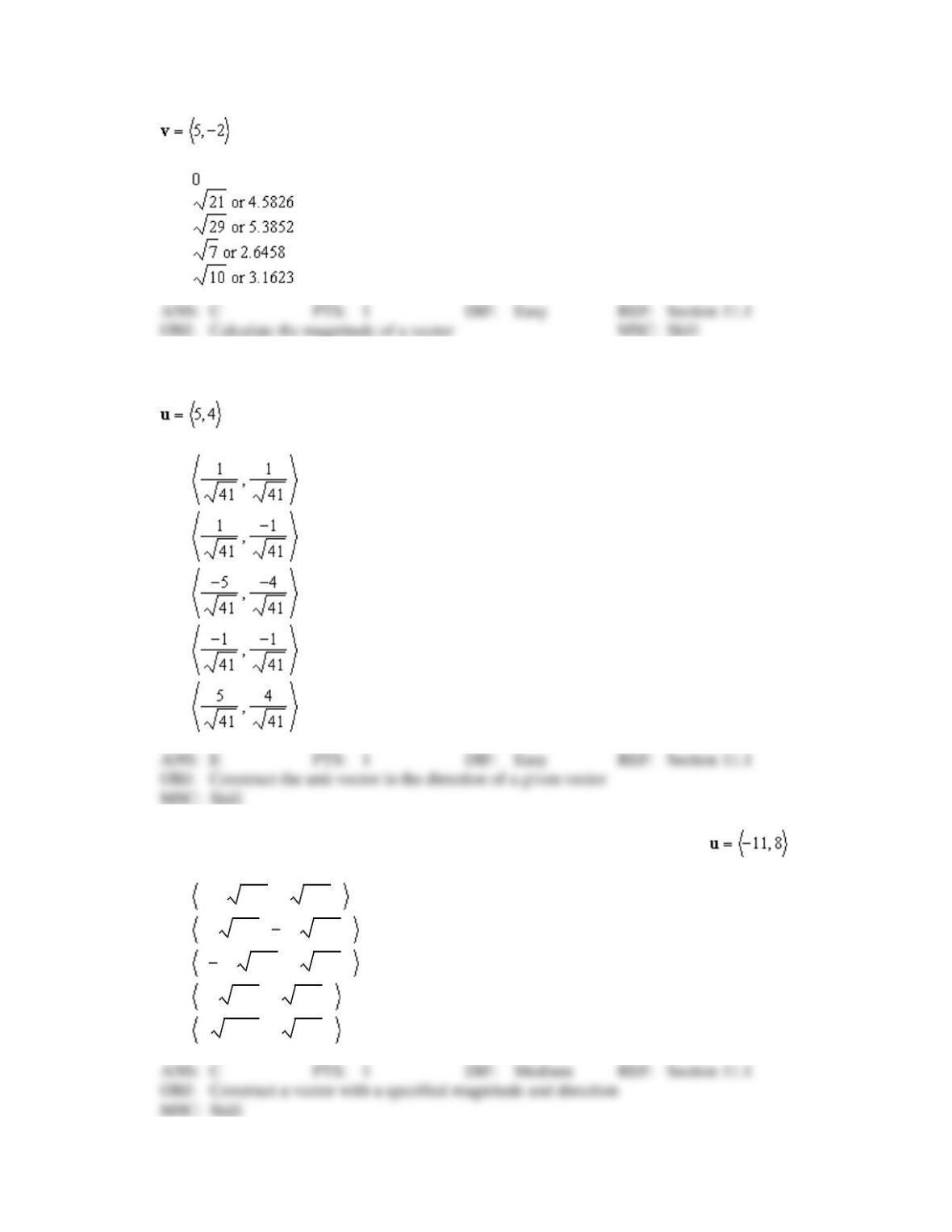
8. Find the magnitude of the vector given below. Round your answer to four decimal places.
a.
b.
c.
d.
e.
9. Find the unit vector in the direction of u.
a.
b.
c.
d.
e.
10. Find the vector v with the given magnitude ||v|| = 185 and the same direction as .
a.
,
b.
,
c.
,
d.
,
e.
,
11 187
8 187
8 185
11 185
11 185
8 185
8 187
8 187
2618
4 187
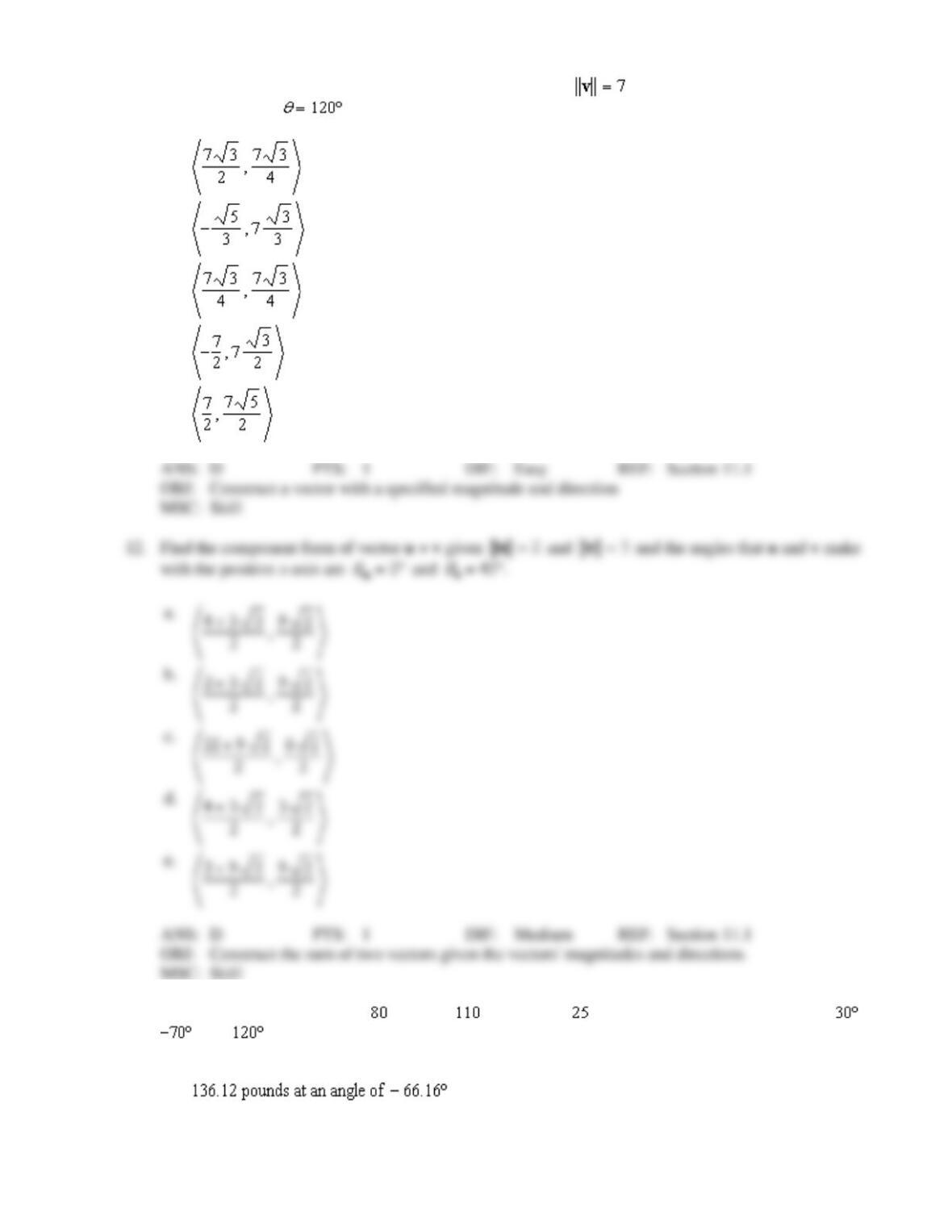
11. Find the component form of vector v given its magnitude is and the angle it makes with the
positive x-axis is .
a.
b.
c.
d.
e.
13. Three forces with magnitudes pounds, pounds and pounds act on an object at angles ,
, and respectively, with the positive x-axis. Find the direction and magnitude of the resultant
force. (The choices below are given to two decimal places.)
a.
with the positive x-axis
b.
d.
b.
with the positive x-axis
c.
with the positive x-axis
d.
with the positive x-axis
e.
pounds at an angle of with the positive x-axis
14. Suppose a gun with a muzzle velocity of 1200 feet per second is fired at an angle of above the
horizontal. Find the horizontal component of the velocity. Round your answer to two decimal places.
a.
ft/sec
b.
ft/sec
c.
ft/sec
d.
ft/sec
e.
ft/sec
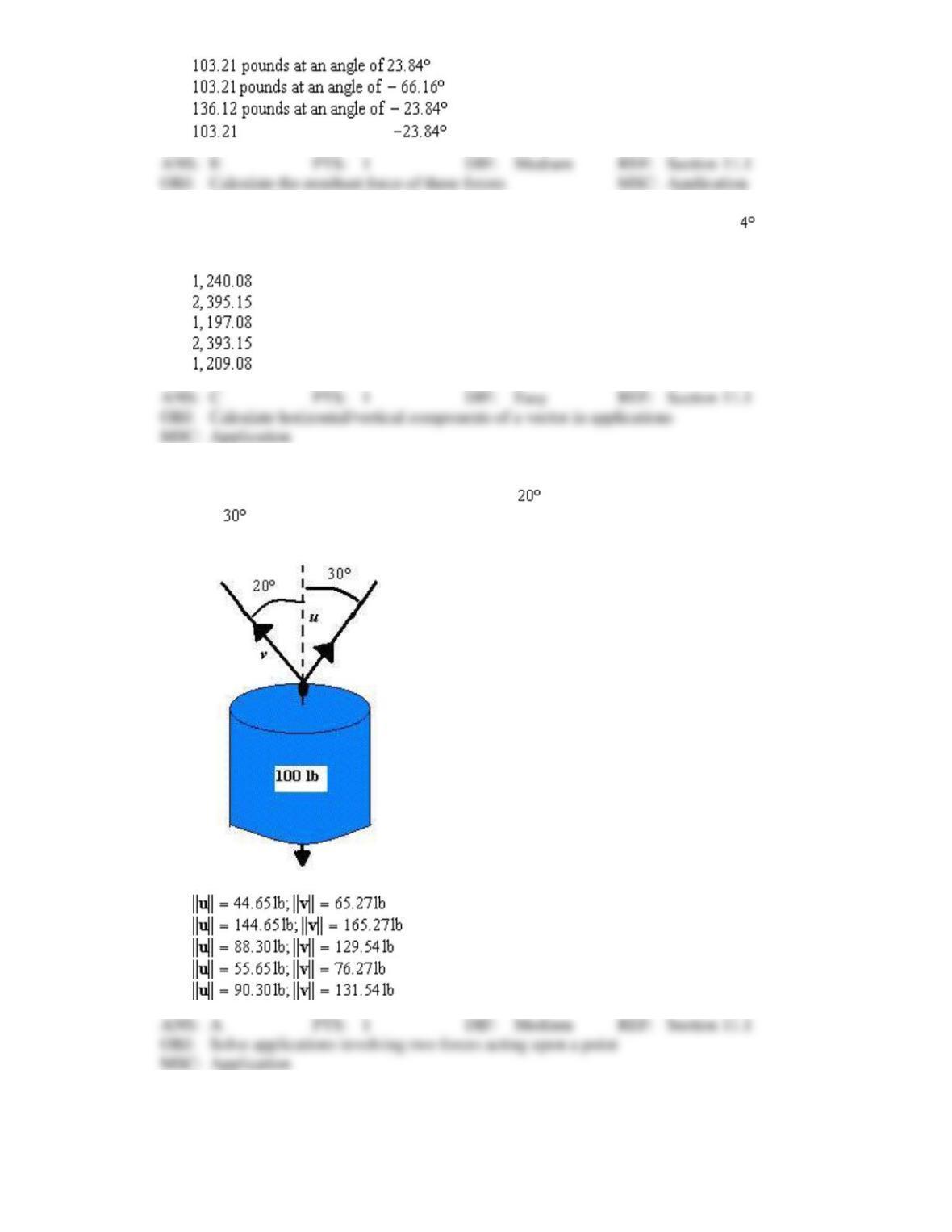
15. To carry a 100-pound cylindrical weight, two workers lift on the ends of short ropes tied to an eyelet
on the top center of the cylinder. One rope makes a angle away from the vertical and the other
makes a angle as shown in the figure below. Find each rope’s tension if the resultant force is
vertical.Round your answer to two decimal places.
a.
b.
c.
d.
e.
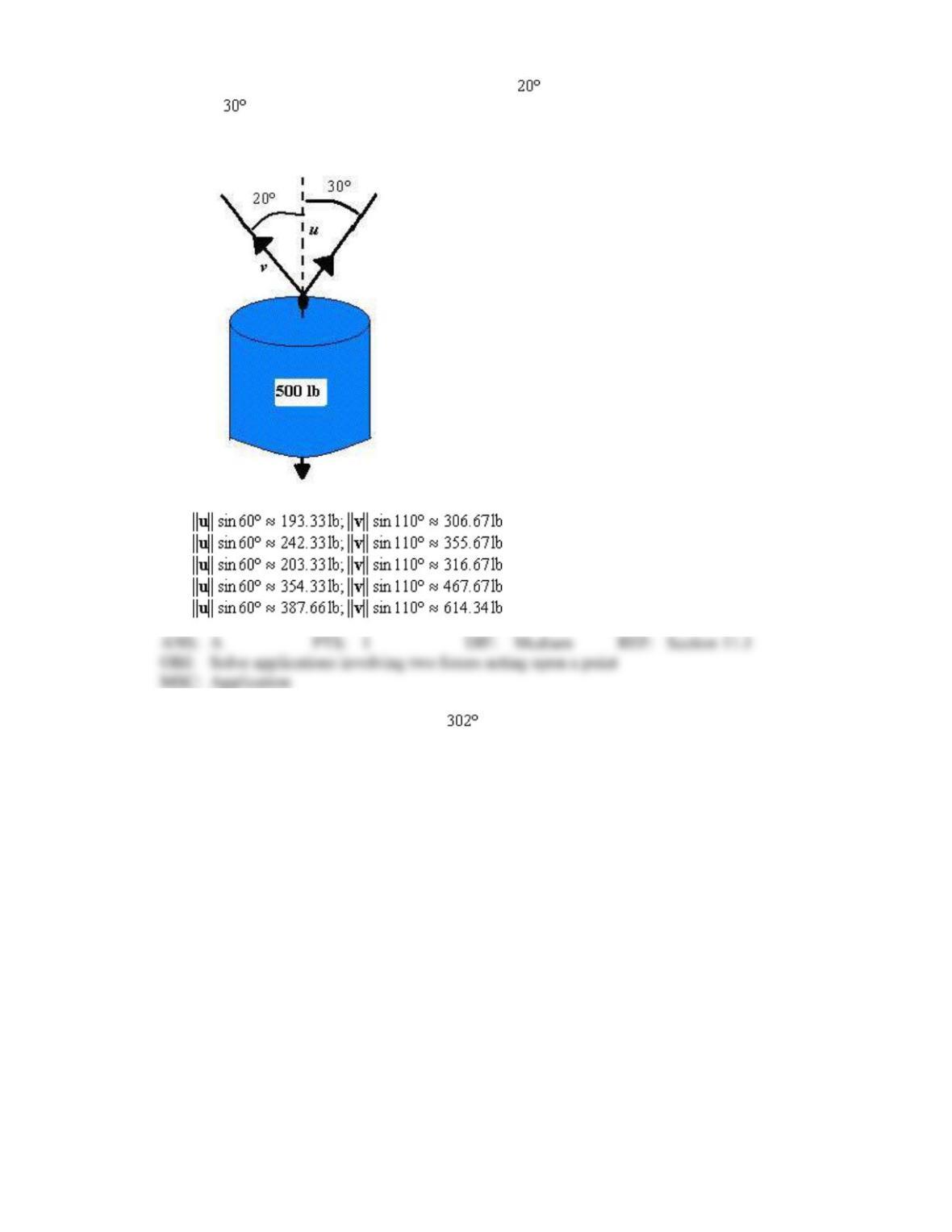
16. To carry a 500-pound cylindrical weight, two workers lift on the ends of short ropes tied to an eyelet
on the top center of the cylinder. One rope makes a angle away from the vertical and the other
makes a angle as shown in the figure below. Find the vertical component of each worker’s force.
Round your answer to two decimal places.
a.
b.
c.
d.
e.
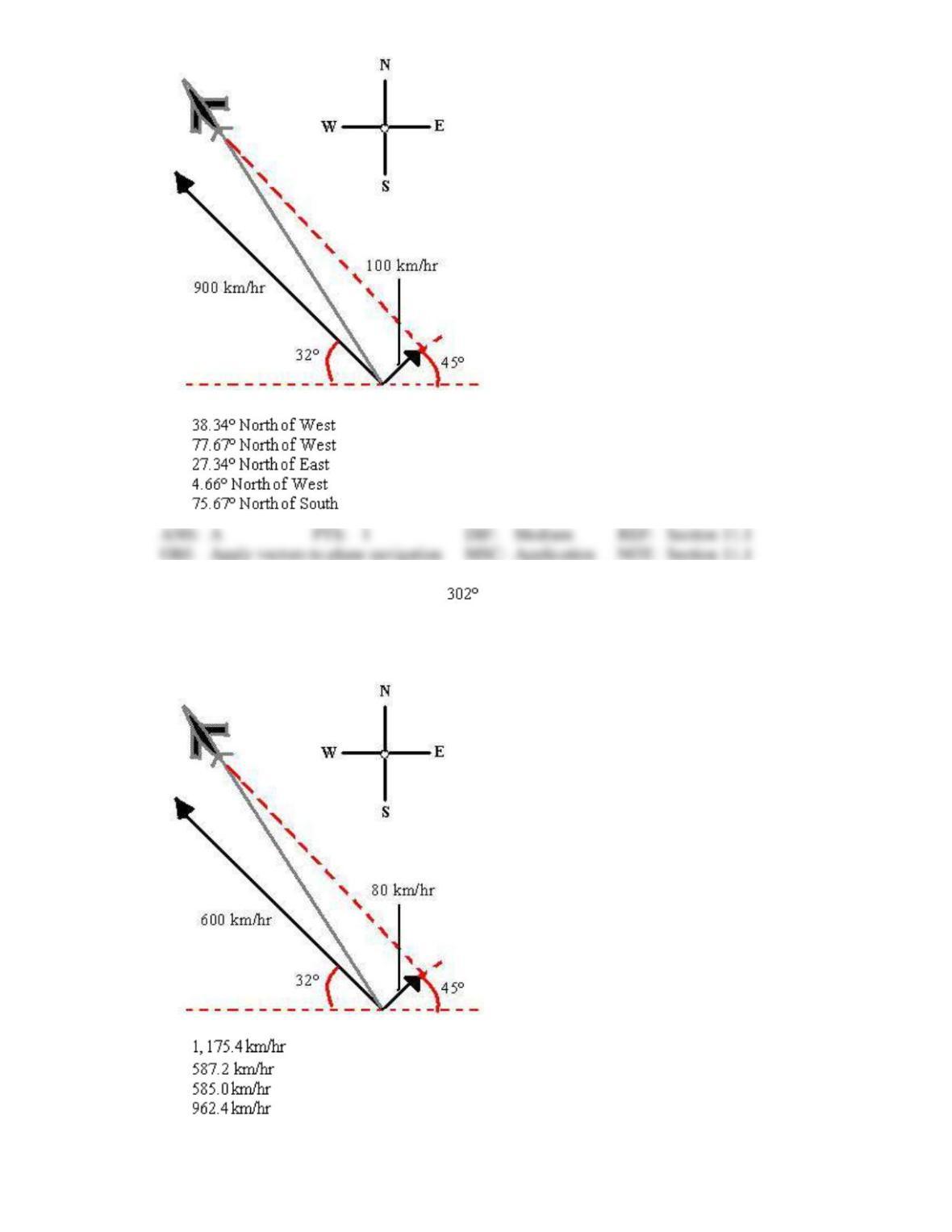
17. Suppose a plane is flying in the direction . Its speed with respect to the air is 900 kilometers per
hour. The wind at the plane’s altitude is from the southwest at 100 kilometers per hour (see figure).
What is the true direction of the plane? Round your answer to two decimal places.
a.
b.
c.
d.
e.
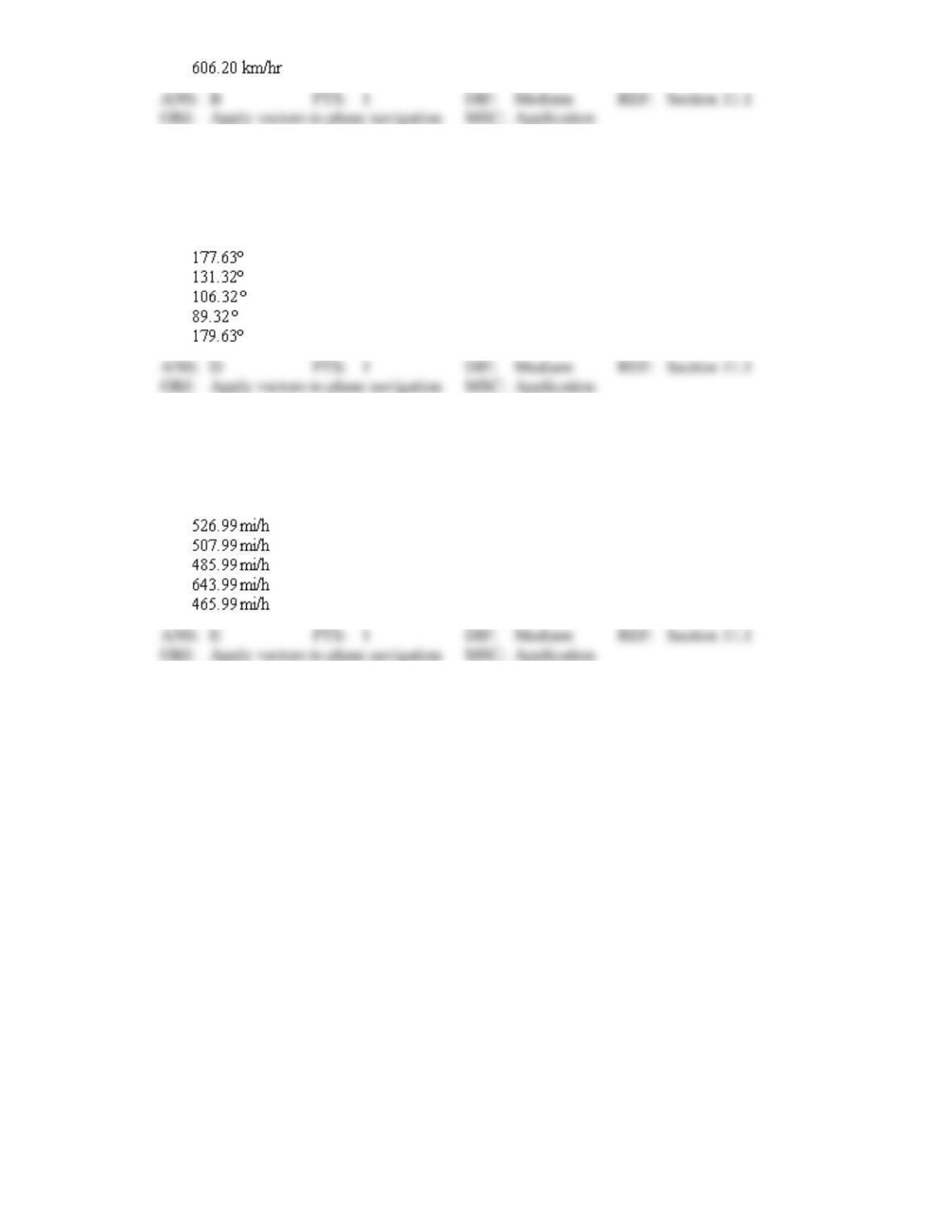
18. Suppose a plane is flying in the direction (relative to the west). Its speed with respect to the air is
600 kilometers per hour. The wind at the plane’s altitude is from the southwest at 80 kilometers per
hour (see figure). What is its speed with respect to the ground? Round your answer to one decimal
place.
a.
b.
c.
d.
e.
19. Suppose a plane flies at a constant groundspeed of 600 miles per hour due east and encounters a 10
mile-per-hour wind from the northwest. Both the airspeed and the compass direction must change to
for the plane to maintain its groundspeed and eastward direction. Find the airspeed to maintain its
groundspeed and eastward direction. Round your answer to two decimal places.
a.
b.
c.
d.
e.
20. Suppose a plane flies at a constant groundspeed of 500 miles per hour due east and encounters a 50
mile-per-hour wind from the northwest. Both the airspeed and the compass direction must change to
for the plane to maintain its groundspeed and eastward direction. Find the airspeed to maintain its
groundspeed and eastward direction. Round your answer to two decimal places.
a.
b.
c.
d.
e.