Solve the equation by the method of your choice. Simplify solutions, if possible.
87)
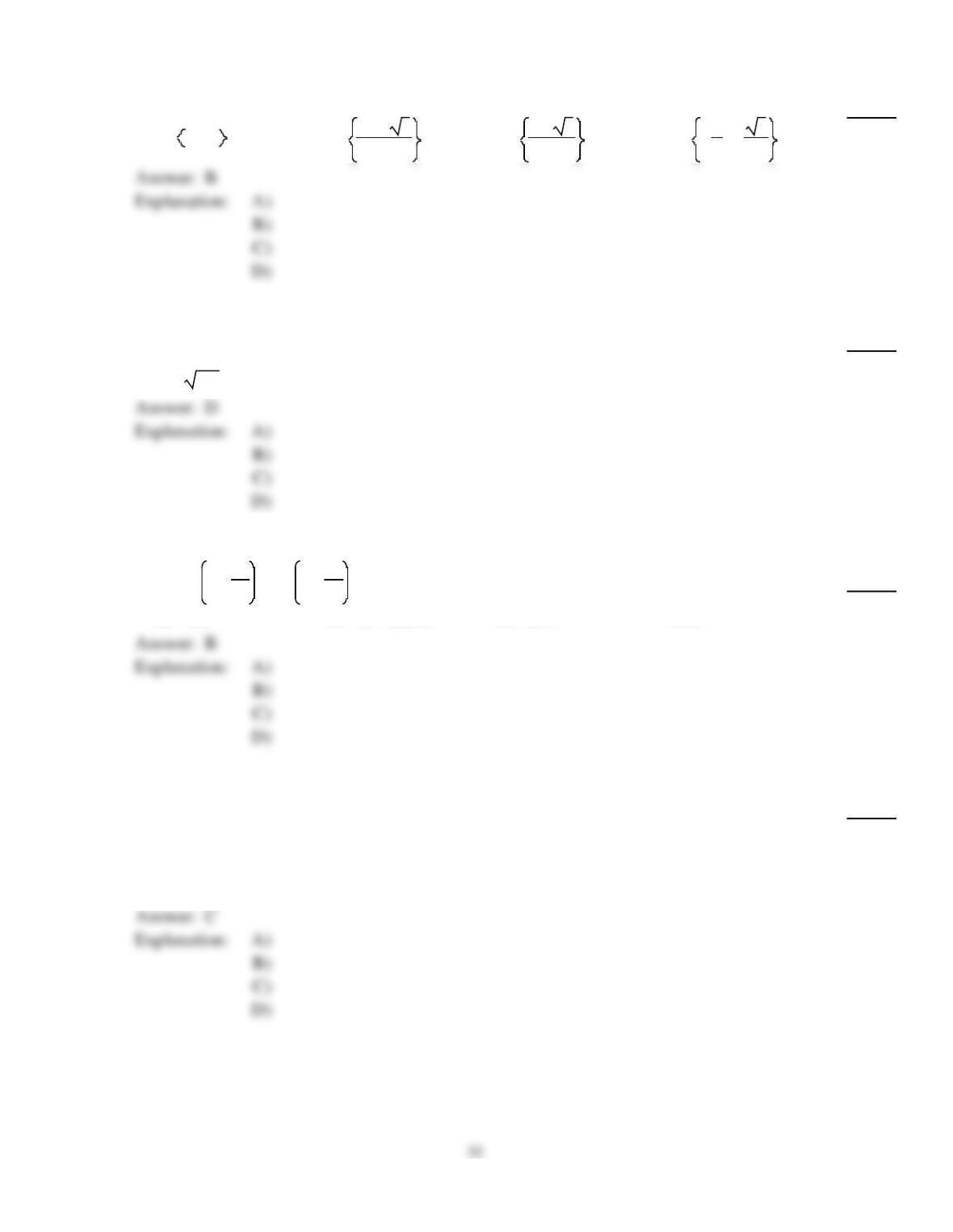
(2x + 5)2=5
87)
A)
–5, 0
B)
–5±5
2
C)
5±5
2
D)
–5
2± i 5
2
Solve.
88)
88)
A ladder that is 26 feet long is 10 feet from the base of a wall. How far up the wall does the ladder
reach?
A)
2194 ft
B)
4 ft
C)
576 ft
D)
24 ft
Solve the problem.
89)
Let f(y) =y –15
y
2– 12 y –15
y. Find all y such that f(y) =28.
89)
A)
– 5, 3
B)
– 5, – 1, 3, 15
C)
–2, 14
D)
Find the intercepts of the quadratic function.
90)
f(x) =x2–4
90)
A)
x–intercept: (–4, 0)
y–intercept: (0, 16)
B)
x–intercepts: none
y–intercept: (0, –4)
C)
x–intercepts: (–2, 0) and (2, 0)
y–intercept: (0, –4)
D)
x–intercepts: (–2, 0) and (2, 0)
y–intercept: (0, 4)
Find the midpoint of the line segment with the given end points.
91)
91)
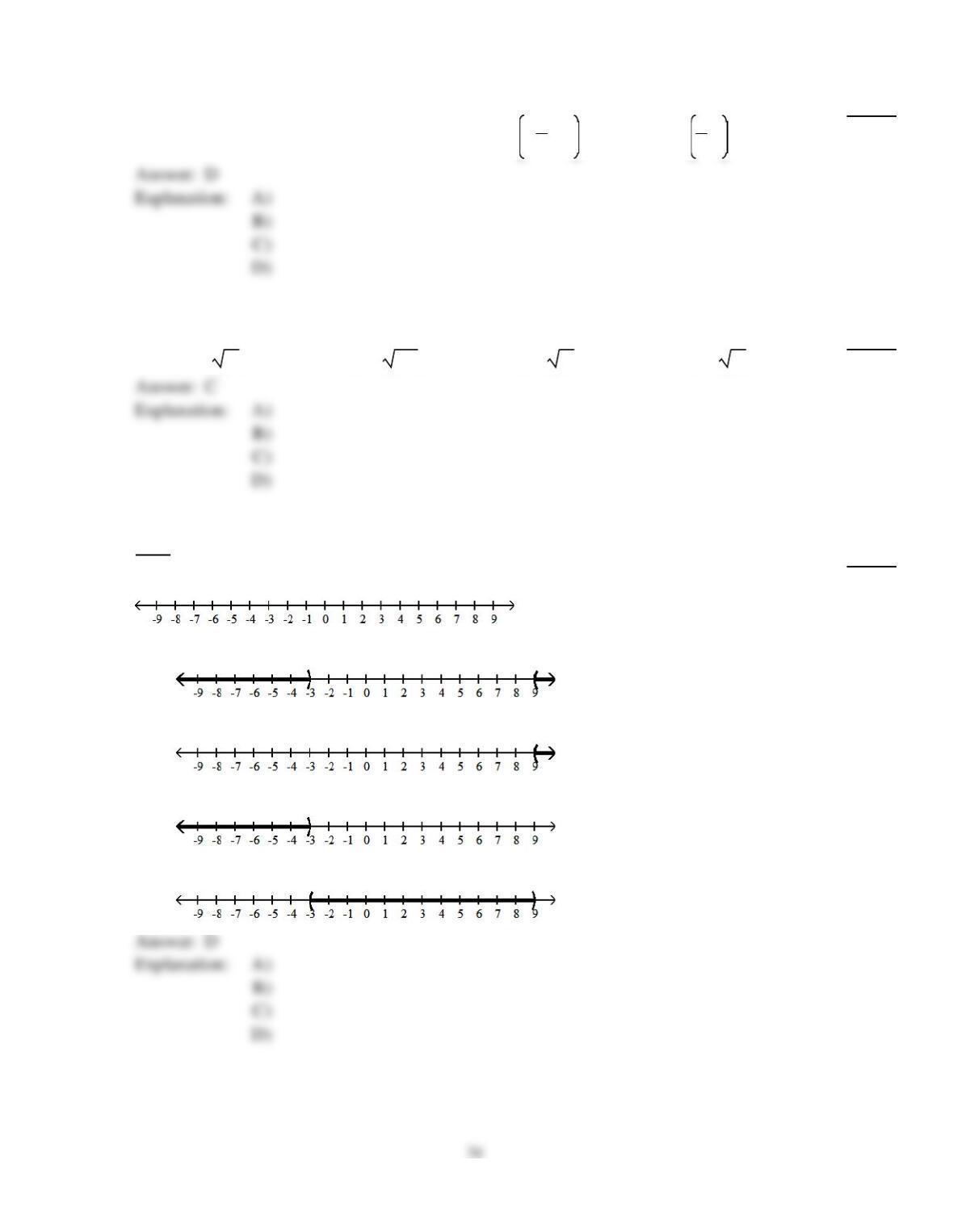
(3, 2) and (4, 4)
A)
(7, 6)
B)
(–1, –2)
C)
–1
2, – 1
D)
7
2, 3
Solve by completing the square.
92)
x2–12x –11 = 0
92)
A)
{–6±47}
B)
{12 ±155}
C)
{6 ±47}
D)
{6 ±11}
Solve the rational inequality and graph the solution set on a real number line.
93)
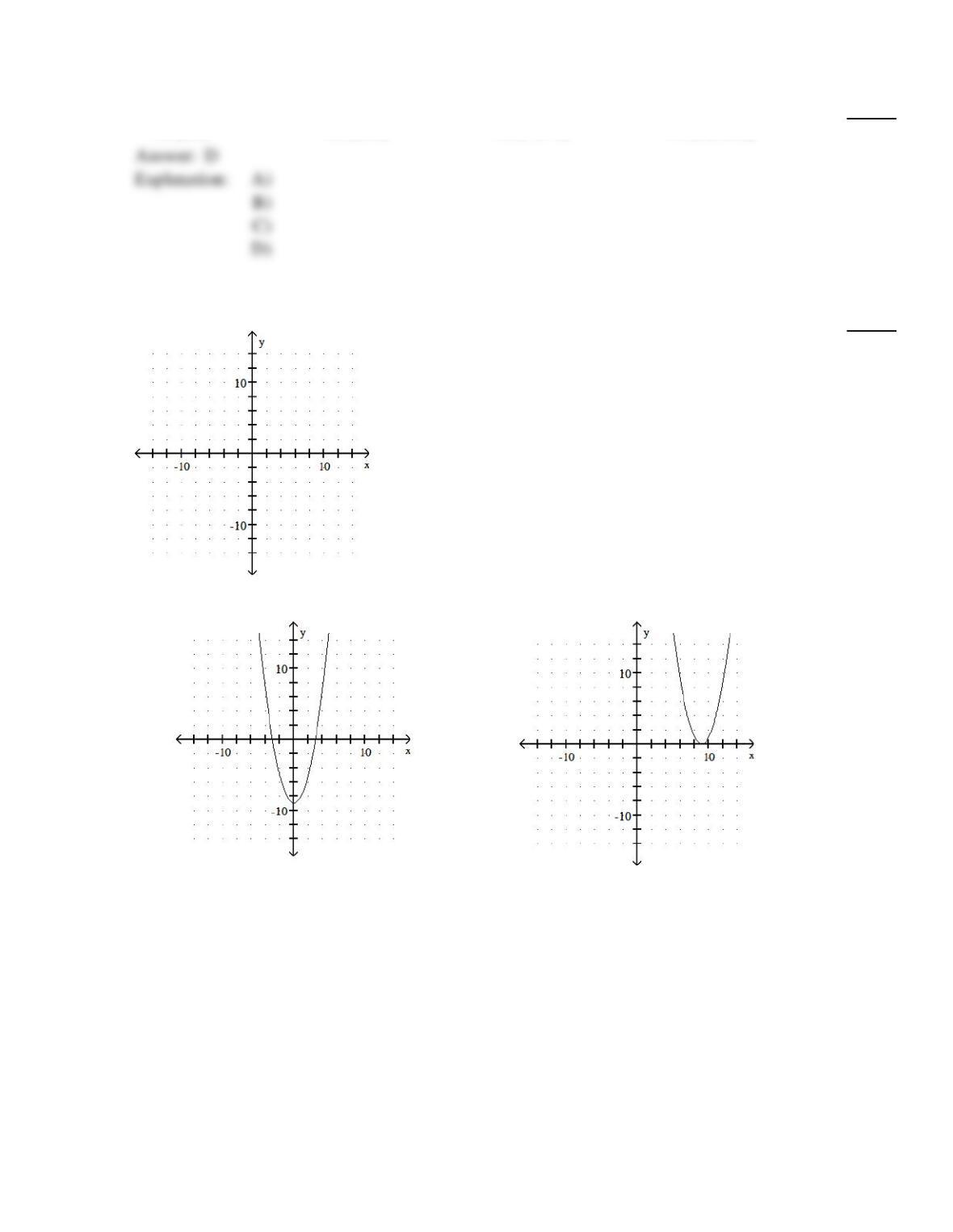
x – 9
x + 3 < 0
93)
A)
(–, –3) (9, )
B)
(9, )
C)
(–, –3)
D)
(–3, 9)
Solve the equation by making an appropriate substitution.
94)
x1/2 –10x1/4 = – 16
94)
A)
{2, 8}
B)
{4, 64}
C)
{–2, –8}
D)
{16, 4096}
Sketch the graph of the quadratic function. Give the vertex and axis of symmetry.
95)
f(x) =x2+9
95)
A)
vertex: (0,–9)
axis of symmetry: x = 0
B)
vertex: (9, 0)
axis of symmetry: x =9
35
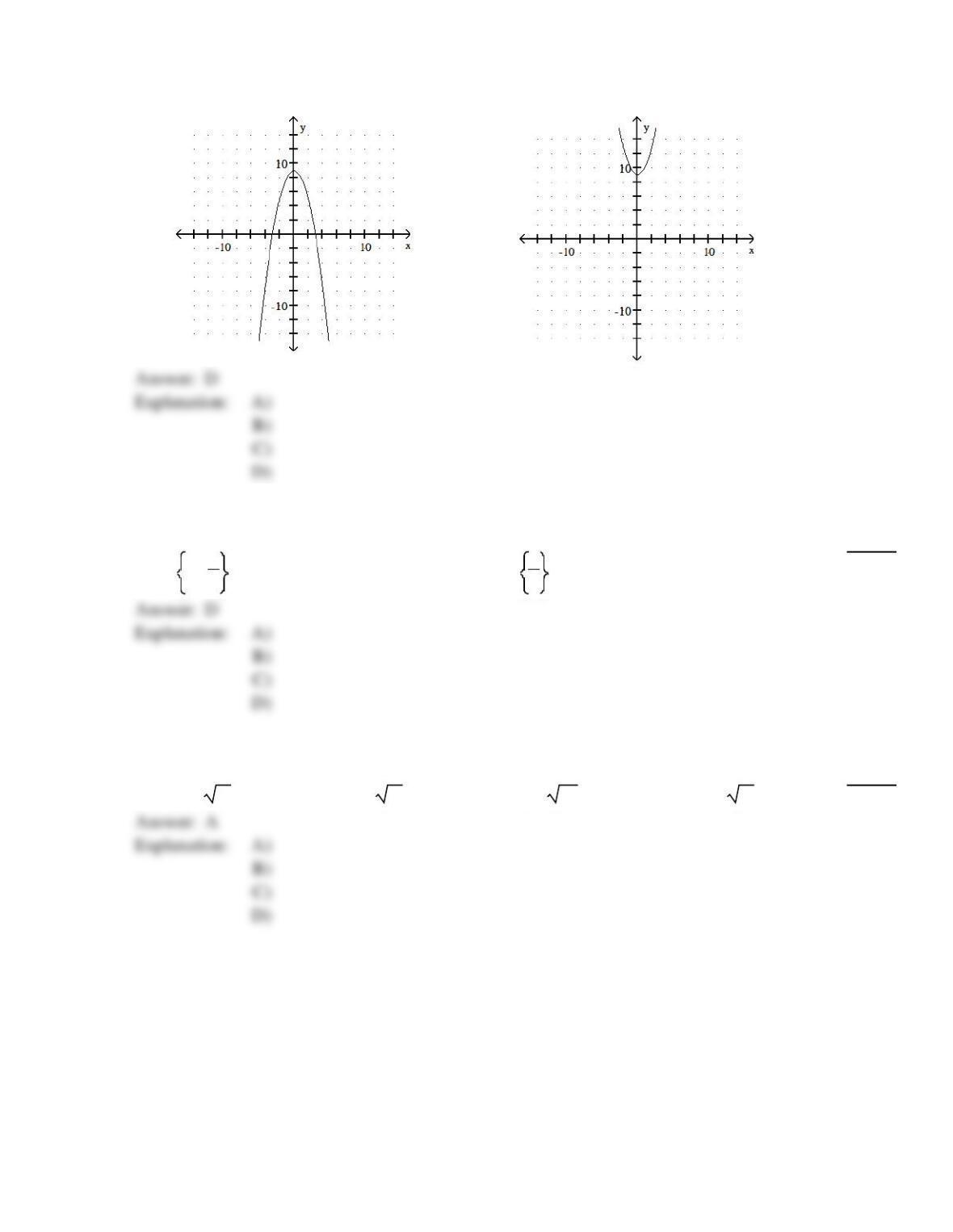
C)
vertex: (0, 9)
axis of symmetry: x = 0
D)
vertex: (0, 9)
axis of symmetry: x = 0
Solve the equation by the method of your choice. Simplify solutions, if possible.
96)
96)
2–10x = (3x – 7)(x + 1)
A)
–1, 7
3
B)
{–1, 3}
C)
1
5
D)
{–3, 1}
Solve the quadratic equation by completing the square.
97)
x2–8x =15
97)
A)
{4 ±31}
B)
{4 ±15}
C)
{8 ±79 }
D)
{–4±31}
Sketch the graph of the quadratic function. Give the vertex and axis of symmetry.
36
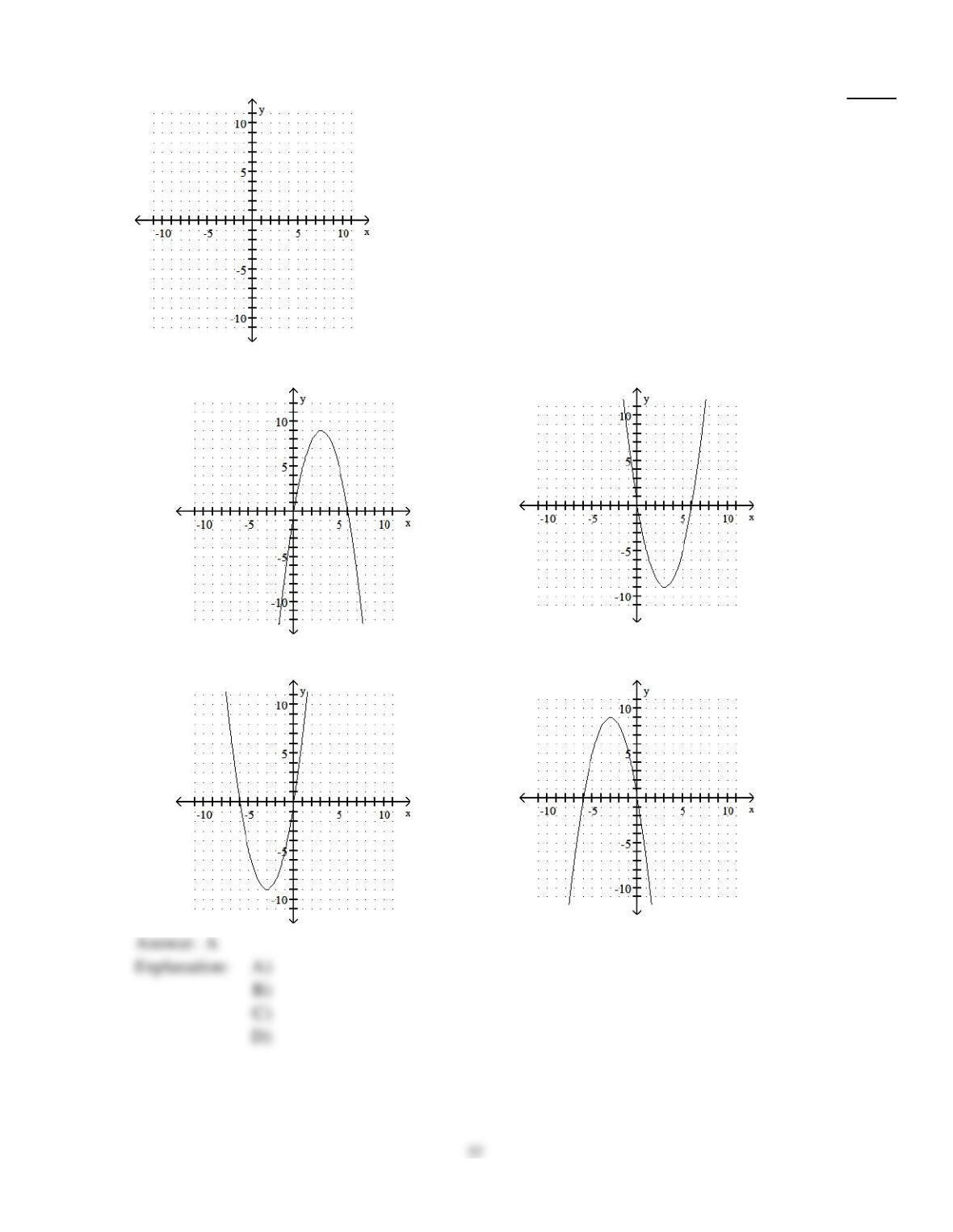
98)
f(x) =9– (x – 3)2
98)
A)
vertex: (3, 9)
axis of symmetry: x =3
B)
vertex: (3, – 9)
axis of symmetry: x =3
C)
vertex: (– 3, – 9)
axis of symmetry: x = – 3
D)
vertex: (– 3, 9)
axis of symmetry: x = – 3
Find the axis of symmetry of the parabola defined by the given quadratic function.
99)
f(x) =5– (x + 2)2
99)
A)
x =5
B)
x =2
C)
x = – 2
D)
x = – 5
Solve the equation by the method of your choice. Simplify solutions, if possible.
100)
x2
14 + x +39
14 = 0
100)
A)
{–14 +39}
B)
{–7±10}
C)
{7 ±39}
D)
{7 +10}
Solve the quadratic equation by completing the square.
101)
x2+ x + 9 = 0
101)
A)
–1 ±i35
2
B)
1 ±i35
2
C)
–1 ±35
2
D)
1 ±35
2
Without solving the given quadratic equation, determine the number and type of solutions.
102)
4x2= – 5x – 4
102)
A)
one (repeated) real rational solution
B)
two real irrational solutions
C)
two real rational solutions
D)
two imaginary solutions
Use the discriminant to determine the number and type of solutions for the given equation.
103)
10 – 5x2=4x + 8
103)
A)
two imaginary solutions
B)
two real irrational solutions
C)
two real rational solutions
D)
one (repeated) real rational solution
Solve.
104)
104)
The total profit function P(x) for a company producing x thousand units is given by
P(x) = – 3x2+ 30x – 48. Find the values of x for which the company makes a profit. [Hint: The
company makes a profit when P(x) > 0.]
A)
x is between 2 thousand units and 8 thousand units
B)
x is greater than 2 thousand units
C)
x is less than 2 thousand units or greater than 8 thousand units
D)
x is less than 8 thousand units
Solve the problem.
105)
105)
The owner of a video store has determined that the cost C, in dollars, of operating the store is
approximately given by C(x) = 2x2–20x +640, where x is the number of videos rented daily.
Find the lowest cost to the nearest dollar.
A)
$540
B)
$590
C)
$440
D)
$690
Find the intercepts of the quadratic function.
106)
f(x) =(x – 3)2–9
106)
A)
x–intercepts: (0, 0)
y–intercept: (0, 0)
B)
x–intercepts: (0, 0) and (6, 0)
y–intercept: (0, 0)
C)
x–intercepts: (0, 0) and (–6, 0)
y–intercept: (0, 0)
D)
x–intercepts: (0, 0) and (6, 0)
y–intercept: (0, –9)
Find the coordinates of the vertex for the parabola defined by the given quadratic function.
107)
f(x) = 11(x –5)2+ 8
107)
A)
(5, 8)
B)
(8, –5)
C)
(–5, 8)
D)
(11, 5)
Find the range of the quadratic function.
108)
f(x) = (x + 5)2+ 9
108)
A)
[–9, )
B)
[9, )
C)
–5, )
D)
[5, )
Find the distance between the pair of points. Give an exact answer.
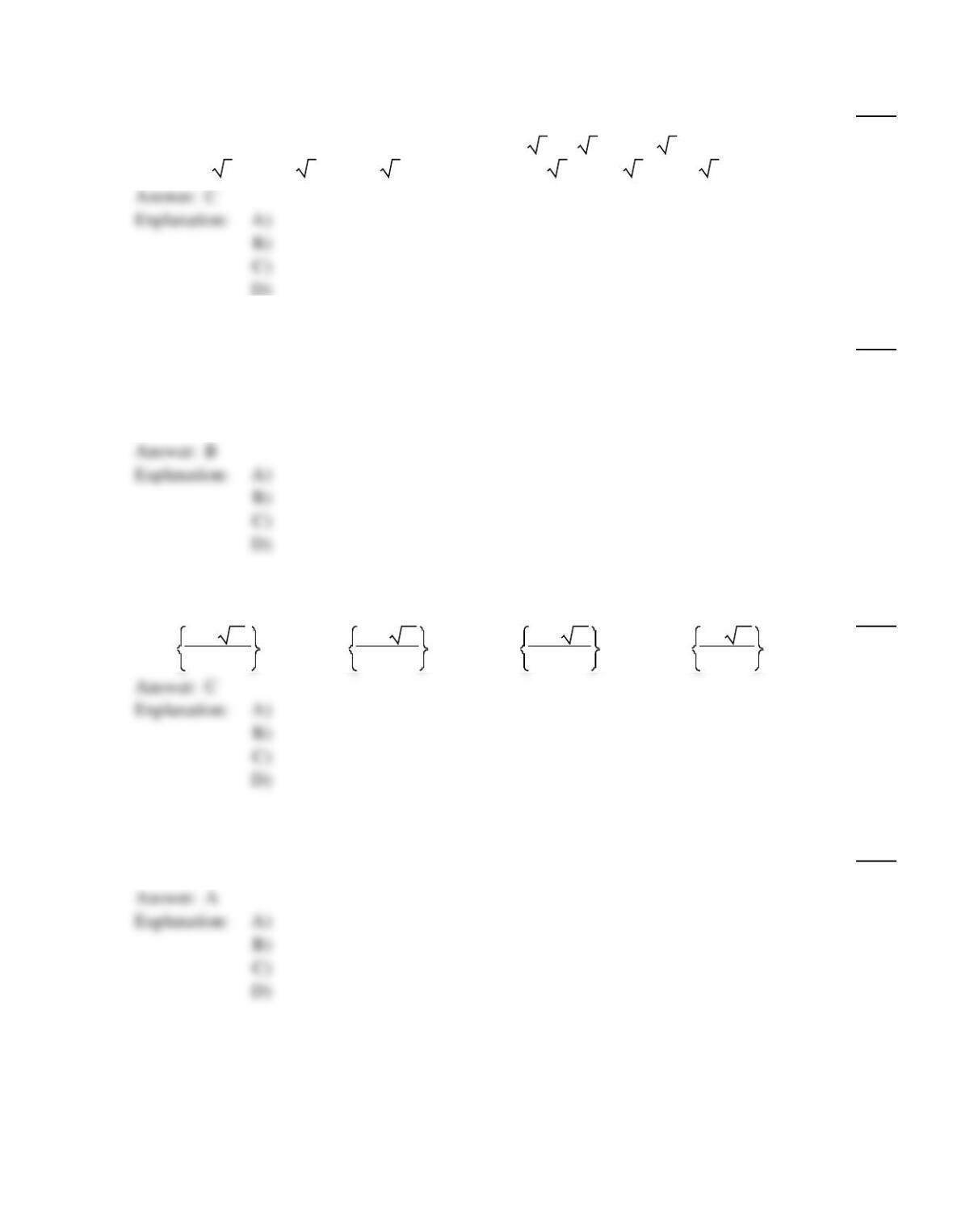
109)
(3 17, 1) and (417, 9)
109)
A)
9 units
B)
8 units
C)
81 units
D)
81
2 units
Solve the problem.
110)
110)
The hypotenuse of an isosceles right triangle is 2 feet longer than either of its legs. Find the exact
length of each side.
A)
2 ft, 2 ft, 4 ft
B)
2 2 ft, 2 2 ft, (2+2 2) ft
C)
(2 +2 2) ft, (2+2 2) ft, (4+2 2) ft
D)
(2 +2) ft, (2+2) ft, (4+2) ft
111)
111)
A ball is thrown upward with an initial velocity of 21 meters per second from a cliff that is
30 meters high. The height of the ball is given by the quadratic equation h = – 4.9t2+21t +50
where h is in meters and t is the time in seconds since the ball was thrown. Find the time that the
ball will be 20 meters from the ground. Round your answer to the nearest tenth of a second.
A)
6.0 sec
B)
5.4 sec
C)
6.1 sec
D)
5.5 sec
Use the quadratic formula to solve the equation.
112)
x2+7x +3= 0
112)
A)
–7±61
2
B)
–7±37
14
C)
–7±37
2
D)
7±37
2
Find the range of the quadratic function.
113)
f(x) =5– (x + 4)2
113)
A)
( , 5]
B)
[–4, )
C)
( , 4]
D)
[5, )
41
Find the distance between the pair of points. Give an exact answer.
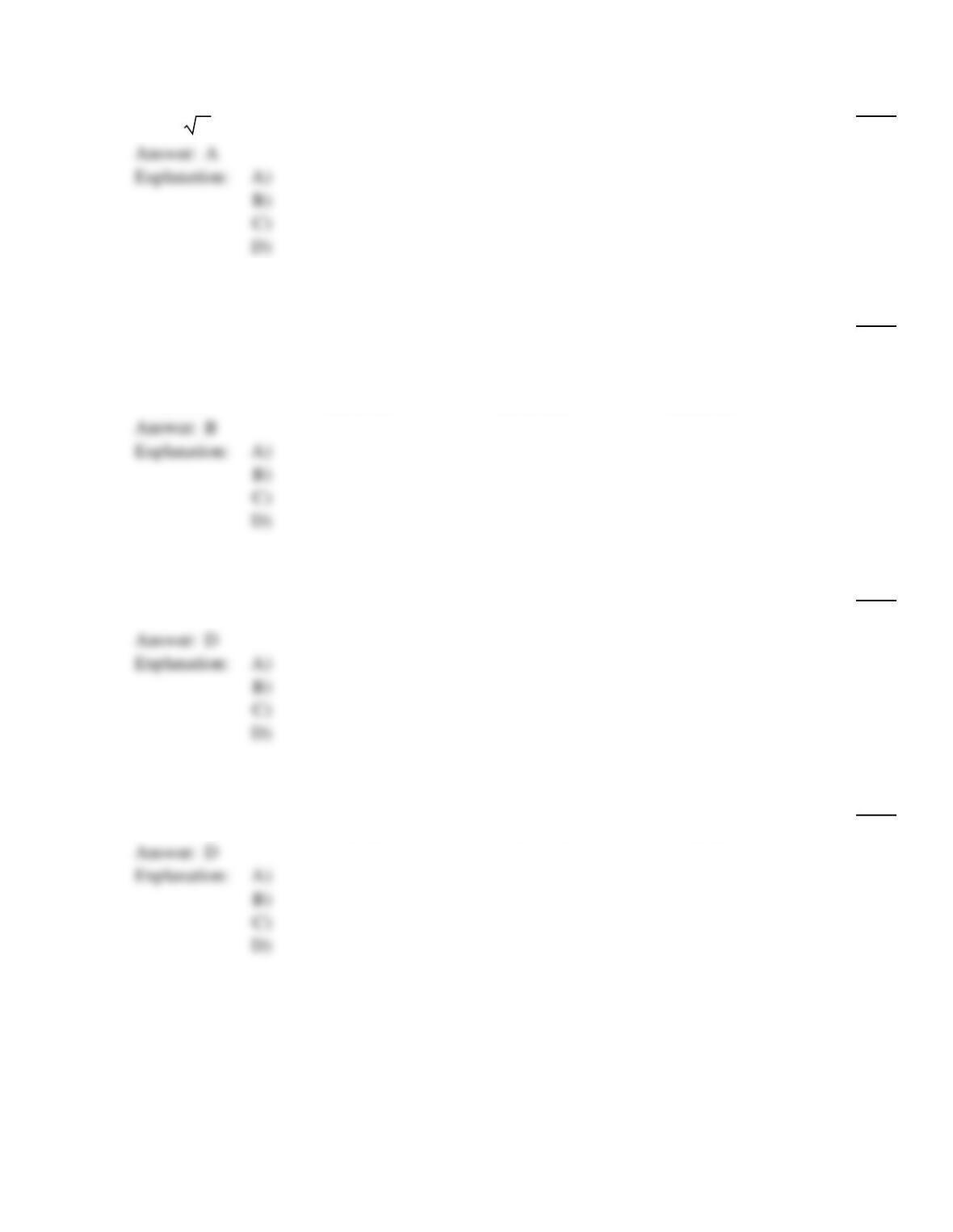
114)
114)
(0, 0) and (3, 9)
A)
310 units
B)
12 units
C)
3 units
D)
90 units
Solve the problem.
115)
115)
A person standing close to the edge on top of a 304–foot building throws a baseball vertically
upward. The quadratic function s(t) = – 16t2+ 64t +304 models the ball‘s height above the ground,
s(t), in feet, t seconds after it was thrown. How many seconds does it take until the ball finally hits
the ground? Round to the nearest tenth of a second if necessary.
A)
2 sec
B)
6.8 sec
C)
368 sec
D)
2.8 sec
Write a quadratic equation in standard form with the given solution set.
116)
116)
{–3i, 3i}
A)
x2–9= 0
B)
x2+6x +9= 0
C)
x2–6x –9= 0
D)
x2+9= 0
Find the coordinates of the vertex for the parabola defined by the given quadratic function.
117)
f(x) =x2– 2x + 9
117)
A)
(–1, 12)
B)
(1, 6)
C)
(–2, 17)
D)
(1, 8)
42
Solve the problem.
118)
118)
The profit that the vendor makes per day by selling x pretzels is given by the function
P(x) = – 0.002x2+1.4x – 400. Find the number of pretzels that must be sold to maximize profit.
A)
350 pretzels
B)
0.7 pretzels
C)
–155 pretzels
D)
700 pretzels
Solve the rational inequality and graph the solution set on a real number line.
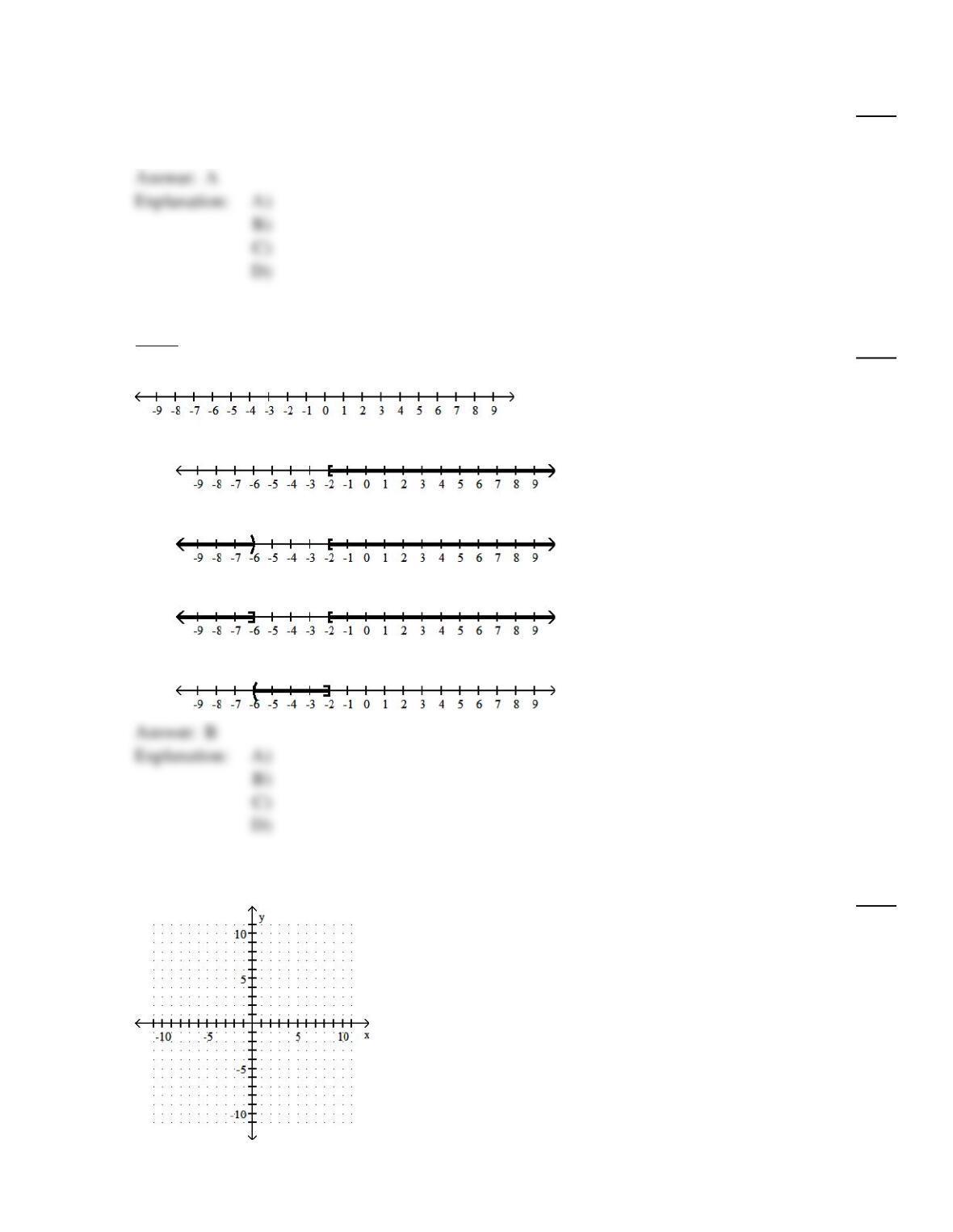
119)
–x –2
x +6
0
119)
A)
[–2, )
B)
(–, –6) [–2, )
C)
(–, –6] [–2, )
D)
(–6, –2]
Sketch the graph of the quadratic function. Give the vertex and axis of symmetry.
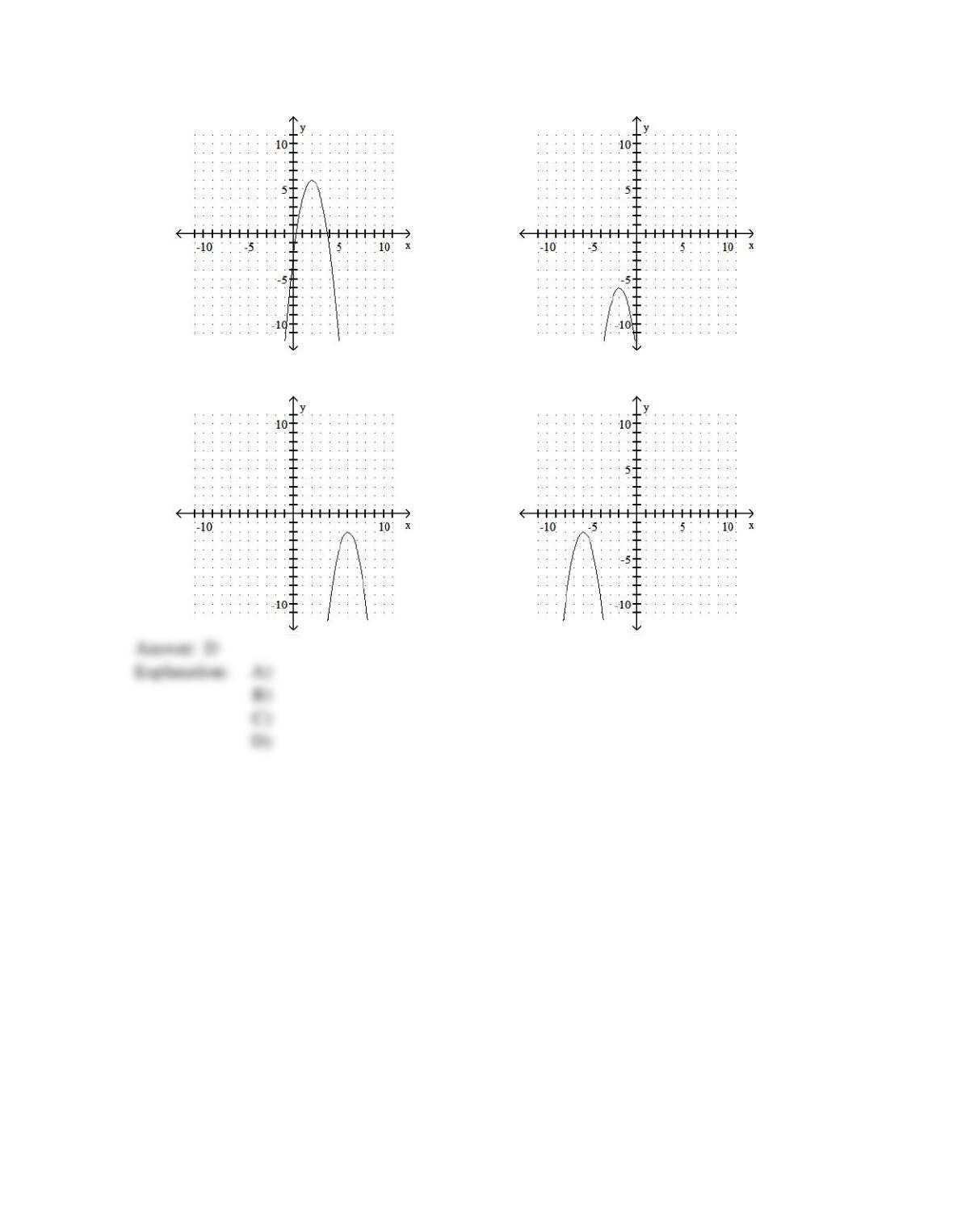
120)
f(x) = – 2(x + 6)2– 2
120)
43
A)
vertex: (2, 6)
axis of symmetry: x =2
B)
vertex: (–2, –6)
axis of symmetry: x = – 2
C)
vertex: (6, –2)
axis of symmetry: x =6
D)
vertex: (–6, –2)
axis of symmetry: x = – 6
44