Stewart – Calculus ET 8e Chapter 11 Form D
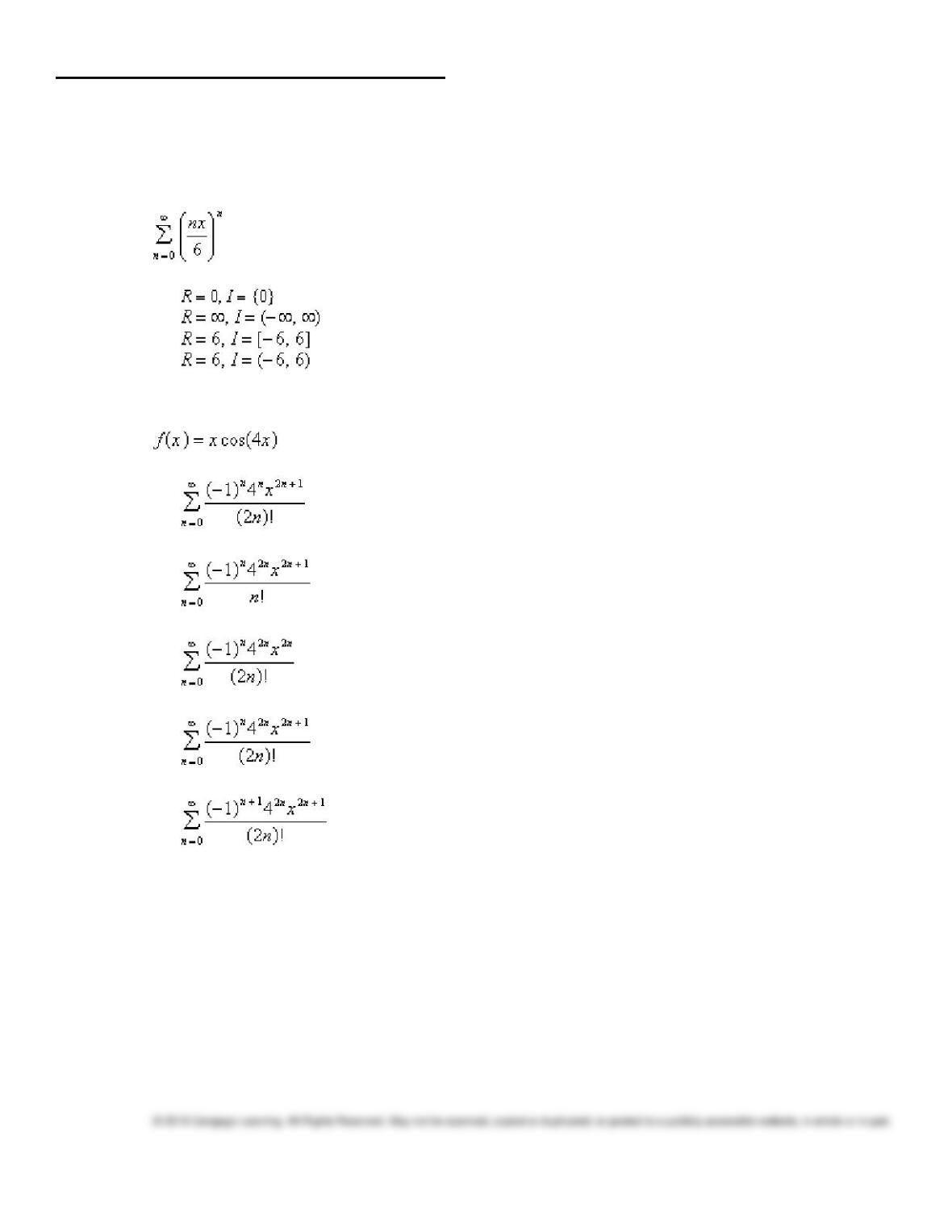
____ 16. Find the radius of convergence and the interval of convergence of the power series.
a.
b.
c.
d.
____ 17. Find the Maclaurin series for f (x) using the definition of the Maclaurin series.
a.
b.
c.
d.
e.
Stewart – Calculus ET 8e Chapter 11 Form D
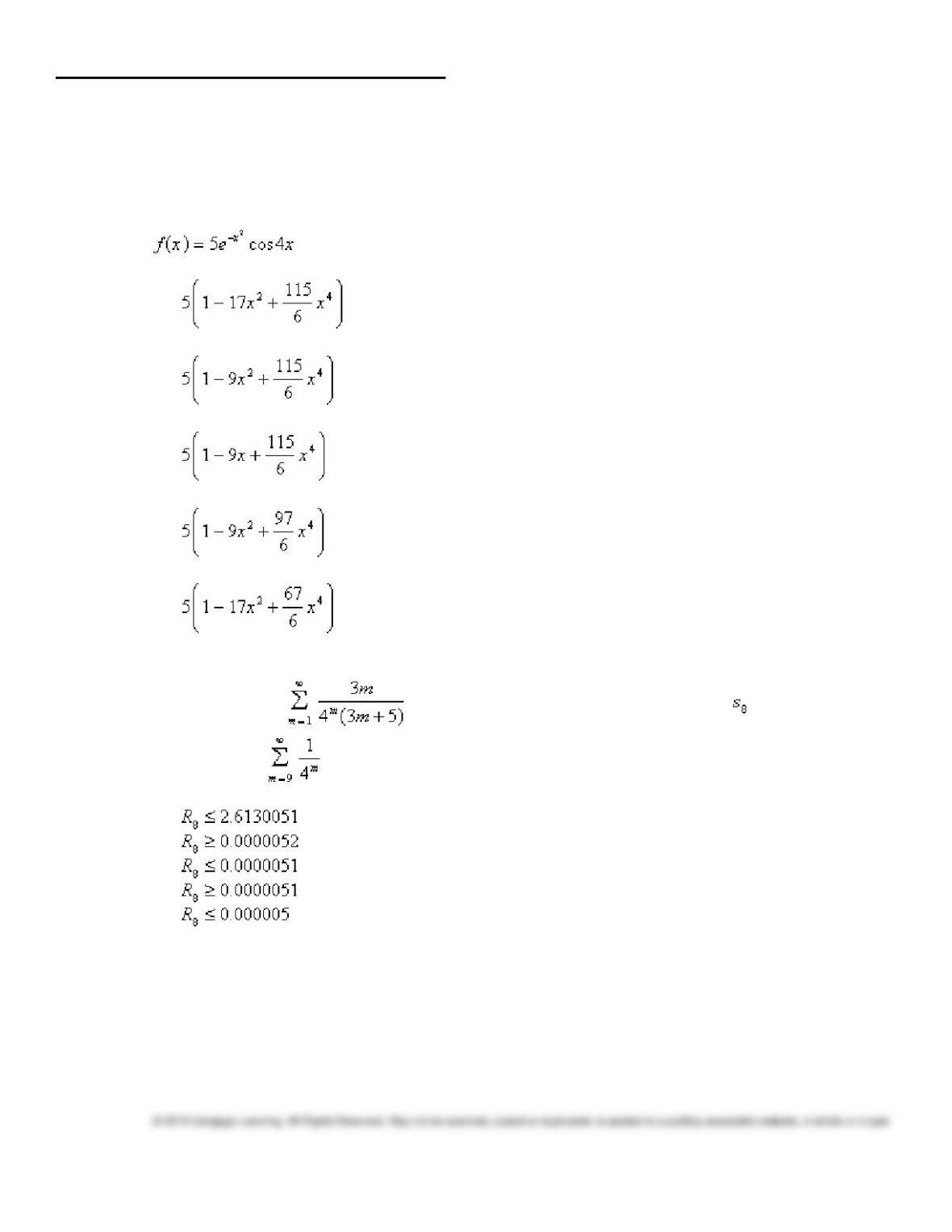
____ 18. Use multiplication or division of power series to find the first three nonzero terms in the Maclaurin
series for the function.
a.
b.
c.
d.
e.
____ 19. Given the series estimate the error in using the partial sum by comparison
with the series .
a.
b.
c.
d.
e.
Stewart – Calculus ET 8e Chapter 11 Form D
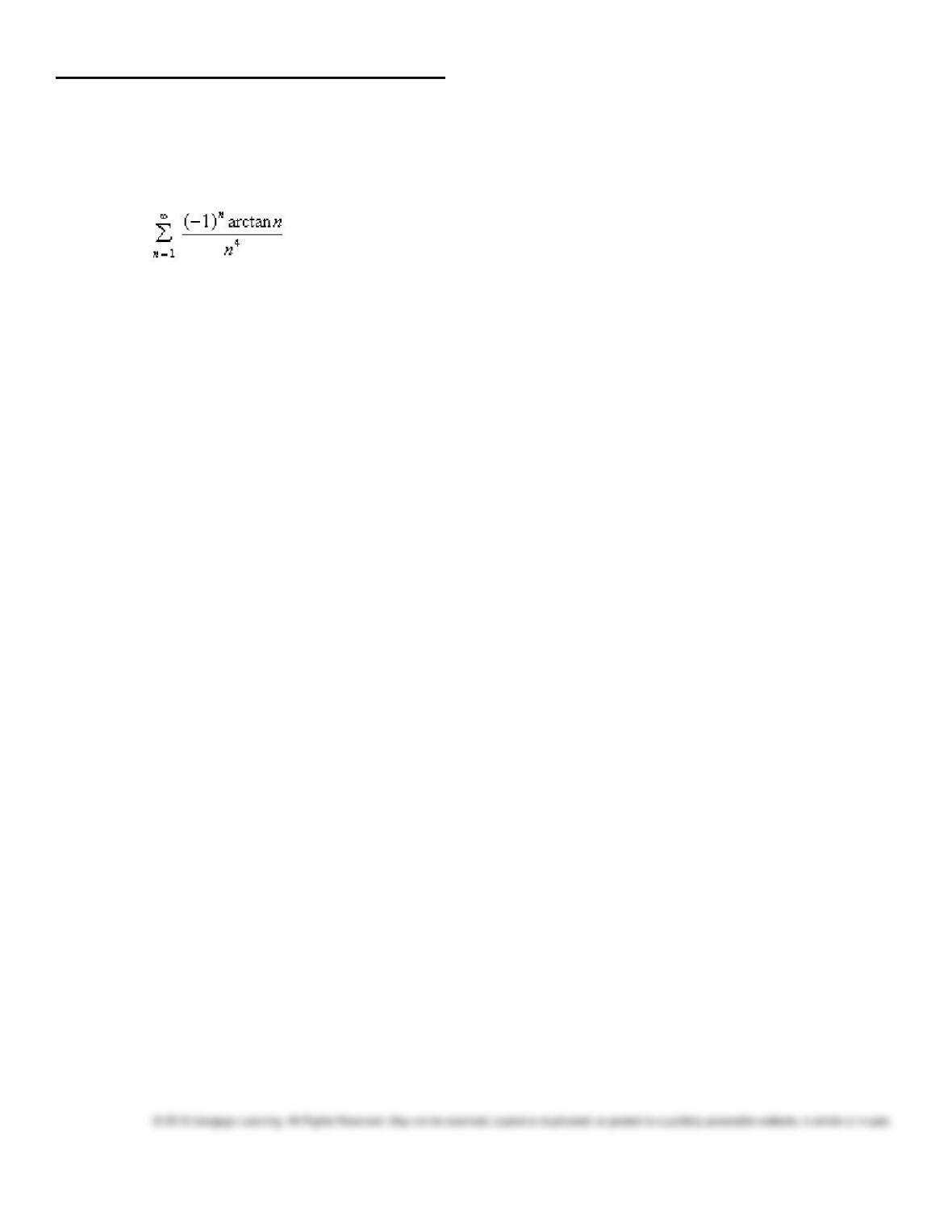
____ 20. Determine whether the series is absolutely convergent, conditionally convergent, or divergent.
a. conditionally convergent
b. absolutely convergent
c. divergent
Stewart – Calculus ET 8e Chapter 11 Form D
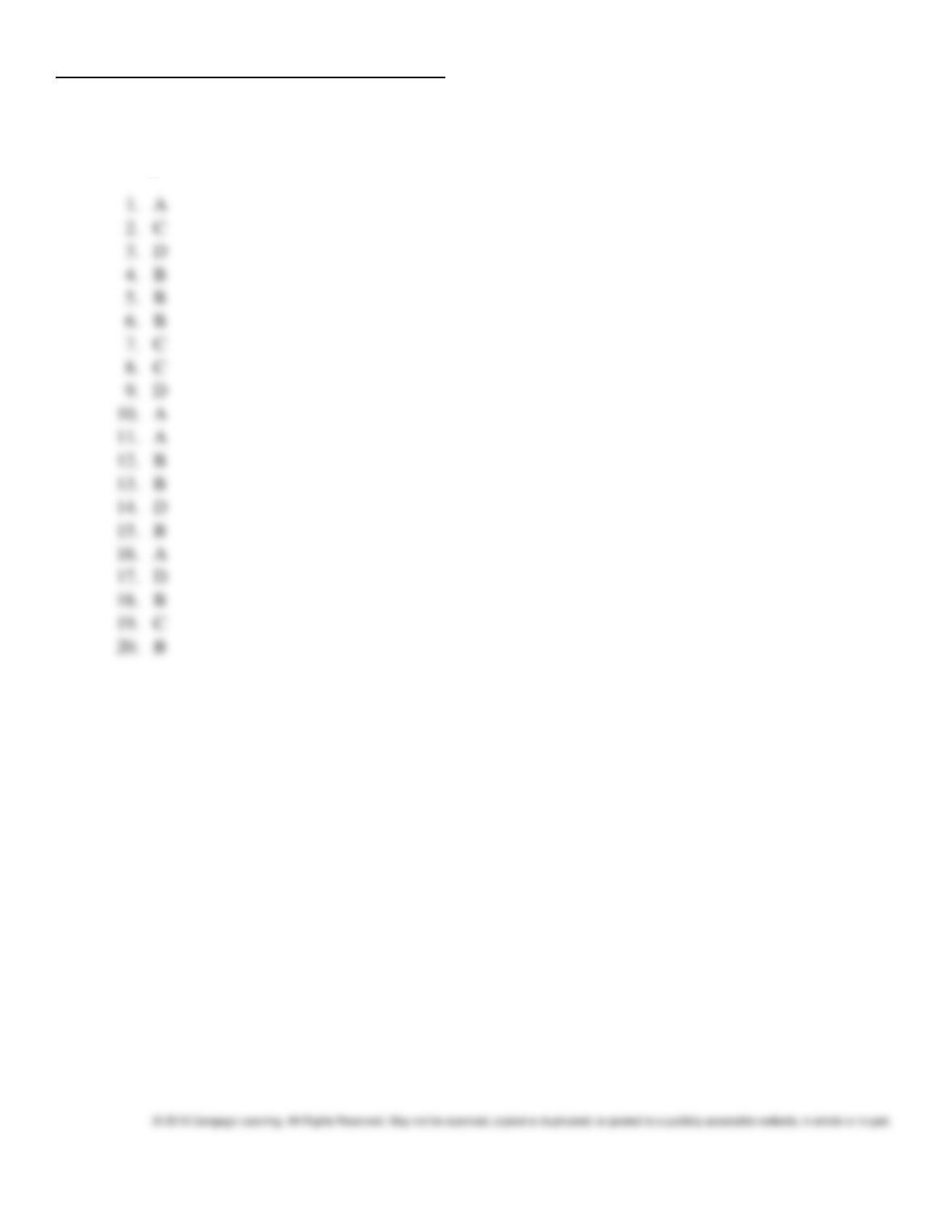
Answer Key
Stewart – Calculus ET 8e Chapter 11 Form E
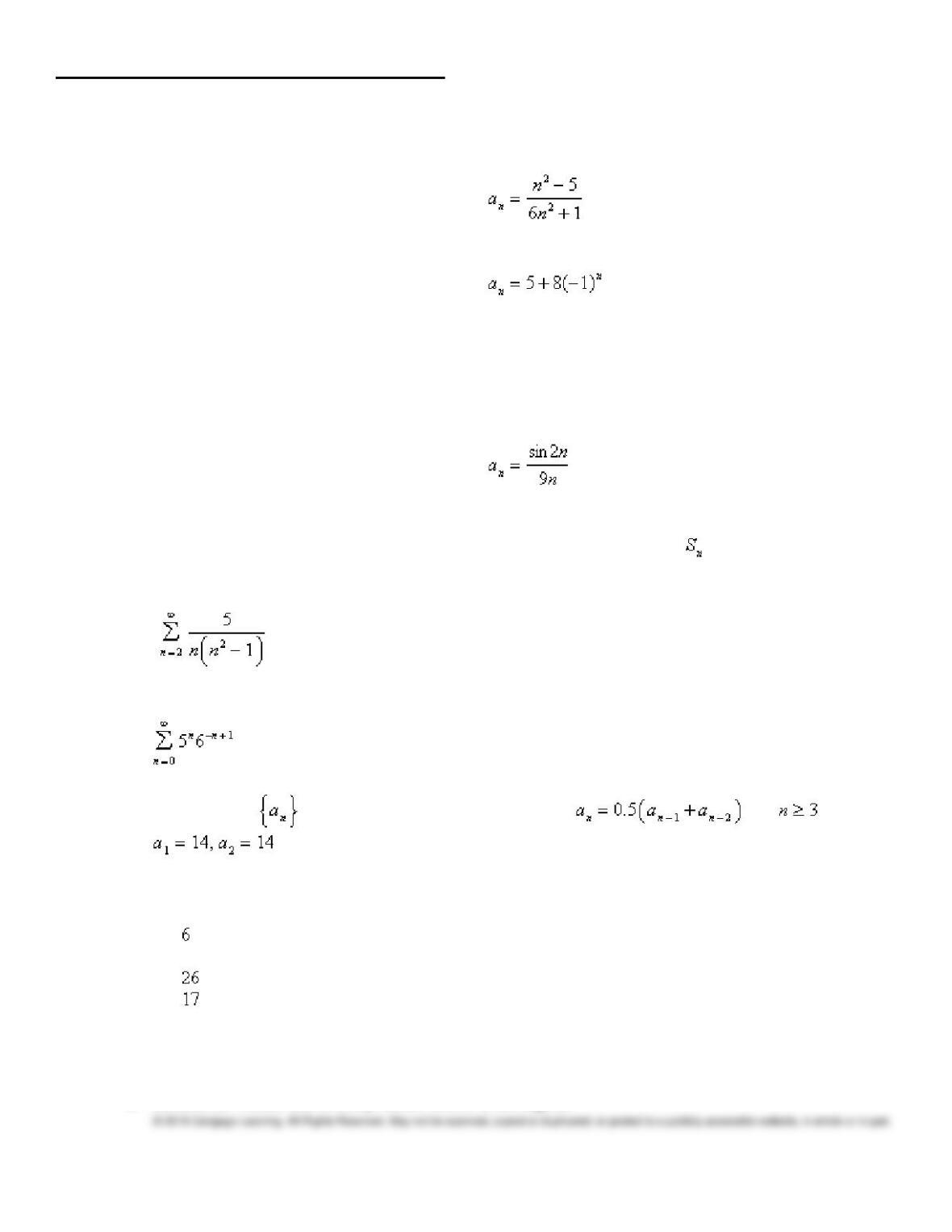
1. Determine whether the sequence defined by converges or diverges. If it converges,
find its limit.
____ 2. Determine whether the sequence defined by converges or diverges. If it
converges, find its limit. Select the correct answer.
a. 13
b. 5
c. Diverges
d. –3
3. Determine whether the sequence defined by converges or diverges. If it converges,
find its limit.
4. Determine whether the series is convergent or divergent by expressing as a telescoping sum. If
it is convergent, find its sum.
.
5. Determine whether the geometric series converges or diverges. If it converges, find its sum.
____ 6. A sequenceis defined recursively by the equation for where
.
Use your calculator to guess the limit of the sequence. Select the correct answer.
a.
b. 14
c.
d.
e. 15
7. Determine which one of the p-series below is convergent.
8. Determine which one of the p-series below is divergent.
Stewart – Calculus ET 8e Chapter 11 Form E
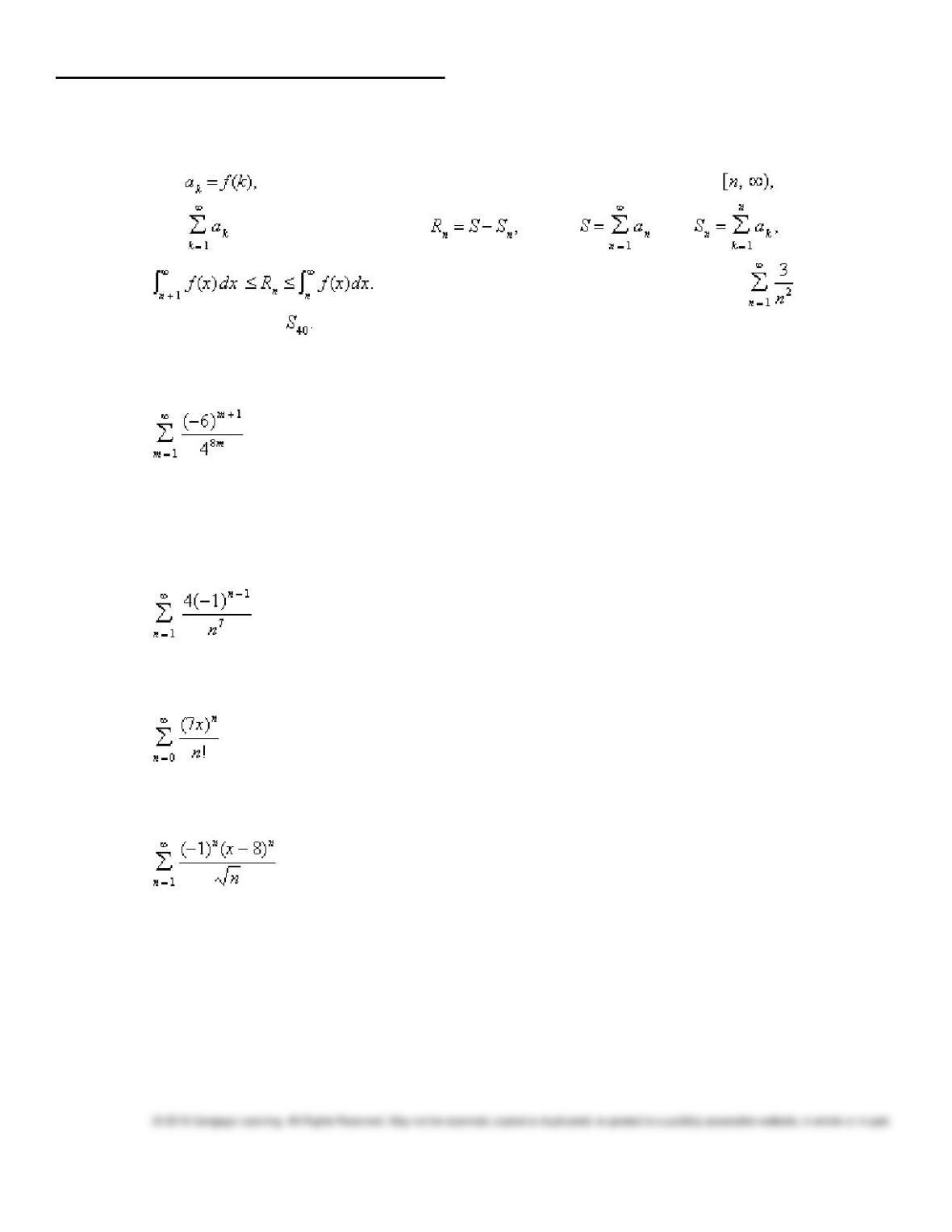
9. Let where f is a continuous, positive, and decreasing function on and suppose
that is convergent. Defining where and we have that
Find the maximum error if the sum of the series is
approximated by
____ 10. Test the series for convergence or divergence. Select the correct answer.
a. The series is convergent.
b. The series is divergent.
11. Approximate the sum to the indicated accuracy.
(five decimal places)
12. Find the radius of convergence and the interval of convergence of the power series.
13. Find the radius of convergence and the interval of convergence of the power series.
Stewart – Calculus ET 8e Chapter 11 Form E
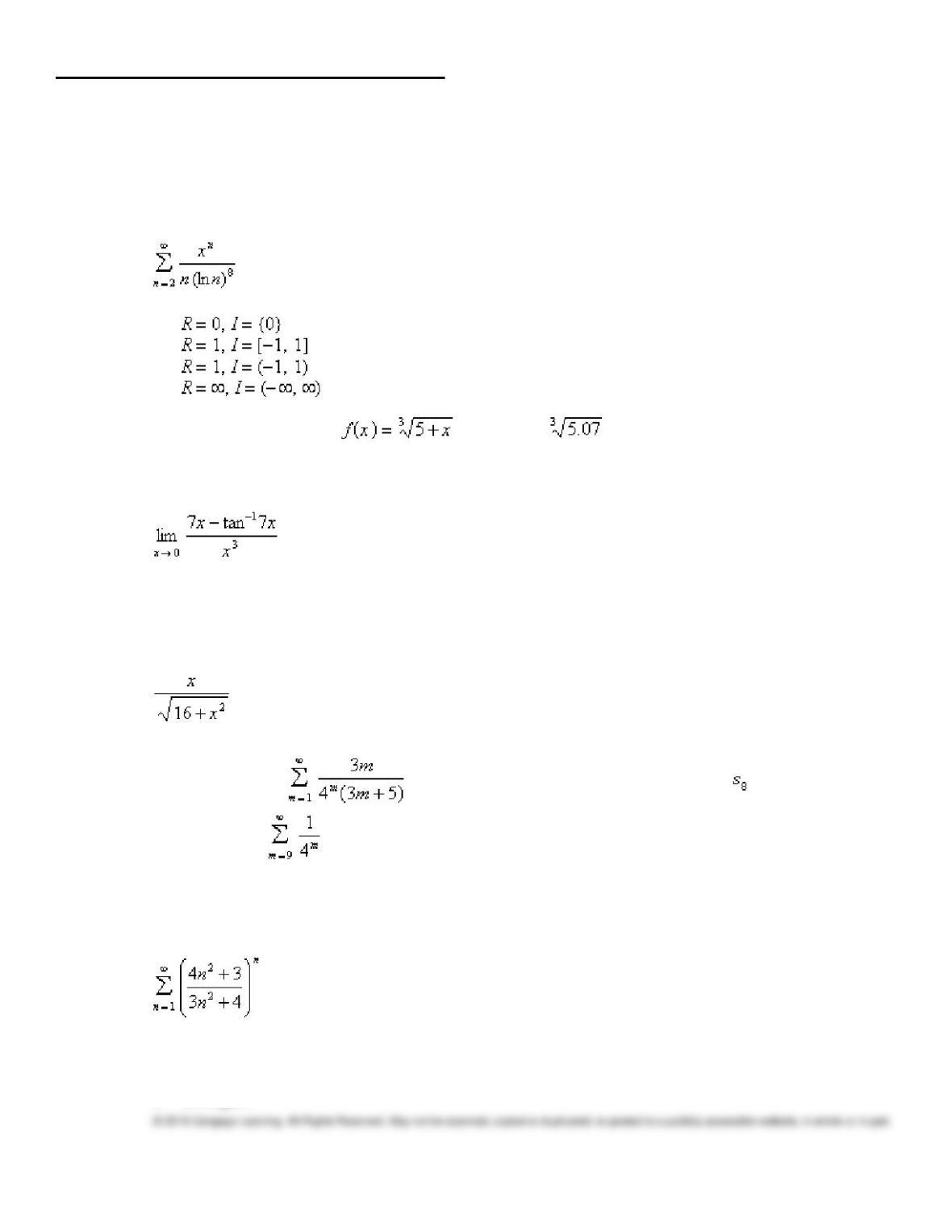
____ 14. Find the radius of convergence and the interval of convergence of the power series.
Select the correct answer.
a.
b.
c.
d.
15. Use the power series for to estimate correct to four decimal places.
16. Use series to evaluate the limit correct to three decimal places.
Select the correct answer.
17. Use the binomial series to expand the function as a power series. Find the radius of convergence.
18. Given the series estimate the error in using the partial sum by comparison
with the series .
____ 19. Determine whether the series is absolutely convergent, conditionally convergent, or divergent.
Select the correct answer.
a. conditionally convergent
b. absolutely convergent
c. divergent
Stewart – Calculus ET 8e Chapter 11 Form E
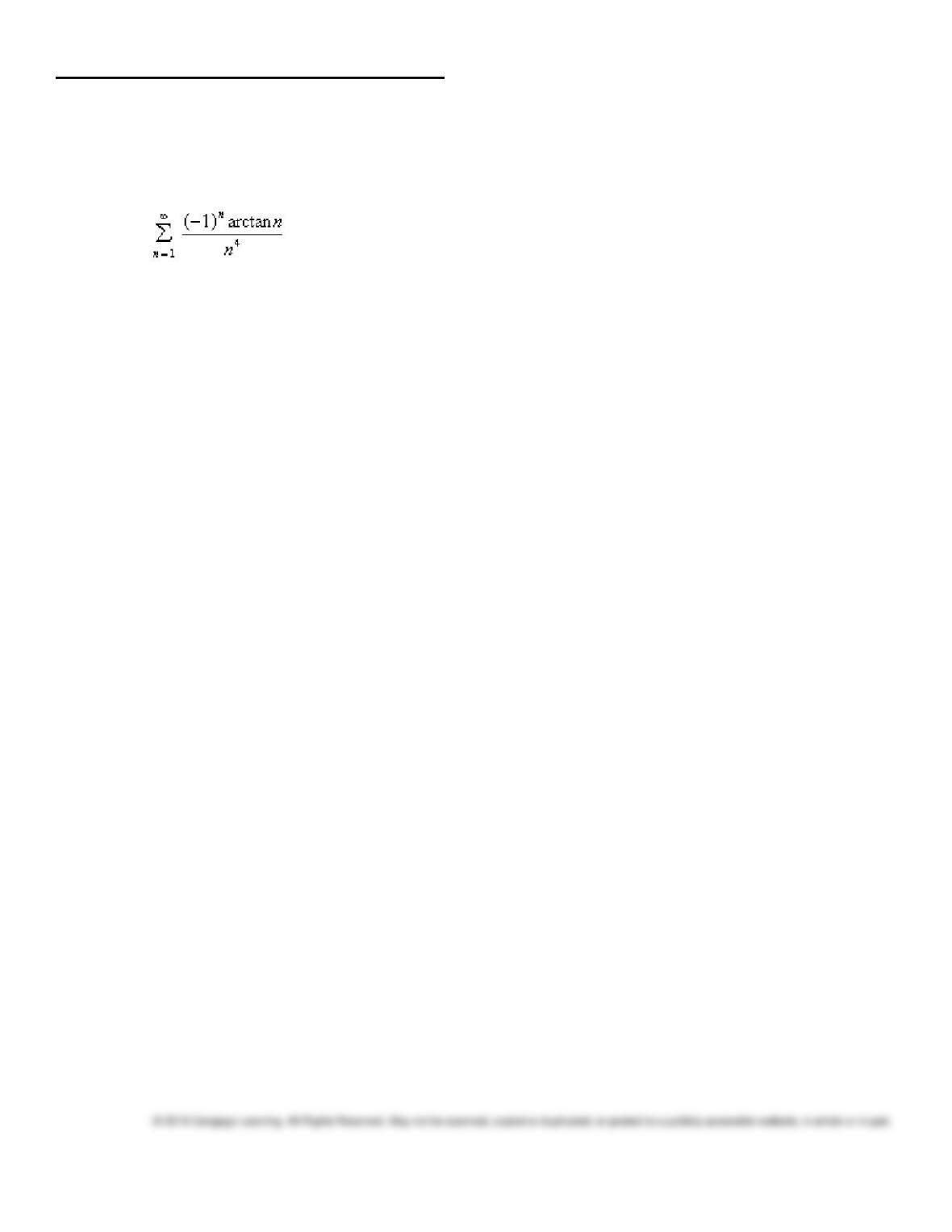
20. Determine whether the series is absolutely convergent, conditionally convergent, or divergent.
Stewart – Calculus ET 8e Chapter 11 Form E
Answer Key
Stewart – Calculus ET 8e Chapter 11 Form F
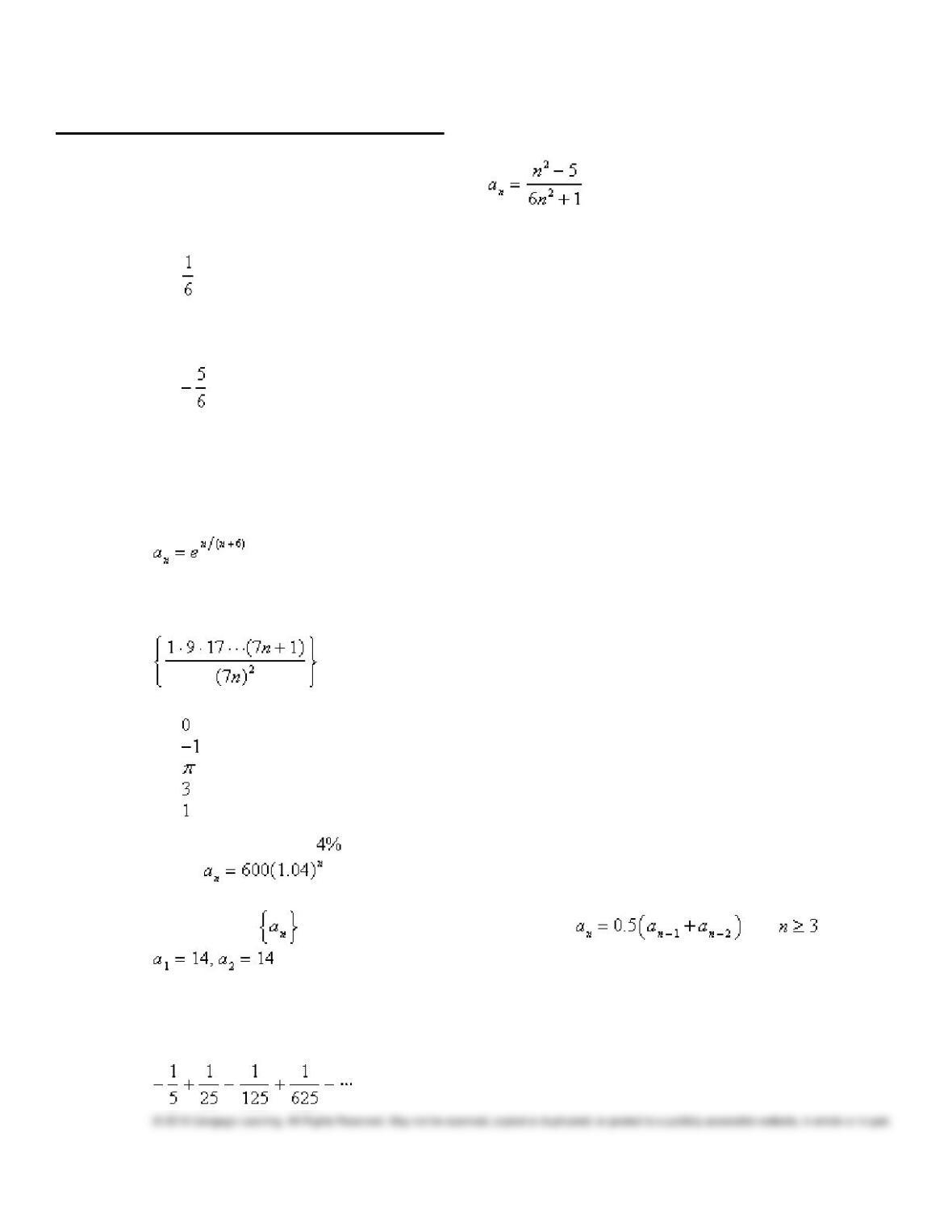
____ 1. Determine whether the sequence defined by converges or diverges. If it converges,
find its limit. Select the correct answer.
a.
b. –5
c.
d. Diverges
2. Determine whether the sequence converges or diverges. If it converges, find the limit.
____ 3. Find the value of the limit for the sequence given. Select the correct answer.
a.
b.
c.
d.
e.
4. If $600 is invested at interest, compounded annually, then after n years the investment is
worth dollars. Find the size of investment after 7 years.
5. A sequenceis
defined recursively by the equation for where
.
Use your calculator to guess the limit of the sequence.
6. Determine whether the geometric series converges or diverges. If it converges, find its sum.
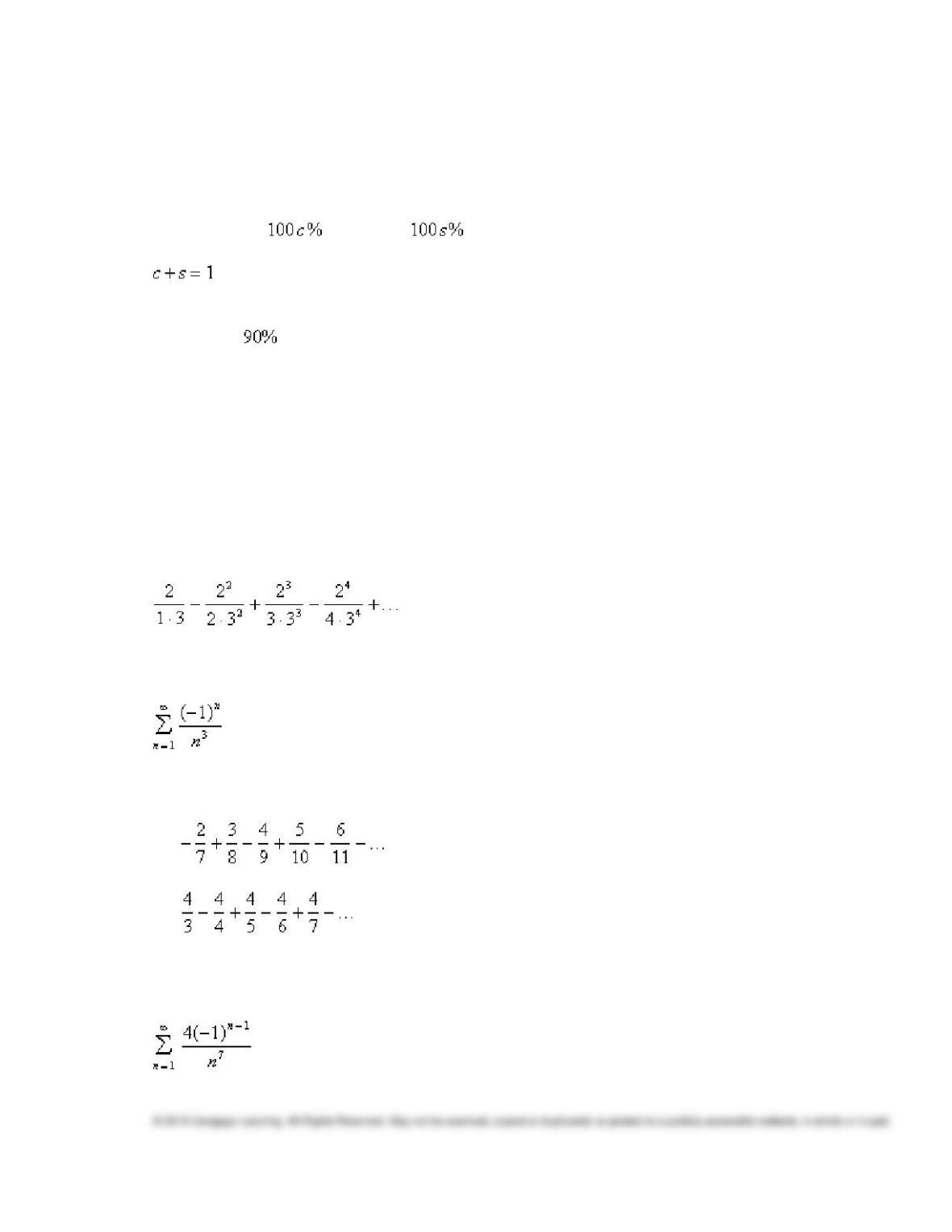
____ 7. When money is spent on goods and services, those that receive the money also spend some of it.
The people receiving some of the twice-spent money will spend some of that, and so on.
Economists call this chain reaction the multiplier effect. In a hypothetical isolated community, the
local government begins the process by spending D dollars. Suppose that each recipient of spent
money spends and saves of the money that he or she receives. The values c and s
are called the marginal propensity to consume and the marginal propensity to save and, of course,
.
The number k = 1/s is called the multiplier. What is the multiplier if the marginal propensity to
consume is ?
Select the correct answer.
a. 4
b. 3
c. 6
d. 7
e. 10
8. Find the sum of the series.
9. Find an approximation of the sum of the series accurate to two decimal places.
____ 10. Determine which series is convergent. Select the correct answer.
a.
b.
11. Approximate the sum to the indicated accuracy.
(five decimal places)
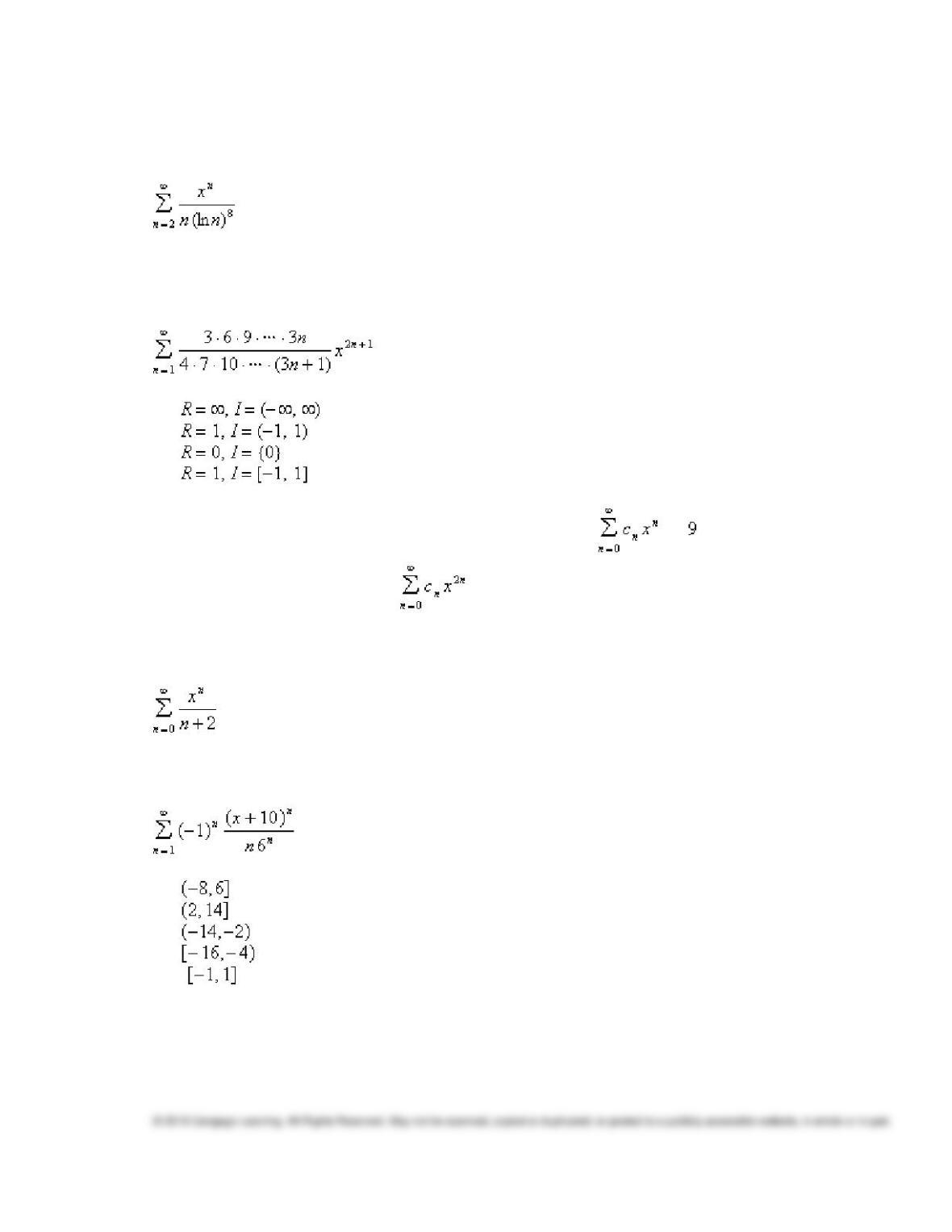
12. Find the radius of convergence and the interval of convergence of the power series.
____ 13. Find the radius of convergence and the interval of convergence of the power series. \
Select the correct answer.
a.
b.
c.
d.
14. Suppose that the radius of convergence of the power series is . What is the radius of
convergence of the power series .
15. Find the radius of convergence and the interval of convergence of the power series.
____ 16. Find the radius of convergence of the series. Select the correct answer.
a.
b.
c.
d.
e.