Chapter 11 Statement of Cash Flows Answer Key
True / False Questions
1.
A statement of cash flows provides a summary of cash inflows and cash outflows during
the reporting period.
2.
The three primary categories of cash flows are cash flows from operating activities, cash
flows from investing activities, and cash flows from financing activities.
3.
Financing activities include cash receipts and cash payments for transactions relating to
revenue and expense activities.
11-2
4.
Investing activities include cash transactions involving the purchase and sale of long–term
assets and current investments.
5.
Operating activities are both inflows and outflows of cash resulting from the external
financing of a business.
11-3
6.
We report interest and dividends received from investments with investing activities.
7.
We report interest paid on bonds or notes payable with operating activities rather than
financing activities.
8.
We record dividends received as a financing activity.
11-4
9.
We record dividends paid as a financing activity.
10.
Transactions that do not increase or decrease cash, but that result in significant investing
and financing activities, are reported either directly after the cash flow statement or in a
separate note to the financial statements as noncash activities.
11.
The purchase of long-term assets by issuing debt is recorded as both an investing activity
and a financing activity.
11-5
12.
The total net cash flows from operating activities differ between the direct and indirect
methods.
13.
Using the indirect method, we begin with net income and then list adjustments to net
income in order to arrive at operating cash flows.
11-6
14.
If no cash was exchanged in the purchase of equipment financed entirely with a note
payable, we represent this as both an investing activity and a financing activity in the
statement of cash flows.
15.
Using the direct method we adjust the items in the income statement to directly show the
cash inflows and outflows from operations.
16.
Because depreciation expense reduces net income, companies will add depreciation
expense back to net income as a step in arriving at net cash flows from operations under
the indirect method.
11-7
17.
A loss on the sale of long-term assets is added back to net income to arrive at net cash
flows from operating activities under the indirect method.
18.
A gain on the sale of long-term assets is added back to net income to arrive at net cash
flows from operating activities under the indirect method.
11-8
19.
Under the indirect method, a decrease in accounts receivable is added to net income to
arrive at net cash flows from operating activities.
20.
Under the indirect method, an increase in prepaid rent is added to net income to arrive at
net cash flows from operating activities.
21.
Under the indirect method, an increase in inventory is added to net income and a decrease
in inventory is subtracted from net income to arrive at net cash flows from operating
activities.
11-9
22.
When preparing a statement of cash flows using the indirect method, a decrease in
accounts payable is subtracted from net income.
23.
Under the indirect method, an increase in accounts payable is added to net income to
arrive at net cash flows from operating activities.
11–10
24.
Under the indirect method, a decrease in accounts payable is added to net income to
arrive at net cash flows from operating activities.
25.
The long-term assets section of the balance sheet is the place to look for investing
activities.
26.
The sale of land is reported in the operating section of the statement of cash flows.
11–11
27.
We report the purchase of stock in another corporation as a cash outflow from investing
activities.
28.
We report the actual amount of cash proceeds received from the sale of land as a cash
inflow from investing activities.
29.
We can find most financing activities by examining changes in long-term liabilities and
stockholders’ equity accounts.
11–12
30.
The inflow of cash received from issuing common stock is reported as an investing
activity.
31.
The balance in Retained Earnings is increased by net income and is decreased by
dividends.
32.
We report the payment of cash dividends as a cash outflow from investing activities.
11–13
33.
The total of the cash flows from operating, investing, and financing activities equals the
net increase or decrease in cash for the period.
34.
We calculate cash return on assets as the change in cash divided by average total assets.
35.
Cash return on assets indicates the amount of operating cash flow generated for each
dollar invested in assets.
11–14
36.
To maximize cash flow from operations, a company strives to increase both cash flows per
dollar of sales and sales per dollar of assets invested.
37.
Cash return on assets can be separated to examine two important business strategies:
cash flow to sales and asset turnover.
38.
Income statement items that have no cash effect are still reported under the direct
method.
11–15
39.
Using the direct method, we examine each account in the income statement and convert it
from an accrual amount to a cash amount.
40.
If accounts receivable decreases, this indicates that revenues exceed cash receipts from
customers.
41.
When accounts payable decrease, cash paid to suppliers must have been more than
purchases.
11–16
42.
If there are no current assets or liabilities associated with operating expenses, the
amounts we report for these expenses in the income statement must equal the amount of
cash we paid for these items.
43.
Depreciation expense is not reported on the statement of cash flows under the direct
method.
44.
We add an increase in interest payable to interest expense in arriving at cash paid for
interest under the direct method.
11–17
45.
We add a decrease in income tax payable to income tax expense to calculate cash paid for
income taxes.
46.
The indirect method begins with net income, while the direct method considers each of
the individual accounts that make up net income.
Multiple Choice Questions
11–18
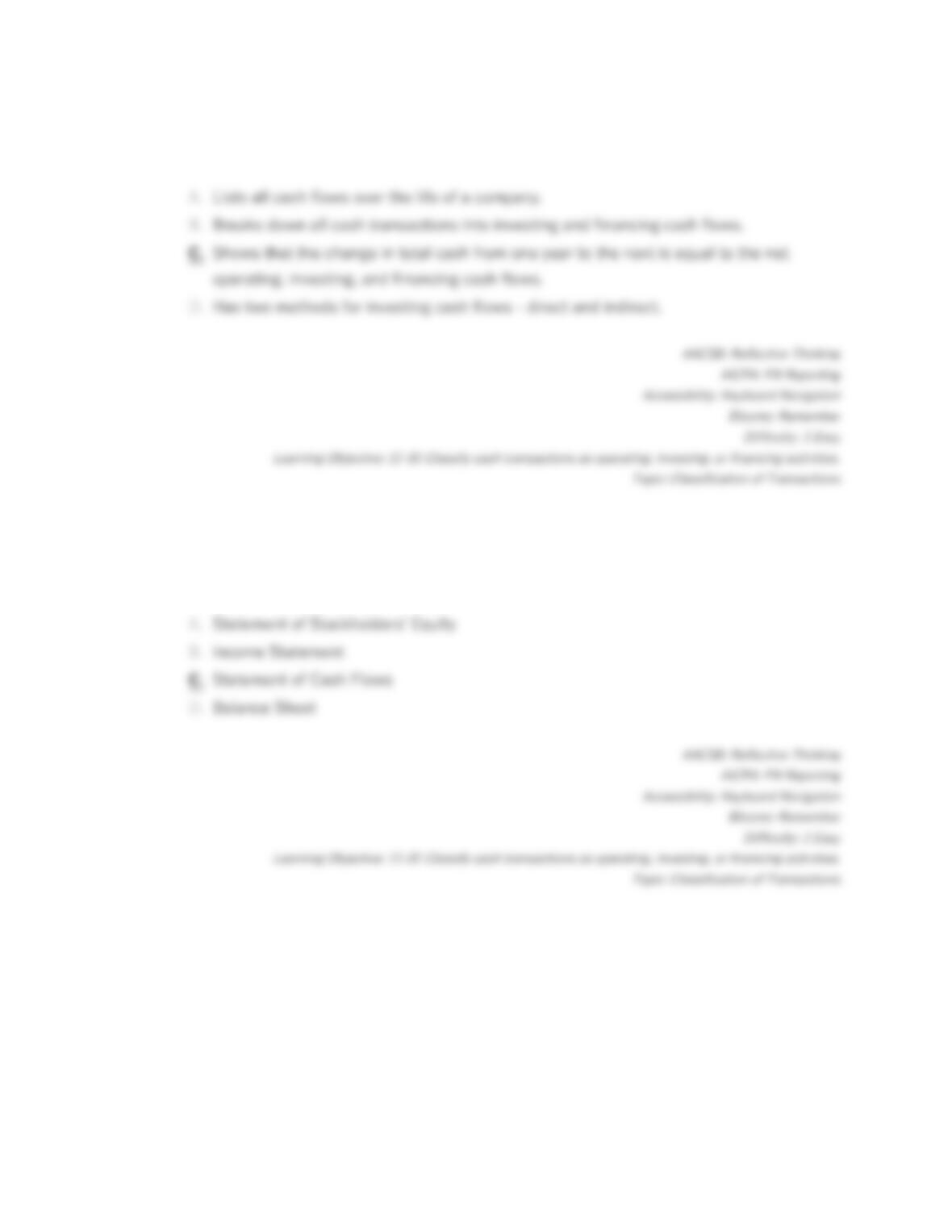
47.
The Statement of Cash Flows:
48.
Which financial statement separates business activities into operating, investing and
financing activities?
11–19
49.
The balance of cash reported in the balance sheet this year minus the balance of cash
reported in the balance sheet last year equals:
50.
The purchase of land is classified in the statement of cash flows as a(n):
51.
The sale of a good or service is classified in the statement of cash flows as a(n):
11–20
52.
The payment of salaries is classified in the statement of cash flows as a(n):
53.
The issuance of notes payable for borrowing is classified in the statement of cash flows as
a(n):