11
Multiple Choice
Identify the choice that best completes the statement or answers the question.
____ 1. Viola’s series titled The Passions is based on ____ paintings of figures in sorrow, ecstasy, or astonishment.
a.
Impressionist and Post-Impressionist
b.
Modern and Postmodern
c.
Byzantine and Gothic
d.
Renaissance and Baroque
____ 2. The Study for the Portrait of Okakura Tenshin showed the Japanese characteristics of ____.
a.
linear perspective
b.
color perspective
c.
flat shapes and contour lines
d.
soft colors and dotted lines
____ 3. In Pollock’s Lucifer, the style of painting called ____ involved the motion of the artist’s entire body.
a.
action painting
b.
pointillist painting
c.
active painting
d.
aggressive painting
____ 4. Van Gogh’s Portrait of Dr. Gachet featured ____ to show the artist’s state of mind.
a.
thick paint
b.
soft pastel colors
c.
lack of forms
d.
tears
____ 5. Chuck Close uses ____ to convey importance in his portraits.
a.
scale
b.
color
c.
contour lines
d.
texture
____ 6. Nancy Burson’s Faces are portraits of children with ____.
a.
their siblings
b.
unusual faces
c.
high intelligence
d.
loving families
____ 7. Lucian Freud’s Leigh under the Skylight is a portrait of ____.
a.
a woman
b.
a goddess
c.
everyman
d.
a unique man
____ 8. Rembrandt’s portraits reveal that The Netherlands encouraged ____.
a.
spirituality
b.
sophistication
c.
social acceptance
d.
individualism
____ 9. Frida Kahlo’s many self-portraits show her face as ____.
a.
changeable
b.
emotionally sunny
c.
unemotional
d.
forever young
____ 10. A Yakshi is a representation of ____.
a.
holiness
b.
sinfulness
c.
fertility
d.
maternity
____ 11. According to Protagoras, man is the ____ of all things.
a.
beginning
b.
measure
c.
best
d.
spirit
____ 12. Doryphoros translates to ____.
a.
spear-bearer
b.
warrior
c.
man with a weapon
d.
godlike defender
____ 13. The Doryphoros is idealized in several ways, including ____.
a.
its size
b.
its emotional intensity
c.
its restrained emotions
d.
its clothing
____ 14. Traditional African sculpture portrays the frontal view as ____.
a.
coinciding with the profile view
b.
symmetrical
c.
asymmetrical
d.
the same as the back view
____ 15. Many African sculptures considered the head and ____ as most important.
a.
feet
b.
shoulders
c.
headdress
d.
neck
____ 16. Laocoön and His Sons revealed ____ Greek attitudes about the body during the Hellenistic period.
a.
the same
b.
completely different
c.
changing
d.
immutable
____ 17. Medieval Christians felt the ____ was more important than the ____.
a.
body/soul
b.
soul/body
c.
mind/soul
d.
soul/mind
____ 18. Eadweard Muybridge’s photos of human bodies revealed his ____ attitude towards the human body.
a.
wondrous
b.
detached
c.
medieval
d.
renaissance
____ 19. The Egyptian ____ style was a new aesthetic, which rejected the rigid, abstract style of the past for a more
flowing, elegant, naturalistic approach.
a.
Amarna
b.
Nefertiti
c.
Classical
d.
Akhenaten
____ 20. Vincent van Gogh’s Portrait of Dr. Gachet was a vehicle for commentary about ____.
a.
the benefits of homeopathic medicine
b.
the political agenda of the bourgeoisie
c.
the suffering inherent in modern, urban life
d.
the simple joys of rural life
____ 21. A(n) ____ pose depicts a figure standing naturally, with one foot forward and one leg bearing most of the
figure’s weight.
a.
chiaroscuro
b.
idealized
c.
alla prima
d.
contrapposto
____ 22. ____ is known for the use of stop motion photography to document the physical movement of humans and
animals.
a.
Eadweard Muybridge
b.
Cindy Sherman
c.
Frida Kahlo
d.
Bill Viola
____ 23. The publication of ____ theories of repression and neurosis influenced many artists of the late nineteenth
century.
a.
Michelangelo Buonarroti’s
b.
Sigmund Freud’s
c.
Jin Soo Kim’s
d.
Okakura Tenshin’s
____ 24. In Marina Abramovic’s performance piece, The Artist Is Present, the artist’s body and the ____ are the art
piece.
a.
musical performance
b.
video footage
c.
backup dancers
d.
actions of the audience
____ 25. A successful portrait in art is usually considered someone’s likeness, not only in face but also in ____.
a.
duality
b.
character
c.
idealism
d.
naturalism
____ 26. The first attribute of a specific portrait is usually ____ features, rather than the broadly stylized features
evident in generic figures.
a.
individualized
b.
abstracted
c.
idealized
d.
elegant
____ 27. Double Mask from the Ejagham People of the Cross River area of Cameroon was worn during rituals that
promoted ____.
a.
education for young boys
b.
initiation rites for hunters
c.
initiation rites for warriors
d.
group cohesion
____ 28. The Dutch artist, ____ made at least sixty-two self-portraits, often identifiable by the subject matter and his
palette of earth tones, dull reds and luminous yellows.
a.
Jan Van Eyck
b.
Peter Paul Rubens
c.
Rembrandt van Rijn
d.
Jan Vermeer
____ 29. ____ was known for using self portraits to comment on the factors shaping her life, including her ancestry and
her chronic pain.
a.
Frida Kahlo
b.
Cindy Sherman
c.
Nancy Burson
d.
Sue Coe
____ 30. ____ photographs reflect socially prescribed roles and explore the nature of stereotypes.
a.
Edward Weston’s
b.
Cindy Sherman’s
c.
Frida Kahlo’s
d.
Eadweard Muybridge’s
____ 31. A(n) ____ figure, such as Doryphoros, is often used to represent ideas about the essence of humanity, rather
than depicting a specific individual.
a.
abstracted
b.
naturalistic
c.
stylized
d.
idealized
____ 32. In ____ Greece, figures were often depicted in theatrical poses as though they were on stage in front of an
audience.
a.
Archaic
b.
Imperial
c.
Classical
d.
Hellenistic
____ 33. During the Renaissance, the ____ as an ideal form became popular again.
a.
nude
b.
church
c.
still-life
d.
landscape
____ 34. In the nineteenth century, new technologies such as ____ changed the understanding of the human body and
the way art was made.
a.
computers
b.
photography
c.
psychoanalysis
d.
advertising
Essay
35. What is the Oceanic view of a person?
36. What do you see in Boccioni’s Unique Forms of Continuity in Space?
37. Describe the message in Munch’s The Scream.
38. Discuss the influence of Okakura Tenshin on the art of Japan.
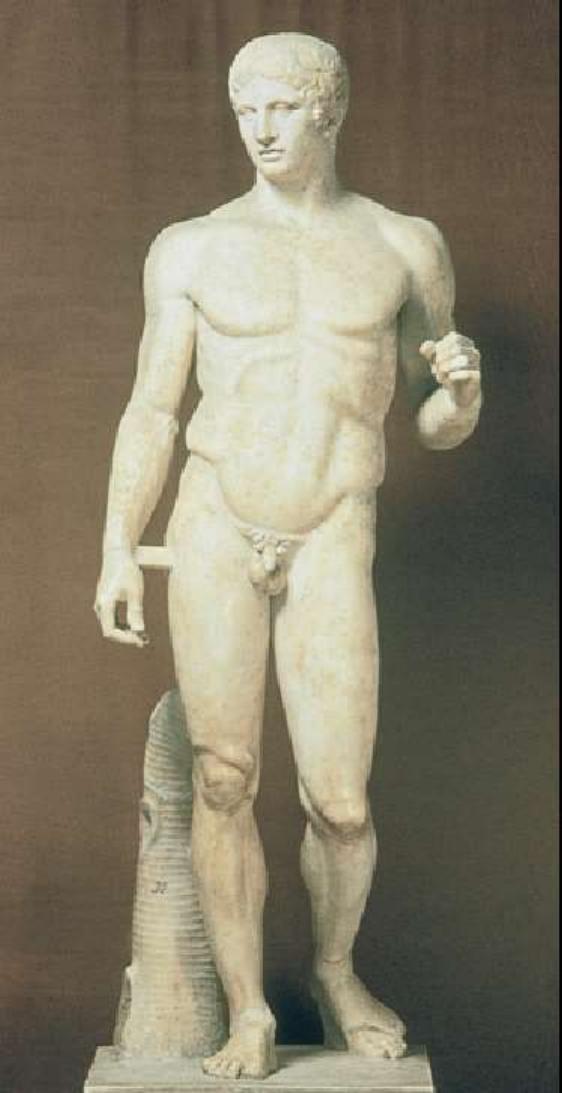
39.
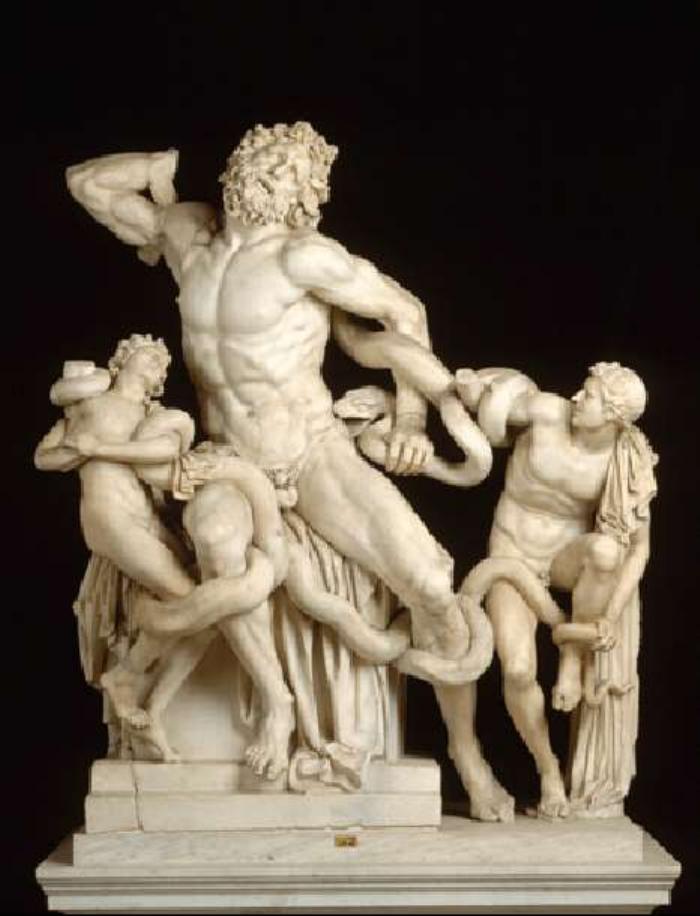
Compare and contrast these two sculptures. How do they illustrate changes in the Greek outlook on life?
True/False
Indicate whether the statement is true or false.
____ 40. Chuck Close is a painter known for making highly idealized figurative paintings based on classical notions of
ideal beauty.
____ 41. Nancy Burson achieved a grainy, fuzzy look in her photographic series Faces by using a cheap plastic
camera.
____ 42. A full-body portrait is always a life-size depiction of an individual.

____ 43. Polykleitos invented and applied a system of mathematical proportions called the Canon for the depiction of
Greek figures.
____ 44. In Medieval Europe, human nature was held in high esteem, and images of the body symbolized the purity of
God’s divine realm.
____ 45. Italian Renaissance artists were strongly influenced by Hellenistic and Roman sculptures that were being
excavated in central Italy.
____ 46. Many late nineteenth century European artists were strongly influenced by Japanese prints and paintings.
____ 47. Ritual tattooing was often used on the eastern islands of the South Pacific as part of initiation rites that
prepared an individual for adulthood.
11
Answer Section
MULTIPLE CHOICE

ESSAY

TRUE/FALSE