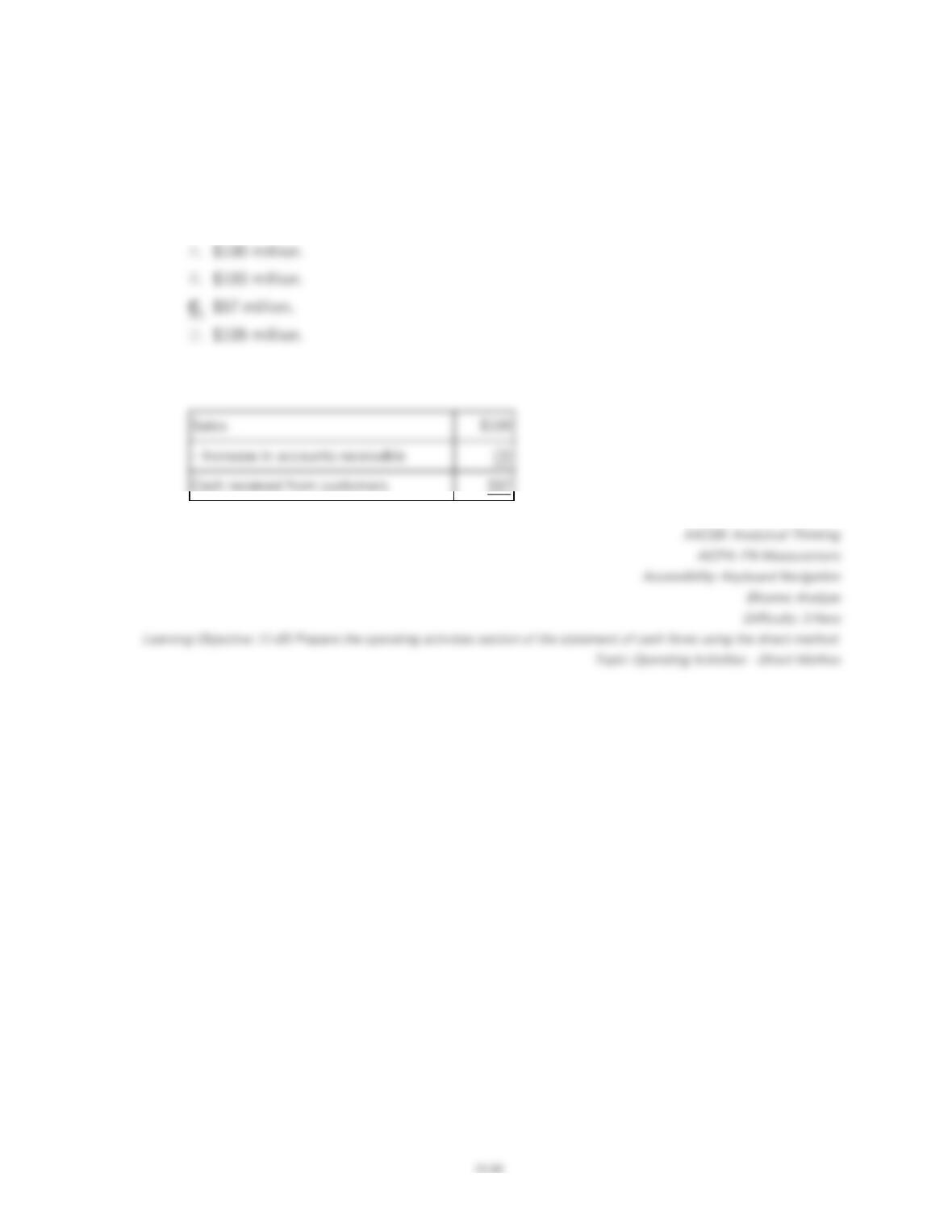
140.
Data Solutions reports sales of $100 million. Accounts receivable at the beginning and end
of the year are $6 million and $9 million, respectively. What is the amount of cash received
from customers?
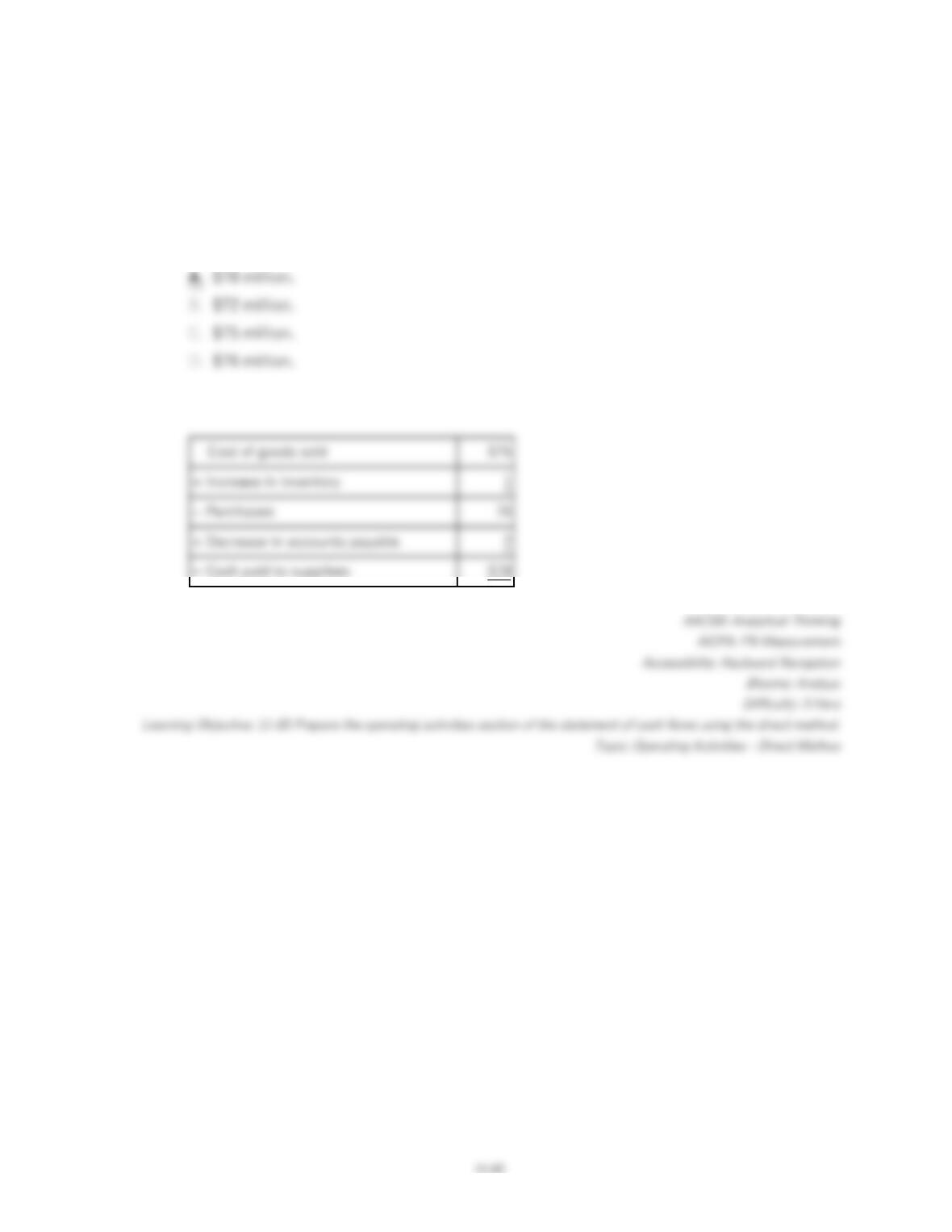
141.
Data Solutions reports cost of goods sold of $75 million. Inventory at the beginning and
end of the year are $8 million and $9 million, respectively. Accounts payable at the
beginning and end of the year are $5 million and $3 million, respectively. What is the
amount of cash paid to suppliers?
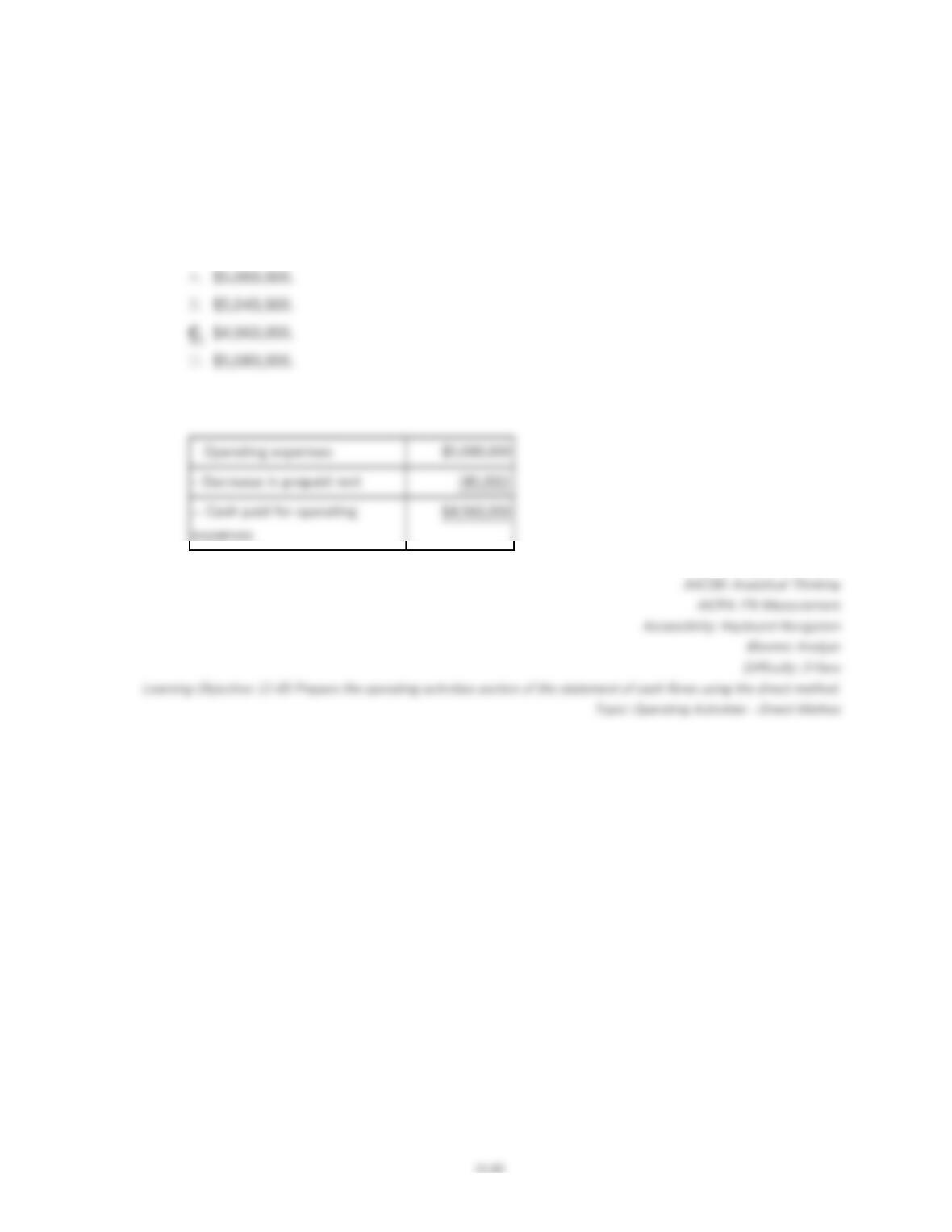
142.
Data Solutions reports operating expenses of $5 million. Operating expenses include rent
expense. Prepaid rent at the beginning and end of the year are $120,000 and $80,000,
respectively. All other operating expenses were paid in cash as incurred. What is the
amount of cash paid for operating expenses?
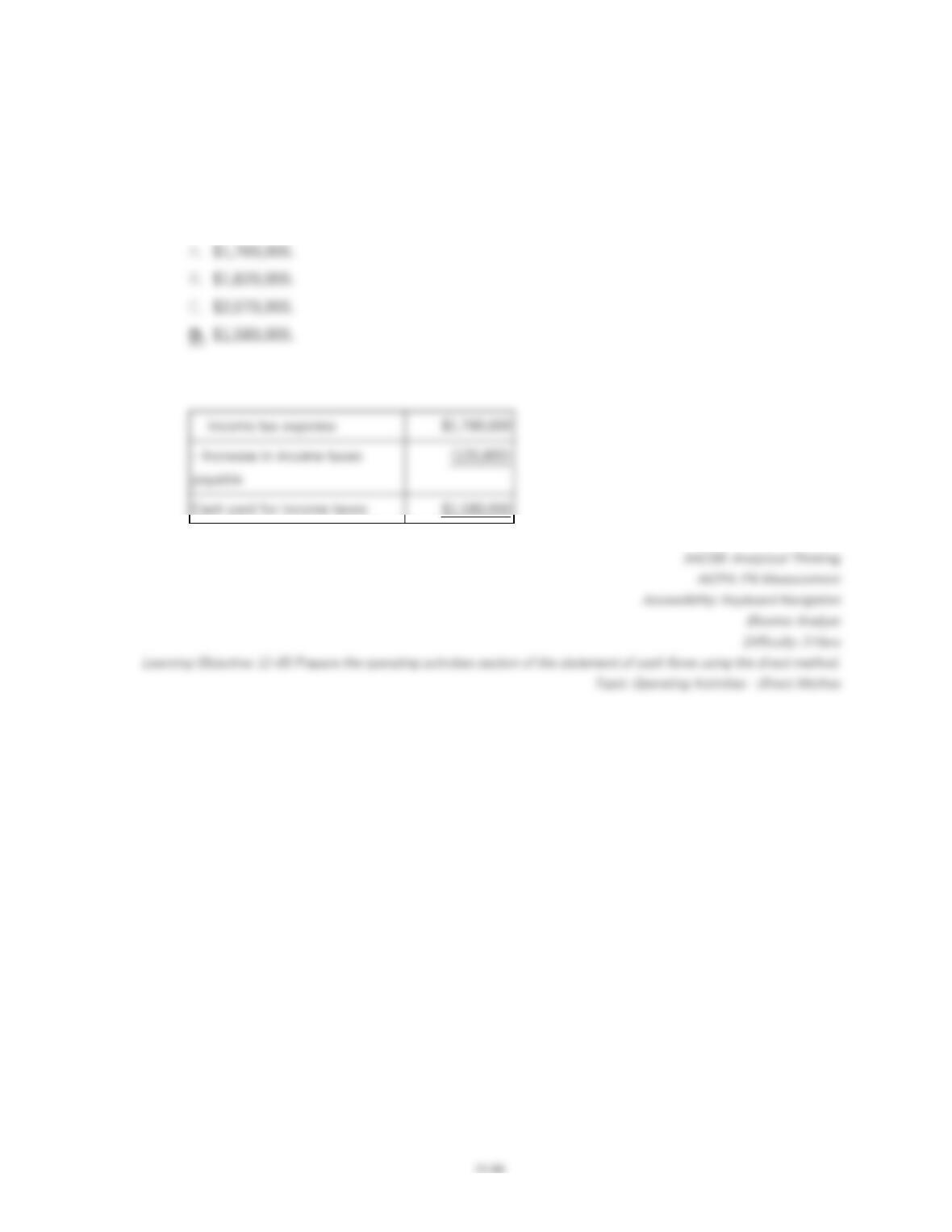
143.
Data Solutions reports income tax expense of $1,700,000. Income taxes payable at the
beginning and end of the year are $250,000 and $370,000, respectively. What is the
amount of cash paid for income taxes?
144.
Schneider Inc. purchases its inventory from suppliers on account. During the year, its
Inventory account increased by $10 million and its accounts payable to suppliers
decreased by $3 million. If cost of goods sold was $440 million, its cash outflows to
inventory suppliers totaled:
145.
A company’s Income Tax Payable account decreased from $14 million to $12 million during
the year. If its income tax expense was $80 million, what would be shown as cash paid for
income taxes under the direct method?
146.
Which of the following items is
not
reported in the operating section of the statement of
cash flows using the
direct
method?
11–87
147.
Which of the following items is reported in the operating section of the statement of cash
flows using the
direct
method?
Matching Questions
148.
Match the following
1. Financing
Begins with net income and then list adjustments to net
2. Investing activities
Significant investing and financing activities that do not
3. Statement of cash
Sales revenue divided by average total assets; measures the
4. Noncash activities
Includes cash receipts and cash payments for transactions
5. Cash flow to sales
Net cash flows from operating activities divided by average
total assets; measures the operating cash flow generated per
A summary of cash inflows and cash outflows during the
reporting period sorted by operating, investing, and financing
7. Operating
Net cash flows from operating activities divided by sales
revenue; measures the operating cash flow generated per
Includes cash transactions resulting from the external
9. Cash return on
Includes cash transactions involving the purchase and sale
Adjusts the items on the income statement to show items
such as cash received from customers, and cash paid for

11–89
Essay Questions
149.
For each of the following ten transactions, indicate by letter whether the cash effect of
each transaction is reported in a statement of cash flows as an operating (O), investing (I),
financing (F), or noncash (NC) activity. Also, indicate whether the transaction is a cash
inflow (CI), cash outflow (CO), or no effect on cash (NE). The first answer is provided as
an example.
Type of
Activity
Cash
Inflow or
Outflow
Transaction
O
CO
Payment of employee salaries
1. Issuance of bonds
2. Payment of income taxes
3. Payment of a long-term note payable
4. Sale of treasury stock
5. Payment of an account payable
6. Sale of land for cash
7. Purchase of long-term assets by issuing debt.
8. Collection of an account receivable
9. Issuance of common stock
10. Purchase of inventory
Type of
Activity
Cash
Inflow or
Outflow
Transaction
O
Payment of employee salaries
1. Issuance of bonds
O
2. Payment of income taxes
3. Payment of a long-term note payable
4. Sale of treasury stock
O
5. Payment of an account payable
9. Issuance of common stock
10. Purchase of inventory
150.
For each of the following five transactions, indicate by letter whether the cash effect of
each transaction is reported in a statement of cash flows as an operating (O), investing (I),
financing (F), or noncash (NC) activity.
Type of
Activity
Transaction
1. Investment in bonds
2. Payment of interest on bonds payable
3. Payment of a cash dividend
4. Purchase of a building
5. Collection of a note receivable
Type of
Activity
Transaction
1. Investment in bonds
2. Payment of interest on bonds payable
3. Payment of a cash dividend
4. Purchase of a building
151.
For each of the following five transactions, indicate by letter whether the cash effect of
each transaction is reported in a statement of cash flows as an operating (O), investing (I),
financing (F), or noncash (NC) activity.
Type of
Activity
Transaction
1. Issuance of common stock
2. Sale of land for cash
3. Purchase of treasury stock
4. Collection of an account receivable
5. Issuance of a note payable
Type of
Transaction
152.
For each of the following five transactions, indicate by letter whether the cash effect of
each transaction is reported in a statement of cash flows as an operating (O), investing (I),
financing (F), or noncash (NC) activity.
Type of
Activity
Transaction
1. Purchase of inventory
2. Repayment of note payable
3. Payment of employee salaries
4. Sale of equipment for a note receivable
5. Issuance of bonds
Type of
Activity
Transaction
1. Purchase of inventory
153.
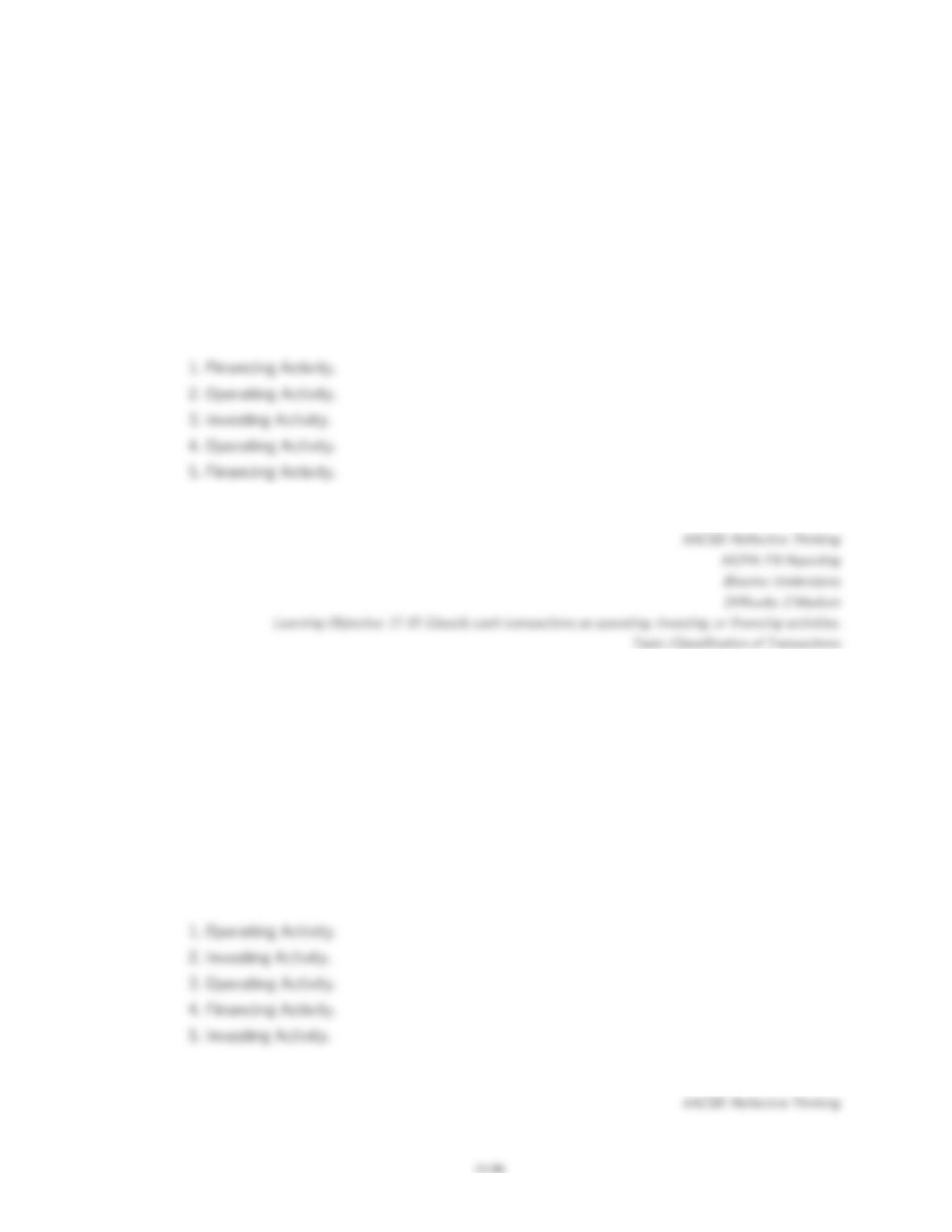
Classify each of the following items as an operating, investing, or financing activity.
1. Dividends paid.
2. Sale of goods or services for cash.
3. Sale of equipment.
4. Purchase of inventory.
5. Repayment of notes payable.
154.
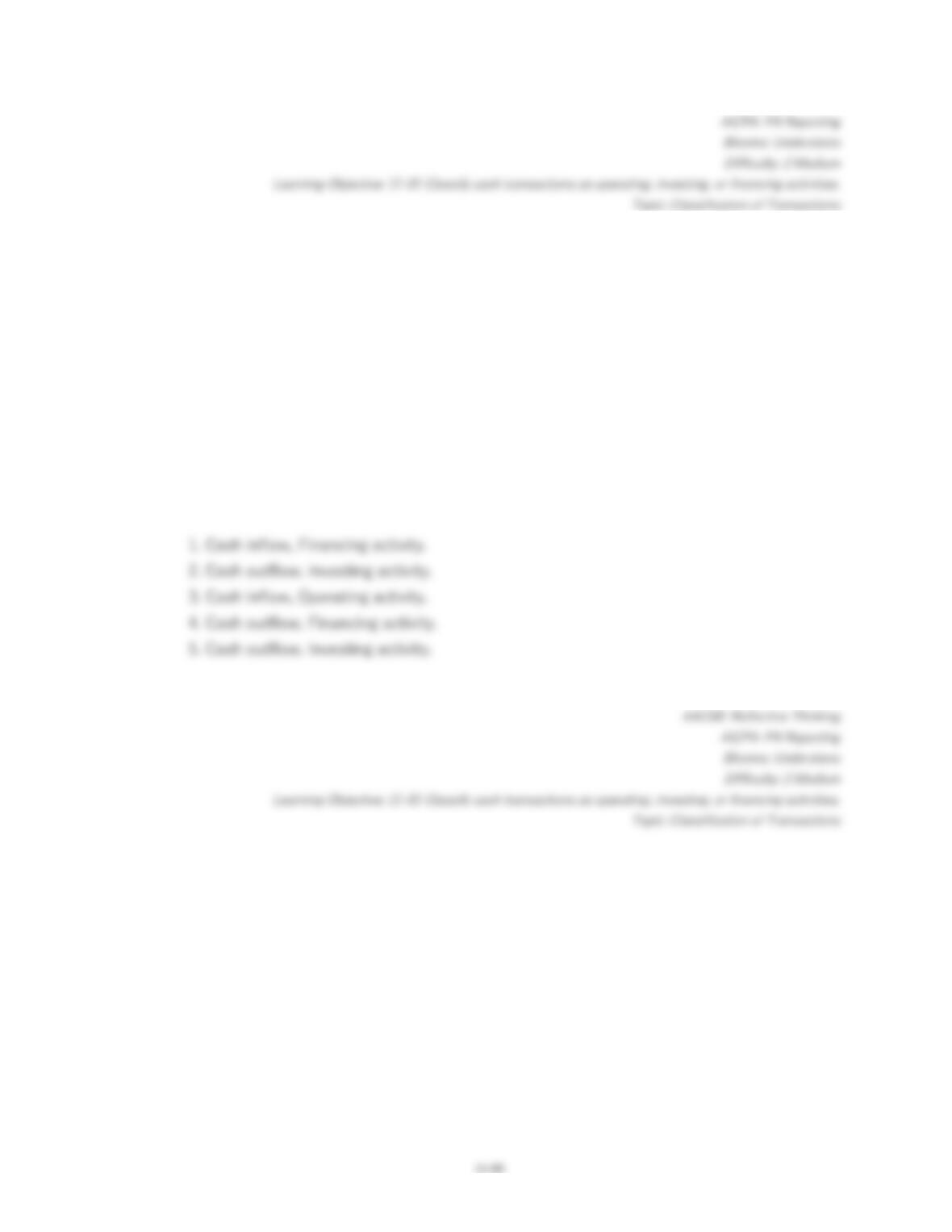
Classify each of the following items as an operating, investing, or financing activity.
1. Payment of income taxes.
2. Sale of investments.
3. Receipt of interest.
4. Issuance of common stock.
5. Purchase of intangibles.
155.
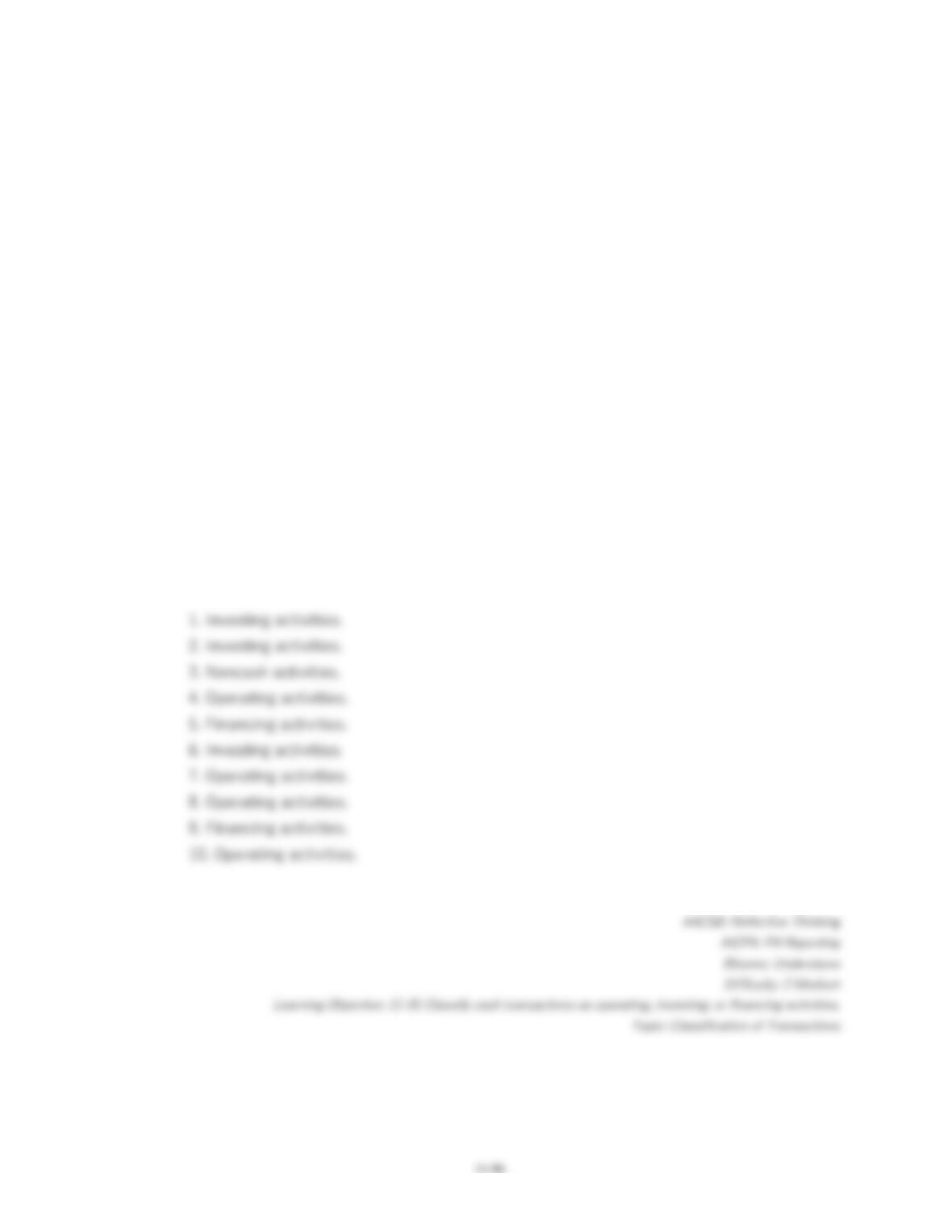
The following selected transactions occur during the first year of operations. Determine
how each should be reported in the statement of cash flows. State whether it is a cash
inflow or a cash outflow and whether it is an operating, investing, or financing activity.
1. Issued a million shares of common stock at $20 per share.
2. Purchased land and a building for $3 million.
3. Received $200,000 from a cash sale of merchandise to customers.
4. Paid a dividend of $1 per share to common stockholders.
5. Loaned $50,000 to an employee and accepted a note receivable.
156.
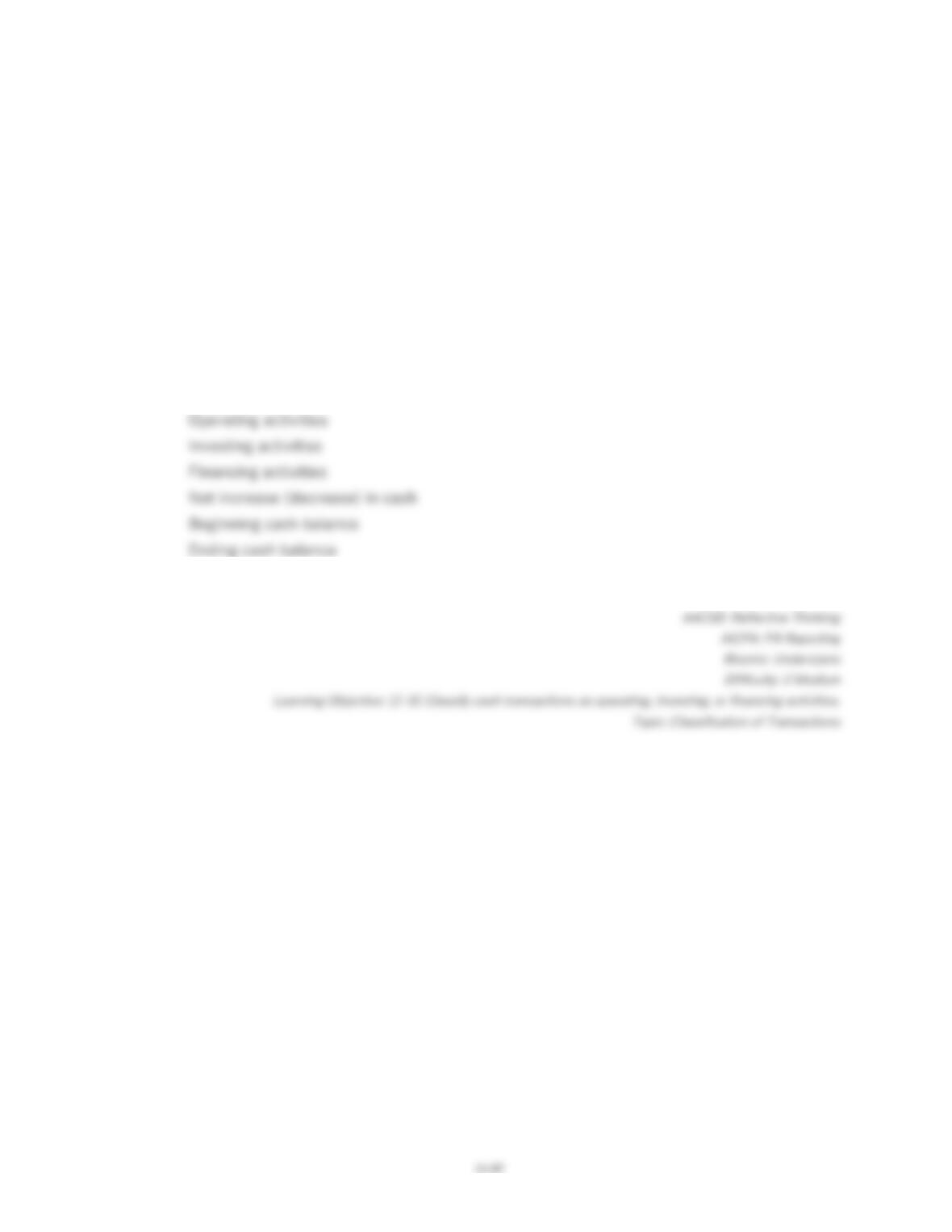
Analysis of an income statement, balance sheets, and additional information from the
accounting records of Gaming Strategies reveal the following items:
1. Collection of notes receivable.
2. Purchase of equipment.
3. Exchange of long-term assets.
4. Decrease in accounts payable.
5. Payment of dividends.
6. Purchase of a patent.
7. Depreciation expense.
8. Decrease in accounts receivable.
9. Issuance of note payable.
10. Increase in inventory.
Indicate in which section of the statement of cash flows each of these items would be
reported: operating activities (indirect method), investing activities, financing activities, or
noncash activities.
157.
Place the following items in the correct order as they would appear in the statement of
cash flows:
1. Beginning cash balance
2. Ending cash balance
3. Investing activities
4. Financing activities
5. Net increase (decrease) in cash
6. Operating activities
158.
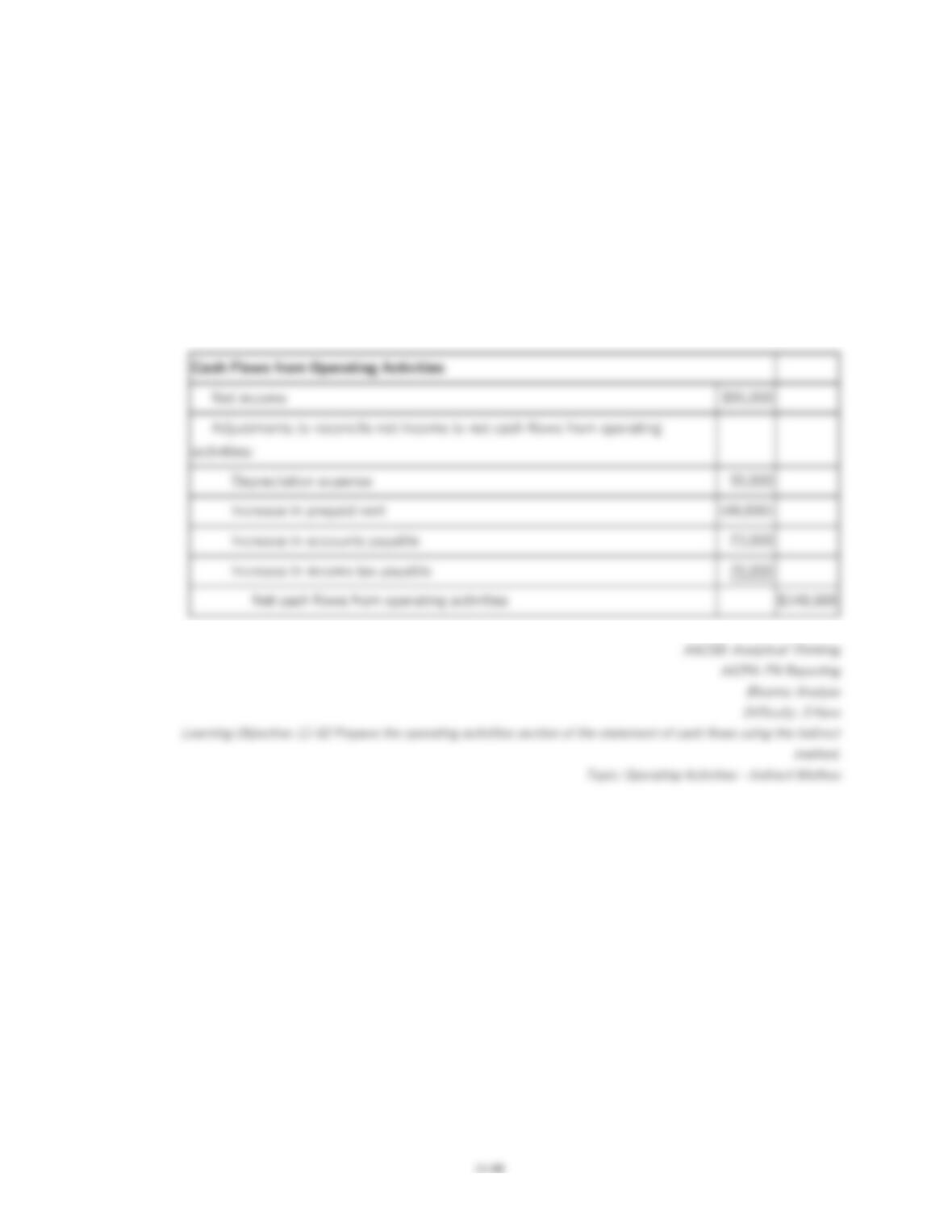
Electronic Wonders reports net income of $95,000. The accounting records reveal
Depreciation Expense of $50,000 as well as increases in Prepaid Rent, Accounts Payable,
and Income Tax Payable of $40,000, $23,000, and $20,000, respectively. Prepare the
operating activities section of Electronic Wonders’ statement of cash flows using the
indirect method.
159.
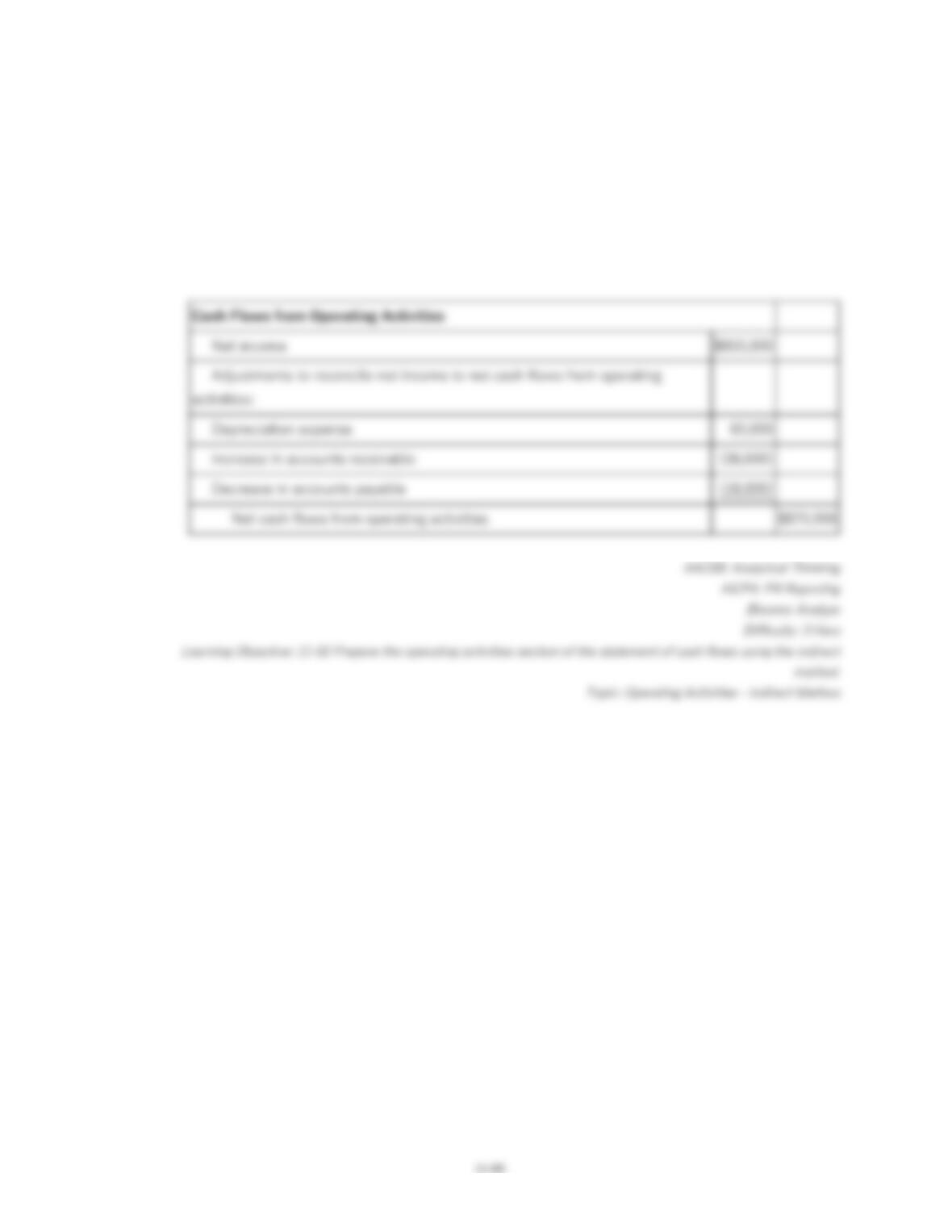
Micro Manufacturing reports net income of $850,000. Depreciation Expense is $60,000,
Accounts Receivable increases $30,000 and Accounts Payable decreases $10,000.
Calculate net cash flows from operating activities using the indirect method.
11-100
160.
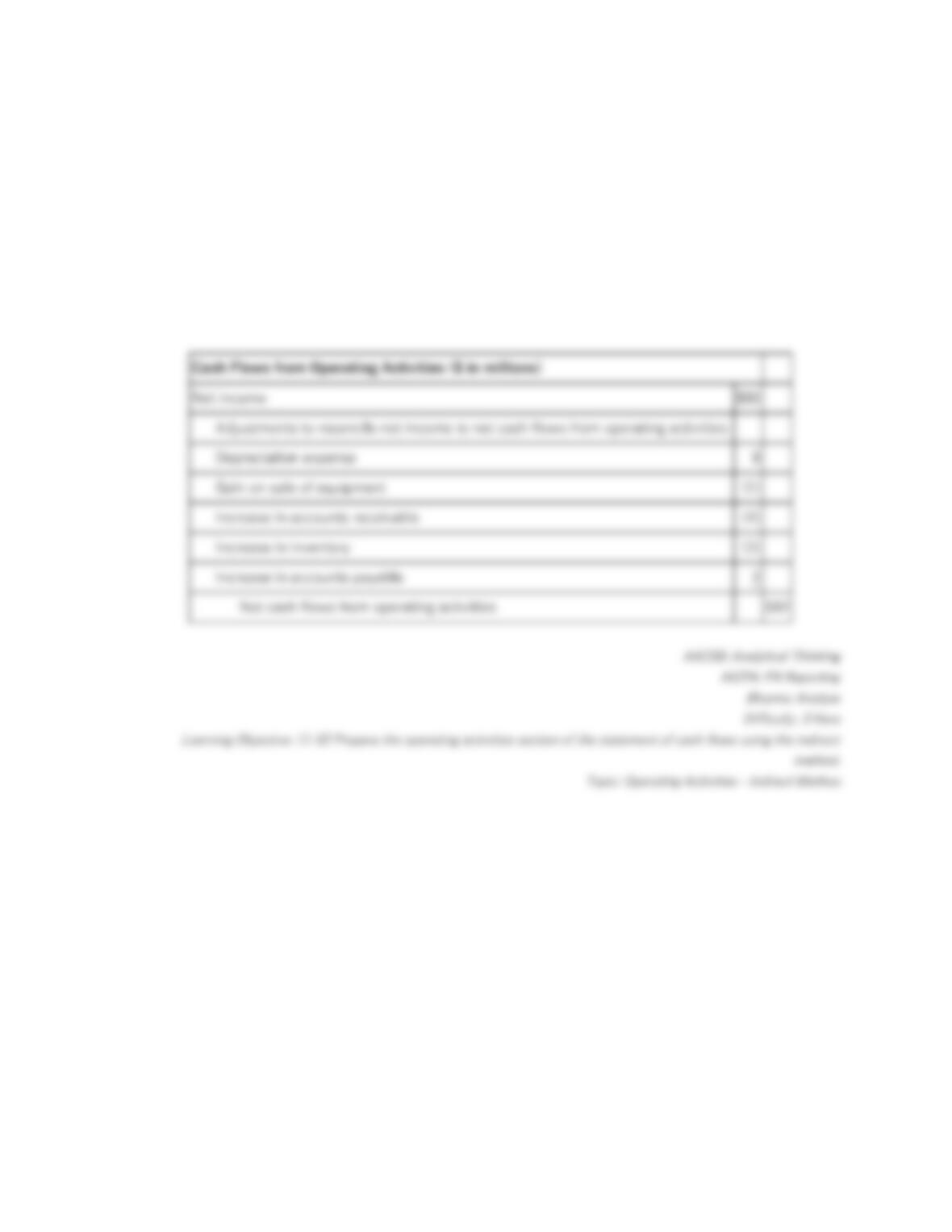
Fidelity Systems reports net income of $80 million. Included in that number is depreciation
expense of $8 million, and a gain on the sale of equipment of $1 million. Records reveal
increases in Accounts Receivable, Inventory, and Accounts Payable of $4 million, $3
million, and $2 million, respectively. Calculate Fidelity’s net cash flows from operating
activities using the indirect method.