Cost Accounting: A Managerial Emphasis, 6e
Chapter 11 – Decision Making and Relevant Information
47) Are relevant revenues and relevant costs the only information needed by managers to select among
alternatives? Explain using examples.
48) Explain why sunk costs are not considered relevant when choosing among alternatives.
11.3 Explain why opportunity cost is relevant and book value is irrelevant in decision
making.
1) The gain or loss on the disposal of a machine is a relevant factor when considering replacing the
machine.
2) Opportunity cost is the contribution to income that is recognized through the use of limited resources
available in the best alternative.
3) Book value of equipment is irrelevant in equipment-replacement decisions.
4) An item’s book value is the historical cost plus accumulated amortization.
Cost Accounting: A Managerial Emphasis, 6e
Chapter 11 – Decision Making and Relevant Information
5) Quantitative factors are relevant, and qualitative factors are irrelevant, in making outsourcing
decisions.
6) When replacing an old machine with a new machine, the purchase price of the old machine is a
relevant cost.
7) If the $17,000 spent to purchase inventory could be invested and earn interest of $1,000, then the
opportunity cost of holding inventory is $17,000.
8) When opportunity costs exist, they are always relevant.
9) A decision as to whether to insource or outsource is a(n)
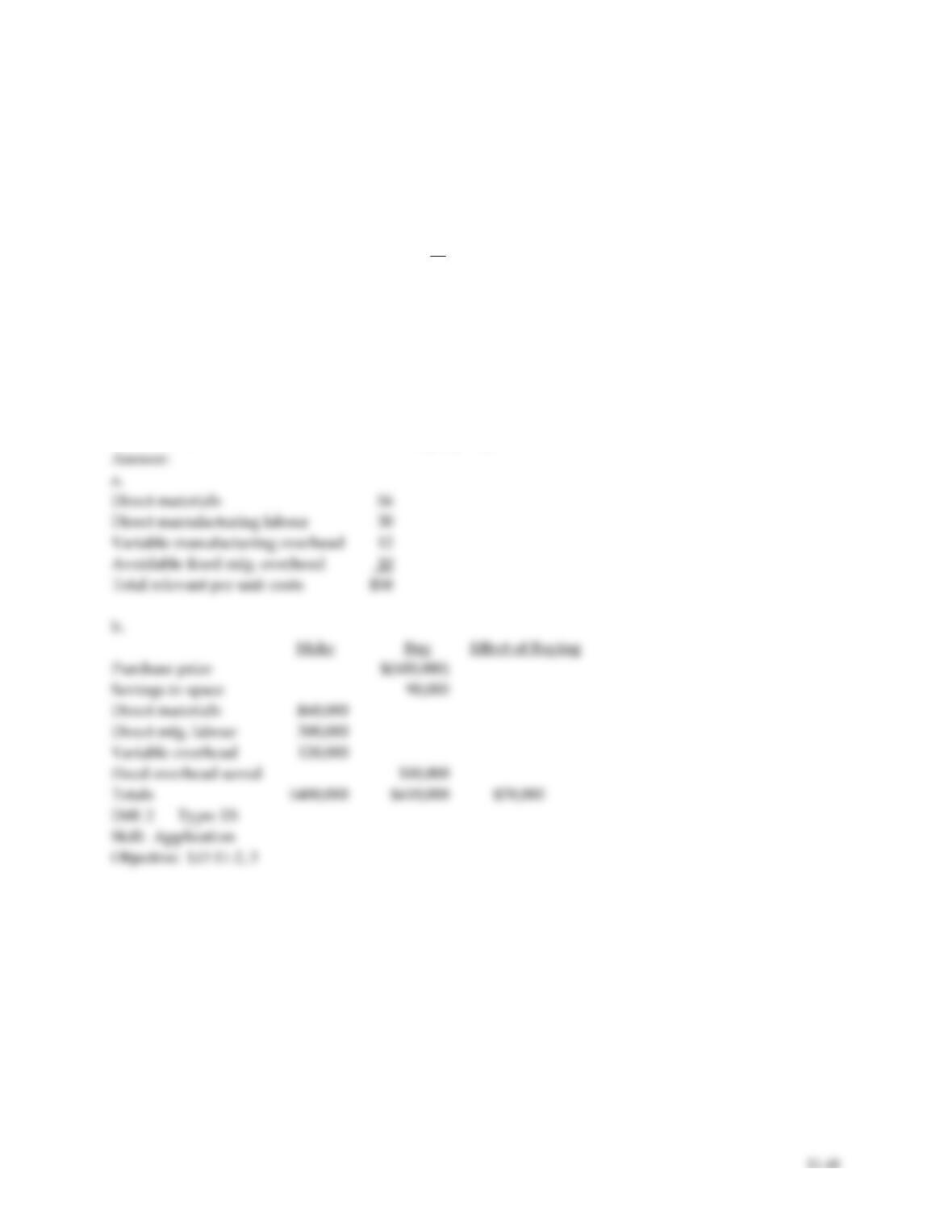
A) idle capacity decision.
B) production scheduling analysis.
C) product mix decision.
D) short-run focus decision.
E) make/buy decision.
Cost Accounting: A Managerial Emphasis, 6e
Chapter 11 – Decision Making and Relevant Information
10) Which of the following would not be considered in a make or buy decision?
A) potential usage of manufacturing capacity
B) variable costs of production
C) potential rental income from space occupied by production area
D) unchanged fixed costs
E) qualitative factors
11) Which of the following is true concerning opportunity costs?
A) They are incorporated into formal financial accounting reports.
B) They entail cash receipts.
C) They entail cash disbursements.
D) They require accounting journal entries.
E) They are relevant for the make/buy decision.
12) If Harry Inc. doesn’t use one of its limited resources in the best possible way, the lost contribution to
income could be called
A) an alternative cost.
B) a total alternative cost.
C) an opportunity cost.
D) a resource cost.
E) a constraining factor.
Cost Accounting: A Managerial Emphasis, 6e
Chapter 11 – Decision Making and Relevant Information
13) A company has two manufacturing facilities: one in Alberta that produces a bulk chemical that it sells
to many different retailers, and one facility in Ontario that is dedicated to producing a specialty chemical
for one client only. The annual profit from the single client is $150,000; and, the profit from the other
facility’s sales is $1,500,000, after allocating combined fixed costs based on units produced. Another
company has offered to lease the Ontario facilities for $250,000.
Which of the following is true?
A) The $250,000 is an opportunity cost of continuing to use the Ontario plant.
B) The company incurred a $250,000 opportunity cost for the past years, but this was not recorded on its
books.
C) The company needs to determine the contribution margin for each product before making any
decision.
D) Incremental revenues exceed total costs if the plant is rented.
E) Incremental costs exceed incremental revenues if the plant is rented.
Answer the following question(s) using the information below.
Central Medical Supply Inc., a manufacturer of medical testing equipment, has $240,000 worth of an
obsolete line of testing equipment. The obsolete equipment can be adapted to fit another line of testing
equipment at a cost of $64,000; the market value would then be $136,000. However, Tripac offered to
purchase the obsolete equipment as is for $88,000.
14) Central Medical Supply Inc., a manufacturer of medical testing equipment, has $240,000 worth of an
obsolete line of testing equipment. The obsolete equipment can be adapted to fit another line of testing
equipment at a cost of $64,000; the market value would then be $136,000. However, Tripac offered to
purchase the obsolete equipment as is for $88,000.
What are the relevant figures above for management in their decision?
A) ($240,000 + $64,000); ($88,000 – 0)
B) ($240,000 + $64,000); ($88,000 – 240,000)
C) ($240,000 + $64,000); ($88,000 + 240,000)
D) ($136,000 – $64,000); ($88,000 – 0)
E) ($136,000 – $64,000); ($88,000 – 240,000)
Cost Accounting: A Managerial Emphasis, 6e
Chapter 11 – Decision Making and Relevant Information
15) What is the opportunity cost associated with the adaptation of the equipment to another line of
testing equipment assuming Central accepts Tripac’s offer?
A) $72,000
B) $88,000
C) $63,000
D) $240,000
E) none of the above
16) Econ Services has requested your services in determining the book values of the following assets,
respectively.
Historical
Costs
Accumulated
Amortization
Auto
$20,000
$15,000
Machinery
150,000
95,000
General repairs and maintenance for the automobile amounted to $4,000. Machinery maintenance
included $2,000 for general upkeep.
What are the book values for Auto and Machinery, respectively?
A) $5,000; $55,000
B) $9,000; $57,000
C) $20,000; $150,000
D) $35,000; $245,000
E) $1,000; $53,000
17) Which of the following factors would be considered irrelevant when evaluating equipment
replacement decisions?
A) the book value of the old machine
B) manufacturing costs
C) overhead costs
D) product production costs
E) useful life of new equipment
Cost Accounting: A Managerial Emphasis, 6e
Chapter 11 – Decision Making and Relevant Information
18) Ignoring tax consequences, how should the gain or loss on disposal of an old machine be treated in an
equipment replacement decision?
A) used to defray installation costs of the new machine
B) deducted from the accumulated amortization
C) deducted from the cost of the new machine
D) added to the accumulated amortization (or deducted from the cost) of the old machine
E) It is irrelevant.
19) Past costs that are unavoidable and unchangeable are known as
A) fixed overhead costs.
B) operating costs.
C) product production costs.
D) sunk costs.
E) constraining costs.
20) Electrical Engineering Equipment Ltd. purchased a machine for $100,000; current accumulated
amortization totals $40,000. Management is contemplating the purchase of a new machine for $120,000.
Current disposal of the old machine would cost $65,000.
What is the correct category for each item?
A) Irrelevant: $120,000 of new machine, $40,000 accumulated amortization;
Relevant: $100,000 cost of old machine, $65,000 of disposal of old machine, $5,000 gain on sale
B) Irrelevant: $100,000 cost of old machine, $40,000 accumulated amortization;
Relevant: $120,000 cost of new machine, $5,000 gain on sale, $65,000 disposal of old machine
C) Irrelevant: $120,000 cost of new machine, $65,000 disposal of old machine.
Relevant: $100,000 cost of old machine, $60,000 book value of old machine, $5,000 gain on sale
D) Irrelevant: $100,000 cost of old machine, $60,000 book value of old machine;
Relevant: $120,000 cost of new machine, $65,000 disposal of old machine, $5,000 gain on sale
E) Irrelevant: $100,000 cost of old machine, $40,000 accumulated amortization, $5,000 gain on sale;
Relevant: $120,000 cost of new machine, $65,000 disposal of old machine
Cost Accounting: A Managerial Emphasis, 6e
Chapter 11 – Decision Making and Relevant Information
21) For make-or-buy decisions, relevant costs include
A) direct material costs plus direct labour costs.
B) incremental costs plus opportunity costs.
C) differential costs plus sunk costs.
D) incremental costs plus fixed costs.
E) variable costs plus fixed overhead.
22) The opportunity cost of holding significant inventory includes
A) contribution margin on the extra inventory.
B) additional insurance costs.
C) additional storage costs.
D) the cost of the inventory plus the added insurance and storage costs.
E) the interest forgone on an alternative investment.
23) A local accounting firm has offered to do all the billings and collections of a general practitioner. The
annual fee will be $12,000. The service will replace the part-time bookkeeper who works for $12 an hour,
10 hours a week. Because outsourcing accounting activities will take place away from the office, the
doctor estimates that she will have one additional hour a week to see patients. Normally she sees four
patients an hour with an average visit fee of $100. The office is open 50 weeks a year. Since the computer
service will maintain all records in its office, the doctor will no longer need to rent storage space for the
office files. The storage space rents for $150 a month.
Required:
Determine whether or not the doctor should accept the offer to use the computer service.
Cost Accounting: A Managerial Emphasis, 6e
Chapter 11 – Decision Making and Relevant Information
24) Car Parts Company manufactures a part for use in its production of automobiles. The costs per unit
when 10,000 items are produced are:
Direct materials $6
Direct manufacturing labour 30
Variable manufacturing overhead 12
Fixed manufacturing overhead 16
Total $64
Auto Company has offered to sell to Car Parts Company 10,000 units of the part for $60. The plant
facilities could be used to manufacture another part at a savings of $90,000 if Car Parts accepts the offer.
In addition, $10 per unit of fixed manufacturing overhead on the original part would be eliminated.
Required:
a. What is the relevant per unit cost for the original part?
b. Which alternative is best for Car Parts Company? By how much?
Cost Accounting: A Managerial Emphasis, 6e
Chapter 11 – Decision Making and Relevant Information
25) A client in another province needs immediate help in solving a personnel training problem in the
shipping department. Classify each activity on the basis of its relationship with this consulting
engagement. Items may have multiple classifications. Use the following headings:
Relevant Costs = R Irrelevant Costs = I
Opportunity = OP Sunk =S
a. Four employees will have to spend three nights in Quebec City, the hotel bill has been negotiated in
advance for $1,800.
b. All staff members receive $1,000 per diem for travel.
c. Current year’s amortization of the firm’s computer system is $15,000.
d. Round-trip transportation for each staff member is $500.
e. The firm is also sending the same four staff members to Toronto, for a two week engagement upon
their return from this trip. The firm’s cost of this trip will be $10,000.
f. The firm has a $2,000 maintenance contract on its telecommunication system for the current year.
g. If the firm accepts this job, it will have to decline a job in Vancouver that has the potential of
providing a net cash inflow of $5,000 after all expenses.
h. The firm’s variable overhead is $50 per client hour.
i. The firm will pay $60 next month for this year’s membership in the Canadian Consultants Society for
each professional staff member.
j. Last year the firm paid $4,000 to make improvements in its 5-year leasehold on its offices.
26) Why is the book value of old equipment irrelevant to the equipment replacement decision?
27) Under what conditions might a manufacturing firm sell a product for less than its long-term price?
Why?
Cost Accounting: A Managerial Emphasis, 6e
Chapter 11 – Decision Making and Relevant Information
28) For short-term pricing decisions, what costs are relevant when there is available surplus capacity?
When there is no available surplus capacity?
11.4 Identify key concepts and apply them to product and customer mix decisions.
1) When managers are faced with constraints the product line with the higher contribution margin per
unit is always the best choice to make.
2) A customer can be considered to be a cost object, in the decision to add or drop a particular customer.
3) Linear programming is a tool that maximizes total contribution margin of a mix of products with
multiple constraints.
4) The greatest possible contribution margin per unit of the constraining factor will ensure which of the
following?
A) minimum total variable costs
B) zero imputed costs
C) minimum fixed cost per unit of production
D) minimum variable costs per unit of production
E) maximum operating income
Cost Accounting: A Managerial Emphasis, 6e
Chapter 11 – Decision Making and Relevant Information
5) Decisions on product mix involving multiple products, should be based on which of the following?
A) the variable cost differential between the products
B) the differential selling prices between the products
C) fixed cost savings
D) the amount of idle capacity
E) individual product contribution margin totals
6) Last year, a sailboard company produced two types of boards: a regular board for multi-purpose
sailing; and, a special trick board used by experts for competitions. The regular board sells for $750 and
the competition board sells for $1,350. The variable production costs are $250 and $400 respectively, and
the company has $400,000 in fixed costs overall. Marketing staff have determined that the company
should specialize in the competition boards only, and sell the regular boards, if at all, under a different
brand name. Last year the company made a profit, selling twice as many regular boards as competition
boards, resulting in a fixed cost allocation of $5.00 per board. It takes 6 hours of direct labour to make a
regular board and 12 hours to make a competition board. The company worked at full capacity of 19,500
direct labour hours last year.
Based on the above information only, which product or mix of products, should the company choose?
Assume that any and all production can be sold.
A) the regular board only, as it takes fewer direct labour hours to build
B) both, as the company made a profit last year using this strategy
C) the competition board only, as it has a higher contribution margin
D) Any combination is equivalent, based on the contribution margin times the number of boards that
could be sold.
E) the regular board only, as it has the highest contribution margin per direct labour hour
7) Companies periodically confront decisions about discontinuing or adding branches or business
segments. In order to determine the best course of action, a ________ should be performed in order to
make the optimal decision.
A) relevant feasibility study
B) relevant risk assessment
C) relevant-revenue and relevant-cost analysis
D) relevant-risks and relevant-loss analysis
E) relevant capital and relevant cash flow analysis
Cost Accounting: A Managerial Emphasis, 6e
Chapter 11 – Decision Making and Relevant Information
8) Which of the following is not one of the steps involved in linear programming?
A) determining the objective
B) determining the technical coefficients
C) computing the optimal solution
D) determining the relevant and irrelevant costs
E) specifying the constraints
9) In linear programming, the goals of management are expressed in
A) an objective function.
B) constraints.
C) operating policies.
D) business functions.
E) a mathematical inequality or equality.
10) In linear programming a mathematical inequality or equality that must be appeased is known as
A) an objective function.
B) a constraint.
C) an operating policy.
D) a business function.
E) the optimal solution.
Cost Accounting: A Managerial Emphasis, 6e
Chapter 11 – Decision Making and Relevant Information
11–53
11) Computer Products produces two keyboards, Regular and Special. Regular keyboards have a unit
contribution margin of $128, and Special keyboards have a unit contribution margin of $720. The demand
for Regulars exceeds Computer Products’ production capacity, which is limited by available machine–
hours and direct manufacturing labour hours. The maximum demand for Special keyboards is 80 per
month. Management desires a product mix that will maximize the contribution toward fixed costs and
profits. Direct manufacturing labour is limited to 1,600 hours a month and machine hours are limited to
1,200 a month. The Regular keyboards require 20 hours of labour and 8 machine hours. Special keyboards
require 34 labour hours and 20 machine hours.
Select the appropriate linear programming objective and constraint functions designed to maximize
Computer Products total contribution margin. Let R represent Regular keyboards and S represent Special
keyboards.
A)
Maximize:
$720S + $128R
Constraints:
Labour hours: 20R + 8S ≤ 1,600
Machine hours:
34R + 20S ≤ 1,200
Special:
S ≤ 80
S ≥ 0
Regular:
R ≥ 0
B)
Maximize:
$128R + $720S
Constraints:
Labour hours: 20R + 34S ≤ 1,600
Machine hours:
8R + 20S ≤ 1,200
Special:
S ≥ 80
S ≤ 0
Regular:
R ≤ 0
C)
Maximize:
$128R + $720S
Constraints:
Labour hours: 20R + 34S ≥ 1,600
Machine hours:
8R + 20S ≥ 1,200
Special:
S ≤ 80
S ≥ 0
Regular:
R ≥ 0
D)
Maximize:
$128R + $720S
Constraints:
Labour hours: 20R + 34S ≤ 1,600
Machine hours:
8R + 20S ≤ 1,200
Special:
S ≤ 80
S ≥ 0
Regular:
R ≥ 0