Chapter 11: Strategic Cost Management
137. Prior to installing a JIT system, Clarendon Company used machine hours to assign maintenance costs to its
three products of 6–inch, 8-inch, and 11-inch insulation. The maintenance costs totaled $400,000 per year. The
machine hours used by each product and the quantity produced of each product are as follows:
Machine Hours
Quantity Produced
6-inch
12,000
31,250 rolls
8-inch
20,000
25,000 rolls
11-inch
18,000
12,000 rolls
After installing JIT, three manufacturing cells were created and the cell workers were trained to perform
maintenance. Maintenance costs for the three cells still totaled $400,000; however, these costs are now traceable to
each cell.
Cell, 6-inch $100,000
Cell, 8-inch 120,000
Cell, 11-inch 180,000
After installing JIT, the maintenance cost per roll of 11-inch insulation would be
a. $12.50.
b. $12.86.
c. $15.00.
d. $5.86.
138. The following transactions take place after the implementation of JIT:
1. Materials were purchased on account for $75,000.
2. Materials were placed into production.
3. Actual direct labor costs were $16,000.
4. Actual overhead costs were $30,000.
5. Conversion costs applied were $52,000.
6. All work was completed for the month.
7. All completed work was sold.
8. The variance is recognized.
What will be the entry to record material placed into production using the traditional approach?
a. Materials and In Process Inventory 75,000
Work-in-Process Inventory 75,000
b. Materials Inventory 75,000
Accounts Payable 75,000
c. Work-n-Process Inventory 75,000
Materials and In Process Inventory 75,000
d. Work-in-Process Inventory 75,000
Materials Inventory 75,000

Chapter 11: Strategic Cost Management
139. The following transactions take place after the implementation of JIT:
1. Materials were purchased on account for $75,000.
2. Materials were placed into production.
3. Actual direct labor costs were $16,000.
4. Actual overhead costs were $30,000.
5. Conversion costs applied were $52,000.
6. All work was completed for the month.
7. All completed work was sold.
8. The variance is recognized.
What will be the entry to record materials placed into production using the backflush approach?
a. Materials and in Process Inventory 75,000
Work-in-Process Inventory 75,000
b. Materials Inventory 75,000
Accounts Payable 75,000
c. Work-in-Process Inventory 75,000
Materials and in Process Inventory 75,000
d. No entry is required
140. The following transactions take place after the implementation of JIT:
1. Materials were purchased on account for $75,000.
2. Materials were placed into production.
3. Actual direct labor costs were $16,000.
4. Actual overhead costs were $30,000.
5. Conversion costs applied were $52,000.
6. All work was completed for the month.
7. All completed work was sold.
8. The variance is recognized.
Which of the following would NOT be an entry under the backflush system, assuming the second trigger point is
the completion of goods?
a. Materials and In Process Inventory 75,000
Accounts Payable 75,000
b. Work-in-Process Inventory 75,000
Materials Inventory 75,000
c. Conversion Cost Control 46,000
Wages Payable 16,000
Accounts Payable 30,000
d. Cost of Goods Sold 102,000
Finished Goods Inventory 102,000
Chapter 11: Strategic Cost Management
141. Laramie Company has a traditional, unit-based cost system. The Kansas City plant of Laramie produces eight
different electronic products. Each year, 100,000 units of all products are produced. The demand for each product
is about the same; thus, the average output for each product is 12,500 units. Although the products differ in
complexity, each product uses about the same labor time and materials. The plant has used direct labor hours for
years to assign overhead to products. The cost accounting department developed the following cost equation to
help design engineers understand the assumed cost relationships. (The equation describes the relationship between
total manufacturing costs and direct labor hours. The equation is supported by a coefficient of determination of 63
percent):
Y = $5,000,000 + $60X where X is the number of direct labor hours
The variable rate of $60 is broken down as follows:
Direct labor $19
Variable overhead 12
Direct materials 29
Because of competitive pressures, product engineering was asked to redesign products to reduce the total cost of
manufacturing. Using the above cost relationships, product engineering adopted the strategy of redesigning to
reduce direct labor content. As each design was completed, an engineering change order was cut, triggering a
series of events such as design approval, vendor selection, bill of materials update, redrawing of schematic, test
runs, changes in setup procedures, development of new inspection procedures, and so on.
After one year of design change, the normal volume of direct labor was reduced from 125,000 hours to 100,000
hours, with the 100,000 units being built. Although each product differs in its labor content, the redesign efforts
reduced the labor content for all products. On average, labor content per unit of product dropped from 1.25
hours per unit to 1 hour per unit. Fixed overhead, however, increased from $5,000,000 to $6,000,000.
Required:
a. Using normal volume, compute the manufacturing cost per labor hour before the
design changes. What is the cost per unit of an “average” product?
b. Using the normal volume after the one year of design changes, compute the manufacturing
cost per hour. What is the cost per unit of an “average” product?
Chapter 11: Strategic Cost Management
142. Alana Rodriguez has decided to purchase a Multi-Function Printer. She has narrowed the choice to two: Brand A
and Brand B. Both brands have the same features and transmitting speed and use the same type of paper. Both
come from companies with good reputations. The selling price for each is identical. After some review, Alana
discovers that the cost of operating and maintaining Brand A over a three-year period is estimated to be $300. For
Brand B, the operating and maintenance cost is $150. The sales agent for Brand B emphasizes the lower operating
and maintenance cost. She claims that it is lower than any other Printer. In addition, she provides Alana with a
copy of an article appearing in a PC magazine that rates service performance of various Printers. Brand B is rated
number one.
Required:
a. Which brand should Alana buy? Why?
b. What is the total product purchased by Alana?
c. What does it mean to obtain a competitive advantage? What role does the cost management
system play in helping to achieve this goal?
143. Ethereal Company sells a product used in many manufacturing processes. The sales activity involves four activity
areas:
Activity Area Cost Driver and Rate
Order taking $100 per purchase order
Sales visits $50 per visit
Delivery vehicles $1 per delivery mile
Special runs $300 per run
The following customer information is given:
A
B
D
Units sold
100,000
80,000
60,000
List price
$50
$50
$50
Actual sales price
$45
$48
$50
Number of purchase orders
30
20
10
Number of sales visits
6
5
3
Number of deliveries
10
8
6
Miles traveled per delivery
40
5
20
Number of special runs
1
0
2
Required:
What is the profitability of customer B?
Chapter 11: Strategic Cost Management
144. Clinton Corp. is a manufacturer of equipment used in motorcycles production. It currently produces a product
with 15 parts but through redesign has reduced the number of parts to 5. Then current activity capacity and
demand for the 15 part configuration and expected activity demand for the 5 part configuration are provided
below:
Activities
Activity Driver
Activity Capacity
Current
Activity Demand
Expected Activity
Demand
Materials usage
number of parts
300,000
300,000
100,000
Assembly
direct labor hours
10,00
10,00
4,000
Purchasing parts
number of orders
10,00
8,000
6,000
Materials usage has a rate of $4 per part and no fixed costs. Assembly has a rate of $15 per labor hour with no fixed
component. Purchasing requires clerks that can process 5000 purchase orders. Each clerk earns $35,000 per year.
There is also a $2 per order processing cost. The product sells for $45 and 50,000 units will be produced.
Required:
1. What is the total cost savings from the new design?
2. What is the new sales price if the cost savings are passed on to the customer?
145. Eva Rodriguez, chairwoman of Wiccan Industries, had just completed examining a projected profit summary for
two components that would be used in LCD Screens. Both units were still in a very preliminary planning stage,
and a decision had to be made regarding their continued viability. The components would be developed, produced,
and sold at the same time. Each product’s life cycle is 40 months. The projected profit performance of the two
items promised a return on sales of 10 percent—less than the 14 percent rate set by company standards. From the
statements below, it appeared to Eva that the culprit was Component 402 because its gross profit percentage was
much lower than that of Component 401.
401
402
Total
Sales
$500,000
$500,000
$1,000,000
Cost of goods sold
250,000
350,000
600,000
Gross profit
$250,000
$150,000
$ 400,000
Research and development
(230,000)
Selling expenses
(70,000)
Profit before taxes
$ 100,000
Required:
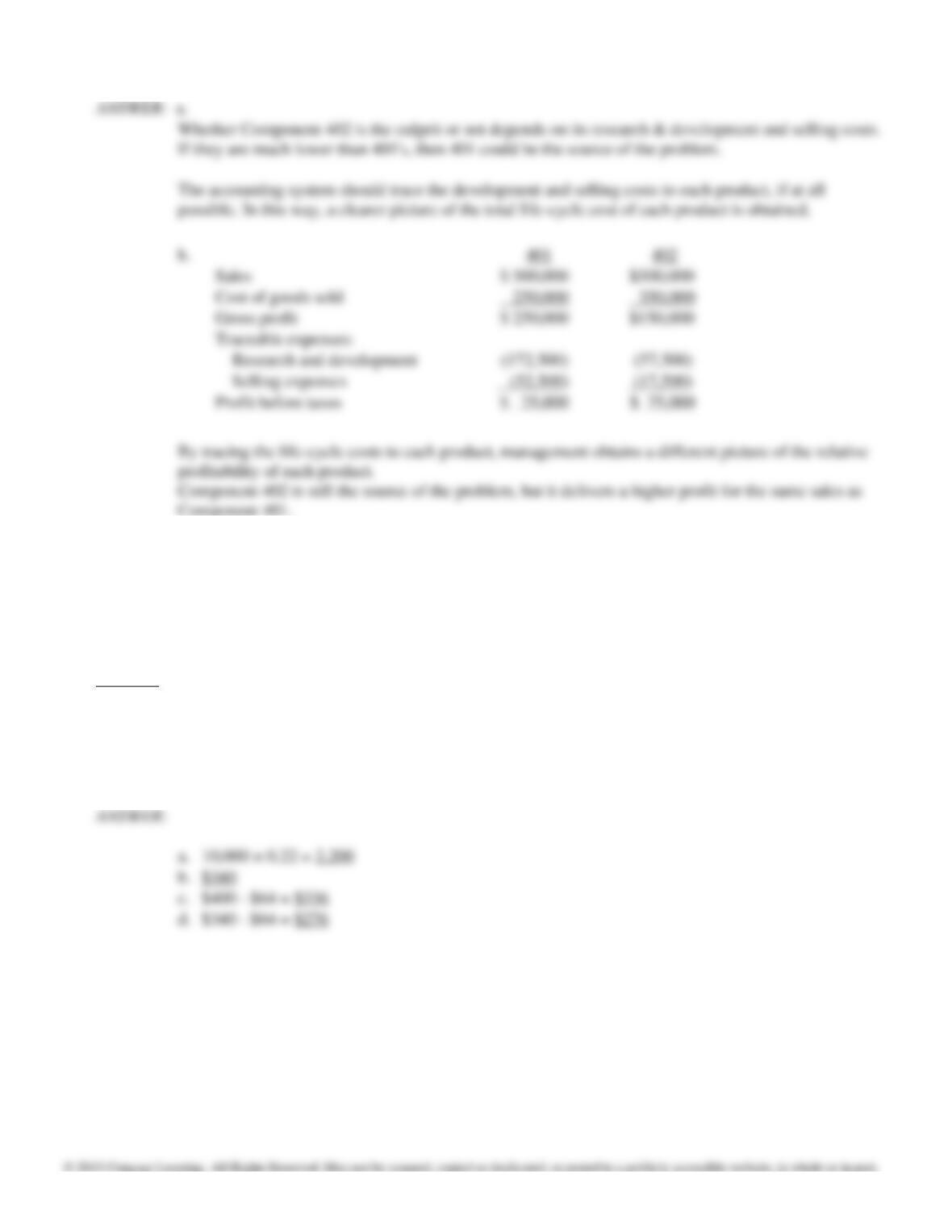
a. Explain why Eva may be wrong in her assessment of the relative performances of the two
products. What change in the company’s life-cycle budgeting approach would you
suggest?
b. Suppose that 75 percent of the research and development and 75 percent of the selling
expenses are traceable to Component 401. Prepare budgeted life–cycle income statements for
each product and calculate the return on sales. What does this tell you about the importance of
accurate life-cycle budgeting?
Chapter 11: Strategic Cost Management
146. Loganberry Corporation sells a product for $400 per unit. Its market share is 22 percent of the units sold. The
marketing manager feels that the market share can be increased to 28 percent of the units sold with a reduction in
price to $340. The product is currently earning a profit of $64 per unit. The president of Loganberry Corporation
feels that his company needs to maintain the same profit level per unit. The market share consists of $4,000,000
(10,000 units).
Required:
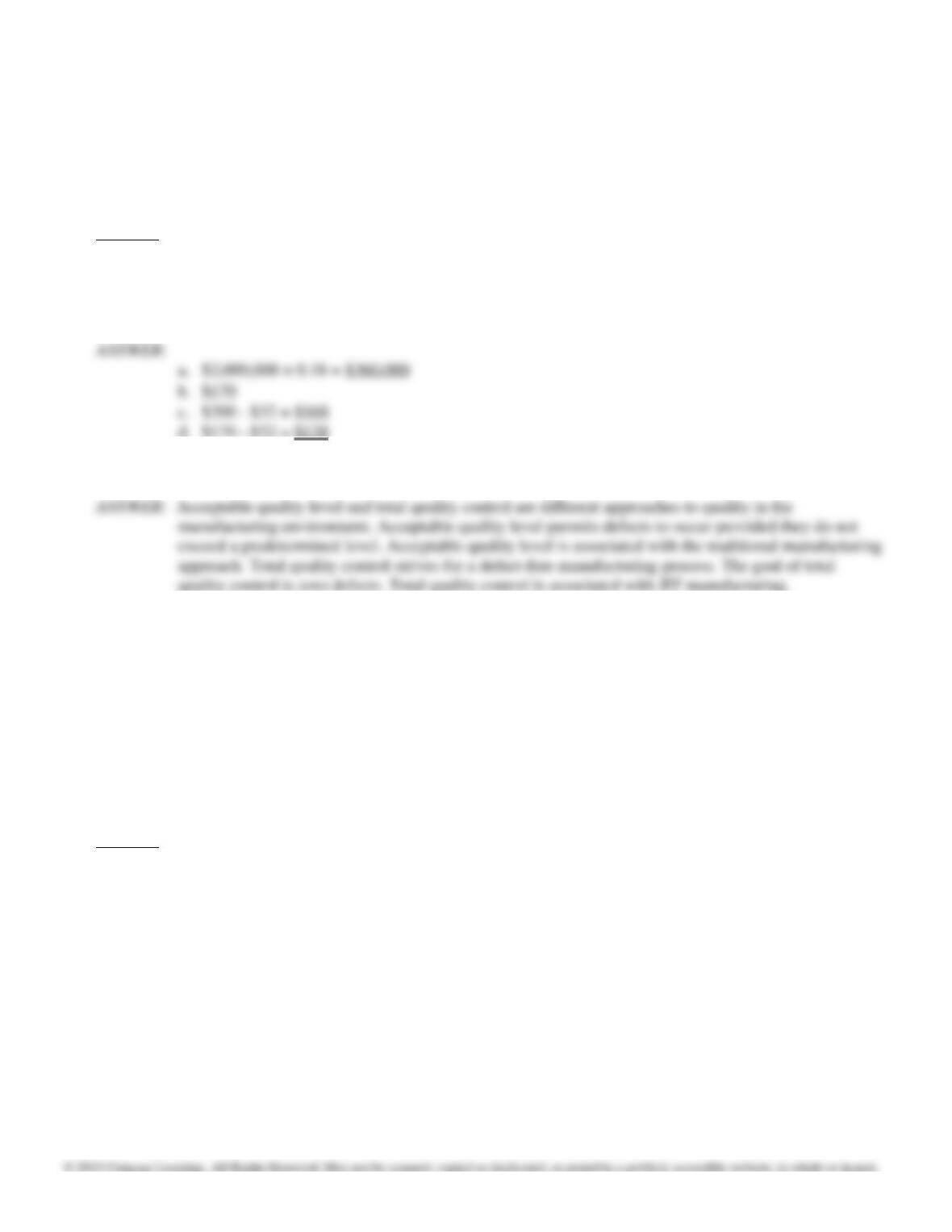
a. How many units does Loganberry Corporation currently sell of the product?
b. What is the target price per unit?
c. What is the original cost per unit?
d. What is the target cost per unit?
Chapter 11: Strategic Cost Management
147. Harmonious Manufacturing Company sells a product for $200 per unit. Its market share is 18 percent of the units
sold. The marketing manager feels that the market share can be increased to 25 percent of the units sold with a
reduction in price to $170. The product is currently earning a profit of $32 per unit. The president of Harmonious
Manufacturing Company feels that his company needs to maintain the same profit level per unit. The market
share consists of $2,000,000 (10,000 units).
Required:
a. Of the market share of $2,000,000, how much is attributable to Harmonious Manufacturing?
b. What is the target price per unit?
c. What is the original cost per unit?
d. What is the target cost per unit?
148. Explain the difference between acceptable quality level and total quality control.
149. MaximumTec has implemented JIT had the following transactions:
1. Materials were purchased on account for $70,000.
2. Materials were placed into production.
3. Actual direct labor costs were $14,000.
4. Actual overhead costs were $50,000.
5. Conversion costs applied were $54,000.
6. All work was completed for the month.
7. All completed work was sold.
8. The variance is recognized.
Required:
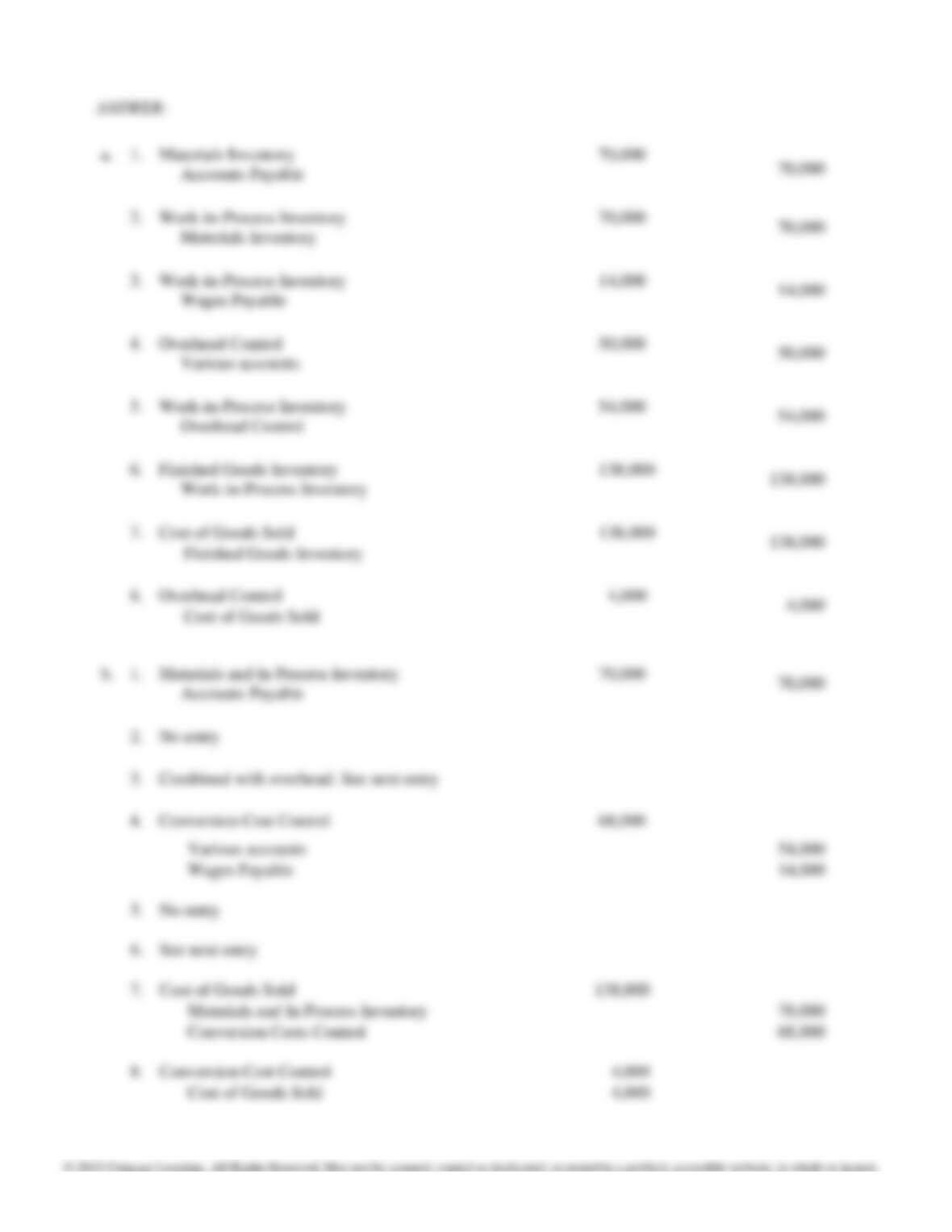
a. Provide the journal entries for the above transactions assuming the traditional approach was used.
b. Provide the journal entries for a backflush system assuming the second trigger point is the point when
goods are sold.
Chapter 11: Strategic Cost Management

Chapter 11: Strategic Cost Management
150. A firm that has implemented JIT had the following transactions:
1. Materials were purchased on account for $50,000.
2. Materials were placed into production.
3. Actual direct labor costs were $10,000.
4. Actual overhead costs were $40,000.
5. Conversion costs applied were $34,000.
6. All work was completed for the month.
7. All completed work was sold.
8. The variance is recognized.
Required:
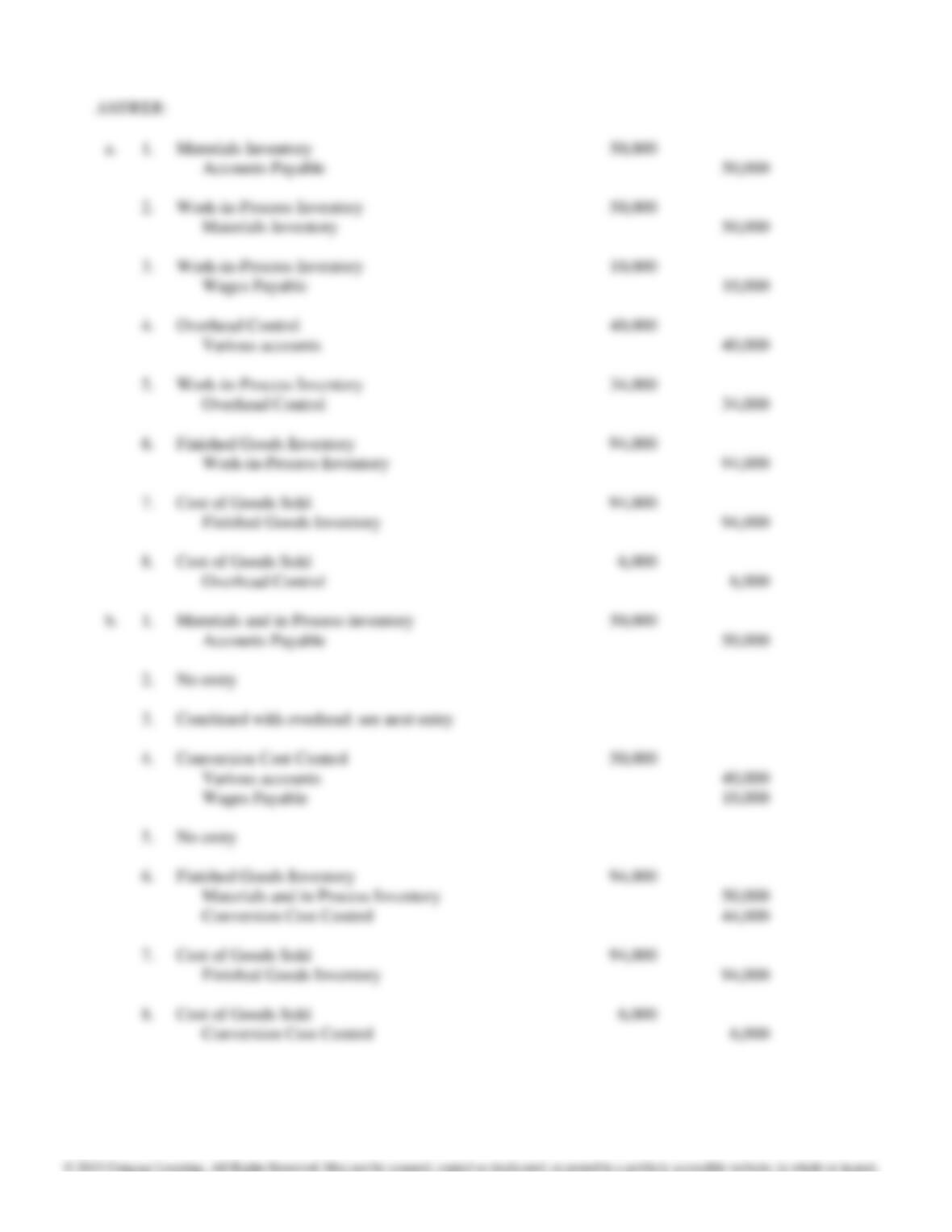
a. Provide the journal entries for the above transactions assuming the traditional approach was used.
b. Provide the journal entries for a backflush system assuming the second trigger point is the point when
goods are completed.
Chapter 11: Strategic Cost Management
Chapter 11: Strategic Cost Management
151. Prior to installing a JIT system, Plasticize Company used machine hours to assign maintenance costs to its
three products of 3-inch, 5-inch, and 7-inch plastic tubing.
The maintenance costs totaled $120,000 per year. The machine hours used by each product and the quantity
produced of each product are as follows:
Machine Hours
Quantity Produced
3-inch
1,000
400 rolls
5-inch
1,500
450 rolls
7-inch
2,500
1,250 rolls
After installing JIT, three manufacturing cells were created and the cell workers were trained to perform
maintenance. Maintenance costs for the three cells still totaled $120,000; however, these costs are now traceable to
each cell.
Cell, 3-inch
$20,000
Cell, 5-inch
32,400
Cell, 7-inch
67,600
Required:
a. Compute the maintenance cost per roll for each type of tubing before JIT is installed.
b. Compute the maintenance cost per roll for each type of tubing after JIT is installed.
c. Explain why the JIT maintenance cost per roll is more accurate than the cost per roll using
the traditional approach.
b.
Chapter 11: Strategic Cost Management
152. Fast & Furious Company recently implemented a JIT system and is considering implementing a backflush costing
system. Following are the transactions for the first quarter of the year.
1. purchased raw materials on account for $525,000
2. all materials were received and placed into production
3. actual labor costs of $75,000 were incurred
4. actual overhead costs of $425,000 were incurred
5. conversion costs of $480,000 were applied to production as conversion costs
are recognized quarterly
6. all work was completed for the month
7. all completed work was sold
8. the difference between applied costs and actual costs was determined
Required:
1. Prepare journal entries using variation 2 of backflush costing.
2. Prepare journal entries using variation 4 of backflush costing.
Chapter 11: Strategic Cost Management
153. Prior to installing a JIT system, PVCTec Company used machine hours to assign maintenance costs to its three
products of 9-inch, 11-inch, and 13-inch plastic pipe.
The maintenance costs totaled $540,000 per year. The machine hours used by each product and the quantity
produced of each product are as follows:
Machine Hours
Quantity Produced
9-inch
10,000
3,750 rolls
11-inch
14,000
4,000 rolls
13-inch
21,000
5,000 rolls
After installing JIT, three manufacturing cells were created, and the cell workers were trained to perform
maintenance. Maintenance costs for the three cells still totaled $540,000; however, these costs are now traceable to
each cell.
Cell, 9-inch
$ 90,000
Cell, 11-inch
160,000
Cell, 13-inch
290,000
Required:
a. Compute the maintenance cost per roll for each type of PVC pipe before JIT is installed.
b. Compute the maintenance cost per roll for each type of PVC pipe after JIT is installed.
c. Explain why the JIT maintenance cost per roll is more accurate than the cost per roll using the
traditional approach.