Chapter 11
Chapter Focus
The assessment process discussed thus far in this text concerns primarily the assessment of
students of school age. This chapter explains the procedures used in assessing very young
children and explores issues related to that process. The assessment of infants and young
children involves different procedures and methods from assessment of school-aged children.
Federal regulations require that much of the assessment process include extensive interviews
with parents and that family needs be considered.
Check Your Understanding
Activity 11.1
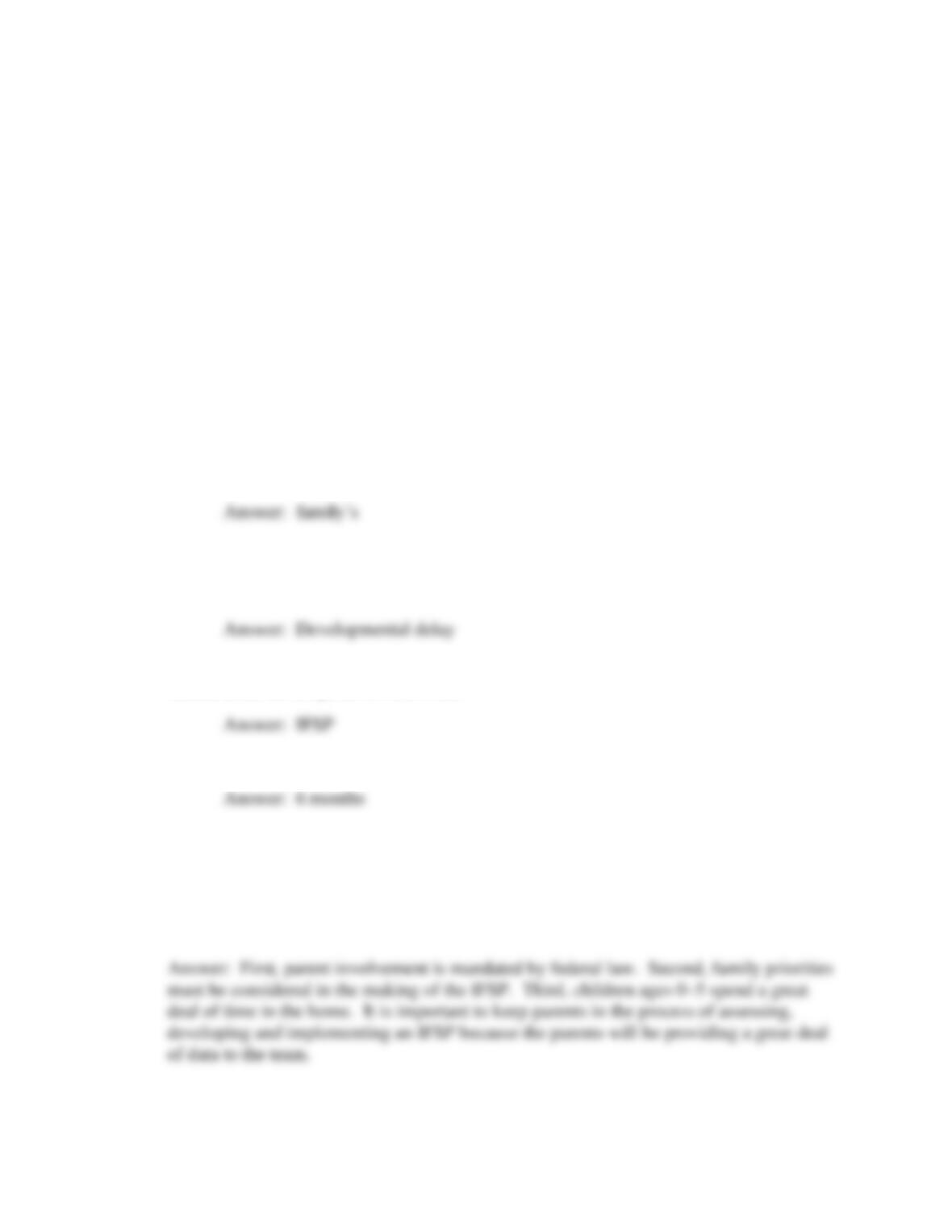
1. Family assessment includes determining the ___ priorities and concerns related to
enhancing the development of the child.
2. ___ may be measured with the appropriate instruments and found in one or more of the
following areas: cognitive development, physical development, communication
development, social or emotional development, and adaptive development.
3. ____ must incorporate the family’s description of its resources, priorities, and concerns
related to the development of the child.
4. The time set for a review of the IFSP of infants and young children ____.
Apply Your Knowledge
Explain why the involvement of the family is emphasized in both assessing the young child and
in developing and implementing the IFSP.
Activity 11.2
1. What five areas of child development must the IFSP address?
2. The IFSP must include the expected ___ of interventions and the degree to which ___
toward achieving them is being made.
3. In which of the program paradigms does the parent play a more active role in the
assessment and planning processes?
4. According to Minke and Scott (1993), parents may need better ___ from professionals.
5. Katz (1989) stated that in some instances, parents and professionals must ___ on goals
for the child.
6. According to Goodman and Hover (1992), when assessment is directed by the parents,
what problems may occur?
7. What are the assessment recommendations of the Division of Early Childhood?
Apply Your Knowledge
Discuss how the IFSP must balance the needs of the parents with those of the child.
Activity 11.3
1. This infant assessment tool is used to determine the possible risk of developmental
disabilities in infants from birth to 1 month of age.
2. These include physical, neurological, and emotional factors that influence the child’s
development.
3. This instrument is based on Piagetian developmental theory and is used for infants
through 2 years of age.
4. These include sleep disturbances, irritability, and unusual movements.
5. This revised instrument includes research on several clinical samples and is used for
children aged 1 to 42 months.
Apply Your Knowledge
How might regulatory disturbances influence a child’s ability to learn?
Activity 11.4
1. Which instrument for younger ages includes many of the same subtests as the WISC–IV?
2. Which instrument was standardized at the same time as the AGS Early Screening
Profiles?
3. What instrument provides scores for expressive and receptive language skills as well as
early academic skills for children aged 5 and 6 years?
4. Which instrument includes an articulation survey but does not have the expanded error
analysis included in the K–SEALS?
5. Which instrument includes both direct assessment and questionnaires/ratings to be
completed by caretakers?
Apply Your Knowledge
Language development is consistently a focus of preschool evaluations. What other areas of
development does language development influence?
Activity 11.5
Use these to construct a test measuring phonemic awareness. For example, the first letter sound
to assess is /a/. In order to make a rhyming item, provide an example of a rhyming word that
uses the sounds /a/ and /t/, or at. Words that can be formed using at with the consonants provided
are sat, fat, mat, and rat.
Model: “Listen to this word: at. I know some words that rhyme with at: mat and fat.”
Sound to be assessed is /i/.
Directions: “Now listen to this word: zip. Tell me a word that rhymes with zip.”
(Acceptable responses: lip, rip, ship).
Continue constructing the test for the blending/segmenting of sounds in the words am, an, if, and
at. To blend, direct the student to say sounds together that you first say in isolation. When the
sounds are said together, they form a word (/a/ /m/ together is am). For segmenting items,
provide an example of how a word sounds when spoken as one unit, then how it sounds when
each sound is articulated individually (am followed by /a/ /m/).
1. Model (blending):
2. Directions:
3. Model (segmenting):
4. Directions:
Now construct test items measuring sound substitution skills. These items
make new words when one sound is replaced with another sound. For example,
when the /f/ sound is substituted with the /r/ sound, fat becomes rat. Use any of
the words presented in Figure 11.4 for the items.
5. Model (substitution):
6. Directions:
Answer: This activity will vary significant for each student. An example is provided
Apply Your Knowledge
Use the information provided in Figures 11.4 and 11.5 to complete an additional phonemic
awareness item. This time, construct an item (model and directions) for the task of phoneme
categorization. For this task, the student must tell you which word does not belong in a list of
words.
Model:
Directions:
Activity 11.6
1. The ____ is an instrument that a parent, teacher, or other professional uses in observing
behaviors of children referred for autism spectrum disorders.
2. The ____ should be administered by a professional with training in clinical interviewing
techniques.
3. A child who does not have oral language but may be average in other skills may have
a(n) ___.
4. _____ is considered the standard for direct assessment of autism spectrum disorders.
Apply Your Knowledge
What is the difference between direct assessment methods and indirect assessment methods for
assessing children referred for autism spectrum disorders?
Think Ahead Exercises
Part I
1. Used with infants and toddlers, the technique of ___ may decrease the time spent in
assessment.
2. Once the family’s and the young child’s needs are determined, the information is used to
complete a(n) ___.
3. When a child is asked to articulate each isolated sound in a whole word, the teacher is
requiring the child to use ___.
4. Among the possible reasons for ___ are physical development behind that of age peers
and cognitive functioning below the levels expected.
5. The transition needs of students age 16 years and older must be included in the IEP,
according to the 1997 IDEA amendments; ___ mandates services for children aged 3 to 5
with disabilities.
6. When a child appears to behave and function differently in specific situations, a(n) ___
may be used to assess these behaviors or abilities.
7. When a child is able to hear and say isolated sounds, recognize that sounds make up
words, discriminate between sounds, provide rhyming words to target words, substitute
sounds upon request, and identify words with specific sounds, the child is demonstrating
evidence of ___.
Part II
1. Identify and explain two or three issues related to family involvement as specified in
legal guidelines and mandates governing early-childhood assessment.
2. According to Mayes (1991), what are the clinical indications that an infant may need a
full evaluation?
3. What areas are assessed when infants are evaluated? Describe these areas in your answer.
4. What are some general considerations to bear in mind when assessing infants, toddlers,
and young children?
Chapter 11 Test Bank
True and False
1. When an examiner interviews parents and teachers in order to assess behavior in a variety
of different settings, the examiner is conducting ecobehavioral interviews.
2. In using a play evaluation, the examiner notes the child’s characteristics of play.
3. Whereas IDEA requires services for children ages 3–5, it provides provisions for states
who wish to serve children from birth through 3.
4. IDEA requires a multidisciplinary evaluation and family-directed assessment.
5. The family’s strengths and needs as they relate to the parents are the objects of
assessment.
6. An assessment process directed by a child’s parents is in the child’s best interest.
7. A holistic view of a child’s developmental level can be gained by conducting formal
assessments.
8. The ability to differentiate the separate sounds in spoken words is phonemic awareness.
9. Autism diagnoses are decreasing.
10. A student’s physical ability is the primary consideration during an AT evaluation.
Multiple Choice
1. Children who experience low birth weight, prolonged respiratory difficulties, or central
nervous system involvement are said to have which of the following?
A. need of special education resource services
B. biological risk factors
C. environmental risk factors
D. learning risk factors
2. IDEA provides for developmental intervention for children beginning at which of the
following ages?
A. birth
B. one year
C. two years
D. three years
3. Young maternal age, disorganization or dysfunction of the family, and few family
support networks are examples of which of the following?
A. biological risk factors
B. environmental risk factors
C. developmental delays
D. all of the above
4. The document required to be written and implemented to plan to meet the needs of the
toddler and the related needs of the family is referred to as which of the following?
A. IEP
B. IAP
C. IFSP
D. IFFP
5. At a minimum, which of the following indicates how often IDEA mandates the plans for
infants and toddlers be reviewed?
A. 3 months
B. 4 months
C. 6 months
D. 12 months
6. At a minimum, which of the following indicates how often IDEA mandates the plans for
infants and toddlers be evaluated?
A. 3 months
B. 4 months
C. 6 months
D. 12 months
7. Which of the following describes the program in which the assessment and goals for the
child are driven by the family’s needs and priorities?
A. family-centered program
B. family-focused program
C. family assessment program
D. family needs based program
8. Disturbances of sleeping, eating and irritability are referred to as which of the following?
A. temperament orientation
B. routine disturbances
C. regulatory disturbances
D. common disturbances
9. Which of the following areas is not required to be evaluated for infants and toddlers
according to the federal regulations?
A. family interaction development
B. physical development
C. cognitive development
D. communication development
10. A technique that places the child and the facilitator in the center of the multidisciplinary
team during the assessment is known as:
A. play evaluations
B. early childhood assessment
C. arena assessment
D. early intervention assessment
11. Which of the following is not an eligibility criterion for early childhood under IDEA?
A. Developmental delay
B. Diagnosed physical or mental condition
C. Diagnosed with a qualifying disability
D. None of the above.
12. Which of the following is evaluated to determine developmental delay?
A. Cognitive & Physical development
B. Communication & Adaptive development
C. Social & Emotional development
D. All of the above.
13. Data collected on children should be used to
A. Determine the effectiveness of interventions and instruction and make
changes as necessary.
B. Assist educational planning and decisions.
C. Implement universal behavioral and academic interventions and assessment.
D. All of the above.
14. Nonorganic failure to thrive, recurrent vomiting or chronic diarrhea, recurrent dermatitis,
recurrent wheezing are all examples of
A. regulatory disturbances
B. social/emotional disturbances
C. psychophysiological disturbances
D. developmental delays
15. When the examiner uses strategies to encourage the child to use communication to solve
problems, it is known as:
A. observations
B. interactive strategies
C. situational play
D. arena evaluations
16. Concerns raised regarding early childhood assessment include
A. Disorders can be difficult to determine in young children.
B. Scores obtained during assessments are unstable.
C. Variability between the educational and home environments.
D. All of the above.
17. Which of the following categories is considered when evaluating a child with a pervasive
developmental disorder?
A. Communication delays or abnormalities
B. Difficulties with social reciprocity or interactions with people
C. Patterns of unusual or repetitive behaviors
D. All of the above.
18. This screening tool is used to identify young children who may be in need of further
diagnostic assessment.
A. DIAL-3
B. Mullen Scales of Early Learning: AGS edition
C. Brigance Scores
D. The Wechsler Preschool and Primary Scale of Intelligence, 3rd edition
19. Which of the following instruments is used in the assessment of infants and toddlers ages
1 to 42 months in the areas of memory, problem-solving, verbal abilities, motor
functioning, and a rating of behavior?
A. Baley Scales of Infant Development – II
B. Uzgiris-Hunt Ordinal Scales of Psychological Development
C. Neonatal Behavioral Assessment Scale – II
D. Developmental Infant Rating System – III
20. The best practice in assessing infants and toddlers as well as preschool age children
involves which of the following?
A. multiple measures, multiple examiners and multiple situations
B. interviewing parents
C. direct observations and surveys
D. cognitive assessment, speech evaluation, and behavioral assessment
21. The WPPSI-III was developed for use with children of what ages?
A. Birth to 3 years of age
B. 2 years and 6 months to 7 years and 3 months
C. 2 years to 6 years and 6 months
D. 1 year of age to 6 years of age
22. Which of the following is an example of phoneme segmentation?
A. /s/ /i/ /p/
B. /s/ /k/ /u/ /l/
C. /sip/
D. skull
23. Which of the following is an example of phoneme identity?
A. Say smile without the /s/. mile
B. The sound /b/ is the same in bike, boy and bell.
C. Which word does not belong—bus, bun, rug? Rug
D. /p/
24. Which of the following is an example of phonemic isolation?
A. p
B. /s/ /i/ /p/
C. /p/
D. /s/ /k/ /u/ /l/
25. Which of the following is an example of phoneme deletion?
A. Which word does not belong—bus, bun, rug? Rug
B. Say smile without the /s/. mile
C. The sound /b/ is the same in bike, boy and bell.
D. /s/ /k/ /u/ /l/
Short Answer
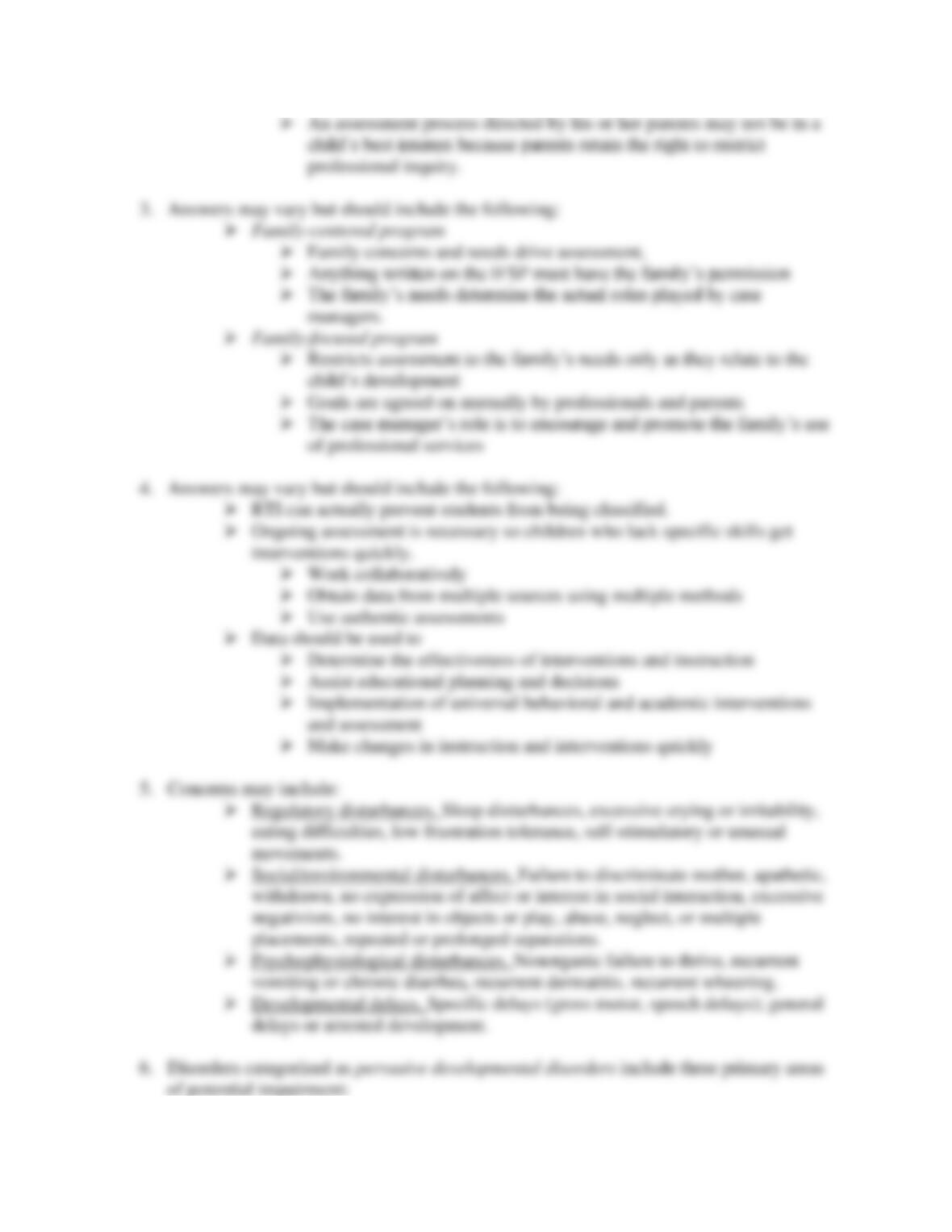
1. Describe the specific components of an IFSP.
2. Discuss the issues surrounding the IFSP regarding family involvement.
3. Discuss the differences between family-centered programs and family-focused programs.
4. Discuss the role of RTI in early childhood. What should assessments look like? How
should the data be used?
5. Infants may be suspected of having developmental delays or of being at risk for
developmental delays if there are clinical indications of concern. What has the research
defined as areas of concern? Identify and define/discuss each.
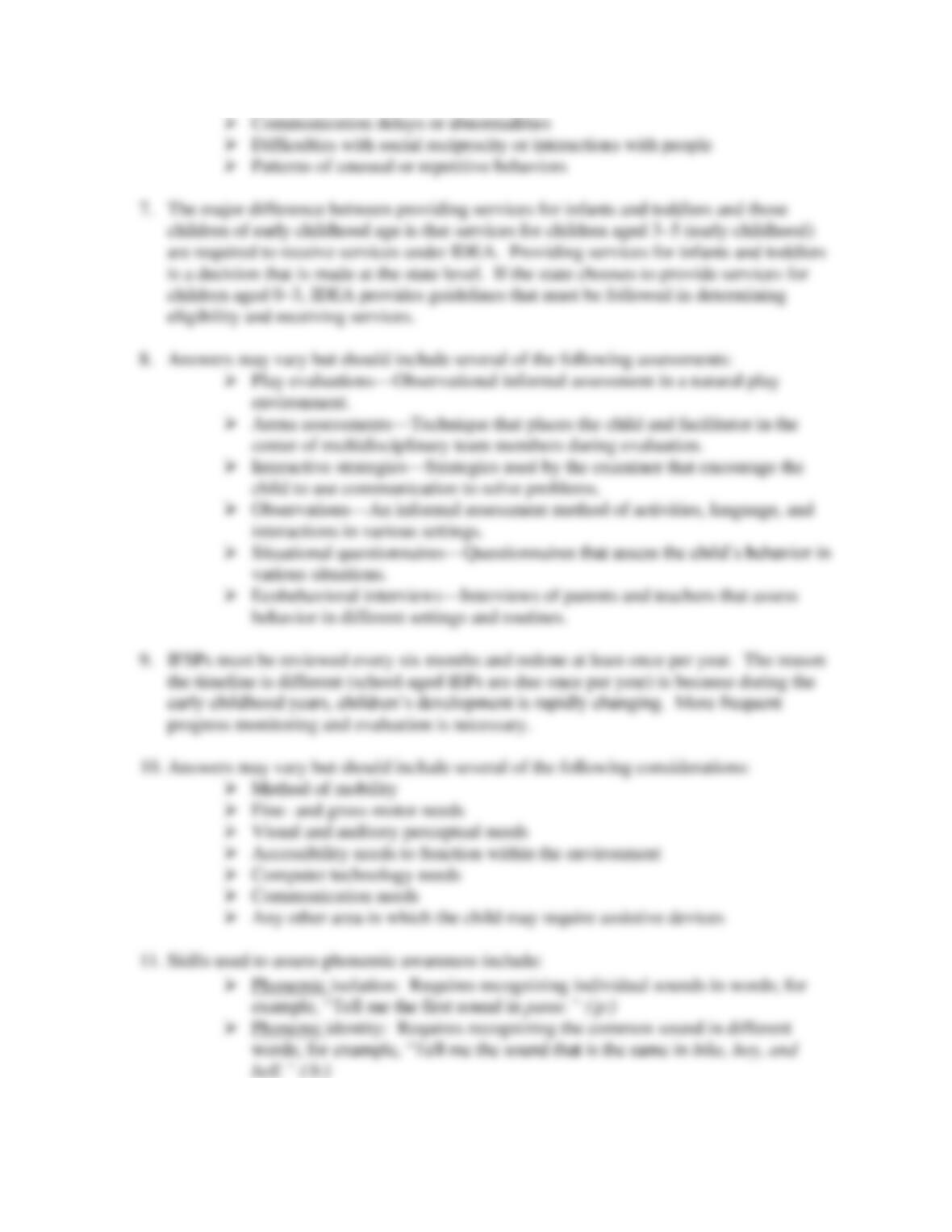
6. Discuss the three primary areas of potential impairment when assessing a student
suspected of being autistic.
7. Describe the major differences in the requirements necessary for eligibility for infant and
toddler services and early-childhood services.
8. Identify and discuss at least three alternative assessments that may be used to identify
young children as requiring special education services.
9. Explain how often an IFSP must be reviewed. Why isn’t the timeline the same as for
children who are of school age?
10. Discuss the evaluation considerations when a student is being assessed for the use of
assistive technology devices.
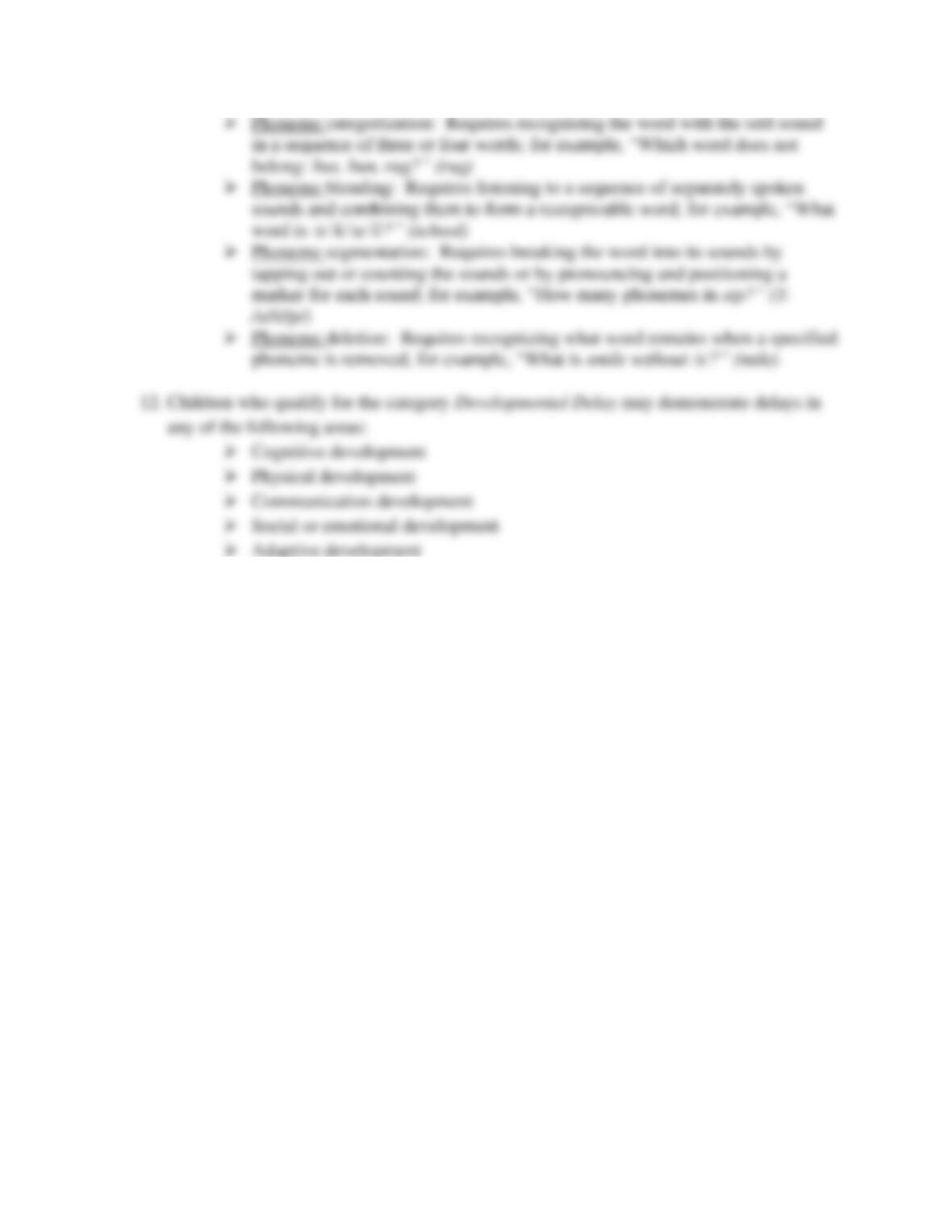
11. Identify and provide an example for the six skills phonemic awareness skills.
12. Identify the five areas in which a child may qualify for services under the
developmentally delayed category in IDEA.
Chapter 11 Test Bank Answer Key
True and False
1. TRUE.

Multiple Choice
Short Answer
1. Answers may vary but should include the following: