CHAPTER 11—THE COST OF CAPITAL
TRUE/FALSE
1. Capital refers to items on the right-hand side of a firm’s balance sheet.
2. The component costs of capital are market-determined variables in as much as they are based on
investors’ required returns.
3. The cost of debt is equal to one minus the marginal tax rate multiplied by the coupon rate on
outstanding debt.
4. The cost of issuing preferred stock by a corporation must be adjusted to an after-tax figure
because of the 70 percent dividend exclusion provision for corporations holding other
corporations’ preferred stock.
5. The firm’s cost of external equity capital is the same as the required rate of return on the firm’s
outstanding common stock.
6. The cost of equity raised by retaining earnings can be less than, equal to, or greater than the cost
of equity raised by selling new issues of common stock, depending on tax rates, flotation costs,
the attitude of investors, and other factors.
7. The cost of equity capital from the sale of new common stock (ke) is generally equal to the cost of
equity capital from retention of earnings (ks), divided by one minus the flotation cost as a
percentage of sales price (1 – F).
8. Funds acquired by the firm through retaining earnings have no cost because there are no dividend
or interest payments associated with them, but capital raised by selling new stock or bonds does
have a cost.
9. The weighted average cost of capital increases if the total funds required call for an amount of
equity in excess of what can be obtained as retained earnings.
10. The marginal cost of capital (MCC) is the cost of the last dollar of new capital that the firm raises,
and the marginal cost declines as more and more of a specific type of capital is raised during a
given period.
260 Chapter 11 The Cost of Capital
11. Even if a firm obtains all of its common equity from retained earnings, its MCC schedule might
still increase if very large amounts of new capital are needed.
12. There is a jump, or break, in a firm’s MCC schedule each time the firm runs out of a particular
source of capital at a particular cost. For example, a firm may use up its 10 percent debt and can
then issue more debt only if it offers a higher rate to investors.
13. The correct discount rate for a firm to use in capital budgeting, assuming that new investments
are of the same degree of risk as the firm’s existing assets, is its marginal cost of capital.
14. The firm’s cost of capital represents the maximum rate of return that a firm can earn from its
capital budgeting projects to ensure that the value of the firm increases.
15. The cost of capital is the firm’s average cost funds given what the market demands be paid to
attract the funds.
16. The cost of capital used in capital budgeting must be determined using the specific financing used
to fund that particular project.
17. A firm’s capital structure has no impact on the firm’s weighted average cost of capital.
18. Each component cost of particular types of capital is identical for each source of funds found in a
firm’s capital structure.
19. The after tax cost of debt is used to calculate the weighted average cost of capital since we are
concerned with the after-tax cash flows of the firm.
20. Tax adjustments to the cost of preferred stock must be made when determining the cost of capital
since dividend expenses on preferred stocks are tax deductible.
21. If a firm cannot invest retained earnings and earn at least the cost of equity, it should pay these
funds to shareholders and let them invest directly in other assets that do provide this return.
22. Long-term capital gains are taxed at a lower rate than dividends for most stockholders leading
companies to pay out dividends rather than use retained earnings to fund capital projects.
Chapter 11 The Cost of Capital 261
23. Flotation costs associated with issuing new equity cause the cost of external equity to be lower
than the cost of retained earnings.
24. If expectations for long-term inflation rose, but the slope of the SML remained constant, this
would have a greater impact on the required rate of return on equity, ks, than on the interest rate
on long-term debt, kd, for most firms. In other words, the percentage point increase in the cost of
equity would be greater than the increase in the interest rate on long-term debt.
25. A firm going from a lower to a higher tax bracket could increase its use of debt, yet actually wind
up with a lower after-tax cost of debt.
26. Since 70 percent of preferred dividends received by a corporation is excluded from taxable
income, the component cost of equity for a company which pays half of its earnings out as
common dividends and half as preferred dividends should, theoretically, be
Cost of equity = ks(0.30)(0.50) + ks(1 – T)(0.70)(0.50).
27. The steeper the demand curve for a firm’s stock, the closer the values of ks and ke are to one
another, other things held constant.
28. In general, it is not possible for ke, the cost of new equity, to be lower than ks, the cost of retained
earnings. However, an exception to this rule occurs when the stock price increases just prior to
the firm issuing new equity such that it more than offsets the flotation costs and thus, ke becomes
less than ks.
29. The cost of debt, kd, is always less than ks, so kd(1 – T) will certainly be less than ks. Therefore,
since a firm cannot be 100% debt financed, the weighted average cost of capital will always be
greater than kd(1 – T).
30. Firms should use their weighted average cost of capital (WACC) when they are funding their
capital projects with a variety of sources. However, when the firm plans on using only debt or
only equity to fund a particular project, it should use the after-tax cost of the specific source of
capital to evaluate that project.
262 Chapter 11 The Cost of Capital
MULTIPLE CHOICE
1. Which of the following is not considered a capital component for the purpose of calculating the
weighted average cost of capital as it applies to capital budgeting?
a.
Long-term debt.
b.
Common stock.
c.
Short-term debt.
d.
Preferred stock.
e.
All of the above are considered capital components for WACC and capital budgeting
purposes.
2. Which of the following statements is most correct?
a.
If a company’s tax rate increases but the yield to maturity of its noncallable bonds remains
the same, the company’s marginal cost of debt capital used to calculate its weighted
average cost of capital will fall.
b.
All else equal, an increase in a company’s stock price will increase the marginal cost of
retained earnings.
c.
All else equal, an increase in a company’s stock price will increase the marginal cost of
issuing new common equity.
d.
Answers a and b are both correct.
e.
Answers b and c are both correct.
3. Which of the following factors in the discounted cash flow (DCF) approach to estimating the cost
of common equity is the least difficult to estimate?
a.
Expected growth rate, g
b.
Dividend yield,
c.
Required return, ks
d.
Expected rate of return,
e.
All of the above are equally difficult to estimate.

Chapter 11 The Cost of Capital 263
4. If a firm can shift its capital structure so as to change its weighted average cost of capital
(WACC), which of the following results would be preferred?
a.
The firm should try to decrease the WACC because such an action will increase the value
of the firm.
b.
The firm should try to increase the WACC because such an action will increase the value
of the firm.
c.
The firm should try to decrease the WACC because such an action will decrease the value
of the firm.
d.
The firm should try to increase the WACC because such an action will decrease the value
of the firm.
e.
The firm should not try to change the WACC because changing the WACC will not
change the value of the firm.
5. The firm’s weighted average cost of capital (WACC) is
a.
set by the board of directors of the firm because it is the benchmark they use to evaluate
upper management.
b.
regulated by the Internal Revenue Service (IRS) because tax-deductible debt is included in
the computation.
c.
determined by the financial markets because investors provide the funds used by firms and
these funds have costs, which are the returns demanded by investors.
d.
the same as the firm’s internal rate of return (IRR).
e.
the total net present value (NPV) of all the capital budgeting projects in which the firm
invests in any year.
6. The before-tax cost of debt, kd, is the same as the
a.
average yield to maturity (YTM) associated with the firm’s bonds.
b.
dividend yield associated with the firm’s common stock.
c.
average coupon rate of the firm’s bonds.
d.
ke if the firm has no preferred stock.
e.
the firm’s marginal tax rate.
7. Alice Stewart, who is the CFO of Meyers Foods, is teaching an upper-level course in corporate
finance at the University of Phoenix. One of the assignments Alice gave her class was to compute
the component costs of capital for Meyers Foods. Meyers Foods uses debt and common stock (no
preferred stock) to finance its investments. Students in the class did not reach the same
conclusions about the relationships among the components costs—that is, the after-tax cost of
debt, kdT, the cost of retained earnings (i.e., internal equity), ks, and the cost of new, or external,
equity, ke. Which of the following relationships should be correct for Meyers Foods?
a.
kdT < ks < ke
b.
ks < kdT < ke
c.
ke < kdT < ks
d.
ke < ks < kdT
e.
None of the above is a correct relationship.
264 Chapter 11 The Cost of Capital
8. Under normal circumstances, the weighted average cost of capital is used as the firm’s required
rate of return because
a.
as long as the firm’s investments earn returns greater than the cost of capital, the value of
the firm will not decrease.
b.
returns below the cost of capital will cover all the fixed costs associated with capital and
provide excess returns to the firm’s stockholders.
c.
it is comparable to the average of all the interest rates on debt that currently prevail in the
financial markets.
d.
it is an indication of the return the firm is earning from all of its assets in combination.
9. Estimating the cost of common equity using the discounted cash flow approach may be difficult
to evaluate because
a.
the dividend yield is extremely difficult to estimate.
b.
the proper growth rate is difficult to establish.
c.
the current price of the common equity is always changing making it difficult to
determine.
d.
all of the above are difficult to estimate.
10. Although it is a subjective measure, analysts often estimate the cost of common equity by adding
a risk premium of 3 to 5 percentage points to the
a.
the cost of preferred stock for the firm.
b.
the risk free rate.
c.
interest rate on the firm’s long term debt.
d.
the market return.
e.
the growth rate of the firm.
11. The target capital structure of a firm is the capital structure that
a.
minimizes the operating risk of the firm’s assets.
b.
maximizes the tax shield created by debt.
c.
minimizes the default risk of long-term debt.
d.
maximizes the price of the firm’s stock.
e.
none of the above.
12. The marginal cost of capital __________ as more capital is raised during a given period.
a.
does not change
b.
decreases
c.
increases
d.
changes in an unpredictable way
e.
approaches zero
Chapter 11 The Cost of Capital 265
13. A graph of a firm’s acceptable capital projects ranked in the order of the projects’ internal rate of
return is called the firm’s ______________.
a.
marginal cost of capital schedule
b.
investment opportunity schedule
c.
modified internal rate of return schedule
d.
internal project classification schedule
e.
optimal capital budget schedule
14. Which of the following may be true concerning debt and equity?
a.
The cost of debt for Firm A is greater than the cost of equity for Firm A.
b.
The cost of debt for Firm A is greater than the cost of equity for Firm B.
c.
The cost of internally generated equity for Firm A is greater than the cost of externally
generated equity funds for Firm A.
d.
The cost of internally generated equity for Firm A is less than the cost of debt for Firm A.
e.
None of the above could be true.
15. Which of the following statements is correct?
a.
Capital components are the types of capital used by firms to raise money. All capital
comes from one of three components: long-term debt, preferred stock, and equity.
b.
Preferred stock does not involve any adjustment for flotation cost since the dividend and
price are fixed.
c.
The cost of debt used in calculating the WACC is an average of the after-tax cost of new
debt and of outstanding debt.
d.
The opportunity cost principle implies that if the firm cannot invest retained earnings and
earn at least ks, it should pay these funds to its stockholders and let them invest directly in
other assets that do provide this return.
e.
The cost of new common equity includes an adjustment for flotation costs which is
expressed as a fixed percentage of the current stock price. The flotation percentage is
determined jointly by the current price of the firm’s stock and its growth rate.
16. Which of the following statements is most correct?
a.
An increase in the corporate tax rate would lower the weighted average cost of capital for
an average firm, other things held constant.
b.
Depreciation-generated funds have a cost equal to the firm’s lowest WACC, and hence
they have no impact on the MCC schedule.
c.
As a firm’s debt ratio approaches 100 percent, the after-tax cost of debt, kdT, at its lowest
level.
d.
Statements a, b, and c are all true.
e.
Statements a, b, and c are all false.
266 Chapter 11 The Cost of Capital
17. Typically, according to the text, the MCC schedule is either horizontal or rising, which implies
that the cost of capital to a firm increases as it raises larger and larger amounts of capital. The
rising section of MCC schedule
a.
Is caused by economies of scale in financing.
b.
Would be eliminated (that is, the MCC schedule would be horizontal) if the firm retained
all of its earnings.
c.
Results from a change in the debt ratio as the firm expands.
d.
Occurs because the firm must, if it is to expand, be willing to take on riskier and riskier
projects, and this causes an increase in the cost of capital.
e.
Results from flotation costs associated with the sale of new common and preferred stock,
along with higher debt costs, as the firm’s rate of expansion increases.
18. Which of the following statements is correct?
a.
Under normal conditions, the CAPM approach to estimating a firm’s cost of retained
earnings gives a better estimate than the DCF approach.
b.
The CAPM approach is typically used to estimate a firm’s flotation cost adjustment factor,
and this factor is added to the DCF cost estimate.
c.
The risk premium used in the bond-yield-plus-risk-premium method is the same as the one
used in the CAPM method.
d.
In practice (as opposed to theory), the DCF method and the CAPM method usually
produce exactly the same estimate for k.
e.
The above statements are all false.
19. In applying the CAPM to estimate the cost of equity capital, which of the following elements is
not subject to dispute or controversy?
a.
Expected rate of return on the market, kM.
b.
The stock’s beta coefficient, i.
c.
Risk-free rate, kRF.
d.
Market risk premium (MRP).
e.
All of the above are subject to dispute.
20. Which of the following statements is correct?
a.
The cost of capital used to evaluate a project should be the cost of the specific type of
financing used to fund that project.
b.
The cost of debt used to calculate the weighted average cost of capital is based on an
average of the cost of debt already issued by the firm and the cost of new debt.
c.
One problem with the CAPM approach to estimating the cost of equity capital is that if a
firm’s stockholders are, in fact, not well diversified, beta might be a poor measure of the
firm’s true investment risk.
d.
The bond-yield-plus-risk-premium approach is the most sophisticated and objective
method of estimating a firm‘s cost of equity capital.
e.
The cost of equity capital is generally easier to measure than the cost of debt, which varies
daily with interest rates, or the cost of preferred stock which is issued infrequently.
Chapter 11 The Cost of Capital 267
21. Which of the following statements is correct?
a.
Beta measures market risk, but if a firm’s stockholders are not well diversified, beta may
not accurately measure the firm’s total risk.
b.
If the calculated beta underestimates the firm’s true investment risk, then the CAPM
method will overestimate ks.
c.
The discounted cash flow method of estimating the cost of equity can’t be used unless the
growth component, g, is constant during the analysis period.
d.
An advantage shared by both the DCF and CAPM methods of estimating the cost of
equity capital, is that they yield precise estimates and require little or no judgment.
e.
None of the above is a correct statement.
22. Which of the following statements is false?
a.
From a theoretical standpoint, the capital weights used to calculate the WACC should be
based on the market values of the different securities. However, if a firm’s book value
weights are closest to its market value weights, book value weights can be used as proxies.
b.
Generally, only long-term debt is included in the calculation of the WACC, because the
WACC is used for capital budgeting purposes, which includes long-term assets, and those
assets are financed with long-term capital.
c.
The first break point a firm encounters in capital budgeting is for retained earnings, unless
a firm has zero or negative net income.
d.
The weighted average cost of capital will change whenever a break point occurs.
e.
Answers a and b are both false.
23. Which of the following statements is most correct?
a.
One purpose of calculating the WACC is to have a singular cost of capital measure that
can be applied to evaluate all of the firm’s projects, including those of greater than and
lesser than average risks.
b.
A firm facing a steep demand curve (that is, high flotation costs) for new equity would
likely also face, at some point, a steeply upward sloping WACC curve.
c.
A breakpoint is based on the dollar value used of a specific type of capital, and occurs at
the point where the cost of that capital type increases. Thus, if a firm has $100,000 in
earnings, and stockholders want $50,000 of those earnings paid as dividends, then retained
earnings will have two breakpoints.
d.
Answers a and b are both correct.
e.
All of the above are false.
268 Chapter 11 The Cost of Capital
24. Which of the following statements is correct?
a.
Suppose a firm is losing money and thus, is not paying taxes, and that this situation is
expected to persist for a few years whether or not the firm uses debt financing. Then the
firm’s after-tax cost of debt will equal its before-tax cost of debt.
b.
The component cost of preferred stock is expressed as kps(1 – T), because preferred stock
dividends are treated as fixed charges, similar to the treatment of debt interest.
c.
The reason that a cost of capital is assigned to retained earnings is because these funds are
already earning a return in the business, the reason does not involve the opportunity cost
principle.
d.
The bond-yield-plus-risk-premium approach to estimating a firm’s cost of common equity
involves adding a subjectively determined risk-premium to the market risk-free bond rate.
e.
None of the above is a correct statement.
25. Consider the discussions concerning the cost of common equity. What is the relationship between
the cost of retained earnings (internal equity), ks, and the cost of new common equity (external
equity), ke?
a.
ks > ke, because new stockholders are willing to accept a lower return and “pay their dues”
before they start receiving the higher returns that existing, loyal stockholders receive.
b.
0 = ks < ke, because there is no “real” cost to the income that the firm decides to retain to
reinvest in assets rather than payout to common stockholders as dividends.
c.
0 < ks < ke, because there is a real cost to retaining income (earnings) for reinvestment, but
the firm has to pay flotation costs when issuing new common stock.
d.
ks = ke, because they both represent essentially the same source of funds, so they must
have the same cost.
e.
None of the above is a correct answer.
26. Which of the following is least likely to lead to a break point in the marginal cost of capital
schedule?
a.
an increase in the required return demanded by investors for a new bond issue.
b.
increased flotation costs associated with seasoned equity offerings.
c.
decreased liquidity in money markets leading to lower selling prices for commercial paper.
d.
using retained earnings to fund new projects for the firm.
e.
issuing preferred stock to institutional investors.
27. Which of the following steps is not necessary for calculating the marginal cost of capital
schedule?
a.
Determine each point at which a break in the marginal cost of capital schedule occurs.
b.
Make a list of all the break points.
c.
Determine the cost of capital for each component in the intervals between the breaks.
d.
Estimate the change in the cost of capital within each interval.
e.
Calculate the weighted averages of these component costs to obtain the WACCs in each
interval.
Chapter 11 The Cost of Capital 269
28. Which of the following statements is correct?
a.
Because we often need to make comparisons among firms that are in different income tax
brackets, it is best to calculate the WACC on a before-tax basis.
b.
If a firm has been suffering accounting losses and is expected to continue suffering such
losses (and therefore its tax rate is zero), it is possible that its after-tax component cost of
preferred stock as used to calculate the WACC will be less than its after-tax component
cost of debt.
c.
Due to the way the MCC is constructed, the first break point in the MCC schedule must be
associated with using up all available retained earnings and having to issue common stock.
d.
Normally, the cost of external equity raised by issuing new common stock is above the
cost of retained earnings. Moreover, the higher the growth rate relative to the dividend
yield, the more the cost of external equity will exceed the cost of retained earnings.
e.
None of the above is a correct statement.
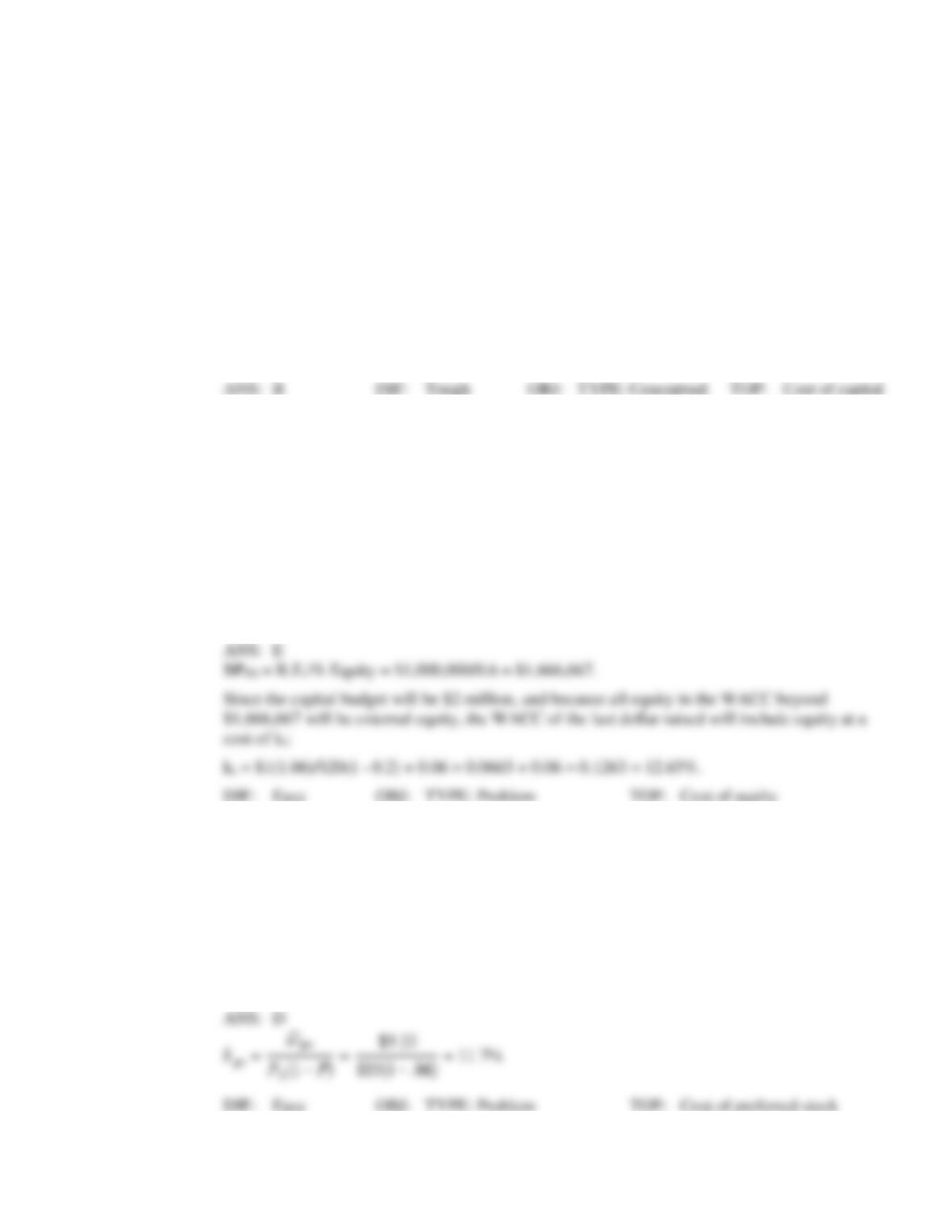
29. Bouchard Company’s stock sells for $20 per share, its last dividend (D0) was $1.00, its growth
rate is a constant 6 percent, and the company would incur a flotation cost of 20 percent if it sold
new common stock. Retained earnings for the coming year are expected to be $1,000,000, and the
common equity ratio is 60 percent. If Bouchard has a capital budget of $2,000,000, what
component cost of common equity will be built into the WACC for the last dollar of capital the
company raises?
a.
11.30%
b.
11.45%
c.
11.80%
d.
12.15%
e.
12.63%
30. Diggin Tools just issued new preferred stock, which sold for $85 in the stock markets. Holders of
the stock will receive an annual dividend equal to $9.35. The flotation costs associated with the
new issue were 6 percent and Diggin’s marginal tax rate is 30 percent. What is Diggins cost of
preferred stock, kps?
a.
11.0%
b.
7.7%
c.
8.2%
d.
11.7%
e.
10.3%
270 Chapter 11 The Cost of Capital
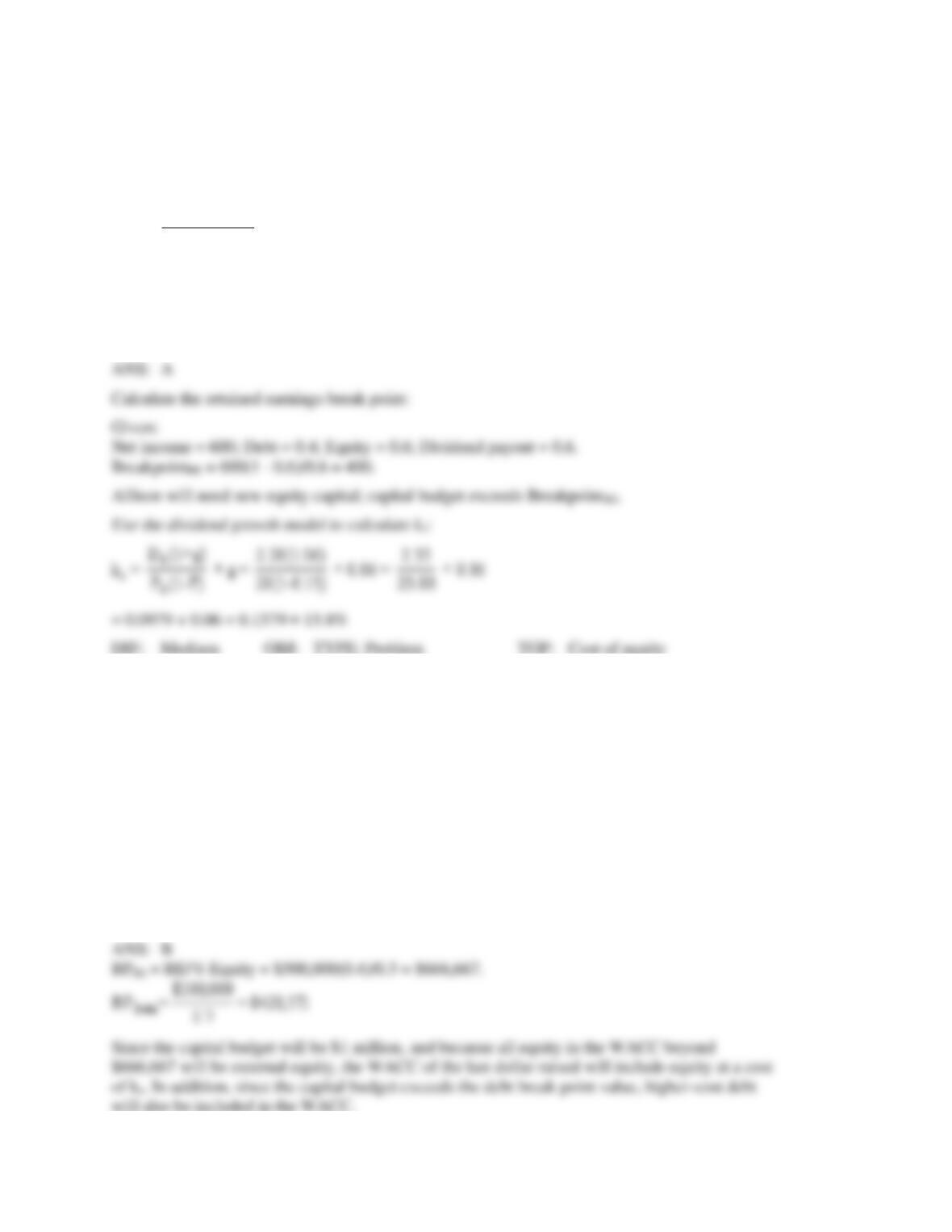
31. Allison Engines Corporation has established a target capital structure of 40 percent debt and 60
percent common equity. The firm expects to earn $600 in after-tax income during the coming
year, and it will retain 40 percent of those earnings. The current market price of the firm’s stock is
P0 = $28; its last dividend was D0 = $2.20, and its expected dividend growth rate is 6 percent.
Allison can issue new common stock at a 15 percent flotation cost. What will Allison’s marginal
cost of equity capital (not the WACC) be if it must fund a capital budget requiring $600 in total
new capital?
a.
15.8%
b.
13.9%
c.
7.9%
d.
14.3%
e.
9.7%
32. Your company’s stock sells for $50 per share, its last dividend (D0) was $2.00, its growth rate is a
constant 5 percent, and the company would incur a flotation cost of 15 percent if it sold new
common stock. Net income for the coming year is expected to be $500,000 and the firm’s payout
ratio is 60 percent. The firm’s common equity ratio is 30 percent and it has no preferred stock
outstanding. The firm can borrow up to $300,000 at an interest rate of 7 percent; any additional
debt will have an interest rate of 9 percent. Your company’s tax rate is 40 percent. If the firm has
a capital budget of $1,000,000, what is the WACC for the last dollar of capital the company
raises?
a.
3.78%
b.
6.76%
c.
9.94%
d.
11.81%
e.
13.25%