93. Candice uses praise, pay increases and recognition as ways of influencing her subordinate’s behaviors. All of these
actions are highly valued by the work group. This is an example of:
a. coercive power.
b. legitimate power.
c. reward power.
d. expert power.
e. referent power.
94. power is based in the ability of the leader to do such things as recommend promotions.
a. Coercive
b. Expert
c. Reward
d. Referent
e. Personal
95. Which of the following types of power is vested in the manager’s ability to punish employees?
a. Coercive
b. Reward
c. Expert
d. Referent
e. Personal
96. Beth, a middle manager at Heather’s Handbags, uses threats and punishments as ways of influencing the behavior
of his subordinates. Which of the following sources of power is Beth relying on?
a. Reward power
b. Coercive power
c. Expert power
d. Referent power
e. Personal power
97. Which of the following types of power stems from a leader’s special knowledge?
a. Reward power
b. Referent power
c. Legitimate power
d. Coercive power
e. None of these
98. Referent power depends on the leader’s:
a. formal title.
b. position in the hierarchy.
c. personal characteristics.
d. salary.
e. reward power.
99. All of the following are essential parts of any definition of leadership EXCEPT:
a. influence.
b. people.
c. goals.
d. coercive power.
e. all of these are essential parts of leadership definition.
100. Peter has the ability to convince others to work toward the attainment of goals. This ability is known as .
a. motivation
b. leadership
c. commitment
d. a conceptual skill
e. personal agenda
101. Which of the following is the most frequently used and a highly effective influence tactic?
a. Using rational persuasion
b. Rewarding desired behaviors
c. Relying on the rule of reciprocity
d. Making people like you
e. Developing allies
102. When leaders influence others through the exchange of benefits or favors, which influence tactic is being used?
a. Develop allies
b. Use rational persuasion
c. Make people like you
d. Rule of reciprocity
e. Reward behaviors
103. The six interpersonal influence tactics for leaders include all of the following EXCEPT:
a. use rational persuasion.
b. rely on the rule of reciprocity.
c. develop allies.
d. do not worry about people liking you.
e. ask for what you want.
104. All of the following are interpersonal influence tactics EXCEPT:
a. help people like you.
b. develop allies.
c. rely on the rule of demand.
d. make use of higher authority.
e. ask for what you want.
Scenario – Barry Bailey
The mandatory leadership-training seminar had just been concluded. All of the newly promoted managers at Marc’s
Music, Inc. had been asked to attend and participate in the two–day seminar, and Barry Bailey had been fascinated
with what she had learned. She is now reviewing the material she covered.
105. Barry will develop strong skills in working with her people and also strong ability in accomplishing the task achieving
the goals of Marc’s Music. On the managerial grid, her style will be:
a.
1,1.
b.
9,9.
c.
9,1.
d.
1,9.
e.
5,5.
106. Barry recognizes that her power can come from five sources, including all of the following EXCEPT:
a. referent power.
b. reward power.
c. coercive power.
d. mechanistic power.
e. All of the sources of power.
107. Barry learns of a recent study on gender differences in leadership behaviors. In which area of leadership do
women score more highly than men?
a. Motivating others
b. Fostering communication
c. Builds relationships
d. Listening to others
e. All of the above
108. To become a level 5 leader, Barry would have to hone which personal characteristic?
a. Humility
b. Tenacity
c. Ruthlessness
d. Drive
e. Ego
109. The ability to influence people toward the attainment of goals is known as .
110. leadership transcends self interest to serve others and the organization.
111. In , the leader favors a consensual and collaborative process, and influence derives from relationships rather
than position power and formal authority.
112. are the distinguishing personal characteristics of a leader, such as intelligence, honesty, and appearance.
113. is the extent to which the leader is mindful of subordinates, respects their ideas and feelings, and establishes
mutual trust.
114. is the extent to which the leader is task oriented and directs subordinates’ work activities toward goal
attainment.
115. , according to the Leadership Grid, occurs when efficiency in operations is the dominant orientation.
116. A model of leadership that describes the relationship between leadership styles and specific organizational situations
is called a(n) approach.
117. A contingency approach to leadership that links the leader’s behavioral style with the task readiness of subordinates
is called the .
118. A(n) for leadership makes the leadership style unnecessary or redundant.
119. A situational variable that counteracts a leadership style is known as a(n) .
120. clarify the role and task requirements of subordinates, initiate structure, provide appropriate rewards, and try
to be considerate to and meet the social needs of subordinates.
121. The has the ability to inspire and motivate people to do more than they would normally do, despite obstacles
and personal sacrifice.
122. A(n) leader is distinguished by a special ability to bring about innovation and change.
123. is the potential ability to influence the behavior of others.
124. Power coming from a formal management position in an organization and the authority granted to it is called
_____.
125. Power that results from the authority to reward others is called .
126. Power that stems from the authority to punish or recommend punishment is called .
127. Power resulting from a leader’s special knowledge or skill regarding the tasks performed by followers is referred to
as _____.
128. Power that results from characteristics that command subordinates’ identification, respect and admiration for and
desire to emulate the leader is called .
129. List the two dimensions used in Blake and Mouton‘s Leadership Grid.
130. List the two types of personal power.
131. What is the basic difference between consideration behavior and initiating structure behavior?
132. Describe the three situational elements under Fiedler’s Contingency Theory that can be described as either
favorable or unfavorable.
133. What three factors combine to create the situation in Fiedler‘s Leadership Contingency Theory? Explain each.
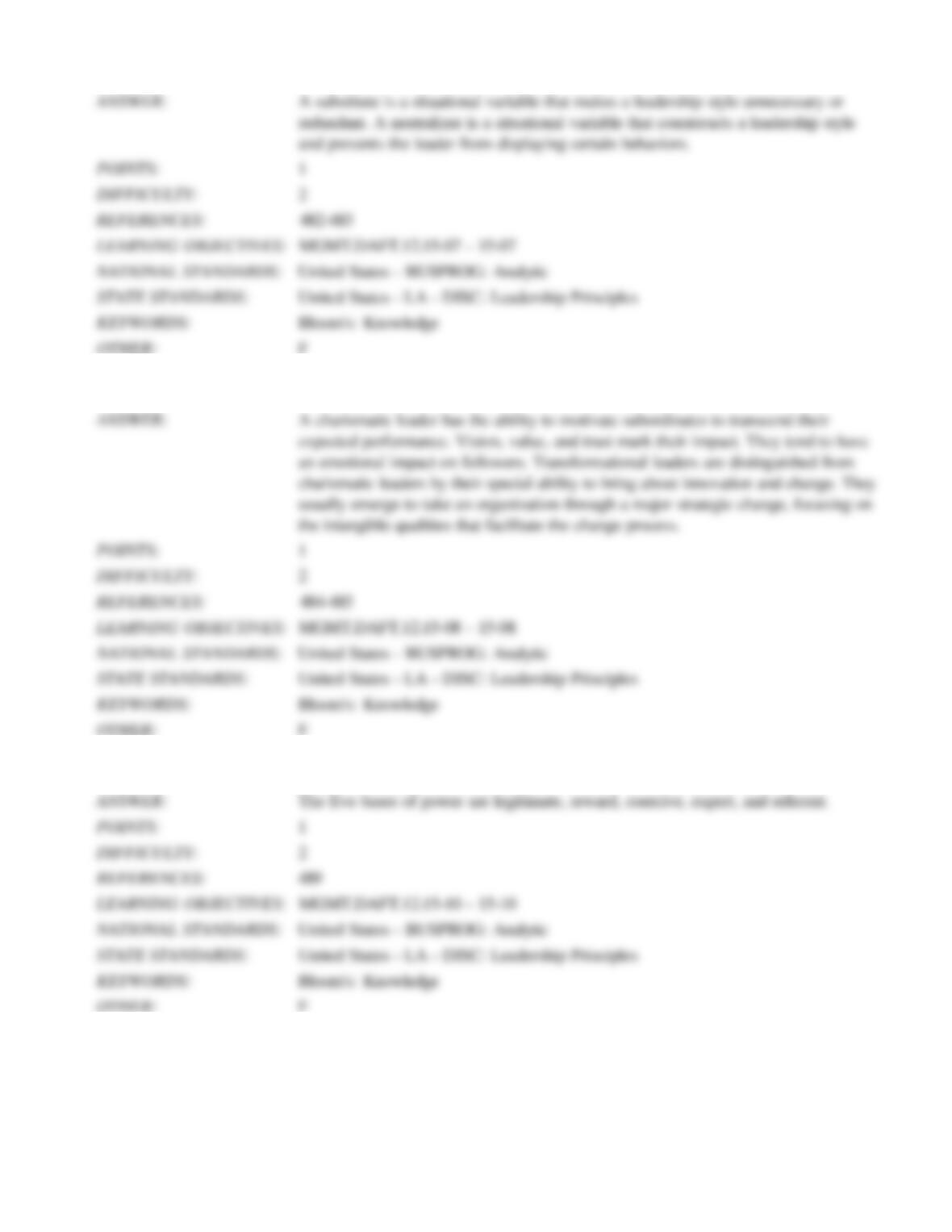
134. Differentiate between a substitute and a neutralizer.
135. Distinguish between charismatic and transformational leadership.
136. Describe the five bases of power typical in organizations.
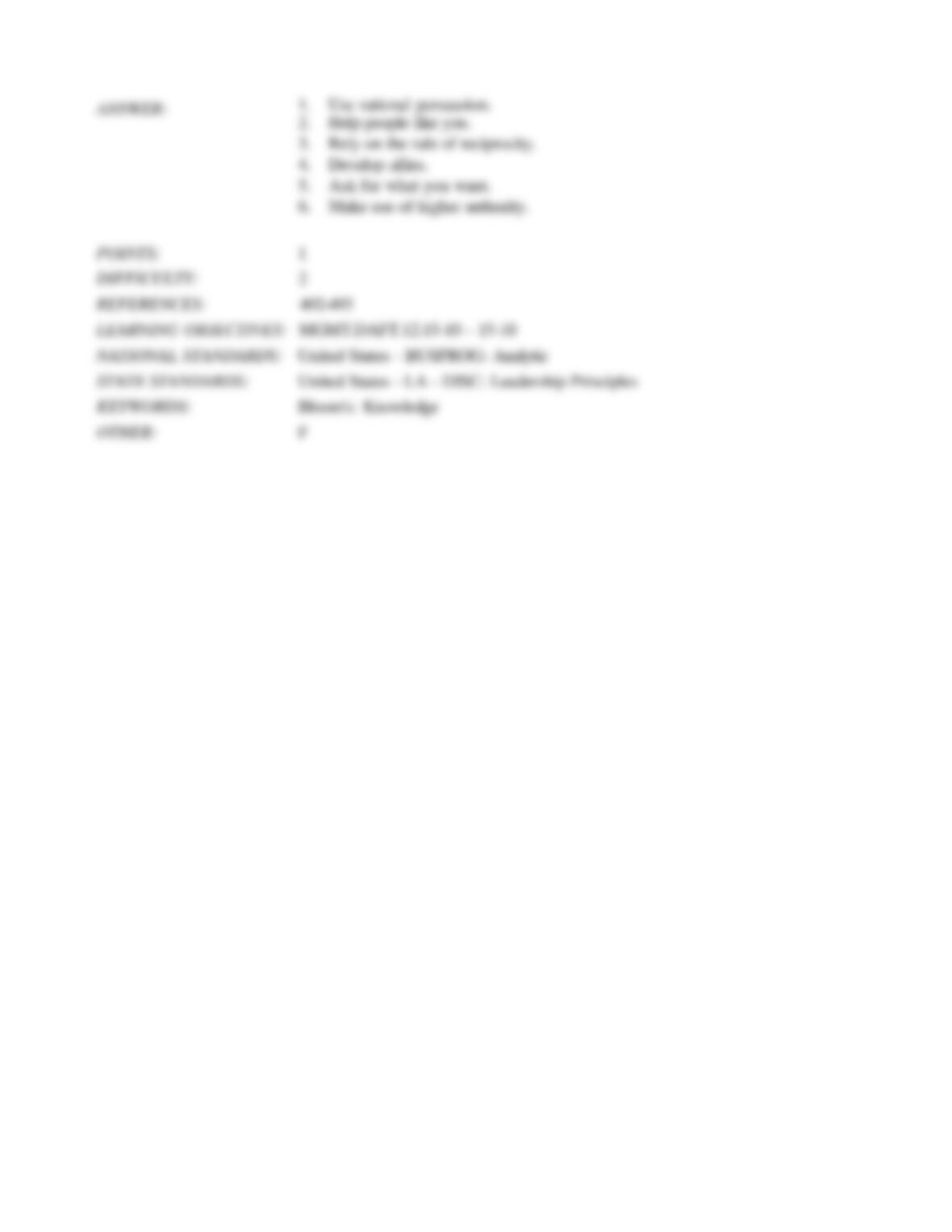
137. Describe the six interpersonal influence tactics for leaders.