Cost Accounting: A Managerial Emphasis, 6e
Chapter 11 – Decision Making and Relevant Information
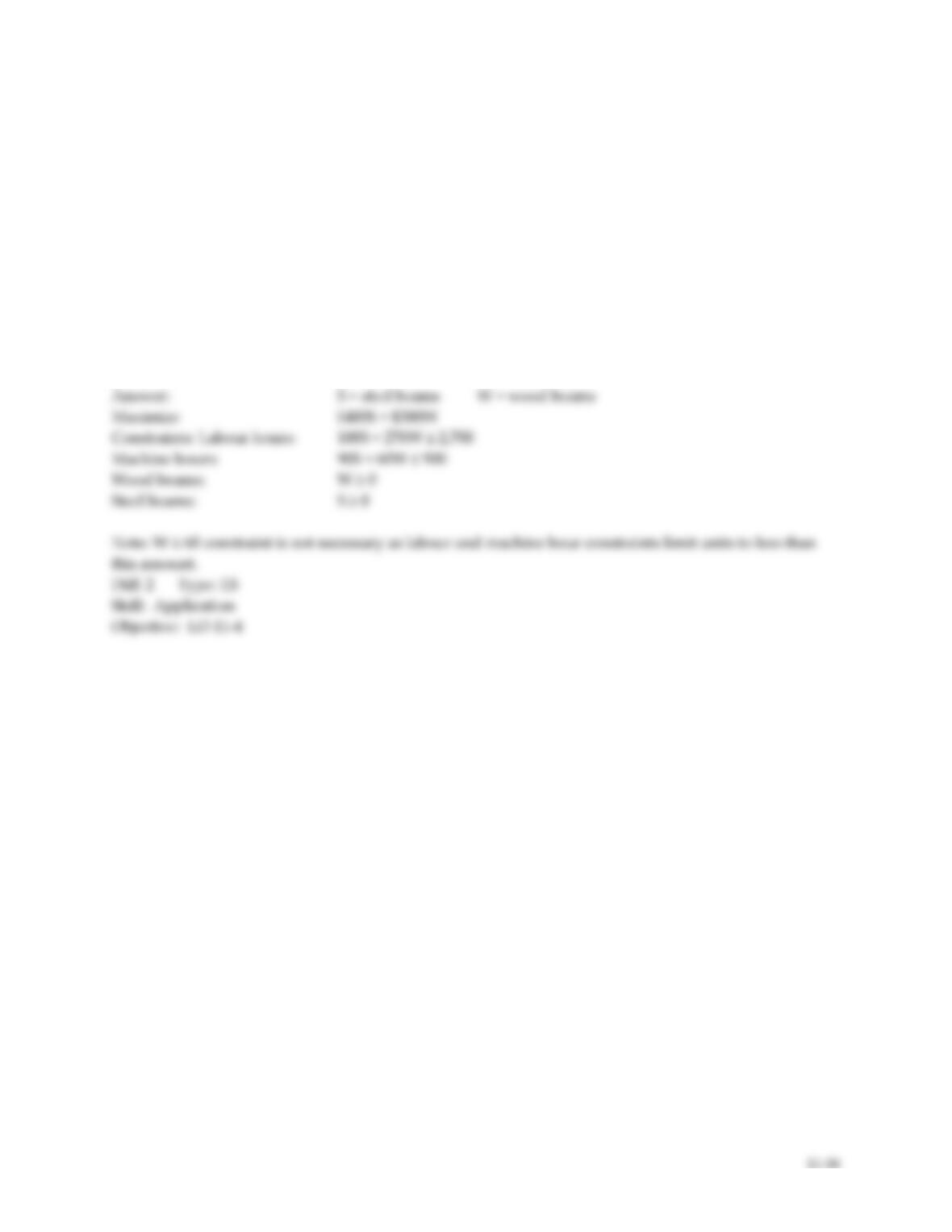
E)
Maximize:
$720S + $128R
Constraints:
Labour hours: 20R + 34S ≤1,600
Machine hours:
8R + 20S ≤ 1,200
Special:
S ≤ 80
S ≤ 0
Regular:
R ≤ 0
Cost Accounting: A Managerial Emphasis, 6e
Chapter 11 – Decision Making and Relevant Information
12) Lovejoy’s Cake Shop makes three types of cakes: White, Chocolate, and, Swirl on one assembly line
that has a limit of 400 labour-hours per week. Lovejoy can sell all the cakes it can make under current
operating capacity. Manufacturing information per cake for each product is as follows:
White Chocolate Swirl
Selling price $16 $10 $20
Variable costs 10 5 18
Labour-hours per cake .4 .2 .4
Required:
Determine the total weekly contribution margin when all labour-hours are allotted to the product with
the highest:
a. Unit selling price.
b. Unit contribution margin.
c. Contribution per labour-hour.
Cost Accounting: A Managerial Emphasis, 6e
Chapter 11 – Decision Making and Relevant Information
13) John Hatelak, a sales representative for a manufacturing equipment company, has decided to spend
less time traveling. He is going to spend only 172 hours per month with his customers. To do this he will
have to give up some of his clients. The following information is from his last full month’s sales activities.
Large Medium Small
Customers Customers Customers
Number of customers 20 100 160
Average sale per customer $6,000 $2,000 $1,200
Commission (% of sales $) 10% 7% 5%
Average time per customer 6 hours 4 hours 3 hours
Required:
a. What should be his customer mix in order to maximize his sales commissions?
b. What will be his income at the best possible customer mix?
Cost Accounting: A Managerial Emphasis, 6e
Chapter 11 – Decision Making and Relevant Information
14) Norton’s Mufflers manufactures three different product lines: Model X, Model Y, and, Model Z.
Considerable market demand exists for all models. The following per unit data apply:
Model X Model Y Model Z
Selling price $80 $90 $100
Direct materials 30 30 30
Direct labour ($10 per hour) 15 15 20
Variable support costs ($5 per machine-hour) 5 10 10
Fixed support costs 20 20 20
Required:
a. For each model, compute the contribution margin per unit.
b. For each model, compute the contribution margin per machine–hour.
c. If there is excess capacity, which model is the most profitable to produce? Why?
d. If there is a machine breakdown, which model is the most profitable to produce? Why?
e. How can Norton encourage her sales people to promote the more profitable model?
Cost Accounting: A Managerial Emphasis, 6e
Chapter 11 – Decision Making and Relevant Information
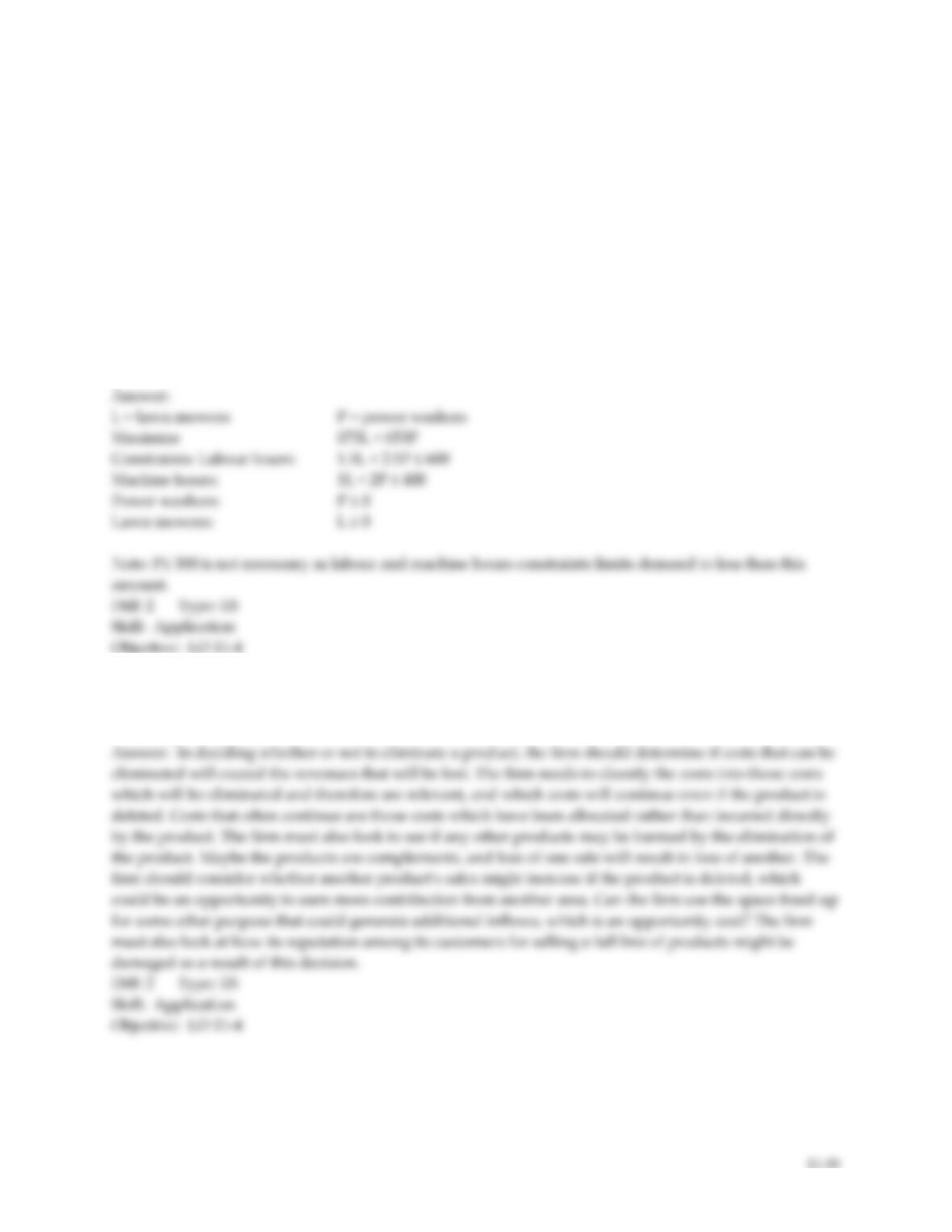
15) Jamboree Manufacturing Ltd. produces two products, steel and wood beams. Steel beams have a unit
contribution margin of $400, and wood beams have a unit contribution margin of $300. The demand for
steel beams exceeds their production capacity, which is limited by available direct labour and machine
hours. The maximum demand for wood beams is 60 per week. Management desires that the product mix
should maximize the weekly contribution toward fixed costs and profits.
Direct manufacturing labour is limited to 2,700 hours a week and 900 hours is all that the company’s
outdated machines can run a week. The steel beams require 180 hours of labour and 90 machine hours.
Wood beams require 270 labour hours and 60 machine hours.
Required:
Formulate the linear programming objective function and constraints necessary to determine the optimal
product mix.
Cost Accounting: A Managerial Emphasis, 6e
Chapter 11 – Decision Making and Relevant Information
16) Kando Manufacturing Ltd. produces two products, lawn mowers and power washers. Lawn mowers
have a unit contribution margin of $75, and power washers have a unit contribution margin of $55. The
demand for lawn mowers exceeds their production capacity, which is limited by available direct labour
and machine hours. The maximum demand for power washers is 300 per week. Management desires that
the product mix should maximize the weekly contribution toward fixed costs and profits.
Direct manufacturing labour is limited to 600 hours a week and 400 hours is all that the company’s
outdated machines can run a week. The lawn mowers require 1.5 hours of labour and 1 machine hour.
Power washers require 2.5 labour hours and 2 machine hours.
Required:
Formulate the linear programming objective function and constraints necessary to determine the optimal
product mix.
17) Doggie Dinner Inc. currently manufactures three different types of scientifically balanced dog food.
The firm is considering eliminating one of the three products. What factors should be taken into account
in making this decision?
Cost Accounting: A Managerial Emphasis, 6e
Chapter 11 – Decision Making and Relevant Information
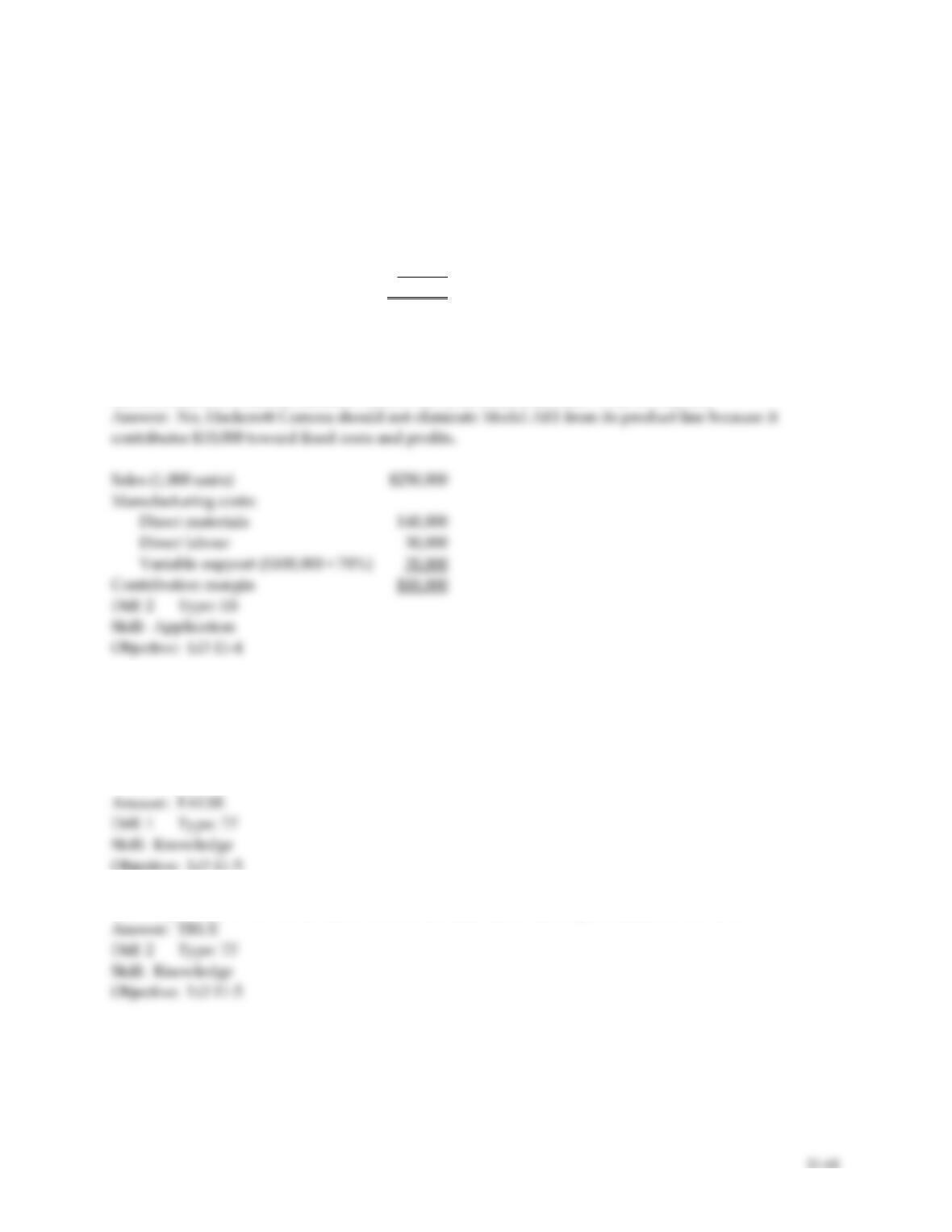
18) The management accountant for the Chocolate S’more Company has prepared the following income
statement for the most current year:
Chocolate Other Candy Fudge Total
Sales $40,000 $25,000 $35,000 $100,000
Cost of goods sold 26,000 15,000 19,000 60,000
Contribution margin 14,000 10,000 16,000 40,000
Delivery and ordering costs 2,000 3,000 2,000 7,000
Rent (per sq. foot used) 3,000 3,000 2,000 8,000
Allocated corporate costs 5,000 5,000 5,000 15,000
Corporate profit $4,000 $(1,000) $7,000 $10,000
Required:
a. Do you recommend discontinuing the Other Candy product line? Why or why not?
b. If the Chocolate product line had been discontinued, corporate profits for the current year would
have decreased by what amount?
Cost Accounting: A Managerial Emphasis, 6e
Chapter 11 – Decision Making and Relevant Information
19) Hackerott Camera is considering eliminating Model AE1 from its camera line because of losses over
the past quarter. The past three months of information for model AE1 is summarized below:
Sales (1,000 units) $250,000
Manufacturing costs:
Direct materials 140,000
Direct labour ($15 per hour) 30,000
Support 100,000
Operating loss ($20,000)
Support costs are 70% variable and the remaining 30% is depreciation of special equipment for model
AE1 that has no resale value.
Should Hackerott Camera eliminate Model AE1 from its product line? Why or why not?
11.5 Explain how to reduce the negative effects and conflicts arising in relevant-cost
analyses.
1) Business function costs consist of all variable costs associated with a particular business function in the
value chain.
2) Managers tend to favour decision choices that make their current performance look better.
Cost Accounting: A Managerial Emphasis, 6e
Chapter 11 – Decision Making and Relevant Information
3) The financial measures used to evaluate a manager’s performance must be the same as those used to
measure the performance of his/her department.
4) Unit cost data can mislead decisions by including irrelevant costs or by
A) not computing fixed overhead costs.
B) computing labour and materials costs only.
C) computing administrative costs.
D) not computing unit costs at the relevant output level.
E) including qualitative data.
5) Koch Brothers purchased a new production machine for $200,000. It is capable of producing 400,000
units over its useful life, thus the manufacturer’s salesperson claimed the unit cost would only be $0.50.
Koch’s own engineers recommended that the company acquire a machine that would have a unit cost of
production of no more than $0.48 (with a $0.03 variance). A competitor of the vendor, who also was
trying to sell Koch some equipment, claimed that the $0.50 is understated by $0.04 per unit. The total
anticipated demand over the asset’s useful life is 300,000 units.
Relevant information includes
A) the $0.50 unit cost.
B) the fact that the $0.50 falls below the $0.48 + $0.03 variance.
C) the unit cost at Koch’s planned capacity utilization.
D) being able to produce at excess capacity.
E) the different unit costs of production between the two vendors‘ machines.
6) The sum of all the costs incurred in a particular business function (for example, marketing) is called
A) business function cost.
B) full product cost.
C) gross product cost.
D) multiproduct cost.
E) incremental cost.
Cost Accounting: A Managerial Emphasis, 6e
Chapter 11 – Decision Making and Relevant Information
7) The sum of all costs incurred in all business functions in the value chain (marketing, customer service,
product design, and manufacturing, for example) is known as
A) business cost.
B) full product cost.
C) gross product cost.
D) multiproduct cost.
E) incremental cost.
8) Which of the following should management consider to avoid the pitfalls of relevant-cost analysis?
A) Consider all current revenues and costs.
B) Include any item of revenue or cost that is either an expected future revenue or expected future cost,
and, differs between the alternatives.
C) Historic revenues and costs for items that differ according to alternatives should be considered.
D) Assume that all fixed costs are irrelevant.
E) Assume that all variable costs are relevant.
Cost Accounting: A Managerial Emphasis, 6e
Chapter 11 – Decision Making and Relevant Information
9) Crest Information Technologies manufactures three sizes of copiers: light usage; medium usage; and,
heavy usage. Potential sales include 200 units of light; 240 units of medium; and, 200 units of heavy per
month. The maximum machine-hours available is 12,000 per week. Product information is provided
below.
Light
Medium
Heavy
Marketing Costs:
Variable
$120
$240
$400
Fixed
$300
$500
$1,000
Manufacturing costs:
Variable
$120
$240
$400
Fixed
$80
$100
$240
Machine-hours per unit
20
40
100
What is the full product cost for heavy usage copiers?
A) $640
B) $1,000
C) $1,800
D) $1,400
E) $2,040
10) A company is preparing its’ budgets for the upcoming year. Current direct materials cost is $150,000
and current direct manufacturing labour is $1,000,000, both of which are expected to increase by 4% next
year. Overhead costs for the year just ending are: variable $18,000, and fixed $30,000. The firm expects to
achieve a 2% cost reduction in overhead costs by continuous improvement.
What is the company’s expected cost for the upcoming year, if production is the same number of units as
the current year?
A) $1,175,000
B) $1,176,920
C) $1,196,920
D) $1,243,040
E) $1,263,040
Cost Accounting: A Managerial Emphasis, 6e
Chapter 11 – Decision Making and Relevant Information
11) Managers tend to favour the alternative that makes their performance look best. This leads to conflicts
between which of the following?
A) the status quo and the chosen alternative
B) the decision model and the performance evaluation model
C) the constraining factor and the performance evaluation model
D) gathering the required information and the performance evaluation model
E) the accrual accounting model and the performance evaluation model
12) If management takes a multiple-year view in the decision model and judges success according to the
current year’s results, a problem will occur in the
A) decision model.
B) performance evaluation model.
C) production evaluation model.
D) year-end review model.
E) responsibility centre allocation.
13) Top management faces a persistent challenge to make sure that the performance evaluation model of
lower level managers is
A) focused on short-term performance.
B) based solely on quantitative factors.
C) not consistent with the decision model.
D) consistent with the decision model.
E) based only on future costs.