
CHAPTER 11—S CORPORATIONS Key
1. Although an S corporation is taxed much like a partnership, it is subject to many of the C corporation rules.
2. For determining the number of shareholders in an S corporation, stock owned by a husband and wife is
treated as owned by one shareholder.
3. P holds stock in an S corporation as custodian for her five minor children. For purposes of counting
shareholders, the entire family is one shareholder.
4. If proper elections are made, any corporation may qualify as an S corporation.
5. An S corporation issues two classes of common stock: class A voting and class B nonvoting stock. The rights
of both classes of stock are identical except for voting rights. The S corporation election will not be valid
because more than one class of stock is outstanding.
6. Unlike partnerships, some S corporations are assessed taxes on certain types of income and/or gains.
7. The consent of all shareholders who have held stock during the pre-election portion of the taxable year is
required in order for the election of S corporation status to be effective for that taxable year, even if the election
is filed timely.

8. The consent of all shareholders who have held stock during the portion of the taxable year prior to revoking S
corporation status is required for the S corporation status to be inapplicable for the taxable year, even if the
election is filed timely.
9. An S corporation has 300 shares of outstanding stock. K owns 250 shares and U owns 50 shares. On June 30
of this year, K sells 200 of his shares to M. M may cause revocation of the S corporation election.
10. An S corporation election is disqualified if its passive investment income exceeds 25 percent of its gross
receipts during any taxable year.
11. H Company, an S corporation owned by A, B, and C, voluntarily terminated its S election and became a C
corporation. One year later, A sold his one-third interest in the corporation to D. B, C, and D may re-elect S
corporation status at this time, without permission from the IRS, since there has been a partial change in
ownership.
12. Reasonable salaries paid to an S corporation’s shareholders who are employees are deductible business
expenses. (The business was incorporated January 1 of the current year.)
13. Either the per day or interim closing of books method may be used to allocate S corporation items among
shareholders for any ownership interest change during the taxable year.
14. When an owner’s share of S corporation losses exceeds the owner’s basis in the corporation, all ordinary
losses flow through to the owner before capital losses flow through.
15. The S years are counted when determining the expiration period of a net operating loss carryover from a C
corporation.
16. An S corporation on the accrual basis may deduct expenses owed to a cash basis owner before the amount is
paid.
17. A shareholder has capital gain only to the extent that S corporation distributions to him exceed his basis in
18. In situations where a parent wants to involve minor children in the business, the general partnership form is
probably preferable to the S corporate form.
19. Even though an S corporation was formerly a C corporation, all of its cash distributions can be confidently
treated as nontaxable if there is no AEP from its C corporation years and the distribution does not exceed the
shareholder’s basis in the S stock.
20. Reasonable employee benefits provided by an S corporation for a shareholder who is an employee are
deductible business expenses by the S corporation and are excluded from the income of the shareholders. (The
business was incorporated January 1 of the current year.)
21. A business is considered a small business corporation for S corporation eligibility purposes if certain
conditions are met. Those conditions include all of the following except
22. Which one of the following qualifies as an eligible corporation for S corporation purposes?
23. Stock of an S corporation may be owned by all of the following except
24. Which of the following events does not automatically terminate an S corporation election?
25. An S corporation has C corporation accumulated earnings and profits. To guard against termination of S
status, the corporation might
26. An S corporation election may be terminated if the corporation has excessive passive investment income.
An example of what is not passive investment income is
27. Net income, gains, and losses are generally computed in the same way for S corporations as they are for
partnerships. However, the treatment of salary paid to shareholder/employees differs from guaranteed
compensation paid to partners. Which of the following statements is true?
28. Y, an S corporation formed at the beginning of the year, has the following information in its first year:
Gross Income from services
$100,000
Net short-term capital loss
(2,200)
Salary paid to F
(10,000)
Medical insurance premium for F
(300)
Other operating expenses
(54,000)
Cash distributions to F
5,000
F, a 50 percent owner of Y, is single and has no other tax information. F’s A.G.I, is
29. An S corporation has the following information for its taxable year:
Net ordinary income before the
items below are considered
$65,000
Salary to Z
(18,000)
Rental income
22,000
Rental expenses
(29,000)
Net income
Z, a 50 percent owner, performs services for the business. Z’s self-employment income from the corporation, which is subject to self-employment tax,
is
30. The purpose of the Schedule K-l (Form 1120S) is to report
31. Z owns five of an S corporation’s 100 shares of common stock outstanding. After holding the stock 73 days
during the taxable year, Z sells all five shares. S corporate records for the year show taxable income to be
$200,000. If no special election is made, Z’s includible share of taxable income from the S corporation is
32. The election for T, a calendar year S corporation, is terminated on May 1, 2011. Select the best answer.
33. Contributions of property in exchange for S corporate stock are nontaxable only if
34. An S corporation shareholder’s basis may be affected by some or all business liabilities
35. An S corporation incurs a net operating loss of $25,000 in the current year and makes no distributions. Its
sole shareholder, K, has a basis in the stock of $30,000 and in a note receivable from the corporation of
$20,000. The $25,000 has the following impact:
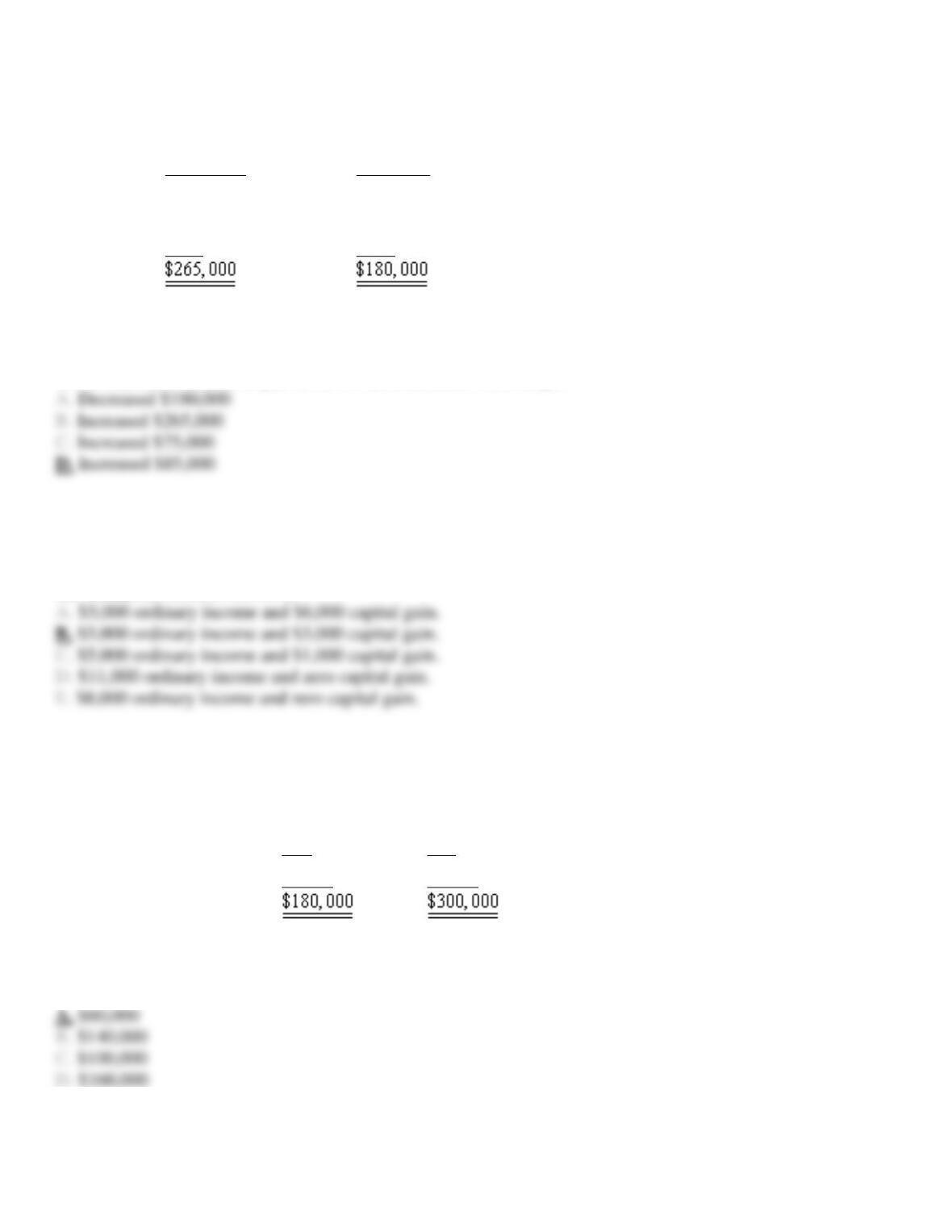
36. H Company, a calendar year S corporation incorporated in 2007, showed the following taxable income and
distributions:
Taxable Income
from Earnings
Distributions
2007
$ 50,000
$ 35,000
2008
55,000
35,000
2009
60,000
25,000
2010
60,000
35,000
2011
40,000
50,000
Total
The company has had a single shareholder since January 1, 2007, and his basis in the stock on that date was $0. The shareholder has no receivables
from the corporation. Based on the figures above, how has the shareholder’s basis changed?
37. H, an S corporation, has net ordinary income from sales of its products of $5,000. During the year, H
distributes $12,000 cash to P, its sole shareholder. P’s basis in H stock, before the net ordinary income and cash
distribution are considered, is $4,000 and H owes P $2,000. H has been an S corporation since it was formed. P
has includible income from H of
38. The following information is available for an S corporation:
Basis
FMV
Cash
$120,000
$120,000
Equipment
160,000
280,000
Equity accounts
X buys Y’s one-third of the shares for $100,000. Y’s basis is $60,000, and she recognizes $40,000 gain. What is X’s share of the inside basis in the
corporation’s net assets?
39. H is a newly incorporated S corporation in the business of growing Christmas trees from seedlings. Tax
planning considerations are important to the owners. Which of the following choices is likely to be the most
advantageous as a taxable year, if the owners expect net losses in the early years:
40. Z Corp elected S corporation status when it was formed. It purchased land for $15,000 and constructed a
warehouse to store inventory for its business. During the past taxable year, Z distributed the warehouse and
land, valued at $200,000, to its shareholders. The original cost to construct the building was $120,000, and
straight-line depreciation of $100,000 has accumulated. The values are allocated as follows:
Fair Market Value
Adjusted Basis
Appreciation
Land
$ 60,000
$15,000
$45,000
Building
140,000
20,000
120,000
Total
$200,000
$35,000
$165,000
Assuming sufficient AAA, what is the effect on the shareholders’ bases for this distribution?
41. A calendar year business was operated as a C corporation from 1998 through 2006, and as an S corporation
since January, 2007. Its account balances at the end of 2011 are
1998-06 accumulated earnings and profits
$3,000
2007-10 accumulated adjustment account
2,000
2011 net ordinary income
5,000
2011 cash distributions to G
12,000
G, the sole shareholder, had a basis in her stock of $4,000 at the beginning of 2011. G is single and has no other tax information. G’s A.G.I, is
42. A calendar year business was operated as a C corporation from 1998 through 2006, and as an S corporation
since 2007. Its account balances at the end of 2011 are
1998-06 accumulated earnings and profits
$2,500
2007-10 accumulated adjustment account
1,000
2011 net ordinary income
2,200
2011 excludable interest income
800
2011 cash distributions to M
4,500
M, the sole shareholder, had a basis in his stock of $4,000 at the beginning of 2011. M is single and has no other tax information. M’s A.G.I, is
43. J and H each have always owned 50 percent of the stock of a calendar-year S corporation that was
previously operated as a C corporation. Accounts at the beginning of the current year are shown below:
Corporate Accounts
Stock Basis
AAA
PTI
AE&P
OAA
J
H
$10,000
$8,000
$1,200
0
$15,000
$10,000
During the year, operations show tax-exempt interest income of $5,000, net ordinary income of $20,000, and cash distributions of $40,000. What are
J and H’s stock basis at the end of the year?
44. When an S corporation distributes property to its shareholders,
45. F Company is an S corporation. It distributes farm acreage to its sole shareholder, H, whose stock basis
before the distribution is $50,000. The corporation’s basis in the acreage is $50,000 and the FMV is $200,000.
The corporation has no accumulated AEP from C corporation years. After the distribution, H’s basis in the stock
is
46. An S corporation, with no AEP, has net ordinary income from sales of its products of $12,000. The only
distribution of profits during the year to L, its sole owner, is land with a market value of $3,000 and a basis of
$2,000. L will hold the land as an investment. At the beginning of the year, L’s basis in the corporation’s stock
was $7,500. L’s basis in the stock, after all items are considered, is
47. When an S corporation terminates S status, special rules allow it to avoid some of the harsh tax
consequences of suddenly becoming a C corporation. Which of the following is not allowed by the post–
termination rules?
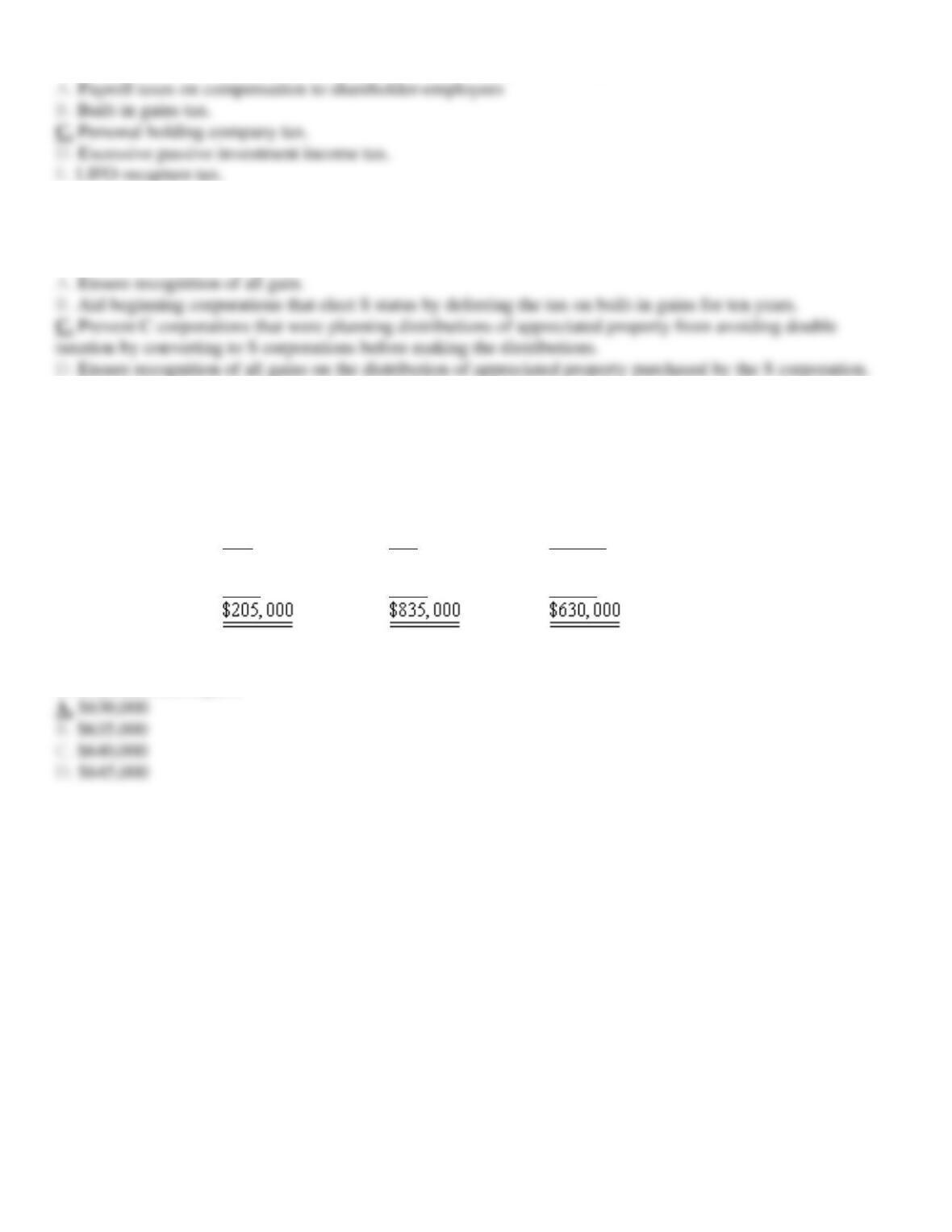
48. R, a C corporation for 2001-10 qualifies as an S corporation throughout 2011. Its net income for 2011 is
Dividend income
$30,000
Gross sales
70,000
Cost of goods sold
(45,000)
Operating expenses
(50,000)
Net income
$ 5,000
R’s AEP from 2001-10 totals $8,000. R’s 2011 Federal tax liability is
49. S corporations may be required to pay all of the following taxes except
50. The built-in gains tax (§ 1374) was enacted to
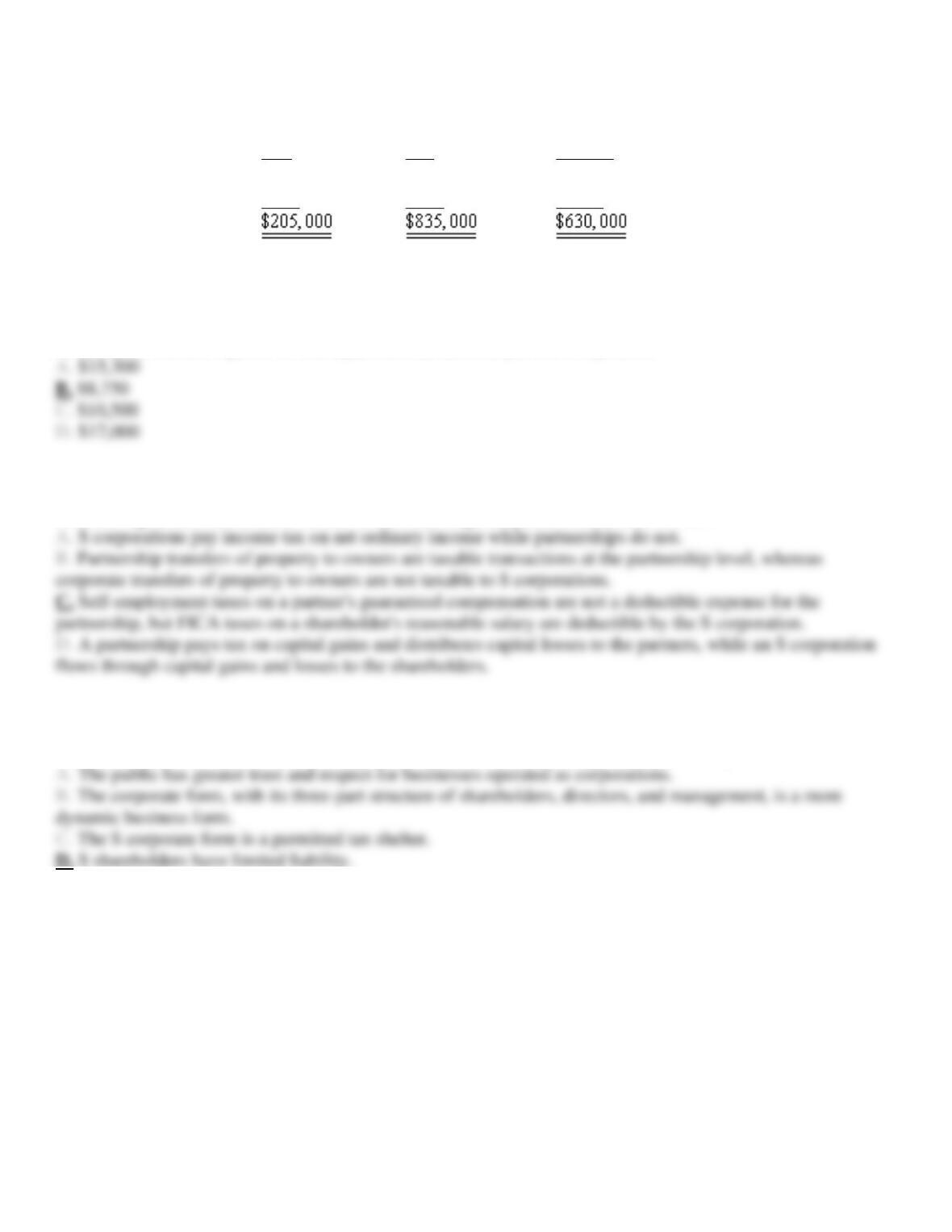
51. B Corporation elected to convert from C status to S status. B uses the accrual basis. At the time the election
takes effect, the records show:
Basis
FMV
Gain/Loss
Inventory
$30,000
$70,000
$40,000
Land/Building
150,000
750,000
600,000
Trucks
25,000
15,000
(10,000)
Total
B’s net unrealized built-in gain is
52. B Corporation elected to convert from C status to S status. B uses the accrual basis. At the time the election
takes effect, the records show:
Basis
FMV
Gain/Loss
Inventory
$30,000
$70,000
$40,000
Land/Building
150,000
750,000
600,000
Trucks
25,000
15,000
(10,000)
Total
In the first taxable year after B became an S corporation, it sold the inventory held by the C corporation for $70,000 and the truck fleet acquired in
the C corporation years for $15,000. In the first taxable year as an S corporation, there was no dividend income, and B’s taxable income was
determined as if it were a C corporation is $50,000. From the C corporation operations, there is NOL carryover of $5,000. For the first taxable year,
the top corporate tax rate is 35 percent. B’s built-in gains tax for the first taxable year as an S corporation is
53. The S corporation form is often compared to the partnership form. Though they are similar in many ways,
there are significant differences. Which of the following comparative statements is true?
54. One of the chief reasons for choosing the S corporate form over the general partnership form is that