Chapter 11 – Liabilities: Bonds Payable
73. Dylan Corporation issues for cash $2,000,000 of 8%, 15-year bonds, interest payable annually, at a time when the
market rate of interest is 9%. The straight-line method is adopted for the amortization of bond discount or
premium. Which of the following statements is true?
a.
The amount of annual interest paid to bondholders remains the same over the life of the bonds.
b.
The amount of annual interest expense decreases as the bonds approach maturity.
c.
The amount of annual interest paid to bondholders increases over the 15-year life of the bonds.
d.
The carrying amount decreases from its amount at issuance date to $2,000,000 at maturity.
74. The entry to record the amortization of a premium on bonds payable on an interest payment date would
a.
a debit to Premium on Bonds Payable and a credit to Interest Revenue
b.
a debit to Interest Expense and a credit to Premium on Bond Payable
c.
a debit to Interest Expense and Premium on Bonds Payable and a credit to Cash
d.
a debit to Bonds Payable and a credit to Interest Expense
75. The adjusting entry to record the amortization of a discount on bonds payable is
a.
debit Discount on Bonds Payable, credit Interest Expense
b.
debit Interest Expense, credit Discount on Bonds Payable
c.
debit Interest Expense, credit Cash
d.
debit Bonds Payable, credit Interest Expense
Chapter 11 – Liabilities: Bonds Payable
76. The journal entry a company records for the issuance of bonds when the contract rate and the market rate are the same
is to
a.
debit Bonds Payable, credit Cash
b.
debit Cash and Discount on Bonds Payable, credit Bonds Payable
c.
debit Cash, credit Premium on Bonds Payable and Bonds Payable
d.
debit Cash, credit Bonds Payable
77. The journal entry a company records for the issuance of bonds when the contract rate is greater than the market rate
would be
a.
debit Bonds Payable, credit Cash
b.
debit Cash and Discount on Bonds Payable, credit Bonds Payable
c.
debit Cash, credit Premium on Bonds Payable and Bonds Payable
d.
debit Cash, credit Bonds Payable
78. The journal entry a company records for the issuance of bonds when the contract rate is less than the market rate
would be
a.
debit Bonds Payable, credit Cash
b.
debit Cash and Discount on Bonds Payable, credit Bonds Payable
c.
debit Cash, credit Premium on Bonds Payable and Bonds Payable
d.
debit Cash, credit Bonds Payable
Chapter 11 – Liabilities: Bonds Payable
79. The journal entry a company records for the payment of interest, interest expense, and amortization of bond discount
is
a.
debit Interest Expense, credit Cash and Discount on Bonds Payable
b.
debit Interest Expense, credit Cash
c.
debit Interest Expense and Discount on Bonds Payable, credit Cash
d.
debit Interest Expense, credit Interest Payable and Discount on Bonds Payable
80. The journal entry a company records for the payment of interest, interest expense, and amortization of bond premium
is
a.
debit Interest Expense, credit Cash and Premium on Bonds Payable
b.
debit Interest Expense, credit Cash
c.
debit Interest Expense and Premium on Bonds Payable, credit Cash
d.
debit Interest Expense, credit Interest Payable and Premium on Bonds Payable
81. On January 1, the Elias Corporation issued 10% bonds with a face value of $50,000. The bonds are sold for
$46,000. The bonds pay interest semiannually on June 30 and December 31 and the maturity date is December 31, ten
years from now. Elias records straight-line amortization of the bond discount. The bond interest expense for the year
ended December 31 of the first year is
a.
$5,000
b.
$5,200
c.
$5,800
d.
$5,400
Chapter 11 – Liabilities: Bonds Payable
82. Eddie Industries issues $1,500,000 of 8% bonds at 105. The amount of cash received from the sale is
a.
$1,425,000
b.
$1,080,000
c.
$1,000,000
d.
$1,575,000
83. If the market rate of interest is greater than the contractual rate of interest, bonds will sell
a.
at a premium
b.
at face value
c.
at a discount
d.
only after the stated rate of interest is increased
84. The interest expense recorded on an interest payment date is increased
a.
only if the market rate of interest is less than the stated rate of interest on that date
b.
by the amortization of premium on bonds payable
c.
by the amortization of discount on bonds payable
d.
only if the bonds were sold at face value
Chapter 11 – Liabilities: Bonds Payable
85. On January 1, $2,000,000, 5-year, 10% bonds, were issued for $1,960,000. Interest is paid semiannually on January 1
and July 1. If the issuing corporation uses the straight-line method to amortize discount on bonds payable, the semiannual
amortization amount is
a.
$8,000
b.
$2,000
c.
$4,000
d.
$10,000
86. If the market rate of interest is 10%, a $10,000, 12%, 10-year bond that pays interest semiannually would sell at an
amount
a.
less than face value
b.
equal to the face value
c.
greater than face value
d.
that cannot be determined
87. Franklin Corporation issues $50,000, 10%, 5-year bonds on January 1, for $52,100. Interest is paid semiannually on
January 1 and July 1. If Franklin uses the straight-line method of amortization of bond premium, the amount of bond
interest expense to be recognized on July 1 is
a.
$10,290
b.
$2,710
c.
$2,500
d.
$2,290
× 1/2 year] – [($52,100 – $50,000) / (5 years × 2)]} = ($2,500 – $210) = $2,290
Chapter 11 – Liabilities: Bonds Payable
88. If bonds are issued at a premium, the stated interest rate is
a.
higher than the market rate of interest
b.
lower than the market rate of interest
c.
too low to attract investors
d.
adjusted to a higher rate of interest
89. The Freeman Corporation issues 2,000, 10-year, 8%, $1,000 bonds dated January 1 at 96. The journal entry to record
the issuance will show a
a.
debit to Cash of $2,000,000
b.
credit to Discount on Bonds Payable for $80,000
c.
credit to Bonds Payable for $1,920,000
d.
debit to Cash for $1,920,000
90. The Glenn Corporation issues 1,000, 10-year, 8%, $2,000 bonds dated January 1 at 96. The journal entry to record the
issuance will show a
a.
debit to Discount on Bonds Payable for $80,000
b.
debit to Cash of $2,000,000
c.
credit to Bonds Payable for $1,920,000
d.
credit to Cash for $1,920,000
Chapter 11 – Liabilities: Bonds Payable
91. The Hayden Corporation issues 1,000, 10-year, 8%, $2,000 bonds dated January 1 at 92. The journal entry to record
the issuance will show a
a.
credit to Discount on Bonds Payable for $160,000
b.
debit to Cash of $2,000,000
c.
credit to Bonds Payable for $2,000,000
d.
credit to Cash for $1,840,000
92. Bonds with a face amount of $1,000,000 are sold at 106. The journal entry to record the issuance is
a.
Cash 1,000,000
Premium on Bonds Payable 60,000
Bonds Payable 1,060,000
b.
Cash 1,060,000
Premium on Bonds Payable 60,000
Bonds Payable 1,000,000
c.
Cash 1,060,000
Discount on Bonds Payable 60,000
Bonds Payable 1,000,000
d.
Cash 1,060,000
Bonds Payable 1,060,000
Chapter 11 – Liabilities: Bonds Payable
93. Bonds with a face amount of $1,000,000 are sold at 98. The entry to record the issuance is
a.
Cash 1,000,000
Premium on Bonds Payable 20,000
Bonds Payable 980,000
b.
Cash 980,000
Premium on Bonds Payable 20,000
Bonds Payable 1,000,000
c.
Cash 980,000
Discount on Bonds Payable 20,000
Bonds Payable 1,000,000
d.
Cash 980,000
Bonds Payable 980,000
94. If bonds payable are not callable, the issuing corporation
a.
can exchange them for common stock
b.
can repurchase them in the open market
c.
must get special permission from the SEC to repurchase them
d.
is more likely to repurchase them if the interest rates increase
Chapter 11 – Liabilities: Bonds Payable
95. When callable bonds are redeemed below the carrying amount
a.
gain on redemption of bonds is credited
b.
loss on redemption of bonds is debited
c.
retained earnings is credited
d.
retained earnings is debited
96. Bonds Payable has a balance of $1,000,000 and Discount on Bonds Payable has a balance of $10,000. If the issuing
corporation redeems the bonds at 97 1/2 what is the amount of gain or loss on redemption?
a.
$10,000 loss
b.
$25,000 loss
c.
$25,000 gain
d.
$15,000 gain
$10,000 = $1,000,000 – $975,000 – $10,000 = $15,000
97. Bonds Payable has a balance of $900,000 and Premium on Bonds Payable has a balance of $10,000. If the issuing
corporation redeems the bonds at 103, what is the amount of gain or loss on redemption?
a.
$1,200 loss
b.
$1,200 gain
c.
$17,000 loss
d.
$17,000 gain
Chapter 11 – Liabilities: Bonds Payable
98. A $300,000 bond was redeemed at 98 when the carrying amount of the bond was $292,000. The entry to record the
redemption would include a
a.
loss on bond redemption of $4,000
b.
gain on bond redemption of $4,000
c.
gain on bond redemption of $2,000
d.
loss on bond redemption of $2,000
99. A $300,000 bond was redeemed at 104 when the carrying amount of the bond was $316,000. The entry to record the
redemption would include a
a.
loss on bond redemption of $3,000
b.
gain on bond redemption of $3,000
c.
gain on bond redemption of $4,000
d.
loss on bond redemption of $4,000
100. Bonds Payable has a balance of $1,000,000 and Discount on Bonds Payable has a balance of $15,500. If the issuing
corporation redeems the bonds at 98 1/2, what is the amount of gain or loss on redemption?
a.
$500 loss
b.
$15,500 loss
c.
$15,500 gain
d.
$500 gain
Chapter 11 – Liabilities: Bonds Payable
101. On the first day of the fiscal year, Lisbon Co. issued $1,000,000 of 10-year, 7% bonds for $1,050,000, with interest
payable semiannually. Orange Inc. purchased the bonds on the issue date for the issue price. The journal entry to record
the amortization of the premium (by the straight-line method) for the year by Lisbon Co. includes a debit to
a.
Interest Expense for $2,500
b.
Premium on Bonds Payable for $2,500
c.
Interest Expense for $5,000
d.
Premium on Bonds Payable for $5,000
102. On the first day of the fiscal year, Lisbon Co. issued $1,000,000 of 10-year, 7% bonds for $1,050,000, with interest
payable semiannually. Orange Inc. purchased the bonds on the issue date for the issue price. If Lisbon uses the straight–
line method for amortizing the premium, the journal entry to record the first semiannual interest payment by Lisbon Co.
would include a debit to
a.
Interest Payable for $30,000
b.
Interest Expense for $32,500
c.
Cash for $70,000
d.
Premium on Bonds Payable for $5,500
Chapter 11 – Liabilities: Bonds Payable
103. Bonds Payable has a balance of $1,000,000 and Premium on Bonds Payable has a balance of $7,000. If the issuing
corporation redeems the bonds at 101, what is the amount of gain or loss on redemption?
a.
$3,000 loss
b.
$3,000 gain
c.
$7,000 loss
d.
$7,000 gain
104. When the bonds are sold for more than their face value, the carrying amount of the bonds is equal to
a.
face value
b.
face value plus the unamortized discount
c.
face value minus the unamortized premium
d.
face value plus the unamortized premium
105. The balance in Discount on Bonds Payable
a.
should be reported on the balance sheet as an asset because it has a debit balance
b.
should be allocated to the remaining periods for the life of the bonds by the straight-line method, if the results
obtained by that method materially differ from the results that would be obtained by the effective interest rate
method
c.
would be added to the related bonds payable to determine the carrying amount of the bonds
d.
would be subtracted from the related bonds payable on the balance sheet
Chapter 11 – Liabilities: Bonds Payable
106. The balance in Premium on Bonds Payable
a.
should be reported on the balance sheet as a deduction from the related bonds payable
b.
should be allocated to the remaining periods for the life of the bonds by the straight-line method, if the results
obtained by that method materially differ from the results that would be obtained by the effective interest rate
method
c.
would be added to the related bonds payable on the balance sheet
d.
should be reported in the paid-in capital section of the balance sheet
107. Any unamortized premium should be reported on the balance sheet of the issuing corporation as
a.
a direct deduction from the face amount of the bonds in the liabilities section
b.
as paid-in capital
c.
a direct deduction from retained earnings
d.
an addition to the face amount of the bonds in the liabilities section
108. The balance in Discount on Bonds Payable that is applicable to bonds due in three years would be reported on the
balance sheet in the section entitled
a.
investments
b.
long-term liabilities
c.
current assets
d.
intangible assets
Chapter 11 – Liabilities: Bonds Payable
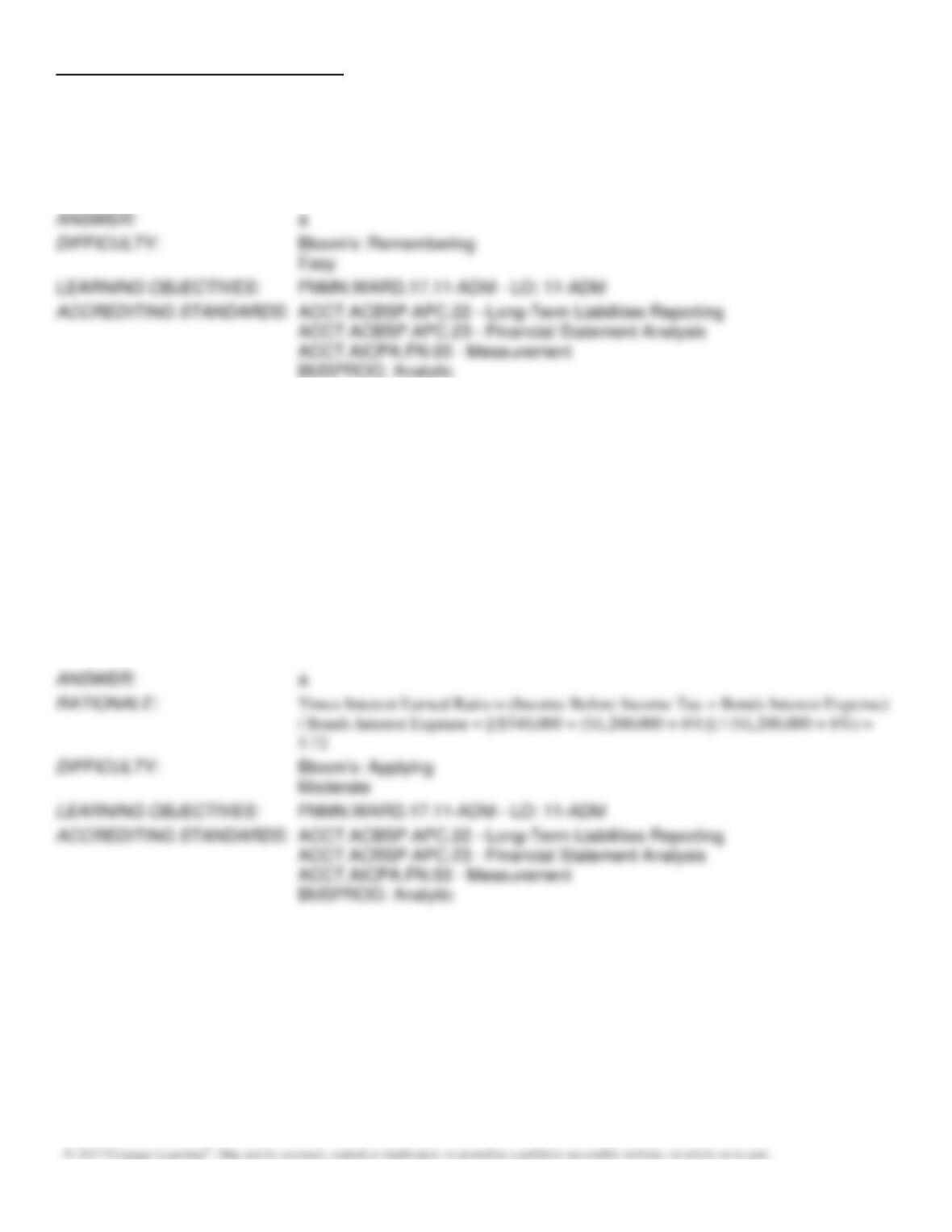
109. Balance sheet and income statement data indicate the following:
Bonds payable, 6% (due in 15 years)
$1,200,000
Income before income tax for year
320,000
Income tax for year
80,000
Interest payable
33,000
Interest receivable
19,000
Based on the data presented above, what is the times interest earned ratio? (Round to two decimal places.)
a.
5.00
b.
5.44
c.
4.00
d.
4.33
110. Creditors are interested in the times interest earned ratio because they want to
a.
know what rate of interest the corporation is paying
b.
have adequate protection against a potential drop in earnings jeopardizing their interest payments
c.
be sure their debt is backed by collateral
d.
know the tax effect of lending to a corporation
Chapter 11 – Liabilities: Bonds Payable
111. The times interest earned ratio is computed as
a.
Income before income taxes + Interest expense ÷ Interest expense
b.
Income before income taxes – Interest expense ÷ Interest expense
c.
Income before income taxes ÷ Interest expense
d.
Income before income taxes + Interest expense ÷ Interest revenue
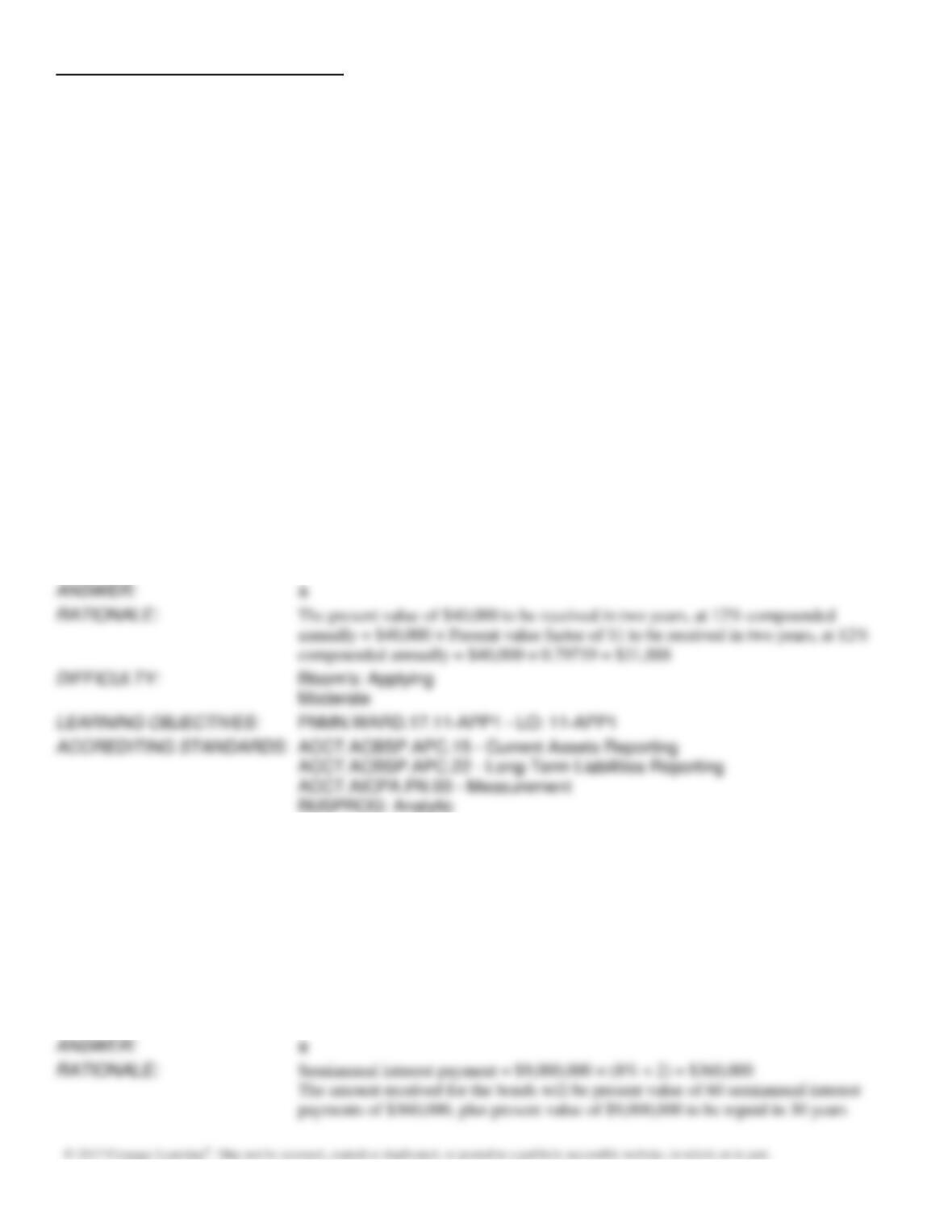
112. Balance sheet and income statement data indicate the following:
Bonds payable, 6% (this is year 4 of 20 years)
$1,200,000
Income before income tax for year
340,000
Income tax for year
80,000
Interest payable
9,000
Interest receivable
26,000
Based on the data presented above, what is the times interest earned ratio? (Round to two decimal places.)
a.
5.72
b.
6.83
c.
4.72
d.
4.83
Chapter 11 – Liabilities: Bonds Payable
113. The present value of $40,000 to be received in two years, at 12% compounded annually, is _____ (rounded to nearest
dollar). Use the following table, if needed.
Present Value of $1 at Compound Interest
Periods
5%
6%
7%
10%
12%
1
0.95238
0.94340
0.93458
0.90909
0.89286
2
0.90703
0.89000
0.87344
0.82645
0.79719
3
0.86384
0.83962
0.81630
0.75132
0.71178
4
0.82270
0.79209
0.76290
0.68301
0.63552
5
0.78353
0.74726
0.71299
0.62092
0.56743
6
0.74622
0.70496
0.66634
0.56447
0.50663
7
0.71068
0.66506
0.62275
0.51316
0.45235
8
0.67684
0.62741
0.58201
0.46651
0.40388
9
0.64461
0.59190
0.54393
0.42410
0.36061
10
0.61391
0.55840
0.50835
0.38554
0.32197
a.
$31,888
b.
$48,112
c.
$8,112
d.
$40,000
114. A corporation issues for cash $9,000,000 of 8%, 30-year bonds, interest payable semiannually. The amount received
for the bonds will be
a.
present value of 60 semiannual interest payments of $360,000, plus present value of $9,000,000 to be repaid in
30 years
b.
present value of 30 annual interest payments of $720,000
c.
present value of 30 annual interest payments of $360,000, plus present value of $9,000,000 to be repaid in 30
years
d.
present value of $9,000,000 to be repaid in 30 years, less present value of 60 semiannual interest payments of
$360,000
The amount received for the bonds will be present value of 60 semiannual interest
Chapter 11 – Liabilities: Bonds Payable
115. The present value of $60,000 to be received in one year, at 6% compounded annually, is _____ (rounded to nearest
dollar). Use the following table, if needed.
Present Value of $1 at Compound Interest
Periods
5%
6%
7%
10%
12%
1
0.95238
0.94340
0.93458
0.90909
0.89286
2
0.90703
0.89000
0.87344
0.82645
0.79719
3
0.86384
0.83962
0.81630
0.75132
0.71178
4
0.82270
0.79209
0.76290
0.68301
0.63552
5
0.78353
0.74726
0.71299
0.62092
0.56743
6
0.74622
0.70496
0.66634
0.56447
0.50663
7
0.71068
0.66506
0.62275
0.51316
0.45235
8
0.67684
0.62741
0.58201
0.46651
0.40388
9
0.64461
0.59190
0.54393
0.42410
0.36061
10
0.61391
0.55840
0.50835
0.38554
0.32197
a.
$56,604
b.
$63,396
c.
$60,000
d.
$3,396