Chapter 11: Stockholders’ Equity
158. Lear Flower Shop presented the stockholders’ equity section of its balance sheet on January 1, 2015, as follows:
Common stock, $2 par, 10,000 shares issued and outstanding
$20,000
Additional paid-in capital—common
40,000
Retained earnings
10,000
Total stockholders‘ equity
$70,000
All common shares were originally sold for $6 each. The following transactions occurred during 2015:
– Reacquired 3,000 shares of common stock at $15 per share on February 16.
– Sold 2,000 shares of treasury stock at $20 per share on June 1.
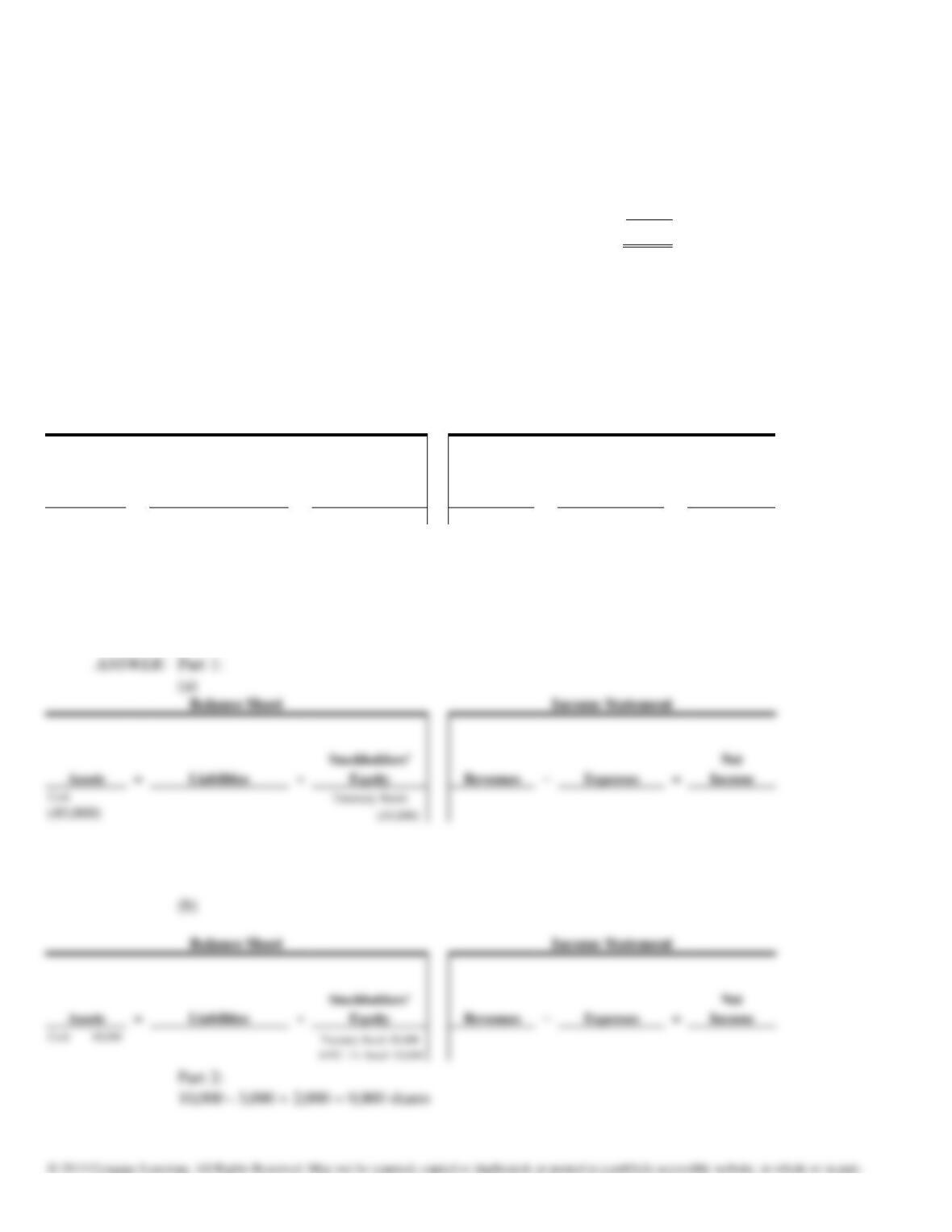
Part 1. Show the effects of the transactions on the accounting equation.
Balance Sheet
Income Statement
Assets
=
Liabilities
+
Stockholders’
Equity
Revenues
–
Expenses
=
Net
Income
Part 2. How many shares of stock are outstanding at June 1, immediately after the sale of the 2,000 shares of
treasury stock?
Balance Sheet
Income Statement
Assets
=
Liabilities
+
Stockholders’
Equity
Revenues
–
Expenses
=
Net
Income
Balance Sheet
Income Statement
Assets
=
Liabilities
+
Stockholders’
Revenues
–
Expenses
=
Net
Chapter 11: Stockholders’ Equity
159. The Stockholders‘ Equity section of Gretchen’s Bistro’s balance sheet on January 1, 2015, appeared as follows:
Common stock, $2 par, 2,000 shares issued and outstanding
$ 4,000
Additional paid–in capital
1,600
Retained earnings
5,400
Total stockholders‘ equity
$11,000
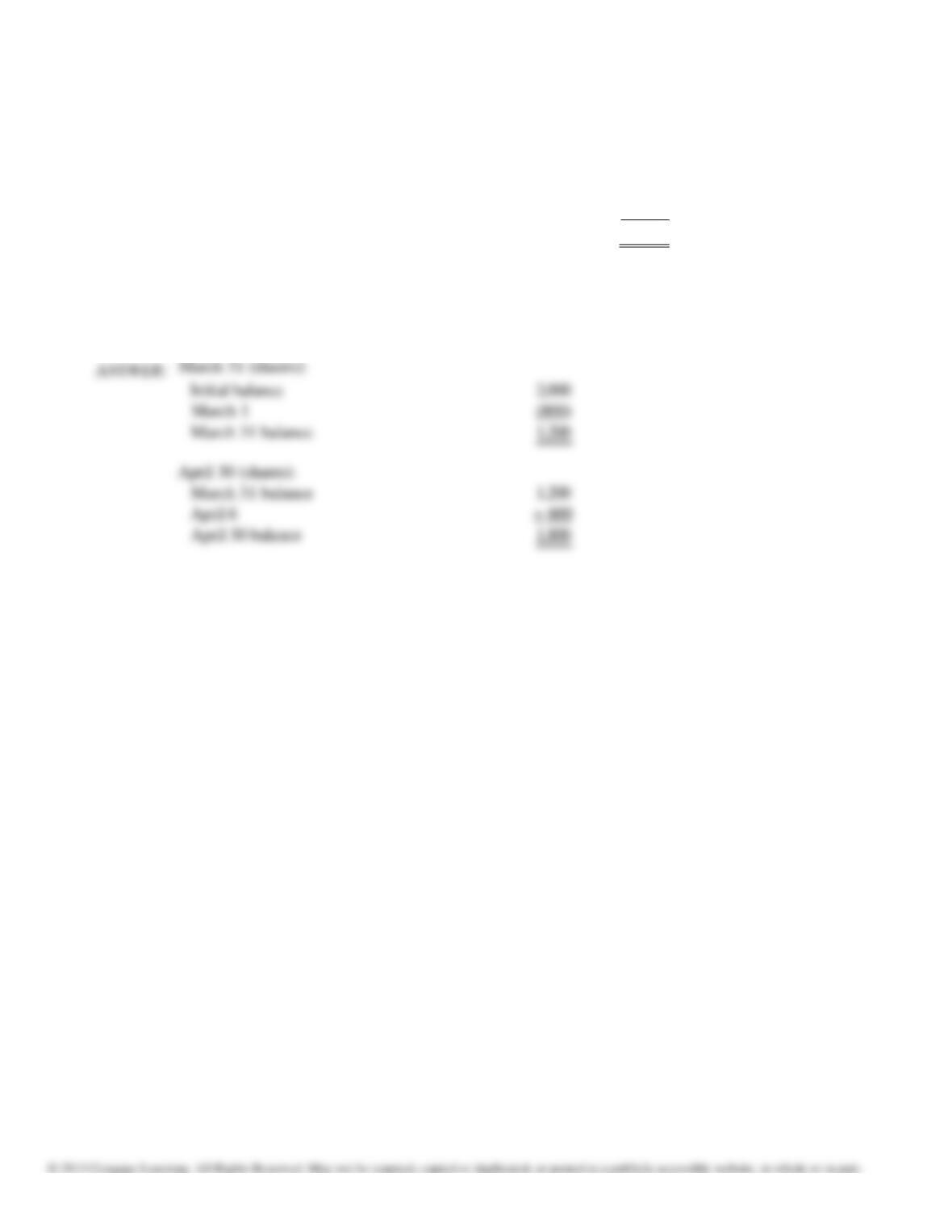
On March 1, 2015, Gretchen’s Bistro reacquired 800 shares of common stock at $12 per share. On April 6,
Gretchen’s Bistro resold 600 shares of treasury stock at $20 per share. How many shares of stock are outstanding
at March 31, and April 30, respectively?
Chapter 11: Stockholders’ Equity
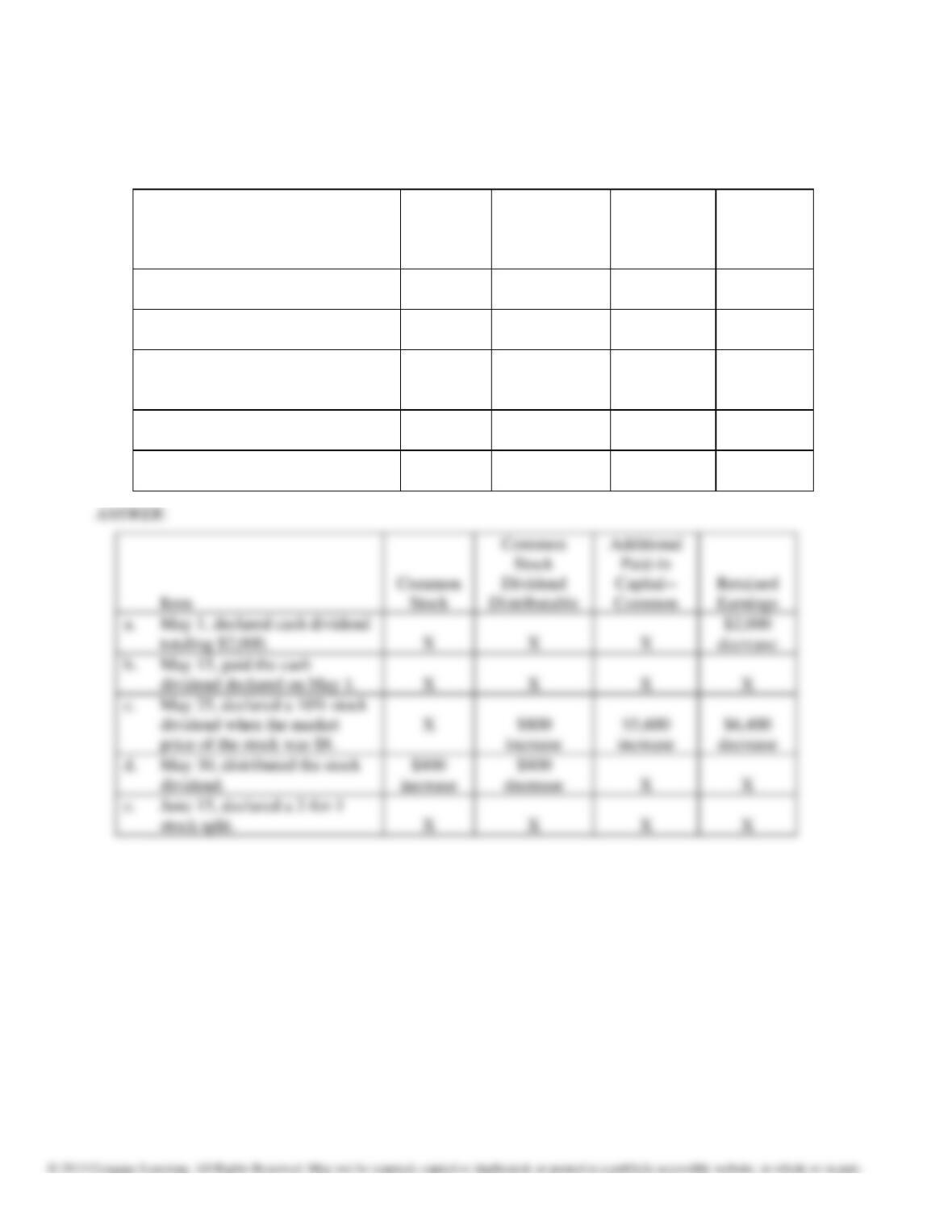
160. In the space provided, indicate the effect of the dividend transactions on each account listed by writing the amount
and whether the account would be increased or decreased. The company has 10,000 shares of $1 par value,
common stock authorized, and 8,000 shares issued. In instances where there is no effect on that account, place an
X in the box.
Item
dividend declared on May 1.
dividend when the market
price of the stock was $8.
d.
May 30, distributed the stock
dividend.
e.
June 15, declared a 2-for-1
stock split.
Item
Common
Stock
Common
Stock
Dividend
Distributable
Additional
Paid-in
Capital—
Common
Retained
Earnings
a.
May 1, declared cash dividend
totaling $2,000.
b.
May 15, paid the cash
dividend declared on May 1.
c.
May 25, declared a 10% stock
dividend when the market
price of the stock was $8.
d.
May 30, distributed the stock
dividend.
e.
June 15, declared a 2-for-1
stock split.
Chapter 11: Stockholders’ Equity
161. Assume that on December 31, 2016, Potaw Company has outstanding 8,000 shares of $15 par, 6%
noncumulative, preferred stock and 40,000 shares of $5 par common stock. Potaw was unable to declare a
dividend in 2014 or 2015 but wants to declare a $75,000 dividend for 2016.
REQUIRED:
1. How much total cash is distributed to preferred stockholders?
2. How much total cash is distributed to common stockholders?
3. What is the dividend per share to preferred stock?
4. What is the dividend per share to common stock?
162. Assume that on December 31, 2016, Potaw Company has outstanding 8,000 shares of $15 par, 6% cumulative,
preferred stock and 40,000 shares of $5 par common stock. Potaw was unable to declare a dividend in 2014 or
2015 but wants to declare a $75,000 dividend for 2016.
REQUIRED:
1. How much cash is distributed to preferred stockholders?
2. How much cash is distributed to common stockholders?
3. What is the dividend per share to preferred stock?
4. What is the dividend per share to common stock?

Chapter 11: Stockholders’ Equity
163. Lakeview Company reported the following amounts on its balance sheet at December 1, 2015:
8% Preferred stock, $2 par, 3,000 shares issued and outstanding
$ 6,000
Common stock, $10 par, 400 shares issued and outstanding
4,000
Additional paid-in capital – Common
22,000
Total contributed capital
$32,000
Retained earnings
48,000
Total stockholders’ equity
$80,000
The following transactions occurred during December:
1. Declared a 20% stock dividend on common stock on December 3, when the stock was selling at $12 per
share. The stock dividend will be distributed on December 20, 2015.
2. Distributed the common stock dividend on December 20.
3. Approved a 2-for-1 stock split of the common stock on December 28, when the stock was selling for $20
per share.
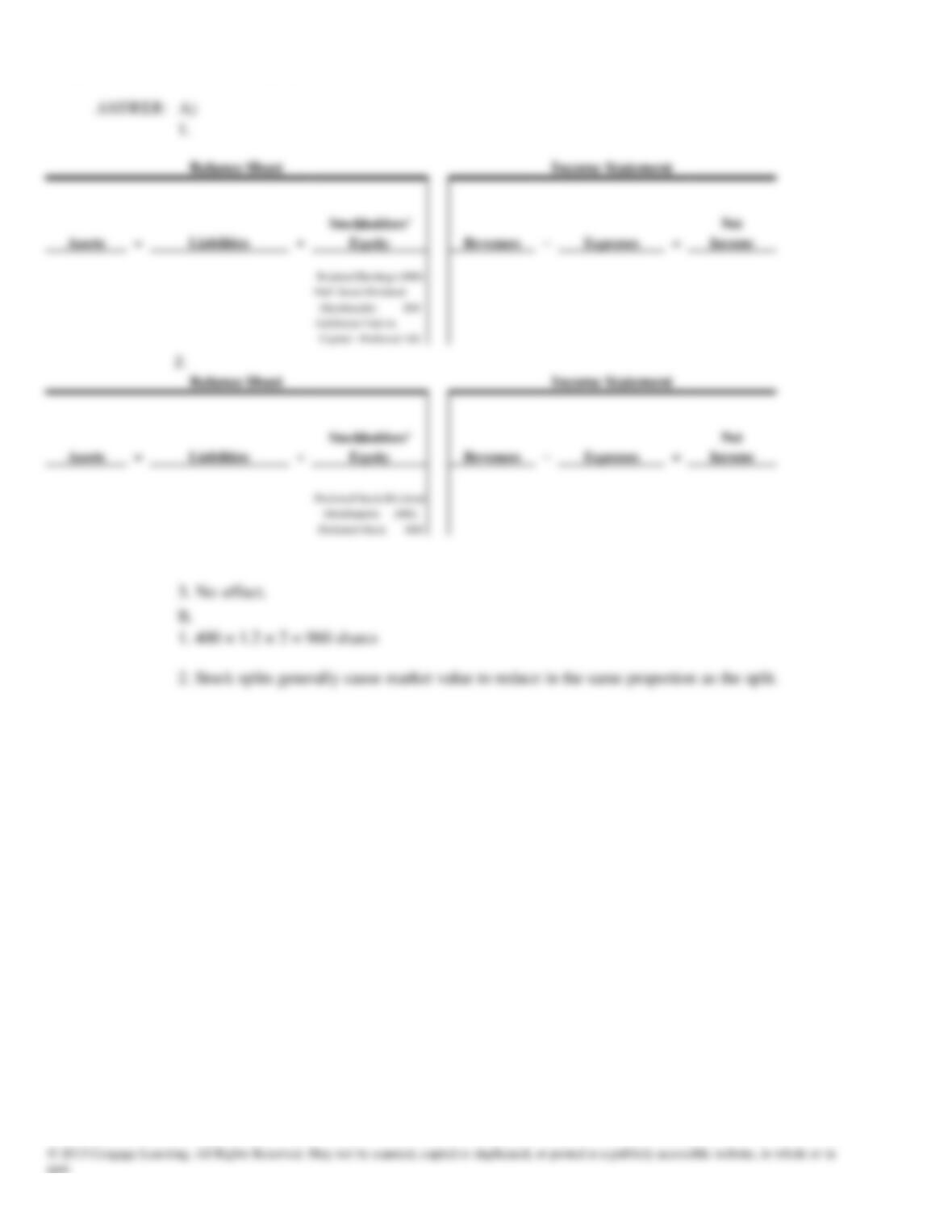
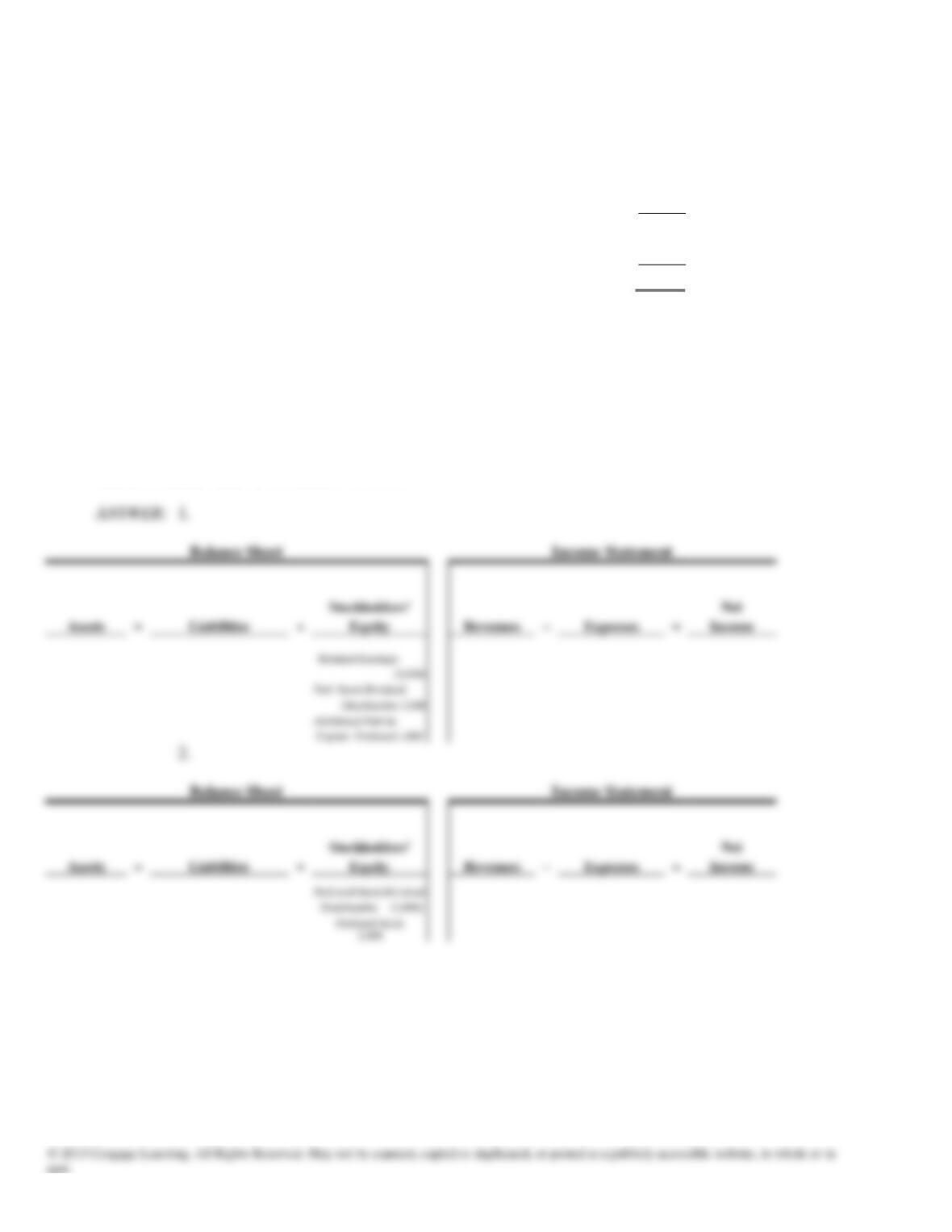
A) Show the effect of the transactions on the accounting equation.
Balance Sheet
Income Statement
Assets
=
Liabilities
+
Stockholders’
Equity
Revenues
–
Expenses
=
Net
Income
B) Answer the following questions:
1. How many common shares are outstanding at December 31, 2015?
2. What effect will the stock split have on the stock‘s market value?
Chapter 11: Stockholders’ Equity
Chapter 11: Stockholders’ Equity
164. Albion Company reported the following amounts on its balance sheet at January 1, 2015:
Preferred stock, $10 par, 5%, 1,000 shares issued and outstanding
$10,000
Common stock, $1 par, 8,000 shares issued and outstanding
8,000
Additional paid-in capital—common
52,000
Total contributed capital
$70,000
Retained earnings
22,000
Total stockholders’ equity
$92,000
The following transactions occurred during 2015:
1. Declared a 20% stock dividend on preferred stock on May 21, when the stock was selling at
$15 per share. The stock dividend will be distributed on June 30, 2015.
2. Distributed the preferred stock dividend on June 30.
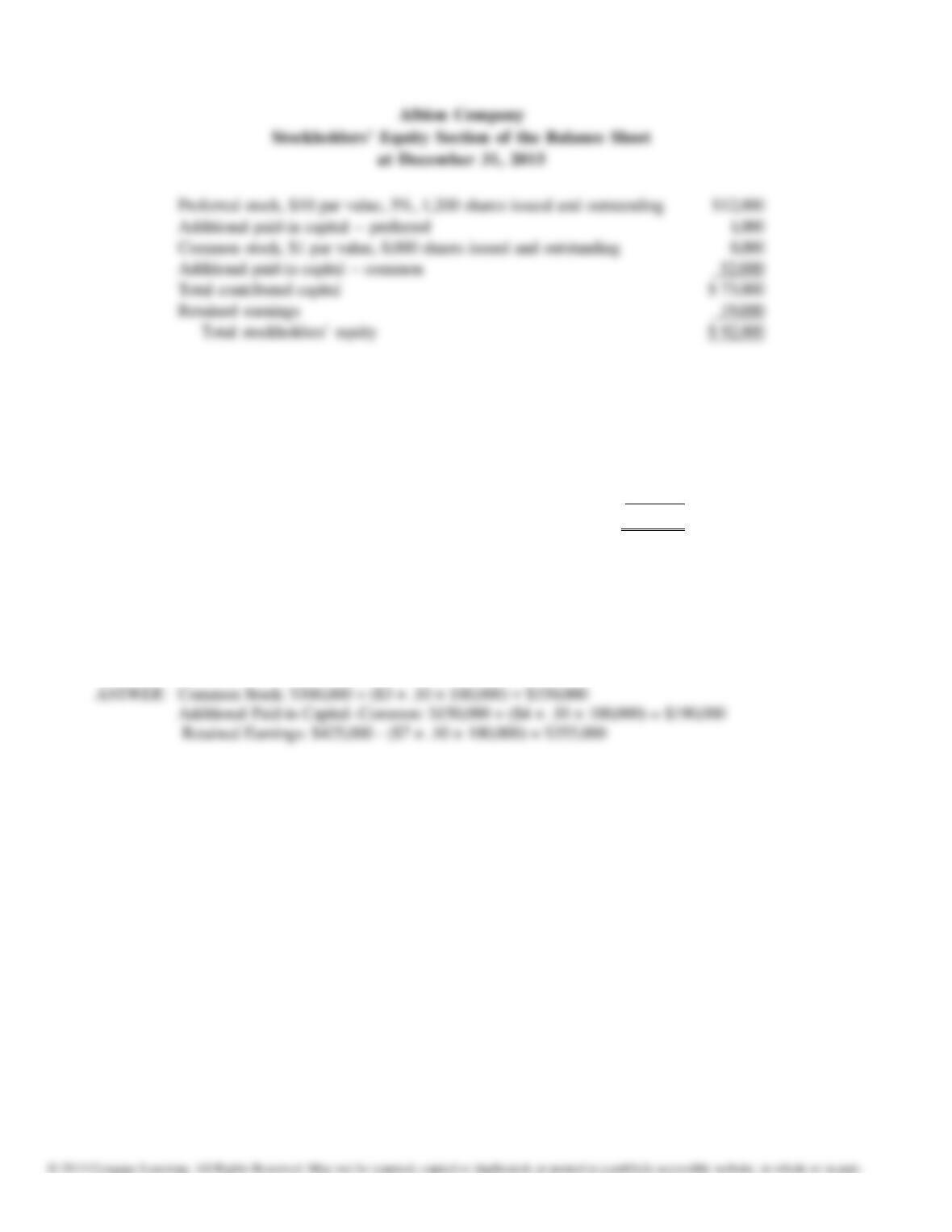
Show the effects of the transactions on the accounting equation and prepare the stockholders‘ equity section of
Albion’s balance sheet at December 31, 2015.
Chapter 11: Stockholders’ Equity
165. The Stockholders‘ Equity section of the balance sheet for High Five Design Company appeared as follows before
its recent stock dividend:
Common stock, $3 par, 100,000 shares issued and outstanding
$300,000
Additional paid-in capital—common
150,000
Retained earnings
425,000
Total stockholders’ equity
$875,000
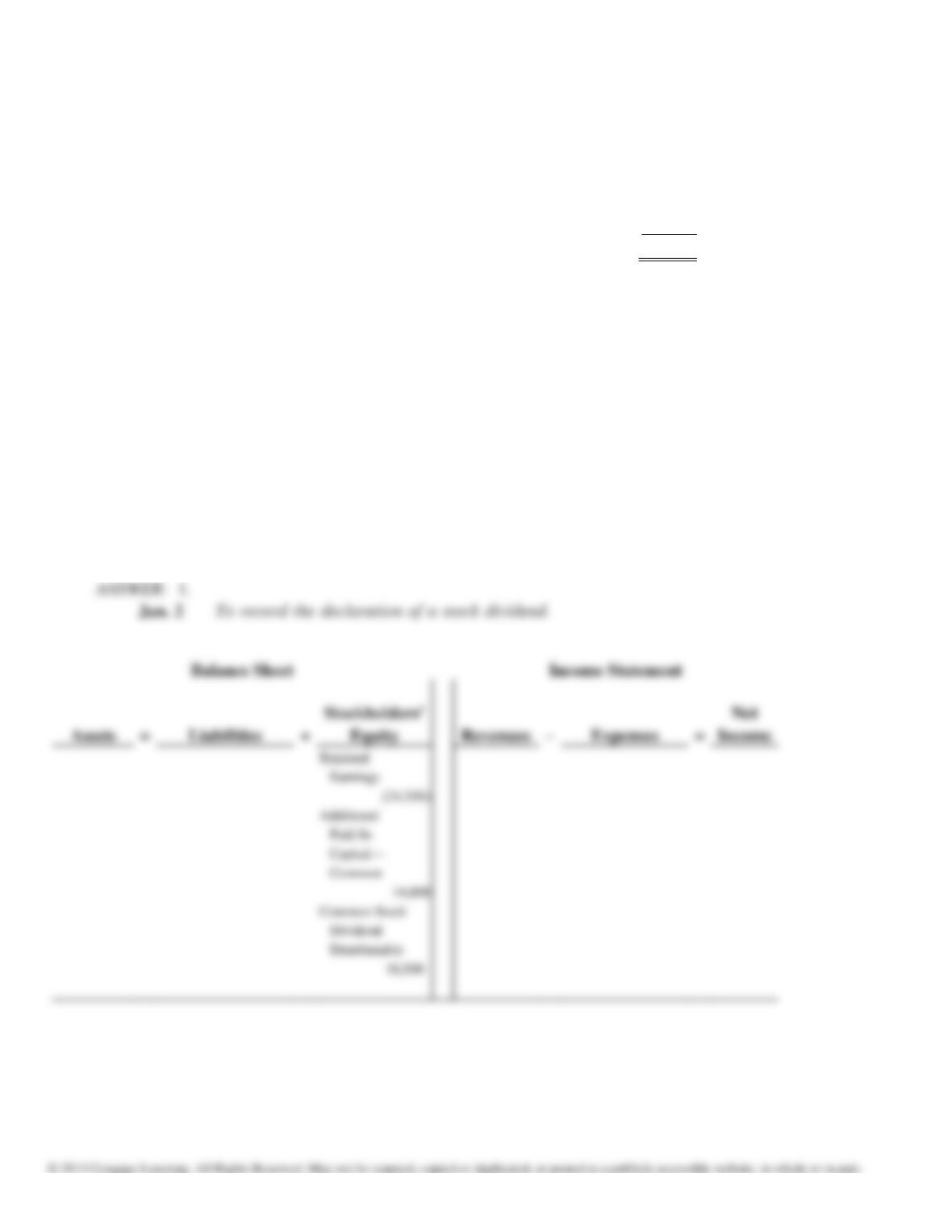
High Five declared a 10% stock dividend when the market price per share was $7. In the space provided, write in
the amounts of each of the components of the stockholders’ equity section, after the stock dividend was distributed.
Common stock $________________________
Additional paid-in capital — Common stock $________________________
Retained earnings $________________________
Chapter 11: Stockholders’ Equity
166. Assume that Wei Company’s Stockholders’ Equity category of the balance sheet appears as follows as of
January 1, 2015:
Common stock, $15 par, 7,000 shares issued and outstanding
$105,000
Additional paid–in capital—Common
70,000
Retained earnings
300,000
Total stockholders’ equity
$475,000
Assume that Wei’s common stock is selling at $35 per share on that date.
REQUIRED:
1. Assume that on January 2, 2015, Wei declares a 10% stock dividend to common stockholders to be distributed
on April 1, 2015. Identify the accounting equation effects of the transaction on Wei’s books.
2. Instead of (1) above, assume that on January 2, 2015, Wei declares a 100% stock dividend to be distributed on
April 1, 2015.
Identify the accounting equation effects of the transaction on Wei’s books.
3. What are the accounting equation effects on Wei’s books when the stock in (2) above, is actually distributed?
Chapter 11: Stockholders’ Equity
Chapter 11: Stockholders’ Equity
167. Assume that Milo Company’s Stockholders’ Equity category of the balance sheet appears as follows as of January
1, 2015:
Common stock, $15 par, 7,000 shares issued and outstanding
$105,000
Additional paid–in capital—Common
70,000
Retained earnings
30,000
Total stockholders’ equity
$205,000
Assume that Milo’s common stock is selling at $35 per share on that date.
REQUIRED:
What is the effect on the Stockholders’ Equity section of Milo’s balance sheet if the company issues a 3-for-1
stock split on January 2, 2015?
168. Park Avenue Toys reported the following information at December 31, 2015:
Common stock, $3 par, 10,000 shares authorized
$ 30,000
Additional paid-in capital—common
80,000
Retained earnings
40,000
Total contributed capital and retained earnings
$150,000
Less: Treasury stock (5,000 common shares at cost)
(10,000)
Total stockholders‘ equity
$140,000
Answer the following questions for Park Avenue Toys.
1. Would the book value per share increase, decrease, or remain the same, if the company declared a 3-for-1
stock split on December 31, 2015? Explain.
2. If cash dividends were declared on January 10, 2016, at $1 per share, by how much would retained earnings
decrease as a result? (Assume that the 3-for-1 stock split occurred.)
Chapter 11: Stockholders’ Equity
169. Marvin’s Shrimp Restaurant incorporated as a new business on January 1, 2015. The company is authorized to issue
40,000 shares of $1 par value common stock, and 10,000 shares of 4%, $5 par value, cumulative, participating
preferred stock. On January 1, 2015 the company issued 15,000 shares of common stock for $8 per share. Net
income for the year ended December 31, 2015, was $115,000. Cash dividends in the amount of $30,000 were
declared, but only $25,000 were paid as of year-end. Prepare the stockholders‘ equity section of the balance sheet
for Marvin’s Shrimp Restaurant at December 31, 2015.
Preferred stock, 4%, $5 par value, cumulative, participating,
Common stock, $1 par value, 40,000 shares authorized,
15,000 shares issued and outstanding
Retained earnings
170. Use the comparative financial statements of Penny Company for the year ended December 31, 2015 to
answer the following question(s).
Penny Company
Statement of Stockholder’s Equity
for the Year Ended December 31, 2015
.
in thousands, except share data
Common Stock
Retained
Treasury Stock
Shares
Amount
Earnings
Shares
Amount
Total
Balance, Jan. 1, 2010
57,936,988
$ 89,861
$20,037
$109,898
Exercise of stock options
including tax benefit of $4,754
945,780
7,911
7,911
Sale of common stock
12,050,000
163,873
163,873
Stock subscription notes
repayments
3,671
3,671
Conversion of convertible
debentures, net
6,798
100
100
Sale of common stock under
employee stock purchase plan
17,424
263
263
Net earnings
26,102
26,102
Unrealized holding gains, net
141
141
Translation adjustment
272
272
Balance Dec. 31, 2010
70,956,990
$265,679
$46,552
0
$ 0
$312,231
See notes to consolidated financial statements.
Chapter 11: Stockholders’ Equity
REQUIRED:
(1) What is the primary cause of the change in Penny’s stockholders’ equity from January 1, 2015 to December 31,
2015?
(2) Did Penny declare dividends during 2015? How do you know? Which items would be included as part of
comprehensive income, if any?
171. Use the comparative financial statements of Penny Company for the year ended December 31, 2015 to
answer the following question.
Penny Company
Statement of Stockholder’s Equity
for the Year Ended December 31, 2015
in thousands, except share data
Common Stock
Retained
Treasury Stock
Shares
Amount
Earnings
Shares
Amount
Total
Balance, Jan. 1, 2010
57,936,988
$ 89,861
$20,037
$109,898
Exercise of stock options
including tax benefit of $4,754
945,780
7,911
7,911
Sale of common stock
12,050,000
163,873
163,873
Stock subscription notes
repayments
3,671
3,671
Conversion of convertible
debentures, net
6,798
100
100
Sale of common stock under
employee stock purchase plan
17,424
263
263
Net earnings
26,102
26,102
Unrealized holding gains, net
141
141
Translation adjustment
272
272
Balance Dec. 31, 2010
70,956,990
$265,679
$46,552
0
$ 0
$312,231
See notes to consolidated financial statements.
Chapter 11: Stockholders’ Equity
REQUIRED:
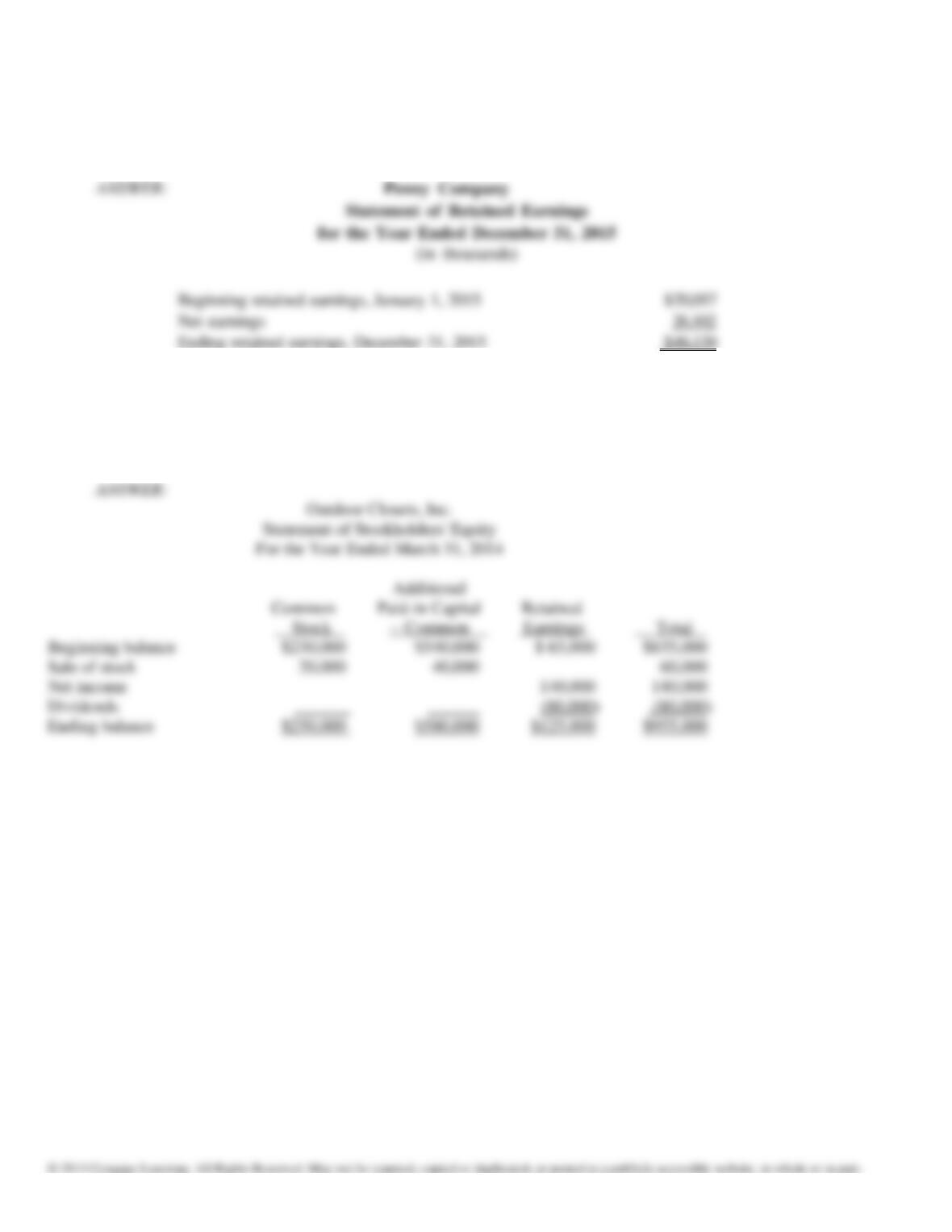
Prepare a statement of retained earnings for the year ended December 31, 2015.
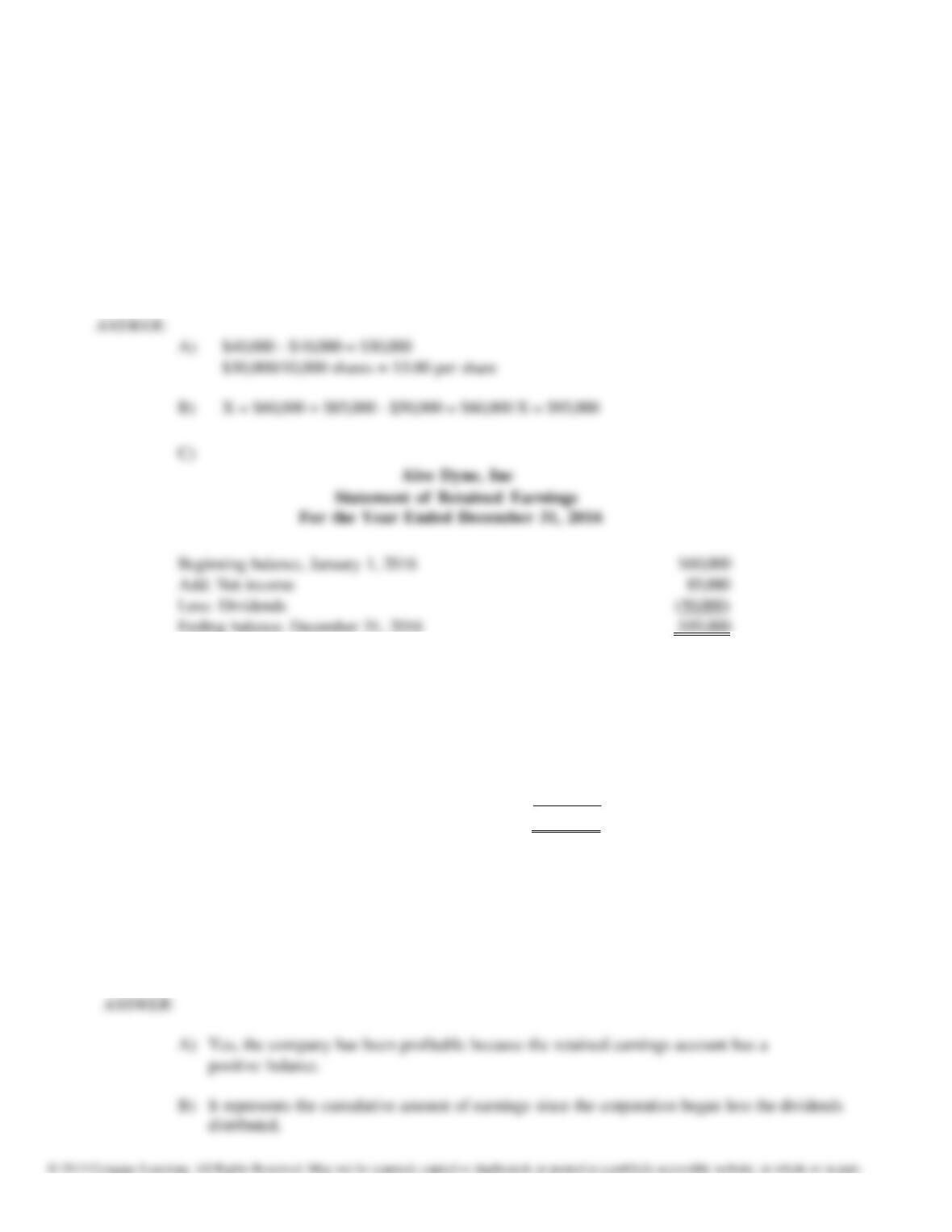
172. On March 31, 2015, Outdoor Closets, Inc. had common stock of $230,000, retained earnings of $65,000, and
additional paid-in capital—common of $540,000. During the fiscal year ended March 31, 2016, 500 shares of stock
were sold for $60,000, of which $40,000 represented additional paid-in capital. The company reported net income of
$140,000 and declared and paid dividends of $80,000. In good form, prepare the financial statement that shows all of
the changes in the stockholders‘ equity accounts.
Chapter 11: Stockholders’ Equity
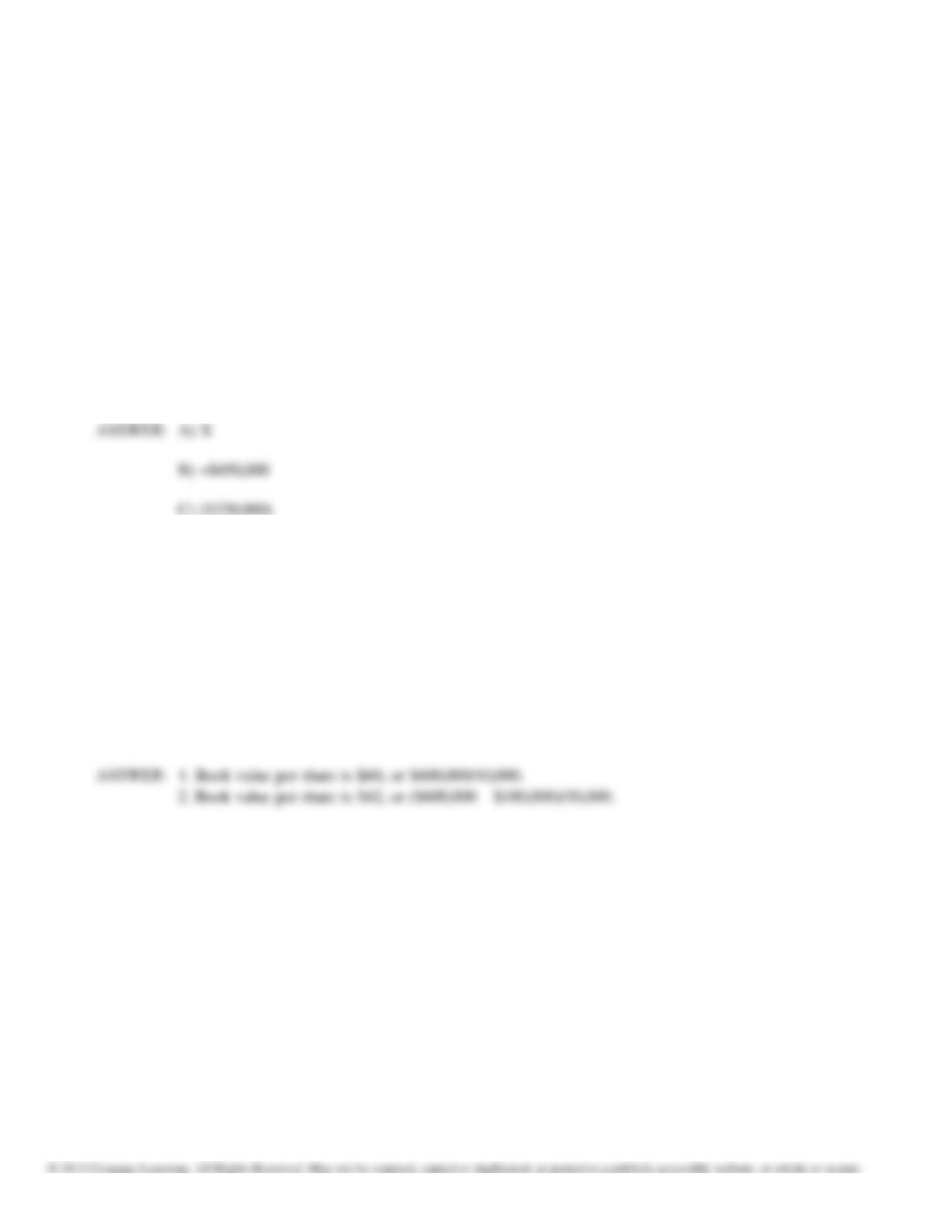
173. On December 31, 2015, Aire Dyne, Inc. reported common stock of $120,000, retained earnings of $60,000, and total
stockholders’ equity equal to $500,000. No unusual accounts appeared in the stockholders‘ equity section of its
balance sheet. During the fiscal year ended December 31, 2016, 10,000 shares of stock were sold for $40,000, of
which $10,000 represented additional paid-in capital. The company reported net income of $85,000 and declared and
paid dividends of $50,000.
A) What is the par value of the stock?
B) What is the amount of the retained earnings at December 31, 2016?
C) Prepare a statement of retained earnings for Aire Dyne, Inc. for the year ended December 31, 2016, in good
form.
Ending balance, December 31, 2016
$95,000
174. The following stockholders‘ equity section of Petal Pusher Company’s balance sheet appeared at December 31,
2015.
Common stock, $1 par value, 200,000 shares issued
$200,000
Additional paid-in capital—common
800,000
Retained earnings
450,000
Total stockholders’ equity
$1,450,000
Answer the following:
A) Has the company been profitable since its inception? How do you know?
B) What does the balance in retained earnings represent?
Chapter 11: Stockholders’ Equity
175. Several transactions occurred for Shadow Dreams Corporation during 2015. Indicate the effect each item has
directly on retained earnings by writing the amount in the space provided. Place a + (plus sign) in front of the amount
if the item increases retained earnings, or ( ) parentheses around the amount if the item decreases retained earnings.
Place an X in the blank for items that have no direct effect on retained earnings. (Items that affect the income
statement do not directly affect retained earnings.)
A)
____
A tornado completely destroyed the company’s warehouse on March 1. The
original cost was $300,000, and the book value was $160,000 on that date. The
company had no insurance on the warehouse.
B)
____
Shadow Dreams earned net income in the amount of $450,000 for the year ending
December 31, 2012.
C)
____
Shadow Dreams declared and paid $320,000 of cash dividends to common and
preferred stockholders during 2012.
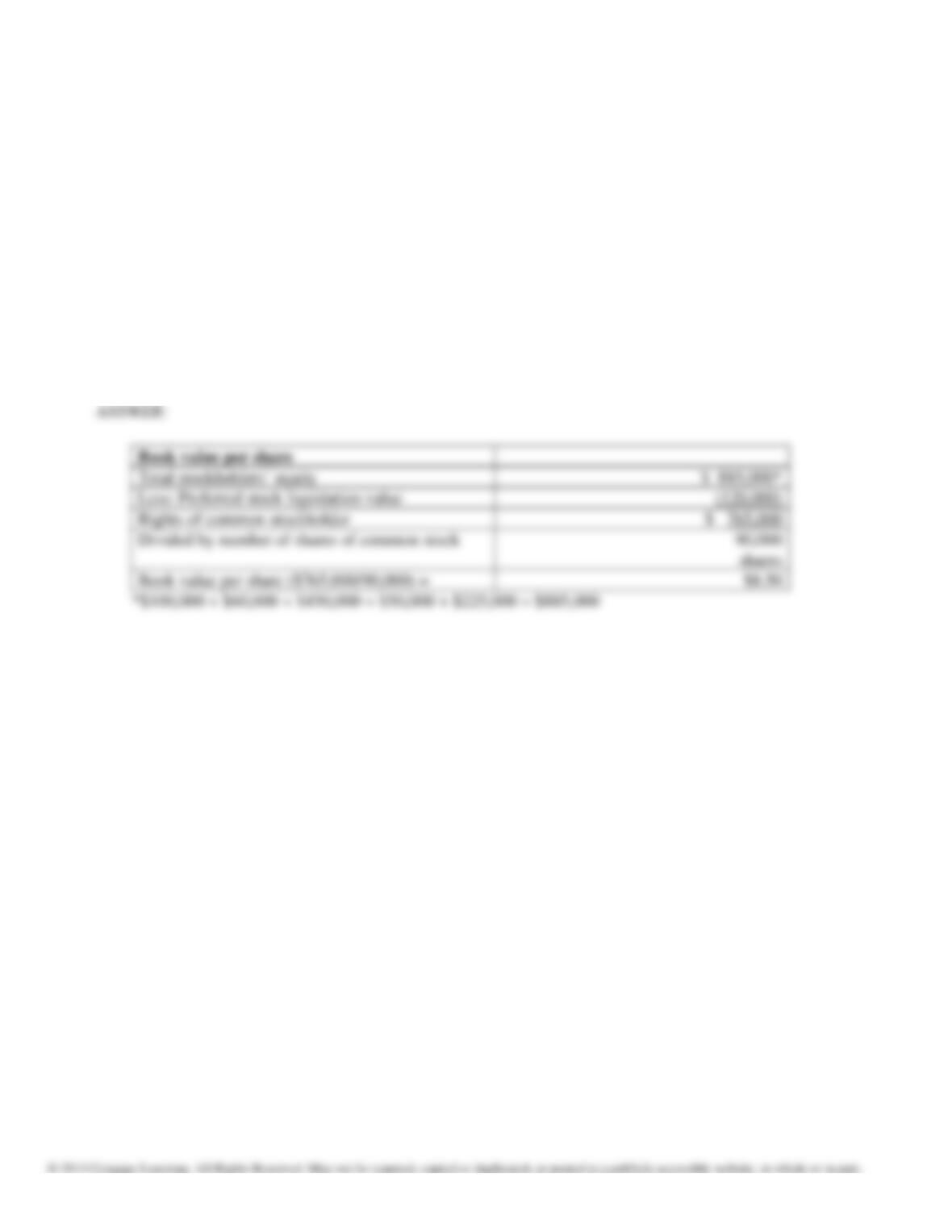
176. Assume the following independent situations:
1. Company A has total stockholders’ equity at year-end of $600,000 and has 10,000 shares of stock.
2. Company B has total stockholders’ equity at year-end of $600,000 and has 10,000 shares of stock. The company
also has 60,000 shares of preferred stock, which has a $1 par value and a liquidation value of $3 per share.
Required:
Calculate the book value per share for Company A and Company B.
Chapter 11: Stockholders’ Equity
177. Heather Valley Company has the following amounts in the Stockholders’ Equity category of the balance sheet at
December 31, 2015:
Preferred Stock, $100 par, 8%, noncumulative (liquidation value of $120 per share)
$100,000
Paid-In Capital—Preferred
60,000
Common Stock, $5 par
450,000
Paid-In Capital—Common
50,000
Retained Earnings
225,000
REQUIRED:
Determine the book value per share of the Heather Valley Company stock.
Chapter 11: Stockholders’ Equity
178. Information taken from the accounting records of Airways, Inc., for the year ended December 31, 2015, appears in
the table below. In the space provided, indicate in which section of the statement of cash flows (investing or
financing) each item would be reported, and whether the item is a cash inflow or outflow. If an item is neither an
investing activity or financing activity, place an X in the box.
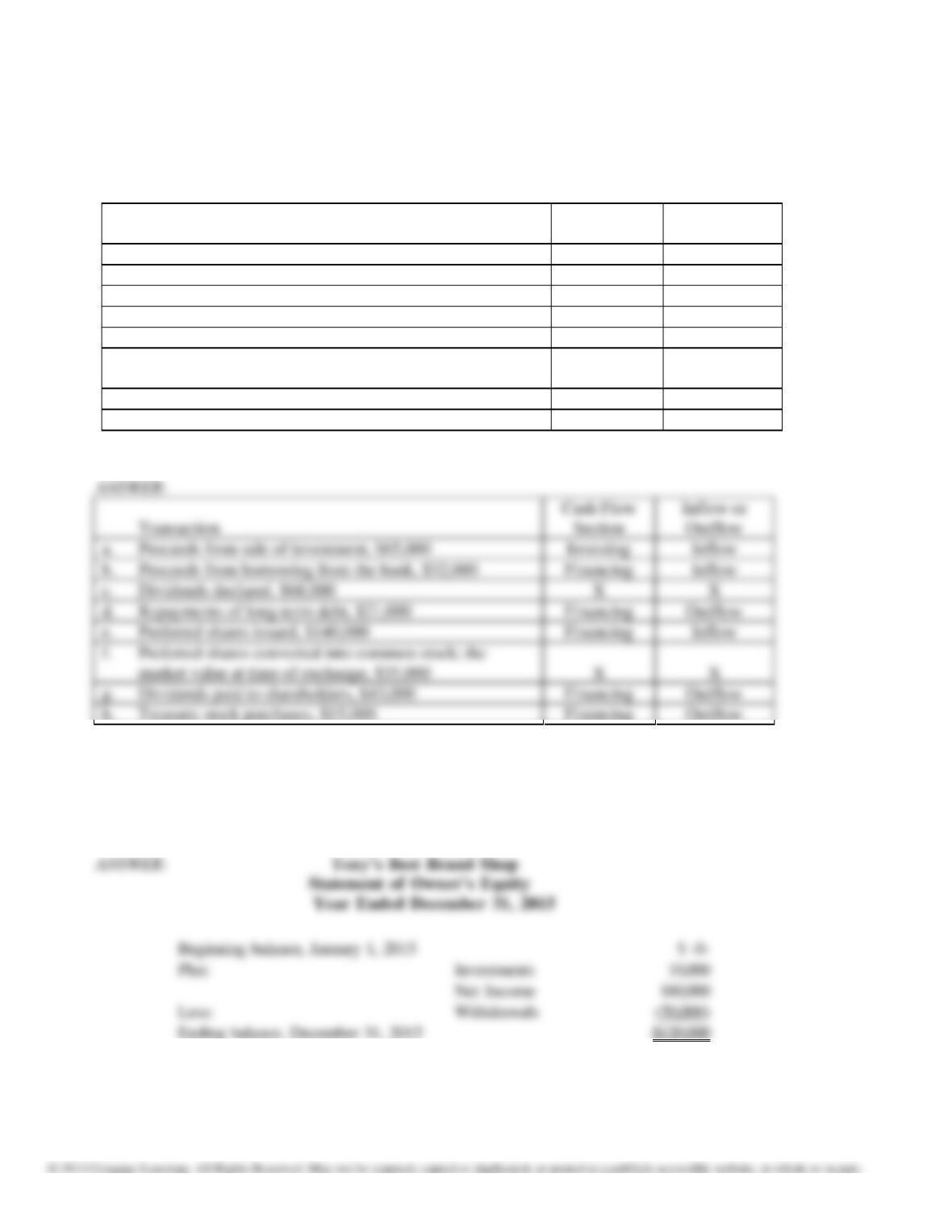
Transaction
Cash Flow
Section
Inflow or
Outflow
a.
Proceeds from sale of investment, $65,000
b.
Proceeds from borrowing from the bank, $32,000
c.
Dividends declared, $68,000
d.
Repayments of long-term debt, $21,000
e.
Preferred shares issued, $140,000
f.
Preferred shares converted into common stock; the
market value at time of exchange, $35,000
g.
Dividends paid to shareholders, $43,000
h.
Treasury stock purchases, $15,000
Transaction
Cash Flow
Inflow or
a.
Proceeds from sale of investment, $65,000
b.
Proceeds from borrowing from the bank, $32,000
c.
Dividends declared, $68,000
d.
Repayments of long-term debt, $21,000
e.
Preferred shares issued, $140,000
Preferred shares converted into common stock; the
market value at time of exchange, $35,000
g.
Dividends paid to shareholders, $43,000
h.
Treasury stock purchases, $15,000
179. [APPENDIX] Tony Venato opened Tony’s Best Brand Shop as a sole proprietorship by investing $10,000 on
January 1, 2015. During the first year, the business earned revenues of $520,000 and incurred expenses of
$360,000. Tony withdrew $50,000 for personal use. Prepare Tony’s statement of owner’s equity for the year ended
December 31, 2015.