CHAPTER 11 – SECURITY THROUGH DISASTER RECOVERY
TRUE/FALSE
1. There are two types of UPS systems that are commonly marketed: onsite and offsite.
2. An online UPS normally regulates power to provide insurance for brownouts as well as outages.
3. Red Hat Linux 9.x supports the implementation of a UPS through the use of the /sbin/powerd utility.
4. In Netware, the AIOCOMX NLM is the software used to configure the communications parameters
for a UPS.
5. Windows 2000, Windows XP Professional, Windows Server 2003, Red Hat Linux 9.x, Mac OS X, and
NetWare 6.x all support multiprocessor systems.
6. Windows 2000 Server, Windows Server 2003, Red Hat Linux 9.x, and NetWare 6.x all have versions
or add-on software to enable clustering.
7. DFS is configured using the Distributed File System tool in the Administrative Tools menu in
Windows 2000 Server.
8. With disk striping, there are two separate drives for each disk volume of data.
9. RAID is a set of standards for lengthening disk life and preventing data loss.
10. Windows 2000 Server and Windows Server 2003 support only RAID levels 0, 1, and 5 for disk fault
tolerance.
MODIFIED TRUE/FALSE
1. An online UPS connects city power directly to the electrical equipment until it senses a sudden
reduction in power, at which time it switches over to batteries. _________________________
2. In the command “ups_aio msgdelay=300 downtime=600″ a power outage warning is sent to all users
within 10 minutes of a power outage. _________________________
3. The NIC is a device, in the form of a card, that enables a computer or network equipment to attach to
the network. _________________________
4. Transmission control firmware is software stored on a chip in the NIC that enables packets and frames
to be correctly formatted for a specific protocol, for example, TCP/IP. _________________________
5. Clustered computers are frequently used to provide uninterrupted service when one computer fails, and
to provide a means to expand processing power, storage, and RAM when an existing system is
overloaded. _________________________
6. In the shared disk model, if one computer fails, the resources that it owns can be taken over by a
different computer in the cluster that is still operational. _________________________
7. In Windows Server 2003, DFS can be used to place copies of the same folders on two or more
computers in different locations. _________________________
8. A significant disadvantage to using level 2 striping is that if one disk fails, you can expect a large data
loss on all volumes. _________________________

9. In Windows Server 2003, all three RAID levels support FAT and NTFS formatted disks.
_________________________
10. In Windows Server 2003, striped dynamic disks are called a striped volume.
_________________________
MULTIPLE CHOICE
1. Which of the following is a type of UPS?
a.
Online
d.
Both a and b
b.
Offline
e.
a, b, and c
c.
Inline
2. Which of the following devices should not be plugged into a UPS?
a.
Computer
c.
Router
b.
Monitor
d.
Laser printer
3. What type of connection does a UPS use to communicate with a computer?
a.
Serial
c.
Network
b.
Parallel
d.
Electrical
4. In Red Hat Linux 9.x, what should be used to communicate with a UPS?
a.
/etc/sysconfig/ups file
b.
/sbin/powerd utility
c.
UPS manufacturer’s configuration software
d.
UPS Manager utility
5. Which UPS_AIO configuration option displays a brief description of the options used with the
UPS_AIO NLM?
a.
path
c.
description
b.
options
d.
?
6. Which UPS_AIO configuration option is the interval between multiple warning messages sent to all
users?
a.
msgdelay=seconds
c.
msginterval=milliseconds
b.
msginterval=seconds
d.
msgdelay=milliseconds
7. Which of the following connectors are available on NICs?

a.
Wireless
d.
Fiber-optic
b.
Coax
e.
All of the above
c.
Twisted-pair
8. Which NIC component works with protocol control firmware installed in the NIC to construct packets
and frames for transmission?
a.
An appropriate connector for the network medium
b.
A transceiver
c.
A MAC controller
d.
Protocol control firmware
9. Which of the following NIC components encapsulate source and destination address information?
a.
Protocol control firmware
b.
A MAC controller
c.
An appropriate connector for the network medium
d.
Both a and b
e.
Both b and c
10. At which layer of the OSI model does the MAC controller work?
a.
Physical
c.
Network
b.
Data Link
d.
Transport
11. Which of the following types of servers should have redundant power supplies installed?
a.
SMTP mail
d.
Database
b.
Global catalog
e.
All of the above
c.
Web
12. What is the maximum number of processors supported by Windows XP Professional?
a.
1
c.
4
b.
2
d.
8
13. What is the maximum number of processors supported by Windows Server 2003 Datacenter Edition?
a.
8
c.
32
b.
16
d.
64
14. Which clustering model is one in which all servers equally share resources that include disk, CD-
ROM, and tape storage?
a.
Shared disk
c.
Shared network
b.
Shared server
d.
Shared none
15. A _____ is a duplicate of some or all of a main databases data.
a.
data mine
c.
data warehouse
b.
data cluster
d.
data farm
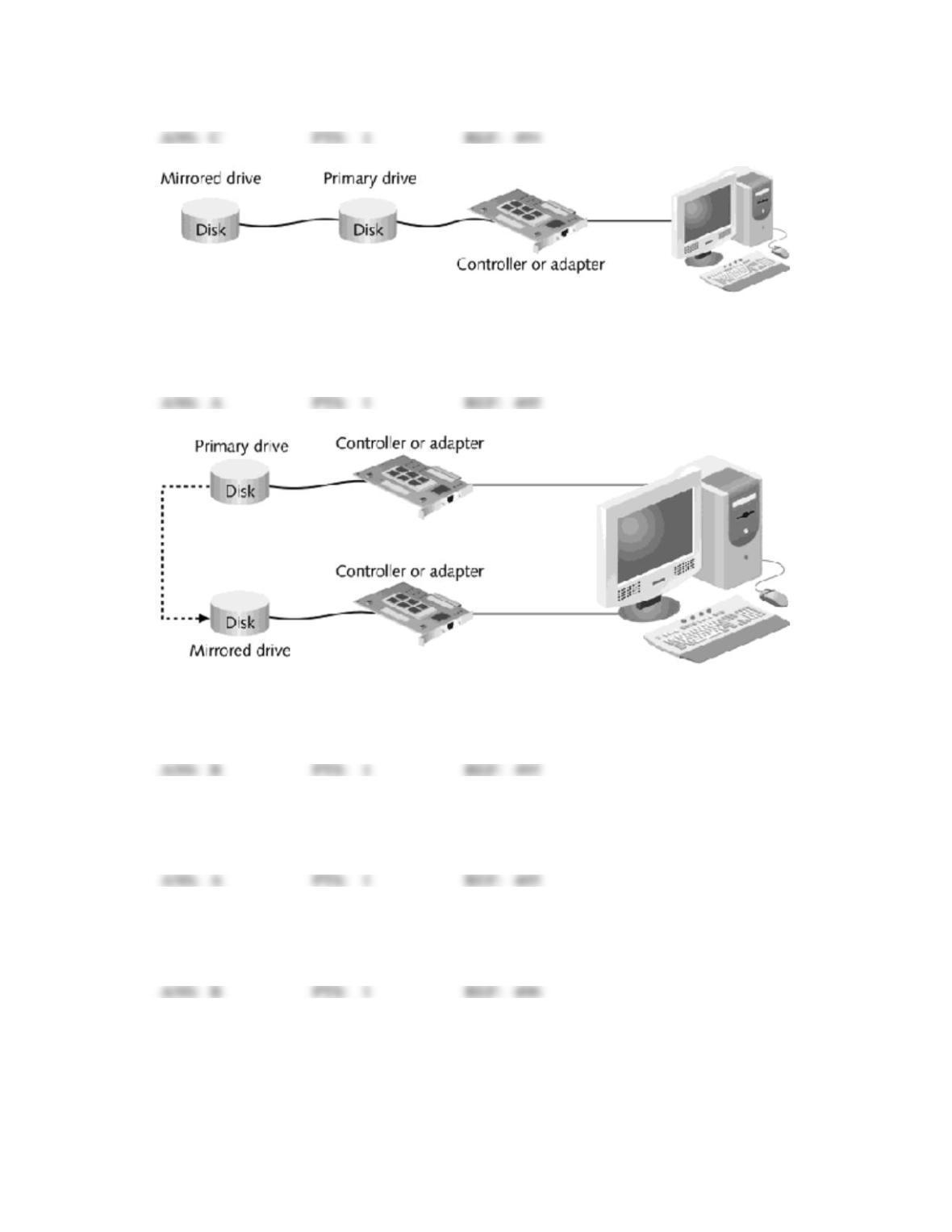
16. The figure above is an example of what type of fault tolerance?
a.
Disk mirroring
c.
Disk striping
b.
Disk duplexing
d.
Disk partitioning
17. The figure above is an example of what type of fault tolerance?
a.
Disk mirroring
c.
Disk striping
b.
Disk duplexing
d.
Disk partitioning
18. In which level of RAID is there striping with no other redundancy features?
a.
0
c.
2
b.
1
d.
5
19. In which level of RAID is disk mirroring and disk duplexing employed?
a.
0
c.
3
b.
1
d.
5
20. Which level of RAID uses an array of disks where the data are striped across all disks in the array but
does not store a checksum?
a.
1
c.
3
b.
2
d.
4

21. Which level of RAID uses disk striping and stores error-correcting information, but the information is
only written to one disk in the array?
a.
0
c.
2
b.
1
d.
3
22. Which level of RAID can perform checksum verification?
a.
3
d.
Both a and b
b.
4
e.
Both b and c
c.
5
23. Which level of RAID spreads both error correction and checksum data over all of the disks, so there is
no single point of failure?
a.
2
c.
4
b.
3
d.
5
24. Which levels of RAID are recommended for use in Windows 2000 Server?
a.
0
d.
Both b and c
b.
1
e.
a, b, and c
c.
5
25. In Windows Server 2003, what is the maximum number of disks that can be incorporated into one
spanned volume?
a.
8
c.
32
b.
16
d.
64
26. Which of the following file systems can dynamic disks be formatted for?
a.
FAT
c.
NTFS
b.
FAT32
d.
All of the above
27. In Windows 2000, how many hard disks can RAID level 1 use?
a.
1
c.
3 to 5
b.
2
d.
3 to 16
28. In Windows 2000, how many hard disks can RAID level 5 use?
a.
2 to 32
c.
3 to 64
b.
3 to 32
d.
5 to 32
29. When using RAID level 1, how much of the disk space is used for redundancy?

a.
25%
c.
50%
b.
33%
d.
66%
30. Which level of RAID is supported by Red Hat Linux?
a.
0
d.
Both a and b
b.
1
e.
a, b, and c
c.
5
31. Which levels of RAID are supported by Mac OS X?
a.
0
d.
Both a and b
b.
1
e.
Both b and c
c.
5
32. Which of the following is not an advantage of hardware RAID?
a.
Faster read and write response
b.
More expensive to implement
c.
The ability to hot swap a failed disk with one that works
d.
More setup options to retrieve damaged data and to combine different RAID levels
33. Which of the following types of backups can be performed by Windows XP?
a.
Normal
c.
Distributed
b.
Essential
d.
File System
34. Which Netware TSA is used for Netware 6.x?
a.
TSA600
c.
GWTSA
b.
TSANDS
d.
W95TSA
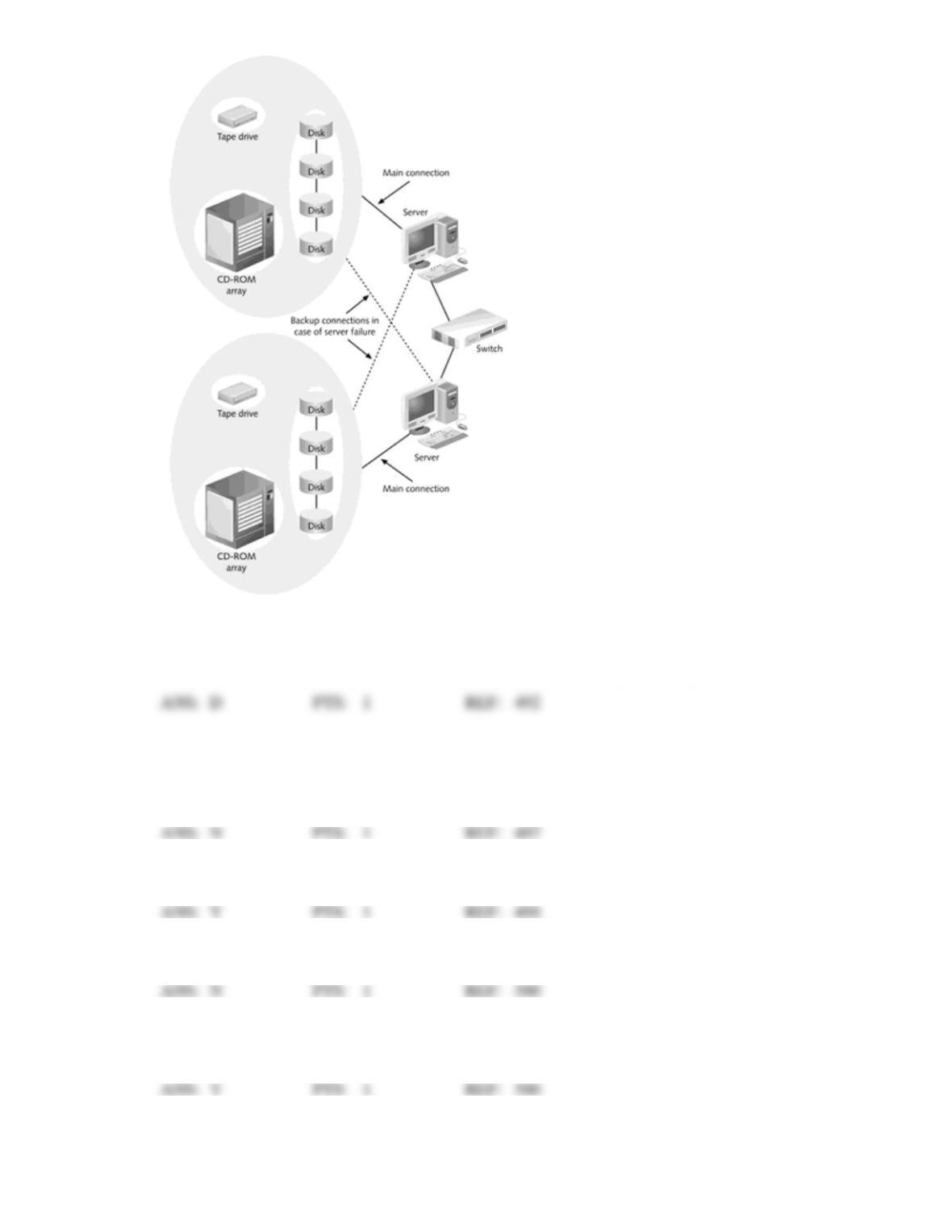
35. What is displayed in the figure above?
a.
Shared disk clustering model
c.
Shared network clustering model
b.
Shared server clustering model
d.
Shared nothing clustering model
YES/NO
1. Does a dynamic disk use traditional disk management techniques?
2. Can RAID be configured when you install Red Hat Linux 9.x using the GUI installation mode?
3. In NetWare 6.x, do you use NDS tools from ConsoleOne to manage RAID?
4. Can the NSSMU be used for configuring RAID during the installation of the Netware 6.5 operating
system, as well as after it is installed?
5. Does Apple recommend that you place the boot files on the RAID disks when configuring Mac OS X
for fault tolerance?
6. Is one of the disadvantages of binary backups the fact that in many versions you cannot restore
individual files or directories, and when you perform a restore, the target disk drive must be the same
size or larger than the disk drive from which the backup was made?
7. Is a differential backup one in which the entire system, including all system files, programs, and data
files are backed up?
8. Does the daily backup option back up only files that have been changed or updated on the day the
backup is performed?
9. Was the dump backup utility designed for archiving tapes, since it includes file information as well as
the archived files?
10. Does Mac OS X support the use of dump and tar, in a way that is identical to Red Hat Linux 9.x and
many other UNIX systems?
COMPLETION
1. In Red Hat Linux, the disk ____________________ utility enables you to manually configure the disk
configuration options, including RAID.
2. NetWare 6.5 offers _____________________, which is a browser tool for managing objects in
NetWare.
3. ____________________ RAID implements fault tolerance through the computer’s operating system.
4. The advantage of ____________________ backup is that it is simple to perform and includes
everything on the disk.
5. A(n) ____________________ backup is a backup of all files that you have selected, usually an entire
partition or volume.
6. In UNIX/Linux, ____________________ is a binary backup that creates a mirror image of a disk onto
the backup medium, such as a tape or CD-R/CD-RW.
7. In UNIX/Linux, the ____________________ utility backs up either all files, files that have changed
by date, or files that have changed after the previous backup.
8. In Netware, ____________________ is used to back up the NDS database and eDirectory.
9. NetWare has long had the ____________________ System to protect files and databases in case of an
unexpected system crash or power failure.
10. The disadvantage of a(n) ____________________ UPS is that it may not switch to battery power in
time to fully protect equipment during a sudden power failure.
MATCHING
Match the following terms to the appropriate definition.
a.
Clustering
f.
Incremental backup
b.
Differential backup
g.
Striping
c.
Disk duplexing
h.
SMP
d.
Disk mirroring
i.
Tower of Hanoi
e.
Fault tolerance
j.
Full file-by-file backup
1. Prevents data loss by duplicating data from a main disk to a backup disk
2. Backs up all files and removes the archive attribute
3. Backs up all files but does not remove the archive attribute
4. Backup rotation scheme designed to extend the life of the backup media
5. A type of computer with two or more CPUs
6. Hardware and software used to provide assurance against equipment failure
7. Backs up the entire contents of one or more disk drives on the basis of directories, subdirectories, and
files
8. Linking two computer systems to appear to function as though they are one
9. Breaks up data files across all volumes of a disk set
10. Places the backup disk on a different controller than is used by the main disk
SHORT ANSWER
1. What four advantages does hardware RAID offer over software RAID?
2. What are the four advantages to performing backups from a tape or CD-R/CD-RW drive installed in a
local computer rather than a remote computer?
3. What are the five different types of backups that the Windows Server 2003 backup tool enables you to
perform?
4. List the five TSAs that are loaded at the Netware Server Console prior to starting a backup.
5. What five options are available for UPS configuration in Power Options on a Windows 2000
computer?
6. List the five methods of implementing hardware redundancy.
7. What four components does a network connection require?
8. Other than encapsulation, what three other functions does a MAC controller perform?
9. What five issues should be considered when choosing a NIC?
10. What six advantages does Windows Server 2003 DFS provide?