
FOR INSTRUCTOR USE ONLY
CHAPTER 11
REPORTING AND ANALYZING STOCKHOLDERS’ EQUITY
SUMMARY OF QUESTIONS BY LEARNING OBJECTIVE AND BLOOM’S TAXONOMY
Item
LO
BT
Ite
m
LO
BT
Item
LO
BT
Item
LO
BT
Item
LO
BT
True-False Statements
1.
1
K
11.
2
K
21.
3
K
31.
5
K
41.
7
K
2.
1
K
12.
2
K
22.
3
C
32.
5
K
42.
8
K
3.
1
K
13.
2
K
23.
3
K
33.
5
K
43.
8
K
4.
1
K
14.
2
K
24.
4
K
34.
6
K
*44.
9
K
5.
1
K
15.
2
K
25.
4
K
35.
6
K
*45.
9
K
6.
1
K
16.
2
K
26.
4
K
36.
6
K
*46.
9
C
7.
1
K
17.
3
K
27.
5
K
37.
6
K
8.
1
K
18.
3
K
28.
5
K
38.
6
K
9.
1
K
19.
3
K
29.
5
K
39.
6
K
10.
2
K
20.
3
K
30.
5
C
40.
7
K
Multiple Choice Questions
47.
1
K
81.
2
AP
115.
5
K
149.
5
AP
183.
7
AP
48.
1
K
82.
2
AP
116.
5
AP
150.
5
AP
184.
7
AP
49.
1
K
83.
2
K
117.
5
AP
151.
5
AP
185.
7
K
50.
1
K
84.
2
C
118.
5
K
152.
5
AP
186.
7
K
51.
1
K
85.
2
K
119.
4
AP
153.
5
AP
187.
7
K
52.
1
K
86.
2
AP
120.
4
C
154.
5
K
188.
7
K
53.
1
K
87.
2
AP
121.
5
AP
155.
5
K
189.
7
K
54.
1
K
88.
2
AP
122.
5
AP
156.
5
K
190.
7
K
55.
1
K
89.
2
K
123.
5
K
157.
5
K
191.
8
K
56.
1
C
90.
2
AP
124.
5
K
158.
5
K
192.
8
K
57.
1
K
91.
2
C
125.
5
K
159.
5
K
193.
8
AP
58.
1
K
92.
2
AP
126.
5
K
160.
5
K
194.
8
AP
59.
1
K
93.
2
AP
127.
5
C
161.
5
C
195.
8
AP
60.
1
K
94.
2
AP
128.
5
AP
162.
5
C
196.
8
AP
61.
1
K
95.
3
K
129.
5
AP
163.
5
C
197.
8
AP
62.
1
K
96.
3
AP
130.
5
AP
164.
5
K
198.
8
AP
63.
1
K
97.
3
AP
131.
5
C
165.
5
K
199.
8
AP
64.
1
K
98.
3
AP
132.
5
AP
166.
6
C
200.
8
AP
65.
1
K
99.
3
AP
133.
5
AP
167.
6
K
201.
8
AP
66.
1
K
100.
3
K
134.
5
K
168.
6
K
202.
8
C
67.
2
K
101.
3
C
135.
5
K
169.
6
K
*203.
9
C
68.
1
K
102.
3
C
136.
5
C
170.
6
K
*204.
9
AP
69.
1
K
103.
3
C
137.
5
K
171.
6
AP
*205.
9
AP
70.
2
K
104.
3
K
138.
5
K
172.
6
AP
*206.
9
AP
71.
1
K
105.
3
K
139.
5
K
173.
6
K
*207.
9
AP
72.
2
K
106.
3
K
140.
5
K
174.
7
AP
*208.
9
AP
73.
2
K
107.
3
K
141.
5
K
175.
7
AP
209.
5
K
74.
2
K
108.
3
K
142.
5
K
176.
7
AP
210.
6
K
75.
2
C
109.
4
K
143.
5
K
177.
7
AP
*211.
9
K
76.
2
K
110.
4
AP
144.
5
C
178.
5
AP
*212.
9
K
77.
2
K
111.
4
C
145.
5
K
179.
7
AP
78.
2
AP
112.
4
AP
146.
5
AP
180.
7
AP
79.
2
AP
113.
5
K
147.
5
AP
181.
7
AP
80.
2
AP
114.
5
K
148.
5
K
182.
5
AP
Brief Exercises
213.
1,3
K
216.
2,3
AP
219.
4
AP
222.
5
AP
214.
1
K
217.
2,3
AP
220.
7
AP
223.
7
AP

Test Bank for Financial Accounting: Tools for Business Decision Making, Seventh Edition
FOR INSTRUCTOR USE ONLY
11-2
215.
2
K
218.
2,3,4
AP
221.
5
AP
224.
8
AP
Exercises
225.
2,3
AP
229.
2,3,7
AP
233.
2,7,9
AP
237.
5,7,9
AP
241.
7
AP
226.
2,3
AP
230.
2-4,7
AP
234.
5
AP
238.
6
AP
242.
8
AN
227.
2,3,4
AP
231.
2,4
AP
235.
5
AP
239.
7
AP
243.
8
AN
228.
2,3,5
AP
232.
2,4,5
AN
236.
5
AP
240.
7
AP
*244.
5,9
AP
Completion Statements
245.
1
K
248.
1
K
251.
3
K
254.
5
K
257.
7
K
246.
1
K
249.
1
K
252.
4
K
255.
5
K
247.
1
K
250.
2
K
253.
5
K
256.
6
K
Matching
258.
1-8
K
Short Answer Essay
259.
1
K
261.
3
C
263.
5
C
265.
5
C
267.
3,5
E
260.
1,4
K
262.
4
C
264.
5
C
266.
8
C
268.
7
C
*This topic is dealt with in an Appendix to the chapter.
SUMMARY OF LEARNING OBJECTIVES BY QUESTION TYPE
Learning Objective 1
Item
Type
Item
Type
Item
Type
Item
Type
Item
Type
Item
Type
1.
TF
47.
MC
56.
MC
65.
MC
247.
C
2.
TF
48.
MC
57.
MC
66.
MC
248.
C
3.
TF
49.
MC
58.
MC
68.
MC
249.
C
4.
TF
50.
MC
59.
MC
69.
MC
258.
Ma
5.
TF
51.
MC
60.
MC
71.
MC
259.
SA
6.
TF
52.
MC
61.
MC
213.
Be
260.
SA
7.
TF
53.
MC
62.
MC
214.
Be
8.
TF
54.
MC
63.
MC
245.
C
9.
TF
55.
MC
64.
MC
246.
C
Learning Objective 2
10.
TF
73.
MC
83.
MC
94.
MC
230.
Ex
11.
TF
74.
MC
84.
MC
215.
Be
231.
Ex
12.
TF
75.
MC
85.
MC
216.
Be
232.
Ex
13.
TF
76.
MC
86.
MC
217.
Be
233.
Ex
14.
TF
77.
MC
87.
MC
218.
Be
250.
C
15.
TF
78.
MC
88.
MC
225.
Ex
258.
Ma
16.
TF
79.
MC
89.
MC
226.
Ex
67.
MC
80.
MC
90.
MC
227.
Ex
70.
MC
81.
MC
91.
MC
228.
Ex
72.
MC
82.
MC
92.
MC
229.
Ex
Learning Objective 3
17.
TF
23.
TF
100.
MC
106.
MC
218.
Be
230.
Ex
18.
TF
95.
MC
101.
MC
107.
MC
225.
Ex
251.
C
19.
TF
96.
MC
102.
MC
108.
MC
226.
Ex
258.
Ma
20.
TF
97.
MC
103.
MC
213.
Be
227.
Ex
261.
SA
21.
TF
98.
MC
104.
MC
216.
Be
228.
Ex
267.
SA
22.
TF
99.
MC
105.
MC
217.
Be
229.
Ex

Reporting and Analyzing Stockholders’ Equity
FOR INSTRUCTOR USE ONLY
11-3
Learning Objective 4
Item
Type
Item
Type
Item
Type
Item
Type
Item
Type
Item
Type
24.
TF
111.
MC
116.
MC
178.
MC
231.
Ex
262
SA
25.
TF
112.
MC
117.
MC
218.
Be
232.
Ex
26.
TF
113.
MC
118.
MC
219.
Be
252.
C
109.
MC
114.
MC
119.
MC
227.
MC
258.
Ma
110.
MC
115.
MC
120.
MC
230.
Ex
260.
SA
Learning Objective 5
27.
TF
122.
MC
136.
MC
150.
MC
164.
MC
244.
Ex
28.
TF
123.
MC
137.
MC
151.
MC
165.
MC
253.
C
29.
TF
124.
MC
138.
MC
152.
MC
178.
NC
254.
C
30.
TF
125.
MC
139.
MC
153.
MC
182.
MC
255.
C
31.
TF
126.
MC
140.
MC
154.
MC
209.
MC
258.
Ma
32.
TF
127.
MC
141.
MC
155.
MC
210.
MC
263.
SA
33.
TF
128.
MC
142.
MC
156.
MC
221.
Be
264.
SA
113.
MC
129.
MC
143.
MC
157.
MC
222.
Be
265.
SA
114.
MC
130.
MC
144.
MC
158.
MC
228.
Ex
267.
SA
115.
MC
131.
MC
145.
MC
159.
MC
232.
Ex
116.
MC
132.
MC
146.
MC
160.
MC
234.
Ex
117.
MC
133.
MC
147.
MC
161.
MC
235.
Ex
118.
MC
134.
MC
148.
MC
162.
MC
236.
Ex
121.
MC
135.
MC
149.
MC
163.
MC
237.
Ex
Learning Objective 6
34.
TF
37.
TF
166.
MC
169.
MC
172.
MC
238.
Ex
35.
TF
38.
TF
167.
MC
170.
MC
173.
MC
256.
C
36.
TF
39.
TF
168.
MC
171.
MC
210.
MC
258.
Ma
Learning Objective 7
40.
TF
177.
MC
183.
MC
220.
Be
237.
Ex
258.
Ma
41.
TF
179.
MC
184.
MC
223.
Be
239.
Ex
174.
MC
180.
MC
185.
MC
229.
Ex
240.
Ex
175.
MC
181.
MC
186.
MC
230.
Ex
241.
Ex
176.
MC
182.
MC
190.
MC
233.
Ex
257.
C
Learning Objective 8
42.
TF
193.
MC
197.
MC
201.
MC
243.
Ex
43.
TF
194.
MC
198.
MC
202.
MC
258.
Ma
191.
MC
195.
MC
199.
MC
224.
Be
266.
SA
192.
MC
196.
MC
200.
MC
242.
Ex
Learning Objective 9
Item
Type
Item
Type
Item
Type
Item
Type
Item
Type
Item
Type
44.
TF
204.
MC
207.
MC
212.
MC
244.
Ex
45.
TF
205.
MC
208.
MC
233.
Ex
46.
TF
206.
MC
211.
MC
237.
Ex

Test Bank for Financial Accounting: Tools for Business Decision Making, Seventh Edition
FOR INSTRUCTOR USE ONLY
11-4
Note: TF = True-False C = Completion
MC = Multiple Choice Ex = Exercise
Ma = Matching SA = Short Answer Essay
CHAPTER LEARNING OBJECTIVES
1. Identify and discuss the major characteristics of a corporation. The major characteristics
of a corporation are separate legal existence, limited liability of stockholders, transferable
ownership rights, ability to acquire capital, continuous life, corporation management,
government regulations, and additional taxes.
2. Record the issuance of common stock. When a company records issuance of common
stock for cash, it credits the par value of the shares to Common Stock. It records in a
separate paid-in capital account the portion of the proceeds that is above par value. When
no-par common stock has a stated value, the entries are similar to those for par value stock.
When no-par common stock does not have a stated value, the entire proceeds from the
issue are credited to Common Stock.
3. Explain the accounting for the purchase of treasury stock. Companies generally use the
cost method in accounting for treasury stock. Under this approach, a company debits
Treasury Stock at the price paid to reacquire the shares.
4. Differentiate preferred stock from common stock. Preferred stock has contractual
provisions that give it priority over common stock in certain areas. Typically, preferred
stockholders have a preference as to (1) dividends and (2) assets in the event of liquidation.
However, they sometimes do not have voting rights.
5. Prepare the entries for cash dividends and understand the effect of stock dividends
and stock splits. Companies make entries for dividends at the declaration date and the
payment date. At the declaration date, the entries for a cash dividend are debit Cash
Dividends and credit Dividends Payable. The effects of stock dividends and splits are as
follows. Small stock dividends transfer an amount equal to the fair value of the shares issued
from retained earnings to the paid-in capital accounts. Stock splits reduce the par value per
share of the common stock while increasing the number of shares so that the balance in the
Common Stock account remains the same.
6. Identify the items that affect retained earnings. Additions to retained earnings consist of
net income. Deductions consist of net loss and cash and stock dividends. In some instances,
portions of retained earnings are restricted, making that portion unavailable for the payment
of dividends.
7. Prepare a comprehensive stockholders’ equity section. In the stockholders’ equity
section of the balance sheet, companies report paid-in capital and retained earnings and
identify specific sources of paid-in capital. Within paid-in capital, companies show two
classifications: capital stock and additional paid-in capital. If a corporation has treasury stock,
it deducts the cost of treasury stock from total paid-in capital and retained earnings to
determine total stockholders’ equity.
8. Evaluate a corporation’s dividend and earnings performance from a stockholder’s
perspective. A company’s dividend record can be evaluated by looking at what percentage
of net income it chooses to pay out in dividends, as measured by the dividend payout ratio
(dividends divided by net income). Earnings performance is measured with the return on
common stockholders’ equity (income available to common stockholders divided by average
common stockholders’ equity.)
Reporting and Analyzing Stockholders’ Equity
11-5
*9. Prepare entries for stock dividends. To record the declaration of a small stock dividend
(less than 20%), debit Stock Dividends for an amount equal to the fair value of the shares
issued. Record a credit to a temporary stockholders’ equity account—Common Stock
Dividends Distributable—for the par value of the shares, and credit the balance to Paid-in
Capital in Excess of Par Value. When the shares are issued, debit Common Stock Dividends
Distributable and credit Common Stock.
TRUE-FALSE STATEMENTS
1. A corporation is not an entity that is separate and distinct from its owners.
2. The liability of a stockholder is usually limited to the stockholder’s investment in the
corporation.
3. The sale of shares in a corporation by one stockholder to another affects the total capital
of the corporation.
4. The tax laws can be a significant disadvantage of the corporate form of business.
5. A corporation can be organized for the purpose of making a profit or it may be nonprofit.
6. A corporation acts under its own name rather than in the name of its stockholders.
7. If a corporation pays taxes on its income, then stockholders will not have to pay taxes on
the dividends received from that corporation.
8. A corporation must be incorporated in each state in which it does business.
9. A stockholder has the right to vote in the election of the board of directors.
Test Bank for Financial Accounting: Tools for Business Decision Making, Seventh Edition
11-6
10. When no-par value stock does not have a stated value, the entire proceeds from the
issuance of the stock become legal capital.
11. When no-par common stock with a stated value is issued for cash, the common stock
account is credited for an amount equal to the cash proceeds.
12. As soon as a corporation is authorized to sell stock, an accounting journal entry should be
made recording the total value of the shares authorized.
13. The par value of common stock must always be equal to its market value on the date the
stock is issued.
14. For accounting purposes, stated value is treated the same way as par value.
15. Paid-in capital is the amount paid in to the corporation by stockholders in exchange for
shares of ownership.
16. The issuance of common stock affects both paid-in capital and retained earnings.
17. The acquisition of treasury stock by a corporation increases total assets and total
stockholders’ equity.
18. Treasury stock should not be classified as a current asset.
19. Treasury stock is reported as an asset on the balance sheet because treasury stock may
later be resold.
20. Treasury stock is a contra stockholders’ equity account.
21. The cost of treasury stock is deducted from total paid-in capital and retained earnings in
determining total stockholders’ equity.
Reporting and Analyzing Stockholders’ Equity
11-7
22. The journal entry to record the purchase of treasury stock will cause total stockholders’
equity to decrease by the amount of the cost of the treasury stock.
23. The number of common shares outstanding can never be greater than the number of
shares issued.
24. Preferred stock has contractual preference over common stock in certain areas.
25. Preferred stockholders generally do not have the right to vote for the board of directors.
26. When preferred stock is cumulative, preferred dividends not declared in a given period are
called dividends in arrears.
27. Dividends may be declared and paid in cash or stock.
28. Cash dividends are not a liability of the corporation until they are declared by the board of
directors.
29. The amount of a cash dividend liability is recorded on the date of record because it is on
that date that the persons or entities who will receive the dividend are identified.
30. A 10% stock dividend will increase the number of shares outstanding but the book value
per share will decrease.
31. A stock dividend does not affect the total amount of stockholders’ equity.
32. A stock split results in a transfer at market value from retained earnings to paid-in capital.
33. A 3-for-1 common stock split will increase total stockholders’ equity but reduce the par or
stated value per share of common stock.
Test Bank for Financial Accounting: Tools for Business Decision Making, Seventh Edition
FOR INSTRUCTOR USE ONLY
11-8
34. Retained earnings represents the amount of cash available for dividends.
35. Dividends in arrears are liabilities of the corporation.
36. Net income of a corporation should be closed to retained earnings and net losses should
be closed to paid-in capital accounts.
37. A debit balance in the Retained Earnings account is identified as a deficit.
38. Retained earnings that are restricted are unavailable for dividends.
39. Restricted retained earnings are available for preferred stock dividends but unavailable for
common stock dividends.
40. A detailed stockholders’ equity section in the balance sheet will list the names of
individuals who are eligible to receive dividends on the date of record.
41. The Common Stock Distributable account is classified as a current liability.
42. Return on common stockholders’ equity is computed by dividing net income by ending
stockholders’ equity.
43. The payout ratio is computed by dividing total cash dividends paid on common stock by
retained earnings.
*44. A liability arises when the board of directors declares a stock dividend.
*45. A stock dividend is a pro rata distribution of cash to a corporation’s stockholders.
*46. A stock dividend will cause an increase in total contributed capital at the date the dividend
is declared.
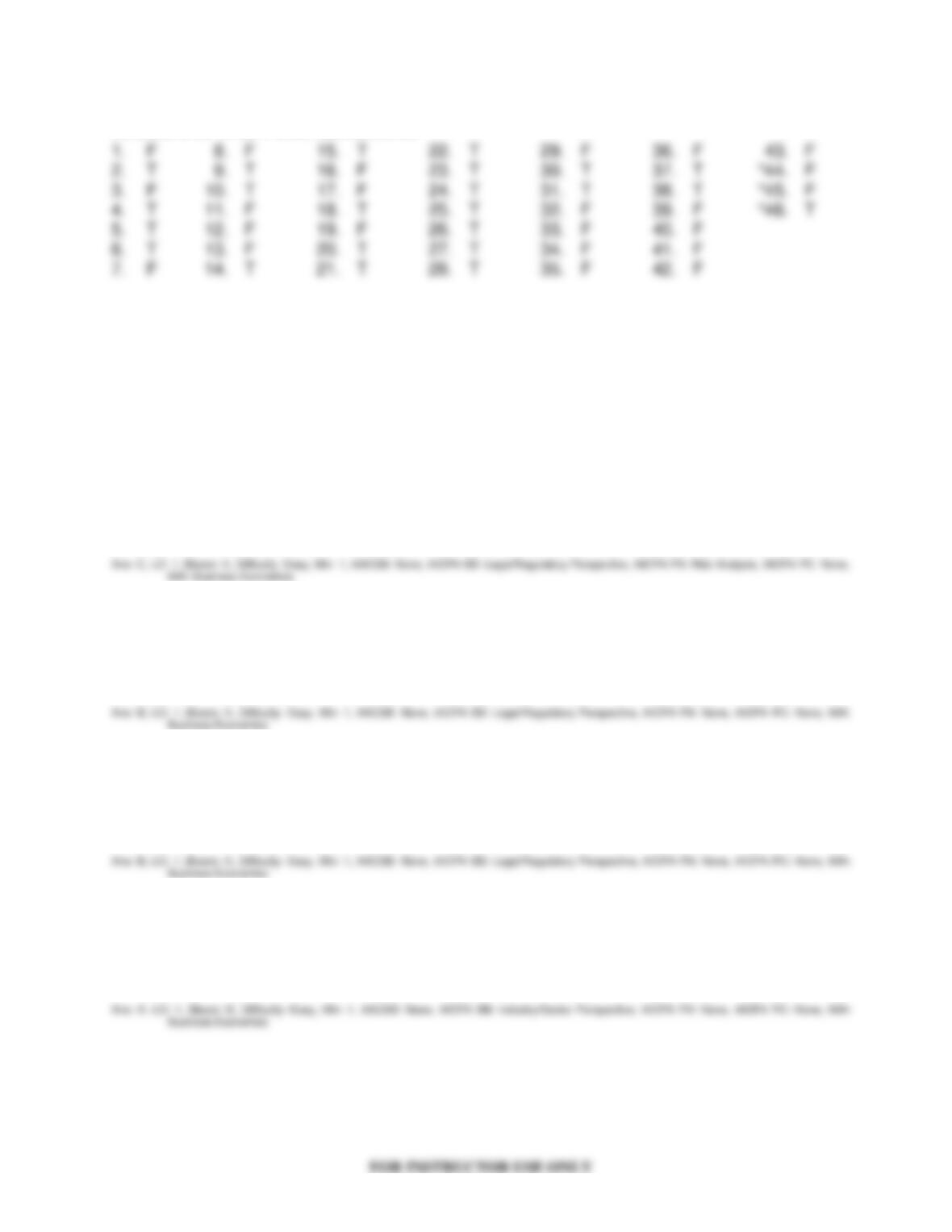
Reporting and Analyzing Stockholders’ Equity
11-9
Answers to True-False Statements
MULTIPLE CHOICE QUESTIONS
47. Under the corporate form of business organization
a. a stockholder is personally liable for the debts of the corporation.
b. stockholders’ acts can bind the corporation even though the stockholders have not
been appointed as agents of the corporation.
c. the corporation’s life is stipulated in its charter.
d. stockholders wishing to sell their corporation shares must get the approval of other
stockholders.
48. Stockholders of a corporation directly elect
a. the president of the corporation.
b. the board of directors.
c. the treasurer of the corporation.
d. all of the employees of the corporation.
49. Those most responsible for the major policy decisions of a corporation are the
a. stockholders.
b. board of directors.
c. management.
d. employees.
50. The chief accounting officer in a company is known as the
a. controller.
b. treasurer.
c. vice-president.
d. president.
Test Bank for Financial Accounting: Tools for Business Decision Making, Seventh Edition
11–10
51. Which one of the following would not be considered an advantage of the corporate form
of organization?
a. Limited liability of stockholders.
b. Separate legal existence.
c. Continuous life.
d. Government regulation.
52. The two ways that a corporation can be classified by purpose are
a. general and limited.
b. profit and not-for-profit.
c. state and federal.
d. publicly held and privately held.
53. The two ways that a corporation can be classified by ownership are
a. publicly held and privately held.
b. stock and non-stock.
c. inside and outside.
d. majority and minority.
54. Which of the following would not be true of a privately held corporation?
a. It is sometimes called a closely held corporation.
b. Its shares are regularly traded on the New York Stock Exchange.
c. It does not offer its shares for sale to the general public.
d. It is usually smaller than a publicly held company.
55. Which of the following is not true of a corporation?
a. It may buy, own, and sell property.
b. It may sue and be sued.
c. The acts of its owners bind the corporation.
d. It may enter into binding legal contracts in its own name.
56. Jason Hansen has invested $600,000 in a privately held family corporation. The
corporation does not do well and must declare bankruptcy. What amount does Hansen
stand to lose?
a. Up to his total investment of $600,000.
b. Zero.
c. The $600,000 plus any personal assets the creditors demand.
d. $400,000.
Reporting and Analyzing Stockholders’ Equity
11–11
57. Which of the following statements reflects the transferability of ownership rights in a
corporation?
a. If a stockholder decides to transfer ownership, he must transfer all of his shares.
b. A stockholder may dispose of part or all of his shares.
c. A stockholder must obtain permission of the board of directors before selling shares.
d. A stockholder must obtain permission from at least three other stockholders before
selling shares.
58. A corporate board of directors does not generally
a. select officers.
b. formulate operating policies.
c. declare dividends.
d. execute policy.
59. The officer that is generally responsible for maintaining the cash position of the
corporation is the
a. controller.
b. treasurer.
c. cashier.
d. internal auditor.
60. The ability of a corporation to obtain capital is
a. enhanced because of limited liability and ease of share transferability.
b. less than a partnership.
c. restricted because of the limited life of the corporation.
d. about the same as a partnership.
61. Which of the following statements concerning taxation is accurate?
a. Partnerships pay state income taxes but not federal income taxes.
b. Corporations pay federal income taxes but not state income taxes.
c. Corporations pay federal and state income taxes.
d. Only the owners must pay taxes on corporate income.
62. Which of the following statements is not considered a disadvantage of the corporate form
of organization?
a. Additional taxes.
b. Government regulations.
c. Limited liability of stockholders.
d. Separation of ownership and management.
Test Bank for Financial Accounting: Tools for Business Decision Making, Seventh Edition
11–12
63. A disadvantage of the corporate form of organization is
a. professional management.
b. tax treatment.
c. ease of transfer of ownership.
d. lack of mutual agency.
64. A disadvantage of the corporate form of business is
a. its status as a separate legal entity.
b. continuous existence.
c. government regulation.
d. ease of transfer of ownership.
65. Which of the following phrases is not descriptive of the corporate form of business?
a. Professional management.
b. Double taxation on distributed earnings.
c. Unlimited liability.
d. Continuous existence.
66. Which one of the following is not an ownership right of a stockholder in a corporation?
a. To vote in the election of directors.
b. To declare dividends on the common stock.
c. To share in assets upon liquidation.
d. To share in corporate earnings.
67. If no-par stock is issued without a stated value, then
a. the par value is automatically $1 per share.
b. the entire proceeds are considered to be legal capital.
c. there is no legal capital.
d. the corporation is automatically in violation of its state charter.
68. If a stockholder cannot attend a stockholders’ meeting, he may delegate his voting rights
by means of a(n)
a. absentee ballot.
b. proxy.
c. certified letter.
d. telegram.
Reporting and Analyzing Stockholders’ Equity
11–13
69. The term residual claim refers to a stockholders’ right to
a. receive dividends.
b. share in assets upon liquidation.
c. acquire additional shares when offered.
d. exercise a proxy vote.
70. Which of the following factors does not affect the initial market price of a stock?
a. The company’s anticipated future earnings.
b. The par value of the stock.
c. The current state of the economy.
d. The expected dividend rate per share.
71. If an investment firm underwrites a stock issue, the
a. risk of being unable to sell the shares stays with the issuing corporation.
b. corporation obtains cash immediately from the investment firm.
c. investment firm has guaranteed profits on the sale of the stock.
d. issuance of stock is likely to be directly to creditors.
72. The par value of a stock
a. is legally significant.
b. reflects the most recent market price.
c. is selected by the SEC.
d. is indicative of the worth of the stock.
FSA
73. Par value
a. represents what a share of stock is worth.
b. represents the original selling price for a share of stock.
c. is established for a share of stock after it is issued.
d. is the value assigned per share in the corporate charter.
FSA
74. The term legal capital is a descriptive term for
a. stockholders’ equity.
b. par value.
c. residual equity.
d. market value.
Test Bank for Financial Accounting: Tools for Business Decision Making, Seventh Edition
11–14
75. A corporation has the following account balances: Common Stock, $1 par value, $80,000;
Paid-in Capital in Excess of Par Value, $2,700,000. Based on this information, the
a. legal capital is $2,780,000.
b. number of shares issued is 80,000.
c. number of shares outstanding is 2,780,000.
d. average price per share issued is $3.48.
76. The authorized stock of a corporation
a. only reflects the initial capital needs of the company.
b. is indicated in its by-laws.
c. is indicated in its charter.
d. must be recorded in a formal accounting entry.
77. The amount of stock that may be issued according to the corporation’s charter is referred
to as the
a. authorized stock.
b. issued stock.
c. unissued stock.
d. outstanding stock.
78. If Norben Company issues 4,000 shares of $5 par value common stock for $140,000, the
account
a. Common Stock will be credited for $140,000.
b. Paid-in Capital in Excess of Par Value will be credited for $20,000.
c. Paid-in Capital in Excess of Par Value will be credited for $120,000.
d. Cash will be debited for $120,000.
79. Alt Corp. issues 3,000 shares of $10 par value common stock at $14 per share. When the
transaction is recorded, credits are made to:
a. Common Stock $30,000 and Paid-in Capital in Excess of Stated Value $12,000.
b. Common Stock $28,000.
c. Common Stock $30,000 and Paid-in Capital in Excess of Par Value $12,000.
d. Common Stock $30,000 and Retained Earnings $12,000.
Reporting and Analyzing Stockholders’ Equity
11–15
80. If Lantz Company issues 5,000 shares of $5 par value common stock for $210,000, the
account
a. Common Stock will be credited for $25,000.
b. Paid-in Capital in Excess of Par Value will be credited for $25,000.
c. Paid-in Capital in Excess of Par Value will be credited for $210,000.
d. Cash will be debited for $185,000.
81. If Pratt Company issues 5,000 shares of $5 par value common stock for $210,000, the
account
a. Common Stock will be credited for $185,000.
b. Paid-in Capital in Excess of Par Value will be credited for $210,000.
c. Paid-in Capital in Excess of Par Value will be credited for $235,000.
d. Cash will be debited for $210,000.
82. If common stock is issued for an amount greater than par value, the excess should be
credited to
a. Cash.
b. Retained Earnings.
c. Paid-in Capital in Excess of Par Value.
d. Legal Capital.
83. Paid-in Capital in Excess of Par Value
a. is credited when no-par stock does not have a stated value.
b. is reported as part of paid-in capital on the balance sheet.
c. represents the amount of legal capital.
d. normally has a debit balance.
84. The Paid-in Capital in Excess of Par Value is increased in the accounting records when
a. the number of shares issued exceeds par value.
b. the stated value of capital stock is greater than the par value.
c. the market value of the stock rises above par value.
d. capital stock is issued at an amount greater than par value.
85. Which of the following represents the largest number of common shares?
a. Treasury shares.
b. Issued shares.
c. Outstanding shares.
d. Authorized shares.
Test Bank for Financial Accounting: Tools for Business Decision Making, Seventh Edition
11–16
86. Tomlinson Packaging Corporation began business in 2014 by issuing 30,000 shares of $5
par common stock for $8 per share and 5,000 shares of 6%, $10 par preferred stock for
par. At year end, the common stock had a market value of $10. On its December 31, 2014
balance sheet, Tomlinson Packaging would report
a. Common Stock of $300,000.
b. Common Stock of $150,000.
c. Common Stock of $240,000.
d. Paid-in Capital of $200,000.
87. Holden Packaging Corporation began business in 2014 by issuing 80,000 shares of $5
par common stock for $8 per share and 20,000 shares of 6%, $10 par preferred stock for
par. At year end, the common stock had a market value of $10. On its December 31, 2014
balance sheet, Holden Packaging would report
a. Common Stock of $800,000.
b. Common Stock of $400,000.
c. Common Stock of $640,000.
d. Paid-In Capital of $600,000.
88. Cey, Inc. issued 8,000 shares of stock at a stated value of $10/share. The total issue of
stock sold for $15/share. The journal entry to record this transaction would include a
a. debit to Cash for $80,000.
b. credit to Common Stock for $80,000.
c. credit to Paid-in Capital in Excess of Par Value for $40,000.
d. credit to Common Stock for $120,000.
89. When stock is issued in exchange for a noncash asset, the value recorded for the shares
issued is best determined by
a. the book value of the noncash asset.
b. the market value of the shares.
c. the par value of the shares.
d. the contributed capital of the shares.
Reporting and Analyzing Stockholders’ Equity
11–17
90. S. Lawyer performed legal services for E. Corp. Due to a cash shortage, an agreement
was reached whereby E. Corp. would pay S. Lawyer a legal fee of approximately $15,000
by issuing 8,000 shares of its common stock (par $1). The stock trades on a daily basis
and the market price of the stock on the day the debt was settled is $1.80 per share.
Given this information, the best journal entry for E. Corp. to record for this transaction is
a. Legal Expense 14,400
Common Stock 14,400
b. Legal Expense 15,000
Common Stock 15,000
c. Legal Expense 15,000
Common Stock 8,000
Paid-in Capital in Excess of Par – Common 7,000
d. Legal Expense 14,400
Common Stock 8,000
Paid-in Capital in Excess of Par – Common 6,400
91. If the market value of the assets received and the market value of the stock issued are
both available, then what amount should be used to value the assets?
a. Market value of the stock.
b. Market value of the assets.
c. Par value of the stock.
d. The more clearly determinable market value.
92. Johnson Company issued 900 shares of no-par common stock for $15,300. Which of the
following journal entries would be made if the stock has no stated value?
a. Cash 15,300
Common Stock – No-Par Value 15,300
b. Cash 15,300
Common Stock – No-Par Value 900
Paid-in Capital in Excess of Par 14,400
c. Cash 15,300
Common Stock – No-Par Value 900
Paid-in Capital in Excess of Stated Value 14,400
d. Common Stock – No-Par Value 15,300
Cash 15,300
Test Bank for Financial Accounting: Tools for Business Decision Making, Seventh Edition
11–18
93. Dawson Company issued 600 shares of no-par common stock for $5,400. Which of the
following journal entries would be made if the stock has stated value of $2 per share?
a. Cash 5,400
Common Stock 5,400
b. Cash 5,400
Common Stock 1,200
Paid-in Capital in Excess of Par 4,200
c. Cash 5,400
Common Stock 1,200
Paid-in Capital in Excess of Stated Value 4,200
d. Common Stock 5,400
Cash 5,400
94. Retro Company is authorized to issue 10,000 shares of 8%, $100 par value preferred
stock and 500,000 shares of no-par common stock with a stated value of $1 per share. If
Retro issues 5,000 shares of common stock to pay its recent attorney’s bill of $25,000 for
legal services on a land access dispute, which of the following would be the best journal
entry for Retro to record?
a. Legal Expense 5,000
Common Stock 5,000
b. Legal Expense 25,000
Common Stock 25,000
c. Legal Expense 25,000
Common Stock 5,000
Paid-in Capital in Excess of Stated Value – Common 20,000
d. Legal Expense 25,000
Common Stock 5,000
Paid-in Capital in Excess of Par value – Common 20,000
95. Which of the following statements about treasury stock is true?
a. Few corporations have treasury stock.
b. Purchasing treasury stock is done to eliminate hostile shareholder buyouts.
c. Companies acquire treasury stock to increase the number of shares outstanding.
d. Companies acquire treasury stock to decrease earnings per share.
96. The following data is available for BOX Corporation at December 31, 2014:
Common stock, par $10 (authorized 30,000 shares) $250,000
Treasury stock (at cost $15 per share) $ 1,200
Based on the data, how many shares of common stock are outstanding?
a. 30,000.
b. 25,000.
c. 29,920.
d. 24,920.
Reporting and Analyzing Stockholders’ Equity
11–19
97. The following data is available for BOX Corporation at December 31, 2014:
Common stock, par $10 (authorized 30,000 shares) $250,000
Treasury stock (at cost $15 per share) $ 1,200
Based on the data, how many shares of common stock are issued?
a. 30,000.
b. 25,000.
c. 29,920.
d. 24,920.
98. Kaplan Manufacturing Corporation purchased 2,500 shares of its own previously issued
$10 par common stock for $57,500. As a result of this event,
a. Kaplan’s Common Stock account decreased $25,000.
b. Kaplan’s total stockholders’ equity decreased $57,500.
c. Kaplan’s Paid-in Capital in Excess of Par Value account decreased $32,500.
d. All of these answer choices are correct.
99. Leary Manufacturing Corporation purchased 5,000 shares of its own previously issued
$10 par common stock for $115,000. As a result of this event,
a. Leary’s Common Stock account decreased $50,000.
b. Leary’s total stockholders’ equity decreased $115,000.
c. Leary’s Paid-in Capital in Excess of Par Value account decreased $65,000.
d. All of these answer choices are correct.
100. Treasury stock is
a. stock issued by the U.S. Treasury Department.
b. stock purchased by a corporation and held as an investment in its treasury.
c. corporate stock issued by the treasurer of a company.
d. a corporation’s own stock, which has been reacquired and held for future use.
101. The acquisition of treasury stock by a corporation
a. increases its total assets and total stockholders’ equity.
b. decreases its total assets and total stockholders’ equity.
c. has no effect on total assets and total stockholders’ equity.
d. requires that a gain or loss be recognized on the income statement.
Test Bank for Financial Accounting: Tools for Business Decision Making, Seventh Edition
11–20
102. A corporation purchases 15,000 shares of its own $20 par common stock for $35 per
share, recording it at cost. What will be the effect on total stockholders’ equity?
a. Increase by $525,000.
b. Decrease by $300,000.
c. Decrease by $525,000.
d. Decrease by $225,000.
103. A corporation purchases 20,000 shares of its own $10 par common stock for $25 per
share, recording it at cost. What will be the effect on total stockholders’ equity?
a. Increase by $200,000.
b. Decrease by $500,000.
c. Increase by $500,000.
d. Decrease by $200,000.
104. Treasury stock should be reported in the financial statements of a corporation as a(n)
a. investment.
b. liability.
c. deduction from total paid-in capital.
d. deduction from total paid-in capital and retained earnings.
105. A company would not acquire treasury stock
a. in order to reissue shares to officers.
b. as an asset investment.
c. in order to increase trading of the company’s stock.
d. to have additional shares available to use in acquisitions of other companies.
106. Treasury Stock is a(n)
a. contra asset account.
b. retained earnings account.
c. asset account.
d. contra stockholders’ equity account.
107. The number of shares of issued stock equals
a. unissued shares minus authorized shares.
b. outstanding shares plus treasury shares.
c. authorized shares minus treasury shares.
d. outstanding shares plus authorized shares.
Reporting and Analyzing Stockholders’ Equity
11–21
108. Treasury shares plus outstanding shares equal
a. authorized stock.
b. issued stock.
c. unissued stock.
d. distributable stock.
109. Which of the following is not a right or preference associated with preferred stock?
a. The right to vote.
b. First claim to dividends.
c. Preference to corporate assets in case of liquidation.
d. To receive dividends in arrears before common stockholders receive dividends.
110. Logan Corporation issues 50,000 shares of $50 par value preferred stock for cash at $60
per share. The entry to record the transaction will consist of a debit to Cash for
$3,000,000 and a credit or credits to
a. Preferred Stock for $3,000,000.
b. Preferred Stock for $2,500,000 and Paid-in Capital in Excess of Par Value—Preferred
Stock for $500,000.
c. Preferred Stock for $2,500,000 and Retained Earnings for $500,000.
d. Paid-in Capital from Preferred Stock for $3,000,000.
111. Logan Corporation issues 40,000 shares of $50 par value preferred stock for cash at $60
per share. In the stockholders’ equity section, the effects of the transaction above will be
reported
a. entirely within the capital stock section.
b. entirely within the additional paid-in capital section.
c. under both the capital stock and additional paid-in capital sections.
d. entirely under the retained earnings section.
112. Nice Corporation issues 30,000 shares of $100 par value preferred stock for cash at $110
per share. The entry to record the transaction will consist of a debit to Cash for
$3,300,000 and a credit or credits to
a. Preferred Stock for $3,300,000.
b. Preferred Stock for $3,000,000 and Paid-in Capital in Excess of Par Value—Preferred
Stock for $300,000.
c. Preferred Stock for $3,000,000 and Retained Earnings for $300,000.
d. Paid-in Capital from Preferred Stock for $3,300,000.
Test Bank for Financial Accounting: Tools for Business Decision Making, Seventh Edition
11–22
113. Dividends in arrears on cumulative preferred stock
a. never have to be paid, even if common dividends are paid.
b. must be paid before common stockholders can receive a dividend.
c. should be recorded as a current liability until they are paid.
d. enable the preferred stockholders to share equally in corporate earnings with the
common stockholders.
114. Dividends in arrears on cumulative preferred stock
a. are considered to be a non-current liability.
b. are considered to be a current liability.
c. only occur when preferred dividends have been declared.
d. should be disclosed in the notes to the financial statements.
115. Dividends in arrears are dividends on
a. cumulative preferred stock that have been declared but have not been paid.
b. non-cumulative preferred stock that have not been declared for a given period of time.
c. cumulative preferred stock that have not been declared for a given period of time.
d. common dividends that have been declared but have not yet been paid.
116. Outstanding stock of the West Corporation included 40,000 shares of $5 par common
stock and 10,000 shares of 6%, $10 par non-cumulative preferred stock. In 2013, West
declared and paid dividends of $4,000. In 2014, West declared and paid dividends of
$12,000. How much of the 2014 dividend was distributed to preferred shareholders?
a. $8,000.
b. $14,000.
c. $6,000.
d. None of these answer choices are correct.
117. Outstanding stock of the Hall Corporation included 40,000 shares of $5 par common stock
and 20,000 shares of 6%, $10 par non-cumulative preferred stock. In 2013, Hall declared
and paid dividends of $8,000. In 2014, Hall declared and paid dividends of $24,000. How
much of the 2014 dividend was distributed to preferred shareholders?
a. $16,000.
b. $28,000.
c. $12,000.
d. None of these answer choices are correct.
Reporting and Analyzing Stockholders’ Equity
11–23
118. All of the following statements about preferred stock are true except
a. preferred stock will have a paid-in capital account that is separate from other stock.
b. preferred stock is presented first on the stockholder’s equity section.
c. preferred stock can be either par value or no-par value.
d. there can be only one class of preferred stock.
119. Retro Company is authorized to issue 10,000 shares of 8%, $100 par value preferred
stock and 500,000 shares of no-par common stock with a stated value of $1 per share. If
Retro issues 5,000 shares of preferred stock for land with an asking price of $625,000 and
a market value of $550,000, which of the following would be the best journal entry for
Retro to record?
a. Land 500,000
Preferred Stock 500,000
b. Land 550,000
Preferred Stock 550,000
c. Land 625,000
Preferred Stock 500,000
Paid-in Capital in Excess of Par – Preferred 125,000
d. Land 550,000
Preferred Stock 500,000
Paid-in Capital in Excess of Par – Preferred 50,000
120. XYZ Company has $20,000 of dividends in arrears. Based on this information, which of
the following statements is false?
a. Dividends in arrears are not considered to be liabilities.
b. An obligation for dividends in arrears exists only after the board of directors declares
payment.
c. The investment community looks favorably on companies with dividends in arrears,
since the money is redirected toward more important growth opportunities.
d. The amount of dividends in arrears should be disclosed in the notes to the financial
statements.
121. On January 1, McCarver Corporation had 600,000 shares of $10 par value common stock
outstanding. On March 31 the company declared a 10% stock dividend. Market value of
the stock was $15/share. As a result of this event,
a. McCarver’s Paid-in Capital in Excess of Par Value account increased $300,000.
b. McCarver’s total stockholders’ equity was unaffected.
c. McCarver’s Stock Dividends account increased $900,000.
d. All of these answer choices are correct.
Test Bank for Financial Accounting: Tools for Business Decision Making, Seventh Edition
11–24
122. On January 1, Edmiston Corporation had 1,600,000 shares of $10 par value common
stock outstanding. On March 31 the company declared a 10% stock dividend. Market
value of the stock was $15/share. As a result of this event,
a. Edmiston’s Paid-in Capital in Excess of Par Value account increased $800,000.
b. Edmiston’s total stockholders’ equity was unaffected.
c. Edmiston’s Stock Dividends account increased $2,400,000.
d. All of these answer choices are correct.
123. Which one of the following is not necessary in order for a corporation to pay a cash
dividend?
a. Adequate cash.
b. Approval of stockholders.
c. Declared dividends.
d. Retained earnings.
124. The date on which a cash dividend becomes a binding legal obligation is on the
a. declaration date.
b. date of record.
c. payment date.
d. last day of the fiscal year end.
125. The cumulative effect of the declaration and payment of a cash dividend on a company’s
financial statements is to
a. decrease total liabilities and stockholders’ equity.
b. increase total expenses and total liabilities.
c. increase total assets and stockholders’ equity.
d. decrease total assets and stockholders’ equity.
126. The board of directors of Bosco Company declared a cash dividend on November 15,
2014, to be paid on December 15, 2014, to stockholders owning the stock on November
30, 2014. Given these facts, the date of November 30, 2014, is referred to as the
a. declaration date.
b. record date.
c. payment date.
d. ex-dividend date.
127. The effect of the declaration of a cash dividend by the board of directors is to
Increase Decrease
a. Stockholders’ equity Assets
b. Assets Liabilities
c. Liabilities Stockholders’ equity
d. Liabilities Assets
Reporting and Analyzing Stockholders’ Equity
11–25
128. Which of the following is the appropriate general journal entry to record the declaration of
cash dividends?
a. Cash Dividends
Cash
b. Dividends Payable
Cash
c. Paid-in Capital
Dividends Payable
d. Cash Dividends
Dividends Payable
129. The board of directors of Yancey Company declared a cash dividend of $1.50 per share
on 42,000 shares of common stock on July 15, 2014. The dividend is to be paid on August
15, 2014, to stockholders of record on July 31, 2014. The correct entry to be recorded on
July 15, 2014, will include a
a. debit to Dividends Payable.
b. debit to Cash Dividends.
c. credit to Cash.
d. credit to Cash Dividends.
130. The board of directors of Yancey Company declared a cash dividend of $1.50 per share
on 42,000 shares of common stock on July 15, 2014. The dividend is to be paid on August
15, 2014, to stockholders of record on July 31, 2014. The effects of the journal entry to
record the declaration of the dividend on July 15, 2014, are to
a. decrease stockholders’ equity and increase liabilities.
b. decrease stockholders’ equity and decrease assets.
c. increase stockholders’ equity and increase liabilities.
d. increase stockholders’ equity and decrease assets.
131. The net effects on the corporation of the declaration and payment of a cash dividend are
to
a. decrease liabilities and decrease stockholders’ equity.
b. increase stockholders’ equity and decrease liabilities.
c. decrease assets and decrease stockholders’ equity.
d. increase assets and increase stockholders’ equity.
132. The board of directors of Benson Company declared a cash dividend of $1.50 per share
on 42,000 shares of common stock on July 15, 2014. The dividend is to be paid on August
15, 2014, to stockholders of record on July 31, 2014. The correct entry to be recorded on
August 15, 2014, will include a
a. debit to Cash Dividends.
b. credit to Cash Dividends.
c. credit to Dividends Payable.
d. debit to Dividends Payable.
Test Bank for Financial Accounting: Tools for Business Decision Making, Seventh Edition
11–26
133. The board of directors of Benson Company declared a cash dividend of $1.50 per share
on 42,000 shares of common stock on July 15, 2014. The dividend is to be paid on August
15, 2014, to stockholders of record on July 31, 2014. The effects of the journal entry to
record the payment of the dividend on August 15, 2014, are to
a. decrease stockholders’ equity and decrease liabilities.
b. decrease liabilities and decrease assets.
c. increase stockholders’ equity and increase liabilities.
d. increase stockholders’ equity and decrease assets.
134. A corporation records a dividend-related liability
a. on the record date.
b. on the payment date.
c. when dividends are in arrears.
d. on the declaration date.
135. Common Stock Dividends Distributable is classified as a(n)
a. asset account.
b. stockholders’ equity account.
c. expense account.
d. liability account.
136. The effect of a stock dividend is to
a. decrease total assets and stockholders’ equity.
b. change the composition of stockholders’ equity.
c. decrease total assets and total liabilities.
d. increase the book value per share of common stock.
137. Stock dividends and stock splits have the following effects on retained earnings:
Stock Splits Stock Dividends
a. Increase No change
b. No change Decrease
c. Decrease Decrease
d. No change No change
138. Dividends are predominantly paid in
a. scrip.
b. property.
c. cash.
d. stock.
Reporting and Analyzing Stockholders’ Equity
11–27
139. Of the four dividends types, the two most common types in practice are
a. cash and scrip.
b. cash and property.
c. cash and stock.
d. property and stock.
140. Regular dividends are declared out of
a. paid-in capital in excess of par value.
b. treasury stock.
c. common stock.
d. retained earnings.
141. Which of the following is not a significant date with respect to dividends?
a. The declaration date.
b. The incorporation date.
c. The record date.
d. The payment date.
142. On the dividend record date
a. a dividend becomes a current obligation.
b. no entry is required.
c. an entry may be required if it is a stock dividend.
d. Dividends Payable is debited.
143. Which of the following statements regarding the date of a cash dividend declaration is not
accurate?
a. The dividend can be rescinded once it has been declared.
b. The corporation is committed to a legal, binding obligation.
c. The board of directors formally authorizes the cash dividend.
d. A liability account must be increased.
144. Indicate the respective effects of the declaration of a cash dividend on the following
balance sheet sections:
Total Assets Total Liabilities Total Stockholders’ Equity
a. Increase Decrease No change
b. No change Increase Decrease
c. Decrease Increase Decrease
d. Decrease No change Increase
Test Bank for Financial Accounting: Tools for Business Decision Making, Seventh Edition
11–28
145. Which of the following statements about dividends is not accurate?
a. Dividends are generally reported quarterly as a dollar amount per share.
b. Low dividends may mean high stock returns.
c. The board of directors is obligated to declare dividends.
d. Payment of dividends from legal capital is illegal in many states.
146. Ace Inc. has 10,000 shares of 5%, $100 par value, cumulative preferred stock and 50,000
shares of $1 par value common stock outstanding at December 31, 2014. What is the
annual dividend on the preferred stock?
a. $50 per share
b. $50,000 in total
c. $5,000 in total
d. $0.50 per share
147. CAB Inc. has 1,000 shares of 6%, $100 par value, cumulative preferred stock and 50,000
shares of $1 par value common stock outstanding at December 31, 2014. What is the
annual dividend on the preferred stock?
a. $60 per share.
b. $6,000 in total.
c. $600 in total.
d. $0.60 per share.
148. Which of the following statements is not true about a 2-for-1 split?
a. Par value per share is reduced to half of what it was before the split.
b. Total contributed capital increases.
c. The market price probably will decrease.
d. A stockholder with ten shares before the split owns twenty shares after the split.
149. Sizemore, Inc. has 10,000 shares of 5%, $100 par value, cumulative preferred stock and
100,000 shares of $1 par value common stock outstanding at December 31, 2014. If the
board of directors declares a $30,000 dividend, the
a. preferred stockholders will receive 1/10th of what the common stockholders will
receive.
b. preferred stockholders will receive the entire $30,000.
c. $30,000 will be held as restricted retained earnings and paid out at some future date.
d. preferred stockholders will receive $15,000 and the common stockholders will receive
$15,000.
Reporting and Analyzing Stockholders’ Equity
11–29
150. Denson, Inc. has 10,000 shares of 7%, $100 par value, non-cumulative preferred stock
and 40,000 shares of $1 par value common stock outstanding at December 31, 2014.
There were no dividends declared in 2013. The board of directors declares and pays a
$120,000 dividend in 2014. What is the amount of dividends received by the common
stockholders in 2014?
a. $0.
b. $70,000.
c. $120,000.
d. $50,000.
151. Brewer Inc. has 5,000 shares of 8%, $50 par value, cumulative preferred stock and
100,000 shares of $1 par value common stock outstanding at December 31, 2014, and
December 31, 2013. The board of directors declared and paid a $15,000 dividend in 2013.
In 2014, $60,000 of dividends are declared and paid. What are the dividends received by
the preferred stockholders in 2014?
a. $35,000.
b. $30,000.
c. $25,000.
d. $20,000.
152. Watson, Inc. has 10,000 shares of 6%, $100 par value, cumulative preferred stock and
20,000 shares of $1 par value common stock outstanding at December 31, 2014. There
were no dividends declared in 2012. The board of directors declares and pays a $100,000
dividend in 2013 and in 2014. What is the amount of dividends received by the common
stockholders in 2014?
a. $20,000.
b. $60,000.
c. $100,000.
d. $0.
153. Berman Inc. has 6,000 shares of 8%, $50 par value, cumulative preferred stock and
50,000 shares of $1 par value common stock outstanding at December 31, 2013, and
December 31, 2014. The board of directors declared and paid an $18,000 dividend in
2013. In 2014, $72,000 of dividends are declared and paid. What are the dividends
received by the common stockholders in 2014?
a. $42,000.
b. $36,000.
c. $30,000.
d. $24,000.
Test Bank for Financial Accounting: Tools for Business Decision Making, Seventh Edition
11–30
154. The board of directors must assign a per share value to a stock dividend declared that is
a. greater than the par or stated value.
b. less than the par or stated value.
c. equal to the par or stated value.
d. at least equal to the par or stated value.
155. Corporations generally issue stock dividends in order to
a. increase the market price per share.
b. exceed stockholders’ dividend expectations.
c. increase the marketability of the stock.
d. decrease the amount of capital in the corporation.
156. A stockholder who receives a stock dividend would
a. expect the market price per share to increase.
b. own more shares of stock.
c. expect retained earnings to increase.
d. expect the par value of the stock to change.
157. When stock dividends are distributed,
a. Common Stock Dividends Distributable is decreased.
b. retained earnings is decreased.
c. Paid-in Capital in Excess of Par Value is debited if it is a small stock dividend.
d. no entry is necessary if it is a large stock dividend.
158. A small stock dividend is defined as
a. less than 30% but greater than 25% of the corporation’s issued stock.
b. between 50% and 100% of the corporation’s issued stock.
c. more than 30% of the corporation’s issued stock.
d. less than 20-25% of the corporation’s issued stock.
159. The per share amount normally assigned by the board of directors to a large stock
dividend is
a. the market value of the stock on the date of declaration.
b. the average price paid by stockholders on outstanding shares.
c. the par or stated value of the stock.
d. zero.

Reporting and Analyzing Stockholders’ Equity
11–31
160. The per share amount normally assigned by the board of directors to a small stock
dividend is
a. the market value of the stock on the date of declaration.
b. the average price paid by stockholders on outstanding shares.
c. the par or stated value of the stock.
d. zero.
161. Identify the effect the declaration of a stock dividend has on the par value per share and
book value per share.
Par Value per Share Book Value per Share
a. Increase Decrease
b. No effect Increase
c. Decrease Decrease
d. No effect Decrease
162. Which of the following show the proper effect of a stock split and a stock dividend?
Item Stock Split Stock Dividend
a. Total paid-in capital Increase Increase
b. Total retained earnings Decrease Decrease
c. Total par value (common) Decrease Increase
d. Par value per share Decrease No change
163. A stock split will
a. have no effect on retained earnings.
b. increase total paid-in capital.
c. increase the total par value of the stock.
d. have no effect on the par value per share of stock.
164. Which of the following statements is not true about a 2-for-1 stock split?
a. The market value of the stock will probably decrease.
b. A stockholder with 5 shares before the split owns 10 shares after the split.
c. Par value per share is reduced to half of what it was before the split.
d. Total paid-in capital increases.
165. Green, Inc. had 200,000 shares of common stock outstanding before a stock split
occurred and 800,000 shares outstanding after the stock split. The stock split was
a. 2-for-8.
b. 8-for-1.
c. 1-for-8.
d. 4-for-1.
Test Bank for Financial Accounting: Tools for Business Decision Making, Seventh Edition
11–32
166. If the board of directors authorizes a $100,000 restriction of retained earnings for a future
plant expansion, the effect of this action is to
a. decrease total assets and total stockholders’ equity.
b. increase stockholders’ equity and to decrease total liabilities.
c. decrease total retained earnings and increase total liabilities.
d. reduce the amount of retained earnings available for dividend declarations.
167. A net loss
a. occurs if operating expenses exceed cost of goods sold.
b. is not closed to Retained Earnings if it would result in a debit balance.
c. is closed to Retained Earnings even if it would result in a debit balance.
d. is closed to the Paid-in Capital account of the stockholders’ equity section of the
balance sheet.
168. Retained earnings are occasionally restricted
a. to set aside cash for dividends.
b. to keep the legal capital associated with paid-in capital intact.
c. due to contractual loan restrictions.
d. if preferred dividends are in arrears.
169. When retained earnings are restricted, total retained earnings
a. are unaffected.
b. increase.
c. decrease.
d. may increase or decrease.
170. Placing a restriction on retained earnings will
a. assure that a company has sufficient cash for a specific purpose.
b. increase total stockholders’ equity.
c. communicate to readers a portion of retained earnings is unavailable for dividends.
d. decrease total stockholders’ equity.
171. The following selected amounts are available for Thomas Company.
Retained earnings (beginning) $2,500
Net loss 200
Cash dividends declared 200
Stock dividends declared 200
What is its ending Retained Earnings balance?
a. $2,200.
b. $2,300.
c. $1,900.
d. $2,100.
172. Hutchinson Company had retained earnings of $15,000 on the balance sheet but
disclosed in the footnotes that $2,000 of retained earnings was restricted for plant
expansion and $1,000 was restricted for bond repayments. Cash of $2,000 had been set
aside for the plant expansion. How much of retained earnings is available for dividends?
a. $12,000.
b. $13,000.
c. $15,000.
d. $10,000.
173. All of the following statements regarding retained earnings are true except
a. retained earnings represents a claim on cash.
b. a debit balance in Retained Earnings indicates a deficit.
c. some companies may restrict availability of retained earnings for dividends.
d. retained earnings is net income that a company retains in a business.
174. What is the total stockholders’ equity based on the following account balances?
Common Stock $1,800,000
Paid-In Capital in Excess of Par 120,000
Retained Earnings 570,000
Treasury Stock 60,000
a. $2,190,000.
b. $2,430,000.
c. $2,550,000.
d. $1,680,000.
175. What is the total stockholders’ equity based on the following account balances?
Common Stock $750,000
Paid-In Capital in Excess of Par 50,000
Retained Earnings 175,000
Treasury Stock 25,000
a. $1,000,000.
b. $975,000.
c. $950,000.
d. $800,000.
Test Bank for Financial Accounting: Tools for Business Decision Making, Seventh Edition
11–34
176. What is the total stockholders’ equity based on the following account balances?
Common Stock $1,300,000
Paid-In Capital in Excess of Par 100,000
Retained Earnings 360,000
Treasury Stock 60,000
a. $1,400,000.
b. $1,820,000.
c. $1,760,000.
d. $1,700,000.
177. Nance Corporation’s December 31, 2014 balance sheet showed the following:
8% preferred stock, $20 par value, cumulative,
30,000 shares authorized; 15,000 shares issued $ 300,000
Common stock, $10 par value, 3,000,000 shares authorized;
1,950,000 shares issued, 1,920,000 shares outstanding 19,500,000
Paid-in capital in excess of par value – preferred stock 60,000
Paid-in capital in excess of par value – common stock 27,000,000
Retained earnings 7,650,000
Treasury stock (30,000 shares) 630,000
Nance’s total paid-in capital was
a. $46,860,000.
b. $47,490,000.
c. $46,230,000.
d. $27,060,000.
178. Nance Corporation’s December 31, 2014 balance sheet showed the following:
8% preferred stock, $20 par value, cumulative,
30,000 shares authorized; 15,000 shares issued $ 300,000
Common stock, $10 par value, 3,000,000 shares authorized;
1,950,000 shares issued, 1,920,000 shares outstanding 19,500,000
Paid-in capital in excess of par value – preferred stock 60,000
Paid-in capital in excess of par value – common stock 27,000,000
Retained earnings 7,650,000
Treasury stock (30,000 shares) 630,000
Nance declared and paid a $75,000 cash dividend on December 15, 2014. If the
company’s dividends in arrears prior to that date were $18,000, Nance’s common
stockholders received
a. $57,000.
b. $27,000.
c. $33,000.
d. no dividend.
Reporting and Analyzing Stockholders’ Equity
11–35
179. Nance Corporation’s December 31, 2014 balance sheet showed the following:
8% preferred stock, $20 par value, cumulative,
30,000 shares authorized; 15,000 shares issued $ 300,000
Common stock, $10 par value, 3,000,000 shares authorized;
1,950,000 shares issued, 1,920,000 shares outstanding 19,500,000
Paid-in capital in excess of par value – preferred stock 60,000
Paid-in capital in excess of par value – common stock 27,000,000
Retained earnings 7,650,000
Treasury stock (30,000 shares) 630,000
Nance’s total stockholders’ equity was
a. $55,140,000.
b. $46,860,000.
c. $54,510,000.
d. $53,880,000.
180. Danley Corporation began business by issuing 200,000 shares of $5 par value common
stock for $24 per share. During its first year, the corporation sustained a net loss of
$40,000. The year-end balance sheet would show
a. Common Stock of $1,000,000.
b. Common Stock of $4,800,000.
c. total paid-in capital of $4,760,000.
d. total paid-in capital of $3,800,000.
181. Racer Corporation’s December 31, 2014 balance sheet showed the following:
8% preferred stock, $20 par value, cumulative,
40,000 shares authorized; 20,000 shares issued $ 400,000
Common stock, $10 par value, 4,000,000 shares authorized;
2,600,000 shares issued, 2,560,000 shares outstanding 26,000,000
Paid-in capital in excess of par value – preferred stock 80,000
Paid-in capital in excess of par value – common stock 36,000,000
Retained earnings 10,200,000
Treasury stock (40,000 shares) 840,000
Racer’s total paid-in capital was
a. $62,480,000.
b. $63,320,000.
c. $61,640,000.
d. $36,080,000.
Test Bank for Financial Accounting: Tools for Business Decision Making, Seventh Edition
11–36
182. Racer Corporation’s December 31, 2014 balance sheet showed the following:
8% preferred stock, $20 par value, cumulative,
40,000 shares authorized; 20,000 shares issued $ 400,000
Common stock, $10 par value, 4,000,000 shares authorized;
2,600,000 shares issued, 2,560,000 shares outstanding 26,000,000
Paid-in capital in excess of par value – preferred stock 80,000
Paid-in capital in excess of par value – common stock 36,000,000
Retained earnings 10,200,000
Treasury stock (30,000 shares) 840,000
Racer declared and paid a $100,000 cash dividend on December 15, 2014. If the
company’s dividends in arrears prior to that date were $24,000, Racer’s common
stockholders received
a. $76,000.
b. $36,000.
c. $44,000.
d. no dividend.
183. Racer Corporation’s December 31, 2014 balance sheet showed the following:
8% preferred stock, $20 par value, cumulative,
40,000 shares authorized; 20,000 shares issued $ 400,000
Common stock, $10 par value, 4,000,000 shares authorized;
2,600,000 shares issued, 2,560,000 shares outstanding 26,000,000
Paid-in capital in excess of par value – preferred stock 80,000
Paid-in capital in excess of par value – common stock 36,000,000
Retained earnings 10,200,000
Treasury stock (30,000 shares) 840,000
Racer’s total stockholders’ equity was
a. $73,520,000.
b. $62,480,000.
c. $72,680,000.
d. $71,840,000.
184. Cerner Corporation began business by issuing 250,000 shares of $5 par value common
stock for $24 per share. During its first year, the corporation sustained a net loss of
$50,000. The year-end balance sheet would show
a. Common Stock of $1,250,000.
b. Common Stock of $6,000,000.
c. total paid-in capital of $5,950,000.
d. total paid-in capital of $4,750,000.
Reporting and Analyzing Stockholders’ Equity
11–37
185. In the stockholders’ equity section of the balance sheet
a. Common Stock Dividends Distributable will be classified as part of additional paid-in
capital.
b. Common Stock Dividends Distributable will appear in its own subsection of the
stockholders’ equity.
c. Additional Paid-in Capital appears under the sub-section paid-in capital.
d. Dividends in Arrears will appear as a restriction of retained earnings.
186. Paid-in capital in excess of stated value would appear on a balance sheet under the
category
a. capital stock.
b. retained earnings.
c. additional paid-in capital.
d. contra to stockholders’ equity.
187. Two classifications appearing in the paid-in capital section of the balance sheet are
a. preferred stock and common stock.
b. paid-in capital and retained earnings.
c. capital stock and additional paid-in capital.
d. capital stock and treasury stock.
188. All of the following are normally found in a corporation’s stockholders’ equity section
except
a. dividends in arrears.
b. common stock.
c. paid-in capital.
d. retained earnings.
189. Information that is not generally reported for each class of stock on the balance sheet is
a. the market value.
b. the par value.
c. shares authorized.
d. shares issued.
190. In published annual reports
a. subclassifications within the stockholders’ equity section are routinely reported in
detail.
b. capital surplus is used in place of retained earnings.
c. the individual sources of additional paid-in capital are often combined.
d. retained earnings is often not shown separately.
Test Bank for Financial Accounting: Tools for Business Decision Making, Seventh Edition
11–38
191. The payout ratio is computed by dividing
a. total cash dividends paid by retained earnings.
b. dividends paid per share by net income.
c. total cash dividends paid by net income.
d. dividends paid per share by year-end stock price.
192. The return on common stockholders’ equity is computed by dividing net income
a. by ending common stockholders’ equity.
b. by average common stockholders’ equity.
c. less preferred dividends by ending common stockholders’ equity.
d. less preferred dividends by average common stockholders’ equity.
193. Ferman Corporation had net income of $160,000 and paid dividends of $50,000 to
common stockholders and $20,000 to preferred stockholders in 2014. Ferman
Corporation’s common stockholders’ equity at the beginning and end of 2014 was
$870,000 and $1,130,000, respectively. Ferman Corporation’s return on common
stockholders’ equity was
a. 16%.
b. 14%.
c. 11%.
d. 9%.
194. Ferman Corporation had net income of $160,000 and paid dividends of $50,000 to
common stockholders and $20,000 to preferred stockholders in 2014. Ferman
Corporation’s common stockholders’ equity at the beginning and end of 2014 was
$870,000 and $1,130,000, respectively. Ferman Corporation’s payout ratio for 2014 was
a. 5.0%.
b. 43.8%.
c. 31.3%.
d. 12.5%.
195. Herman Corporation had net income of $120,000 and paid dividends of $24,000 to
common stockholders and $20,000 to preferred stockholders in 2014. Herman
Corporation’s common stockholders’ equity at the beginning and end of 2014s was
$450,000 and $550,000, respectively. Herman Corporation’s return on common
stockholders’ equity is
a. 24.0%.
b. 20.0%.
c. 19.2%.
d. 15.2%.
Reporting and Analyzing Stockholders’ Equity
FOR INSTRUCTOR USE ONLY
11–39
196. Herman Corporation had net income of $120,000 and paid dividends of $24,000 to
common stockholders and $20,000 to preferred stockholders in 2014. Herman
Corporation’s common stockholders’ equity at the beginning and end of 2014 was
$450,000 and $550,000, respectively. Herman Corporation’s payout ratio for 2014 is
a. 5%.
b. 20%.
c. 17%.
d. 10%.
197. From the information below, compute the payout ratio for Kevin’s Trailers.
Net Income $200
Cash Dividends (common) 40
Retained Earnings 500
Stock Dividends (common) 10
a. 25%.
b. 20%.
c. 8%.
d. 2%.
198. The following information pertains to Benedict Company. Assume that all balance sheet
amounts represent average balance figures.
Total assets $300,000
Stockholders’ equity—common 150,000
Total stockholders’ equity 200,000
Sales revenue 100,000
Net income 25,000
Number of shares of common stock 6,000
Common dividends 6,000
Preferred dividends 4,000
What is the payout ratio for Benedict?
a. 40%
b. 24%
c. 16%
d. 6%
199. The following information pertains to Benedict Company. Assume that all balance sheet
amounts represent average balance figures.
Total assets $300,000
Stockholders’ equity—common 150,000
Total stockholders’ equity 200,000
Sales revenue 100,000
Net income 25,000
Number of shares of common stock 6,000
Common dividends 6,000
Test Bank for Financial Accounting: Tools for Business Decision Making, Seventh Edition
11–40
MC: 199 (count)
Preferred dividends 4,000
What is the return on common stockholders’ equity ratio for Benedict?
a. 16.7%
b. 14.0%
c. 12.7%
d. 10.5%
200. The following information pertains to Marsh Company. Assume that all balance sheet
amounts represent average balance figures.
Total asset $400,000
Stockholders’ equity—common 200,000
Total stockholders’ equity 280,000
Sales revenue 120,000
Net income 25,000
Number of shares of common stock 8,000
Common dividends 9,000
Preferred dividends 6,000
What is Marsh’s payout ratio?
a. 60%.
b. 36%.
c. 24%.
d. 7.5%.
201. The following information pertains to Marsh Company. Assume that all balance sheet
amounts represent average balance figures.
Total asset $400,000
Stockholders’ equity—common 200,000
Total stockholders’ equity 280,000
Sales 120,000
Net income 24,000
Number of shares of common stock 8,000
Common dividends 9,000
Preferred dividends 6,000
What is Marsh’s return on common stockholders’ equity?
a. 12%.
b. 9%.
c. 7.5%.
d. 6.4%.
Reporting and Analyzing Stockholders’ Equity
FOR INSTRUCTOR USE ONLY
11–41
202. Which of the following statements is true regarding corporate performance ratios?
a. A high payout ratio may indicate that a company is retaining earnings for future growth
investments.
b. As a company grows larger, it is easy to sustain a high return on common
stockholder’s equity.
c. Return on common stockholder’s equity is often higher under bond financing rather
than common stock financing.
d. Companies low growth rates are characterized by low payout ratios.
*203. John Jones Company has 20,000 shares of $100 par value common stock. Assuming that
the proper journal entry was made to record a 5% common stock dividend on the
declaration date when the market value of the stock was $135, which of the following
accounts would be debited when the stock dividend is distributed?
a. Retained Earnings.
b. Dividends Payable.
c. Common Stock Dividends Distributable.
d. Paid-in Capital in Excess of Par Value.
*204. On January 1, Hamblin Corporation had 90,000 shares of $10 par value common stock
outstanding. On March 17 the company declared a 10% stock dividend to stockholders of
record on March 20. Market value of the stock was $13 on March 17. The entry to record
the transaction of March 17 would include a
a. credit to Stock Dividends for $27,000.
b. credit to Cash for $117,000.
c. credit to Common Stock Dividends Distributable for $90,000.
d. debit to Common Stock Dividends Distributable for $90,000.
*205. On January 1, Hamblin Corporation had 90,000 shares of $10 par value common stock
outstanding. On March 17 the company declared a 10% stock dividend to stockholders of
record on March 20. Market value of the stock was $13 on March 17. The stock was
distributed on March 30. The entry to record the transaction of March 30 would include a
a. credit to Cash for $90,000.
b. debit to Common Stock Dividends Distributable for $90,000.
c. credit to Paid-in Capital in Excess of Par Value for $27,000.
d. debit to Stock Dividends for $27,000.
Test Bank for Financial Accounting: Tools for Business Decision Making, Seventh Edition
11–42
*206. On January 1, Ripken Corporation had 40,000 shares of $10 par value common stock
outstanding. On March 17 the company declared a 10% stock dividend to stockholders of
record on March 20. Market value of the stock was $13 on March 17. The entry to record
the transaction of March 17 would include a
a. debit to Stock Dividends for $52,000.
b. credit to Cash for $52,000.
c. credit to Common Stock Dividends Distributable for $52,000.
d. credit to Common Stock Dividends Distributable for $12,000.
*207. On January 1, Ripken Corporation had 40,000 shares of $10 par value common stock
outstanding. On March 17 the company declared a 10% stock dividend to stockholders of
record on March 20. Market value of the stock was $13 on March 17. The stock was
distributed on March 30. The entry to record the transaction of March 30 would include a
a. credit to Common Stock for $40,000.
b. debit to Common Stock Dividends Distributable for $52,000.
c. credit to Paid-in Capital in Excess of Par Value for $12,000.
d. debit to Stock Dividends for $12,000.
*208. If a corporation declares a 10% stock dividend on its common stock, the account to be
debited on the date of declaration is
a. Common Stock Dividends Distributable.
b. Common Stock.
c. Paid-in Capital in Excess of Par.
d. Stock Dividends.
209. Which one of the following events would not require a journal entry on a corporation’s
books?
a. 2-for-1 stock split.
b. 100% stock dividend.
c. 2% stock dividend.
d. $1 per share cash dividend.
210. Which of the following would not affect the balance of the Retained Earnings account?
a. Net income.
b. Stock dividend.
c. Stock split.
d. Gains and losses of a company.
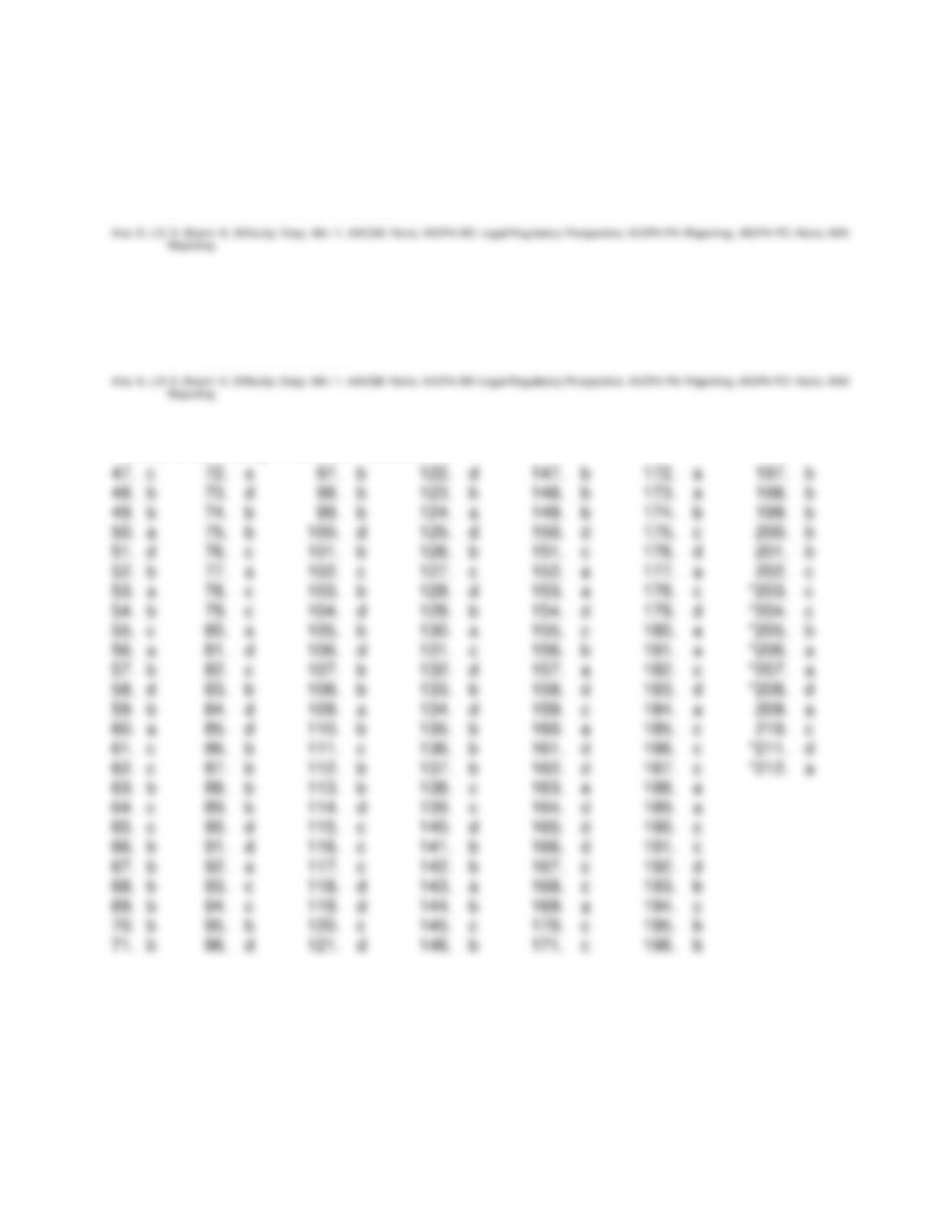
Reporting and Analyzing Stockholders’ Equity
FOR INSTRUCTOR USE ONLY
11–43
*211. The declaration and distribution of a stock dividend will
a. increase total stockholders’ equity.
b. increase total assets.
c. decrease total assets.
d. have no effect on total assets.
*212. The declaration of a small stock dividend will
a. increase paid-in capital.
b. change the total of stockholders’ equity.
c. increase total liabilities.
d. increase total assets.
Answers to Multiple Choice Questions
Test Bank for Financial Accounting: Tools for Business Decision Making, Seventh Edition
FOR INSTRUCTOR USE ONLY
11–44
BRIEF EXERCISES
Be. 213
1. Name at least three advantages of a corporation.
2. Corporations acquire treasury stock for a variety of purposes. Name three reasons why a
corporation may acquire treasury stock.
Reporting and Analyzing Stockholders’ Equity
11–45
Be. 214
Identify (by letter) each of the following characteristics as being an advantage or a disadvantage
of the corporate form of business or not applicable to the corporate form of business organization.
A = Advantage
D = Disadvantage
N = Not Applicable
Characteristics
_____ 1. Separate legal entity
_____ 2. Taxable entity resulting in additional taxes
_____ 3. Continuous life
_____ 4. Unlimited liability of owners
_____ 5. Government regulation
_____ 6. Separation of ownership and management
_____ 7. Ability to acquire capital
_____ 8. Ease of transfer of ownership
Be. 215
Patrick Corporation is authorized to issue 1,000,000 shares of $1 par value common stock.
During 2014, the company has the following stock transactions.
Jan. 15 Issued 700,000 shares of stock at $7 per share.
Sept. 5 Purchased 20,000 shares of common stock for the treasury at $8 per share.
Dec. 6 Declared a $0.50 per share dividend to stockholders of record on December 20,
payable January 3, 2015.
Instructions
Journalize the transactions for Patrick Corporation.
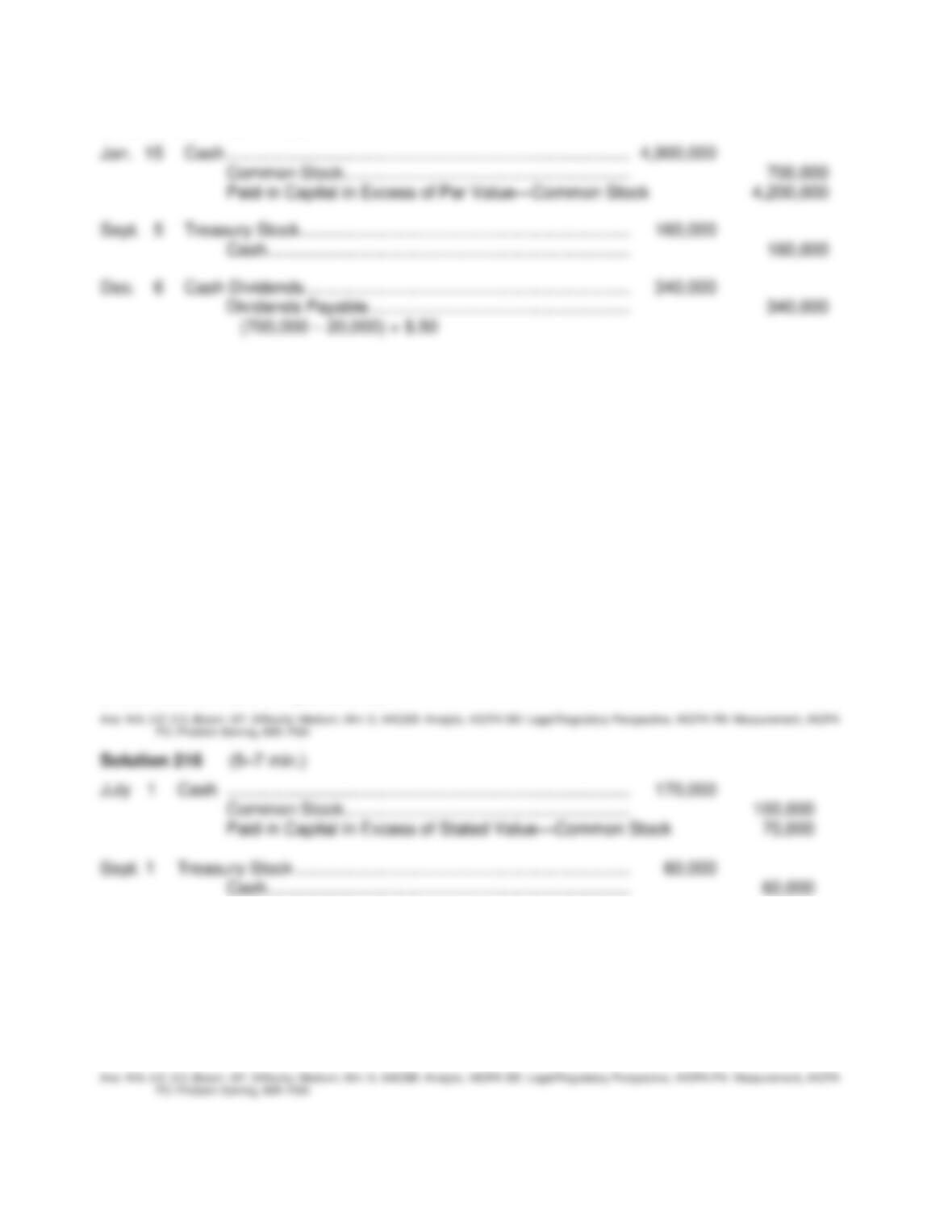
Test Bank for Financial Accounting: Tools for Business Decision Making, Seventh Edition
FOR INSTRUCTOR USE ONLY
11–46
Solution 215 (5–7 min.)
Be. 216
An inexperienced accountant for Teahan Corporation made the following entries.
July 1 Cash ……………………………………………………………………….. 170,000
Common Stock ………………………………………………….. 170,000
(Issued 20,000 shares of no-par common stock,
stated value $5 per share)
Sept. 1 Common Stock …………………………………………………………. 36,000
Retained Earnings …………………………………………………….. 24,000
Cash ………………………………………………………………… 60,000
(Purchased 4,000 shares issued on July 1 for the
treasury at $15 per share)
Instructions
On the basis of the explanation for each entry, prepare the entry that should have been made for
the transactions. (Omit explanations.)
Be. 217
On January 1, 2014, Wooden Company issued 16,000 shares of $2 par value common stock for
$120,000. On March 1, 2014, the company purchased 2,000 shares of its common stock for $15
per share for the treasury.
Instructions
Journalize the stock transactions of Wooden Company in 2014.
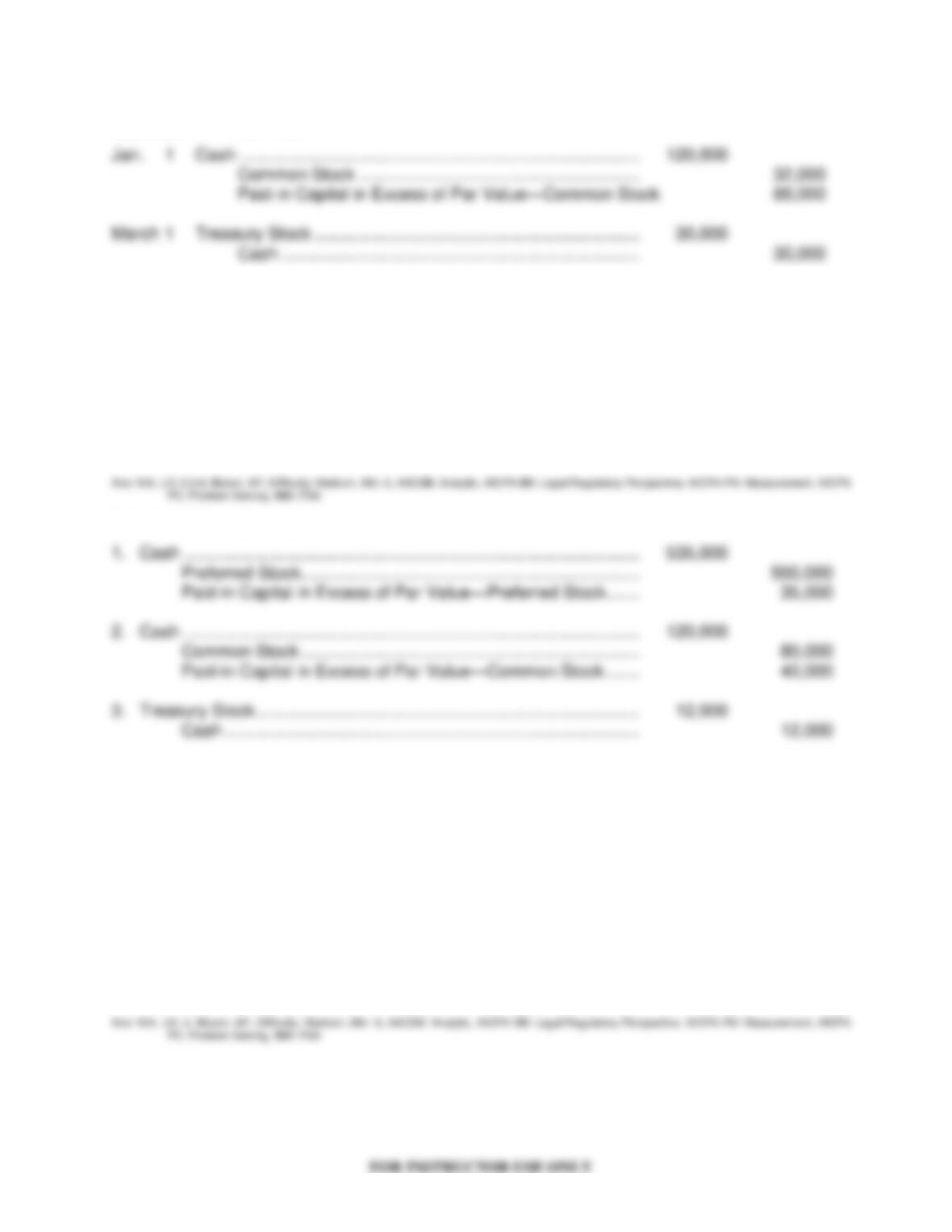
Reporting and Analyzing Stockholders’ Equity
11–47
Solution 217 (5 min.)
Be. 218
Samson Company had the following transactions.
1. Issued 5,000 shares of $100 par preferred stock at $107 for cash.
2. Issued 8,000 share of common stock with a par value of $10 for $120,000.
3. Purchased 500 shares of treasury common stock for $12,000.
Instructions
Prepare the journal entries to record the above stock transactions.
Solution 218 (5 min.)
Be. 219
In its first year of operations, Martinez Corporation had the following transactions pertaining to its
$10 par value preferred stock.
Feb. 1 Issued 8,000 shares for cash at $24 per share.
July 1 Issued 6,000 shares for cash at $25 per share.
Instructions
(a) Journalize the transactions.
(b) Indicate the amount to be reported for (1) preferred stock, and (2) paid-in capital in excess
of par value—preferred stock at the end of the year.
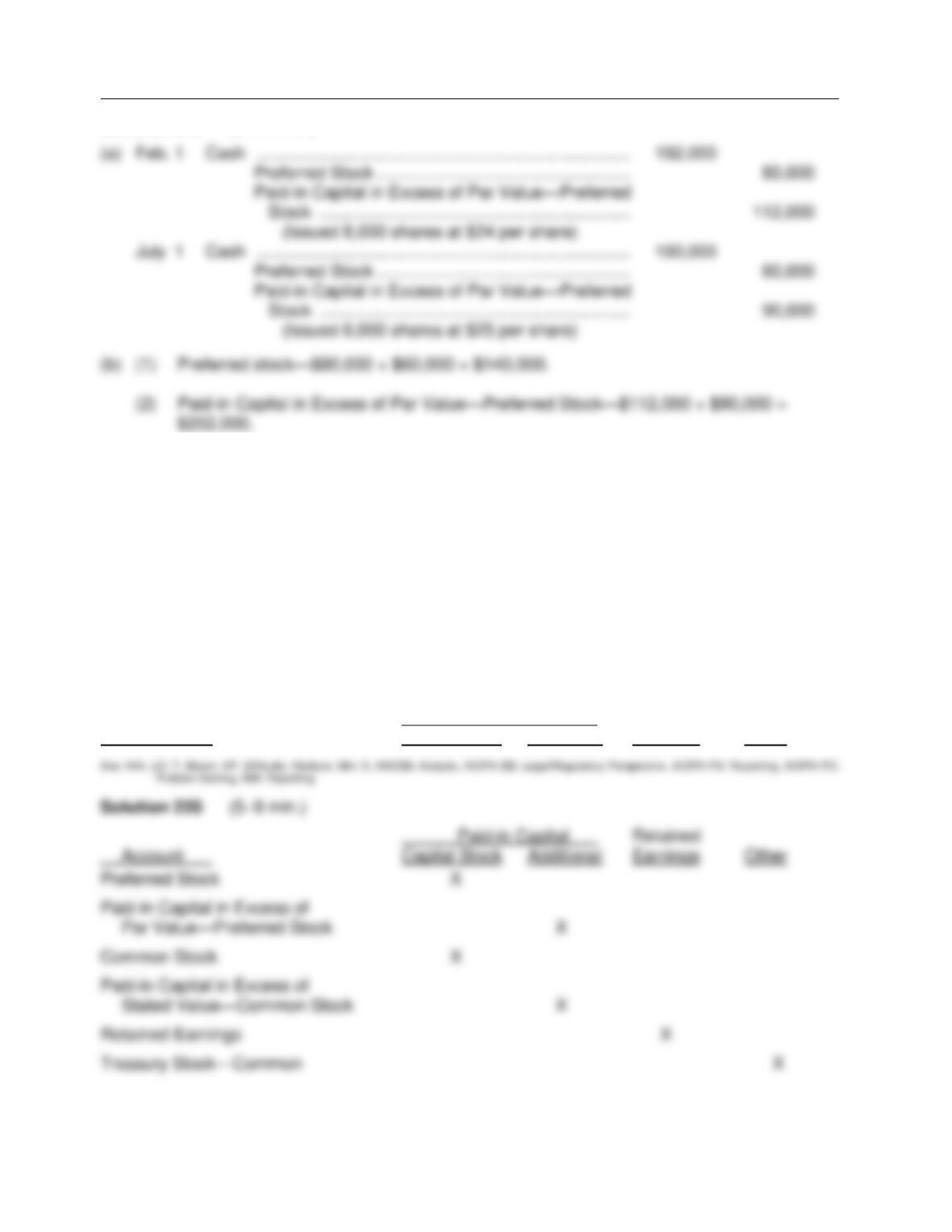
Test Bank for Financial Accounting: Tools for Business Decision Making, Seventh Edition
FOR INSTRUCTOR USE ONLY
11–48
Solution 219 (6–10 min.)
Be. 220
The Huntsman Corporation has the following stockholders’ equity accounts:
Preferred Stock
Paid-in Capital in Excess of Par Value—Preferred Stock
Common Stock
Paid-in Capital in Excess of Stated Value—Common Stock
Retained Earnings
Treasury Stock—Common
Instructions
Classify each account using the following tabular alignment.
Paid-in Capital Retained
Account Capital Stock Additional Earnings Other
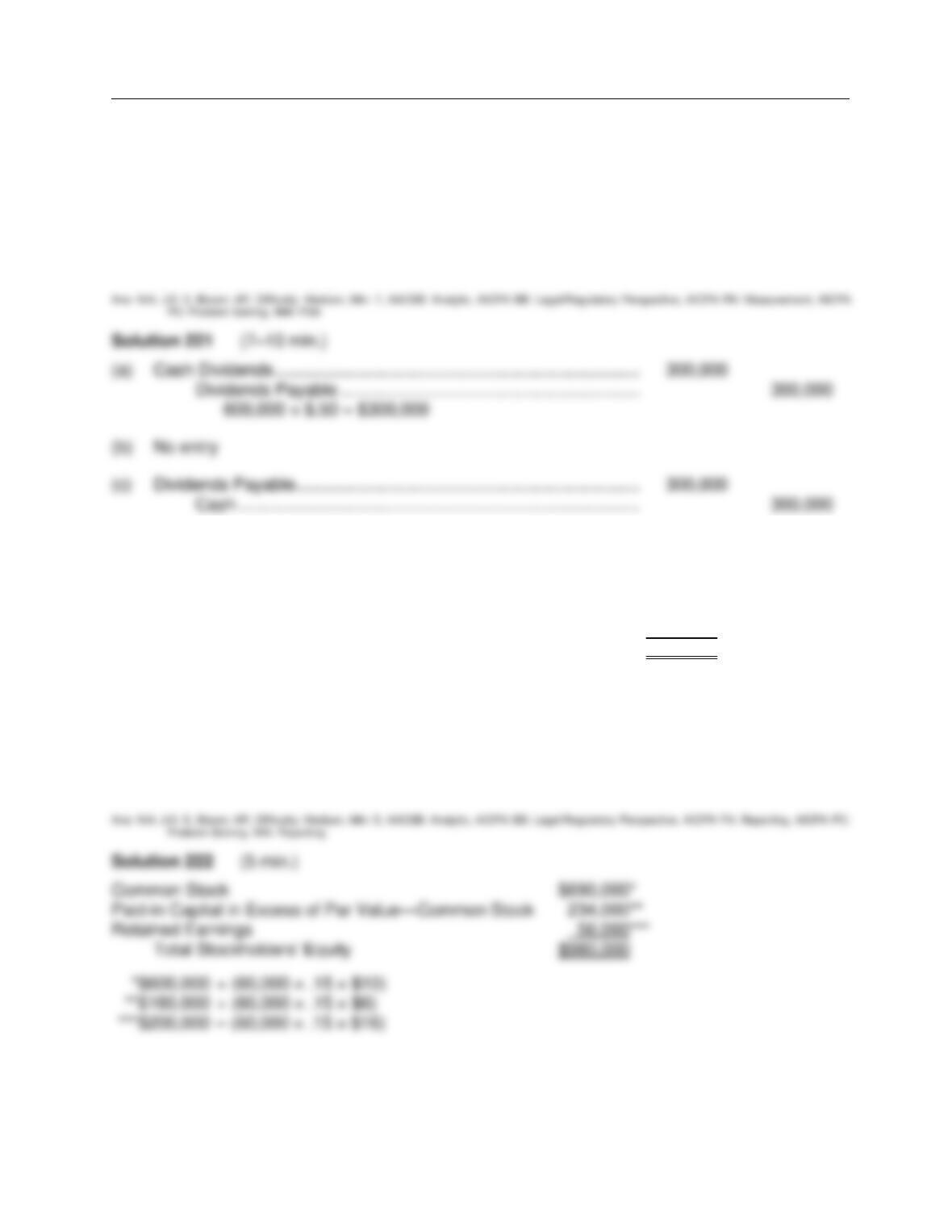
Reporting and Analyzing Stockholders’ Equity
FOR INSTRUCTOR USE ONLY
11–49
Be. 221
Lindy Corporation has 1,000,000 authorized shares of $20 par value common stock. As of June
30, 2014, there were 600,000 shares issued and outstanding. On June 30, 2014, the board of
directors declared a $0.50 per share cash dividend to be paid on August 1, 2014.
Instructions
Prepare the necessary journal entries to be recorded on (a) the date of declaration, (b) the date of
record, and (c) the date of payment.
Be. 222
On November 1, 2014, Kalen Corporation’s stockholders’ equity section is as follows:
Common stock, $10 par value $600,000
Paid-in capital in excess of par value—Common Stock 180,000
Retained earnings 200,000
Total stockholders’ equity $980,000
On November 1, Kalen declares and distributes a 15% stock dividend when the market value of
the stock is $16 per share.
Instructions
Indicate the balances in the stockholders’ equity accounts after the stock dividend has been
distributed.
Test Bank for Financial Accounting: Tools for Business Decision Making, Seventh Edition
FOR INSTRUCTOR USE ONLY
11–50
Be. 223
Listed below are items typically found in the stockholders’ equity section of the balance sheet.
Common stock, $10 stated value
Retained earnings
8% Preferred stock, $100 par value
Paid-in capital in excess of par value—Preferred Stock
Paid-in capital in excess of stated value—Common Stock
Treasury stock
Stockholders’ equity
Paid-in capital
Capital stock
Additional paid-in capital
Total additional paid-in capital
Total paid-in capital
Retained earnings
Total paid-in capital and retained earnings
Total stockholders’ equity
Instructions
Place each of the items listed below in the appropriate subdivision of the stockholders’ equity
section of a balance sheet.
Reporting and Analyzing Stockholders’ Equity
FOR INSTRUCTOR USE ONLY
11–51
Be. 224
The following information is available for Epstein Corporation
2014 2013
Average common stockholders’ equity $1,500,000 $1,000,000
Average total stockholders’ equity 2,000,000 1,500,000
Common dividends declared and paid 72,000 50,000
Preferred dividends declared and paid 30,000 30,000
Net income 180,000 150,000
Instructions
Compute the payout ratio and return on common stockholders’ equity for both years. Briefly
comment on your findings.
EXERCISES
Ex. 225
The corporate charter of Torres Corporation allows the issuance of a maximum of 4,000,000
shares of $1 par value common stock. During its first three years of operation, Torres issued
2,080,000 shares at $15 per share. It later acquired 80,000 of these shares as treasury stock for
$25 per share.
Instructions
Based on the above information, answer the following questions:
(a) How many shares were authorized?
(b) How many shares were issued?
(c) How many shares are outstanding?
(d) What is the balance of the Common Stock account?
(e) What is the balance of the Treasury Stock account?
Test Bank for Financial Accounting: Tools for Business Decision Making, Seventh Edition
FOR INSTRUCTOR USE ONLY
11–52
Solution 225 (8–11 min.)
Ex. 226
The following items were shown on the balance sheet of Martin Corporation on December 31,
2014:
Stockholders’ Equity
Paid-In Capital
Capital Stock
Common stock, $5 par value, 750,000 shares
authorized; ______ shares issued and ______ outstanding ………………….. $3,000,000
Additional paid-in capital
In excess of par value ………………………………………………………………… 180,000
Total paid in capital ………………………………………………………………. 3,180,000
Retained Earnings ……………………………………………………………………………….. 500,000
Total paid-in capital and retained earnings …………………………………….. 3,680,000
Less: Treasury stock (20,000 shares) …………………………………………………….. 280,000
Total stockholders’ equity ……………………………………………………………. $3,400,000
Instructions
Complete the following statements and show your computations.
(a) The number of shares of common stock issued was _______________.
(b) The number of shares of common stock outstanding was ____________.
(c) The total sales price of the common stock when issued was $____________.
(d) How much did the treasury stock cost per share? $_______________
(e) What was the average issue price of the common stock? $______________
Reporting and Analyzing Stockholders’ Equity
FOR INSTRUCTOR USE ONLY
11–53
Solution 226 (10–15 min.)
Ex. 227
Miles Co. had these transactions during the current period.
June 12 Issued 50,000 shares of $3 stated value common stock for cash of $250,000.
July 11 Issued 2,000 shares of $100 par value preferred stock for cash at $108 per share.
Nov. 28 Purchased 2,000 shares of treasury stock for $10,000.
Instructions
Prepare the journal entries for the preceding transactions.
Test Bank for Financial Accounting: Tools for Business Decision Making, Seventh Edition
FOR INSTRUCTOR USE ONLY
11–54
Ex. 228
On January 1, 2014, Browning Corporation had 75,000 shares of $1 par value common stock
issued and outstanding. During the year, the following transactions occurred:
Mar. 1 Issued 90,000 shares of common stock for $675,000
June 1 Declared a cash dividend of $2.00 per share to stockholders of record on June 15
June 30 Paid the $2.00 cash dividend
Dec. 1 Purchased 5,000 shares of common stock for the treasury for $18 per share
Dec. 15 Declared a cash dividend on outstanding shares of $2.50 per share to stockholders
of record on December 31
Net income for 2014 amounted to $951,000.
Instructions
Prepare journal entries to record the above transactions.
Ex. 229
The stockholders’ equity section of Piper Corporation’s balance sheet at December 31, 2013,
appears below:
Stockholders’ equity
Paid-in capital
Common stock, $10 par value, 400,000 shares authorized;
300,000 issued and outstanding $3,000,000
Paid-in capital in excess of par 1,200,000
Total paid-in capital 4,200,000
Retained earnings 900,000
Total stockholders’ equity $5,100,000
Reporting and Analyzing Stockholders’ Equity
FOR INSTRUCTOR USE ONLY
11–55
Ex. 229 (Cont.)
During 2014, the following stock transactions occurred:
Jan. 18 Issued 80,000 shares of common stock at $23 per share.
Aug. 20 Purchased 20,000 shares of Piper Corporation’s common stock at $25 per share to
be held in the treasury.
Instructions
(a) Prepare the journal entries to record the above stock transactions.
(b) Prepare the stockholders’ equity section of the balance sheet for Piper Corporation at
December 31, 2014. Assume that net income for the year was $150,000 and that no
dividends were declared.
Test Bank for Financial Accounting: Tools for Business Decision Making, Seventh Edition
FOR INSTRUCTOR USE ONLY
11–56
Ex. 230
The stockholders’ equity section of Patrick Corporation’s balance sheet at December 31 is
presented here:
PATRICK CORPORATION
Balance Sheet (partial)
Stockholders’ equity
Paid-in capital
Preferred stock, cumulative, 10,000 shares authorized,
6,000 shares issued and outstanding $ 600,000
Common stock, no par, 750,000 shares authorized,
600,000 shares issued 6,000,000
Total paid-in capital 6,600,000
Retained earnings 1,358,000
Total paid-in capital and retained earnings 7,958,000
Less: Treasury stock (4,000 common shares) (32,000)
Total stockholders‘ equity $7,926,000
Instructions
From a review of the stockholders’ equity section, answer the following questions.
(a) How many shares of common stock are outstanding?
(b) Assuming there is a stated value, what is the stated value of the common stock?
(c) What is the par value of the preferred stock?
(d) If the annual dividend on preferred stock is $30,000, what is the dividend rate on preferred
stock?
(e) If dividends of $60,000 were in arrears on preferred stock, what would be the balance
reported for retained earnings?
Reporting and Analyzing Stockholders’ Equity
FOR INSTRUCTOR USE ONLY
11–57
Ex. 231
Ritchey Corporation has the following capital stock outstanding at December 31, 2014:
9% Preferred stock, $100 par value, cumulative
12,000 shares issued and outstanding …………………………………………… $1,200,000
Common stock, no par, $10 stated value, 500,000 shares authorized,
300,000 shares issued and outstanding …………………………………………. 3,000,000
The preferred stock was issued at $125 per share. The common stock was issued at an average
per share price of $14.
Instructions
Prepare the paid-in capital section of the balance sheet at December 31, 2014.
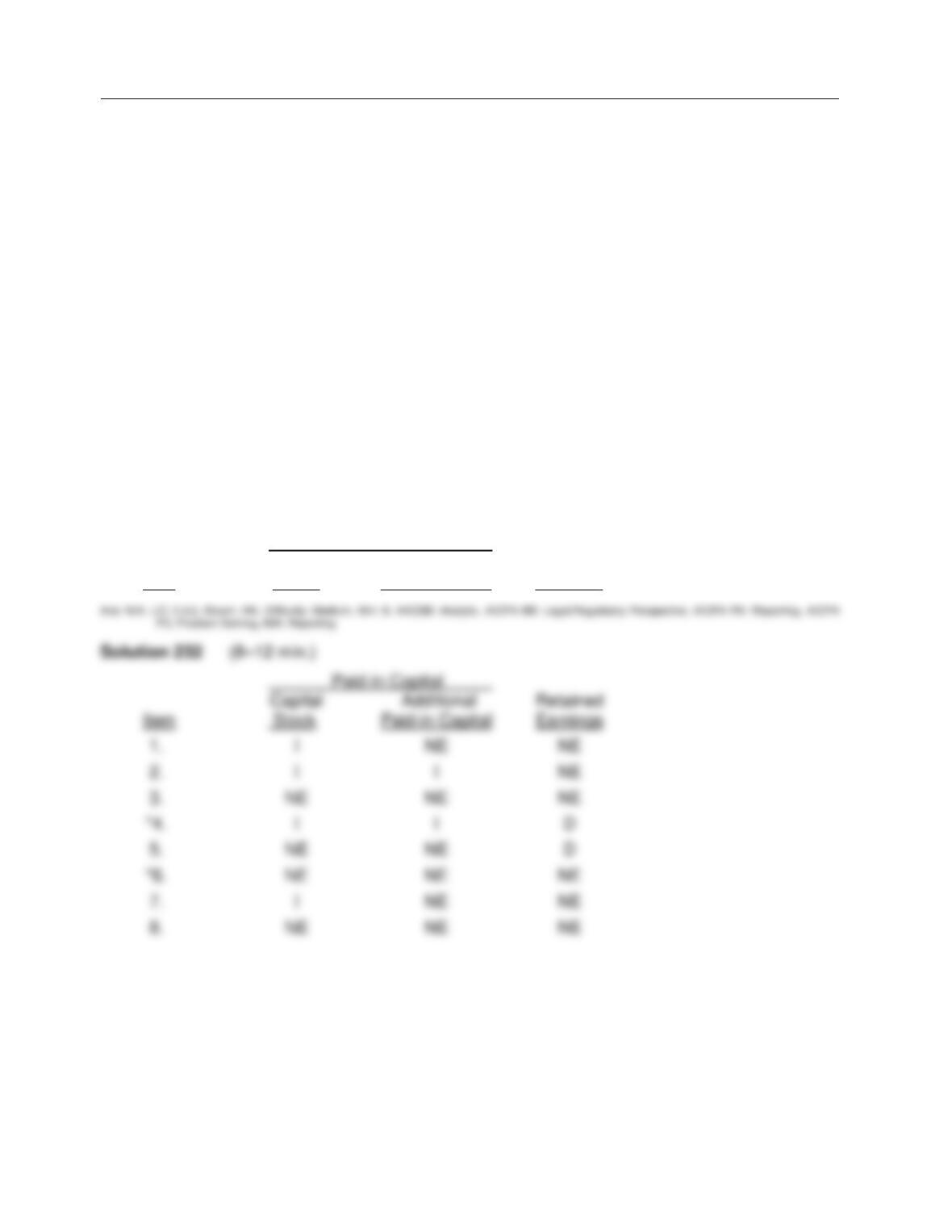
Test Bank for Financial Accounting: Tools for Business Decision Making, Seventh Edition
FOR INSTRUCTOR USE ONLY
11–58
Ex. 232
During 2014 Kenton Corporation had the following transactions and events:
1. Issued par value preferred stock for cash at par value
2. Issued par value common stock for cash at an amount greater than par value
3. Completed a 2 for 1 stock split in which the $10 par value common stock was changed to $5
par value stock
*4. Declared a small stock dividend when the market value was higher than the par value
5. Declared a cash dividend
*6. Issued the shares of common stock required by the stock dividend declaration in 4. above
7. Issued par value common stock for cash at par value
8. Paid the cash dividend
Instructions
Indicate the effect(s) of each of the foregoing items on the subdivisions of stockholders’ equity.
Present your answers in tabular form with the following columns. Use (I) for increase, (D) for
decrease, and (NE) for no effect.
Paid-in Capital
Capital Additional Retained
Item Stock Paid-in Capital Earnings
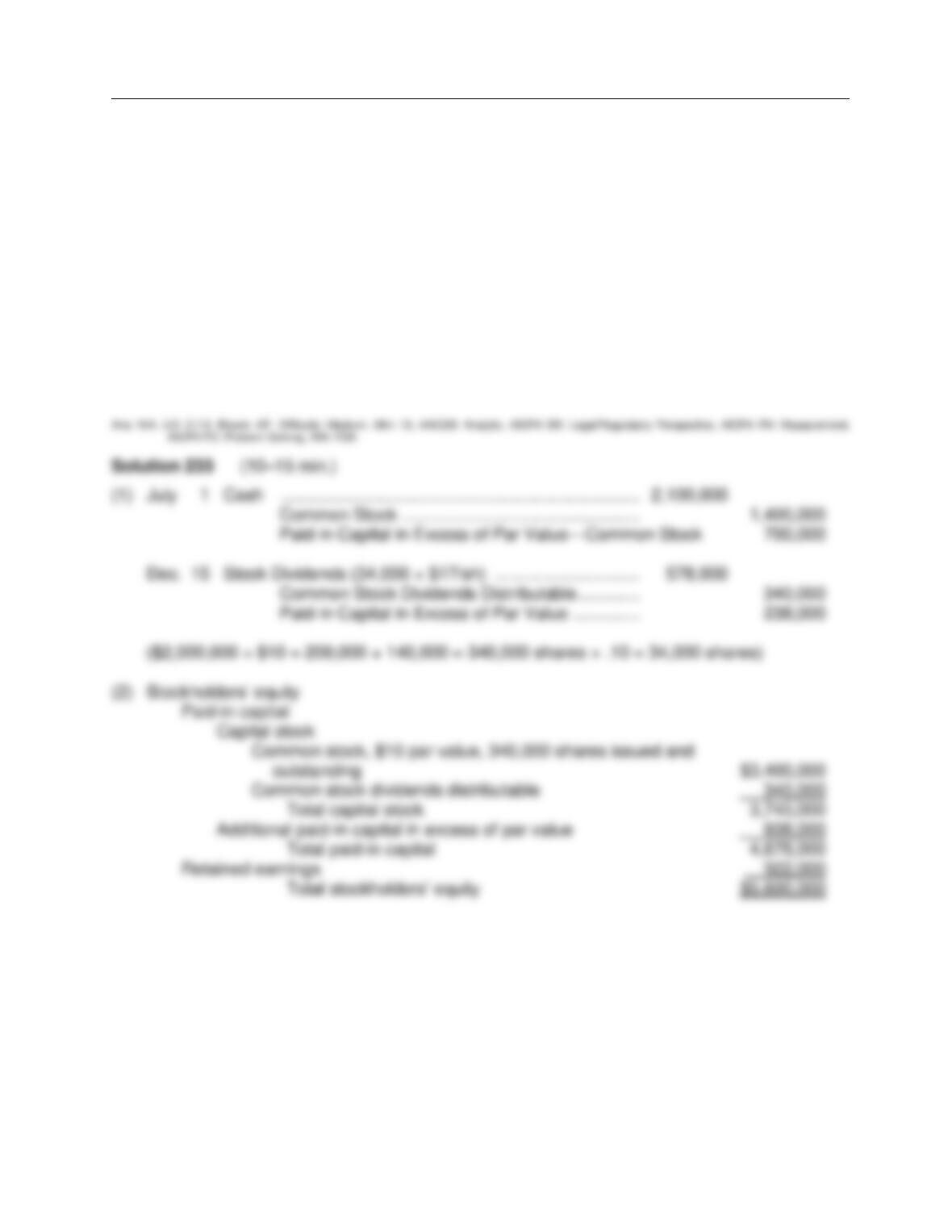
Reporting and Analyzing Stockholders’ Equity
FOR INSTRUCTOR USE ONLY
11–59
*Ex. 233
On January 1, 2014, the Black Corporation had $2,000,000 of $10 par value common stock
outstanding that was issued at par and Retained Earnings of $1,000,000. The company issued
140,000 shares of common stock at $15 per share on July 1. On December 15, the board of
directors declared a 10% stock dividend to stockholders of record on December 31, 2014,
payable on January 15, 2015. The market value of Black Corporation stock was $17 per share on
December 15 and $16 per share on December 31. Net income for 2014 was $500,000.
Instructions
(1) Journalize the issuance of stock on July 1 and the declaration of the stock dividend on
December 15.
(2) Prepare the stockholders’ equity section of the balance sheet for Black Corporation at
December 31, 2014.
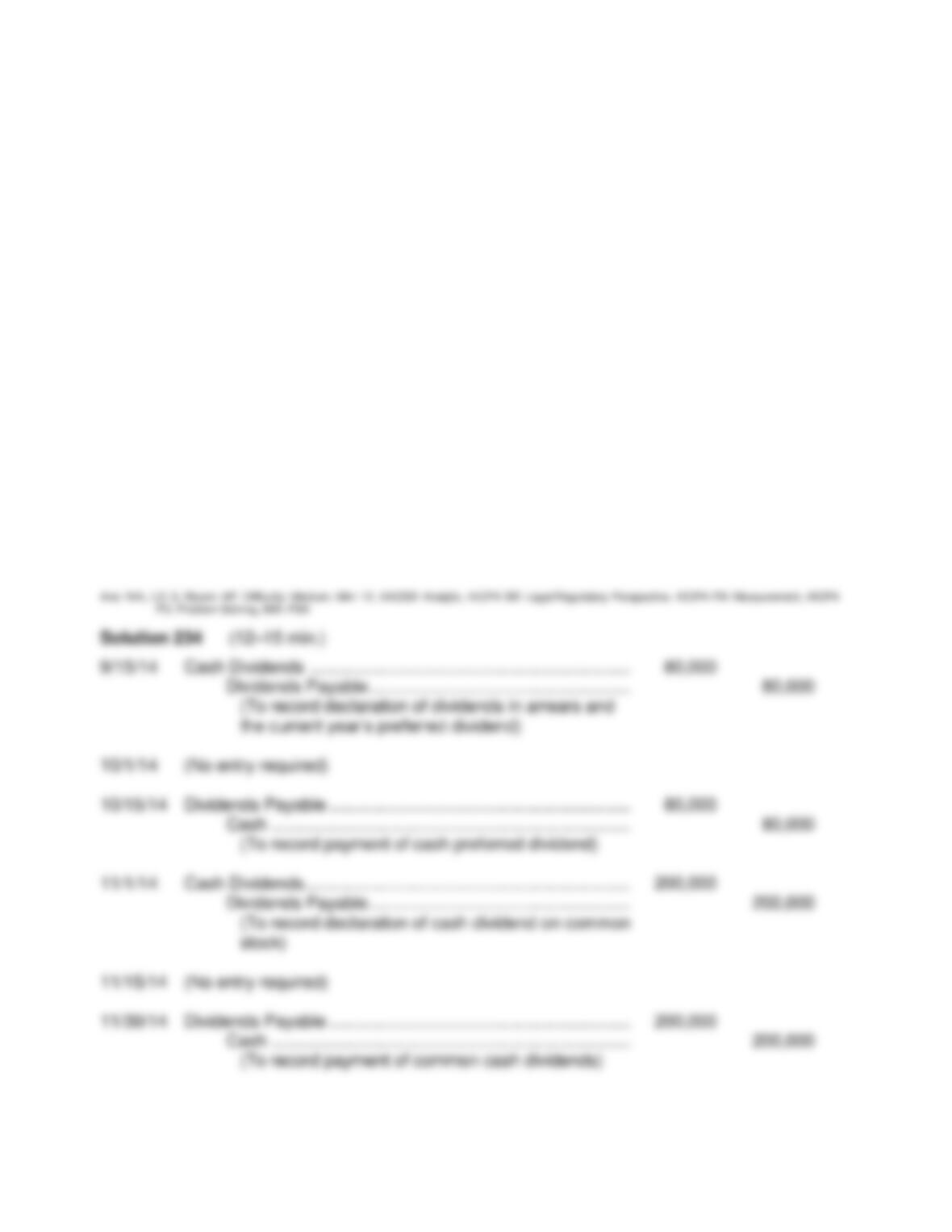
Test Bank for Financial Accounting: Tools for Business Decision Making, Seventh Edition
FOR INSTRUCTOR USE ONLY
11–60
Ex. 234
The stockholders’ equity section of Fleming Corporation at December 31, 2013, included the
following:
4% preferred stock, $100 par value, cumulative,
15,000 shares authorized, 10,000 shares issued and outstanding ….. $1,000,000
Common stock, $10 par value, 250,000 shares authorized,
200,000 shares issued and outstanding …………………………………….. $2,000,000
Dividends were not declared on the preferred stock in 2013 and are in arrears.
On September 15, 2014, the board of directors of Fleming Corporation declared dividends on the
preferred stock to stockholders of record on October 1, 2014, payable on October 15, 2014.
On November 1, 2014, the board of directors declared a $1 per share dividend on the common
stock, payable November 30, 2014, to stockholders of record on November 15, 2014.
Instructions
Prepare the journal entries that should be made by Fleming Corporation on the dates indicated
below:
September 15, 2014 November 1, 2014
October 1, 2014 November 15, 2014
October 15, 2014 November 30, 2014
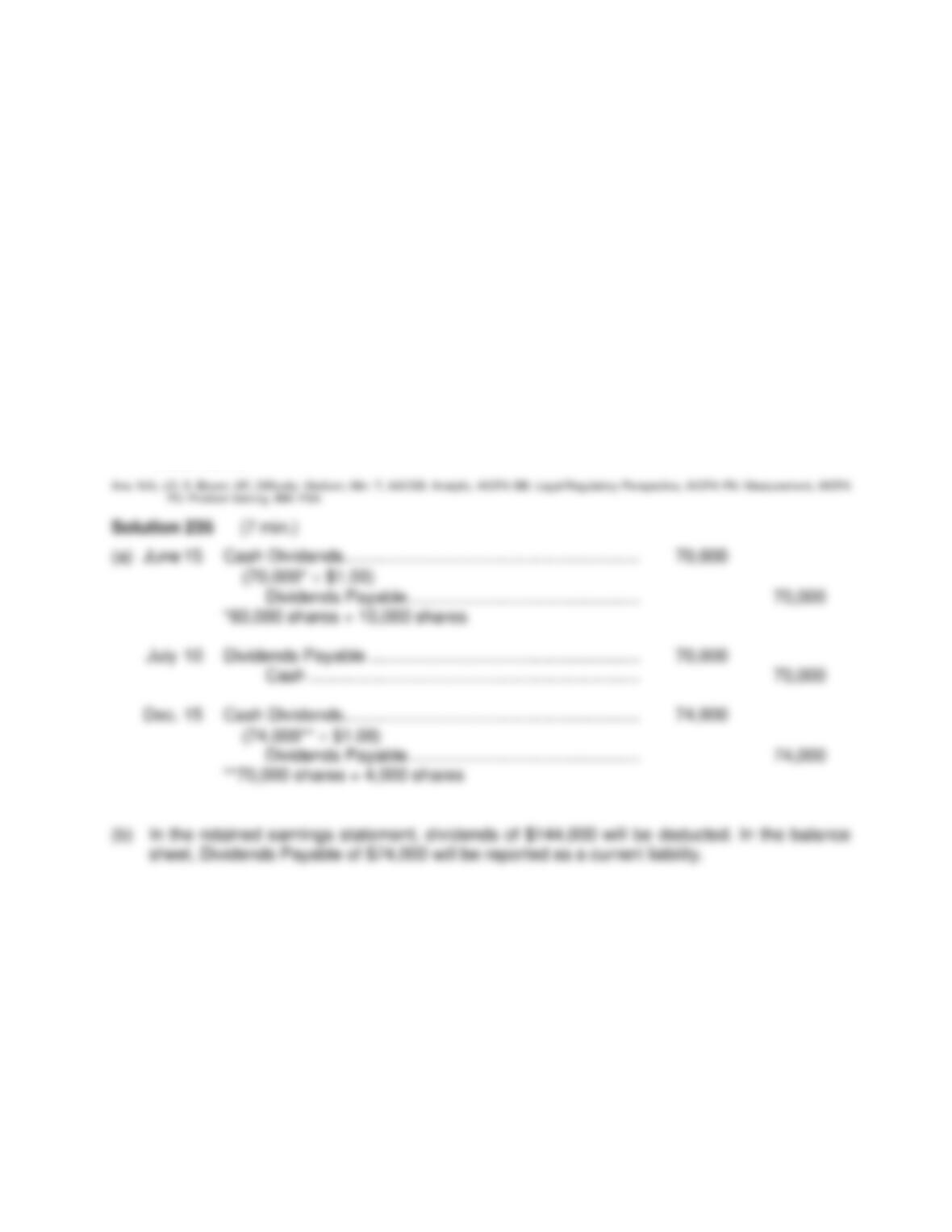
Reporting and Analyzing Stockholders’ Equity
FOR INSTRUCTOR USE ONLY
11–61
Ex. 235
On January 1 Weiss Corporation had 60,000 shares of no-par common stock issued and
outstanding. The stock has a stated value of $5 per share. During the year, the following
transactions occurred:
Apr. 1 Issued 10,000 additional shares of common stock for $10 per share.
June 15 Declared a cash dividend of $1.00 per share to stockholders of record on June 30.
July 10 Paid the $1.00 cash dividend.
Dec. 1 Issued 4,000 additional shares of common stock for $12 per share.
15 Declared a cash dividend on outstanding shares of $1.00 per share to stockholders
of record on December 31.
Instructions
(a) Prepare the entries, if any, on each of the three dates that involved dividends.
(b) How are dividends and dividends payable reported in the financial statements prepared at
December 31?
Test Bank for Financial Accounting: Tools for Business Decision Making, Seventh Edition
FOR INSTRUCTOR USE ONLY
11–62
Ex. 236
On October 31 the stockholders’ equity section of Eaton Company’s balance sheet consists of
common stock $600,000 and retained earnings $400,000. Eaton is considering the following two
courses of action: (1) declaring a 10% stock dividend on the 60,000 $10 par value shares
outstanding or (2) affecting a 2-for-1 stock split that will reduce par value to $5 per share. The
current market price is $15 per share.
Instructions
Prepare a tabular summary of the effects of the alternative actions on the company’s
stockholders’ equity and outstanding shares. Use these column headings: Before Action, After
Stock Dividend, and After Stock Split.
Ex. 237
Giraldi Corporation’s stockholders’ equity section at December 31, 2013, appears below:
Stockholders’ equity
Paid-in capital
Common stock, $10 par, 60,000 outstanding $600,000
Paid-in capital in excess of par 162,500
Total paid-in capital $762,500
Retained earnings 150,000
Total stockholders’ equity $912,500
On June 30, 2014, the board of directors of Giraldi Corporation declared a 15% stock dividend,
payable on July 31, 2014, to stockholders of record on July 15, 2014. The fair value of Giraldi
Corporation’s stock on June 30, 2014, was $16.
On December 1, 2013, the board of directors declared a 2 for 1 stock split effective December 15,
2014. Giraldi Corporation’s stock was selling for $18 on December 1, 2014, before the stock split
was declared. Par value of the stock was adjusted. Net income for 2014 was $230,000 and there
were no cash dividends declared.
Reporting and Analyzing Stockholders’ Equity
FOR INSTRUCTOR USE ONLY
11–63
Ex. 237 (Cont.)
Instructions
(a) Prepare the journal entries on the appropriate dates to record the stock dividend and the
stock split.
(b) Fill in the amount that would appear in the stockholders’ equity section for Giraldi
Corporation at December 31, 2014, for the following items:
1. Common stock $____________
2. Number of shares outstanding _____________
3. Par value per share $____________
4. Paid-in capital in excess of par $____________
5. Retained earnings $____________
6. Total stockholders’ equity $____________
Test Bank for Financial Accounting: Tools for Business Decision Making, Seventh Edition
FOR INSTRUCTOR USE ONLY
11–64
Ex. 238
On January 1, 2014, Mather Corporation had Retained Earnings of $625,000. During the year,
Mather had the following selected transactions:
1. Declared stock dividends of $40,000
2. Declared cash dividends of $50,000
3. A 2 for 1 stock split involving the issue of 200,000 shares of $5 par value common stock for
100,000 shares of $10 par value common stock
4. Suffered a net loss of $80,000
Instructions
Prepare a Retained Earnings Statement for the year.
Ex. 239
The following accounts appear in the ledger of Bradley, Inc., after the books are closed at
December 31, 2014.
Common Stock, $1 par value, 800,000 shares authorized, 550,000 shares
issued $550,000
Common Stock Dividends Distributable 80,000
Paid-in Capital in Excess of Par Value—Common Stock 950,000
Preferred Stock, $100 par value, 8%, 10,000 shares authorized; 4,000 shares
issued 400,000
Retained Earnings 680,000
Treasury Stock (10,000 common shares) 40,000
Paid-in Capital in Excess of Par Value—Preferred Stock 75,000
Instructions
Prepare the stockholders’ equity section at December 31, 2014, assuming that part of retained
earnings is restricted for plant expansion in the amount of $200,000.
Reporting and Analyzing Stockholders’ Equity
FOR INSTRUCTOR USE ONLY
11–65
Solution 239 (15–20 min.)
Ex. 240
The following are selected accounts and balances from the records of Doran Corporation on June
30, 2014.
Common Stock, $10 par value, 75,000 shares authorized, 54,000 shares
issued $540,000
Paid-in Capital in Excess of Par Value—Common Stock 150,000
Preferred Stock, $100 par value, 8%, 3,000 shares authorized and
issued 300,000
Retained Earnings 280,000
Treasury Stock (10,000 common shares) 150,000
Paid-in Capital in Excess of Par Value—Preferred Stock 30,000
Instructions
Prepare in proper form the stockholders’ equity section of the balance sheet.
Test Bank for Financial Accounting: Tools for Business Decision Making, Seventh Edition
FOR INSTRUCTOR USE ONLY
11–66
Solution 240 (8 min.)
Ex. 241
The following stockholders’ equity accounts, arranged alphabetically, are in the ledger of Marvel
Corporation at December 31, 2014.
Common Stock ($5 stated value) $2,800,000
Paid-in Capital in Excess of Par Value—Preferred Stock 45,000
Paid-in Capital in Excess of Stated Value—Common Stock 1,050,000
Preferred Stock (8%, $100 par, noncumulative) 1,000,000
Retained Earnings 1,684,000
Treasury Stock (10,000 shares) 98,000
Instructions
Prepare the stockholders’ equity section of the balance sheet at December 31, 2014.
Reporting and Analyzing Stockholders’ Equity
FOR INSTRUCTOR USE ONLY
11–67
Solution 241 (8 min.)
Ex. 242
Mann Corporation decided to issue common stock and used the $120,000 proceeds to retire all of
its outstanding bonds on January 1, 2014. The following information is available for the company
for 2013 and 2014.
2014
2013
Net income
$ 120,000
$ 100,000
Average stockholders‘ equity
1,000,000
800,000
Total assets
1,200,000
1,200,000
Current liabilities
100,000
100,000
Total liabilities
360,000
480,000
Instructions
(a) Compute the return on common stockholders‘ equity for both years.
(b) Explain how it is possible that net income increased, but the return on common
stockholders’ equity decreased.
(c) Compute the debt to assets ratio for both years, and comment on the implications of this
change in the company’s solvency.
Test Bank for Financial Accounting: Tools for Business Decision Making, Seventh Edition
FOR INSTRUCTOR USE ONLY
11–68
Solution 242 (10 min.)
Ex. 243
Manning Company has $1,000,000 in assets and $1,000,000 in stockholders’ equity, with 50,000
shares outstanding the entire year. It has a return on assets ratio of 9%. In the past year it had
net income of $75,000. On January 1, 2014, it issued $300,000 in debt at 5% and immediately
repurchased 25,000 shares for $300,000. Management expected that, had it not issued the debt,
it would have again had net income of $75,000.
Instructions
(a) Determine the Company‘s net income and earnings per share for 2013 and 2014. (Ignore
taxes in your computations.)
(b) Compute the Company‘s return on common stockholders’ equity for 2013 and 2014.
(c) Compute the company’s debt to assets ratio for 2013 and 2014.
Reporting and Analyzing Stockholders’ Equity
FOR INSTRUCTOR USE ONLY
11–69
Solution 243 (Cont.)
Ex. 244
On January 1, 2014, Holt Corporation had $1,000,000 of common stock outstanding that was
issued at par and retained earnings of $750,000. The company issued 60,000 shares of common
stock at par on July 1 and earned net income of $400,000 for the year.
Instructions
Journalize the declaration of a 15% stock dividend on December 10, 2014, for the following two
independent assumptions.
(a) Par value is $10 and market value is $16.
(b) Par value is $5 and market value is $8.
Test Bank for Financial Accounting: Tools for Business Decision Making, Seventh Edition
11–70
COMPLETION STATEMENTS
245. A corporation has a separate __________________________ distinct from its owners.
246. The major advantages of the corporate form of organization include (1) limited
_________________ of stockholders, (2) continuous ____________________ and (3)
ease of transferring ___________________.
247. The _______________ is the chief executive officer with direct responsibility for managing
the business.
248. Most publicly held corporations are required to make extensive disclosure of their financial
affairs to the _______________.
249. Stockholders generally have the right to share in corporate _______________ and in
______________ upon liquidation.
250. Par value of stock represents the __________________ per share that must be retained
in the business for the protection of corporate ___________________.
251. A corporation’s own stock that has been reacquired by the corporation and held for future
use is called __________________ and is deducted from total _____________________
on the balance sheet.
252. The _______________ feature of preferred stock gives the preferred stockholders the
right to receive current-year dividends and unpaid prior-year dividends before common
stockholders receive any dividends.
253. Three important dates associated with dividends are the: (1)___________________,
(2)__________________, and (3)__________________.
254. The entry to record the declaration of a stock dividend increases _________________,
and decreases ________________.
Reporting and Analyzing Stockholders’ Equity
FOR INSTRUCTOR USE ONLY
11–71
255. Both a stock split and a stock dividend will _________________ the number of shares
outstanding and have _________________ on total stockholders’ equity.
256. A debit balance in retained earnings is identified as a ________________.
257. The paid-in capital section of the balance sheet consists of two classifications:
______________________ and ______________________.
Answers to Completion Statements
Test Bank for Financial Accounting: Tools for Business Decision Making, Seventh Edition
FOR INSTRUCTOR USE ONLY
11–72
MATCHING
258. Match the items below by entering the appropriate code letter in the space provided.
A. Controller F. Preemptive right
B. Deficit G. Par value
C. Payout ratio H. Legal capital
D. Stock dividend I. Treasury stock
E. Declaration date J. Cumulative feature
____ 1. The date the board of directors formally declares a dividend.
____ 2. The amount that must be retained in the business for the protection of creditors.
____ 3. Preferred stockholders have a right to receive current and unpaid prior-year dividends
before common stockholders receive any dividends.
____ 4. The chief accounting officer.
____ 5. Measures the percentage of earnings distributed in the form of dividends to common
stockholders.
____ 6. The amount assigned to each share of stock in the corporate charter.
____ 7. A debit balance in retained earnings.
____ 8. Enables stockholders to maintain their same percentage ownership when new shares
are issued.
____ 9. Corporation’s own stock that has been reacquired by the corporation but not retired.
____ 10. A pro rata distribution of the corporation’s own stock to stockholders.
SHORT-ANSWER ESSAY QUESTIONS
S-A E 259
Define par value, and discuss its significance in accounting.
Reporting and Analyzing Stockholders’ Equity
FOR INSTRUCTOR USE ONLY
11–73
Solution 259
S-A E 260
Companies frequently issue both preferred stock and common stock. What are the major
differences in the rights of stockholders between these two classes of stock?
S-A E 261
For what reasons might a company like IBM repurchase some of its stock (treasury stock)?
S-A E 262
(a) Preferred stock may be cumulative. Discuss this feature.
(b) How are dividends in arrears presented in the financial statements?
Test Bank for Financial Accounting: Tools for Business Decision Making, Seventh Edition
FOR INSTRUCTOR USE ONLY
11–74
S-A E 263
A large stock dividend and stock split can frequently have the same effect on the market price of
a corporation’s stock. Explain how stock dividends and stock splits affect the market price of a
corporation’s stock.
S-A E 264
Why must a corporation have sufficient retained earnings before it may declare cash dividends?
S-A E 265
Linda Merton asks, “Since stock dividends don‘t change anything, why declare them?” What is
your answer to Linda?
S-A E 266
What is the formula for the payout ratio? What does it indicate?
Reporting and Analyzing Stockholders’ Equity
FOR INSTRUCTOR USE ONLY
11–75
Solution 266
S-A E 267 (Ethics)
Mark Remington, the president and CEO of Earth Systems, Inc., a waste management firm, was
recently hospitalized, suffering from exhaustion and a heart ailment. Immediately prior to his
hospitalization, Earth Systems had experienced a sharp decline in its stock price, and trading
activity became almost nonexistent. The primary reason for this was concern expressed in the
media over a new untested waste management system implemented by the company.
Mr. Remington had been unwilling to submit the procedure to testing before implementation, but
he reluctantly agreed to limited tests after the system was operational. No problems have been
identified by the tests to date.
The other members of management called a meeting to determine what they should do. Terry
Jackson, the marketing manager, suggested that the company purchase a large number of
shares of treasury stock. In that way, investors might notice that activity had picked up, and might
decide to buy some more shares. This plan would use up most of the company’s available cash,
so that there will be no money available for a cash dividend. Earth Systems has paid cash
dividends every quarter for over ten years.
Required:
1. Is Mr. Jackson’s suggestion ethical? Explain.
2. Is it ethical to discontinue the cash dividend? Explain.
Test Bank for Financial Accounting: Tools for Business Decision Making, Seventh Edition
FOR INSTRUCTOR USE ONLY
11–76
S-A E 268 (Communication)
As part of a Careers in Accounting program sponsored by accounting organizations and
supported by your company, you will be taking a group of high-school students through the
accounting department in your company. You will also provide them with various materials to
explain the work of an accountant. One of the materials you will provide is the Stockholders’
Equity section of a recent balance sheet.
Required:
Prepare a short response explaining each major section: Common Stock, Additional Paid-in
Capital, and Retained Earnings. You should try to be brief but clear.
Reporting and Analyzing Stockholders’ Equity
11–77
IFRS QUESTIONS
1. Jahnke Corporation issued 8,000 shares of €2 par value ordinary shares for €11 per
share. The journal entry to record the sale will include
a. a debit to Cash for €16,000.
b. a credit to Share Premium–Ordinary for €72,000.
c. a credit to Share Capital–Ordinary for €88,000.
d. a debit to Retained Earnings for €72,000.
2. La Vida Corporation issued 24,000 shares of no-par value ordinary shares for €29.50 per
share. Which of the following statements is true?
a. Share Premium–Ordinary account will increase by €276,000.
b. The Cash account will increase by €24,000.
c. Retained Earnings account will increase by €684,000.
d. Share Capital–Ordinary account will increase by €708,000.
3. Freidrichs Company has issued and outstanding 11,000 shares of cumulative, 6%, €50
par value preference shares which it sold for €54 per share at the beginning of 2012. The
company has never paid preference dividends. As of December 31, 2014, dividends in
arrears are
a. €66,000.
b. €99,000.
c. €121,500.
d. €106,920.
4. Looper, Inc. has 30,000 shares of 6%, ₤100 par value, noncumulative preference shares
and 50,000 ordinary shares with a ₤1 par value outstanding at December 31, 2014. There
were no dividends declared in 2013. The board of directors declares and pays a ₤250,000
dividend in 2014. What is the amount of dividends received by the common shareholders
in 2014?
a. ₤0
b. ₤180,000
c. ₤250,000
d. ₤70,000
Test Bank for Financial Accounting: Tools for Business Decision Making, Seventh Edition
11–78
5. Manner, Inc. has 10,000 shares of 5%, ₤100 par value, noncumulative preference shares
and 20,000 ordinary shares with a ₤1 par value outstanding at December 31, 2014. There
were no dividends declared in 2013. The board of directors declares and pays a ₤90,000
dividend in 2014. What is the amount of dividends received by the ordinary share holders
in 2014?
a. ₤0
b. ₤50,000
c. ₤90,000
d. ₤40,000
6. Anders, Inc has 10,000 shares of 5%, €100 par value, cumulative preference shares and
20,000 ordinary shares with a $1 par value outstanding at December 31, 2014. There
were no dividends declared in 2012. The board of directors declares and pays a €90,000
dividend in 2013 and in 2014. What is the amount of dividends received by the ordinary
shareholders in 2014?
a. €30,000
b. €50,000
c. €90,000
d. €0
7. On January 1, Swanson Corporation had 80,000 ordinary shares with a €10 par value
outstanding. On March 17, the company declared a 15% share dividend to shareholders
of record on March 20. Market value of the shares was €13 on March 17. The entry to
record the transaction of March 17 would include a
a. credit to Cash Dividends for €36,000.
b. credit to Cash for €156,000.
c. credit to Ordinary Share Dividends Distributable for €120,000.
d. debit to Ordinary Share Dividends Distributable for €120,000.
8. On January 1, Swanson Corporation had 80,000 ordinary shares with a €10 par value
outstanding. On March 17, the company declared a 15% share dividend to shareholders
of record on March 20. Market value of the shares was €13 on March 17. The shares
were distributed on March 30. The entry to record the transaction of March 30 would
include a
a. credit to Cash for €120,000.
b. debit to Ordinary Share Dividends Distributable for €120,000.
c. credit to Share Premium–Ordinary for €36,000.
d. debit to Cash Dividends for €36,000.
Reporting and Analyzing Stockholders’ Equity
11–79
9. Oxford Inc. was authorized to issue 100,000 £10 par value ordinary shares. As of
December 31, 2014, the company had issued 44,000 shares at an average price of £22
per share. During 2014, the company felt that the shares were undervalued so it
purchased 10,000 treasury shares at £18 per share. When the share price rebounded
later in the year, the company sold 4,000 of the treasury for £25. Retained earnings was
£1,658,000 at December 31, 2014.
Total equity at December 31, 2014 is
a. £2,446,000.
b. £2,518,000.
c. £2,546,000.
d. £2,762,000.