
CHAPTER 11: STRATEGIC COST MANAGEMENT
1. Strategic cost management is the identification of strategies to develop a competitive advantage.
a. True
b. False
2. Strategic decision making is important to achieve good inventory control.
a. True
b. False
3. The objective of strategic cost management is to reduce costs while strengthening strategic positions.
a. True
b. False
4. There are two general cost management strategies: cost leadership and focusing.
a. True
b. False
5. Value-chain analysis is identifying and exploiting internal and external linkages to achieve strong strategic
positions.
a. True
b. False
6. Exploiting internal linkages involves the assessment of management reliability.
a. True
b. False
7. Exploiting supplier linkages is the exploitation of a firm’s internal activities.
a. True
b. False
8. Exploiting customer linkages is not important since customers do not affect profitability.
a. True
b. False

Chapter 11: Strategic Cost Management
9. Strategic cost management emphasizes the importance of an external focus and the need to recognize and exploit
internal and external linkages.
a. True
b. False
10. Life-cycle cost management involves two types of life-cycle viewpoints: the marketing viewpoint and
the production viewpoint.
a. True
b. False
11. Target costing provides a method for reducing costs by exploiting customer and supplier linkages.
a. True
b. False
12. Life-cycle costs are all costs associated with a product during the production viewpoint.
a. True
b. False
13. JIT manufacturing eliminates waste by producing products only when, and in the quantities needed.
a. True
b. False
14. In JIT purchasing, materials are usually at warehouse long before they are needed.
a. True
b. False
15. A major difference between traditional and JIT environments is the degree of responsibility given to workers in the
organization.
a. True
b. False
16. Acceptable quality level (AQL) allows defects to occur within predetermined parameters.
a. True
b. False
Chapter 11: Strategic Cost Management
17. In a JIT environment, many overhead costs are directly traceable to products.
a. True
b. False
18. The structure for a JIT environment is a vastly complicated process costing system.
a. True
b. False
19. Accounting is simplified in the JIT system by the use of backflush costing.
a. True
b. False
20. In a job-order setting using JIT, repetitive business is separated from unique orders.
a. True
b. False
21. Choosing alternative strategies that provide long-term growth involves decision making.
22. The creation of customer value for same or lower cost than competitors is called advantage.
23. the difference between what the customer receives and gives up is the .
24. analysis relies on identifying and exploiting internal and external linkages.
25. The assignments to suppliers and customers that provide the best cost information needed are
called assignments.
26. The length of time a product serves the needs of customers is called the life.
27. The stage during which a product loses market acceptance is called the stage.
Chapter 11: Strategic Cost Management
28. The manufacturing system focused on reducing inventory levels and waste is called manufacturing.
29. In traditional and JIT environments using direct tracing, the manufacturing costs assigned to products are the
direct materials costs and the costs.
30. Accounting for the cost accounting cycle in a JIT environment is simplified by using costing.
31. The strategy which involves choosing among alternative strategies with the goal of selecting a strategy or
strategies that provides a company with reasonable assurance of long-term growth and survival is called:
a. Competitive advantage
b. Strategic cost management
c. Strategic decision making
d. Customer value
32. The strategy to create better customer value for the same or lower cost than competitors or creating equivalent
value for lower cost than offered by competitors is called:
a. Strategic decision making
b. Competitive advantage
c. Strategic cost management
d. Total product
33. A competitive advantage has been established when
a. customers see the variation as important and the value added to the customer exceeds the cost of providing
differentiation.
b. a high-cost strategy increases customer value by minimizing customer sacrifices.
c. a low-profit item is dropped from the product line.
d. both a and b.
34. The difference between what a customer receives and what the customer gives up is called:
a. Customer value
b. Strategic cost management
c. Competitive advantage
d. Strategic decision making

Chapter 11: Strategic Cost Management
35. The total product, the complete range of benefits that a customer receives from a purchased product include(s):
a. intangible benefits
b. activity
c. tangible benefits
d. both a and c
36. The use of cost data to develop and identify superior strategies that will produce a sustainable competitive
advantage is called:
a. Strategic decision making
b. Competitive advantage
c. Strategic cost management
d. Customer value
37. When a computer company maintains the internal storage space for a lower price, it is following a
a. focusing strategy.
b. cost leadership strategy.
c. differentiation strategy.
d. strategic positioning strategy.
38. When a computer company increases the internal storage space for the same price, it is following a
a. focusing strategy.
b. low-cost strategy.
c. differentiation strategy.
d. strategic positioning strategy.
39. When a computer company targets customers in the South, it is following a
a. focusing strategy.
b. low-cost strategy.
c. differentiation strategy.
d. strategic allocation strategy.
40. When a computer company selects a mix of strategies in order to create sustainable competitive advantage, it is
following a
a. focusing strategy.
b. low-cost strategy.
c. differentiation strategy.
d. strategic positioning strategy.

Chapter 11: Strategic Cost Management
41. The relationships among activities that are performed with a firm’s portion of the value chain is(are) called:
a. Internal linkages
b. External linkages
c. Industrial value chain
d. Both a and b
42. The industrial value-chain analysis
a. recognizes only complex linkages within the firm.
b. is not compatible with differentiation strategies.
c. determines a linked set of value-creating activities.
d. requires a firm to operate across the entire value chain.
43. The factor(s) that describe the relationships of a firm’s value chain activities that are performed with its suppliers
and customers is(are) called:
a. Internal linkages
b. External linkages
c. Industrial value chain
d. Both a and b
44. When a computer manufacturing company addresses supplier production problems, it is focusing on
a. external linkages.
b. internal linkages.
c. a differentiation strategy.
d. a cost leadership strategy.
45. The structural and executional factors that determine the long-term cost structure of an organization are called:
a. Organizational activities
b. Operational cost drivers
c. Operational activities
d. Organizational cost drivers
46. Structural and executional activities are types of
a. organizational activities.
b. operating activities.
c. JIT.
d. both a and b.

Chapter 11: Strategic Cost Management
47. Building plants, management structuring, and grouping employees are examples of
a. executional activities.
b. structural activities.
c. operational activities.
d. both a and b.
48. The factors that drive the cost of day-to-day activities performed as a result of the structure and processes selected
by the organization are called:
a. Organizational activities
b. Organizational cost drivers
c. Operational cost drivers
d. Operational activities
49. Plant layout, quality management systems, and providing capacity are examples of
a. executional activities.
b. structural activities.
c. operational activities.
d. both a and b.
50. The operational activity of moving inventory is classified as a
a. unit-level activity.
b. batch-level activity.
c. product-level activity.
d. facility-level activity.
51. The operational activity of setting up equipment is classified as a
a. unit-level activity.
b. batch-level activity.
c. product-level activity.
d. facility-level activity.
52. The operational activity of assembling parts is an example of a
a. unit-level activity.
b. batch-level activity.
c. product-level activity.
d. facility-level activity.

Chapter 11: Strategic Cost Management
53. The operational activity of redesigning products is classified as a
a. unit-level activity.
b. batch-level activity.
c. product-level activity.
d. facility-level activity.
54. The operational activity of inspecting is classified as a
a. unit-level activity.
b. batch-level activity.
c. product-level activity.
d. facility-level activity.
55. Activities required to design, develop, produce, market, distribute, and service a product are known as
a. whole life activities.
b. value-chain activities.
c. target activities.
d. overhead.
56. The first link of the internal value chain is
a. design.
b. develop.
c. market.
d. distribute.
57. The last link of the internal value chain is
a. design.
b. service.
c. market.
d. distribute.
58. Analyzing how costs and other financial factors vary as different bundles of activities are considered to strengthen
a firm’s strategic position is the process of
a. exploiting linkages.
b. design.
c. cost driver analysis.
d. distribution.
Chapter 11: Strategic Cost Management
59. The industry value chain includes
a. shareholder value chain activities as well as firm activities.
b. buyer and supplier value chain activities as well as firm activities.
c. only firm activities.
d. only firm production activities.
60. Identifying profitable and unprofitable customers is an example of exploiting
a. supplier linkages.
b. the product life cycle.
c. consumable life.
d. Customer linkages.
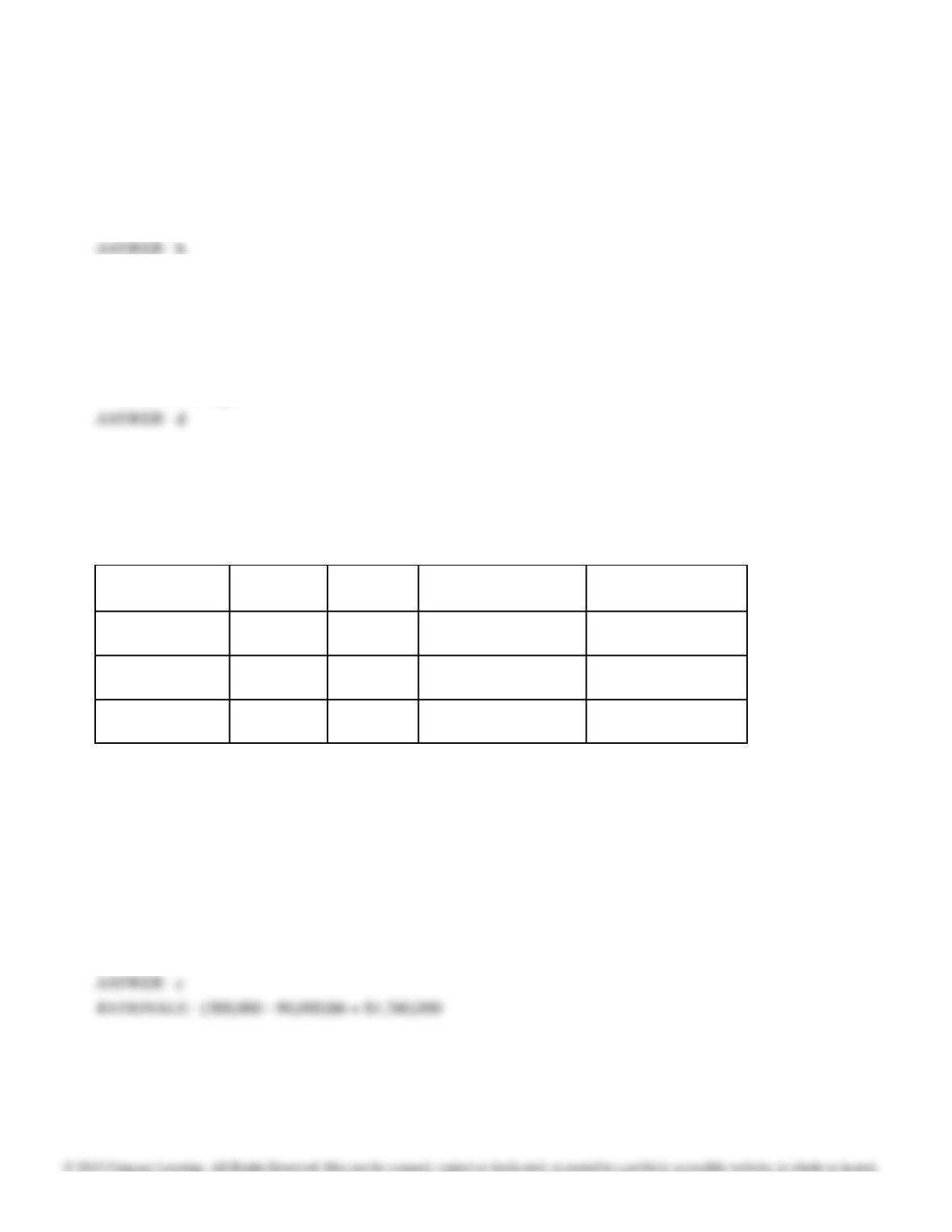
Figure 11-1
Ambrosia Corp. is a manufacturer of equipment used in manufacturing. It currently produces a product with 30
parts but through redesign has reduced the number of parts to 9. Then current activity capacity and demand for the
30 unit configuration and expected activity demand for the 9 part configuration are provided below:
Activities
Activity
Driver
Activity
Capacity
Current Activity
Demand
Expected Activity
Demand
Materials
usage
number of
parts
300,000
300,000
90,000
Assembly
direct labor
hours
20,000
20,000
6,000
Purchasing parts
number of
orders
20,000
16,000
8,000
Materials usage has a rate of $6 per part and no fixed costs. Assembly has a rate of $20 per labor hour with no
fixed component. Purchasing requires clerks that can process 5,000 purchase orders. Each clerk earns $40,000 per
year. There is also a $1 per order processing cost.
61. Refer to Figure 11-1. What is the savings in materials usage cost with the new design changes?
a. $252,000
b. $480,000
c. $1,260,000
d. $1,800,000
Chapter 11: Strategic Cost Management
62. Refer to Figure 11-1. What is the cost savings from purchasing parts?
a. $80,000
b. $88,000
c. $48,000
d. $40,000
63. Refer to Figure 11-1. What is the total cost reduction of the new design?
a. $2,208,000
b. $2,194,000
c. $1,628,000
d. $1,624,000
64. Refer to Figure 11-1. If 10,000 units are being produced and the sales price is $500, what is the new sales price if
the cost savings are passed on to the consumer?
a. $129.80
b. $317.40
c. $237.00
d. $337.20
65. In activity-based costing, supplier costs
a. must be narrower, including only the purchase price.
b. are allocated to products arbitrarily.
c. include costs of quality, reliability and timeliness and are assigned to products on a causal basis.
d. all of these statements are true.
Chapter 11: Strategic Cost Management
Figure 11-2
Blue Vibrance Company sells a product used in many manufacturing processes. The sales activity involves three
activity areas:
Activity Area Cost Driver and Rate
Order taking $100 per purchase order
Sales visits $50 per visit
Delivery vehicles $1 per delivery mile
The following customer information is given:
AX
BY
DZ
Units sold
100,000
80,000
60,000
List price
$50
$50
$50
Actual sales price
$45
$48
$50
Number of purchase orders
30
20
10
Number of sales visits
6
5
3
Number of delivery miles
100
80
60
66. Refer to Figure 11-2. Which customer is most profitable?
a. AX
b. BY
c. DZ
d. They are equally profitable.
67. Refer to Figure 11-2. Which customer has the least activity costs?
a. AX
b. BY
c. DZ
d. They are the same.
Chapter 11: Strategic Cost Management
68. Refer to Figure 11-2. What is the profitability of customer BY?
a. $4,000,000
b. $3,840,000
c. $3,837,670
d. $2,330,000
69. Which of the following are true about total quality control?
a. Total quality control is an approach to differentiate and reduce overall quality costs.
b. Total quality control demands production of defect-free products.
c. Total quality control links suppliers closely with the firm.
d. All of these statements are true about total quality control.
Figure 11-3
Awesome Products Company manufactures a product sold to retailers. It is considering suppliers for its process.
The supplier quality involves four activity areas:
Activity Area Cost Driver and Rate
Order cost $120 per purchase order
Defective units $200 per unit internal failure costs
Delivery trips $5 per delivery mile
Carrying cost $1 per order
The following supplier information is given:
X3
Y2
Z1
Materials units needed
100,000
100,000
100,000
Actual purchase price
$5
$4.99
$5.01
Number of purchase orders
20
30
18
Number of defects
6
12
0
Number of deliveries
20
30
18
Chapter 11: Strategic Cost Management
70. Refer to Figure 11-3. Which supplier is least costly?
a. X3
b. Y2
c. Z1
d. They are equally costly.
71. Refer to Figure 11-3. Which supplier has the most defective units?
a. X3
b. Y2
c. Z1
d. They are equal.
72. Refer to Figure 11-3. What is the cost of supplier Z1?
a. $503,358
b. $503,268
c. $501,000
d. $499,000
73. The length of time that a product serves the needs of customers is called the:
a. Product life cycle
b. Revenue producing life
c. Introduction stage
d. Consumable life

Chapter 11: Strategic Cost Management
74. The time a product exists—from conception to abandonment is called the:
a. Revenue producing life
b. Product life cycle
c. Consumable life
d. Introduction stage
75. The stage during which the product loses market acceptance is called the:
a. decline stage
b. growth stage
c. maturity stage
d. introduction stage
76. The period of time when sales increase at a decreasing rate is called the:
a. introduction stage
b. growth stage
c. decline stage
d. maturity stage
77. The stage characterized by preproduction and startup activities is called the:
a. maturity stage
b. growth stage
c. introduction stage
d. decline stage
78. The period of time when sales increase at an increasing rate is called the:
a. introduction stage
b. maturity stage
c. growth stage
d. decline stage
79. The viewpoint that describes the general sales pattern of a product as it passes through the introduction, growth,
maturity, and decline stages is called the:
a. Marketing viewpoint
b. Customer viewpoint
c. Production viewpoint
d. Accounting viewpoint

Chapter 11: Strategic Cost Management
80. The viewpoint which defines stages of the life cycle by changes in the type of activities performed is called the:
a. Accounting viewpoint
b. Production viewpoint
c. Customer viewpoint
d. Marketing viewpoint
81. Which stage in the marketing viewpoint is characterized by preproduction and startup activities?
a. decline
b. introduction
c. growth
d. maturity
82. Which of the following is NOT a stage of the marketing viewpoint of the product life cycle?
a. decline
b. growth
c. maturity
d. production
83. Which of the following is NOT a stage of the consumable life-cycle viewpoint?
a. disposal
b. maintaining
c. logistics
d. purchasing
84. Life-cycle cost management consists of
a. actions taken to enable a product to be designed, developed, produced, marketed, distributed, operated,
maintained, serviced, and disposed of in order to maximize profits.
b. actions to extend the life of a product through design, development, production, and maintenance.
c. actions that focus on minimizing the cost of developing, designing, producing, distributing, operating, servicing,
and disposal of a product.
d. actions taken to design, develop, test, market, distribute, maintain, service, and dispose of a product to
maximize revenues.

Chapter 11: Strategic Cost Management
85. Which of the following is NOT a stage of the production life-cycle viewpoint?
a. design
b. introduction
c. research
d. testing
86. Which of the life-cycle viewpoints is the revenue-oriented viewpoint?
a. consumable life-cycle viewpoint
b. production viewpoint
c. marketing viewpoint
d. planning viewpoint
87. Which of the following is NOT a stage of the production life-cycle viewpoint?
a. planning
b. production
c. purchasing
d. logistics
88. Which of the life-cycle viewpoints is the cost-oriented viewpoint?
a. product life-cycle
b. consumable life-cycle
c. production life-cycle
d. planning life-cycle
89. Which viewpoint of the product life-cycle is customer-value oriented?
a. production life-cycle
b. marketing life-cycle
c. consumable life-cycle
d. planning life-cycle
90. Which stage of the marketing life-cycle has slow sales growth with peak sales?
a. introduction
b. growth
c. maturity
d. decline

Chapter 11: Strategic Cost Management
91. At which stage of the consumable life-cycle is price sensitivity low?
a. introduction
b. growth
c. maturity
d. decline
92. According to the authors, 90 percent or more of a product’s life-cycle costs are determined during
a. growth stage.
b. development stage.
c. decline stage.
d. maturity stage.
93. Information for life-cycle cost management is supported by a(n)
a. functional-based costing system.
b. activity-based costing system.
c. normal costing system.
d. all of these.
94. Life-cycle cost management emphasizes
a. cost control.
b. cost reduction.
c. normal costing.
d. process costing.
95. The difference between the sales price needed to capture a predetermined market share and the desired profit per
unit is called:
a. Gross profit
b. Target market
c. Target price
d. Target cost
Chapter 11: Strategic Cost Management
Figure 11-4
The Algonquin Company developed the following budgeted life-cycle income statement for two proposed products.
Each product’s life cycle is expected to be two years.
Sales
Product A
$280,000
Product B
$200,000
Total
$480,000
Cost of goods sold
200,000
130,000
330,000
Gross profit
$ 80,000
$ 70,000
$150,000
Period expenses:
Research and development
(70,000)
Marketing
(50,000)
Life-cycle income
$ 30,000
A 10 percent return on sales is required for new products. Because the proposed products did not have a 10
percent return on sales, the products were going to be dropped.
Relative to Product B, Product A requires more research and development costs but fewer resources to market the
product. Sixty percent of the research and development costs are traceable to Product A, and 30 percent of the
marketing costs are traceable to Product A.
96. Refer to Figure 11-4. If research and development costs and marketing costs are traced to each product, life-cycle
income for Product A would be
a. $15,000.
b. $23,000.
c. $27,000.
d. $38,000.
Chapter 11: Strategic Cost Management
97. Refer to figure 11-4. If research and development costs and marketing costs are traced to each product, life-cycle
income for Product B would be
a. $35,000.
b. $7,000.
c. $12,000.
d. $20,000.
98. Refer to Figure 11-4. Return on sales for Product A would be
a. 40.0%.
b. 25.0%.
c. 8.2%.
d. 2.5%.
Chapter 11: Strategic Cost Management
99. Lavalier Company developed the following budgeted life-cycle income statement for two proposed products.
Each product’s life cycle is expected to be two years.
Product AA
Product BB
Total
Sales
$400,000
$350,000
$750,000
Cost of goods sold
300,000
200,000
500,000
Gross profit
$100,000
$150,000
$250,000
Period expenses:
Research and development
(100,000)
Marketing
(75,000)
Life-cycle income
$ 75,000
A 12 percent return on sales is required for new products. Because the proposed products did not have a 12
percent return on sales, the products were going to be dropped.
Relative to Product BB, Product AA requires more research and development costs but fewer resources to market
the product. Sixty-five percent of the research and development costs are traceable to Product AA, and 40 percent
of the marketing costs are traceable to Product AA.
If research and development costs and marketing costs are traced to each product, life-cycle income for Product
AA would be
a. $3,000.
b. $100,000.
c. $35,000.
d. $5,000.