
CHAPTER 11
SHAREHOLDERS’ EQUITY
SUMMARY OF QUESTION TYPES BY LEARNING OBJECTIVE AND
LEVEL OF DIFFICULTY
Item
LO
LOD
Item
LO
LOD
Item
LO
LOD
Item
LO
LOD
Item
LO
LOD
True-False Statements
1.
1
E
9.
3
E
17.
3
M
25.
4
H
33.
6
M
2.
2
E
10.
3
M
18.
3
M
26.
4
H
34.
6
M
3.
2
M
11.
3
M
19.
4
E
27.
5
E
35.
6
H
4.
3
E
12.
3
E
20.
4
E
28.
5
M
36.
6
E
5.
3
E
13.
3
E
21.
4
M
29.
5
M
6.
3
M
14.
3
H
22.
4
E
30.
5
M
7.
3
E
15.
3
M
23.
4
M
31.
5
H
8.
3
M
16.
3
M
24.
4
M
32.
6
M
Multiple Choice Questions
37.
2
M
47.
3
E
57.
3
H
67.
4
M
77.
5
M
38.
3
M
48.
3
E
58.
3
M
68.
4
M
78.
5
E
39.
3
M
49.
3
M
59.
3
M
69.
4
M
79.
5
H
40.
3
E
50.
3
E
60.
4
E
70.
4
M
80.
5
H
41.
3
M
51.
3
E
61.
4
E
71.
4
M
81.
6
H
42.
3
E
52.
3
M
62.
4
E
72.
4
M
82.
6
M
43.
3
E
53.
3
M
63.
4
M
73.
4
H
83.
6
M
44.
3
H
54.
3
M
64.
4
M
74.
4
H
84.
6
M
45.
3
M
55.
3
E
65.
4
E
75.
5
M
85.
6
H
46.
3
E
56.
3
H
66.
4
M
76.
5
E
Exercises
86.
3,4
M
87.
4,5
E
88.
4,5
H
89.
6
H
90.
6
M
Matching
91.
4
H
Short-Answer Essay
92.
3
M
93.
4
M
94.
4,5
M
Essay
95.
3
M
96.
7
M
Note: E = Easy M = Medium H = Hard

11 – 2 Test Bank for Understanding Financial Accounting, Canadian Edition
SUMMARY OF LEARNING OBJECTIVES BY QUESTION TYPE
Item
Type
Item
Type
Item
Type
Item
Type
Item
Type
Item
Type
Item
Type
Learning Objective 1
1.
TF
Learning Objective 2
2.
TF
3.
TF
37.
MC
Learning Objective 3
4.
TF
10.
TF
16.
TF
41.
MC
47.
MC
53.
MC
59.
MC
5.
TF
11.
TF
17.
TF
42.
MC
48.
MC
54.
MC
86.
Ex
6.
TF
12.
TF
18.
TF
43.
MC
49.
MC
55.
MC
92.
SAE
7.
TF
13.
TF
38.
MC
44.
MC
50.
MC
56.
MC
95.
Es
8.
TF
14.
TF
39.
MC
45.
MC
51.
MC
57.
MC
9.
TF
15.
TF
40.
MC
46.
MC
52.
MC
58.
MC
Learning Objective 4
19.
TF
24.
TF
62.
MC
67.
MC
72.
MC
88.
Ex
20.
TF
25.
TF
63.
MC
68.
MC
73.
MC
91.
Ma
21.
TF
26.
TF
64.
MC
69.
MC
74.
MC
93.
SAE
22.
TF
60.
MC
65.
MC
70.
MC
86.
Ex
94.
SAE
23.
TF
61.
MC
66.
MC
71.
MC
87.
Ex
Learning Objective 5
27.
TF
29.
TF
31.
TF
76.
MC
78.
MC
80.
MC
88.
Ex
28.
TF
30.
TF
75.
MC
77.
MC
79.
MC
87.
Ex
94.
SAE
Learning Objective 6
32.
TF
34.
TF
36.
MC
82.
MC
84.
MC
89.
Ex
33.
TF
35.
TF
81.
MC
83.
MC
85.
MC
90.
Ex
Learning Objective 7
96.
Es
Note: TF = True-False Ex = Exercise SAE = Short-Answer Essay
MC = Multiple Choice Ma = Matching Es = Essay
Shareholders’ Equity 11 – 3
CHAPTER LEARNING OBJECTIVES
1. Explain why the shareholders’ equity section is significant to users.
2. Explain the components of the shareholders’ equity section of the statement of
financial position.
3. Describe the different types of shares and explain why corporations choose to issue a
variety of share types.
11 – 4 Test Bank for Understanding Financial Accounting, Canadian Edition
4. Describe the types of dividends, explain why one type of dividend may be used rather
than another, and describe how dividends are recorded.
5. Describe what a stock split is and explain how it is accounted for.
6. Calculate and interpret the price/earnings ratio, dividend payout ratio, dividend yield,
and return on shareholders’ equity ratio.
Shareholders’ Equity 11 – 5
7. Identify the advantages and disadvantages of using equity financing.

11 – 6 Test Bank for Understanding Financial Accounting, Canadian Edition
TRUE-FALSE STATEMENTS
1. Employees are NOT eligible to purchase their employers shares.
2. Share capital represents the amount that investors paid for the shares when they were
initially issued by the company.
3. Accumulated other comprehensive income is a revenue account reported on the statement of
income.
4. Convertible preferred shares are convertible to common shares at the option of the
shareholder.
5. The repurchase of shares may result in a recognizable gain or loss.
6. Contributed surplus is reported on the statement of income because it is a recognized gain.
7. If a company would like to issue additional shares, they do NOT need to amend their Articles
of Incorporation.
8. Repurchasing shares increases the number of shares outstanding.
9. Shares that have been sold by the company are known as issued shares.
10. Corporations generally issue shares through investment bankers known as “tellers”.
11. Every corporation must have one class of shares that represents the company’s basic voting
ownership rights.
12. Common shareholders have the right to vote at shareholder meetings.
13. All companies are obligated to declare dividends.
14. Pre-emptive rights prevent ownership interests from being diluted.

Shareholders’ Equity 11 – 7
15. Preferred shares are normally non-voting.
16. Non-cumulative means that common shareholders must be paid for dividends in arrears
before preferred shareholders are paid.
17. Retractable shares can be sold back to the company at the option of the shareholder.
18. Convertible preferred shares can be converted, at the option of the company, into other
types of preferred shares.
19. Stock dividends are accounted for using the fair market value of the shares on the date of
declaration.
20. Dividends are only paid in cash.
21. The Statement of Financial Position shows all the dividends declared during the year.
22. Cash dividends are paid on the date of record.
23. The date of record results in a legal obligation to pay the cash dividends.
24. Early-stage or growing companies do NOT normally pay dividends.
25. A company may pay a one-time dividend if it has benefitted from an unusual gain.
26. Public companies cannot pay a dividend on the date of declaration.
27. Stock splits only apply to common shareholders.
28. Stock splits do NOT impact the value of the contributed capital or retained earnings
accounts.
29. A 2-for-1 stock split should have the effect of cutting the market price per share in half.
30. Stock splits are normally associated with profitable growing companies.

11 – 8 Test Bank for Understanding Financial Accounting, Canadian Edition
31. Reverse stock splits are also known as consolidations.
32. The denominator in the return on equity calculation is the average number of common
shares outstanding.
33. The price/earnings ratio provides a measure of the return to common shareholders.
34. Stable companies usually pay out a lower portion of their earnings in dividends.
35. Dividend yield measure the dividends an investor will receive relative to the share price.
36. Earnings per share provides a measure of the earnings relative to the number of common
shares outstanding.

Shareholders’ Equity 11 – 9
ANSWERS TO TRUE-FALSE STATEMENTS
Item
Ans.
Item
Ans.
Item
Ans.
Item
Ans.
Item
Ans.

11 – 10 Test Bank for Understanding Financial Accounting, Canadian Edition
MULTIPLE CHOICE QUESTIONS
37. Which of the following accounts is NOT reported on the Statement of Changes in
Shareholders’ Equity?
a) Accumulated Other Comprehensive Income
b) Retained Earnings
c) Other Comprehensive Income
d) Share Capital
38. The articles of incorporation include all of the following EXCEPT
a) what kinds of shares are to be issued.
b) the costs of issuing the shares.
c) the type of business to be conducted.
d) how the board of directors is organized.
39. For accounting purposes, the most important section of the articles of incorporation is the
description of
a) the shares to be issued.
b) the type of business to be conducted.
c) how the board of directors will be organized.
d) who will make up the management.
40. The maximum number of shares that a firm can issue is the number of
a) issued shares.
b) authorized shares.
c) outstanding shares.
d) permissible shares.
41. In the case of liquidation, where do preferred shareholders rank?
a) before creditors and common shareholders
b) after creditors and common shareholders
c) after creditors and equally with common shareholders
d) before common shareholders and after creditors
42. Which of the following is NOT a basic right of common shares?
a) right to share in profits and losses
b) right to participate in the management of the company
c) right to vote in the selection of the board of directors for the corporation
d) right to share in the assets upon liquidation
43. The one class of shares that represent a company’s basic voting rights are
a) preferred shares.
b) capital shares.

Shareholders’ Equity 11 – 11
c) cumulative shares.
d) common shares.
44. Generally the major difference between preferred shares and common shares is
a) preferred shares are restricted by the amount of dividends that can be paid out.
b) common shares have a priority claim over corporate assets.
c) preferred shares have voting rights.
d) there are no significant differences between preferred and common shares.
45. The pre-emptive right is the right to
a) share in the management of the company.
b) share proportionately in any new sale of shares.
c) share in the profits and losses of the company.
d) share in any dividends paid by the company.
46. Which of the following statements is true?
a) Dividends are guaranteed to preferred shareholders.
b) Dividends accumulate on common shares.
c) Dividends are only issued if the board of directors declares them.
d) Dividends are paid to all classes of shares on the same basis.
47. Which of the basic rights of shareholders does the preferred shareholder usually give up in
order to acquire preferences over the common shareholder?
a) right to share in profits and losses
b) right to share in subsequent issues of shares
c) right to share in assets upon liquidation
d) right to vote
48. The type of preferred share that can be bought back by the company at a specified time and
price is a
a) cumulative preferred share.
b) convertible preferred share.
c) redeemable preferred share.
d) non-participating preferred share.
49. What type of preferred share is entitled to dividends above its specified dividend if the
common shares receive excess dividends and must receive dividends in arrears before the
common dividends can be declared?
a) cumulative and participating
b) cumulative and non-participating
c) redeemable and participating
d) redeemable and cumulative
50. Which of the following is the largest number of shares?

11 – 12 Test Bank for Understanding Financial Accounting, Canadian Edition
a) outstanding shares
b) authorized shares
c) issued shares
d) approved shares
51. Dividends in arrears relate to which of the following?
a) cumulative preferred shares
b) participating preferred shares
c) cumulative common shares
d) participating common shares
52. Shares that have been issued and subsequently repurchased but NOT cancelled are called
a) issued shares.
b) re-issued shares.
c) treasury shares.
d) outstanding shares.
53. When shares are repurchased for less than their cost, the difference is recognized as
a) contributed surplus.
b) ordinary gains.
c) extraordinary gains.
d) an increase to retained earnings.
54. Dividends are NOT paid on
a) common shares.
b) preferred shares.
c) treasury shares.
d) outstanding shares.
55. All of the following are terms used to refer to the number of company shares EXCEPT
a) authorized.
b) available.
c) issued.
d) outstanding.
56. Repurchasing shares
a) increases the number of shares outstanding.
b) decreases the number of shares outstanding.
c) has no effect on the number of shares outstanding.
d) splits shares in half.
57. When common or preferred shares are issued, the details of the shares are discussed in a
legal document called
a) articles of incorporation.

Shareholders’ Equity 11 – 13
b) share agreements.
c) shareholder composition.
d) prospectus.
58. At least one class of a company’s common share must have all three of the following rights
EXCEPT
a) the right to vote at meetings of the company’s shareholders.
b) the right to receive dividends, if declared.
c) the right to a share of the company’s net assets upon liquidation of the company.
d) the right to convert shares to cumulative participating preferred shares.
59. Dividends NOT declared in one year carry over to the next year for
a) cumulative preferred shares.
b) cumulative common shares.
c) arrears shares.
d) pre-emptive shares.
60. Which of the following is the first date in the sequence required to pay dividends?
a) payment date
b) announcement date
c) date of record
d) declaration date
61. Which of the following happens at the date of declaration?
a) Dr. Dividends Expense, Cr. Dividends Declared
b) Dr. Dividends Declared, Cr. Cash
c) Dr. Dividends Declared, Cr. Dividends Payable
d) The board of directors approves the dividend but no entry is made in the accounts.
62. Which of the following happens at the date of record?
a) Dr. Dividends Declared, Cr. Dividends Payable
b) Dr. Dividends Declared, Cr. Cash
c) No entry is made in the accounts, but a list of shareholders entitled to receive the dividend is
prepared.
d) The board of directors approves the dividend but no entry is made in the accounts.
63. A legal liability for cash dividends occurs on which of the following dates?
a) date of record
b) ex-dividend date
c) date of payment
d) date of declaration
64. Which date is used to determine which shareholders will receive the declared dividend?
a) date of record

11 – 14 Test Bank for Understanding Financial Accounting, Canadian Edition
b) date of declaration
c) ex-dividend date
d) date of payment
Use the following information for questions 65–67.
Lakeshore Co. has $200,000 of no par value 4% cumulative preferred shares, and 12,000
shares of no par value common shares outstanding. In its first three years of operation, the
company paid cash dividends as follows: Year 1: $8,000; Year 2: $18,000; and Year 3: $24,000.
65. The amount of dividends received by the common shareholders in year 1 was
a) $4,000.
b) $ 0.
c) $8,000.
d) $12,000.
66. The amount of dividends received by the preferred shareholders in year 2 was
a) $8,000.
b) $9,000.
c) $12,000.
d) $18,000.
67. The amount of dividends received by the common shareholders in year 3 was
a) $8,000.
b) $12,000.
c) $16,000.
d) $20,000.
68. The declaration and issuance of a stock dividend
a) increases total shareholders’ equity.
b) does not change total shareholders’ equity.
c) increases current liabilities.
d) does not change total retained earnings.
Use the following information for questions 69–71.
On January 1, Carita’s Dancing Divas had total shareholders’ equity as shown below when their
shares were selling at $25 per share:
Common shares (125,000 shares) ……….. $2,500,000
Retained earnings ……………………………… 4,000,000
Total shareholders’ equity……………… $6,500,000
69. Assume the company declared and issued a 50% stock dividend. The effect of this dividend
would

Shareholders’ Equity 11 – 15
a) increase common shares by $1,250,000 and shares issued and outstanding by 62,500.
b) increase common shares by $1,250,000 with no change in the number of issued and
outstanding shares.
c) leave total shareholders’ equity unchanged but increase the number of shares issued and
outstanding to 187,500.
d) reduce retained earnings by $2,000,000 and double the number of shares issued and
outstanding.
70. Assume the company declared and issued a 10% stock dividend and that the market price
remained constant. The effect of this dividend would
a) increase common shares by $312,500.
b) increase common shares by $250,000.
c) decrease retained earnings by $250,000.
d) increase common shares by $400,000.
71. If the company declared a 15% stock dividend, the number of issued and outstanding
shares would
a) remain unchanged.
b) increase by 18,750 shares.
c) decrease by 18,750 shares.
d) total 143,700 shares.
72. All of the following are reasons for issuing small stock dividends EXCEPT
a) it does not reduce the assets of the company.
b) it provides an opportunity for the company to capitalize its retained earnings.
c) it allows the company to issue a dividend without recording it in their records.
d) it allows the shareholders the option of keeping the shares or selling them for cash.
73. Information to determine the amount of dividends declared and the amount of dividends paid
during the year is found on which financial statement?
Dividends declared Dividends paid
a) Statement of Changes in Shareholders’ equity Income Statement
b) Statement of Changes in Shareholders’ equity Cash Flow Statement
c) Cash Flow Statement Income Statement
d) Cash Flow Statement Cash Flow Statement
74. In 2017, Horseshoe Valley Co. reported net income of $75,000 and declared a dividend of
$40,000. The dividend is to be paid on February 1, 2018 to shareholders of record on January
15, 2018. The balance in the retained earnings account on January 1, 2017 was $140,000. At
Horseshoe’s year end on December 31, 2017 the company reported the following ending
balance on the statement of changes in shareholders’ equity:
a) $35,000.
b) $115,000.
c) $175,000.
d) $215,000.

11 – 16 Test Bank for Understanding Financial Accounting, Canadian Edition
75. Stock splits
a) decrease the Retained Earnings account.
b) increase the number of outstanding shares.
c) increase the Contributed Capital account.
d) all of the above.
76. Which of the following is a reason a company would declare a stock split?
a) to increase the marketability of its shares
b) to increase the share price in the market
c) to increase the value of the company
d) to increase the legal paid-in capital of the company
77. On December 1, Goliath Ltd. declared a 2 for 1 stock split when the market value was $40
per share. Prior to the split, there were 200,000 shares issued and outstanding. After the stock
split, the number of shares outstanding and the share capital balance were
Shares Capital
a) 200,000 $8,000,000.
b) 200,000 $4,000,000.
c) 400,000 $8,000,000.
d) 400,000 $4,000,000.
78. Stock splits are usually declared in order to
a) increase the number of shares outstanding.
b) improve the earnings per share.
c) reduce the shareholders’ equity.
d) reduce the shares‘ market price.
79. Reverse stock splits are used by companies whose low share price
a) puts the company at risk of being listed on a stock exchange as a result of their share price
being barely above the minimum threshold for listing on the exchange.
b) makes them eligible investments for certain institutional investors.
c) allows them to list on a public exchange.
d) prevents them from listing on a public exchange.
80. Which of the following statements is correct in regards to the effect on share capital?
a) Cash dividends increase share capital.
b) Stock dividends increase share capital.
c) Stock splits increase share capital.
d) They all have no effect on share capital.
81. Life and Leaders Ltd. is a public company trading on the Toronto Stock Exchange. The
company’s shares are currently trading for $16.00 per share. Life and Leaders just released the
following information related to its 2017 year-end:
2017 2016

Shareholders’ Equity 11 – 17
Total assets ………………………………………………. $14,500,000 13,250,000
Total liabilities …………………………………………… 7,500,000 6,750,000
Net income ………………………………………………. 762,500 555,000
Preferred share dividends …………………………... 65,000 65,000
Average number of common shares outstanding 100,000 100,000
For 2017, the company’s earnings per share were closest to
a) $7.63.
b) $6.98.
c) $6.50.
d) cannot be calculated with the information provided.
82. Yermo Ltd.’s shares were issued for $21.00 but now have a market value of $35.00. The
most recent EPS for the company was $3.00. The P/E ratio for Yan Ltd. is
a) 4.67.
b) 7.0.
c) 11.67.
d) 18.67.
83. The first step in calculating the price/earnings ratio is
a) calculate number of preferred shares.
b) calculate number of common shares.
c) calculate balance in the retained earnings account.
d) calculate earnings per share.
84. What measures the dividends an investor will receive relative to the share price?
a) dividend payout ratio
b) EPS
c) dividend yield
d) price/earnings ratio
85. The dividend payout ratio measures
a) the portion of a company’s earnings that are distributed as dividends.
b) the dividends an investor will receive relative to the share price.
c) accounting earnings to market price.
d) none of the above.

11 – 18 Test Bank for Understanding Financial Accounting, Canadian Edition
ANSWERS TO MULTIPLE CHOICE QUESTIONS
Item
Ans.
Item
Ans.
Item
Ans.
Item
Ans.
Item
Ans.
Item
Ans.

Shareholders’ Equity 11 – 19
EXERCISES
86. Celebrity Inc. has the following shares outstanding at December 31, 2017:
Common shares, $1,500,000 no par value, 10,000 shares issued and outstanding,
unlimited number authorized.
Preferred shares, $200,000, $5.00, no par value, non voting shares, 2,000 shares issued
and outstanding.
Assume the following situations are independent:
a) The preferred shares are noncumulative and non-participating.
Dividends declared are $47,500.
b) The preferred shares are cumulative and non-participating.
Dividends have not been declared for the past two years.
Dividends declared are $30,000.
Instructions
Determine the amount of the dividend that would be paid to each class of shares under each
situation.
Solution (5 min.)
87. Melanson Inc. had the following balances in its shareholders’ equity at the beginning of the
current year:
Common shares (no par value, 9,000 shares) ………… $ 180,000
Retained earnings ……………………………………………… 92,000
Total shareholders’ equity……………………………… $272,000
During the year the following transactions took place:
• Issued 7,000 shares at $20 per share.
• Declared a 10% stock dividend, market price $21 per share.
• Paid the stock dividend.
• Declared a 4 to 1 stock split.
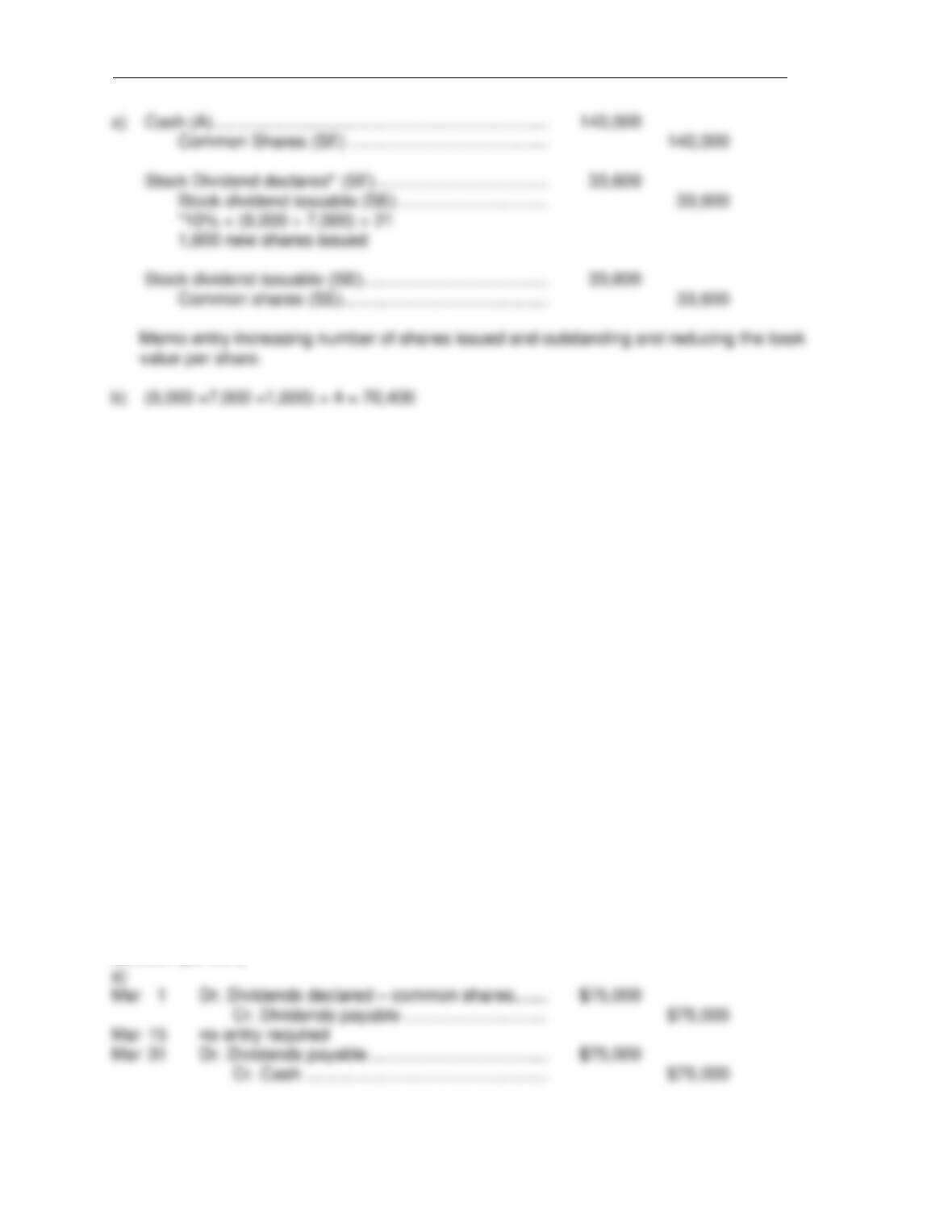
Instructions
a) Prepare the journal entries to record the transactions.
b) Determine the number of shares outstanding.
Solution (5 min.)
11 – 20 Test Bank for Understanding Financial Accounting, Canadian Edition
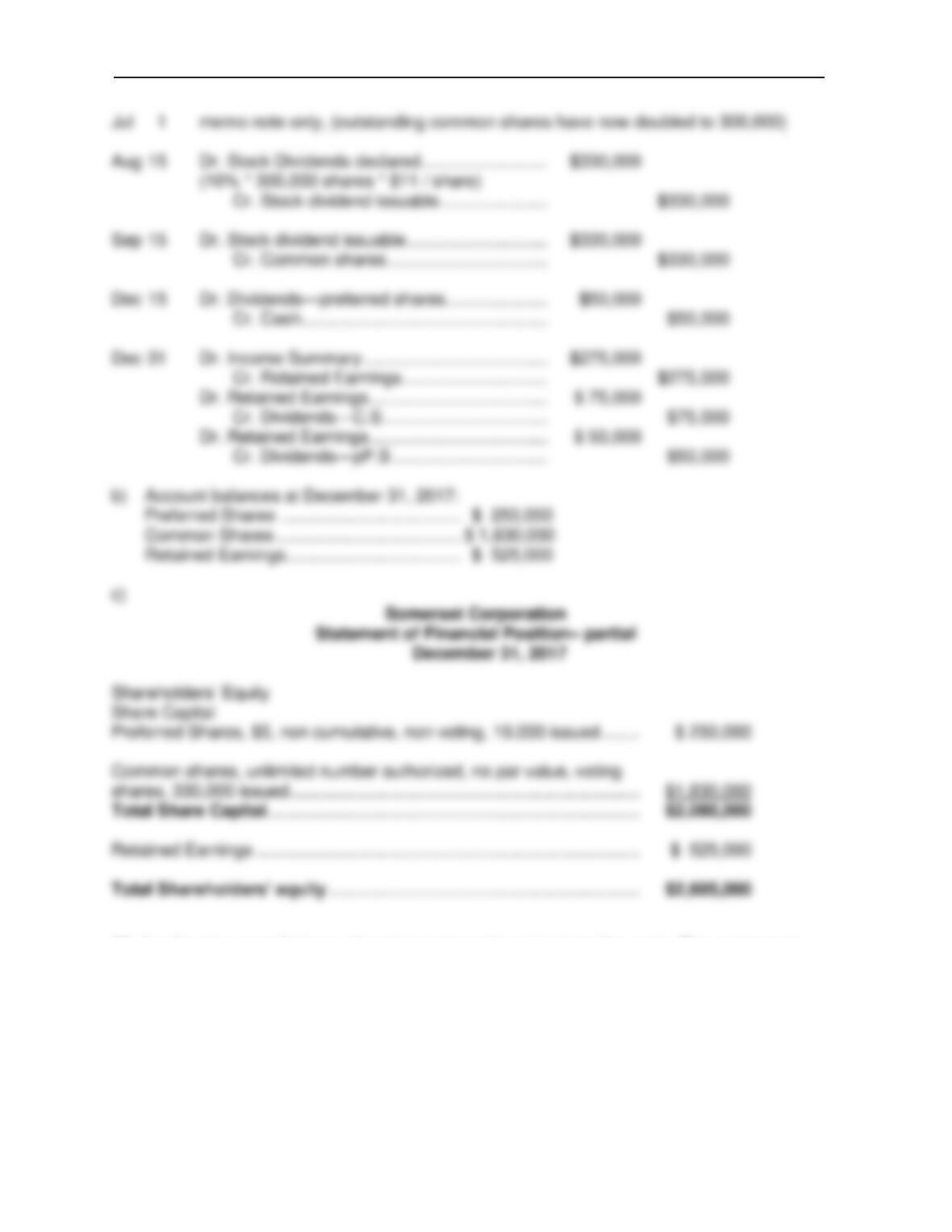
88. Somerset Corporation has the following account balances on January 1, 2017:
Preferred Shares, $5, non cumulative, non voting, 10,000 issued . $ 250,000
Common shares, unlimited number authorized, no par value, voting
shares, 150,000 issued ……………………………………………………….. $1,500,000
Retained Earnings ………………………………………………………………. $ 375,000
The following transactions take place during 2017:
Mar 1 – a $0.50 / share cash dividend is declared on common shares
Mar 15 – date of record
Mar 31 – date of payment
Jul 1 – 2-for-1 stock split
Aug 15 – 10% stock dividend declared on common shares, share price is $11
Sep 15 – date of issuance of stock dividend
Dec 15 – preferred shares dividend is paid
Dec 31 – Net income of $275,000
Instructions
a) Make all of the necessary journal entries.
b) Determine the 2017 year end balance in the preferred shares, common shares and retained
earnings accounts.
c) Prepare the shareholders equity section of the Statement of Financial Position.
Solution (20 min.)
Shareholders’ Equity 11 – 21
89. Ace Inc. is a manufacturer of custom motorcycle and automotive parts. The company is
publicly traded with its common shares trading at $8.75/share.
In 2017, the company earned a net income of $975,250 and had an average shareholders’
equity of $3,457,000. During 2017, the company had shareholders’ equity consisting of 575,000
common shares and 125,000, $1 non voting, cumulative preferred shares. There were no
common shares sold or repurchased in 2017 and preferred shareholders received a dividend
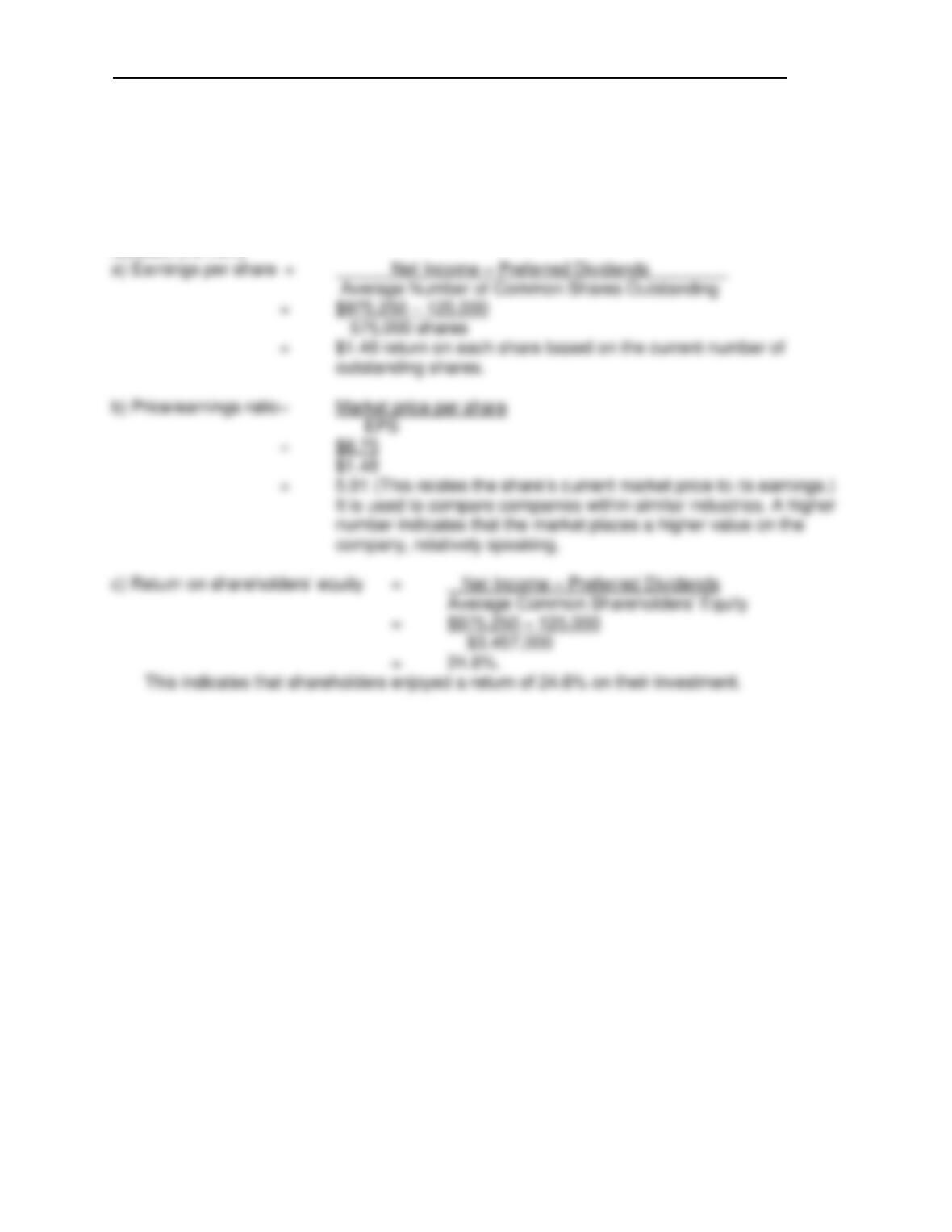
payment.
11 – 22 Test Bank for Understanding Financial Accounting, Canadian Edition
Instructions
Calculate and comment on the following ratios for Ace for 2017:
a) Earnings per share
b) Price/earnings ratio
c) Return on shareholders’ equity
Solution (10 min.)
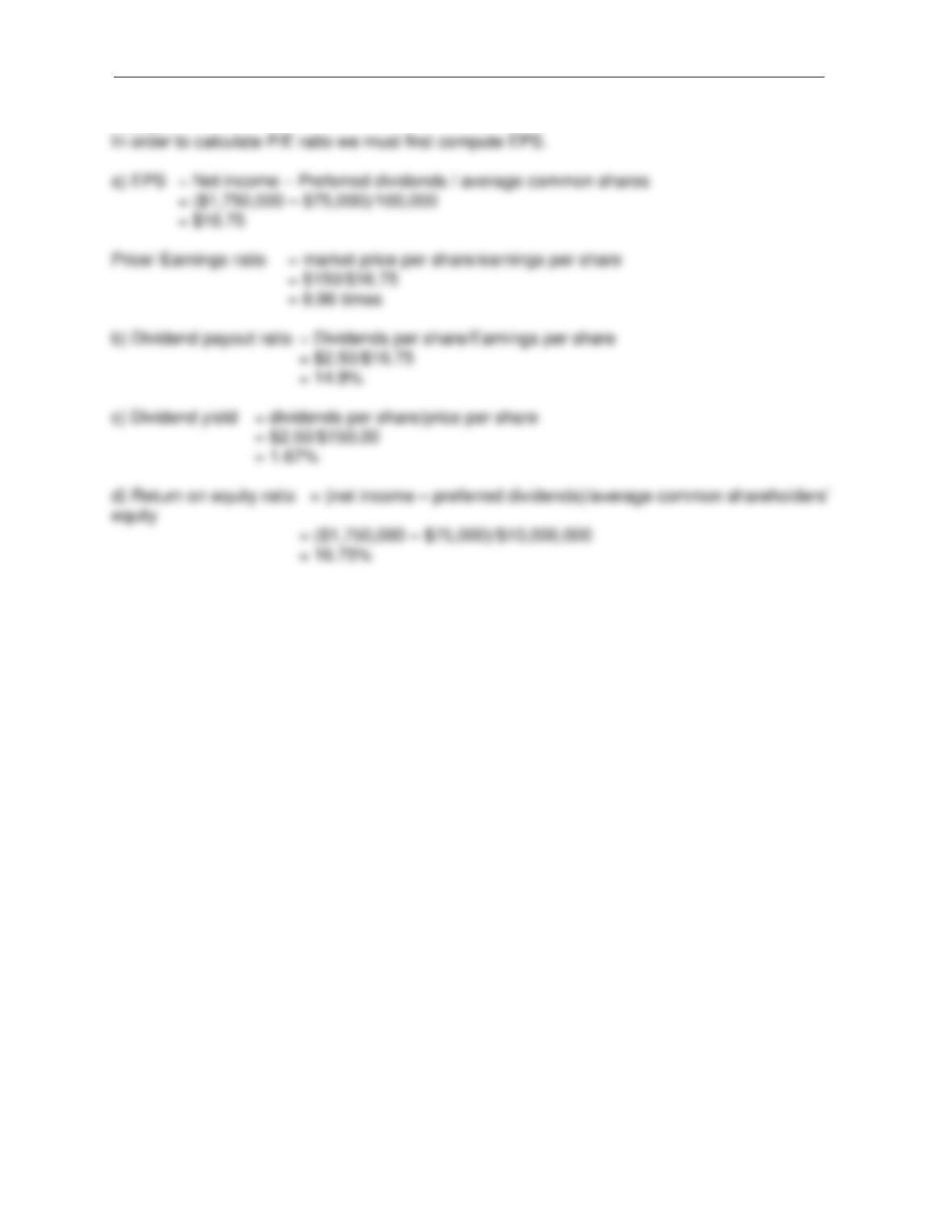
90. Below is the financial data for Anthony’s Atomic Atoms Inc. for the year ended December
31, 2018:
Market price per share ……………………….. $150.00
Net Income ……………………………………….. $1,750,000
Preferred Dividends declared ………………. $75,000
Average common share ……………………… 100,000
Dividends per share …………………………... $2.50
Average common shareholders’ equity …. 10,000,000
Total assets ………………………………………. $22,500,000
Total Liabilities ………………………………….. $11,675,000
Accumulated Other Comprehensive Income $185,000
Instructions
Calculate the following amounts:
a) Price/earnings ratio
b) Dividend payout ratio
c) Dividend yield
d) Return on shareholders’ equity
Shareholders’ Equity 11 – 23
Solution

11 – 24 Test Bank for Understanding Financial Accounting, Canadian Edition
MATCHING
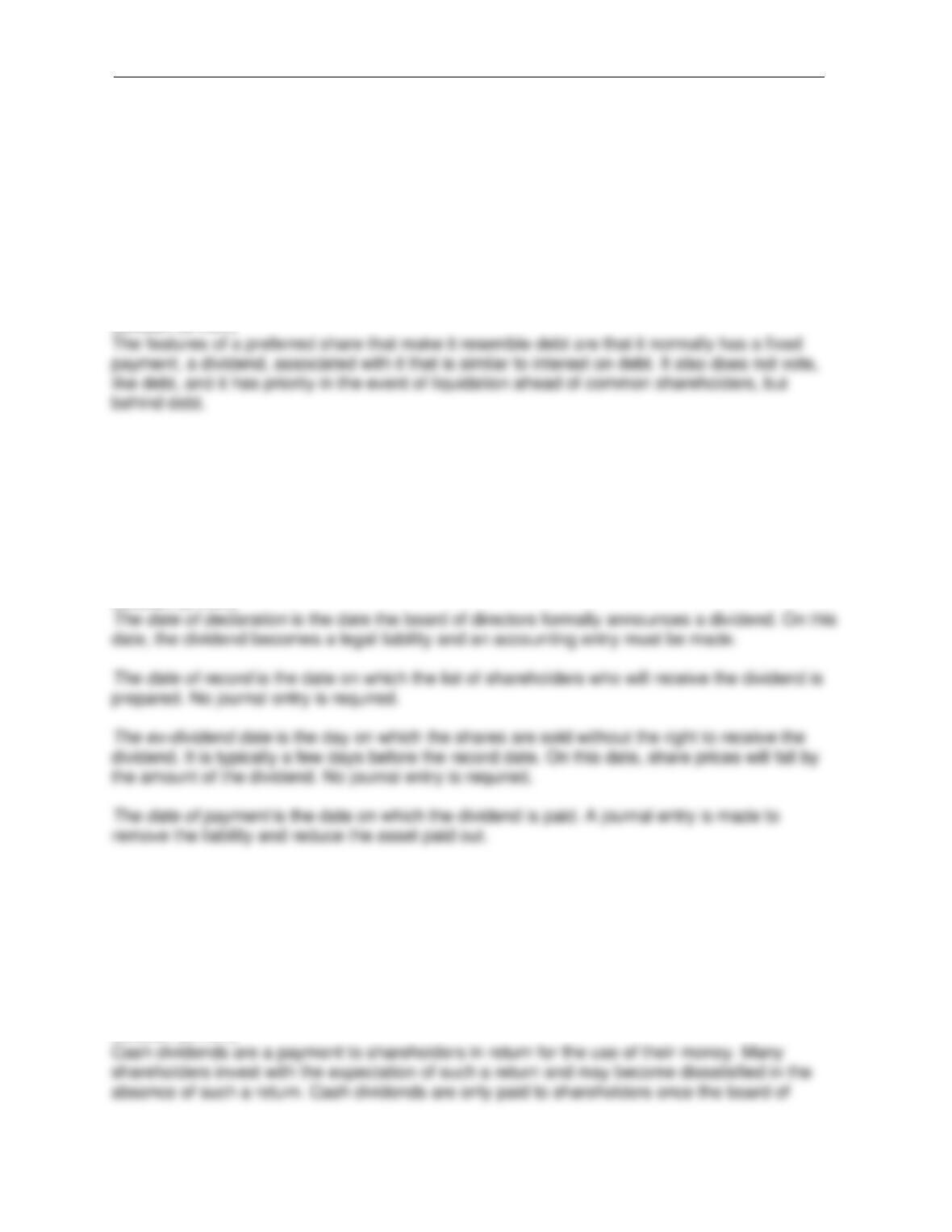
91. Listed below are several types of dividends followed by a series of descriptive
characteristics. Match the types of dividends to the characteristics by placing the appropriate
letter(s) in the space provided. Some characteristics may pertain to more than one type of
dividend.
TYPES OF DIVIDENDS
A. Cash D. Stock Split
B. Stock E. In arrears
CHARACTERISTICS
_____ 1. Does not change assets, liabilities, or total shareholders’ equity
_____ 2. Results in the value per share being changed
_____ 3. Pertains to preferred shares only
_____ 4. Results in a liability on the date of declaration based on fair market value
_____ 5. An entry may not be made on the date of declaration
_____ 6. May be reflected with a memorandum entry
_____ 7. Reduces total assets and shareholders’ equity
_____ 8. Increases the number of shares outstanding
_____ 9. Results in a change to the number of authorized shares
Solution (3 min.)
Shareholders’ Equity 11 – 25
SHORT-ANSWER ESSAY QUESTIONS
92. Preferred shares are often referred to as hybrid securities—a hybrid between debt and
common shares.
Instructions
Discuss the features of a preferred share that make it resemble debt and explain why it is
normally recorded in the equity section of the Statement of Financial Position.
Solution (3 min.)
93. Accounting for cash dividends involves four important dates. Some of these dates have
accounting significance and some do not.
Instructions
Identify and briefly discuss each of the four dates connected with accounting for dividends and
indicate which require a journal entry.
Solution (5 min.)
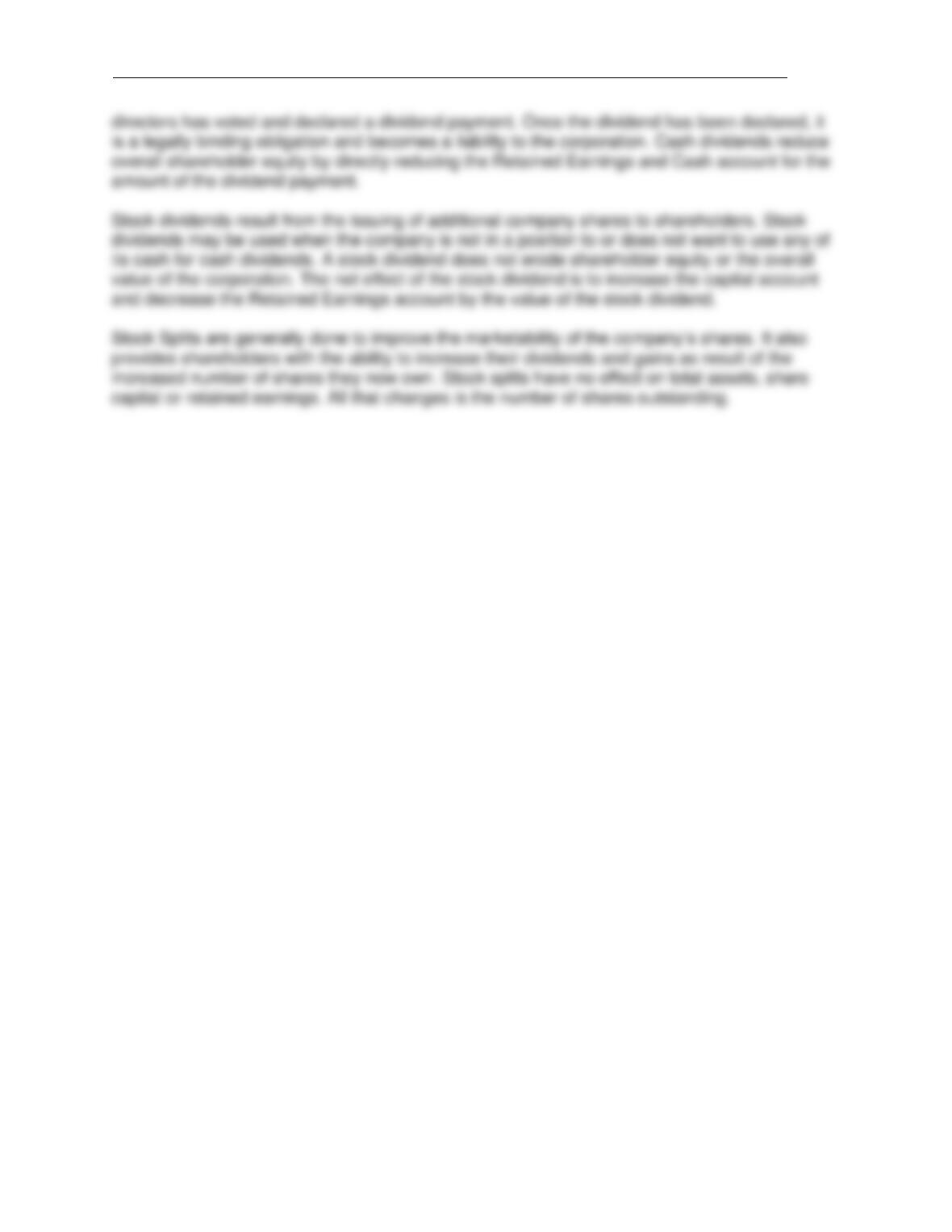
94. Corporations have several dividend options when it comes to compensating shareholders.
These options include cash dividends, stock dividends, and stock splits.
Instructions
Compare and contrast these dividend options and discuss why a corporation may choose one
option over the other.
Solution (8 min.)
11 – 26 Test Bank for Understanding Financial Accounting, Canadian Edition
Shareholders’ Equity 11 – 27
ESSAY QUESTIONS
95. Shareholders have certain rights as owners of a corporation. These rights may differ
depending on the type of shares purchased.
Instructions
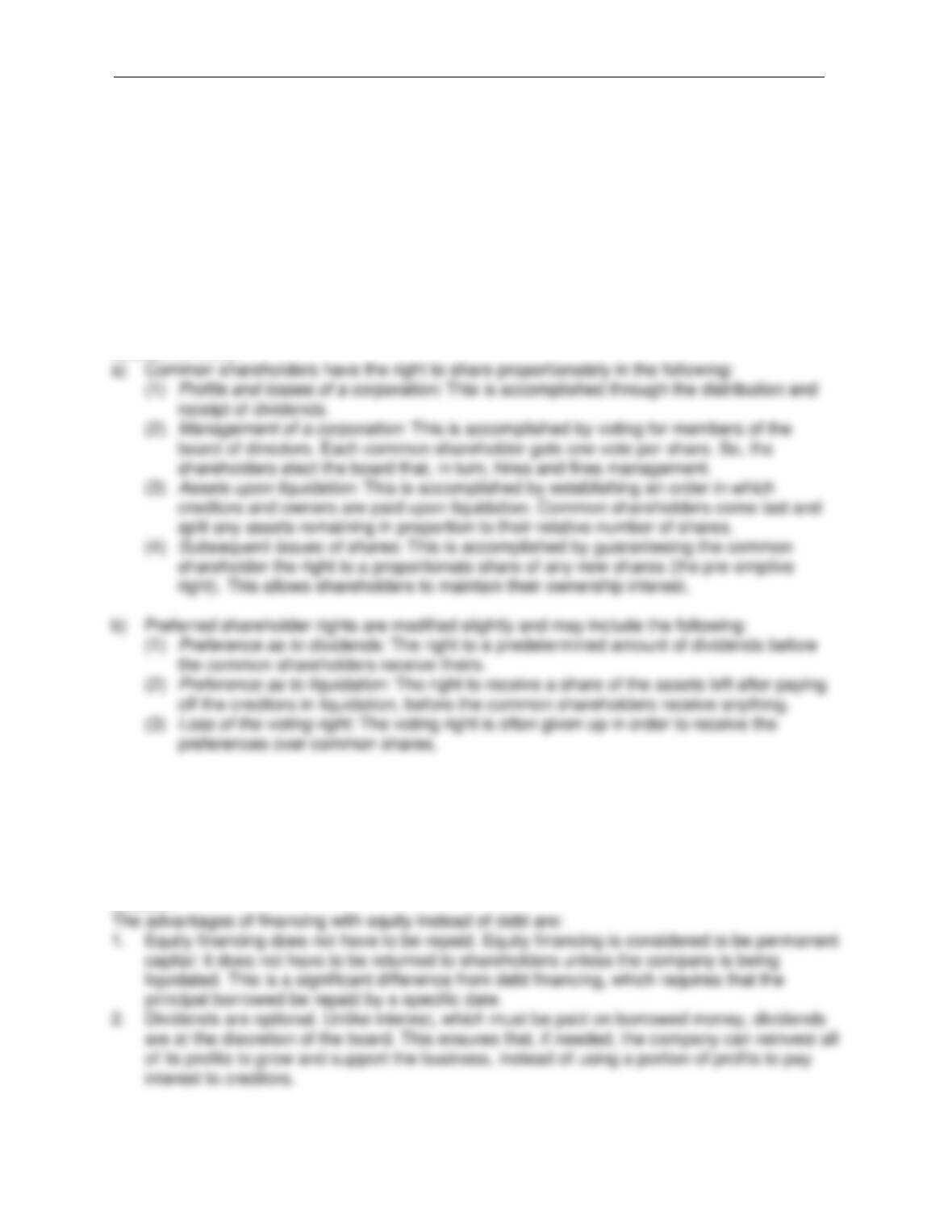
a) List and briefly discuss the general rights of a common shareholder.
b) List and briefly discuss the rights and preferences attached to preferred shares that differ
from those of common shares.
Solution (7 min.)
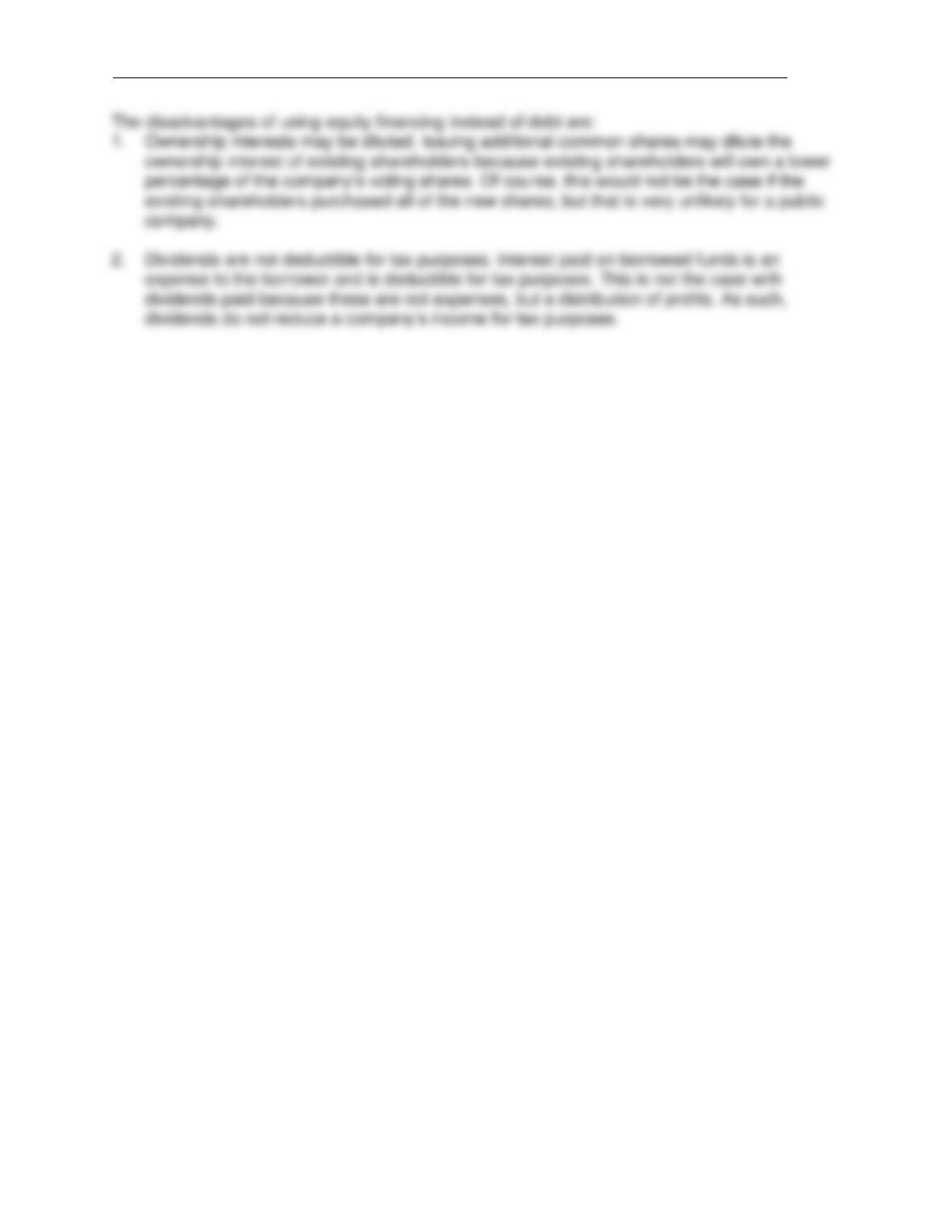
96. Why would a company prefer to issue shares?
Instructions
List the advantages and disadvantages to issuing additional shares.
Solution
11 – 28 Test Bank for Understanding Financial Accounting, Canadian Edition
Shareholders’ Equity 11 – 29
LEGAL NOTICE