103.
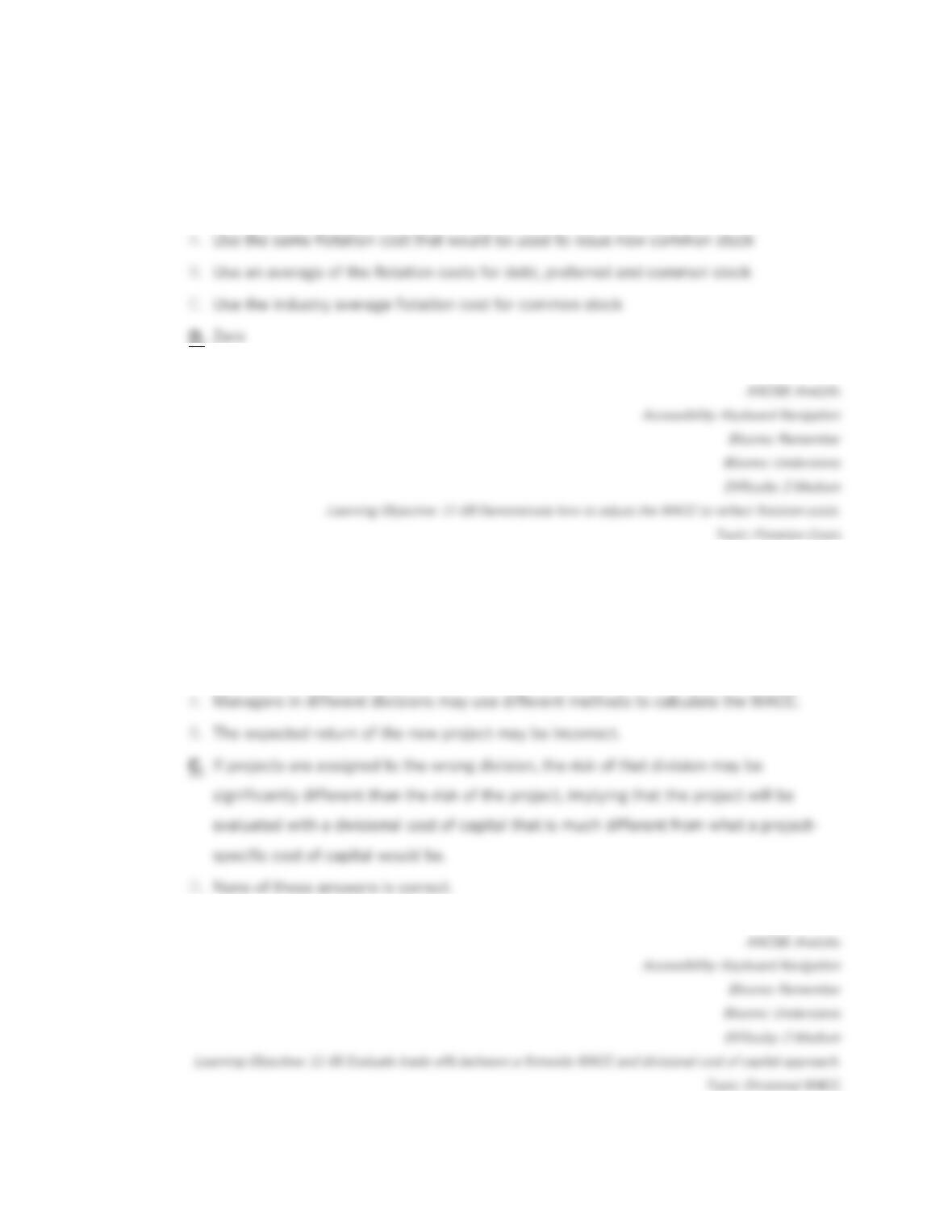
Suppose a new project was going to be financed partially with retained earnings. What
flotation costs should you use for retained earnings?
104.
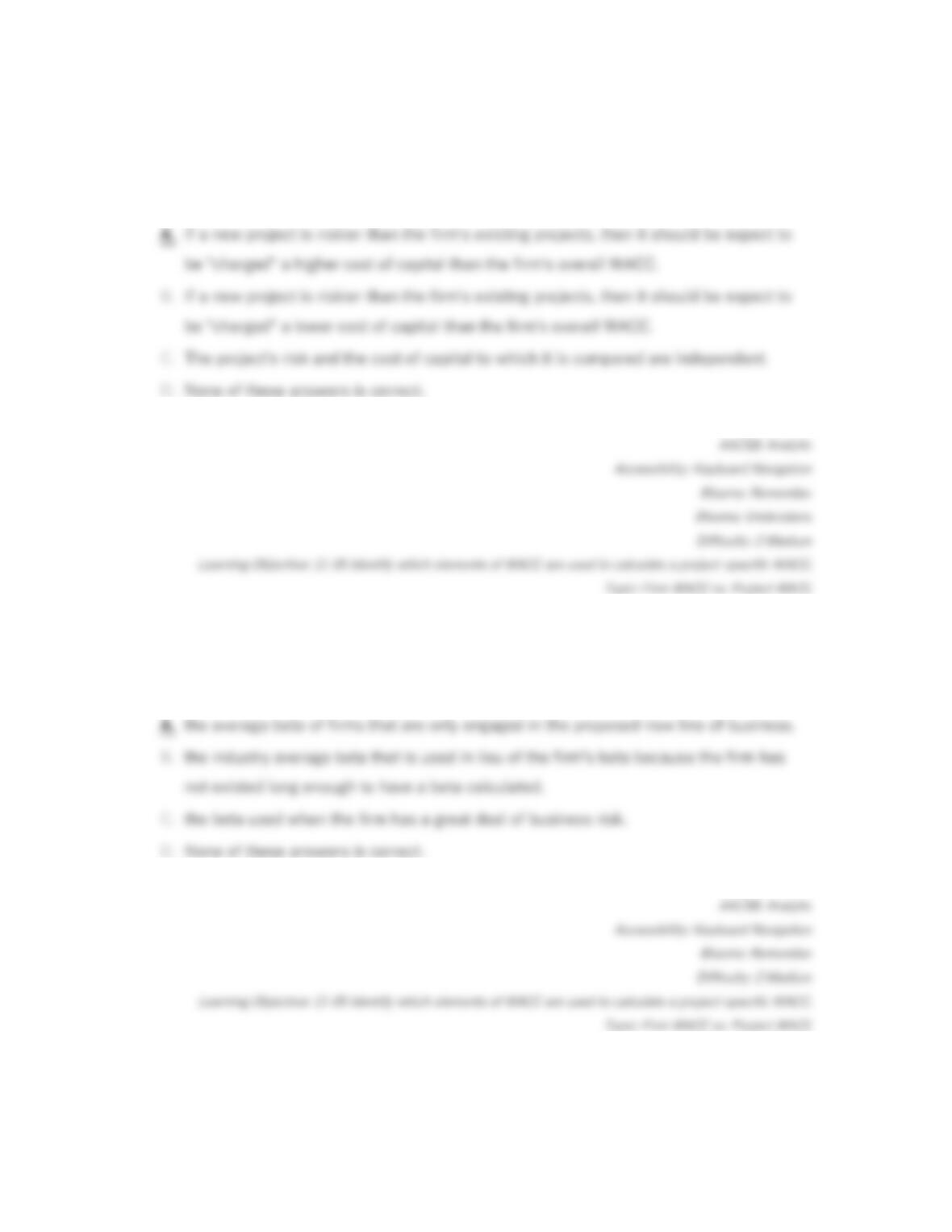
Which of the following is a reason why the divisional cost of capital approach may cause
problems if new projects are assigned to the wrong division?
105.
Which of the following statements is correct?
106.
A proxy beta is:
107.
Which of the following statements is correct?
108.
Which of the following statements is correct?
109.
Which of the following statements is correct?
110.
Which of the following will increase the cost of equity?
111.
Which of the following is most correct?
112.
Apple’s 9 percent annual coupon bond has 10 years until maturity and the bonds are
selling in the market for $890. The firm’s tax rate is 36 percent. What is the firm’s after-tax
cost of debt?
113.
Apple’s 9 percent annual coupon bond has 10 years until maturity and the bonds are
selling in the market for $1,190. If the firm’s after-tax cost of debt is 5 percent, what was
the firm’s tax rate?
114.
Apple’s 9 percent annual coupon bond has 10 years until maturity and the bonds are
selling in the market for $790. If the firm’s after-tax cost of debt is 8 percent, what was the
firm’s tax rate?
115.
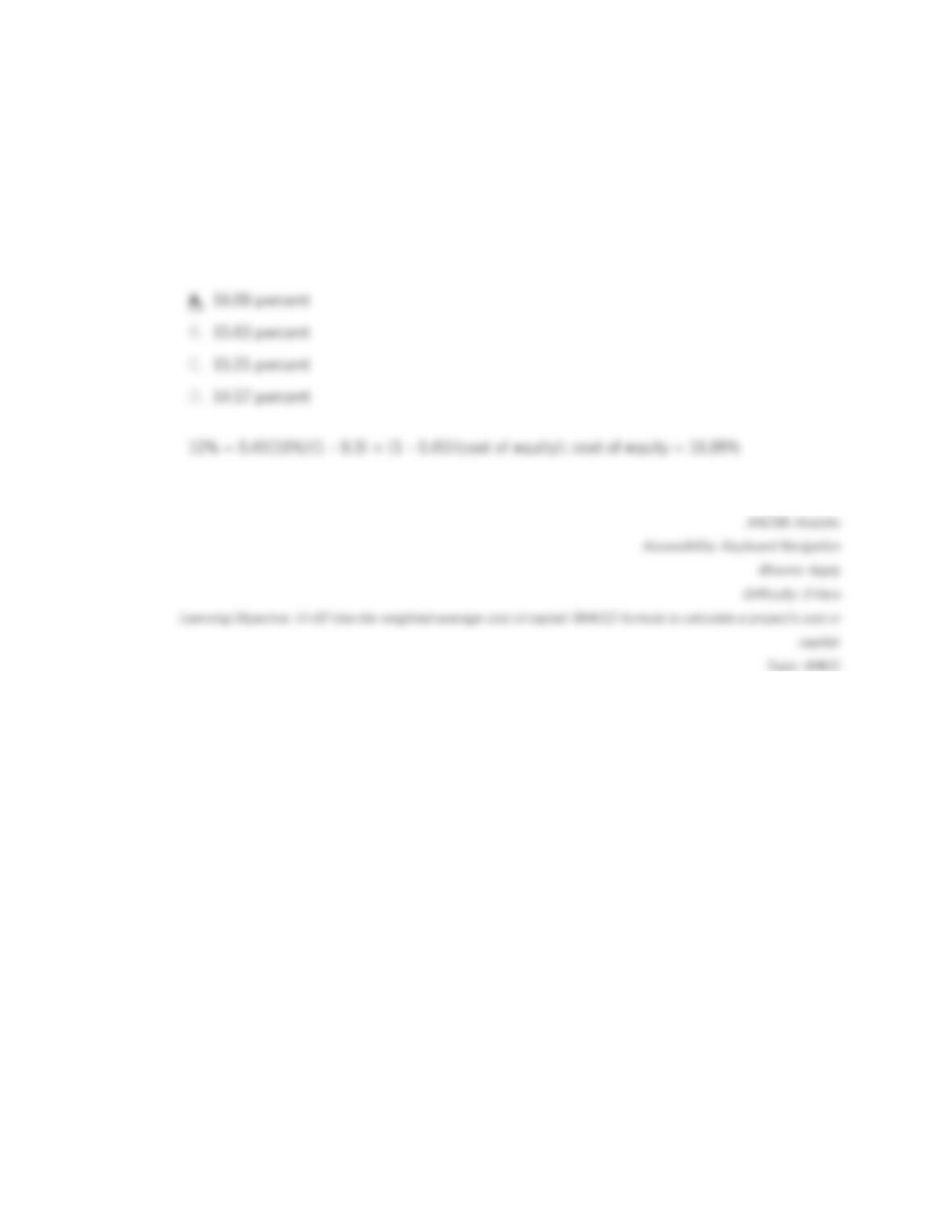
A firm uses only debt and equity in its capital structure. The firm’s weight of debt is 40
percent. The firm could issue new bonds at a yield to maturity of 9 percent and the firm
has a tax rate of 30 percent. If the firm’s WACC is 11 percent, what is the firm’s cost of
equity?
116.
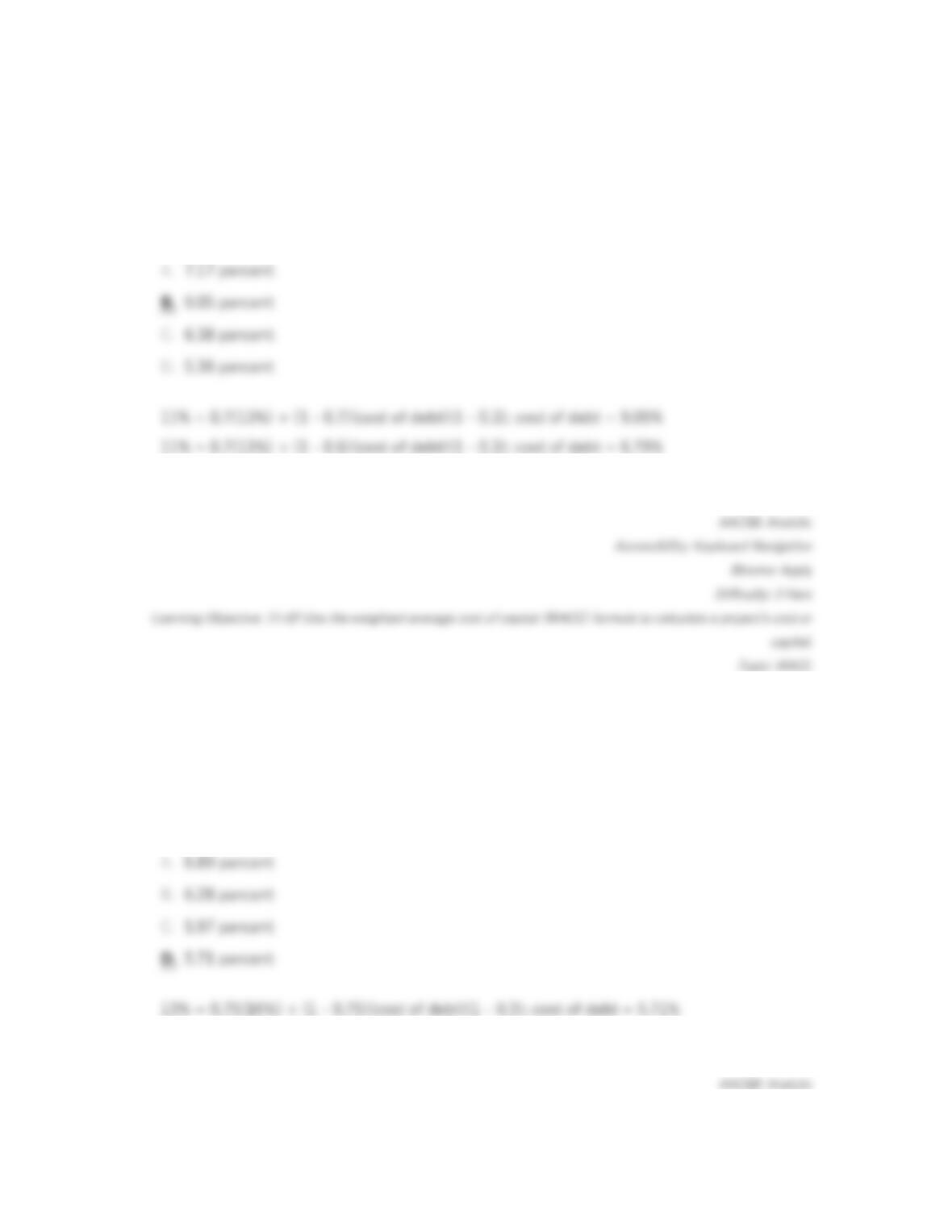
A firm uses only debt and equity in its capital structure. The firm’s weight of debt is 45
percent. The firm could issue new bonds at a yield to maturity of 10 percent and the firm
has a tax rate of 30 percent. If the firm’s WACC is 12 percent, what is the firm’s cost of
equity?
117.
A firm uses only debt and equity in its capital structure. The firm’s weight of equity is 70
percent. The firm’s cost of equity is 13 percent and it has a tax rate of 30 percent. If the
firm’s WACC is 11 percent, what is the firm’s before–tax cost of debt?
118.
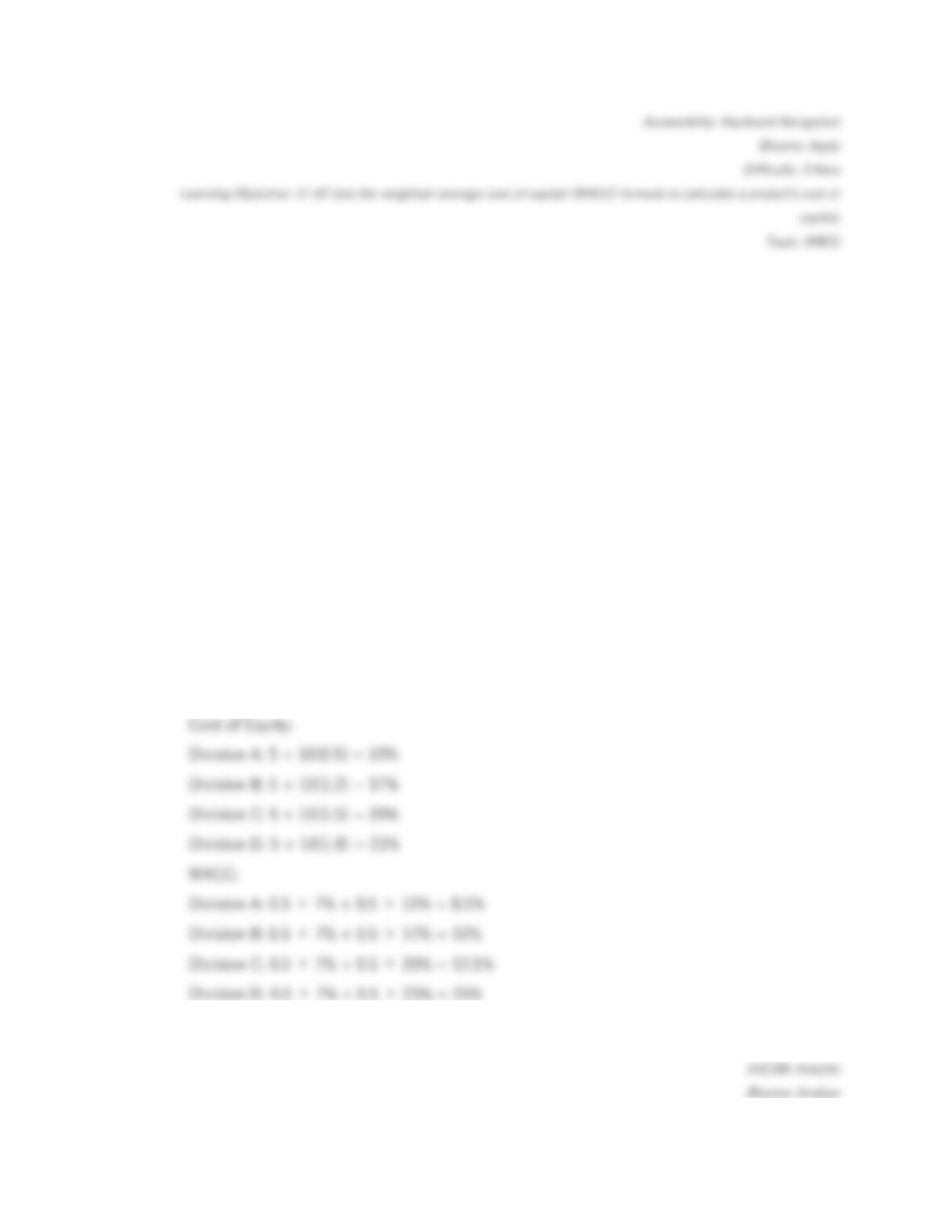
A firm uses only debt and equity in its capital structure. The firm‘s weight of equity is 75
percent. The firm’s cost of equity is 16 percent and it has a tax rate of 30 percent. If the
firm’s WACC is 13%, what is the firm’s before-tax cost of debt?
Essay Questions
119.
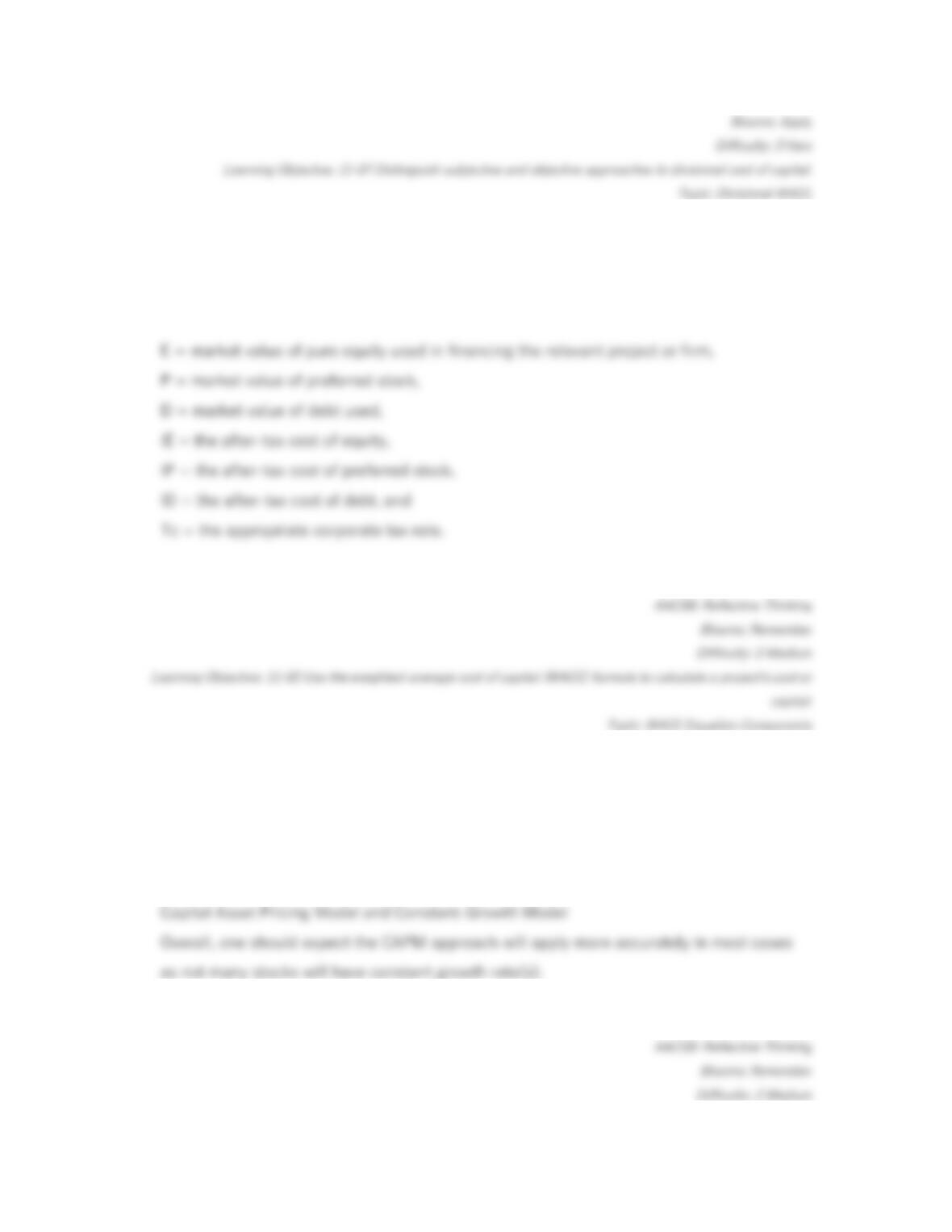
Suppose your firm has decided to use a divisional WACC approach to analyze projects.
The firm currently has four divisions, A through D, with average betas for each division of
0.5, 1.2, 1.5 and 1.8, respectively. If all current and future projects will be financed with
half debt and half equity, and if the current cost of equity (based on an average firm beta
of 1.0 and a current risk-free rate of 5 percent, market premium of 10 percent) is 15
percent and the after-tax yield on the company’s bonds is 7 percent, what will the WACCs
be for each division?
120.
List and explain all the components of the WACC equation.
121.
When calculating the component cost of equity, what two ways can it be calculated?
Which way is better and why?
122.
When calculating WACC, should project-specific or firmwide debt and preferred stock
components be used, and why?
123.
For computing a project WACC, why do we take some component costs from the firm, but
compute others that are specific for the project being considered?
124.
Why do we use market-based weights instead of book-value weights when computing the
WACC?
125.
Explain why the divisional cost of capital approach may cause problems if new projects
are assigned to the wrong division.
126.
Denote the impact that flotation costs have on capital budgeting decisions.
127.
Differentiate between the objective and subjective approach to computing a divisional
cost of capital.
128.
Define subjective and objective approaches to divisional cost of capital.
129.
Explain how the weights of each security are determined for WACC.
130.
What might happen when managers use a single, firmwide WACC for all projects?