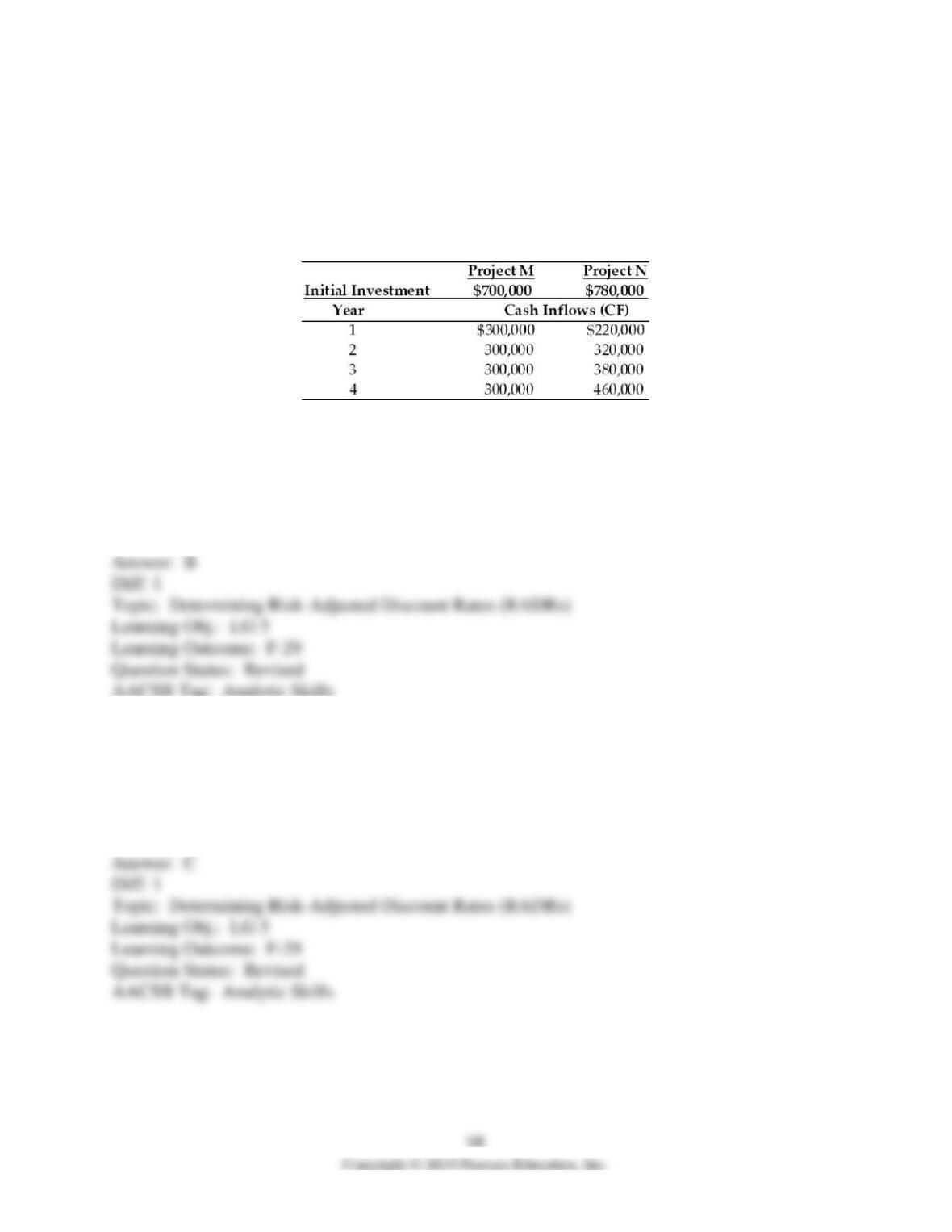
Table 11.8
Tangshan Mining Company is considering investment in one of two mutually exclusive projects
M and N which are described below. Tangshan Mining’s overall cost of capital is 15 percent, the
market return is 15 percent and the risk-free rate is 5 percent. Tangshan estimates that the beta
for project M is 1.20 and the beta for project N is 1.40.
24) Using the risk-adjusted discount rate method of project evaluation, the NPV for Project M is
________. (See Table 11.8)
A) $156,494
B) $122,970
C) $85,732
D) $500,000
25) Using the risk-adjusted discount rate method of project evaluation, the NPV for Project N is
________. (See Table 11.8)
A) $166,132
B) $122,970
C) $85,732
D) $600,000
26) Using the risk-adjusted discount rate method of project evaluation, the better investment for
Tangshan Mining is ________. (See Table 11.8)
A) Project M because it has a higher NPV
B) Project N because it has a higher NPV
C) Project N because it has a higher IRR
D) Project M because it has a higher IRR
27) Which project would be preferable if both projects were of average risk as the overall firm
and Tangshan Mining has a beta of 1.0? (See Table 11.8)
A) Project M because it has a higher NPV
B) Project N because it has a higher NPV
C) Project N because it has a higher IRR
D) Project M because it has a higher IRR
28) The shares traded publicly in an efficient market are ________.
A) generally positively affected by diversification, because of the reduction in risk
B) generally negatively affected by diversification, because of the increase in risk
C) generally not affected by diversification, unless greater returns are expected
D) generally negatively affected by diversification, because of the increase in the required rate of
return
29) Firms do not usually get rewarded by diversifying investments in different lines of business
because ________.
A) the capital markets are efficient and they quickly respond to change in economic conditions
B) cash flows from such projects tend to respond less to changing economic conditions
C) investors themselves can diversify by holding securities in a variety of firms; they do not need
the firm to do it for them
D) it is not possible for a firm to diversify its risk as the inflation premium is different for
different projects
Table 11.9
Johnson Farm Implement is faced with two mutually exclusive projects, P and Q. The following
are the data about the two projects.
30) Evaluate the projects using risk-adjusted discount rates. (See Table 11.9)
31) Which project do you recommend? (See Table 11.9)
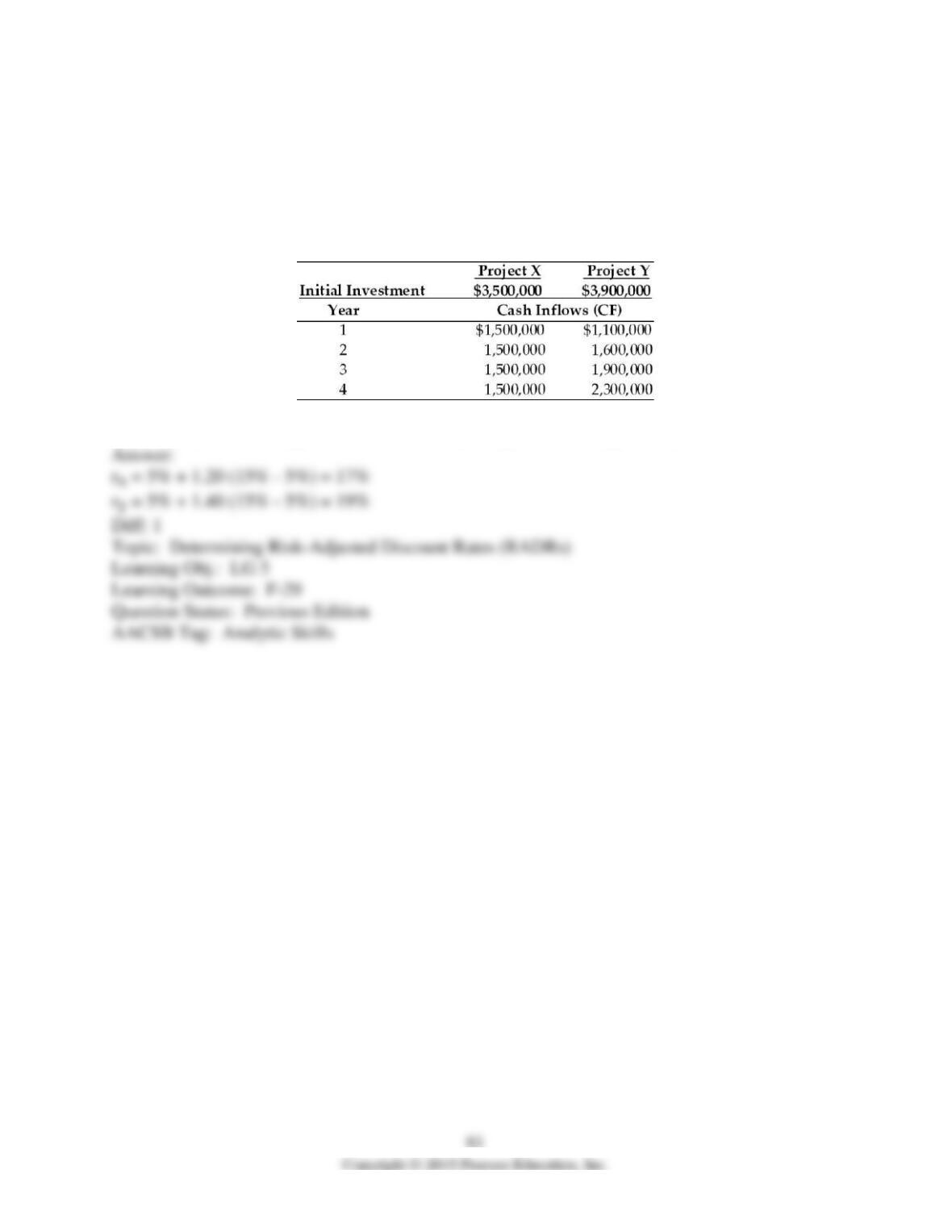
Table 11.10
Nico Manufacturing is considering investment in one of two mutually exclusive projects X and
Y which are described below. Nico Manufacturing’s overall cost of capital is 15 percent, the
market return is 15 percent and the risk-free rate is 5 percent. Nico estimates that the beta for
project X is 1.20 and the beta for project Y is 1.40.
32) Calculate the risk-adjusted discount rates for Project X and Project Y. (See Table 11.10)
33) Using the risk-adjusted discount rate method of project evaluation, find the NPV for projects
X and Y. Which project should Nico select using this method? (See Table 11.10)
34) Calculate the NPV of projects X and Y assuming that the firm did not employ the RADR
method and instead used the firm’s overall cost of capital to evaluate projects X and Y. (See
Table 11.10)
35) What potential biases exist in project selection if Nico Manufacturing did not adjust for the
difference in risk between Projects X and Y (See Table 11.10).

11.6 Select the best of a group of unequal-lived, mutually exclusive projects using annualized
net present values (ANPVs).
1) In case of unequal-lived, mutually exclusive projects, the use of net present value to select the
better project results in an incorrect decision.
2) When unequal-lived projects are independent, the length of the project lives is not critical.
3) When unequal-lived projects are independent, the impact of differing lives must be considered
because the projects do not provide service over comparable time periods.
4) The risk-adjusted discount rate approach to evaluating projects with unequal lives converts the
net present value of unequal-lived, mutually exclusive projects into an equivalent annual amount.

5) Annualized net present value approach is the most efficient technique for dealing with projects
of unequal lives.
6) In selecting the best group of unequal-lived projects, if the projects are mutually exclusive, the
length of the projects lives is not critical.
7) The annualized net present value approach used to evaluate projects with unequal lives
converts the net present value of unequal-lived, mutually exclusive projects into an equivalent
annual amount.
8) Real options are opportunities that are embedded in capital budgeting projects that enable
managers to alter their cash flows and risks in a way that affects project acceptability.

9) Futures and options are opportunities that are embedded in capital budgeting projects that
enable managers to alter their cash flows and risks in a way that affects project acceptability.
10) The objective of capital rationing is to select the group of projects that provides the highest
overall net present value and does not require more dollars than are budgeted.
11) A firm with limited funds for investment in capital assets must ration those funds by
allocating them to projects that will maximize share value.
12) The objective of capital rationing is to select the group of projects that provides the quickest
overall payback and does not require more dollars than are budgeted.
13) The ________ approach is used to convert the net present value of unequal-lived projects
into an equivalent annual amount (in net present value terms).
A) internal rate of return
B) investment opportunities schedule
C) risk-adjusted discount rate
D) annualized net present value
14) The option to develop follow-on projects, expand markets, expand or retool plants, and so on
that
would not be possible without implementation of the project that is being evaluated is called
________.
A) growth option
B) timing option
C) flexibility option
D) abandonment option
15) A(n) ________ allows management to avoid or minimize losses on projects that turn bad.
A) abandonment option
B) growth option
C) timing option
D) put option
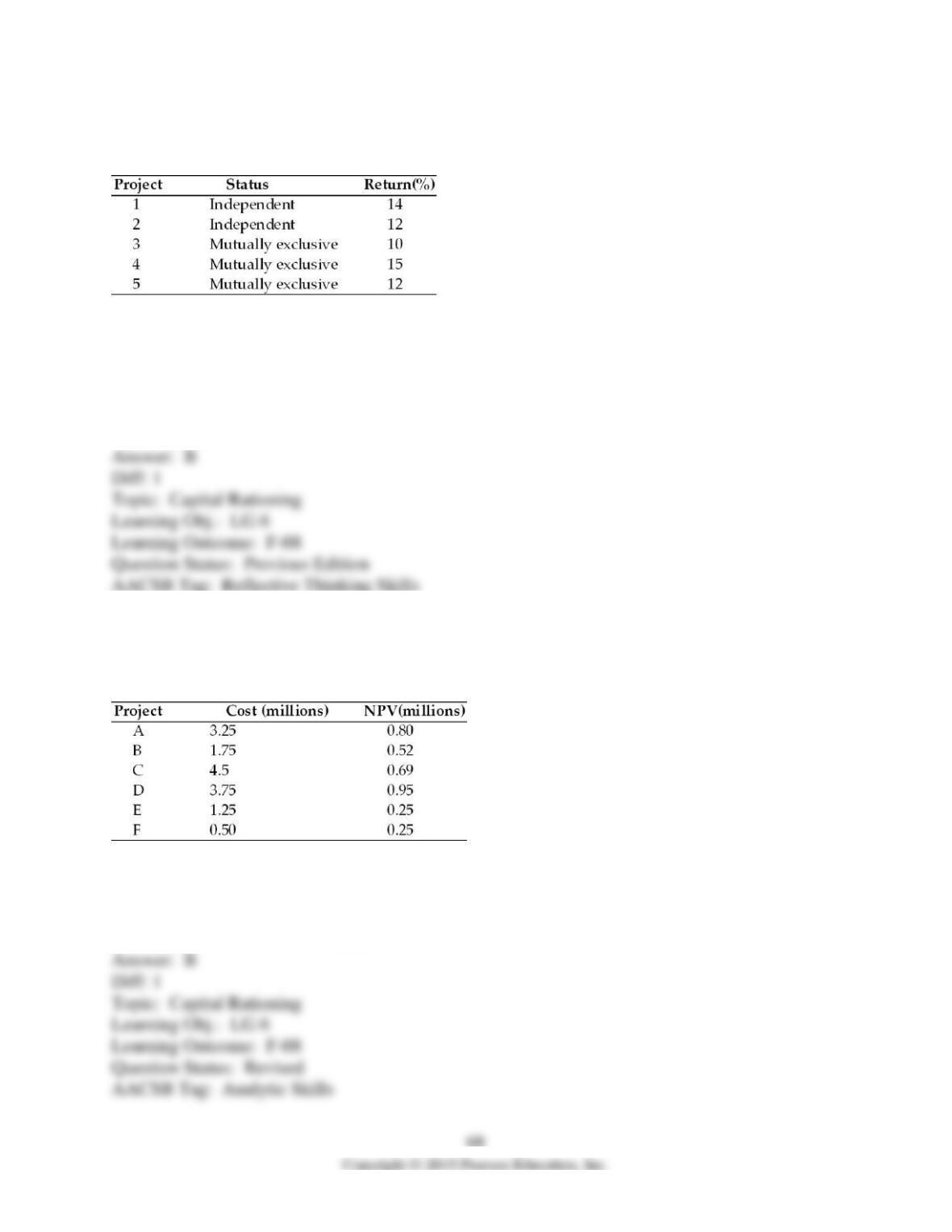
16) A firm with unlimited funds must evaluate five projects. Projects 1 and 2 are independent
and Projects 3, 4, and 5 are mutually exclusive. The projects are listed with their returns.
A ranking of the projects on the basis of their returns from the best to the worst according to their
acceptability to the firm would be ________.
A) 4, 1, 2 or 5, and 3
B) 4, 1, and 2
C) 3, 2 or 5, 1, and 4
D) 4, 1, 5, and 3
17) Which of the following proposed projects should be accepted for the upcoming year since
only $6 million is available for the next year’s capital budget. What is the total NPV of the
projects that should be accepted?
A) A, B, & F; total cost = $5.5 million; Total NPV= $1.57
B) F, B, & D; total cost = $6 million; Total NPV= $1.72
C) E, F, & D; total cost = $5.5 million; Total NPV= $1.45
D) A, E, & F; total cost = $5 million; Total NPV= $1.3
18) The objective of ________ is to select the group of projects that provides the highest overall
net present value and does not require more dollars than are budgeted.
A) capital rationing
B) scenario analysis
C) real options
D) sensitivity analysis
19) An IRR approach to capital rationing involves graphically plotting project IRRs in
descending order against total dollar investment on an ________ graph.
A) ANPV
B) NPV
C) RADR
D) IOS
20) If a firm has a limited capital budget to fund its capital projects, it is said to be facing the
problem of ________.
A) constrained capital
B) wealth optimization
C) capital rationing
D) profitability
21) An approach to capital rationing that involves graphing project returns in descending order
against the total dollar investment to determine the group of acceptable projects is called the
________.
A) net present value approach
B) internal rate of return approach
C) payback approach
D) profitability index approach
Table 11.11
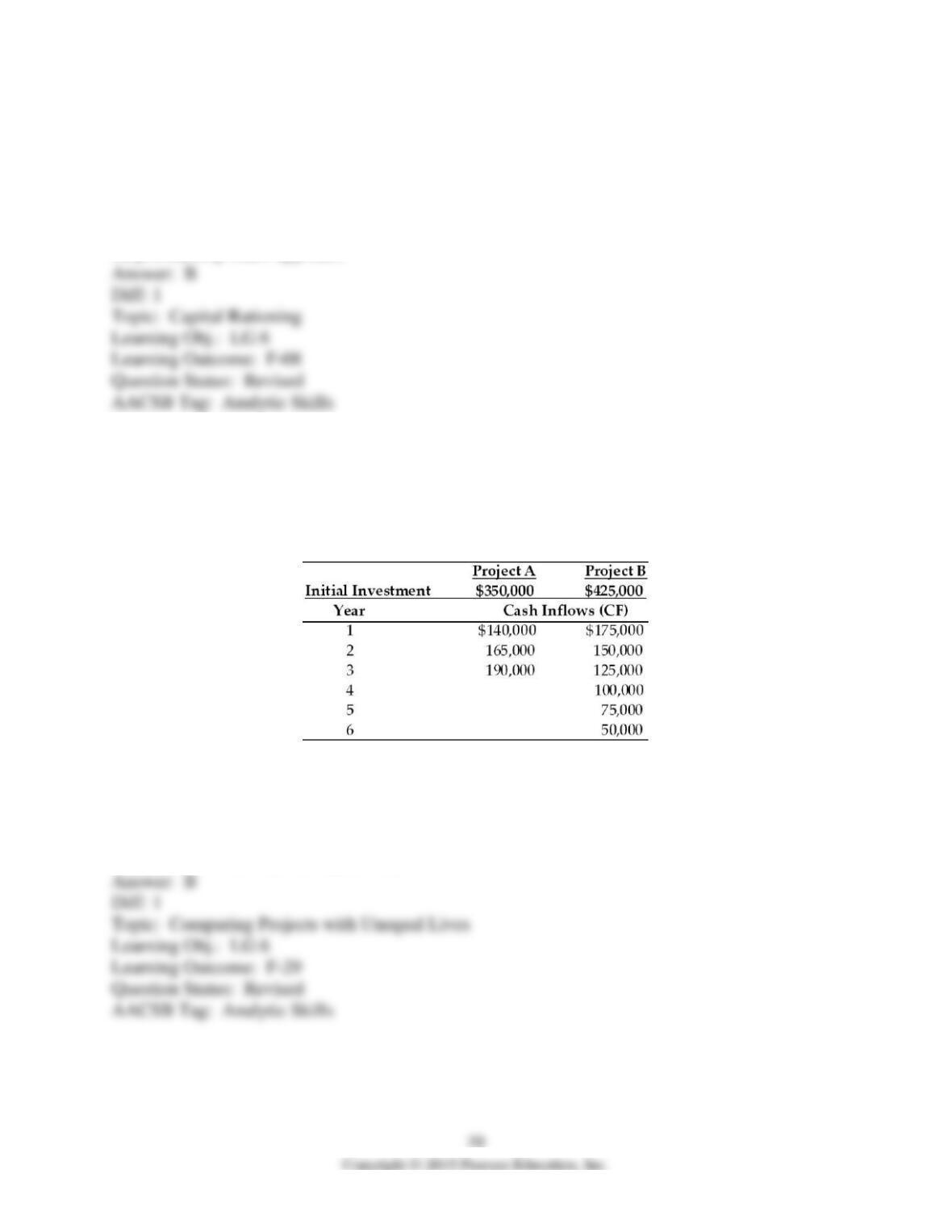
Yong Importers, an Asian import company, is evaluating two mutually exclusive projects, A and
B. The relevant cash flows for each project are given in the table below. The cost of capital for
use in evaluating each of these equally risky projects is 10 percent.
22) The NPVs of Projects A and B are ________. (See Table 11.11)
A) $95,066 and $56,386, respectively
B) $56,386 and $95,066, respectively
C) -$56,386 and -$95,066, respectively
D) $45,000 and $650,000, respectively
23) The annualized NPV of Project A is ________. (See Table 11.11)
A) $22,674
B) $12,947
C) $38,227
D) $21,828
24) The annualized NPV of Project B is ________. (See Table 11.11)
A) $11,673
B) $12,947
C) $38,227
D) $21,828
25) Which project should be chosen on the basis of the normal NPV approach? (See Table
11.11)
A) Project A because its NPV is higher
B) Project B because its NPV is higher
C) Project A because its IRR is higher
D) Project B because its IRR is higher
26) Which project should be chosen using the Annualized NPV approach? (See Table 11.11)
A) Project A because its annualized NPV is higher
B) Project B because its NPV is higher
C) Project A because its IRR is higher
D) Project B because its annualized NPV is higher
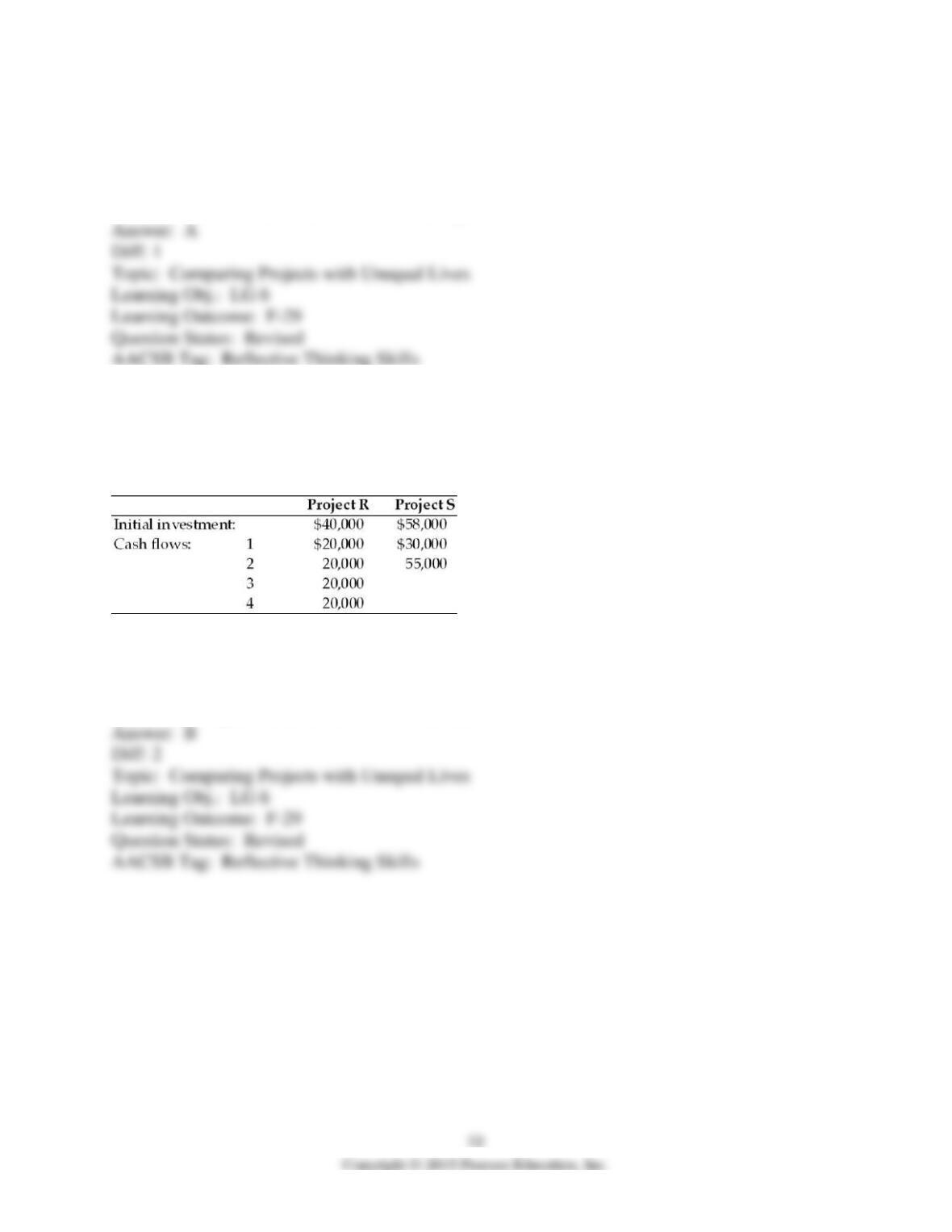
27) A firm is evaluating two mutually exclusive projects that have unequal lives. The firm must
evaluate the projects using the annualized net present value approach and recommend which
project they should select. The firm’s cost of capital has been determined to be 14 percent, and
the projects have the following initial investments and cash flows:
A) Choose Project R because its ANPV is $6459
B) Choose Project S because its ANPV is $6459
C) Choose Project R because its ANPV is $18,274
D) Choose Project S because its ANPV is $10,637
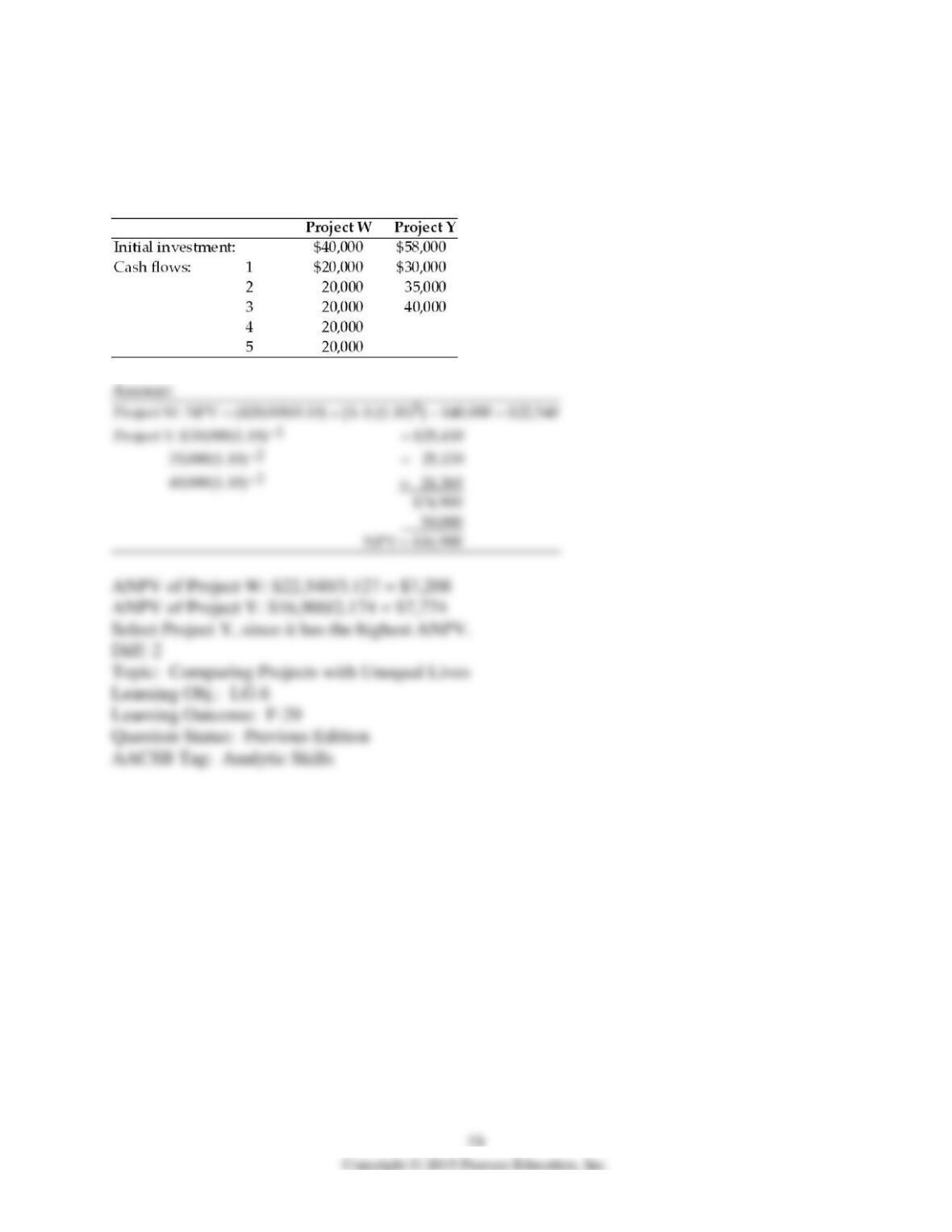
28) A firm is evaluating two mutually exclusive projects that have unequal lives. The firm must
evaluate the projects using the annualized net present value approach and recommend which
project they should select. The firm’s cost of capital has been determined to be 18 percent, and
the projects have the following initial investments and cash flows: