76.
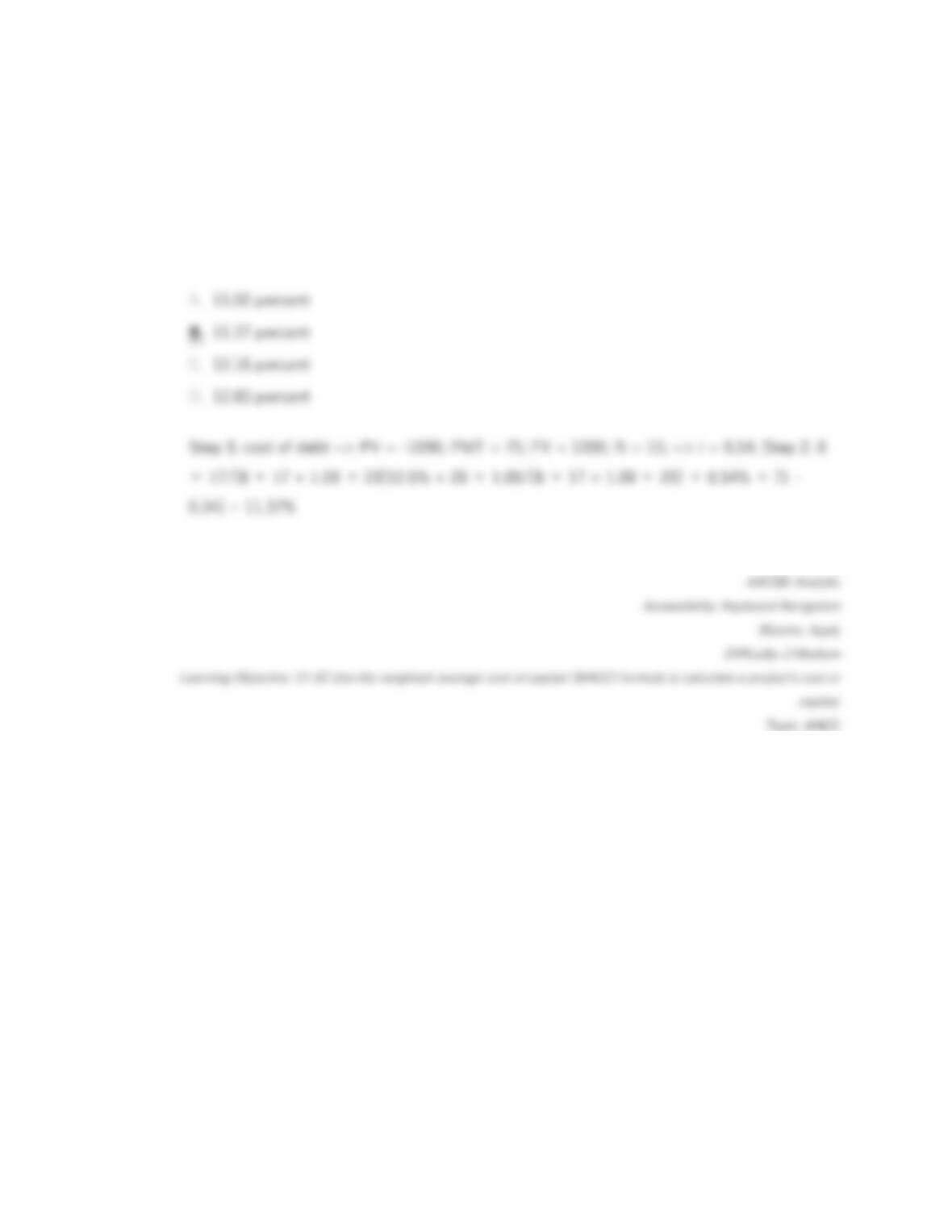
TAFKAP Industries has 8 million shares of stock outstanding selling at $17 per share and
an issue of $20 million in 7.5 percent, annual coupon bonds with a maturity of 15 years,
selling at 109 percent of par ($1,000). If TAFKAP’s weighted average tax rate is 34% and
its cost of equity is 12.5 percent, what is TAFKAP’s WACC?
77.
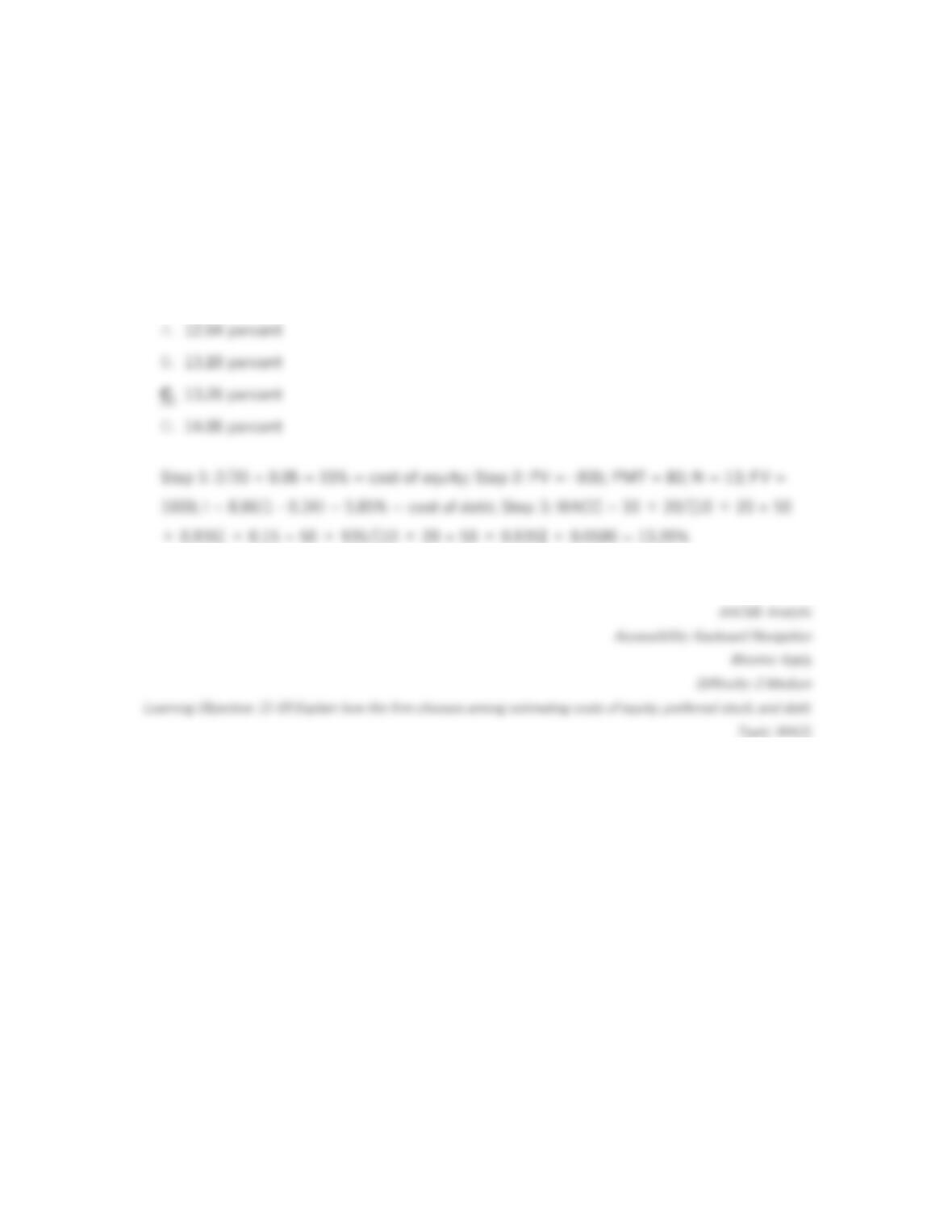
Johnny Cake Ltd. has 10 million shares of stock outstanding selling at $20 per share and
an issue of $50 million in 8 percent, annual coupon bonds with a maturity of 13 years,
selling at 93.5 percent of par ($1,000). If Johnny Cake’s weighted average tax rate is 34
percent, its next dividend is expected to be $2.00 per share, and all future dividends are
expected to grow at 5 percent per year, indefinitely, what is its WACC?
78.
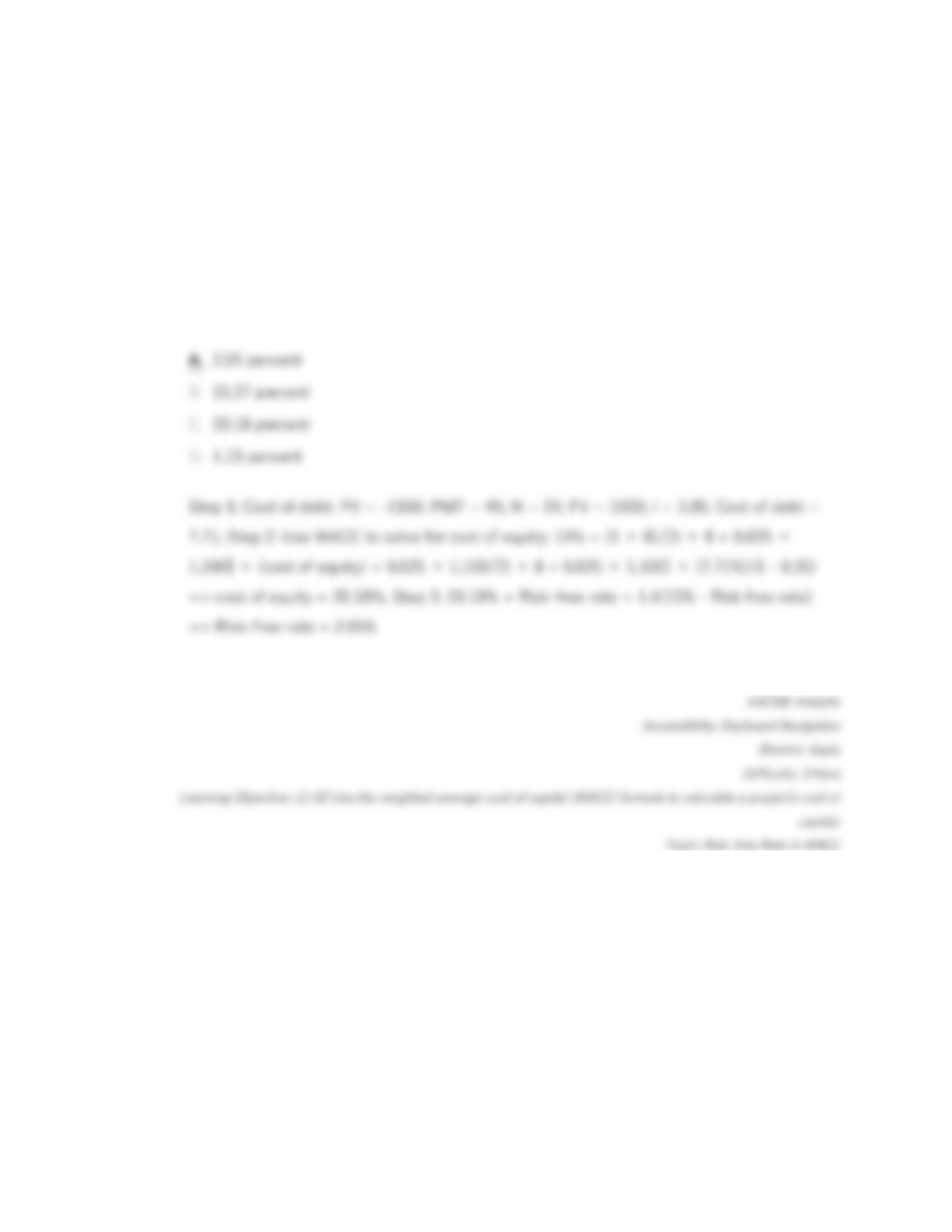
A firm has 5,000,000 shares of common stock outstanding, each with a market price of
$8.00 per share. It has 25,000 bonds outstanding, each selling for $1,100 with a $1,000
face value. The bonds mature in 12 years, have a coupon rate of 9 percent, and pay
coupons semi-annually. The firm’s equity has a beta of 1.4, and the expected market
return is 15 percent. The tax rate is 35 percent and the WACC is 14 percent. Calculate the
risk-free rate.
79.
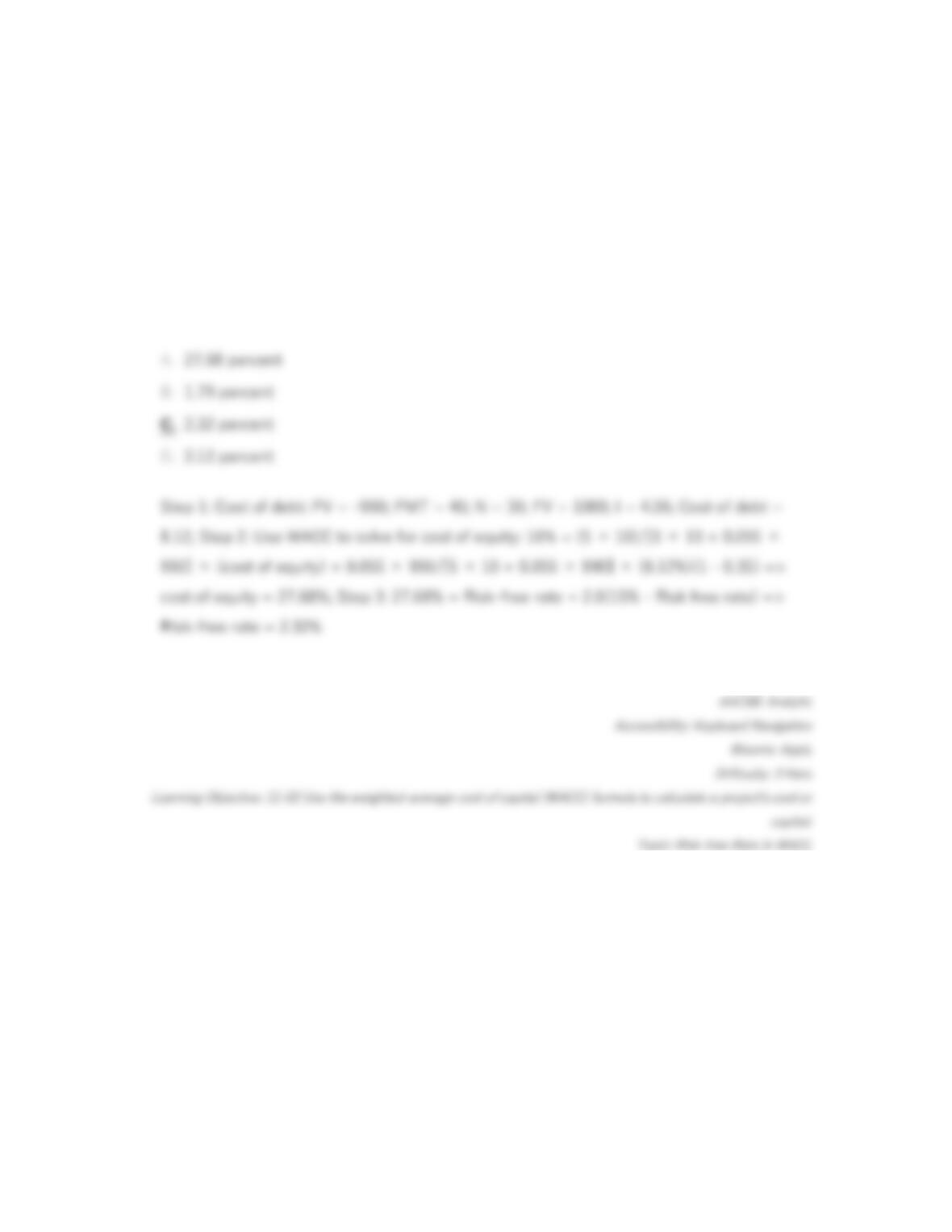
A firm has 5,000,000 shares of common stock outstanding, each with a market price of
$10.00 per share. It has 55,000 bonds outstanding, each selling for $990 with a $1,000 face
value. The bonds mature in 15 years, have a coupon rate of 8 percent, and pay coupons
semi-annually. The firm’s equity has a beta of 2.0, and the expected market return is 15
percent. The tax rate is 35 percent and the WACC is 16 percent. Calculate the risk-free
rate.
80.
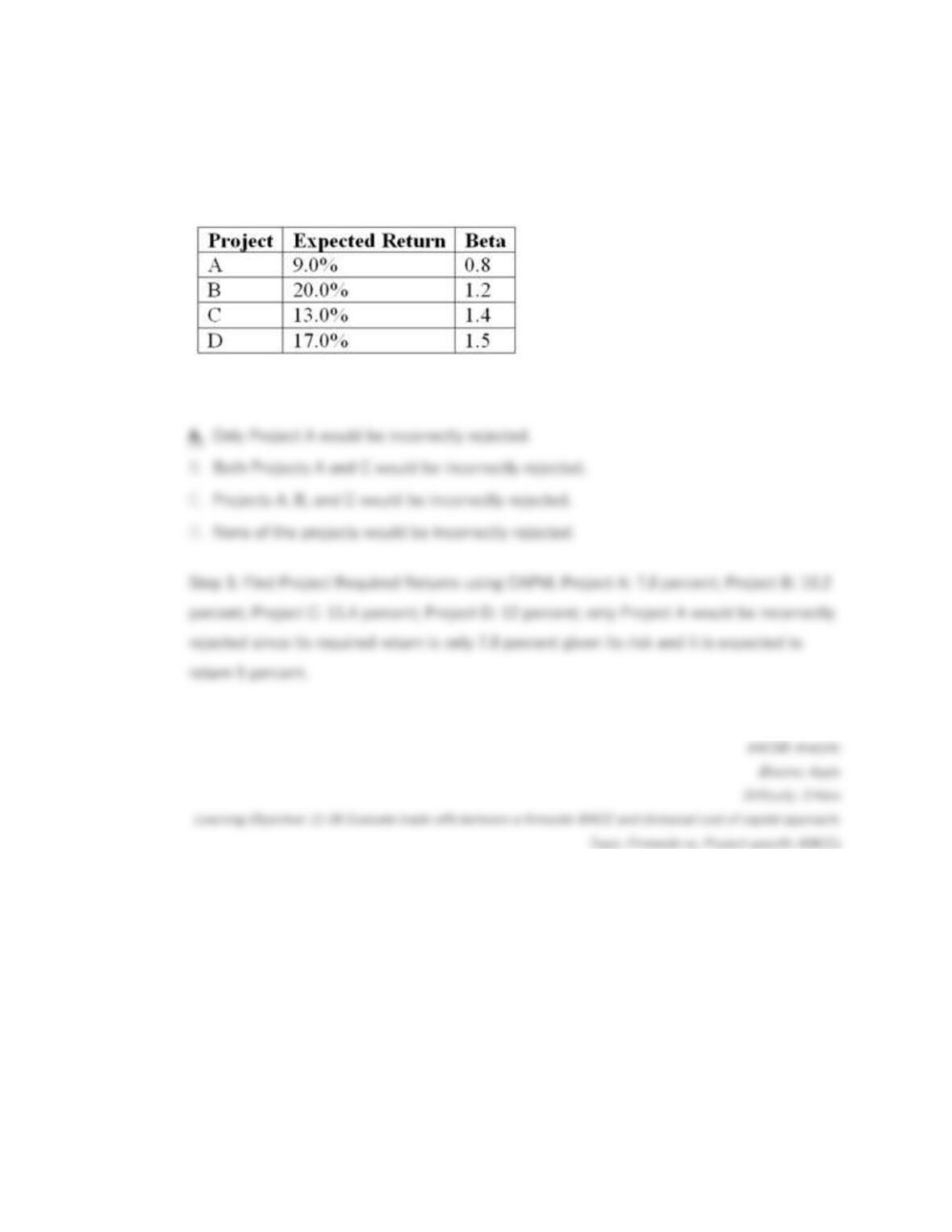
An all-equity firm is considering the projects shown as follows. The T-bill rate is 3 percent
and the market risk premium is 6 percent. If the firm uses its current WACC of 12 percent
to evaluate these projects, which project(s), if any, will be incorrectly rejected?
81.
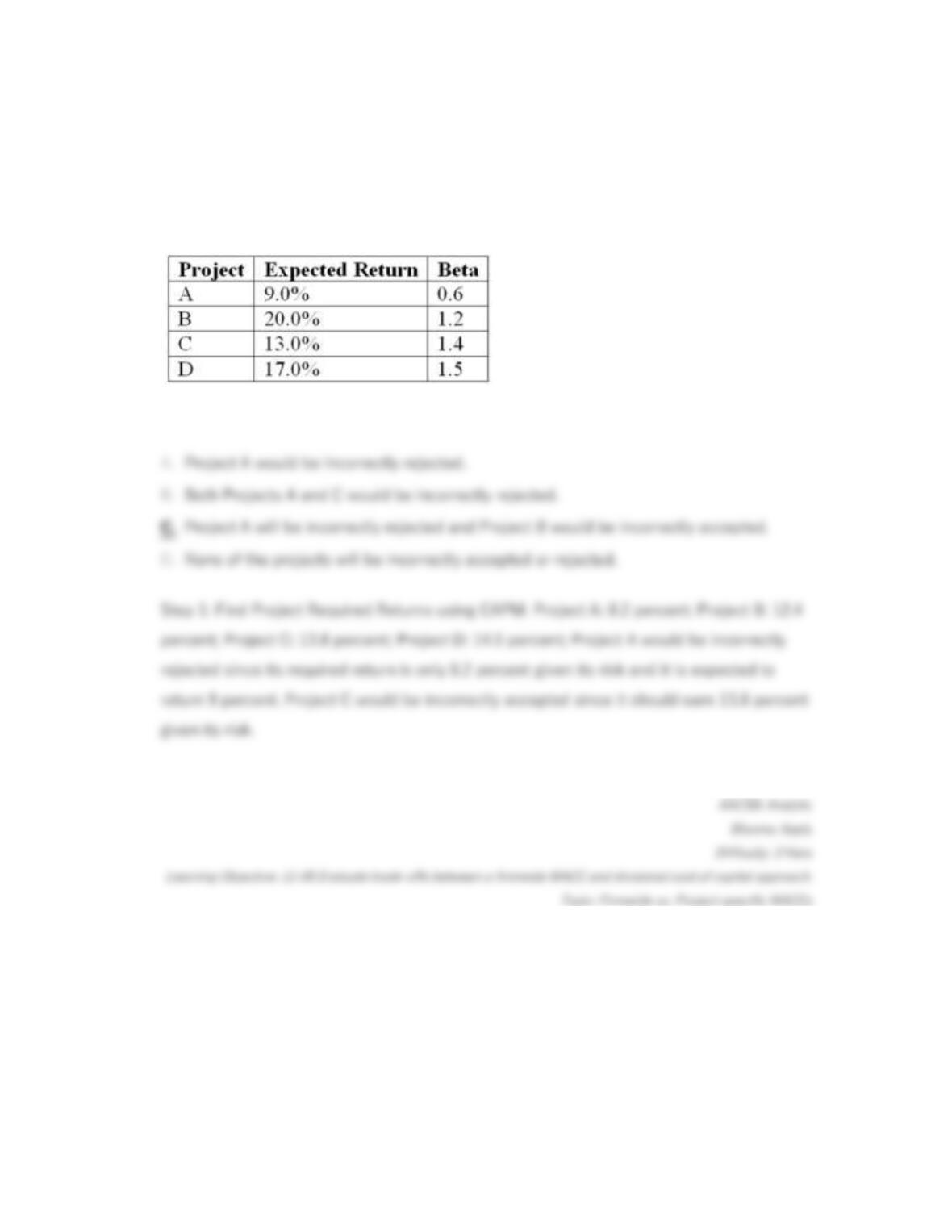
An all-equity firm is considering the projects shown as follows. The T-bill rate is 4 percent
and the market risk premium is 7 percent. If the firm uses its current WACC of 12 percent
to evaluate these projects, which project(s), if any, will be incorrectly accepted or
rejected?
82.
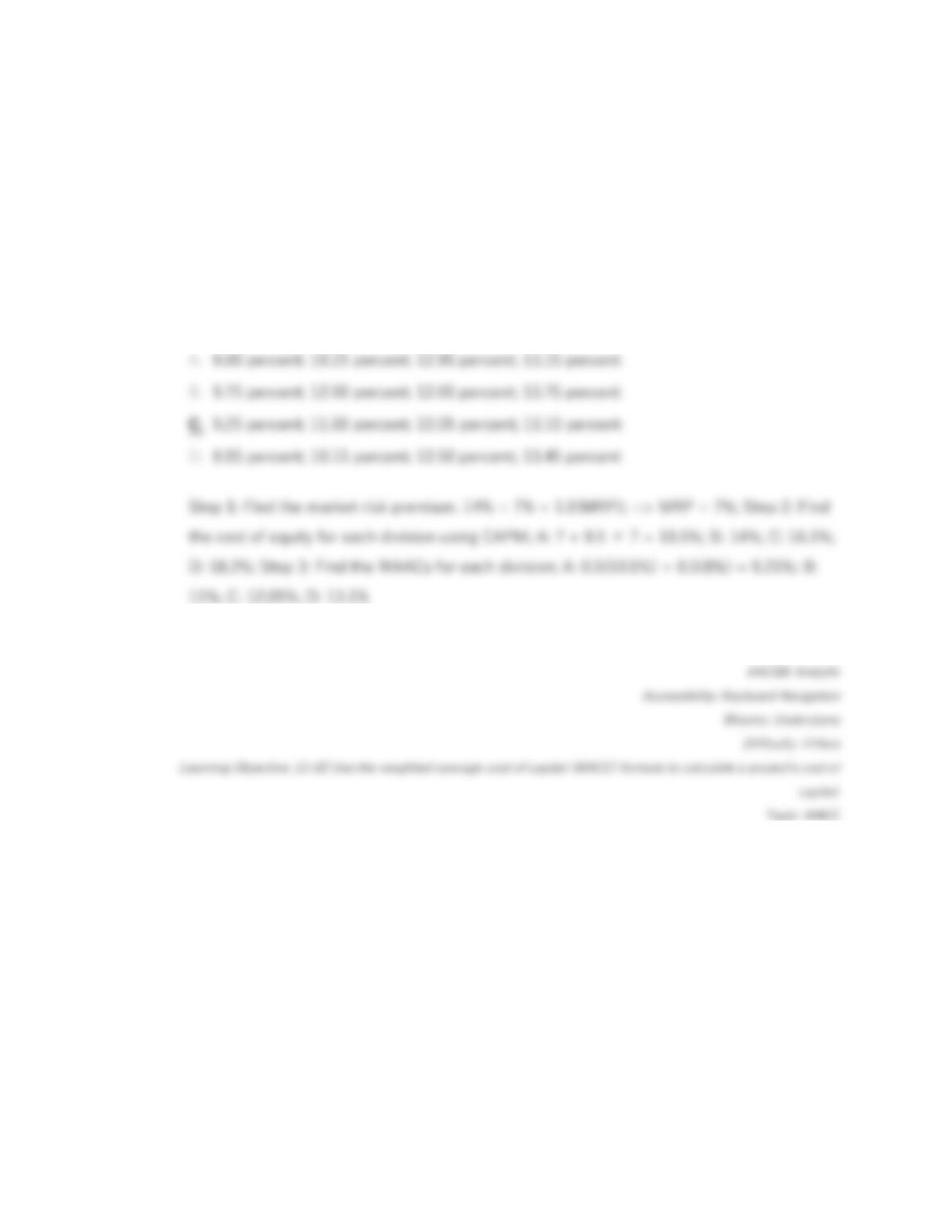
Suppose your firm has decided to use a divisional WACC approach to analyze projects.
The firm currently has four divisions, A through D, with average betas for each division of
0.5, 1.0, 1.3 and 1.6, respectively. If all current and future projects will be financed with
half debt and half equity, and if the current cost of equity (based on an average firm beta
of 1.0 and a current risk-free rate of 7 percent) is 14 percent and the after-tax yield on the
company’s bonds is 8 percent, what are the WACCs for divisions A through D?
83.
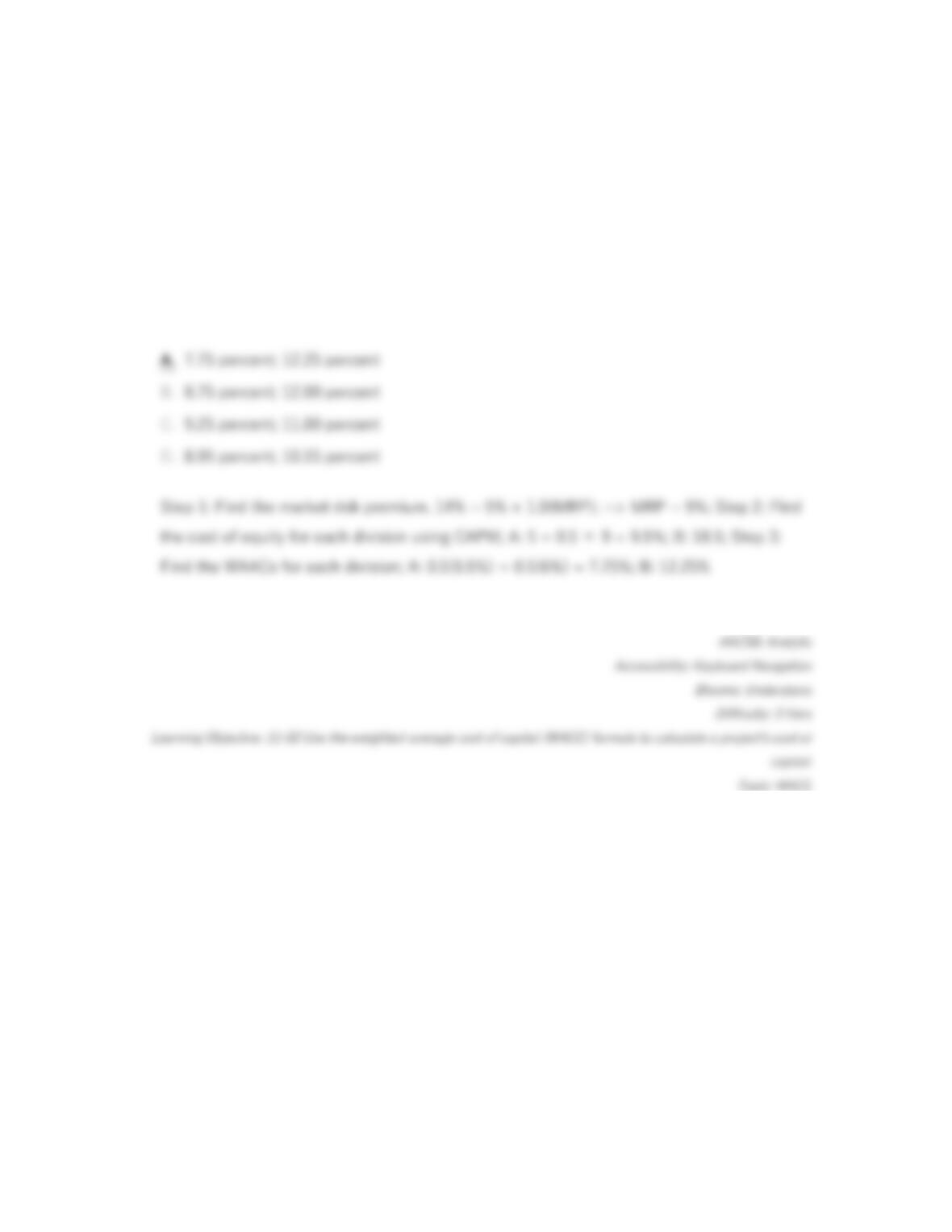
Suppose your firm has decided to use a divisional WACC approach to analyze projects.
The firm currently has 2 divisions, A and B, with betas for each division of 0.5 and 1.5,
respectively. If all current and future projects will be financed with half debt and half
equity, and if the current cost of equity (based on an average firm beta of 1.0 and a current
risk-free rate of 5 percent) is 14 percent and the after-tax yield on the company‘s bonds is
6 percent, what are the WACCs for divisions A and B?
84.
Which of the following statements is correct?
85.
Which of the following statements is correct?
86.
Which of the following will impact the cost of equity component in the weighted average
cost of capital?
87.
ADK Industries common shares sell for $40 per share. ADK expects to set their next
annual dividend at $1.75 per share. If ADK expects future dividends to grow at 7 percent
per year, indefinitely, the current risk-free rate is 4 percent, the expected rate on the
market is 11 percent, and the stock has a beta of 1.2, what should be the best estimate of
the firm’s cost of equity?
88.
ADK Industries common shares sell for $60 per share. ADK expects to set their next
annual dividend at $3.75 per share. If ADK expects future dividends to grow at 9 percent
per year, indefinitely, the current risk-free rate is 4 percent, the expected rate on the
market is 11 percent, and the stock has a beta of 1.5, what should be the best estimate of
the firm’s cost of equity?
89.
Which of the following will directly impact the cost of equity?
90.
Which of the following will directly impact the cost of debt?
91.
ADK has 30,000 15-year 9 percent annual coupon bonds outstanding. If the bonds
currently sell for 111 percent of par and the firm pays an average tax rate of 36 percent,
what will be the before-tax and after-tax component cost of debt?
92.
ADK has 30,000 15-year 9 percent semi-annual coupon bonds outstanding. If the bonds
currently sell for 90 percent of par and the firm pays an average tax rate of 32 percent,
what will be the before-tax and after-tax component cost of debt?
93.
An estimated WACC computed using some sort of proxy for the average equity risk of the
projects in a particular business unit is known as the:
94.
The ___________ approach to computing a divisional weighted average cost of capital
(WACC) uses the average beta of projects in each division to calculate the WACC.
95.
The ____________ approach to computing a divisional weighted average cost of capital
(WACC) requires only that WACCs for “risky” and “relatively safe” divisions be adjusted.
96.
Flotation costs are:
97.
Which of the following statements is correct?
98.
What is the theoretical minimum for the weighted average cost of capital?
99.
Which of following is a situation in which you would want to use the CAPM approach for
estimating the component cost of equity?
100.
Which of the following is a situation in which you would want to use the constant growth
model approach for estimating the component cost of equity?
101.
The reason that we do not use an after-tax cost of preferred stock is:
102.
Why do we use market-value weights instead of book-value weights?