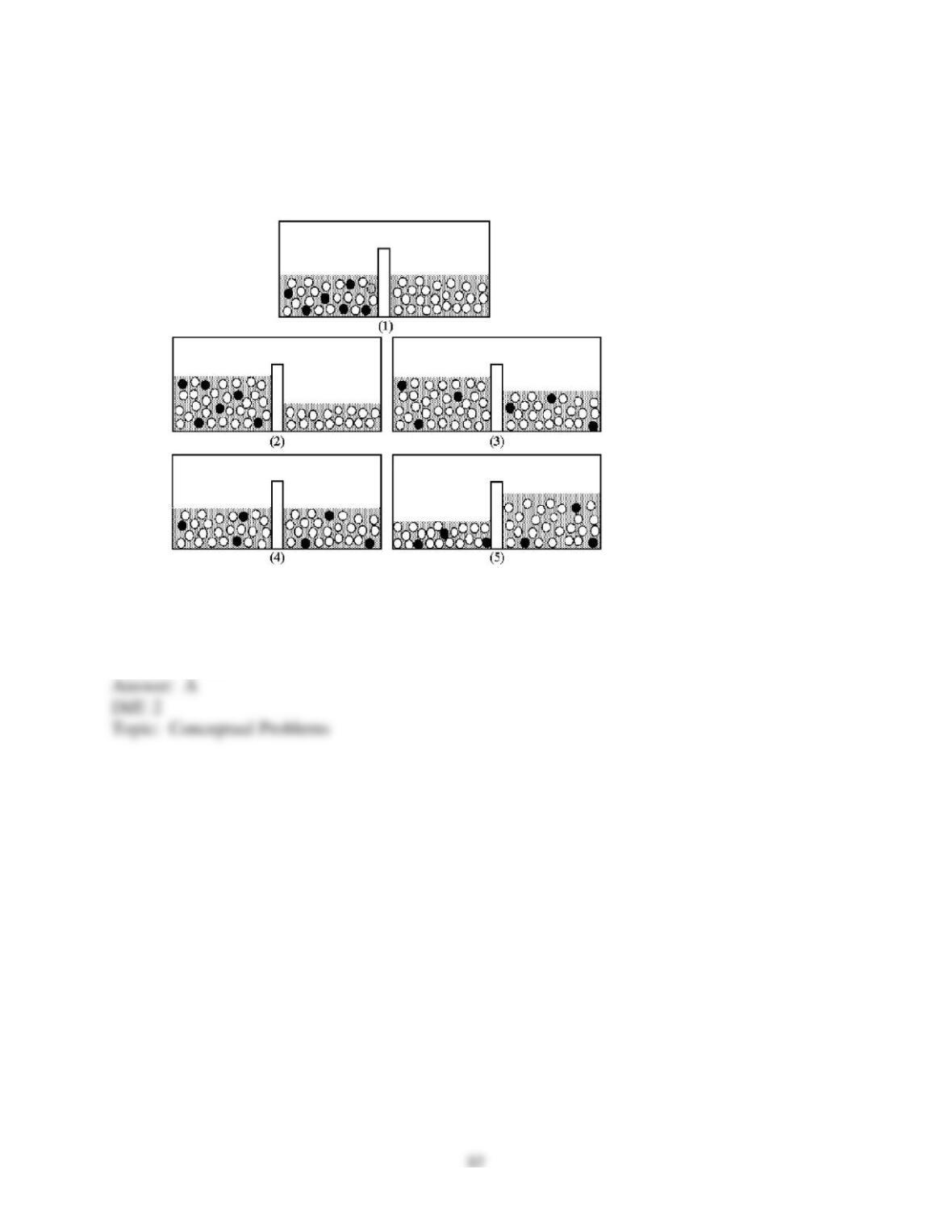
125) Drawing (1) shows a nonequilibrium system comprised of pure water separated from an
aqueous solution by a semipermeable membrane. Shaded spheres represent solute particles and
unshaded spheres represent water molecules. Which drawing (2)-(5) represents this system after
equilibrium is reached?
A) drawing (2)
B) drawing (3)
C) drawing (4)
D) drawing (5)
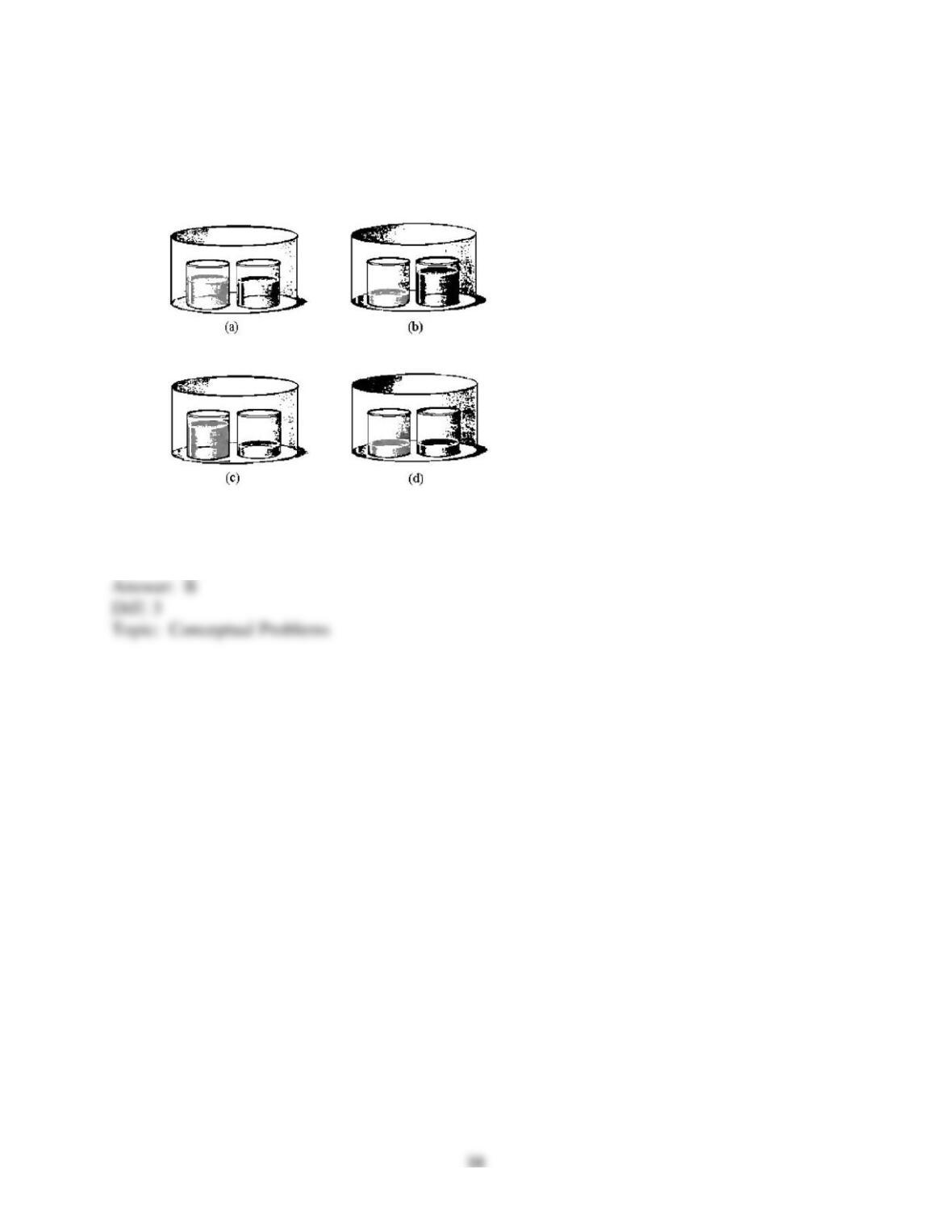
126) Two beakers, one with pure water (light gray) and the other with an aqueous solution of
KBr (dark gray), are placed in a closed container represented by drawing (a). Which of the
drawings (a)-(d) represents what the beakers will look like after a substantial amount of time has
passed?
A) drawing (a)
B) drawing (b)
C) drawing (c)
D) drawing (d)
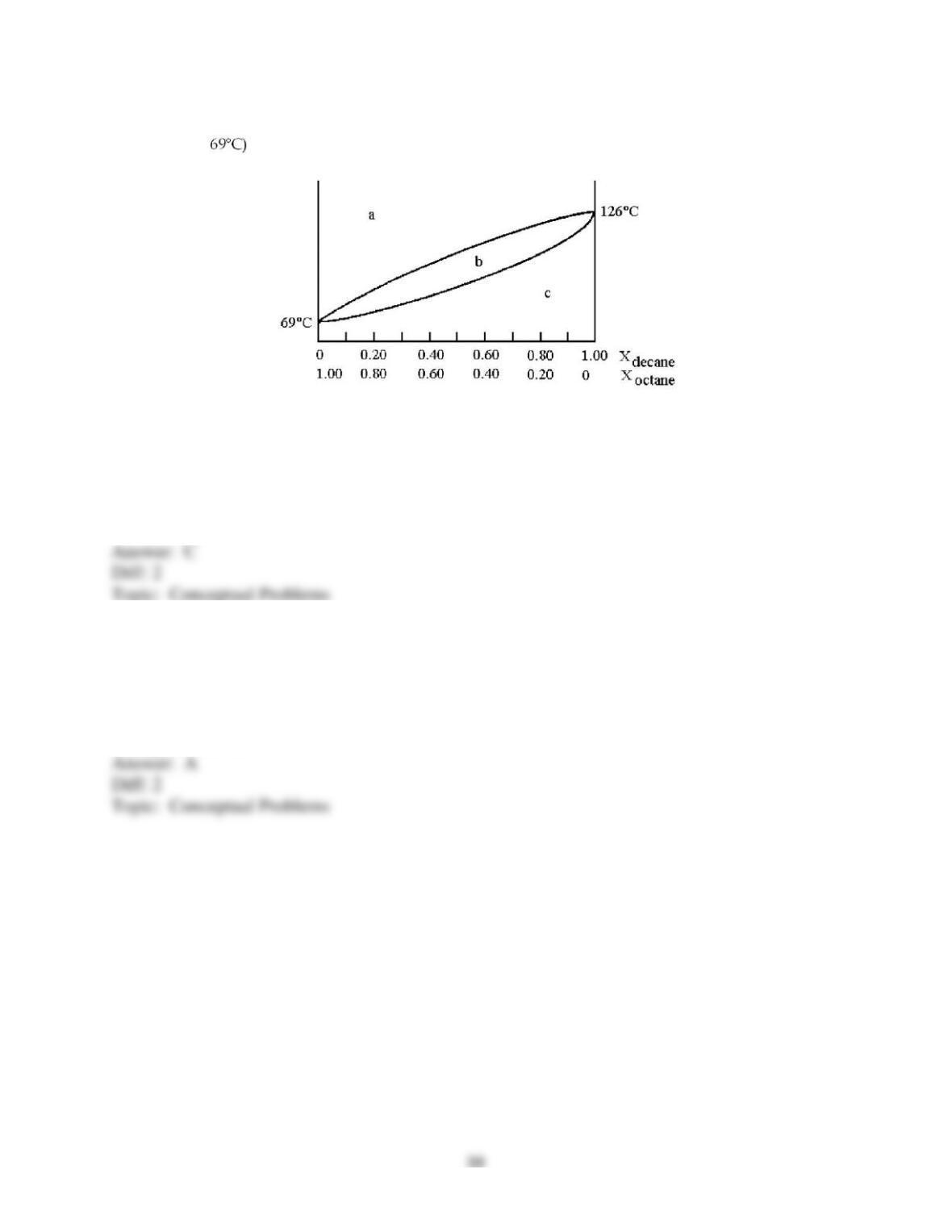
A phase diagram of temperature versus composition for a mixture of the two volatile liquids
octane (bp = and decane (bp = 126°C) is shown.
127) Assume that you start with a mixture containing 0.80 mol of decane and 0.20 mol of octane,
what region of the diagram corresponds to liquid?
A) region a
B) region b
C) region c
D) regions a and c
128) Assume that you start with a mixture containing 0.80 mol of decane and 0.20 mol of octane,
what region of the diagram corresponds to vapor?
A) region a
B) region b
C) region c
D) regions a and c
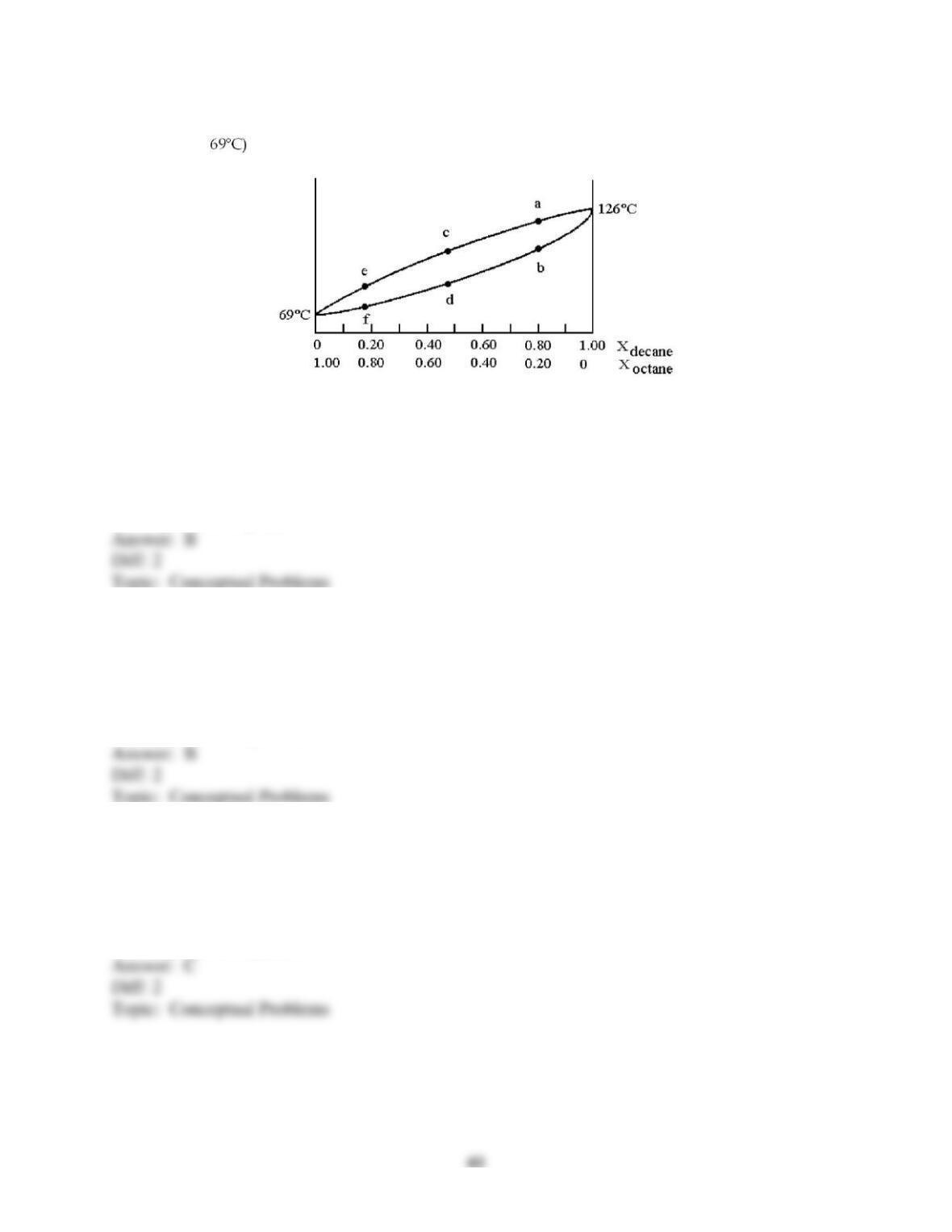
A phase diagram of temperature versus composition for a mixture of the two volatile liquids
octane (bp = and decane (bp = 126°C) is shown.
129) Assume that you start with a mixture containing 0.80 mol of decane and 0.20 mol of octane,
at what approximate temperature will the mixture begin to boil?
A) temperature at point a
B) temperature at point b
C) temperature at point d
D) temperature at point f
130) Assume that you start with a mixture containing 0.80 mol of decane and 0.20 mol of octane,
what is the liquid composition at the boiling point?
A) 100% decane
B) composition at point b
C) composition at point c
D) composition at point e
131) Assume that you start with a mixture containing 0.80 mol of decane and 0.20 mol of octane,
what is the vapor composition at the boiling point?
A) 100% decane
B) composition at point b
C) composition at point c
D) composition at point e
132) Assume that the vapor at point c is condensed and reboiled. What is the liquid composition
of the condensed vapor prior to reboiling?
A) 100% decane
B) composition at point b
C) composition at point d
D) composition at point e
133) Assume that the vapor at point c is condensed and reboiled. What is the vapor composition
during reboiling?
A) 100% decane
B) composition at point b
C) composition at point c
D) composition at point e
134) Assume that the vapor at point c is condensed and reboiled. What is the boiling point?
A) temperature at point b
B) temperature at point c
C) temperature at point d
D) temperature at point f
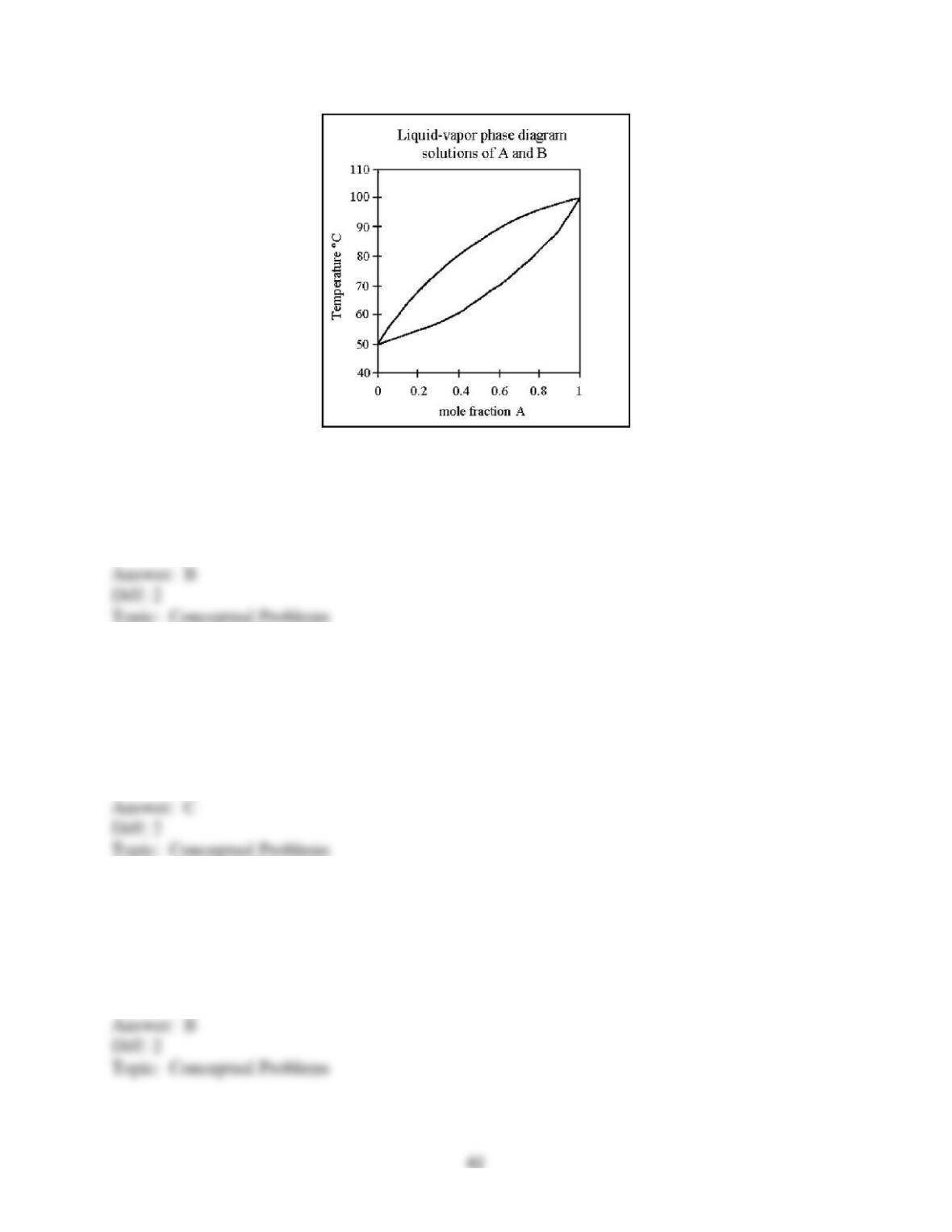
135) What is the approximate boiling temperature of a mixture that is 0.70 XA and 0.30 XB?
A) 50°C
B) 75°C
C) 95°C
D) 100°C
136) What is the approximate vapor composition above a boiling solution that is 0.70 XA and
0.30 XB ?
A) 0.70 XA, 0.30 XB
B) 0.50 XA, 0.50 XB
C) 0.30 XA, 0.70 XB
D) 0 XA, 1.00 XB
137) What is the approximate boiling temperature of the liquid formed from the condensation of
the vapor above a boiling solution that is 0.70 XA and 0.30 XB?
A) 50°C
B) 55°C
C) 90°C
D) 100°C
138) At 80°C, pure liquid A has a vapor pressure of 700 mm Hg and pure liquid B has a vapor
pressure of 940 mm Hg. What is XA for a solution of A and B with a normal boiling point of
A) 0.25
B) 0.50
C) 0.75
D) A solution of A and B cannot boil at 80°C.
11.2 Algorithmic Questions
1) Which cation in each set is expected to have the larger (more negative) hydration energy?
I Be2+ or Ca2+
II Rb+ or Zn2+
A) Be2+ in set I and Rb+ in set II
B) Be2+ in set I and Zn2+ in set II
C) Ca2+ in set I and Rb+ in set II
D) Ca2+ in set I and Zn2+ in set II
2) What is the mole fraction of ethanol in a solution made by dissolving 29.2 g of ethanol,
C2H5OH, in 53.6 g of water?
A) 0.176
B) 0.213
C) 0.352
D) 0.545
3) What is the mole fraction of I2 in a solution made by dissolving 55.6 g of I2 in 245 g of
hexane, C6H14?
A) 0.0715
B) 0.0770
C) 0.133
D) 0.154
4) What is the mole fraction of oxygen in a gas mixture that is 37% oxygen and 63% nitrogen by
volume?
A) 0.34
B) 0.37
C) 0.25
D) 0.52
5) What is the mass percent of vitamin C in a solution made by dissolving 6.50 g of vitamin C,
C6H8O6, in 55.0 g of water?
A) 0.547%
B) 1.21%
C) 10.6%
D) 11.8%
6) What is the weight percent of a caffeine solution made by dissolving 8.35 g of caffeine,
C8H10N4O2, in 75 g of benzene, C6H6?
A) 0.010%
B) 0.011%
C) 10%
D) 11%
7) What volume of a 0.716 M KBr solution is needed to provide 30.5 g of KBr?
A) 21.8 mL
B) 42.7 mL
C) 184 mL
D) 357 mL
8) What volume of 3.00 M CH3OH solution is needed to provide 0.220 mol of CH3OH?
A) 1.52 mL
B) 13.6 mL
C) 73.3 mL
D) 660 mL
9) How much water must be added to 40.0 g of CaCl2 to produce a solution that is 35.0 mass %
CaCl2?
A) 54.0 g
B) 74.2 g
C) 87.5 g
D) 114 g
10) To make a 0.500 M solution, one could take 0.500 moles of solute and add
A) 1.00 L of solvent.
B) 1.00 kg of solvent.
C) enough solvent to make 1.00 L of solution.
D) enough solvent to make 1.00 kg of solution.
11) To make a 2.00 m solution, one could take 2.00 moles of solute and add
A) 1.00 L of solvent.
B) 1.00 kg of solvent.
C) enough solvent to make 1.00 L of solution.
D) enough solvent to make 1.00 kg of solution.
12) What molality of pentane is obtained by dissolving 15 g pentane, C5H12, in 245.0 g hexane,
C6H14?
A) 0.058 m
B) 0.068 m
C) 0.85 m
D) 61 m
13) A solution is 2.25% by mass NaHCO3. How many grams of NaHCO3 are in 150.0 g of
solution?
A) 1.50 g
B) 3.38 g
C) 66.7 g
D) 225 g
14) How many grams of KBr are required to make 350. mL of a 0.115 M KBr solution?
A) 0.338 g
B) 3.04 g
C) 4.79 g
D) 40.3 g
15) What is the molality of a glucose solution prepared by dissolving 18.0 g of glucose,
C6H12O6, in 125.9 g of water?
A) 7.94 × 10⁻⁴ m
B) 0.143 m
C) 0.695 m
D) 0.794 m
16) A solution of LiCl in water has XLiCl = 0.0900. What is the molality?
A) 4.46 m LiCl
B) 5.00 m LiCl
C) 5.49 m LiCl
D) 9.89 m LiCl
17) A solution of LiCl in water is 20.0 mass % LiCl. What is the mole fraction of LiCl?
A) 0.0960
B) 0.106
C) 0.472
D) 4.44
18) In which case should CO2(g) be more soluble in water?
A) The total pressure is 5 atm and the partial pressure of CO2 is 0.5 atm.
B) The total pressure is 3 atm and the partial pressure of CO2 is 1 atm.
C) The total pressure is 1 atm and the partial pressure of CO2 is 0.03 atm.
D) The total pressure is 1 atm and the partial pressure of CO2 is 0.4 atm.
48
19) The Henry’s Law constant of methyl bromide, CH3Br, is k = 0.159 mol/(L ∙ atm) at 25°C.
What is the solubility of methyl bromide in water at 25°C and at a partial pressure of 270. mm
Hg?
A) 0.0565 mol/L
B) 0.355 mol/L
C) 0.448 mol/L
D) 42.9 mol/L
20) A solution is prepared by dissolving 40.0 g of sucrose, C12H22O11, in 250. g of water at
25°C. What is the vapor pressure of the solution if the vapor pressure of water at 25°C is 23.76
mm Hg?
A) 0.198 mm Hg
B) 20.5 mm Hg
C) 23.6 mm Hg
D) 24.0 mm Hg
21) A KCl solution is prepared by dissolving 25.0 g KCl in 250.0 g of water at 25°C. What is the
vapor pressure of the solution if the vapor pressure of water at 25°C is 23.76 mm Hg?
A) 21.6 mm Hg
B) 22.7 mm Hg
C) 23.2 mm Hg
D) 24.9 mm Hg
22) At a given temperature the vapor pressures of benzene and toluene are 183 mm Hg and 59.2
mm Hg, respectively. Calculate the total vapor pressure over a solution of benzene and toluene
with Xbenzene = 0.580.
A) 106 mm Hg
B) 121 mm Hg
C) 131 mm Hg
D) 242 mm Hg
23) Which of the following solutions will have the lowest freezing point?
A) 0.010 m K Br
B) 0.010 m Na2CO3
C) 0.035 m CH3CH2OH
D) 0.015 m BaCl2
24) What is the expected freezing point of a 0.50 m solution of Li2SO4 in water? Kf for water is
1.86°C/m.
A) -0.93°C
B) -1.9°C
C) -2.8°C
D) -6.5°C
25) Calculate the freezing point of a solution of 40.0 g methyl salicylate, C7H6O2, dissolved in
800. g of benzene, C6H6. and the freezing point is 5.50°C for benzene.
A) -2.09°C
B) 2.09°C
C) 3.41°C
D) 7.59°C
26) What is the freezing point of a solution of 7.15 g MgCl2 in 100 g of water? Kf for water is
A) -0.140°C
B) -1.40°C
C) -2.80°C
D) -4.18°C
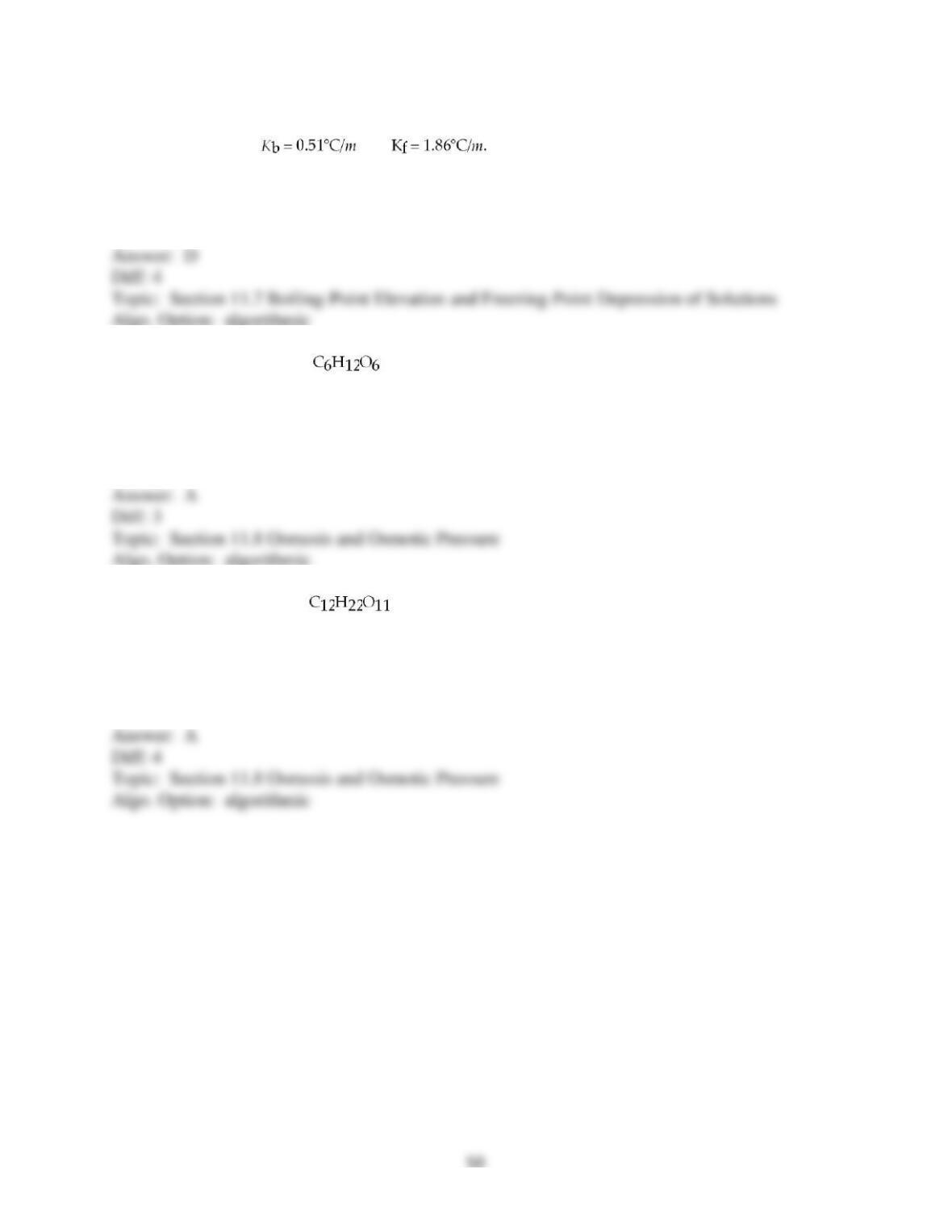
27) An aqueous solution has a normal boiling point of 103.0°C. What is the freezing point of this
solution? For water and
A) -0.82°C
B) -3.0°C
C) -3.6°C
D) -11°C
28) A solution of fructose, , exerts an osmotic pressure of 78.0 torr at 25° C. What is
the molarity of the fructose solution?
A) 0.00419 M
B) 3.19 M
C) 4.21 M
D) 0.00509 M
29) A solution of sucrose, , exerts an osmotic pressure of 3.06 atm at 25° C. What is
the molality of the sucrose solution? The density of the solution is 1.013 g/mL.
A) 0.129 m
B) 0.125 m
C) 1.49 m
D) 1.55 m
11.3 Short Answer Questions
1) In a solution that is 55% ethyl alcohol and 45% water, the solute is ________ and the solvent
is ________.
2) According to the rule of thumb “like dissolves like.” ionic solids like NaCl or polar substances
like glucose are more soluble in ________ solvents, whereas nonpolar substances like I2 are
more soluble in ________ solvents.
3) When KI is dissolved in water, the major forces overcome are ________ forces in the solute
and ________ forces in the solvent, and the major forces created between solute and solvent
particles are ________ forces.
4) Molarity is defined as ________, whereas molality is defined as ________.
5) The number of moles of ions in 25 mL of 2.0 M Na2SO4 is ________ moles.
6) The volume of 0.200 M H2SO4 that contains 5.00 mmol of H+ is ________ mL.
7) The solubility of a gas in a liquid is greatest at ________ pressures and ________
temperatures.
8) Freezing point depression, boiling point elevation, vapor pressure lowering, and osmotic
pressure are examples of ________ properties, which depend on the amount but not the chemical
identity of dissolved particles.
9) The boiling point of a solution containing a nonvolatile solute will be ________ than the
boiling point of the pure solvent, whereas the boiling point of a solution of two volatile liquids
will be ________ than the boiling point of the more volatile liquid and ________ than the boiling
point of the less volatile liquid.
10) A 1.0 m aqueous CaCl2 solution will have a ________ vapor pressure, ________ freezing
point, and ________ boiling point than a 1.0 m aqueous solution of NaCl.