17) Refer to Figure 11-4. Curve G approaches curve F because
A) marginal cost is above average variable costs.
B) average fixed cost falls as output rises.
C) fixed cost falls as capacity rises.
D) total cost falls as more and more is produced.
18) If the marginal cost curve is below the average variable cost curve, then
A) average variable cost is increasing.
B) average variable cost is decreasing.
C) marginal cost must be decreasing.
D) average variable cost could either be increasing or decreasing.
19) If the average variable cost curve is above the marginal cost curve, then
A) marginal costs must be decreasing.
B) average variable costs must be increasing.
C) marginal costs must be increasing.
D) marginal costs can be either increasing or decreasing.
20) Average total cost is equal to average variable cost minus average fixed cost.
21) As output increases, average fixed cost gets smaller and smaller.
22) As the level of output increases, what happens to the value of average fixed cost, and what
happens to the difference between the value of average total cost and average variable cost?
23) Suppose the total cost of producing 40,000 flash drives is $120,000, and the fixed cost is
$30,000.
a. What is the variable cost?
b. When output is 40,000, what are the average variable cost and the average fixed cost?
c. Assuming the cost curves have the usual shape, is the dollar difference between the average
total cost and the average variable cost greater when the output is 40,000 flash drives or when the
output is 60,000 flash drives? Explain.
24) Explain how the listed events (a-d) would affect the following at Hilton Hotels.
i. Marginal cost
ii. Average variable cost
iii. Average fixed cost
iv. Average total cost
a. Hilton decides on an across-the-board 5 percent increase in executive salaries.
b. Hilton decides to eliminate all print advertising.
c. Hilton signs a new contract with the Culinary Workers Union that requires the company to
increase wages for all its kitchen workers.
d. The federal government starts to levy a $5 room tax on all hotel rooms.
11.6 Costs in the Long Run
1) Long-run cost curves are U-shaped because
A) of the law of demand.
B) of the law of diminishing returns.
C) of economies and diseconomies of scale.
D) of the law of supply.
2) If, when a firm doubles all its inputs, its average cost of production decreases, then production
displays
A) diminishing returns.
B) economies of scale.
C) diseconomies of scale.
D) declining fixed costs.
3) If production displays economies of scale, the long-run average cost curve is
A) above the short-run average total cost curve.
B) downward-sloping.
C) upward sloping.
D) below the long-run marginal cost curve.
4) Economies of scale exist as a firm increases its size in the long run because of all of the
following except
A) the firm can afford more sophisticated technology in production.
B) labor and management can specialize even further in their tasks.
C) as a larger input buyer, the firm can purchase inputs at a lower per unit cost.
D) as a firm expands its production, its profit margin per-unit of output increases.
5) Over the past twenty years, the number of small family farms has fallen significantly and in
their place there are fewer, but larger, farms owned by corporations. Which of the following best
explains this trend?
A) diseconomies of scale in farming
B) economies of scale in farming
C) diminishing returns to labor in farming
D) declining productivity
6) The long-run average cost curve shows
A) the lowest average cost of producing every level of output in the long run.
B) where the most profitable level of output occurs.
C) the average cost of producing where diminishing returns are not present.
D) the plant size or scale that the firm should build.
7) In 1955, the chairman of the Sony corporation offered to sell transistor radios through
department stores in the United States. Sony based its selling price on its average total cost of
production. If a store bought 5,000 radios, Sony would sell them at $29.95 each. For 10,000 there
would be a discount, and for more than 10,000 the price would begin to climb. Based on this
information, 10,000 radios was located at the
A) minimum point on Sony’s average total cost curve.
B) maximum point on Sony’s average total cost curve.
C) minimum point on Sony’s marginal cost curve.
D) maximum point on Sony’s marginal cost curve.
8) In 1955, the chairman of the Sony corporation offered to sell transistor radios through
department stores in the United States. Sony based its selling price on its average total cost of
production. If a store bought 5,000 radios, Sony would sell them at $29.95 each. For 10,000 there
would be a discount, and for more than 10,000 the price would begin to climb. Based on this
information, Sony reached minimum efficient scale
A) at a quantity below 5,000 radios.
B) at a quantity of 5,000 radios.
C) at a quantity of 10,000 radios.
D) at a quantity above 10,000 radios.
9) If a firm decreases its plant size and finds that its long-run average costs have decreased, then
A) its labor is more productive in a smaller plant.
B) its diseconomies of scale are less.
C) the firm should reduce its plant size even more.
D) the firm is now profitable.
10) If, when a firm doubles all its inputs, its average cost of production increases, then
production displays
A) diminishing returns.
B) economies of scale.
C) diseconomies of scale.
D) declining fixed costs.
11) Which of the following is a reason why a firm would experience diseconomies of scale?
A) To finance an increase in the size of its plant a firm must borrow more money or sell more
shares of stock.
B) As the size of the firm increases, it becomes more difficult to find markets where it doesn’t
already have operations.
C) As the size of the firm increases it becomes more difficult to coordinate the operations of its
manufacturing plants.
D) As the size of the firm increases, it must operate in other countries where differences in
language, customs and laws increase its average costs.
12) The minimum efficient scale is
A) the level of output where diminishing returns have not set in yet.
B) the plant size that yields the most profit.
C) level of operation where long-run average costs are lowest.
D) the smallest output level where the firm finally reaches productive efficiency.
13) All of the following statements are true of the minimum efficient scale except one. Which
one?
A) All possible economies of scale have been exhausted.
B) The short-run average total cost curve’s minimum point is equal to the long run average cost
curve’s minimum point.
C) Any increase in the scale of operation will encounter diseconomies of scale.
D) An increase in the output level will increase profit.
14) At the minimum efficient scale,
A) all possible economies of scale have not been exhausted.
B) the firm has achieved the lowest possible average cost of production.
C) any increases in the scale of operation will encounter further economies of scale.
D) marginal cost is at its minimum.
15) The ABC Company manufactures routers that are used to provide high-speed Internet
service. ABC sells an average of 1,000 routers each month, but to exhaust economies of scale in
its industry ABC would have to sell 3,000 routers each month. Therefore,
A) ABC is experiencing diseconomies of scale.
B) ABC is experiencing diminishing returns.
C) to reach minimum efficient scale ABC would have to sell at least 3,000 routers each month.
D) ABC will soon go out of business.
16) When a firm’s long-run average cost curve is horizontal for a range of output, then that range
of production displays
A) increasing returns to scale.
B) constant returns to scale.
C) decreasing returns to scale.
D) constant average fixed costs.
17) Ford Motor Company started producing the Model A at plants scattered around the United
States
A) to save on transport costs.
B) because diseconomies of scale at its initial River Rouge plant resulted in high production
costs.
C) to locate its production centers closer to its customers.
D) because it was not able to attract skilled workers in Michigan (where its first plant was
located).
18) If production displays diseconomies of scale, the long run average cost curve is
A) above the short run average total cost curve.
B) above the long run marginal cost curve.
C) upward sloping.
D) downward sloping.
19) The president of Toyota’s Georgetown plant was quoted as saying, “Demand for high
volumes saps your energy. Over a period of time, it eroded our focus [and] thinned out the
expertise and knowledge we painstakingly built up over the years.” This quote suggests that
A) Toyota was experiencing an excess demand for its automobiles which it had difficulty
keeping up with.
B) as Toyota expanded its capacity, it experienced diseconomies of scale.
C) Toyota was focused on “churning” out cars for which it did not invest sufficiently in training
its workers.
D) high demand for Toyota’s cars prevented the company from focusing on its strength: auto
design.
20) The president of Toyota’s Georgetown plant was quoted as saying, “Demand for high
volumes saps your energy. Over a period of time, it eroded our focus [and] thinned out the
expertise and knowledge we painstakingly built up over the years.” Based on this quote, what
must be true of the plant’s average cost of production curve?
A) It is upward-sloping.
B) It is downward-sloping.
C) It is a ray from the origin.
D) It is U-shaped.
21) What is the difference between “diminishing marginal returns” and “diseconomies of scale”?
A) Both concepts explain why marginal cost increases after some point but diminishing marginal
returns applies only in the short run when there is at least one fixed factor, while diseconomies of
scale applies in the long run when all factors are variable.
B) Both concepts explain why average total cost increases after some point but diminishing
marginal returns applies only in the short run when there is at least one fixed factor, while
diseconomies of scale applies in the long run when all factors are variable.
C) Diminishing marginal returns, which applies only in the short run when at least one factor is
fixed, explains why marginal cost increases, while diseconomies of scale, which applies in the
long run when all factors are variable, explains why average cost increases.
D) Diminishing marginal returns,which applies only in the long run when all factors are variable,
explains why average variable cost increases, while diseconomies of scale, which applies in the
short run when at least one factor is fixed, explains why average total cost increases.
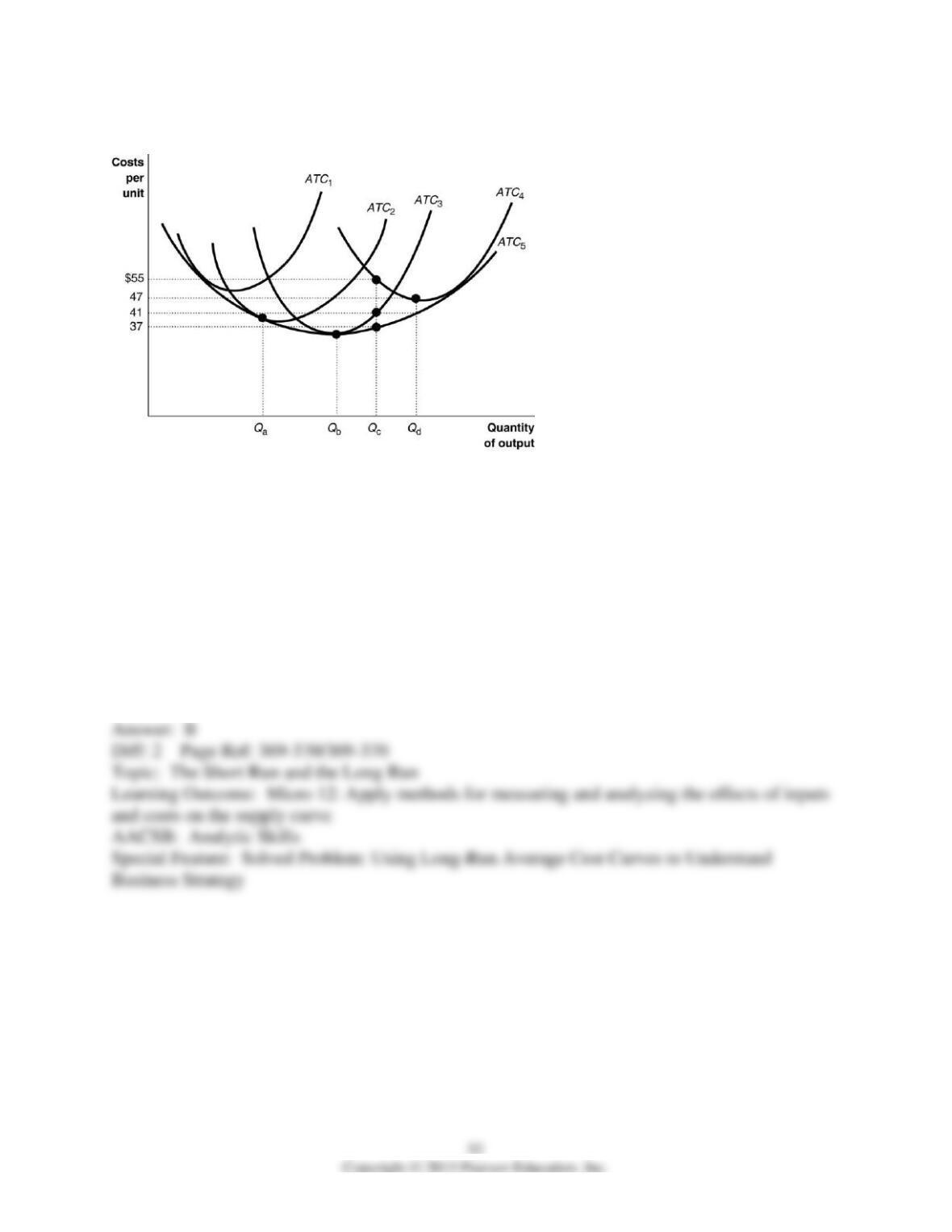
Figure 11-5
22) Refer to Figure 11-5. Suppose for the past 8 years the firm has been producing Qd units per
period using plant size ATC4. Now, following a permanent change in demand, it plans to cut
production to Qc units. What will happen to its average cost of production?
A) In the short run, its average cost falls from $47 to $41, and in the long run, average cost falls
even further to $37.
B) In the short run, its average cost rises from $47 to $55, and in the long run, average cost falls
to $41.
C) In the short run, its average cost falls from $47 to $37, and in the long run, average cost rises
to $41.
D) In the short run, its average cost rises from $47 to $55, and in the long run, average cost falls
to $37.
23) Refer to Figure 11-5. Identify the minimum efficient scale of production.
A) Qa
B) Qb
C) Qc
D) Qd
24) Assume that 1366 Technologies initially does not sell enough solar wafers to realize
economies of scale. To reach economies of scale, 1366 Technologies must
A) produce and sell more wafers at a lower average total cost.
B) produce and sell fewer wafers at a lower average total cost.
C) produce and sell more wafers at a higher average total cost.
D) produce and sell fewer wafers at a lower average total cost.
25) A positive technological change which decreases the price of inputs 1366 Technologies uses
to produce solar wafers will cause
A) 1366 Technologies’ average total cost curve and marginal cost curve to shift downward.
B) 1366 Technologies’ average total cost curve but not its marginal cost curve to shift downward.
C) 1366 Technologies’ marginal cost curve but not its average total cost curve to shift downward.
D) a movement downward along 1366 Technologies’ current average total cost curve.
26) In the long run the relevant cost is total cost.
27) If the long-run average total cost curve is downward-sloping, then the firm is experiencing
decreasing returns to scale.
28) If production displays constant returns to scale, then all economies of scale have been
exhausted.
29) An important reason why diseconomies of scale arise is because firms may have to hire
lower skilled workers as firms expand.
30) What are economies of scale? What are diseconomies of scale?
31) What is the difference between total cost and variable cost in the long run?