
Test Bank for Intermediate Accounting, Fifteenth Edition
11 – 34
BE. 11-127 (cont.)
____ 9. The methods of depreciation based upon output assume that obsolescence will not
significantly affect the usefulness of the asset.
____ 10. The revision of prior periods’ depreciation estimates would be disclosed on the
retained earnings statement.
Solution 11-127
BE. 11-128—Depreciation methods.
Each of the statements appearing below is descriptive of one or more of the following
depreciation methods. In the spaces below, place the letter(s) belonging to the method(s) to
which the statement best applies.
a. Declining-balance e. Sum-of-the-years’-digits
b. Group f. Units of output
c. Composite g. Working hours
d. Straight-line
____ 1. The depreciation charged by this method decreases by the same amount each year.
____ 2. These methods are used for depreciating multiple-asset accounts.
____ 3. These methods allocate larger shares of the cost of a plant asset to expense during
the years in which the greatest use is made of the asset.
____ 4. These methods always allocate larger shares of the cost of a plant asset to expense
during the earlier years of its life.
____ 5. Once the depreciable base, scrap value, and life of a plant asset are determined, the
annual charges to operations under this method will be the same.
Solution 11-128
Depreciation, Impairments, and Depletion
11 – 35
EXERCISES
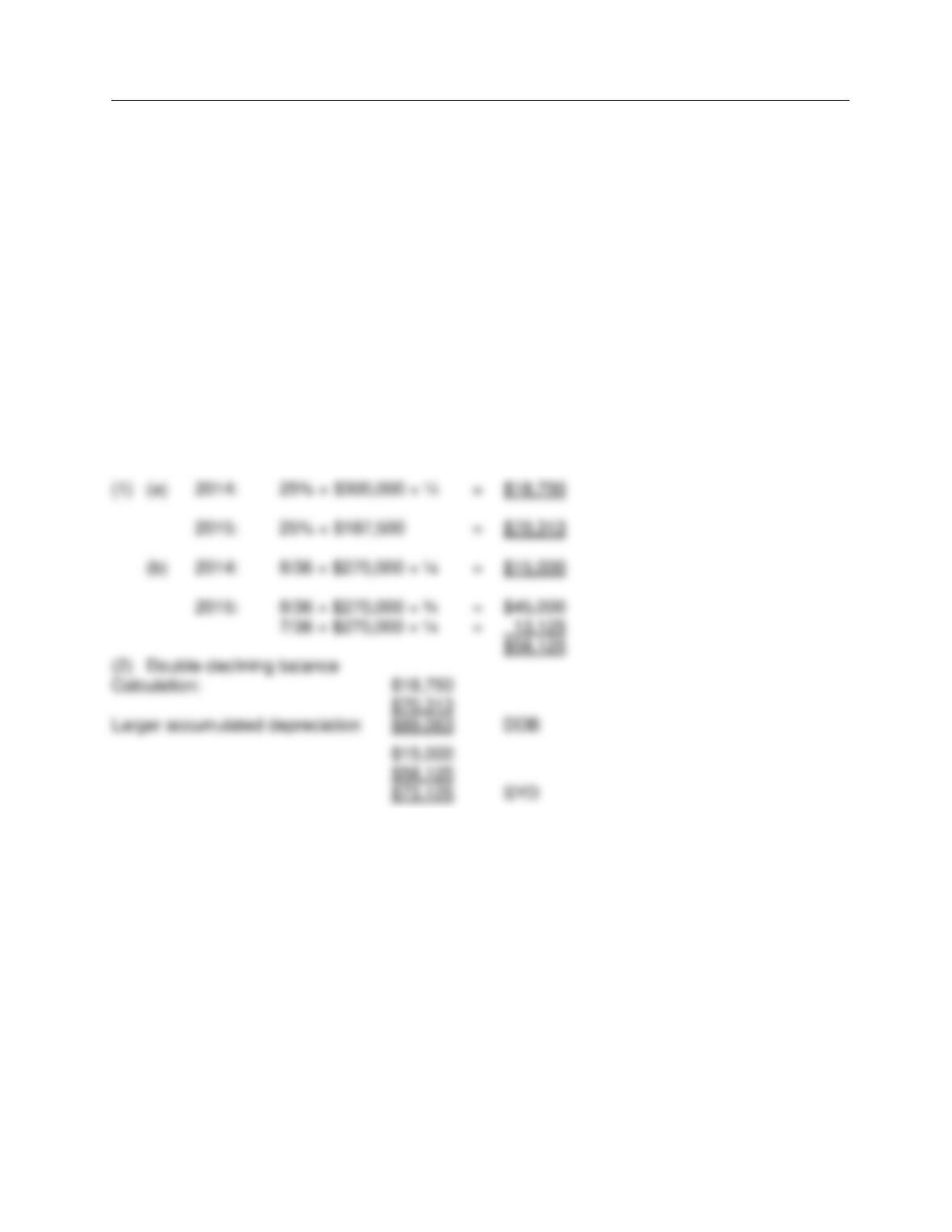
Ex. 11-129—Calculate depreciation.
A machine which cost $300,000 is acquired on October 1, 2014. Its estimated salvage value is
$30,000 and its expected life is eight years.
Instructions
(1) Calculate depreciation expense for 2014 and 2015 by each of the following methods, showing
the figures used.
(a) Double-declining balance
(b) Sum-of-the-years’-digits
(2) At the end of 2015, which method results in the larger accumulated depreciation amount?
Solution 11-129
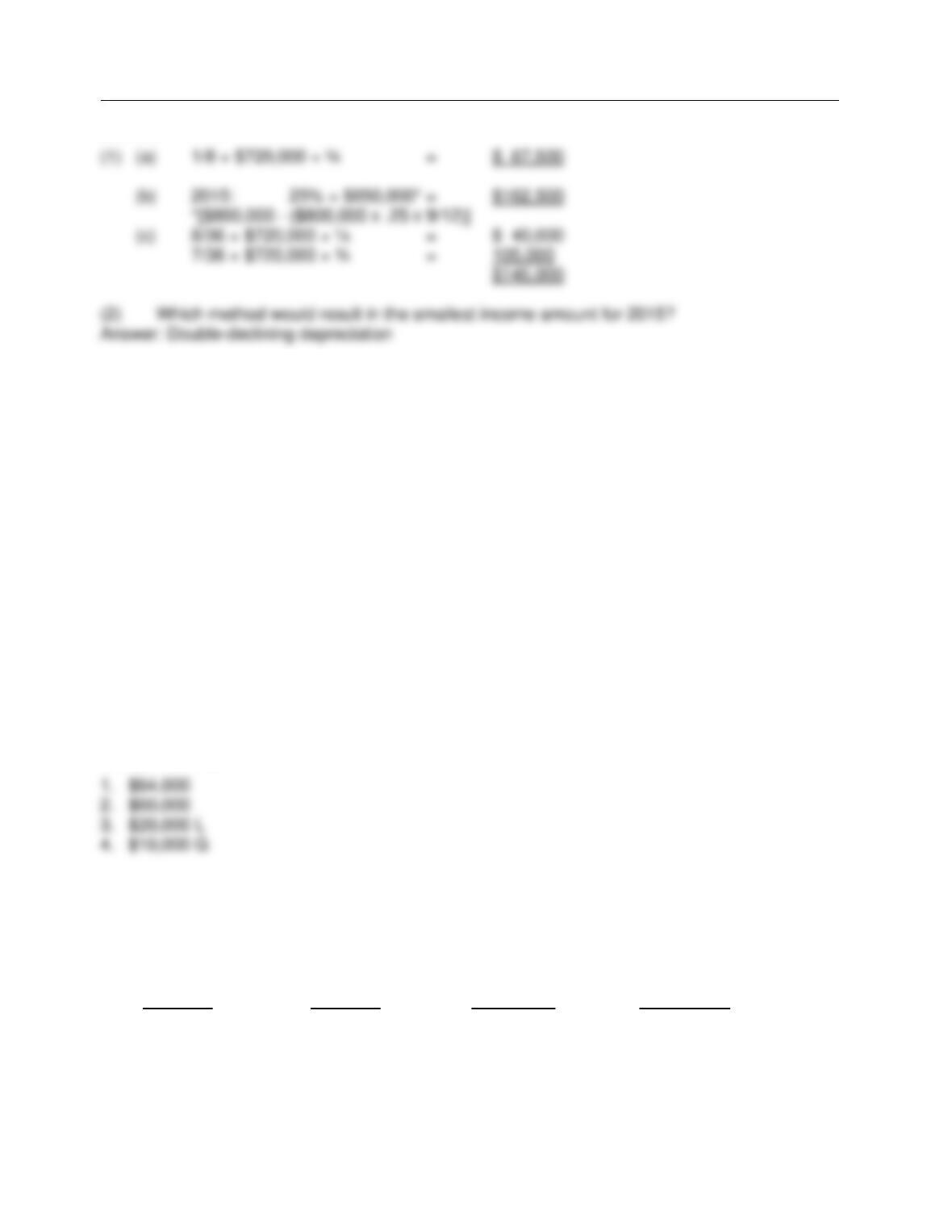
Ex. 11-130—Calculate depreciation.
A machine cost $800,000 on April 1, 2014. Its estimated salvage value is $80,000 and its
expected life is eight years.
Instructions
(1) Calculate the depreciation expense (to the nearest dollar) by each of the following
methods, showing the figures used.
(a) Straight-line for 2014
(b) Double-declining balance for 2015
(c) Sum-of-the-years’-digits for 2015
(2) Which method would result in the smallest income amount for 2015?
Test Bank for Intermediate Accounting, Fifteenth Edition
11 – 36
Solution 11-130
Ex. 11-131—Asset depreciation and disposition.
Answer each of the following questions.
1. A plant asset purchased for $400,000 has an estimated life of 10 years and a residual value
of $20,000. Depreciation for the second year of use, determined by the declining-balance
method at twice the straight-line rate is $_____________.
2. A plant asset purchased for $330,000 at the beginning of the year has an estimated life of 5
years and a residual value of $30,000. Depreciation for the third year, determined by the sum-
of-the-years’-digits method is $______________.
3. A plant asset with a cost of $320,000 and accumulated depreciation of $90,000, is given
together with cash of $120,000 in exchange for a similar asset worth $330,000. The gain or
loss recognized on the disposal (indicate by “G” or “L”) is $______________.
4. A plant asset with a cost of $270,000, estimated life of 5 years, and residual value of $45,000,
is depreciated by the straight-line method. This asset is sold for $190,000 at the end of the
second year of use. The gain or loss on the disposal (indicate by “G” or “L”) is $___________.
Solution 11-131
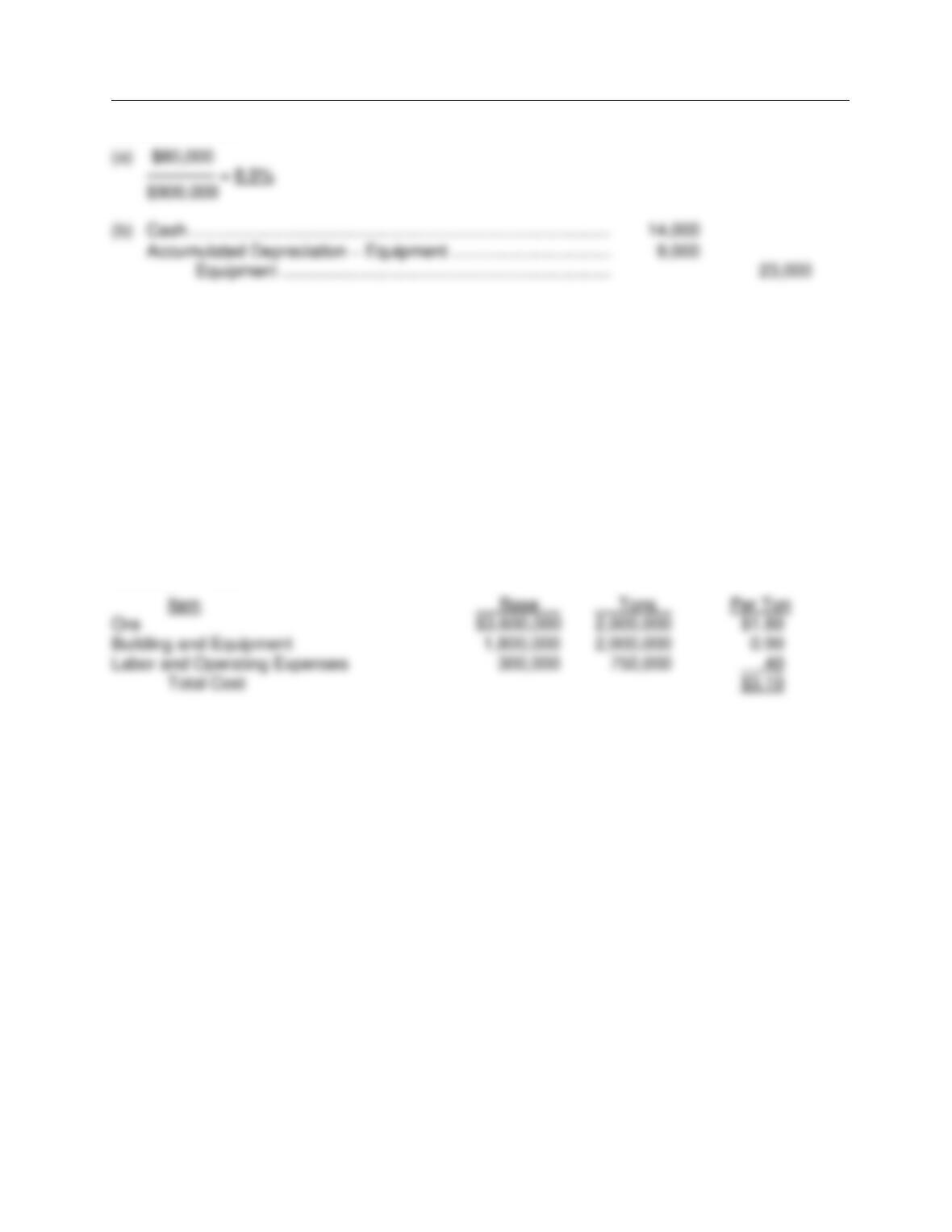
Ex. 11-132—Composite depreciation.
Callon Co. uses the composite method to depreciate its equipment. The following totals are for all
of the equipment in the group:
Initial Residual Depreciable Depreciation
Cost Value Cost Per Year
$900,000 $100,000 $800,000 $80,000
Instructions
(a) What is the composite rate of depreciation? (To nearest tenth of a percent.)
(b) A machine with a cost of $23,000 was sold for $14,000 at the end of the third year. What
entry should be made?
Depreciation, Impairments, and Depletion
11 – 37
Solution 11-132
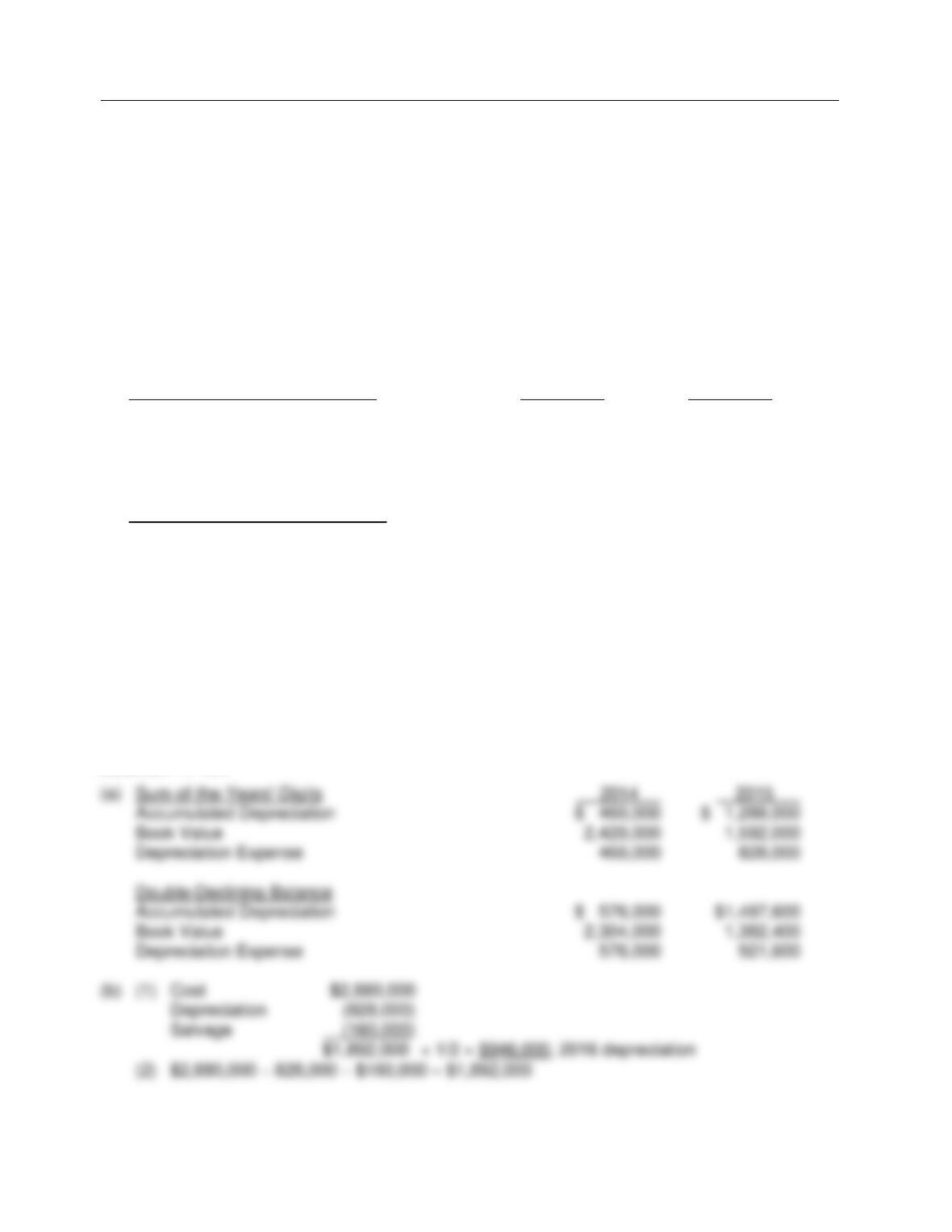
Ex. 11-133—Depletion allowance.
Mareos Company purchased for $3,800,000 a mine estimated to contain 2 million tons of ore.
When the ore is completely extracted, it was expected that the land would be worth $200,000. A
building and equipment costing $1,800,000 were constructed on the mine site, and they will be
completely used up and have no salvage value when the ore is exhausted. During the first year,
750,000 tons of ore were mined, and $300,000 was spent for labor and other operating costs.
Instructions
Compute the total cost per ton of ore mined in the first year. (Show computations by setting up a
schedule giving cost per ton.)
Solution 11-133
Test Bank for Intermediate Accounting, Fifteenth Edition
11 – 38
PROBLEMS
Pr. 11-134—Depreciation methods.
On July 1, 2014, Sport Company purchased for $2,880,000 snow-making equipment having an
estimated useful life of 5 years with an estimated salvage value of $120,000. Depreciation is
taken for the portion of the year the asset is used.
Instructions
(a) Complete the form below by determining the depreciation expense and year-end book values
for 2014 and 2015 using the
1. sum-of-the-years‘-digits method.
2. double-declining balance method.
Sum-of-the-Years’-Digits Method 2014 2015
Equipment $2,880,000 $2,880,000
Less: Accumulated Depreciation ______ _______
Year-End Book Value ______ _______
Depreciation Expense for the Year ______ _______
Double-Declining Balance Method
Equipment $2,880,000 $2,880,000
Less: Accumulated Depreciation ______ _______
Year-End Book Value ______ _______
Depreciation Expense for the Year ______ _______
(b) Assume the company had used straight-line depreciation during 2014 and 2015. During
2016, the company determined that the equipment would be useful to the company for only
one more year beyond 2016. Salvage value is estimated at $160,000.
(1) Compute the amount of depreciation expense for the 2016 income statement.
(2) What is the depreciation base of this asset?
Solution 11-134
Depreciation, Impairments, and Depletion
11 – 39
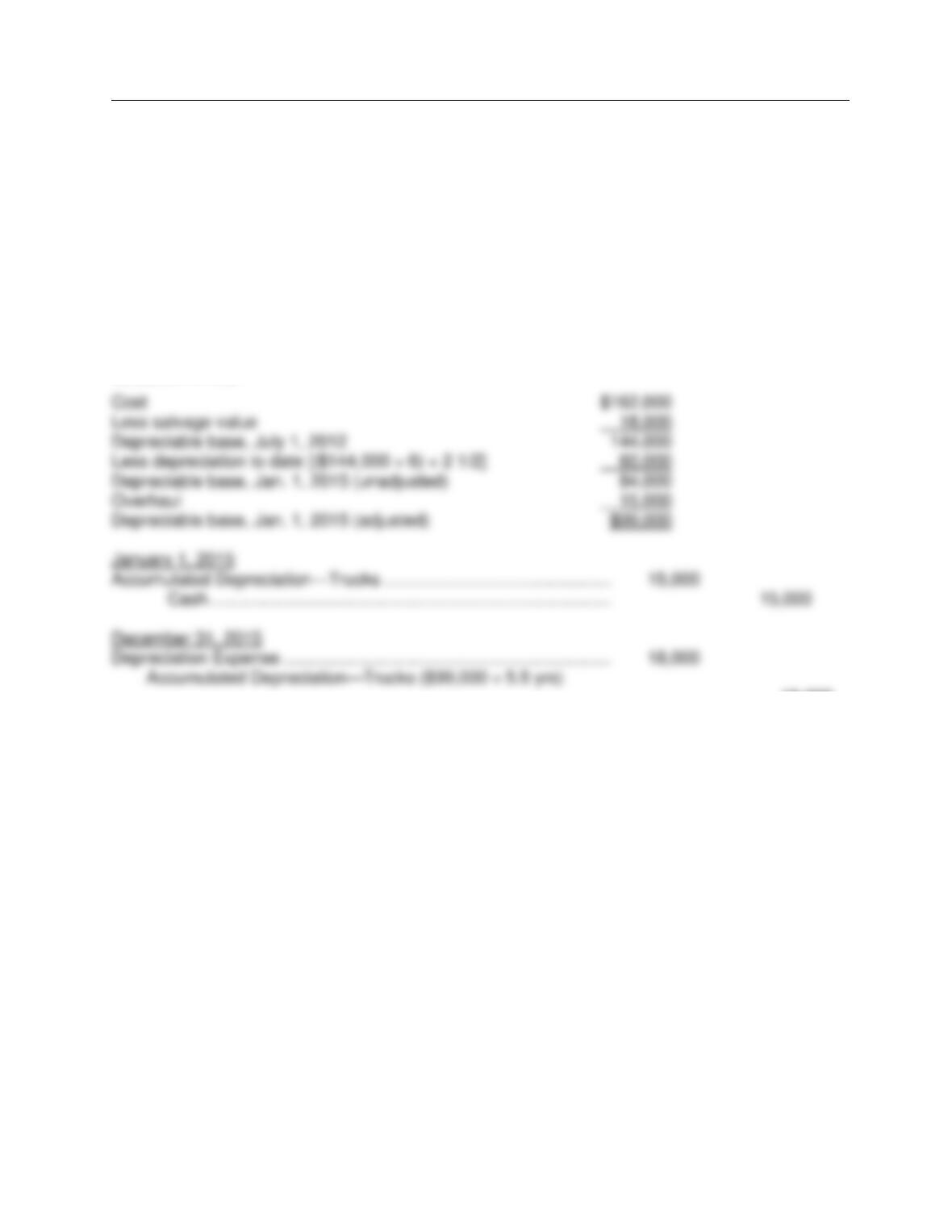
Pr. 11-135—Adjustment of Depreciable Base.
A truck was acquired on July 1, 2012, at a cost of $162,000. The truck had a six-year useful life
and an estimated salvage value of $18,000. The straight-line method of depreciation was used.
On January 1, 2015, the truck was overhauled at a cost of $15,000, which extended the useful life
of the truck for an additional two years beyond that originally estimated (salvage value is still
estimated at $18,000). In computing depreciation for annual adjustment purposes, expense is
calculated for each month the asset is owned.
Instructions
Prepare the appropriate entries for January 1, 2015 and December 31, 2015.
Solution 11-135
18,000
Pr. 11-136—Impairment.
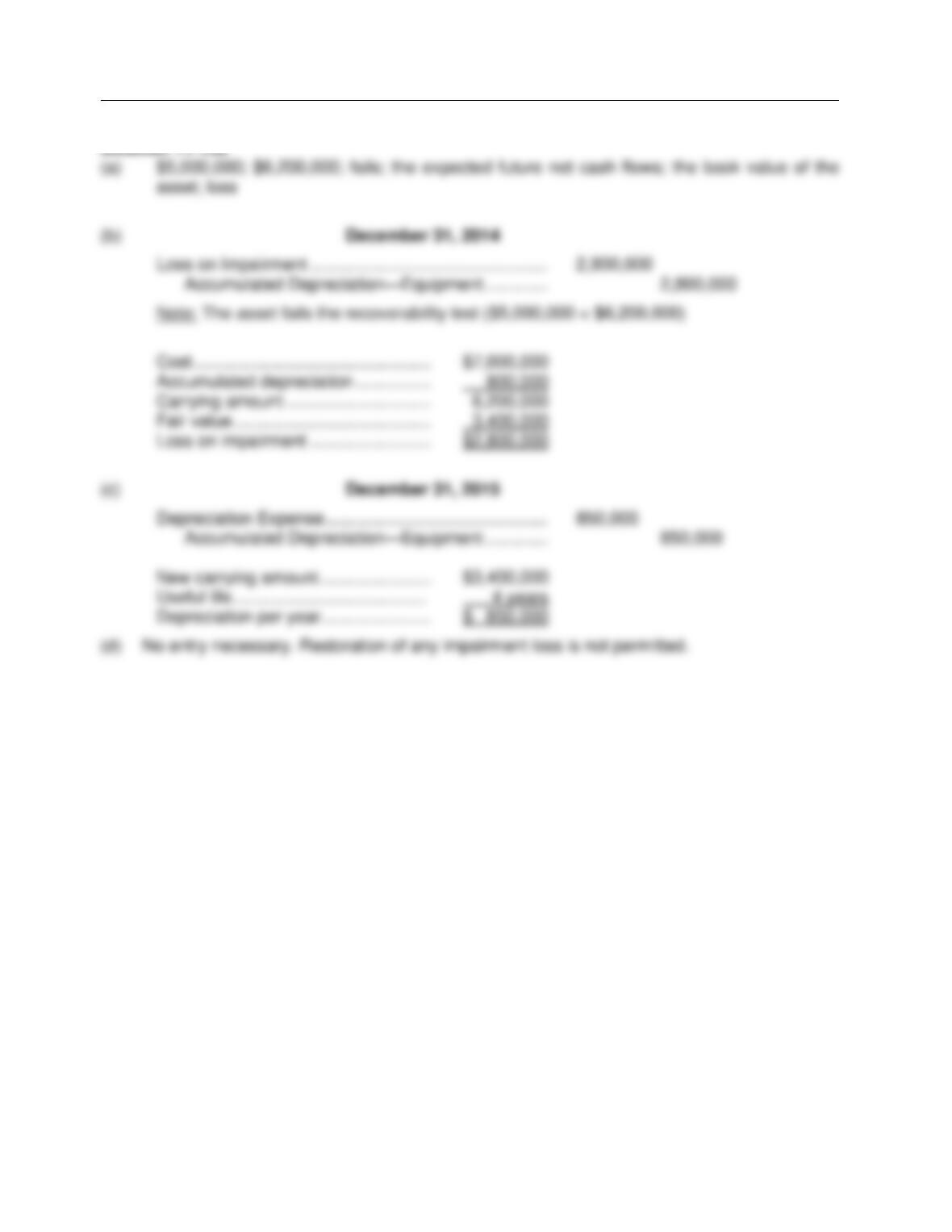
Presented below is information related to equipment owned by Porto Company at December 31,
2014.
Cost $7,000,000
Accumulated depreciation to date 800,000
Expected future net cash flows 5,000,000
Fair value 3,400,000
Assume that Porto will continue to use this asset in the future. As of December 31, 2014, the
equipment has a remaining useful life of 4 years.
Instructions
(a) For Porto company, the recoverability test compares $______ to $______. As a result, the
asset ______ the recoverability test, because ______ is/are less than ______ so a ______ on
impairment is recorded in 2014.
(b) Prepare the journal entry (if any) to record the impairment of the asset at December 31, 2014.
(c) Prepare the journal entry to record depreciation expense for 2015.
(d) The fair value of the equipment at December 31, 2015 is $4,100,000. Prepare the journal
entry (if any) necessary to record this increase in fair value.
Test Bank for Intermediate Accounting, Fifteenth Edition
11 – 40
Pr. 11-137—Impairment.
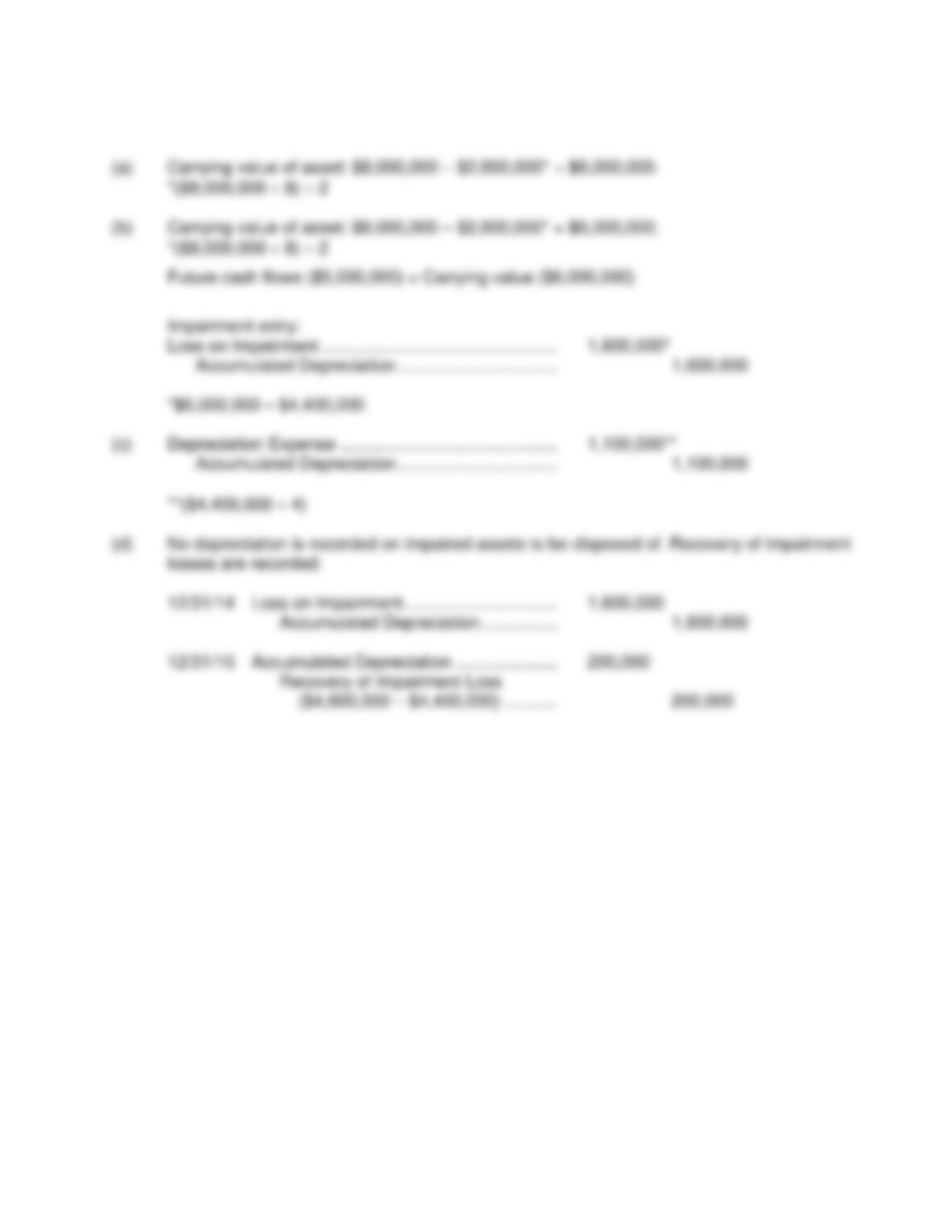
Dolphin Company uses special strapping equipment in its packaging business. The equipment
was purchased in January 2013 for $8,000,000 and had an estimated useful life of 8 years with
no salvage value. At December 31, 2014, new technology was introduced that would accelerate
the obsolescence of Dolphin’s equipment. Dolphin’s controller estimates that expected future net
cash flows on the equipment will be $5,000,000 and that the fair value of the equipment is
$4,400,000. Dolphin intends to continue using the equipment, but it is estimated that the
remaining useful life is 4 years. Dolphin uses straight-line depreciation.
Instructions
(a) What is the carrying value of the asset?
(b) Prepare the journal entry (if any) to record the impairment at December 31, 2014.
(c) Prepare any journal entries for the equipment at December 31, 2015. The fair value of the
equipment at December 31, 2015, is estimated to be $4,600,000.
(d) Repeat the requirements for (a) and (b), assuming that Dolphin intends to dispose of the
equipment and that it has not been disposed of as of December 31, 2015.
Depreciation, Impairments, and Depletion
11 – 41
Solution 11-137
Test Bank for Intermediate Accounting, Fifteenth Edition
11 – 42
IFRS QUESTIONS
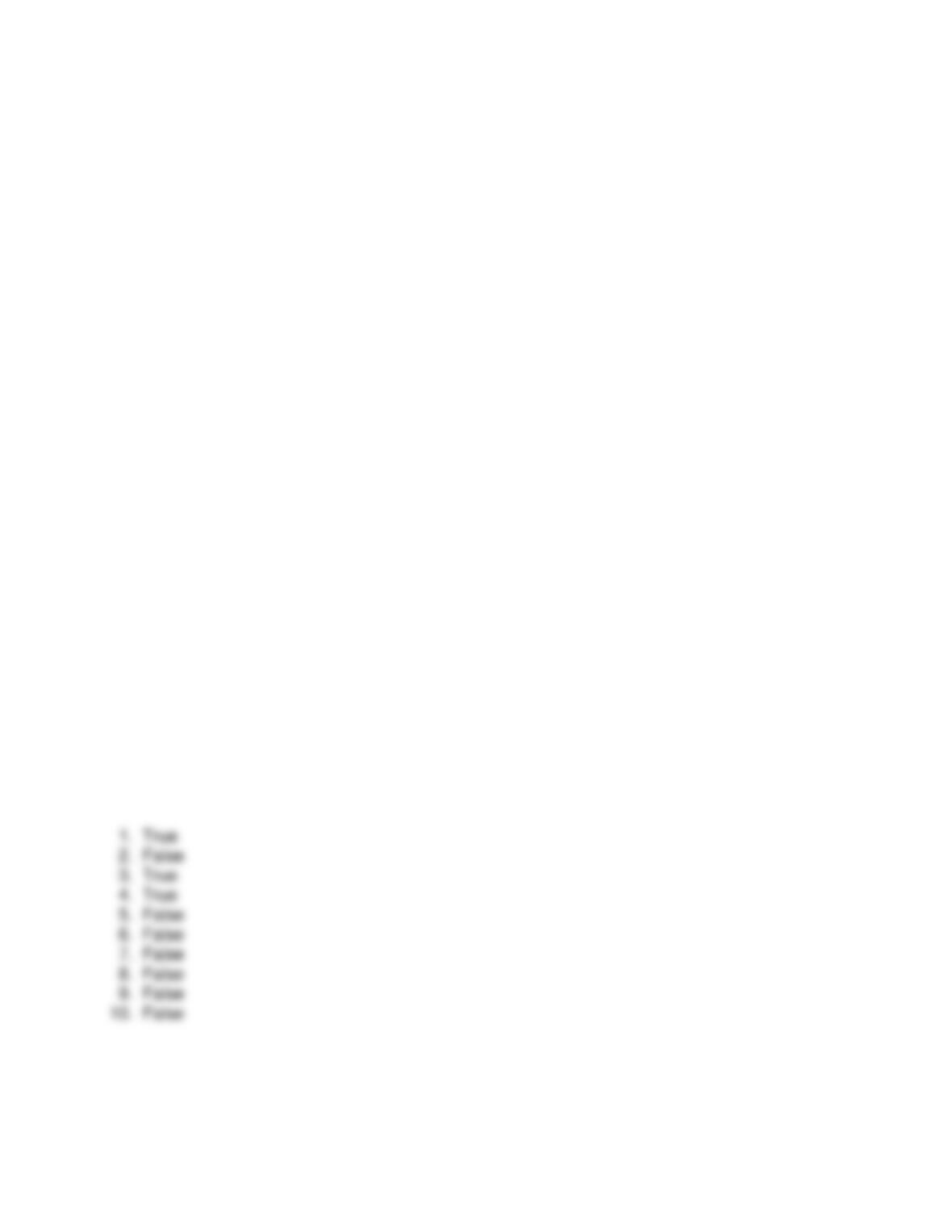
True / False
1. Under both IFRS and U.S. GAAP, interest costs incurred during construction must be
capitalized.
2. As with U.S. GAAP, IFRS requires that both direct and indirect costs in self-constructed
assets be capitalized.
3. IFRS, like U.S. GAAP, capitalizes all direct costs in self-constructed assets.
4. Even though IFRS does not employ the first-stage recoverability test used under U.S.
GAAP − comparing the undiscounted cash flows to the carrying amount, the fact that
IFRS uses a fair value test to measure impairment loss makes IFRS stricter than U.S.
GAAP
5. U.S. GAAP, like IFRS, permits write-up for subsequent recoveries of impairment, back up
to the original amount before the impairment in all circumstances.
6. Unlike U.S. GAAP, interest costs incurred during construction are not capitalized under
IFRS.
7. Asset revaluations are permitted under IFRS and U.S. GAAP.
8. In general, IFRS adheres to very different principles than U.S. GAAP.
9. U.S. GAAP, per SFAS No. 153, now requires that gains on exchanges of nonmonetary
assets be recognized if the exchange lacks commercial substance.
10. IFRS permits the same depreciation methods as U.S GAAP, with the exception of the
units-of-production method, which is not allowed under IFRS.
Answers to True / False questions

Depreciation, Impairments, and Depletion
11 – 43
Multiple-Choice Questions
1. IFRS uses a fair value test to measure impairment loss. However, IFRS does not use the
first-stage recoverability test under U.S. GAAP − comparing the undiscounted cash flow to
the carrying amount. As a result, the IFRS test is
a. not as strict as U.S. GAAP.
b. more strict than U.S. GAAP.
c. essentially the same strictness as U.S. GAAP.
d. None of the above.
2. Acceptable depreciation methods under IFRS include
a. Straight-line.
b. Accelerated.
c. Units-of-production.
d. All of these answers are correct.
3. The primary IFRS related to property, plant and equipment is found in
a. IAS 1 and IAS 34.
b. IAS 11 and IAS 17.
c. IAS 16 and IAS 23.
d. IAS 27 and IAS 39.
4. The accounting exchanges of nonmonetary assets has recently converged between IFRS
and U.S. GAAP, per SFAS No. 153, now requires
a. that gains on exchanges of nonmonetary assets be recognized if the exchange has
commercial substance.
b. that gains on exchanges of nonmonetary assets be recognized if the exchange does
not have commercial substance.
c. that gains on exchanges of nonmonetary assets be recognized if the exchange does
not have commercial substance, and has never been impaired.
d. All of the above.
5. In measuring an impairment loss, IFRS uses
a. undiscounted cash flows.
b. discounted cash flows.
c. a fair value test.
d. a replacement value test.
6. IFRS permits companies to carry assets at historical cost or use a revaluation model for
fixed assets. According to IAS 16, if revaluation is used:
1. it must be applied to all assets in a class of assets.
2. assets must be revalued on an annual basis.
3. assets must be depreciated on the straight-line basis.
4. salvage values must be zero.
a. 1 is correct
b. 2 is correct
c. 1 and 2 are correct
d. All of these answers are correct

Test Bank for Intermediate Accounting, Fifteenth Edition
11 – 44
Questions 7 through 10 are based on the following information:
Tongas Company applies revaluation accounting to plant assets with a carrying value of
$1,600,000, a useful life of 4 years, and no salvage value. Depreciation is calculated on the
straight-line basis. At the end of year 1, independent appraisers determine that the asset has a
fair value of $1,500,000.
7. The journal entry to record depreciation for year one will include a
a. debit to Accumulated Depreciation for $400,000.
b. debit to Depreciation Expense for $100,000.
c. credit to Accumulated Depreciation for $100,000.
d. debit to Depreciation Expense for $400,000.
8. The journal entry to adjust the plant assets to fair value and record revaluation surplus in
year one will include a
a. debit to Accumulated Depreciation for $100,000.
b. credit to Depreciation Expense for $300,000.
c. credit to Plant Assets for $300,000.
d. credit to Revaluation Surplus for $300,000.
9. The financial statements for year one will include the following information
a. Accumulated depreciation $400,000.
b. Depreciation expense $100,000.
c. Plant assets $1,500,000.
d. Revaluation surplus $100,000.
10. The entry to record depreciation for this same asset in year two will include a
a. debit to Accumulated Depreciation for $400,000.
b. debit to Depreciation Expense for $500,000.
c. credit to Accumulated Depreciation for $300,000.
d. debit to Depreciation Expense for $400,000.
Answers to multiple choice:
Depreciation, Impairments, and Depletion
11 – 45
Short Answer:
1. Briefly describe some of the similarities and differences between U.S. GAAP and IFRS with
respect to the accounting for property, plant, and equipment.
2. At a recent executive committee meeting, the controller for Marx Company remarked, “With
only a single key difference between U.S. GAAP and IFRS for property, plant, and
equipment, it should be smooth sailing for the FASB and IASB to converge their standards in
this area.” Prepare a response to the controller.

Test Bank for Intermediate Accounting, Fifteenth Edition
11 – 46