Test Bank – Chapter 11 – Long-Term Liabilities: Notes, Bonds, and Leases 11-33
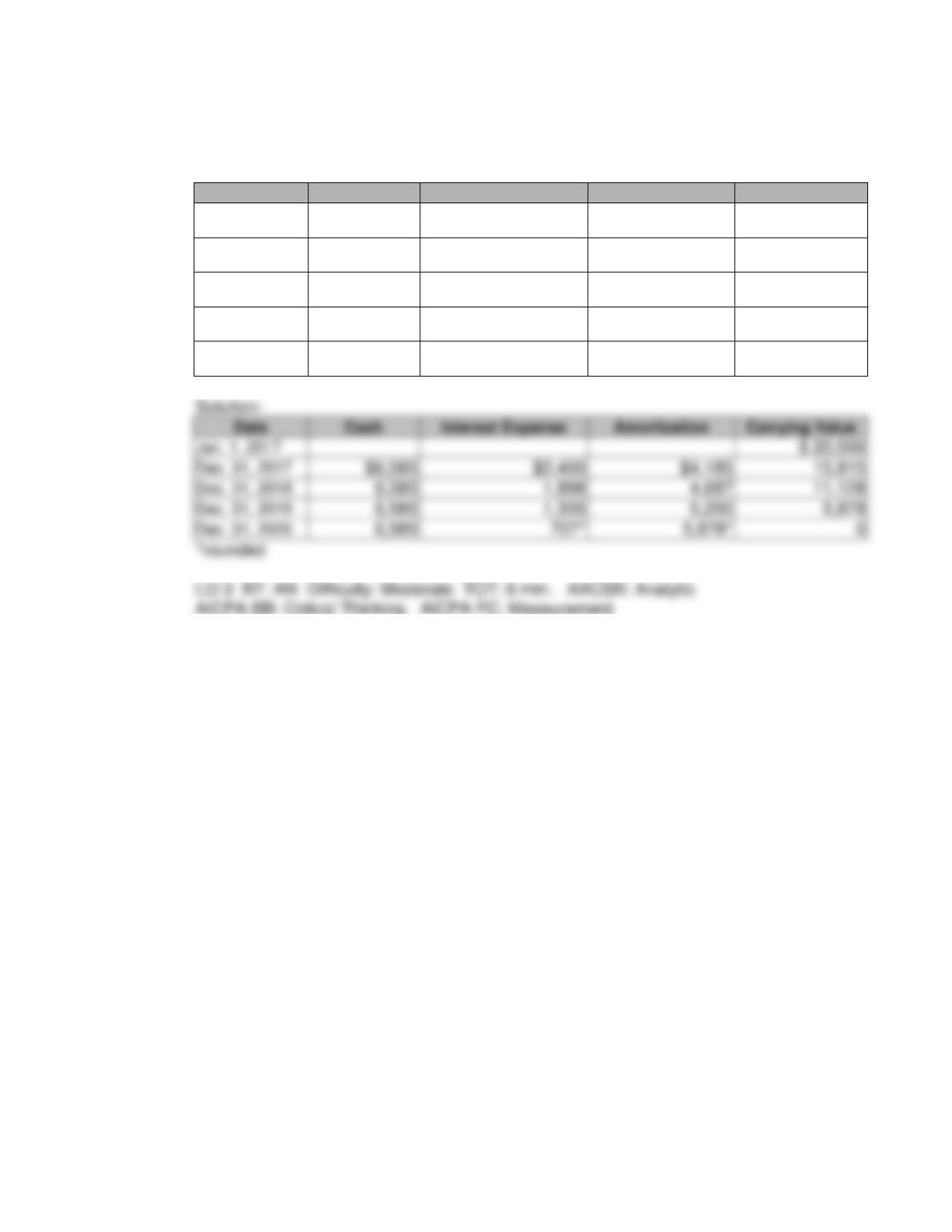
26. On January 1, 2017, Jackson Corporation issued a 4-year, 12%, $20,000 installment
note payable. The payment on this note is $6,585 and is paid annually at year-end
beginning December 31, 2017. Complete the following amortization schedule.
Date
Cash
Interest Expense
Amortization
Carrying Value
Jan. 1, 2017
Dec. 31, 2017
Dec. 31, 2018
Dec. 31, 2019
Dec. 31, 2020
Date
Cash
Interest Expense
Amortization
Carrying Value
11–34 Test Bank – Chapter 11 – Long-Term Liabilities: Notes, Bonds, and Leases
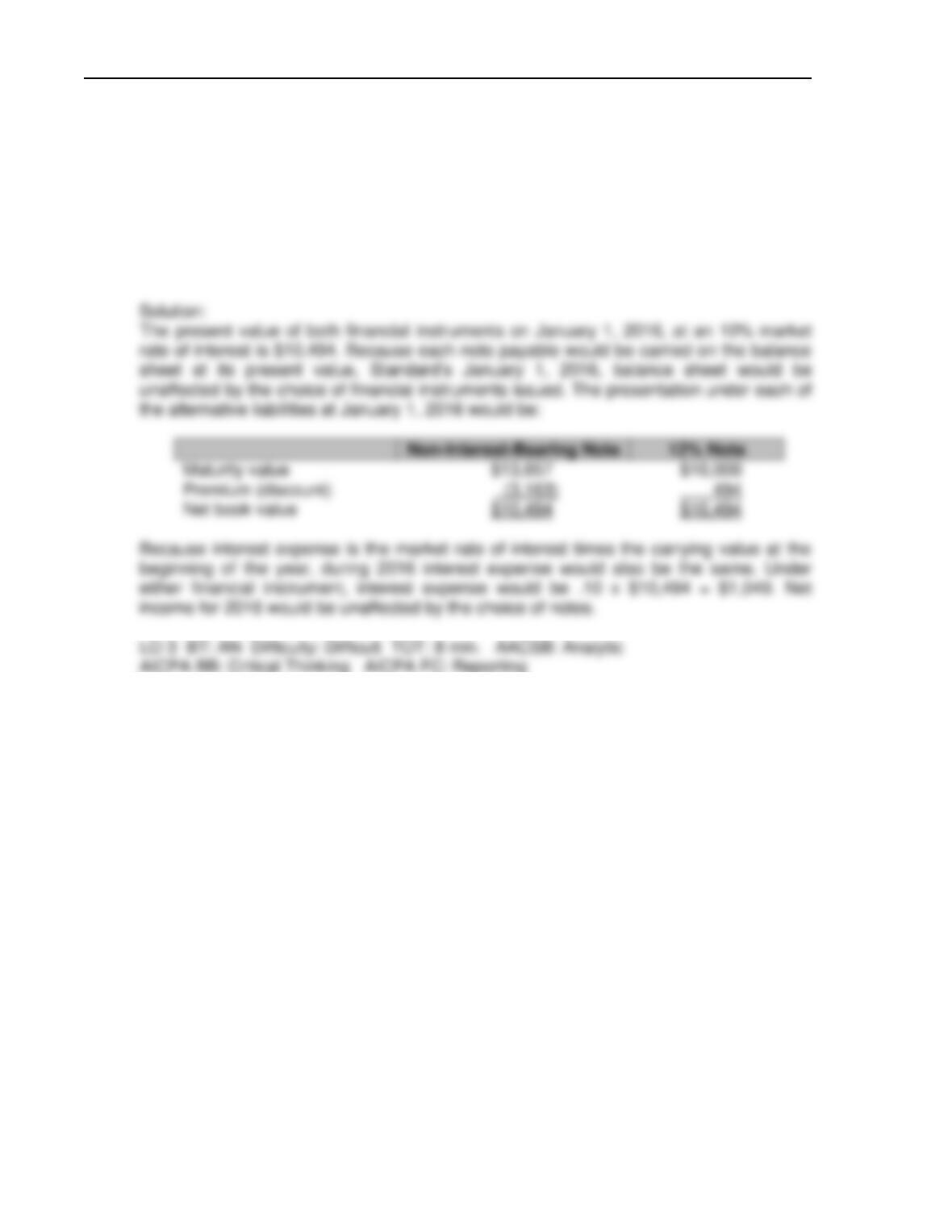
27. On January 1, 2016, Standard Incorporated is going to issue long-term debt in order to
obtain money required to finance the purchase of equipment. It will have to pay a market
rate of interest of 10% on this borrowed money. Standard is considering two different
financial instruments in order to obtain $10,494. The first instrument being considered is
a 3-year, 12%, $10,000 note with interest payable every December 31 over the life of the
note. Alternatively, a 3-year, non-interest-bearing note with maturity value of $13,657 will
be issued. Show how Standard’s January 1, 2016 balance sheet and 2016 income
statement will differ if Standard chooses to issue the non-interest-bearing note instead of
the 10% note.
Test Bank – Chapter 11 – Long-Term Liabilities: Notes, Bonds, and Leases 11-35
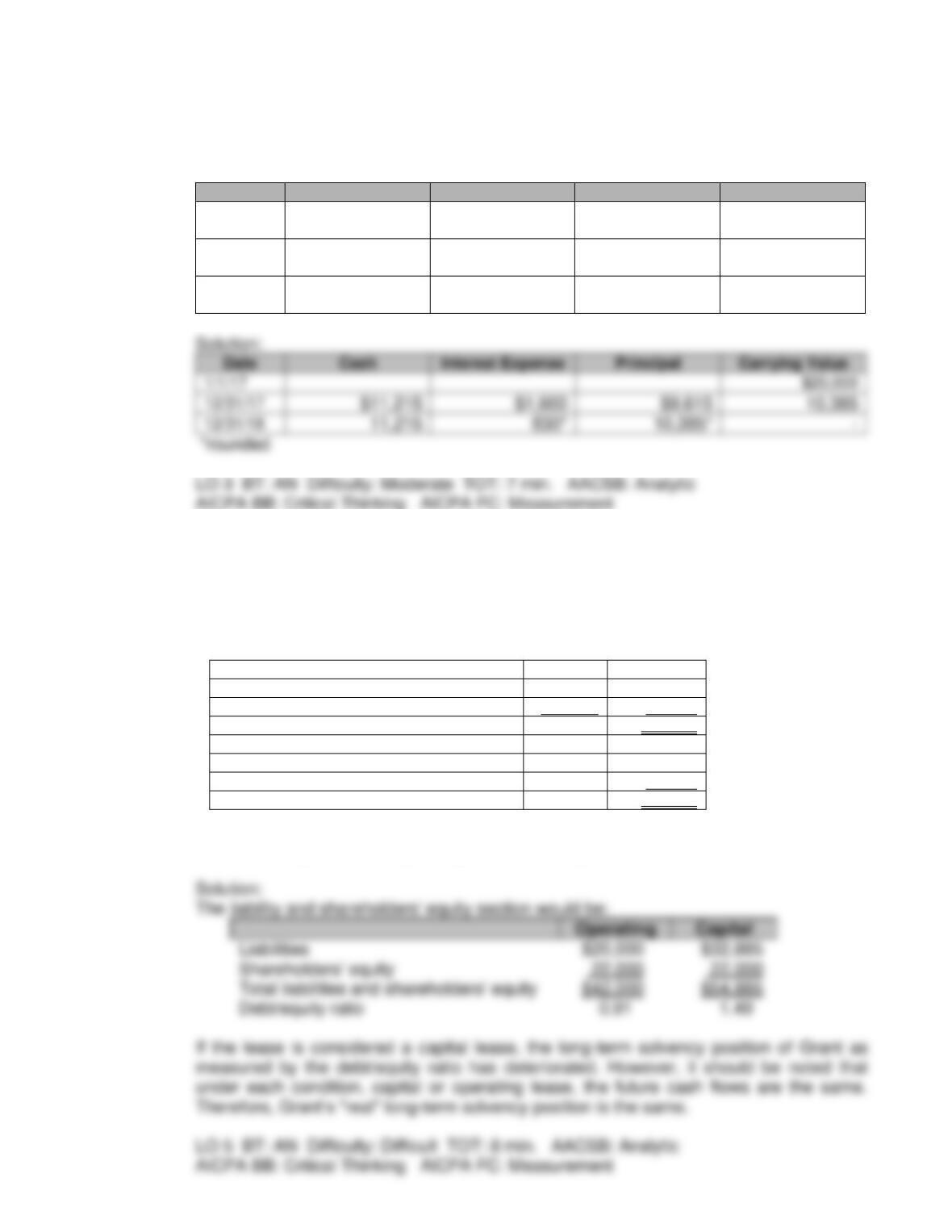
28. On January 1, 2017, Gee Company issued a 2-year, 8%, $20,000 installment note
payable. The payment on this note is $11,215 and is paid annually at year-end
beginning December 31, 2017. When the note was issued, the market rate of interest
was 8%. Complete the following amortization schedule.
Date
Cash
Interest Expense
Principal
Carrying Value
1/1/17
12/31/17
12/31/18
29. On January 1, 2016, Grant Company leased telephone equipment from Xu, Inc. Grant
uses straight-line depreciation. The contract requires Grant to pay $5,000 each
December 31 for the next three years, at which time the equipment is to be returned to
Xu. Using an interest rate of 8%, the present value of the lease payments is $12,885.
The following is Grant’s January 1, 2016, balance sheet before the lease agreement.
Current assets
$20,000
Equipment
$25,000
Accumulated depreciation
(3,000)
22,000
Total assets
$42,000
Liabilities
$20,000
Shareholders’ equity
22,000
Total liabilities and shareholders’ equity
$42,000
Calculate and compare Grant’s debt/equity ratios on January 1, 2016, immediately after
the lease is signed, as an operating lease and a capital lease.
Date
Cash
Interest Expense
Principal
Carrying Value
11–36 Test Bank – Chapter 11 – Long-Term Liabilities: Notes, Bonds, and Leases
Use the table below to answer the problems 30 through 33.
Jan. 1, 2016
$36,021
Dec. 31, 2016
$2,400
3,602
1,202
37,223
Dec. 31, 2017
2,400
3,722
1,322
38,545
Dec. 31, 2018
2,400
3,855
1,455
40,000
30. What is the nature of the table presented? What is being amortized?
Solution:
31. Were the bonds issued at a discount or premium? How do you know?
Solution:
32. Determine the coupon rate of interest on the bonds. What does this amount represent?
Solution:
33. Calculate the effective interest rate on these bonds. Why is this amount different than
the coupon rate?
Test Bank – Chapter 11 – Long-Term Liabilities: Notes, Bonds, and Leases 11-37
34. On January 1, 2016, Foresite Corporation issued a 10-year, 9%, $100,000 installment
note payable. The payment on this note is $15,582 and is paid annually at year-end
beginning December 31, 2016. How much total interest is paid over the loan period?
35. On January 1, 2016, Justin Corp. leased equipment under a five-year lease with
payments of $20,000 on each December 31 of the lease period. The present value of
the lease payments is $77,800, using a market interest rate of 9%. Justin depreciates its
equipment straight-line over 5 years with zero salvage value. The capital lease criteria
are met. Calculate depreciation expense for 2016.
36. On January 1, 2016, Denver Company leased equipment under a 5-year lease with
payments of $5,000 on each December 31 of the lease term. The present value of the
lease payments at a discount rate of 12% is $18,024. If the lease is considered a capital
lease, what is the book value of the lease obligation on January 1, 2017?
11–38 Test Bank – Chapter 11 – Long-Term Liabilities: Notes, Bonds, and Leases
37. Crawford Company conducts a lottery system for Mississippi. The agreement specifies
that the lottery must be conducted on a not-for-profit basis. Crawford’s monthly sales of
lottery tickets amounts to $1,400,000. Monthly operating expenses are $400,000,
including a management charge of $30,000. The payment schedule for the guaranteed
$1 million dollar payout for a winning lottery ticket is $100,000 immediately and $100,000
each year for the next 9 years. Crawford produced the following income statement as
evidence of its not-for-profit status:
Ticket sales
$1,400,000
Expenses:
Payout expense
$1,000,000
Operating expenses
400,000
1,400,000
Net income
$ 0
A. If the market rate of interest is 4%, determine the present value of the $900,000
liability arising from the monthly winning lottery ticket.
B. Recalculate the income statement to reflect GAAP measurement of payout expense.
38. On January 1, 2017, Holly Company leased telephone equipment from ICON, Inc.
Straight-line depreciation is used on all equipment with no salvage value. The contract
required Holly to pay $5,000 each December 31 for the next three years, at which time
the equipment is to be returned to ICON. Using an effective rate of interest of 8%, the
present value of the lease payments is $12,885. Numerically derive the difference in
Holly’s 2017 income if the lease is treated as an operating lease instead of a capital
lease.
Ticket sales
Expenses:
Payout expense ($743,533 + $100,000)
Operating expenses
Net income
Test Bank – Chapter 11 – Long-Term Liabilities: Notes, Bonds, and Leases 11-39
39. On January 1, 2017, Everton Company leased equipment under a 3-year lease with
payments of $10,000 on January 1, 2017, 2018, and 2019. The present value of the
lease payments at a discount rate of 9% is $27,591, which includes the immediate cash
payment on January 1, 2017. If the lease is considered an operating lease, how much is
rent expense for 2017?
SHORT ESSAY QUESTIONS
1. Branson Incorporated is considering leasing equipment. It can either lease the
equipment for five or ten years. The five-year lease allows Branson to classify the lease
as an operating lease. However, the ten-year lease requires Branson to classify the
lease as a capital lease. Branson is operating under a debt covenant that sets a
maximum on its debt/equity ratio. If Branson is close to violating this debt covenant,
which lease contract would you advise Branson to sign? Why?
11–40 Test Bank – Chapter 11 – Long-Term Liabilities: Notes, Bonds, and Leases
2. Felton Incorporated is considering leasing equipment. It can either lease that equipment
for five or ten years with the same annual lease payments under either agreement. The
five-year lease allows Felton to classify the lease as an operating lease. However, the
ten-year lease requires Felton to classify the lease as a capital lease. If Felton desires to
measure net income higher in the initial year of the lease agreement, which lease
contract would you advise Felton to sign? Why?
3. Distinguish between an installment obligation and a non-interest-bearing obligation.
4. How do debt covenants impact a company‘s financial position?
5. What is the risk premium of a bond issue and what role does it play in the determination
of bond prices?
Solution:
6. When the effective interest method is used to account for notes, the dollar amount of
interest will increase or decrease throughout the maturity period. Explain why.
11–42 Test Bank – Chapter 11 – Long-Term Liabilities: Notes, Bonds, and Leases
7. What are ‘off-balance sheet risks’? What disclosures are required?
8. Various contractual forms specify additional terms such as collateral. Describe collateral
as it pertains to a company’s debt.
9. Describe the two cash flows associated with bonds.
10. Why might a company redeem bonds before they mature?
Test Bank – Chapter 11 – Long-Term Liabilities: Notes, Bonds, and Leases 11-43
11. How does the balance between debt and equity in non-U.S. companies compare to the
balance of debt and equity in U.S. companies?
12. Describe the relationship between the stated rate of interest and the effective rate of
interest as it relates to bonds.
11–44 Test Bank – Chapter 11 – Long-Term Liabilities: Notes, Bonds, and Leases
13. Why are some types of leases recorded as purchases?
14. How does an investor’s required rate of return affect investing decisions?
15. How do changes in market interest rates lead to misstated balance sheet values for
long-term debt?