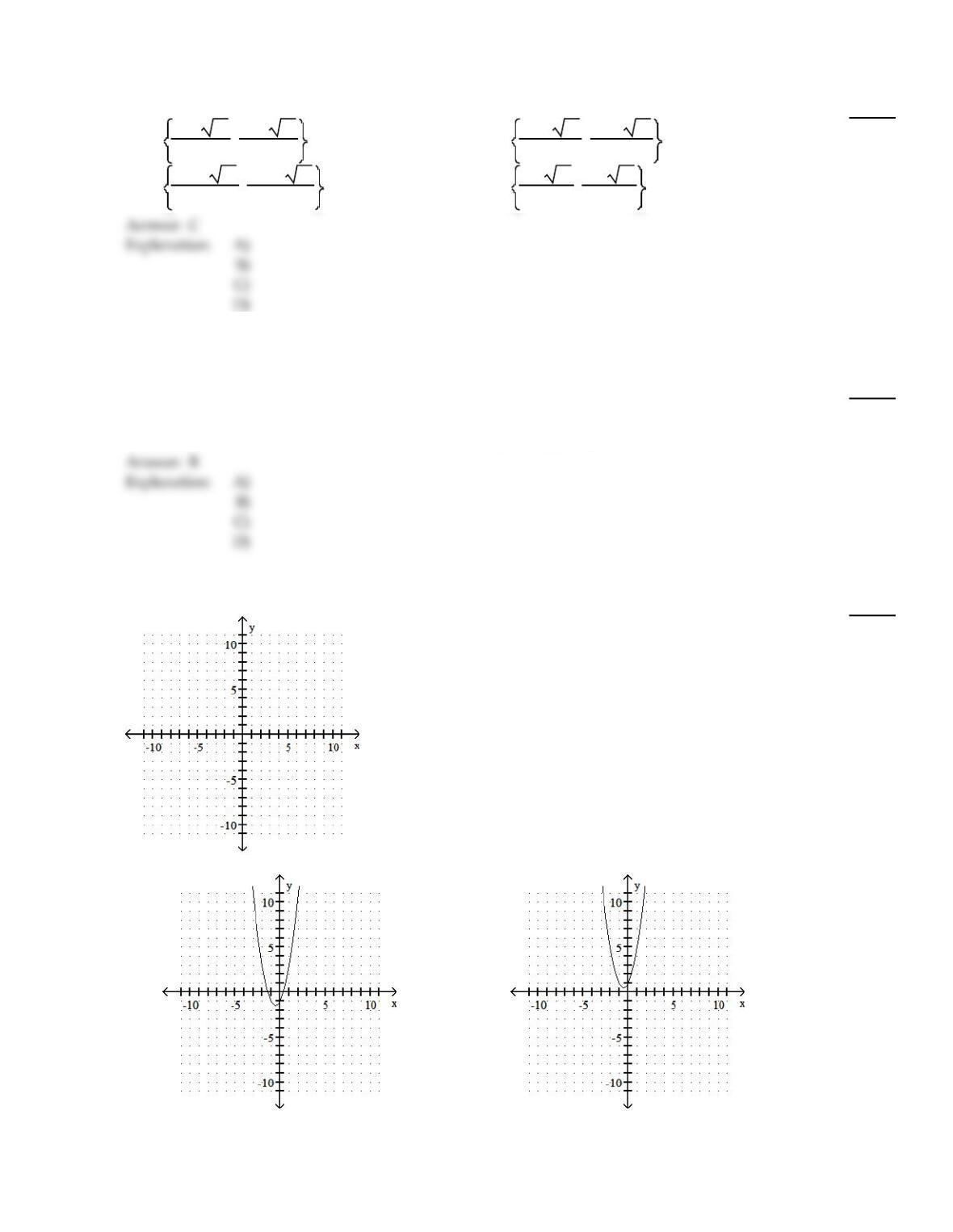
Use the quadratic formula to solve the equation.
121)
2x2= – 5x – 7
121)
A)
5 + i 31
4, 5 – i 31
4
B)
–5 +31
4, –5 –31
4
C)
–5 + i 31
4, –5 – i 31
4
D)
5 +31
4, 5 –31
4
Use the discriminant to determine if the equation can be solved by factoring. If the equation can be solved by factoring,
then factor it.
122)
7k2=3k – 2
122)
A)
(k + 1)(k – 3) = 0
B)
Cannot be solved by factoring
C)
(k –1.4)2= 0
D)
(k + 2)(k – 7) = 0
Graph the parabola.
123)
f(x) =2x2+ 2x – 1
123)
A)
B)
41
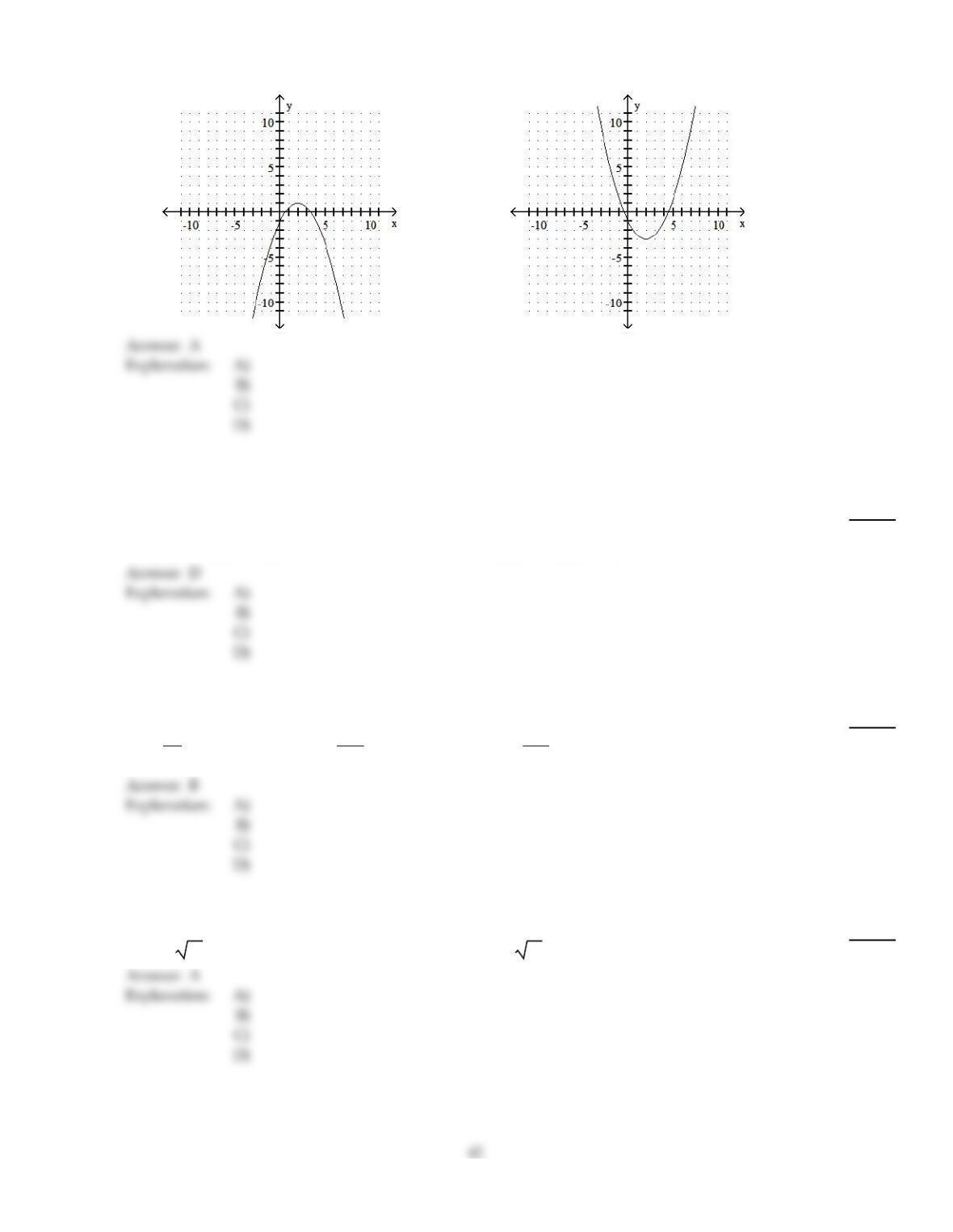
C)
D)
Use the discriminant to determine if the equation can be solved by factoring. If the equation can be solved by factoring,
then factor it.
124)
40m2– 9m – 9 = 0
124)
A)
(40m + 3)(m + 3) = 0
B)
Cannot be solved by factoring
C)
(8m – 3)(5m + 3) = 0
D)
(5m – 3)(8m + 3) = 0
D
Find the value of k so that the equation will have exactly one rational solution.
125)
2x2+ 11x + k = 0
125)
A)
1
11
B)
121
8
C)
–121
8
D)
None
B
Solve the equation by using the square root property. Simplify all radicals.
126)
y2=22
126)
A)
{±22}
B)
{484}
C)
{22}
D)
{±11}
A
A
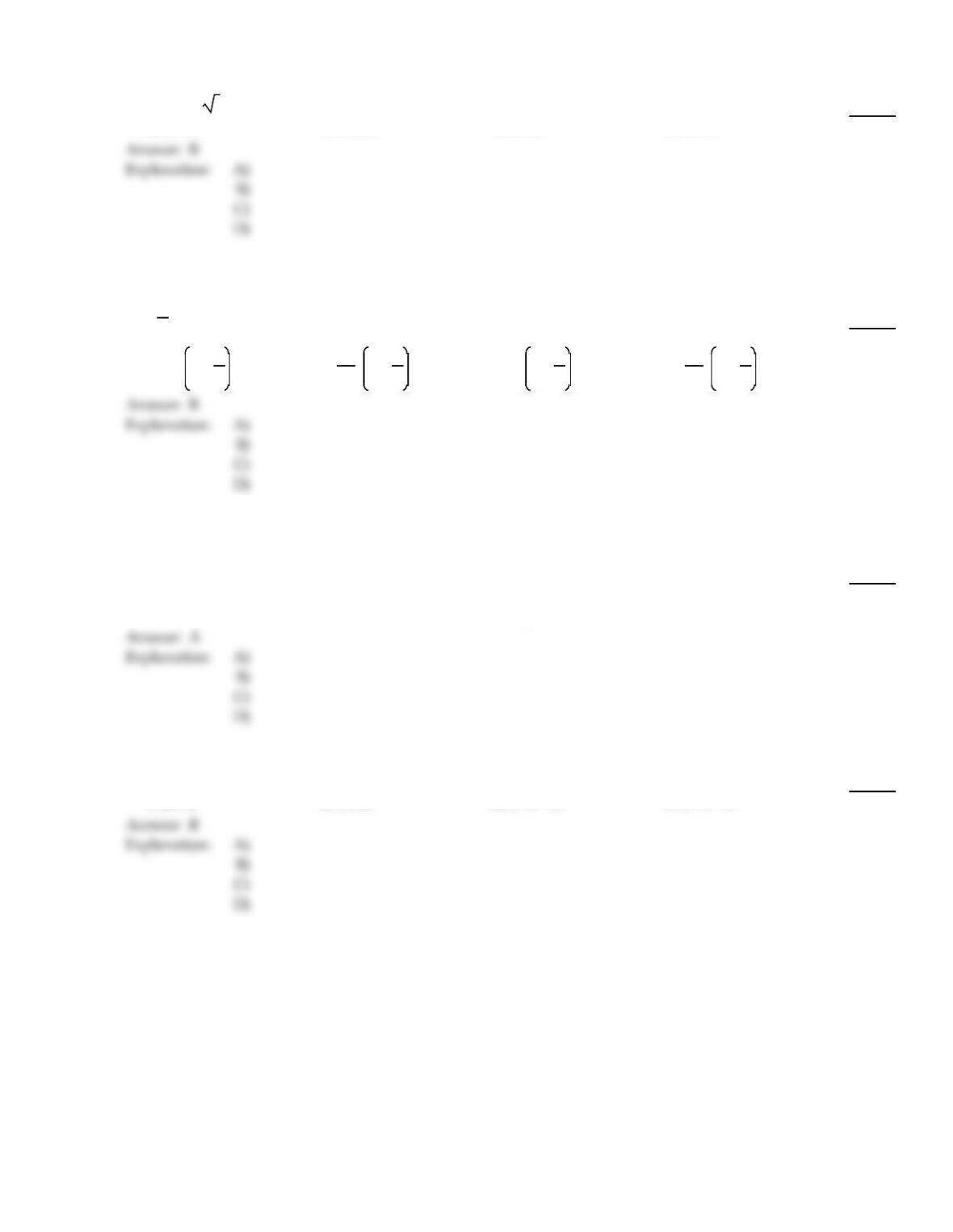
Solve the equation.
127)
s =512 + 16 s
127)
A)
{2048}
B)
{1024}
C)
{512}
D)
{768}
Find the term that should be added to the expression to form a perfect square trinomial. Write the resulting perfect square
trinomial in factored form.
128)
x2+2
9x +
128)
A)
81; x +1
9
2
B)
1
81 ; x +1
9
2
C)
0; x –1
9
2
D)
1
81 ; x –1
9
2
For the quadratic function, tell whether the graph opens up or down and whether the graph is wider, narrower, or the
same shape as the graph of f(x) =x2.
129)
f(x) =9x2– 8
129)
A)
Up; narrower
B)
Down; narrower
C)
Down; wider
D)
Up; wider
Find the vertex of the parabola.
130)
f(x) =3x2– 18x + 32
130)
A)
(5, 3)
B)
(3, 5)
C)
(–5, –3)
D)
(–3, –5)
43
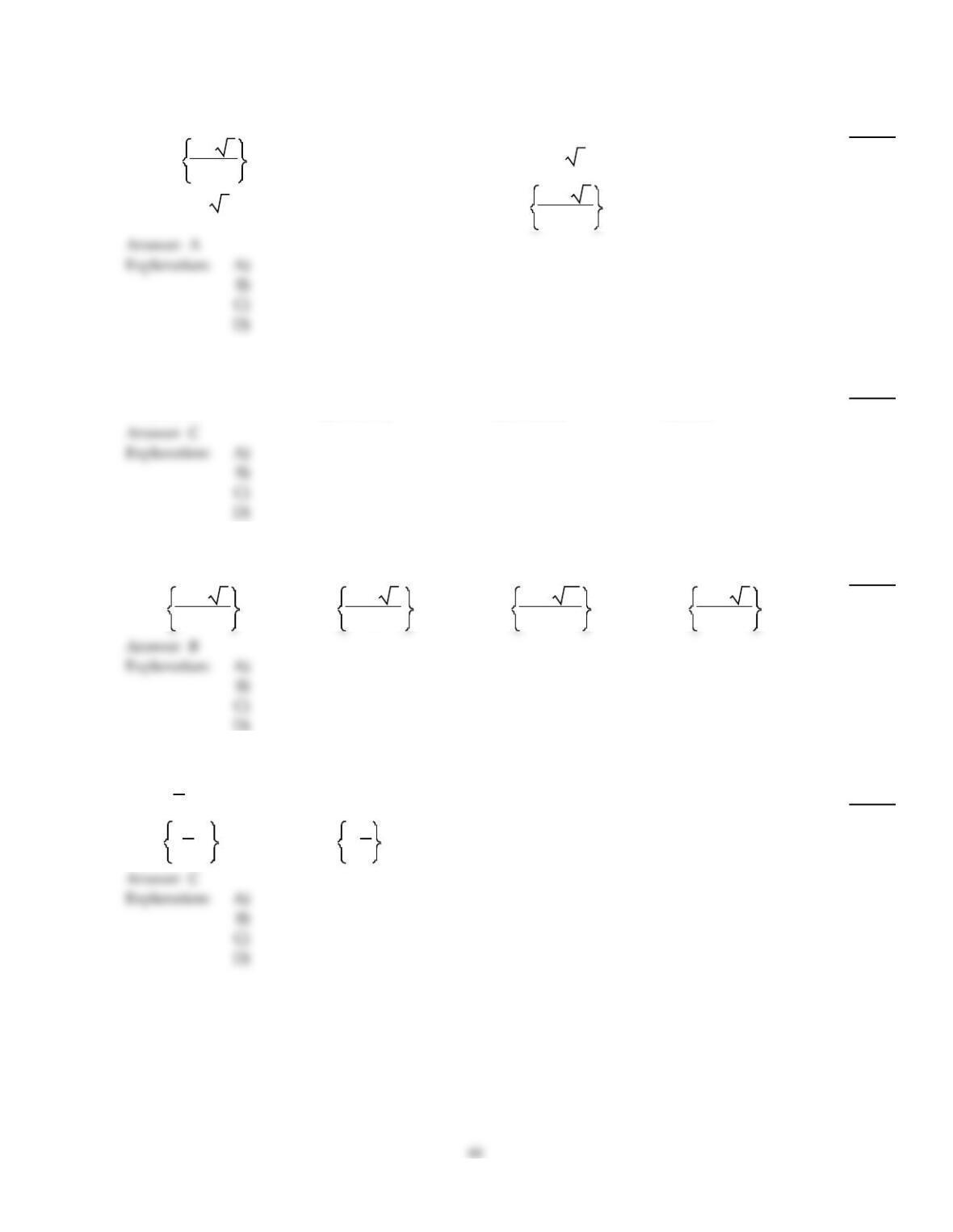
Solve the equation by completing the square. Then (i) give the exact solutions and (ii) give the solutions rounded to the
nearest thousandth.
131)
2x2+3x =1+5x
131)
A)
(i) 1±3
2 (ii) {1.366, –0.366}
B)
(i) {–1±3} (ii) {0.732, –2.732}
C)
(i) {1±3} (ii) {2.732, –0.732}
D)
(i) –1±3
2 (ii) {0.366, –1.366}
Solve the equation by the zero–factor property.
132)
x2+ 3 =147
132)
A)
{73.5}
B)
{–11, 11}
C)
{–12, 12}
D)
{12}
Solve the equation by completing the square.
133)
2x2+ 6x = – 3
133)
A)
–6±3
2
B)
–3±3
2
C)
–3±15
2
D)
–3±3
4
Solve the equation.
134)
x –5=6
x
134)
A)
–1
6, 1
B)
1, 1
6
C)
{–1, 6}
D)
{–6, 1}
Use the discriminant to determine if the equation can be solved by factoring. If the equation can be solved by factoring,
then factor it.
135)
49k2+ 56k + 16 = 0
135)
A)
(7k + 4)2= 0
B)
(7k + 4)(7k – 4) = 0
C)
(49k – 4) = 0
D)
Cannot be solved by factoring
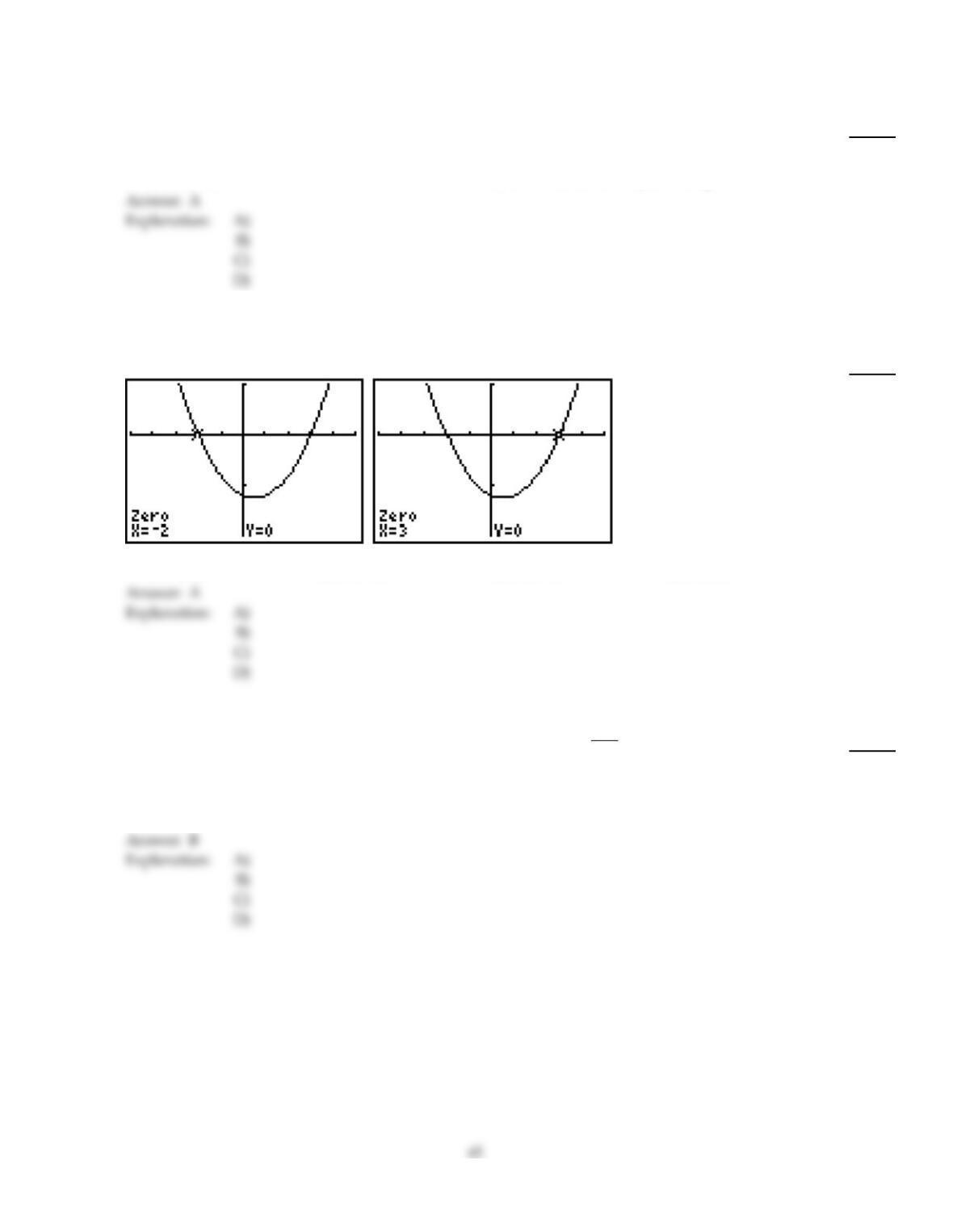
The calculator graphs shows the x–values of the x–intercepts of the graph of the polynomial in the equation. Use the
graphs to solve the equation.
136)
x2–x – 6 = 0
136)
A)
{–2, 3}
B)
{–3, –2}
C)
{–1, –6}
D)
{–3, 2}
A
Solve the problem.
137)
A manufacturer has found that the daily demand for a certain item is 700
p, where p is the price of
the item in dollars. The daily supply is 4p –2. At what price does supply equal demand? Round
your answer to the nearest cent.
137)
A)
$8.62
B)
$13.48
C)
$28.46
D)
$107.85
B
A
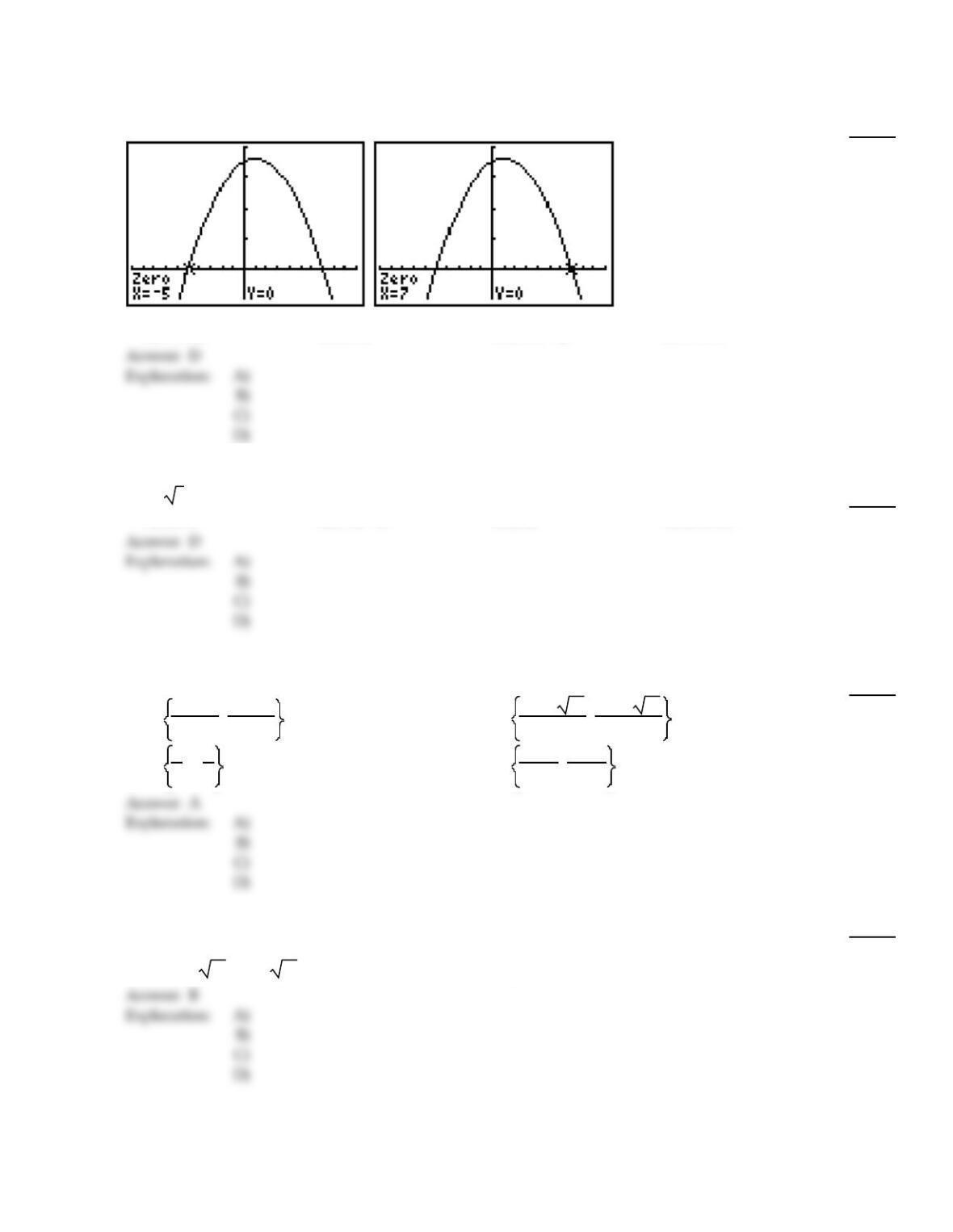
The calculator graphs shows the x–values of the x–intercepts of the graph of the polynomial in the equation. Use the
graphs to solve the equation.
138)
–x2+ 2x + 35 = 0
138)
A)
{–7, 5}
B)
{5, 7}
C)
{–35, –2}
D)
{–5, 7}
Solve the equation.
139)
x –15 x+54 = 0
139)
A)
{6, 9}
B)
{–6, –9}
C)
{36}
D)
{36, 81}
D
Find the nonreal complex solutions of the equation.
140)
–5x2– 4x – 4 = 0
140)
A)
–2 + 4i
5, –2 – 4i
5
B)
–4 + i 64
10 , –4 – i 64
10
C)
2
5, –6
5
D)
2 + 4i
5, 2 – 4i
5
A
141)
x2+ 4x +29 = 0
141)
A)
{2 +5i, 2 –5i}
B)
{–2 +5i, –2 –5i}
C)
{–2 +29i, –2 –29i}
D)
{3, –7}
B
46
D
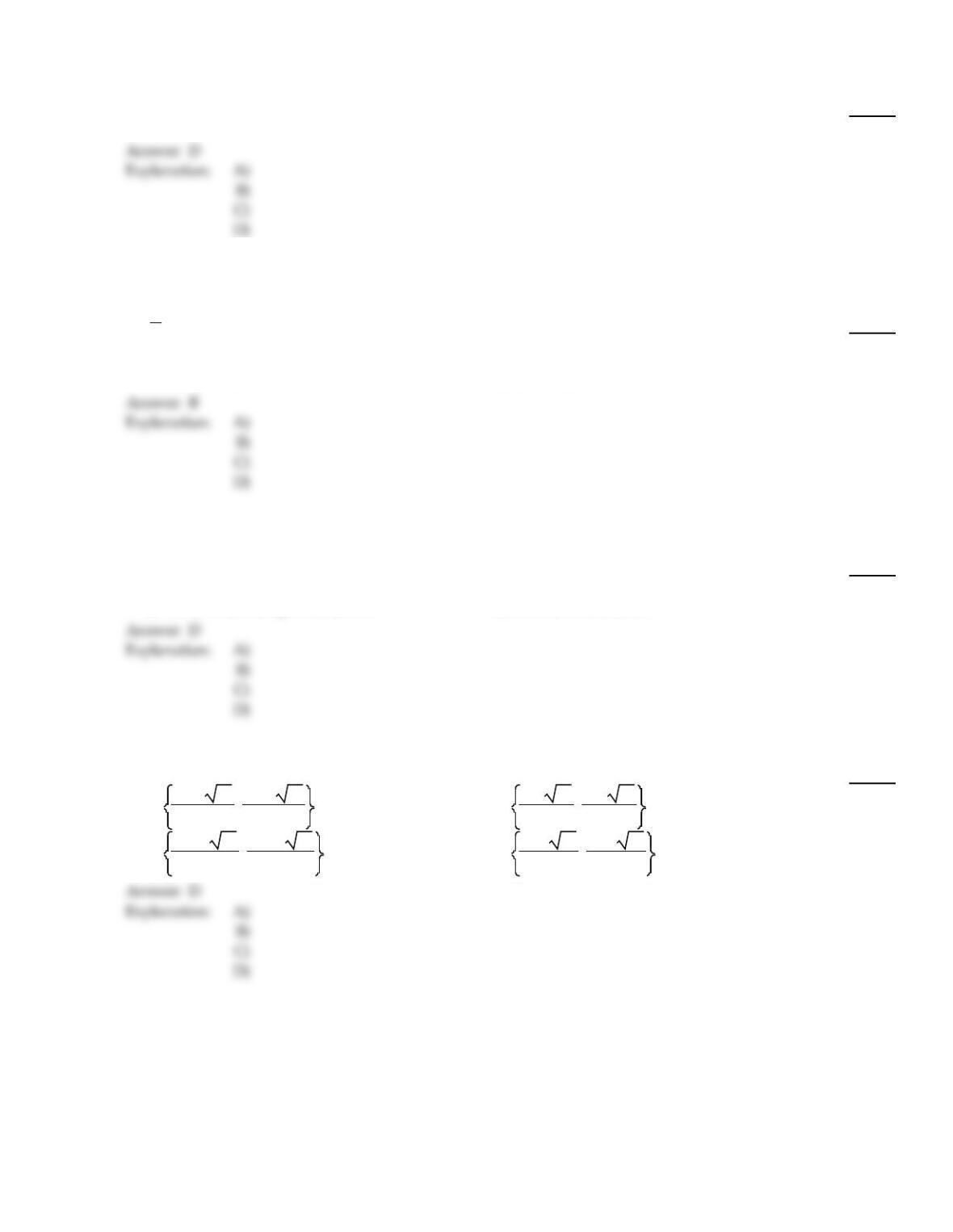
Solve the equation by using the square root property. Simplify all radicals.
142)
(3x + 3)2=36
142)
A)
{13, –13}
B)
{0, 1}
C)
{1, 3}
D)
{1, –3}
Decide whether the graph of the equation opens up, down, to the left, or to the right; and whether it is wider, narrower, or
the same shape as the graph of f(x) =x2 (or x =y2).
143)
x =1
9y2+ 2y – 1
143)
A)
To the right; narrower
B)
To the right; wider
C)
To the left; wider
D)
To the left; narrower
Use the discriminant to determine whether the equation has two rational solutions, one rational solution, two irrational
solutions, or two nonreal complex solutions. Do not actually solve.
144)
16x2+ 8x + 1 = 0
144)
A)
Two rational solutions
B)
Two irrational solutions
C)
Two nonreal complex solutions
D)
One rational solution
Find the nonreal complex solutions of the equation.
145)
2x2– 3x + 6 = 0
145)
A)
–3+39
4, –3–39
4
B)
3+39
4, 3–39
4
C)
–3+ i 39
4, –3– i 39
4
D)
3+ i 39
4, 3– i 39
4
47
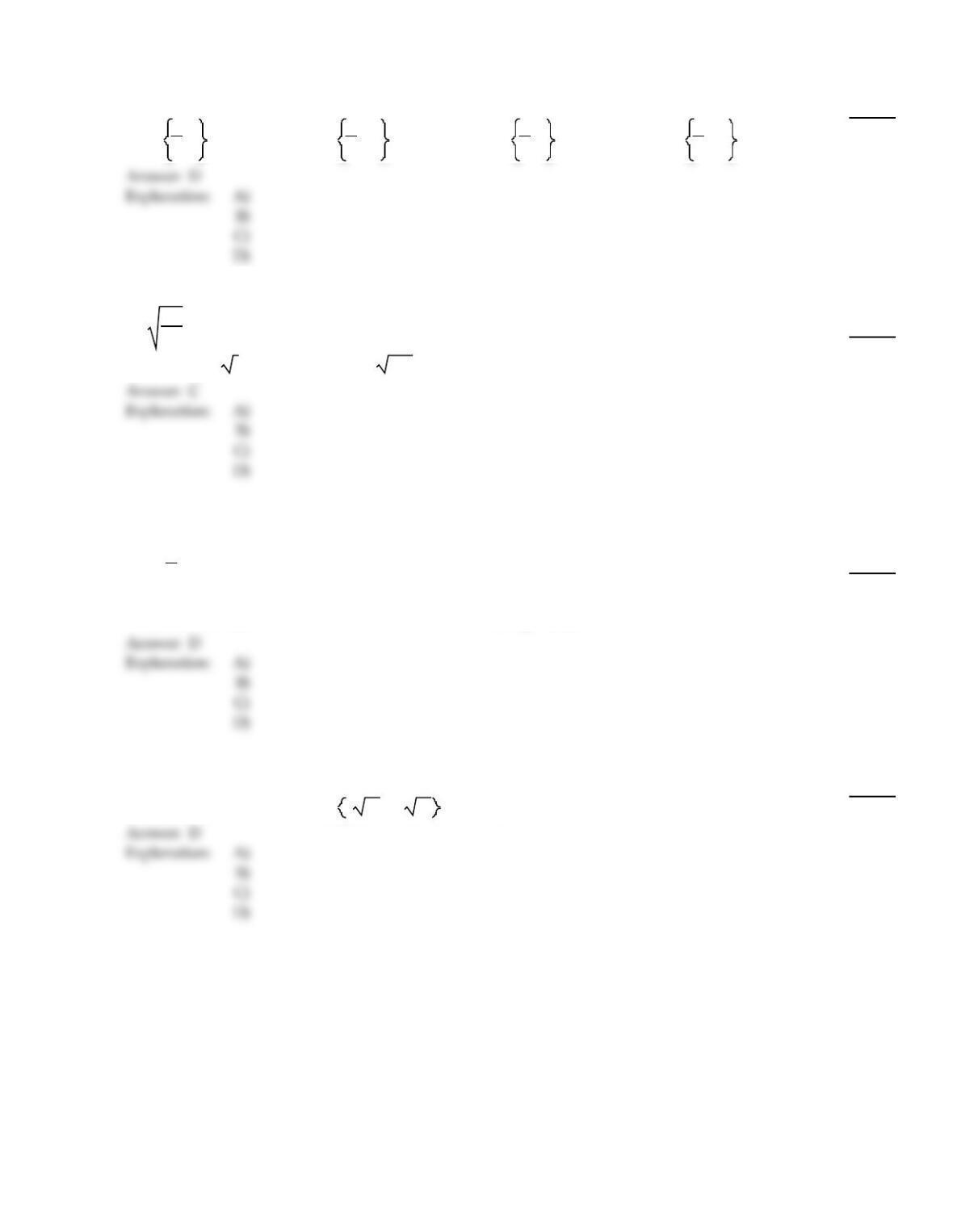
Use the quadratic formula to solve the equation. (All solutions are real numbers.)
146)
4x2– 3x – 7 = 0
146)
A)
4
7, 0
B)
4
7, –1
C)
4
7, 1
D)
7
4, –1
Solve the equation for the indicated variable. (Leave ± in your answer, when appropriate.)
147)
r =A
2 for A
147)
A)
A = ± 2r
B)
A = ± 2r
C)
A = 2r2
D)
A = 2r
For the quadratic function, tell whether the graph opens up or down and whether the graph is wider, narrower, or the
same shape as the graph of f(x) =x2.
148)
f(x) =1
9x2– 5
148)
A)
Down; narrower
B)
Up; narrower
C)
Down; wider
D)
Up; wider
Use the quadratic formula to solve the equation. (All solutions are real numbers.)
149)
a2+ 14a + 40 = 0
149)
A)
{–20, –8}
B)
210, –210
C)
{4, 10}
D)
{–10, –4}
48

Solve the equation by completing the square. Then (i) give the exact solutions and (ii) give the solutions rounded to the
nearest thousandth.
150)
x2=5– 6x
150)
A)
(i) {3+14} (ii) {6.742}
B)
(i) {–1±14} (ii) {2.742, –4.742}
C)
(i) {–3±14} (ii) {0.742, –6.742}
D)
(i) {–3±214} (ii) {4.483}
Solve the problem.
151)
Bob owns a watch repair shop. He has found that the cost of operating his shop is given by
c(x) =2x2– 156x + 63, where x is the number of watches repaired. How many watches must he
repair to have the lowest cost?
151)
A)
31 watches
B)
63 watches
C)
20 watches
D)
39 watches
Solve the problem, if possible. Round your answer to the nearest tenth, when appropriate.
152)
A square has an area of 49 in.2. If the same amount is added to the length and removed from the
width, the resulting rectangle has an area of 45 in.2. Find the dimensions of the rectangle.
152)
A)
4 in. by 9 in.
B)
5 in. by 10 in.
C)
5 in. by 9 in.
D)
Cannot be determined without additional information
Decide whether the graph of the equation opens up, down, to the left, or to the right; and whether it is wider, narrower, or
the same shape as the graph of f(x) =x2 (or x =y2).
153)
f(x) = – x2– 10x – 14
153)
A)
Up; same
B)
Down; narrower
C)
Down; same
D)
Up; narrower
49
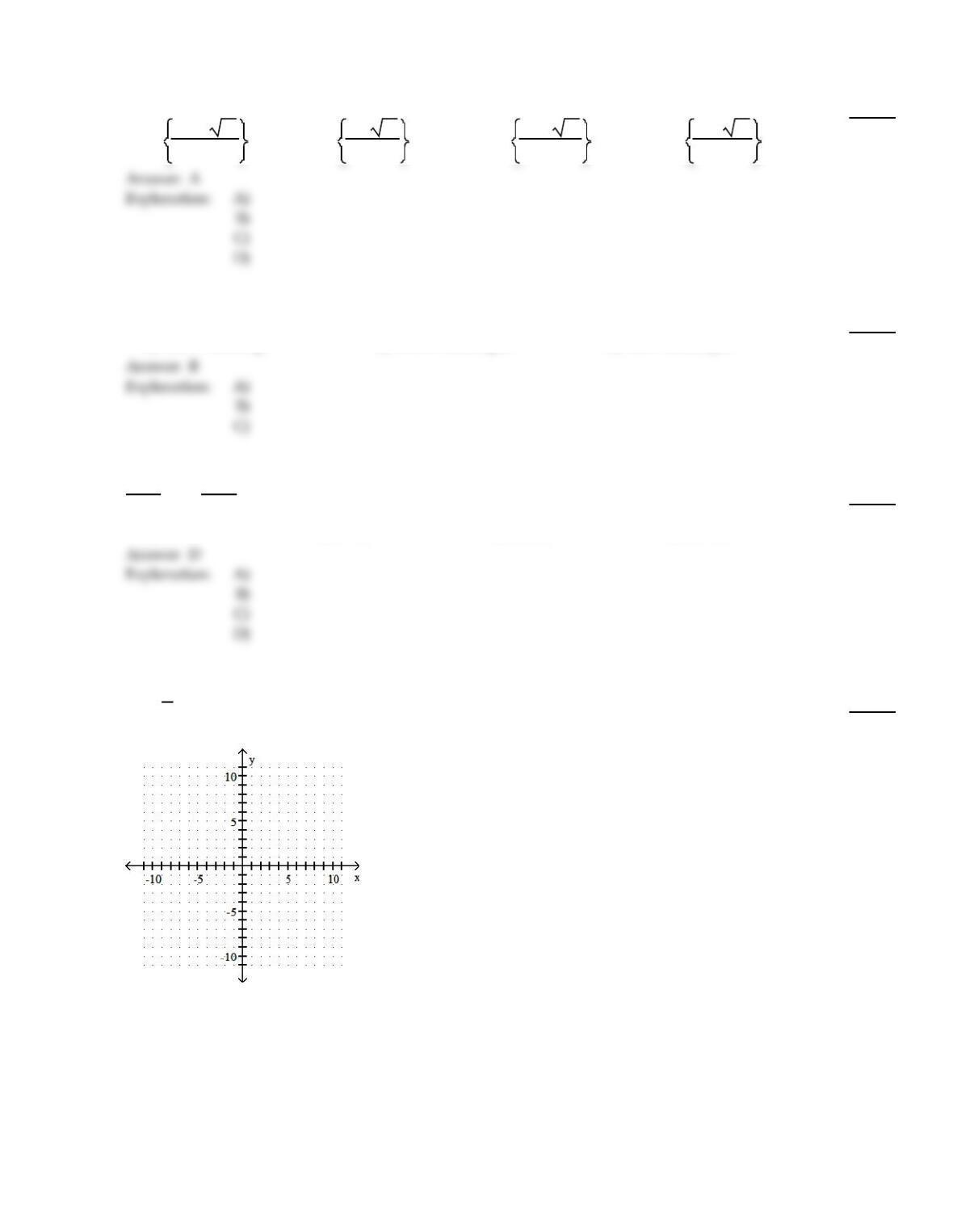
Solve by using the quadratic formula.
154)
8x2+ 7x = – 2
154)
A)
–7 ± i 15
16
B)
7 ±15
16
C)
–7 ±15
16
D)
7 ± i 15
16
Use the discriminant of the equation to determine the number of x–intercepts.
155)
f(x) = – x2+ 8x + 8
155)
A)
One x–intercept
B)
Two x–intercepts
C)
No x–intercepts
Solve the equation.
156)
16
b + 2 = 1 +2
b – 4
156)
A)
B)
{–12}
C)
{–2, 4}
D)
{6, 10}
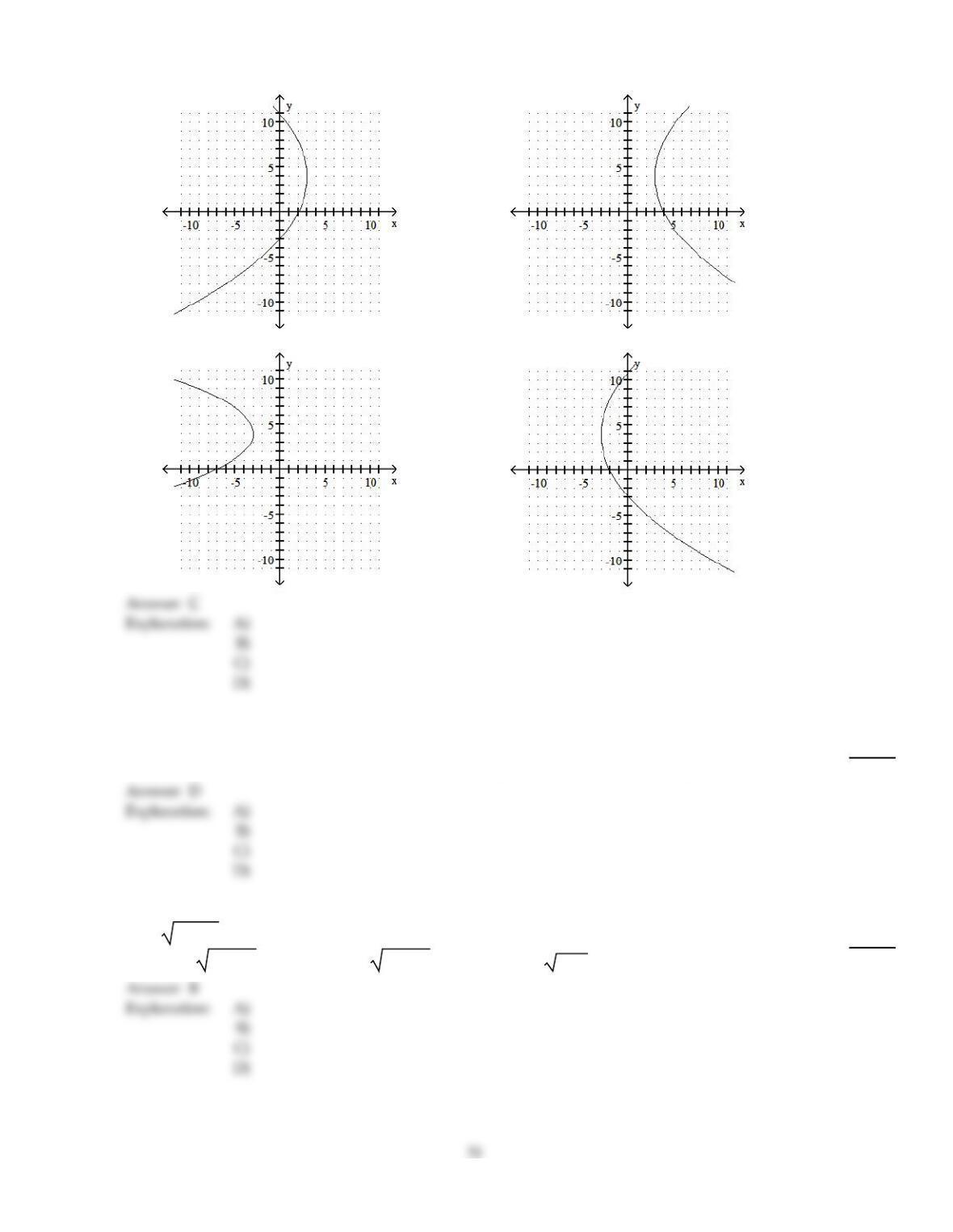
Graph the parabola.
157)
x = – 1
4y2+ 2y –7
157)
50
A)
B)
C)
D)
Identify the vertex of the given parabola.
158)
f(x) =x2+ 9
158)
A)
(–9, 0)
B)
(0, –9)
C)
(9, 0)
D)
(0, 9)
Solve the equation for the indicated variable. (Leave ± in your answer, when appropriate.)
159)
x = ± r2–y2 for r
159)
A)
r = ± x2–y2
B)
r = ± x2+y2
C)
r = ± x + y
D)
r = x + y
Solve the problem.
160)
To solve the rational inequality –2
x +1
2, you can first write the inequality with 0 on one side and
the other side expressed as a single fraction. What value or values of x make the denominator of
that fraction equal to 0?
160)
A)
{1}
B)
{–1}
C)
{–2, –1}
D)
{–2}
Solve the equation.
161)
(3m – 3)2– 11(3m – 3) + 28 = 0
161)
A)
–1
3, 4
3
B)
7
3, 10
3
C)
7
3, –10
3
D)
1
3, –4
3
Decide whether the graph of the equation opens up, down, to the left, or to the right; and whether it is wider, narrower, or
the same shape as the graph of f(x) =x2 (or x =y2).
162)
x =y2+ 8y + 3
162)
A)
To the left; same
B)
To the right; wider
C)
To the right; same
D)
To the right; narrower
Solve the problem.
163)
John owns a hot dog stand. He has found that his profit is given by the equation P = – x2+ 50x + 68,
where x is the number of hot dogs sold. How many hot dogs must he sell to earn the most profit?
163)
A)
21 hot dogs
B)
25 hot dogs
C)
26 hot dogs
D)
43 hot dogs
A boy is standing on a flat field and tosses his ball toward a second boy standing at the other end of the field. The path of
the ball is a parabola, and the equation of the path is f(x) = – 4x2+
8x. Based on this information, answer the question.
164)
True or false? The parabola opens down.
164)
A)
False
B)
True
Solve the problem.
165)
Which pair of numbers whose sum is 70 has the largest product?
165)
A)
25 and 45
B)
34 and 36
C)
35 and 35
D)
27 and 43
Determine the number that will complete the square to solve the equation after the constant term has been written on the
right side. Do not actually solve.
166)
w2– 8w – 10 = 0
166)
A)
–4
B)
16
C)
25
D)
0
Solve the problem. Round your answer to the nearest tenth, if necessary.
167)
Two pipes together can fill a large tank in 10 hr. One of the pipes, used alone, takes 15 hr longer
than the other to fill the tank. How long would each pipe take to fill the tank alone?
167)
A)
10 hr; 25 hr
B)
15 hr; 30 hr
C)
12.5 hr; 27.5 hr
D)
25 hr; 40 hr
Solve the equation for the indicated variable. (Leave ± in your answer, when appropriate.)
168)
E = mc2 for c
168)
A)
c = ± Em
B)
c = ± Em
m
C)
c = Em
D)
c =E
m
Solve the equation by using the square root property. Simplify all radicals.
169)
(2m – 1)2=81
169)
A)
{8, –10}
B)
{4, –5}
C)
{10, –8}
D)
{5, –4}
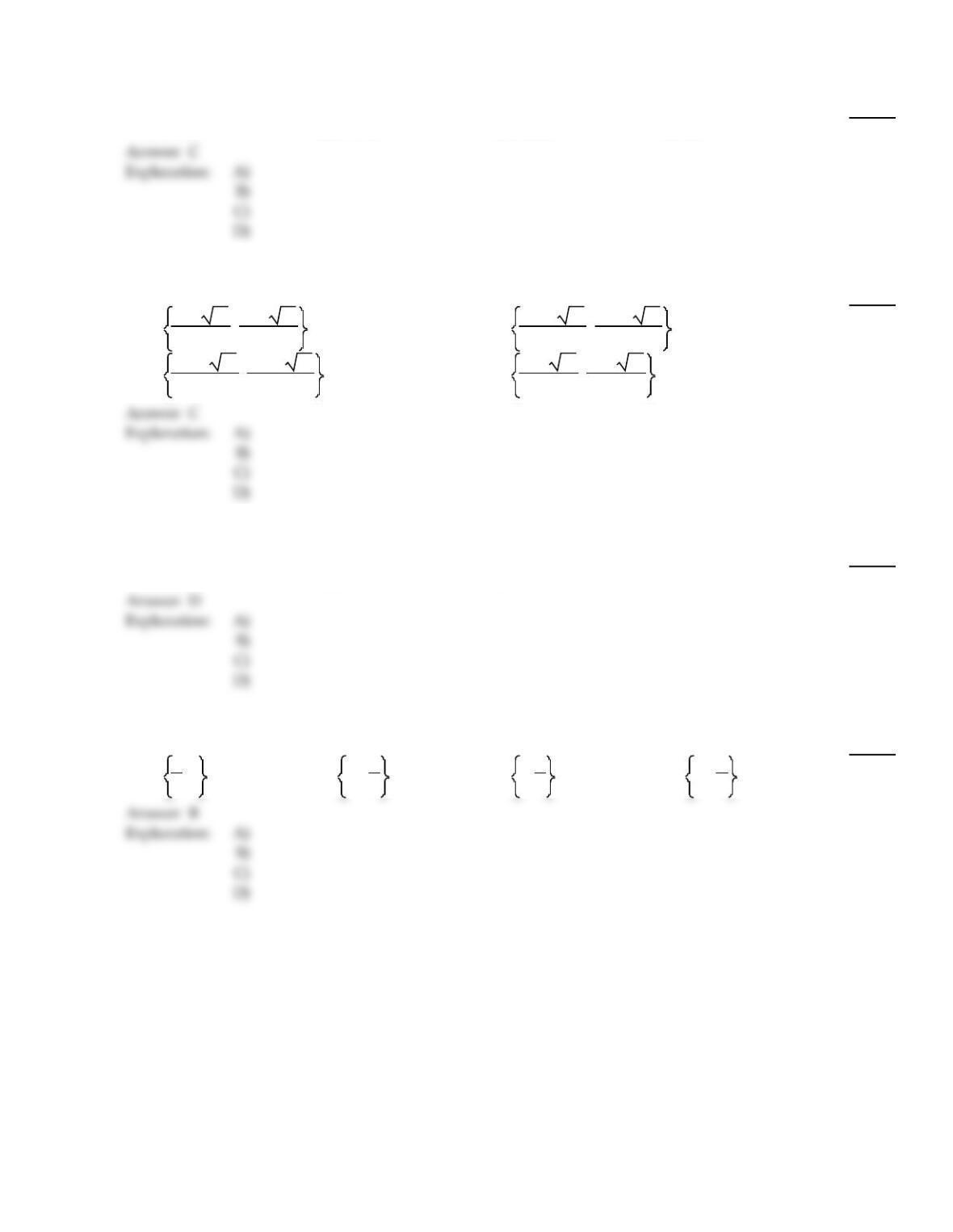
Solve the equation by the zero–factor property.
170)
3z2+ 5 =197
170)
A)
{98.5}
B)
{–9, 9}
C)
{–8, 8}
D)
{8}
Use the quadratic formula to solve the equation.
171)
9x2+ 5x + 1 = 0
171)
A)
5+ i 11
18 , 5– i 11
18
B)
–5+ i 11
9, –5– i 11
9
C)
–5+ i 11
18 , –5– i 11
18
D)
5+ i 11
9, 5– i 11
9
Find the vertex of the parabola.
172)
f(x) =2x2+ 8x + 5
172)
A)
(2, 3)
B)
(3, 2)
C)
(–3, –2)
D)
(–2, –3)
Solve the equation by completing the square.
173)
9x2+ 4x – 5 = 0
173)
A)
9
5, 1
B)
–1, 5
9
C)
0, 9
5
D)
–1, 9
5
54
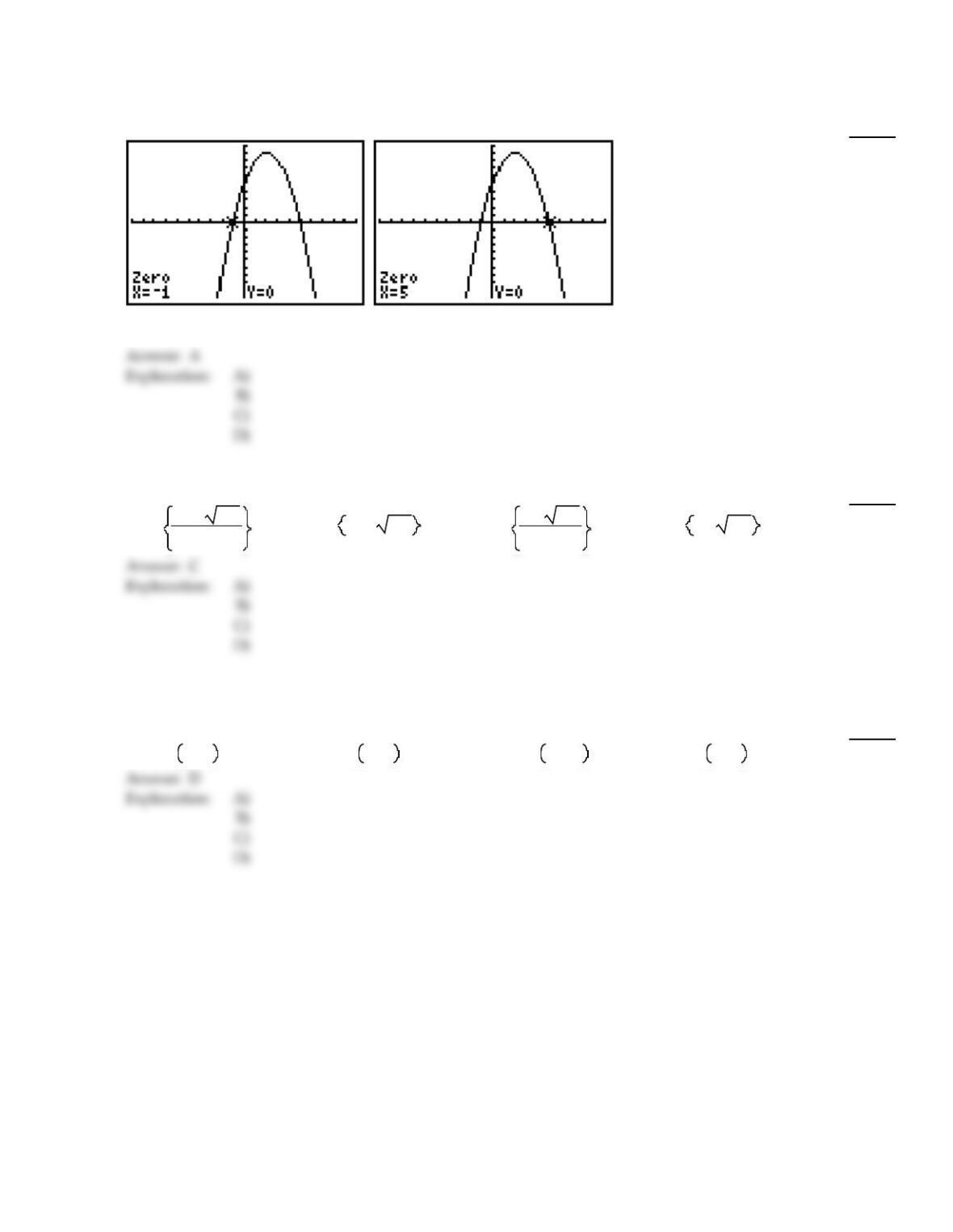
The calculator graphs shows the x–values of the x–intercepts of the graph of the polynomial in the equation. Use the
graphs to solve the equation.
174)
–x2+ 4x + 5 = 0
174)
A)
{–1, 5}
B)
{4, 5}
C)
{–5, –1}
D)
{–5, 1}
Solve the equation by completing the square.
175)
(x +8)(x –9) =1
175)
A)
–1±293
2
B)
–1±293
C)
1±293
2
D)
1±293
Find the term that should be added to the expression to form a perfect square trinomial. Write the resulting perfect square
trinomial in factored form.
176)
x2+ 16x +
176)
A)
0; x + 8 2
B)
64; x – 8 2
C)
256; x + 16 2
D)
64; x + 8 2
55
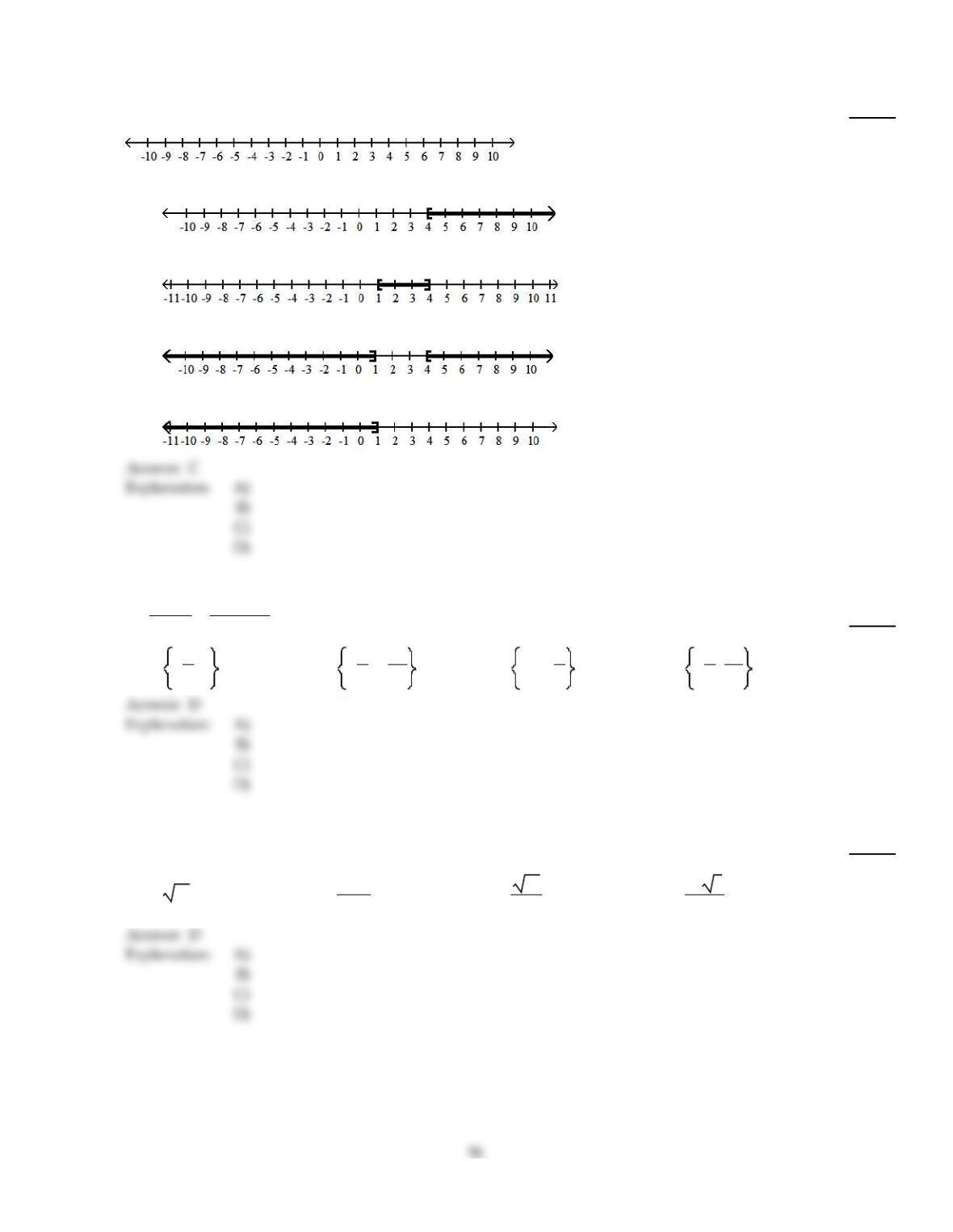
Solve the inequality, and graph the solution set.
177)
v2– 5v + 4 0
177)
A)
[4, )
B)
[1, 4]
C)
(–, 1] [4, )
D)
(–, 1]
Solve the equation.
178)
2 +5
7z – 1 =–2
(7z – 1)2
178)
A)
–1
7, 0
B)
–1
7, –1
14
C)
–2, –1
2
D)
–1
7, 1
14
Solve the problem.
179)
A 41–inch–square TV is on sale at the local electronics store. If 41 inches is the measure of the
diagonal of the screen, use the Pythagorean theorem to find the length of the side of the screen.
179)
A)
41 in.
B)
1681
2
C)
41
2 in.
D)
41 2
2 in.
Answer Key
Testname: C11
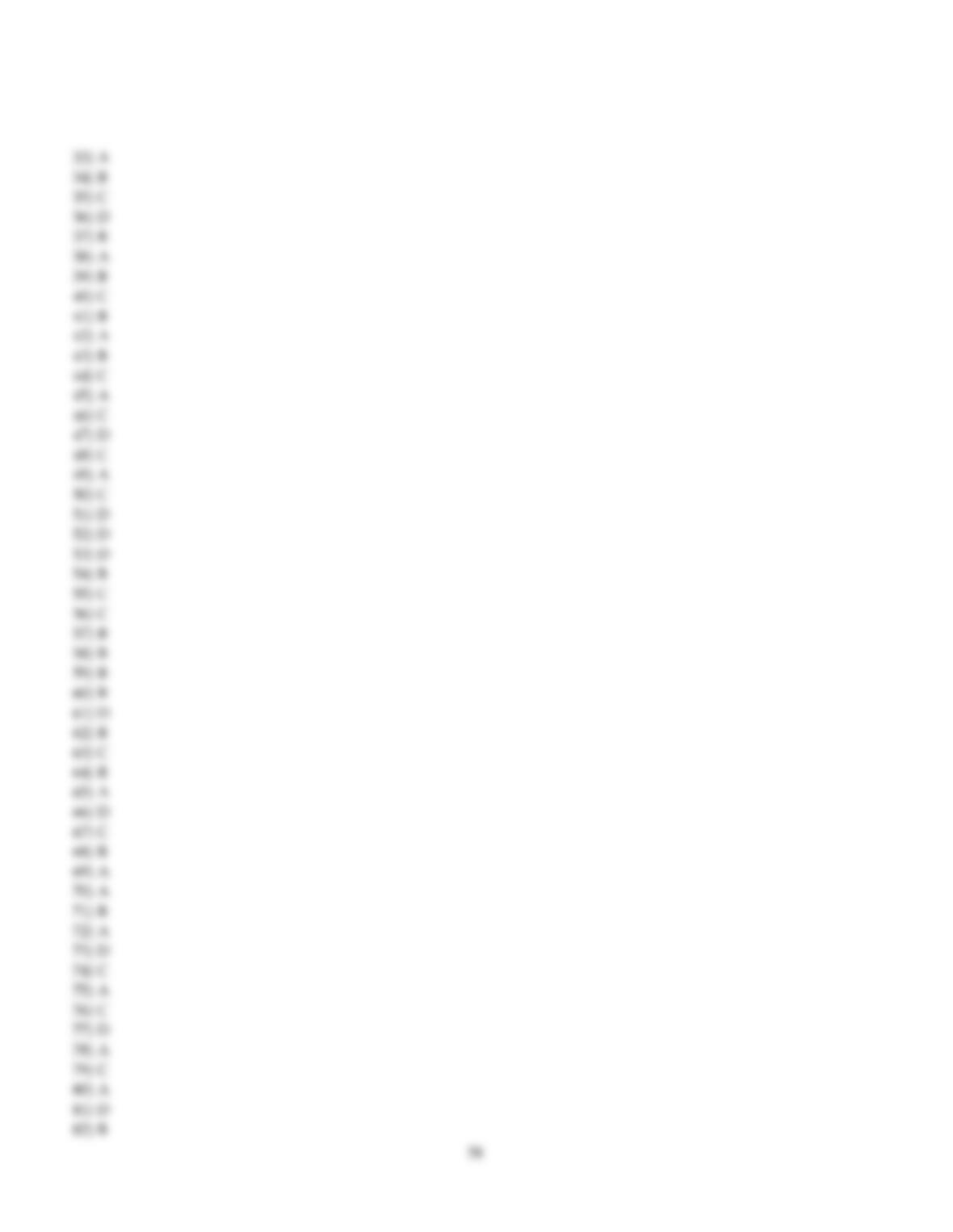
Answer Key
Testname: C11
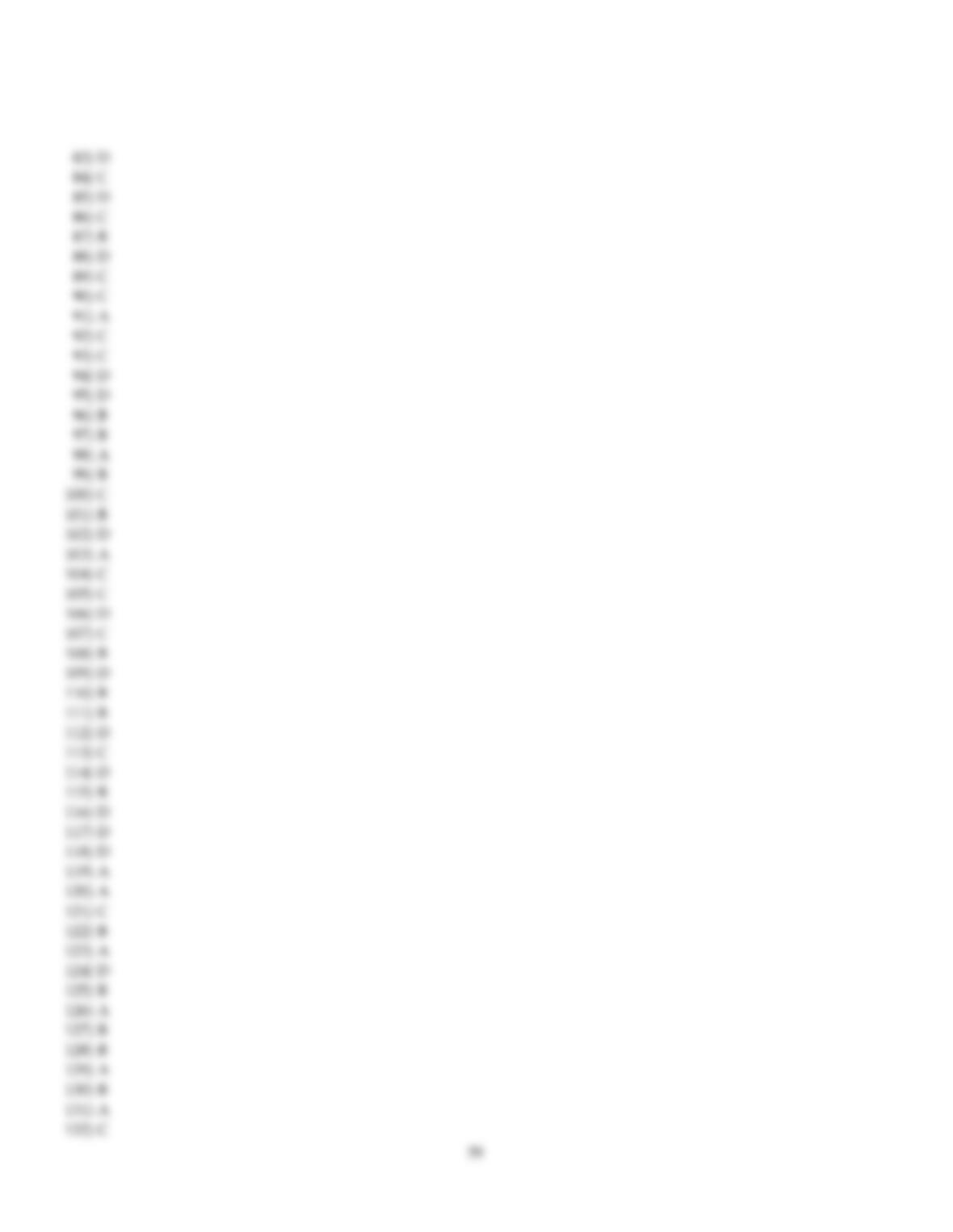
Answer Key
Testname: C11
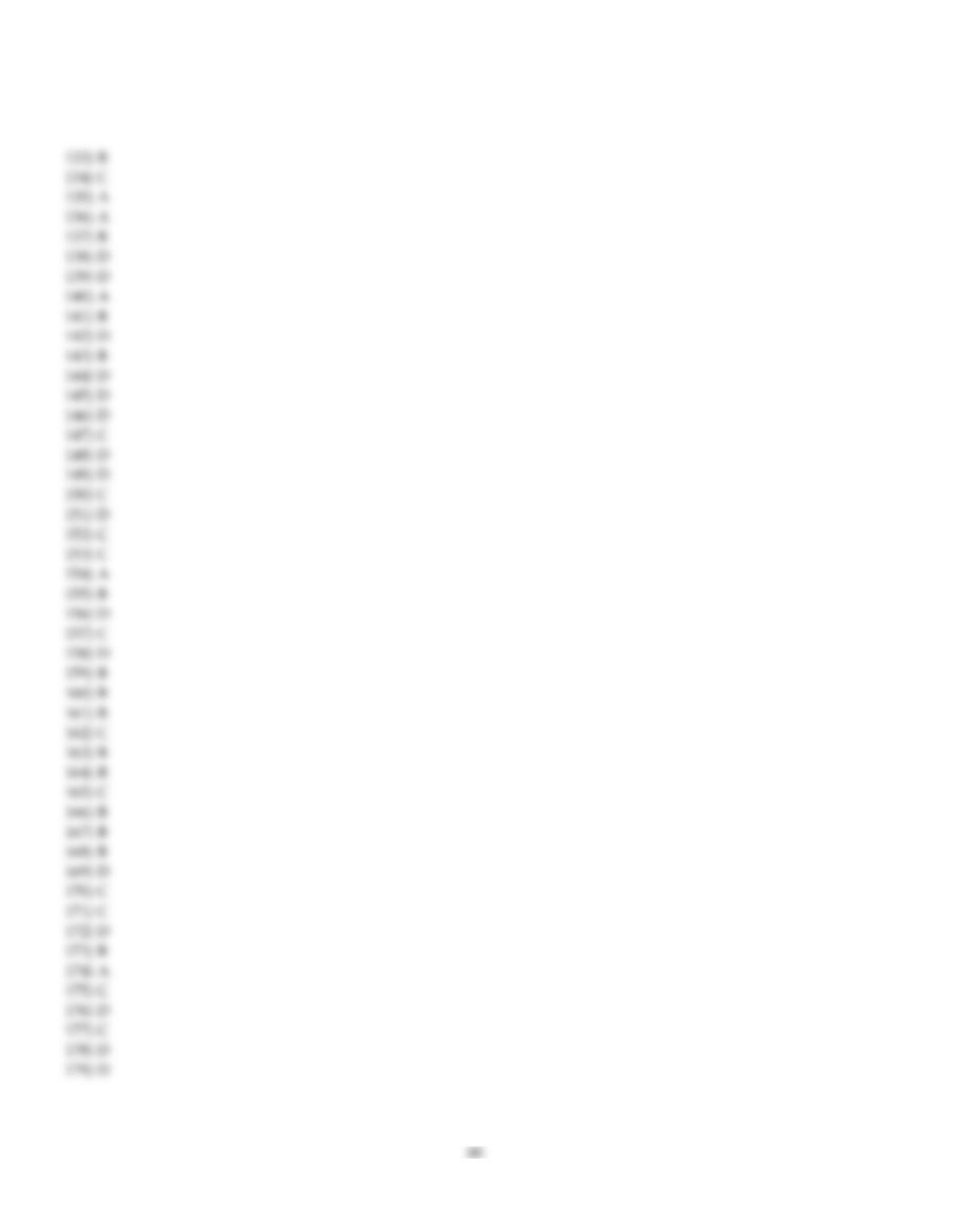
Answer Key
Testname: C11