B.
$(28,000)
C.
$(24,000)
D.
$(18,000)
41. Big Deals, Inc., had the following cash flows during March:
Paid for inventory
$2000
Paid wages to employees
4000
Received from cash sales
10,000
Paid for equipment
6000
Received a loan
7000
What was the cash flow from investing activities?
A.
$5000 inflow
B.
$8000 outflow
C.
$12,000 outflow
D.
$6000 outflow
42. Which of the following statements regarding consolidated accounts and economic entities is
incorrect?
A.
An economic entity consisting of a parent and subsidiaries is a separate legal entity having
the legal rights and obligations of a company.
B.
For an entity to be considered a subsidiary, the parent entity must control both the
financial and operating policies of the subsidiary.
C.
Consolidated accounts are prepared by combining similar accounts of the parent entity and
its subsidiaries after eliminating inter-company transactions.
D.
Consolidated accounts display the operations of the parent entity and all of its controlled
entities.
43. A controls B and B controls C. During 20X7, C sold $100 of goods to A, $90 to B and $2000 to
other parties. B sold $100 of goods to C and $500 to other parties (not including A). A sold goods
of $50 to B, $300 to outside parties.
What is the total revenue reported by C?
A.
$90
B.
$190
C.
$2000
D.
$2190
44. A controls B and B controls C. During 20X7, C sold $100 of goods to A, $90 to B and $2000 to
other parties. B sold $100 of goods to C and $500 to other parties (not including A). A sold goods
of $50 to B, $300 to outside parties.
What is the total consolidated revenue for 20X7?
A.
$340
B.
$2500
C.
$2800
D.
$3140
45. When preparing consolidated accounts for a parent company and a subsidiary company, the
eliminations are made to:
A.
the investment account.
B.
the intercompany sales.
C.
inter-company debtors and creditors.
D.
all of the above.
46. Consolidated financial statements are prepared only when:
A.
the parent and subsidiary companies are in the same industry.
B.
the parent and subsidiary companies are operating as totally separate entities.
C.
the parent controls the subsidiary company.
D.
the parent owns 50% of the subsidiary company.
47. Consolidated financial statements:
A.
report the combined economic activities of two or more corporations owned by the same
shareholders.
B.
report to ASIC a shortened version of financial statements reported to the public.
C.
report the combined financial statements of only controlled entities that are 100% owned.
D.
report the combined financial statements of only entities where the parent owns more than
50% of the voting shares..
48. Consolidated statements encompass the principle that:
A.
a company cannot have a debt to itself.
B.
an entity’s ownership of its own shares is neither an asset nor shareholders equity.
C.
all companies in a group are viewed as a single economic entity.
D.
All of the above are correct.
49. A Ltd and B Ltd are parent and subsidiary companies within a group. A Ltd has accounts
receivables of $30,000 and B Ltd has accounts receivables of $20,000. Of B Ltd’s receivables,
$5000 is a receivable from A Ltd. The consolidated balance sheet should show accounts receivable
of:
A.
$20,000
B.
$20,000
C.
$45,000
D.
$50,000
50. The Accounts Receivable balances of a parent company and its two controlled entities are as
follows:
P1 Co.
S1 Co.
S2 Co.
Accounts Receivable
$100,000
$20,000
$30,000
If all of S1 Co.’s credit sales are to S2 Co., then what is the amount of Accounts Receivable on the
consolidated balance sheet?
A.
$100,000
B.
$120,000
C.
$130,000
D.
$150,000
51. Which of the following statements regarding tax-effect accounting is incorrect?
A.
The tax-effect method of accounting for income tax determines that temporary differences
may arise, resulting in the recognition of either a liability or an asset.
B.
The tax-effect method for calculating income tax expense is where the taxable income is
multiplied by the tax rate.
C.
A tax loss can only be carried forward as a future tax benefit if it is probable that the entity
will earn taxable income in the future.
D.
A deferred tax liability will occur where taxable income is less than accounting profit in
the current period.
52. AKP Ltd uses the accrual-basis method of accounting for accounting profit. In the current
accounting period, they have recognised income for interest not yet received. Taxable income is
determined on a cash basis. Based on this information, which of the following statements is
correct?
A.
Taxable income will be greater than accounting profit, and will give rise to a deferred tax
liability.
B.
Taxable income will be less than accounting profit, and will give rise to a deferred tax
liability.
C.
Taxable income will be greater than accounting profit, and will give rise to a deferred tax
benefit.
D.
Taxable income will be less than accounting profit, and will give rise to a deferred tax
benefit.
53. AKP Ltd depreciates a non-current asset using the straight-line method. Tax law stipulates that the
asset should be depreciated using the reducing-balance method at 1.5 times the straight line rate.
Under normal circumstances, which of the following statements is correct?
A.
After year 1, the tax base of the asset exceeds the accounting base and will give rise to a
deferred tax liability.
B.
After year 1, the tax base of the asset is less than the accounting base and will give rise to
a deferred tax liability.
C.
After year 1, the tax base of the asset exceeds the accounting base and will give rise to a
deferred tax asset.
D.
After year 1, the tax base of the asset exceeds the accounting base and will give rise to a
tax asset.
54. Sporter Enterprises has incurred a tax loss in the current period. Under tax law, which of the
following statements is not correct?
A.
A deferred tax asset can be recognised if it is probable that Sporter will earn taxable
income in the future.
B.
Assuming all relevant tax laws have been adhered to, Sporter can carry the loss forward to
reduce taxable income in future periods.
C.
A deferred tax liability is created, as Sporter will have to pay tax on taxable income in the
future.
D.
Sporter cannot carry the loss forward as a deferred tax asset if is probable that future
taxable income will not be earned.
55. In following the trail of a woollen coat sold to a customer for $525, it was determined that the bale
of wool from which the coat was made was sold by a farmer to a manufacturer for $80, and the
manufacturer produced the coat and on-sold it to a wholesaler of garments, charging $150. The
wholesaler then charged a retailer $200. Assuming that GST is still to be calculated at 10% on each
of the above transactions, which of the following statements is incorrect?
A.
The farmer will remit $8 and the manufacturer $7 to the ATO at the end of the period.
B.
The total amount of GST that will be paid to the ATO is $52.50, which is the amount the
retailer will remit to the ATO.
C.
The wholesaler will remit $5 to the ATO and has recorded $20 as a liability.
D.
Assuming no other expenses, the retailer made a profit of $272.50 on the sale of the coat.
SHORT ANSWER
1. Briefly describe what information is contained in the Statement of Cash Flows
2. Why is the statement of cash flows important?
3. How is the statement of cash flows organised?
4. Consolidated general purpose reports are prepared where one company controls another company.
What is meant by the term ‘control’ under those circumstances?
5. Which duties associated with handling and accounting for cash should ideally be separated in order
to promote the internal control of the asset?
PROBLEM
1.
(a)
Classify the following transactions according to whether they relate to operating,
investing or financing activities or none of those categories for the purposes of
preparing a statement of cash flows.
1.
Received cash of $14,000 from the sale of equipment previously used in carrying
out the entity’s operations.
2.
Paid cash of $11,000 to accounts payable for inventory previously purchased on
credit.
3.
Received $45,000 cash from accounts receivable.
4.
Paid cash dividends to shareholders $54,000.
5.
Issued shares in exchange for land $105,000.
6.
Paid insurance in advance $9000 cash.
7.
Purchased vehicles for use in the business for $48,000 cash.
8.
Deposited $12,000 into a short-term deposit, redeemable at call.
9.
Issued $85,000 in shares in exchange for cash.
10.
Borrowed $40,000 in cash repayable in five years.
(b)
Calculate the cash flow from operating activities based on the foregoing 10
transactions.
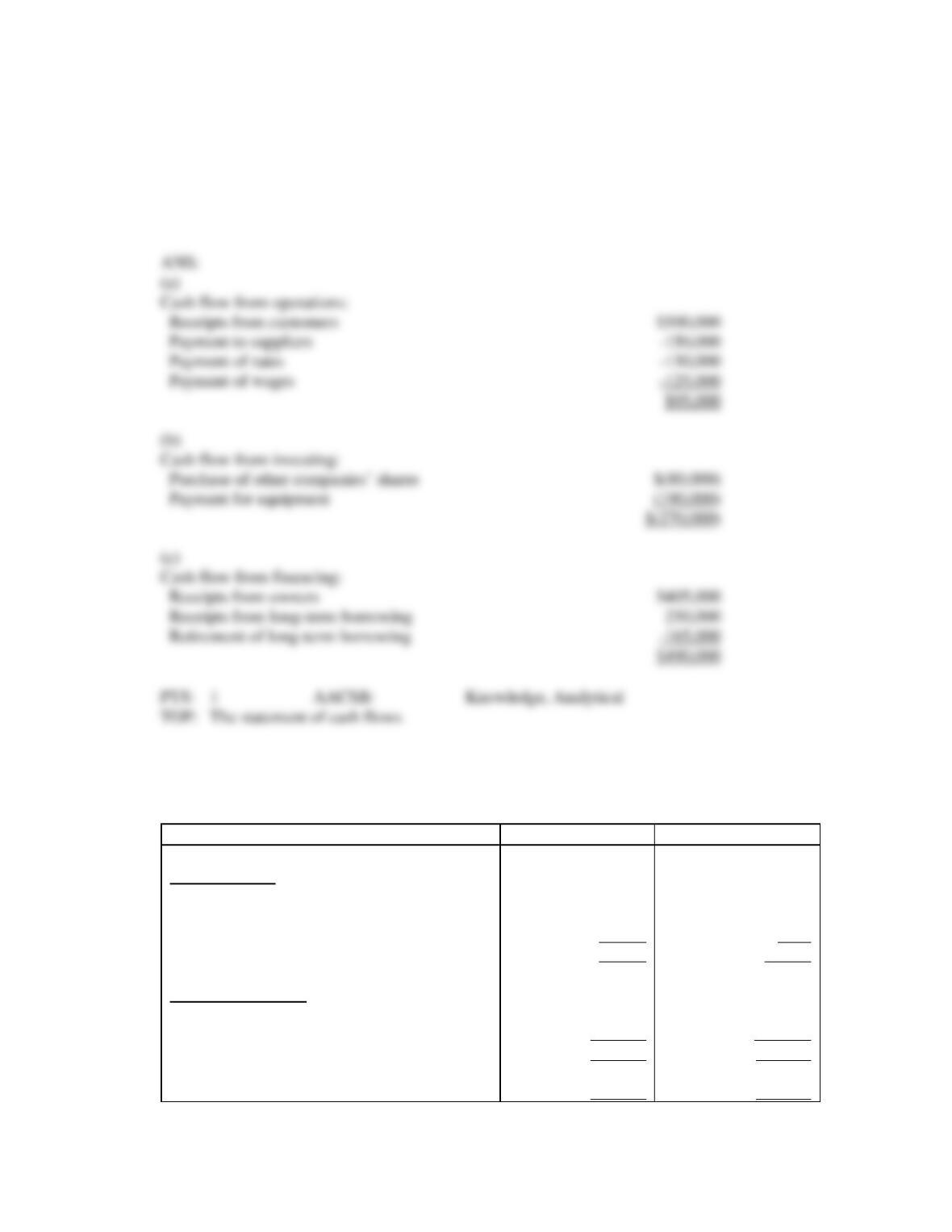
2. The following information about Thompson Corp. applies to the entity for the year ended 30 June
20X7.
Payment to suppliers
$150,000
Receipts from owners
405,000
Receipts from long-term borrowing
250,000
Payment of rates
130,000
Payment of wages
125,000
Purchase of other companies’ shares
80,000
2. 3. 6.
1. 7.
4. 9. 10.
5.
8
Acs receivable
Acs payable
Insurance
Retirement of long-term borrowing
165,000
Receipts from customers
500,000
Payment for equipment
190,000
Depreciation on equipment
90,000
Average total assets
1,200,000
(a) What was Thompson Corp.’s cash flow from operating activities?
(b) What was Thompson Corp.’s cash flow from investing activities?
(c) What was Thompson Corp’s cash flow from financing?
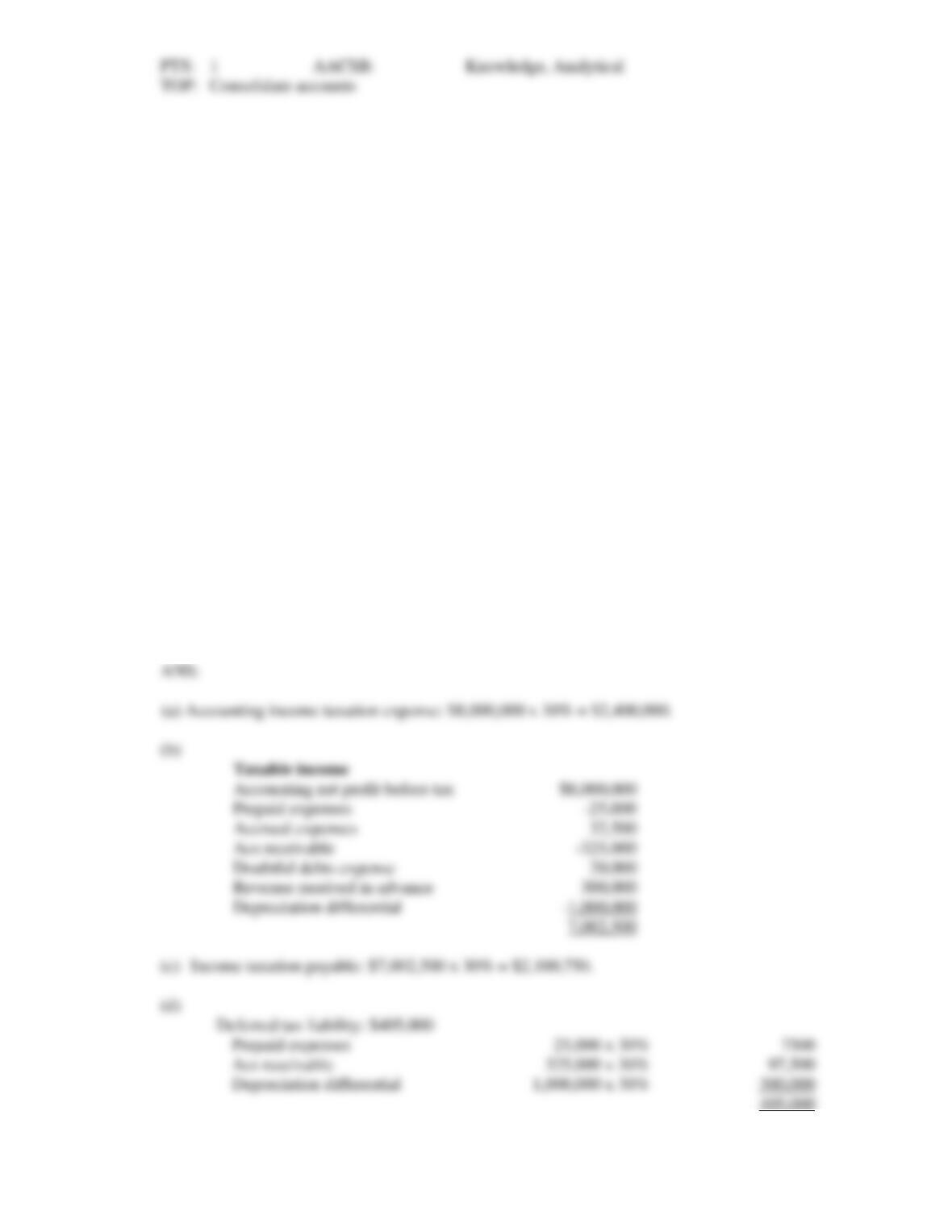
3. Following are the balance sheets of Valentine Ltd and Saint Pty Ltd as at 30 June 20X7. On 1
October 20X6, Valentine purchased all of the issued shares of Saint for $125,000. At 30 June
20X7 Saint owed Valentine $6000 which forms part of the accounts payable and receivable of the
respective companies.
Balance sheets
Valentine Ltd
Saint Pty Ltd
Current assets
Cash at bank
Accounts receivable
Other
Total current assets
Non-current assets
Property, plant & equipment
Investment in Saint Pty Ltd
Total non-current assets
TOTAL ASSETS
13,000
28,000
22,000
63,000
260,000
125,000
385,000
448,000
9000
14,000
9000
32,000
120,000
———–
120,000
152,000
Receipts from customers
Payment to suppliers
Payment of rates
-130,000
Payment of wages
-125,000
$95,000
Purchase of other companies’ shares
Payment for equipment
Receipts from owners
Receipts from long-term borrowing
250,000
Retirement of long-term borrowing
Current liabilities
Accounts payable
Total current liabilities
Non-current liabilities
Borrowings
Total non-current liabilities
TOTAL LIABILITIES
NET ASSETS
Shareholders’ equity
Share capital
Retained profits
Total shareholders’ equity
32,000
32,000
210,000
210,000
242,000
206,000
160,000
46,000
206,000
11,000
11,000
16,000
16,000
27,000
125,000
100,000
25,000
125,000
Complete the worksheet for the consolidation of the balance sheets of the parent and subsidiary.
CASE
1. The operating net profit before income tax of Fraxinus Ltd for the year ended 30 June 20X7 – the
entity’s first year of operation – was $8,000,000. The figure was derived using the accrual
approach to measuring profit. The company determines tax based on a cash basis.
Taking into consideration the additional information provided below, you are required to:
(a)
Calculate the accounting income taxation expense for the company for the
financial year.
(b)
Calculate the taxable income of the company for the financial year.
(c)
Calculate the income taxation payable to the ATO for the financial year.
(d)
Assuming that the difference between (a) and (c) are attributable to temporary
differences, calculate the amount of the deferred tax liability and deferred tax
asset arising out of the difference between the accounting profit (income taxation
expense) before taxation and taxable income (income taxation liability).
Additional information
1.
Prepaid expenses at 30 June 20X7 $25,000.
2.
Accrued expenses at 30 June 20X7 $32,500.
3.
Cash received from customers for the year $94,975,000.
4.
Accounts receivable outstanding at 30 June 20X7 $325,000 (gross).
5.
Provision for doubtful debts $20,000.
6.
Revenue received in advance at 30 June 20X7 $300,000
7.
Depreciation for accounting purposes $4,000,000
8.
Depreciation as a taxation deduction $5,000,000.
9.
The company income taxation rate is 30%.
(c)
Income taxation payable: $7,002,500 x 30% = $2,100,750.
(d)