80) If one mole of each is dissolved in 1.00 L of water, which will lower the vapor pressure the
most?
A) C12H22O11
B) NaNO3
C) C3H7OH
D) MgCl2
81) When 2.36 g of a nonvolatile solute is dissolved in 100 g of solvent, the largest change in
freezing point will be achieved when the solvent is
A) benzene, Kf = 5.07.
B) camphor, Kf = 37.8.
C) chloroform, Kf = 4.70.
D) All are expected to have the same freezing point.
82) A 0.50 m solution of which solute has the largest van’t Hoff factor?
A) CaCl2
B) K3PO4
C) LiCO3
D) NaNO3
83) A 0.020 m aqueous solution containing which solute will have the lowest freezing point?
A) LiCl
B) NaCl
C) KCl
D) All will have approximately the same freezing point.
84) Which of the following solutions will have the lowest freezing point?
A) 0.0100 m NaCl
B) 0.0100 m Li2SO4
C) 0.035 m CH3CH2CH2OH
D) 0.015 m MgCl2
85) Which of the following pairs of solutions have roughly the same boiling point elevation?
A) 0.100 m C6H12O6 and 0.0333 m CuCl2
B) 0.100 m NaCl and 0.100 m C6H12O6
C) 0.200 m NaCl and 0.300 m Na2SO4
D) 0.100 m KCl and 0.0500 m MgBr2
86) What is the expected freezing point of a 0.50 m solution of Na2SO4 in water? Kf for water is
1.86°C/m.
A) -0.93°C
B) -1.9°C
C) -2.8°C
D) -6.5°C
87) Calculate the freezing point of a solution of 20.0 g methyl salicylate, C7H6O2, dissolved in
800. g of benzene, C6H6. Kf for benzene is and the freezing point is 5.50°C for benzene.
A) -1.05°C
B) 1.05°C
C) 4.45°C
D) 6.54°C
88) What is the freezing point of a solution of 1.43 g MgCl2 in 100 g of water? Kf for water is
1.86°C/m for water.
A) -0.0279°C
B) -0.279°C
C) -0.559°C
D) -0.838°C
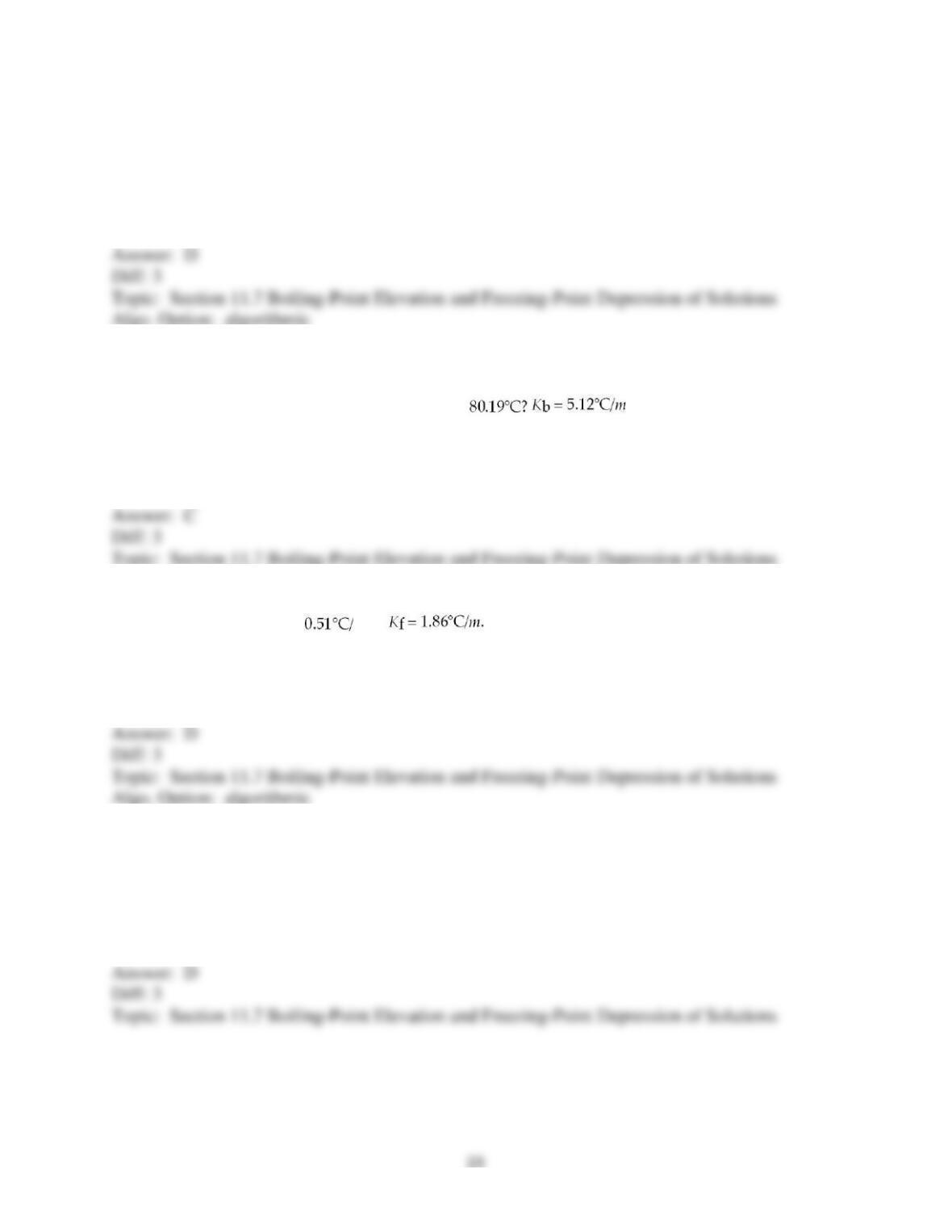
89) The normal boiling point of pure benzene is found to be 80.10°C. What is the approximate
molecular weight of a nonionizing substance if a solution of 3.55 g of the substance dissolved in
100. g of benzene has a normal boiling point of for benzene, C6H6.
A) 20 amu
B) 500 amu
C) 2000 amu
D) 20,000 amu
90) An aqueous solution has a normal boiling point of 102.0°C. What is the freezing point of this
solution? For water Kb is and
A) -0.55°C
B) -2.0°C
C) -3.6°C
D) -7.3°C
91) A solution of 0.2113 g of water dissolved in 25.0 g of a solvent freezes at 11.5°C below the
freezing point of the solvent. What is Kf for this solvent?
A) 0.735°C/m
B) 1.36°C/m
C) 5.39°C/m
D) 24.5°C/m
92) A 0.51 m aqueous solution of an unknown solute has a boiling point elevation of 0.62°C. The
boiling point elevation of a 0.51 m solution of a nonionizing molecular solute in water is 0.26°C.
How many moles of particles are formed per mole of solute when the unknown solute is
dissolved in water?
A) 1.4
B) 2.0
C) 2.4
D) 3.0
93) An aqueous CsCl solution is 8.00 mass % CsCl and has a density of 1.0643 g/mL at 20°C.
What is the boiling point of this solution? Kb = 0.51°C/m for water.
A) 100.27°C
B) 100.53°C
C) 103.8°C
D) 104.3°C
94) Chloroform has a boiling point of 61.1°C and dichloromethane has a boiling point of 40.0°C.
When 0.100 mol of dichloromethane is added to 0.900 mol of chloroform, the resulting solution
will have a boiling point
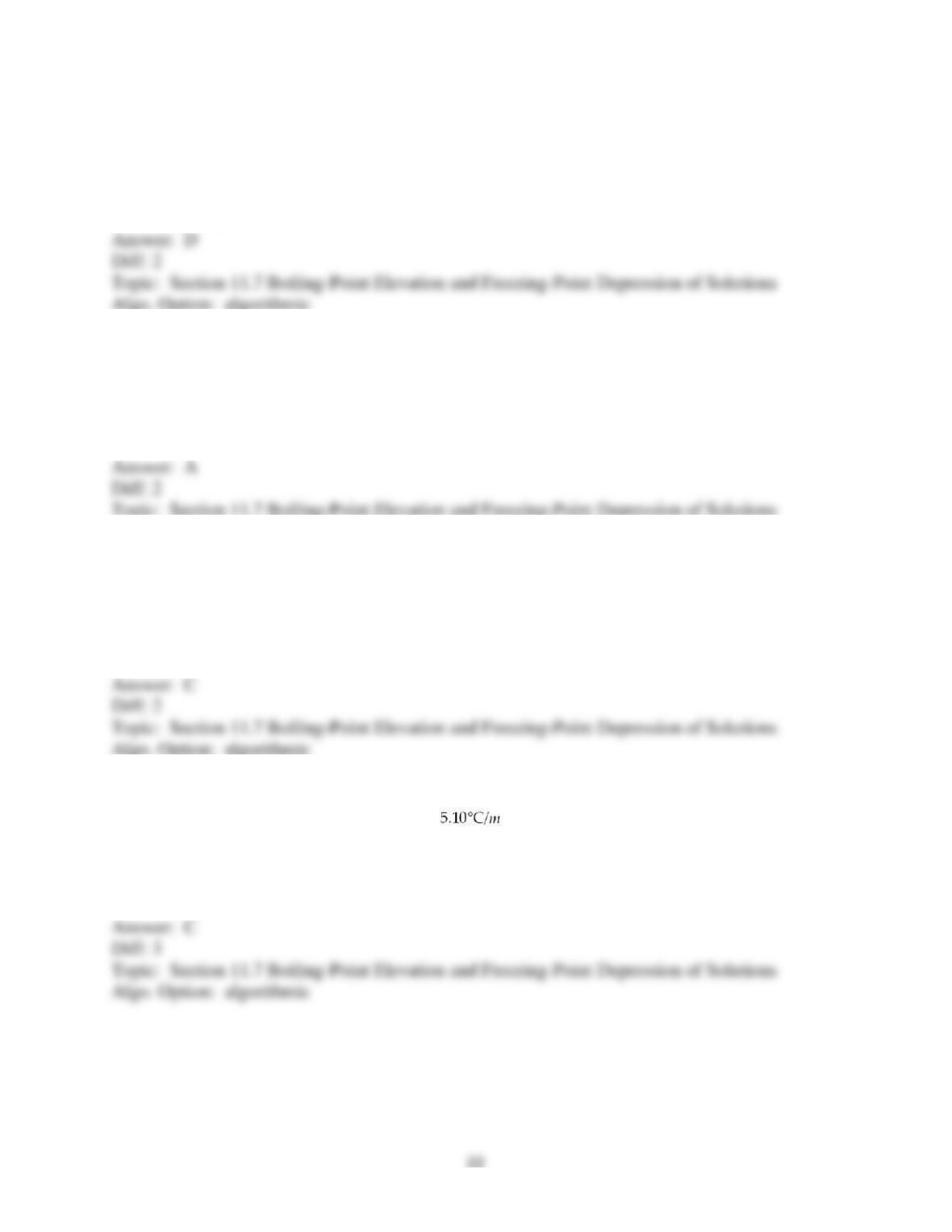
A) between 40.0°C and 61.1°C, but closer to 61.1°C.
B) between 40.0°C and 61.1°C, but closer to 40.0°C.
C) greater than 61.1°C.
D) less than 40.0°C.
95) Two aqueous solutions, A and B, are separated by a semipermeable membrane. The osmotic
pressure of solution A immediately begins to decrease. Which of the following statements is
true?
A) Solvent molecules are moving from solution B into solution A.
B) The initial osmotic pressure of solution B is greater than that of solution A.
C) The solvent molecules are moving from the solution of higher osmotic pressure to that of
lower osmotic pressure.
D) Both B and C are true statements.
96) Red blood cells are placed into pure water. Which of the following statements is true?
A) Water molecules flow out of the red blood cells, causing them to collapse.
B) Water flows into the red blood cells, causing them to swell and burst.
C) The osmotic pressure of the cell contents increases, causing the cells to burst.
D) The osmotic pressure inside the cells equals the osmotic pressure outside.
97) How will the osmotic pressure of an aqueous solution change as evaporation occurs?
A) The osmotic pressure will increase.
B) The osmotic pressure will not change.
C) The osmotic pressure will decrease.
D) The osmotic pressure will increase or decrease until it equals the vapor pressure of water.
98) Assuming that sea water is a 3.5 mass % solution of NaCl in water, calculate its osmotic
pressure at 20°C. The density of a 3.5% NaCl solution at 20°C is 1.023 g/mL.
A) 1.0 atm
B) 15 atm
C) 29 atm
D) 100 atm
99) A solution is made by dissolving 13 g of sucrose, C12H22O11, in 117 g of water, producing
a solution with a volume of 125 mL at 20°C. What is the expected osmotic pressure at 20°C?
A) 7.3 atm
B) 10 atm
C) 14 atm
D) 58 atm
100) The average osmotic pressure of blood is about 7 atm. Therefore
A) the average blood pressure is about 7 atm.
B) the average pressure inside the body is about 7 atm above the external pressure.
C) a pressure of about 7 atm would be required to prevent osmosis if blood is in contact with
pure water across a semipermeable membrane.
D) All of the above are true.
26
101) When 0.500 g of vitamin K is dissolved in 10.0 g of camphor (Kf = 40.0°C/m), the freezing
point of the solution is 4.43°C lower than that of pure camphor. Assuming vitamin K is a
nonelectrolyte in camphor, calculate its molar mass.
A) 0.451 g/mol
B) 55.4 g/mol
C) 451 g/mol
D) 3.54 × 10⁴ g/mol
102) When ethylene glycol, HOCH2CH2OH, is added to the water in an automobile radiator, the
effect is to
A) lower the boiling point and lower the freezing point.
B) lower the boiling point and raise the freezing point.
C) raise the boiling point and lower the freezing point.
D) raise the boiling point and raise the freezing point.
103) The coolant in automobiles is often a 50/50 % by volume mixture of ethylene glycol,
HOCH2CH2OH, and water. At 20°C, the density of ethylene glycol is 1.1088 g/mL and the
density of water is 0.9982 g/mL. Assuming that the volumes are additive, what is the expected
freezing point of a 50/50(v/v)% ethylene glycol/water solution? Kf = 1.86°C/m for water.
A) -16°C
B) -17°C
C) -30°C
D) -33°C
104) Naproxen is a commercially important anti-inflammatory agent that can be isolated from
the thyroid gland. A solution of 1.138 g of naproxen in 25.00 g benzene has an osmotic pressure
of 4.00 atm at 20°C. The density of benzene is 0.8787 g/mL at this temperature. Calculate the
molar mass of naproxen, assuming it remains intact upon dissolution and the density of the
solution equals the density of pure benzene.
A) 176 g/mol
B) 230 g/mol
C) 307 g/mol
D) 3.80 × 10⁵ g/mol
105) A solution of 62.4 g of insulin in enough water to make 1.000 L of solution has an osmotic
pressure of 0.305 atm at 25°C. Based on these data, what is the molar mass of insulin?
A) 621 g/mol
B) 5000 g/mol
C) 7570 g/mol
D) 71,900 g/mol
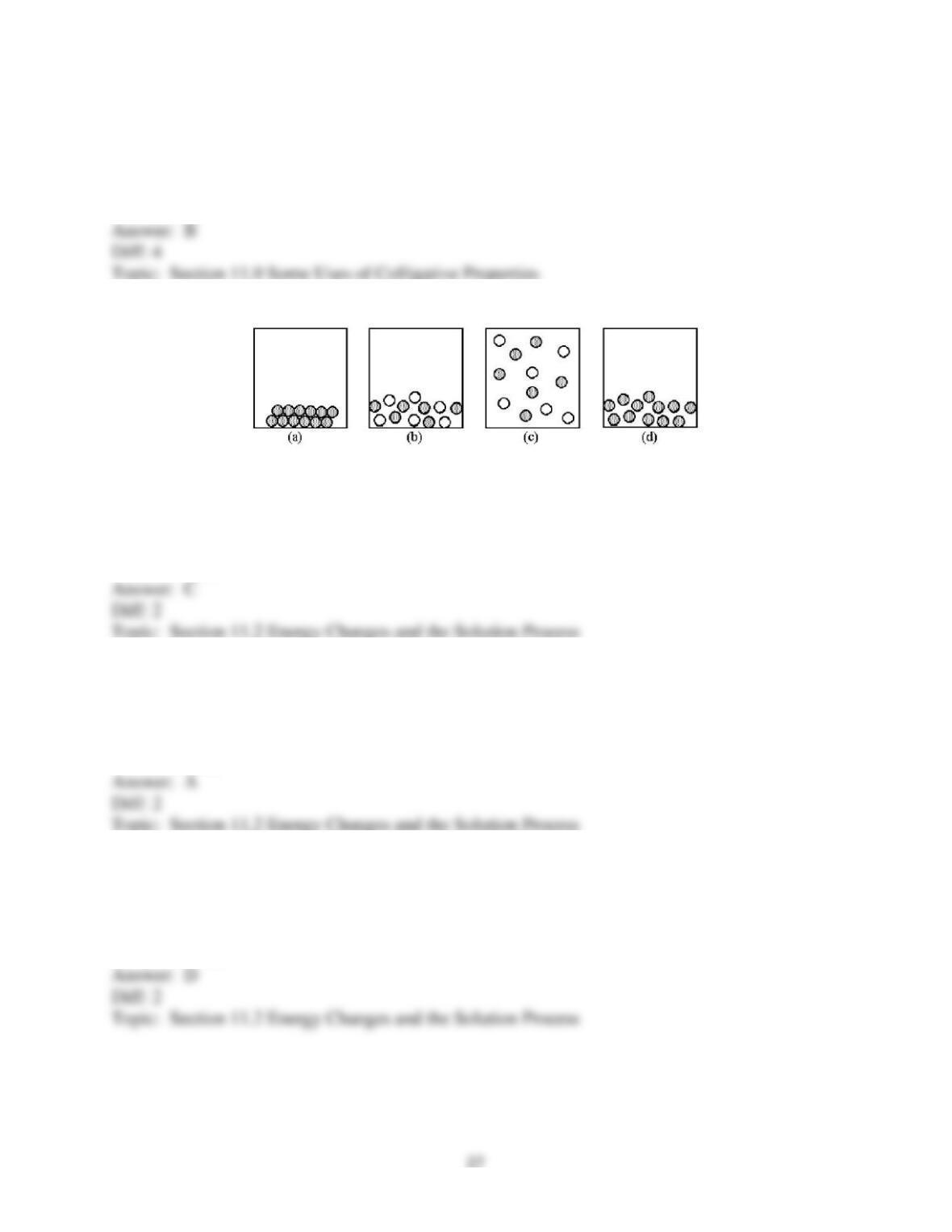
106) Which drawing above represents the system with the highest entropy?
A) drawing (a)
B) drawing (b)
C) drawing (c)
D) drawing (d)
107) Which drawing above represents the system with the lowest entropy?
A) drawing (a)
B) drawing (b)
C) drawing (c)
D) drawing (d)
108) Which drawing above represents the system with the second lowest entropy?
A) drawing (a)
B) drawing (b)
C) drawing (c)
D) drawing (d)
109) Which drawing above represents the system with the second highest entropy?
A) drawing (a)
B) drawing (b)
C) drawing (c)
D) drawing (d)
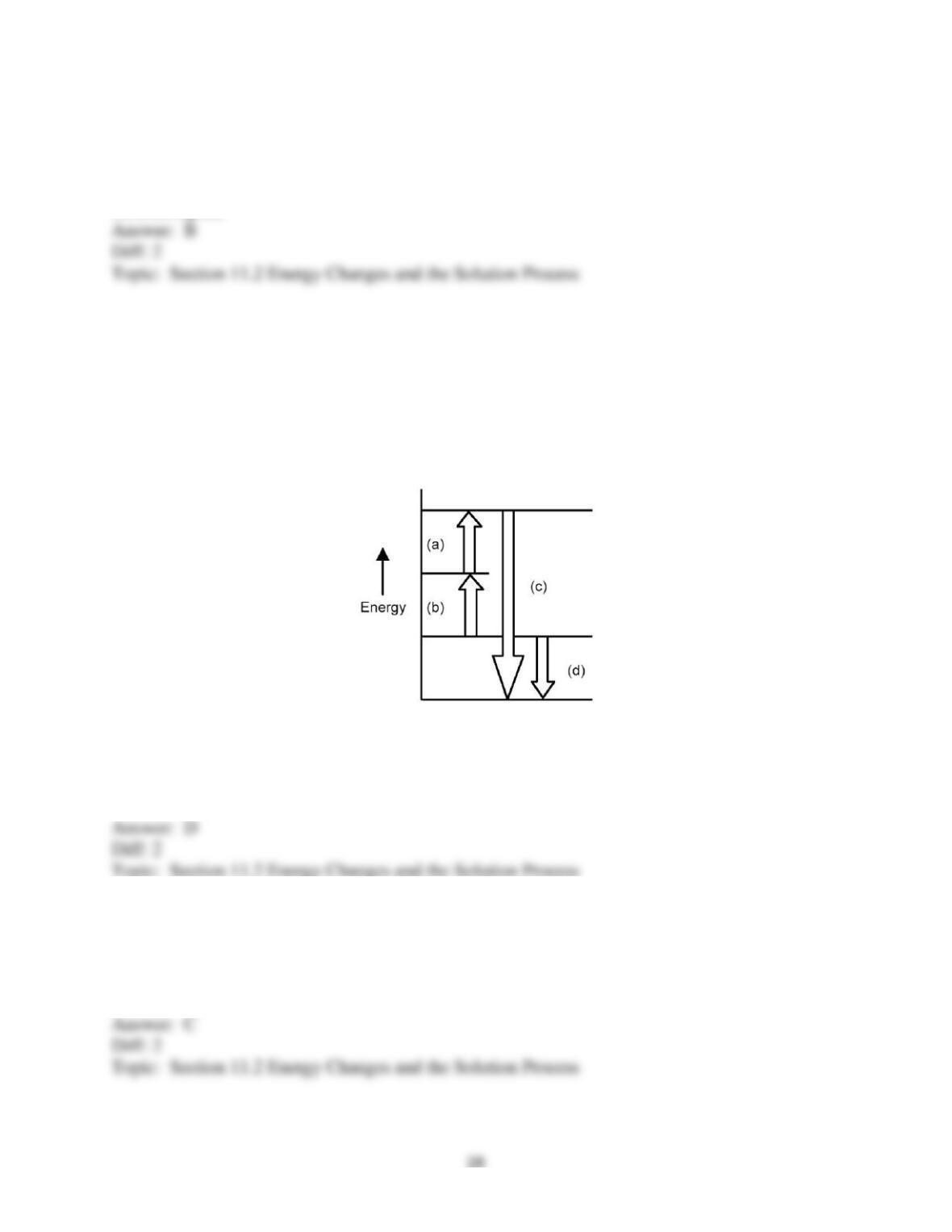
Arrows in the energy diagram below represent enthalpy changes occurring in the exothermic
formation of a solution:
ΔHsoln = enthalpy of solution
ΔHsolute-solute = enthalpy change involving solute-solute interactions
ΔHsolute-solvent = enthalpy change involving solute-solvent interactions
ΔHsolvent-solvent = enthalpy change involving solvent-solvent interactions
110) Which arrow represents ΔHsoln?
A) arrow (a)
B) arrow (b)
C) arrow (c)
D) arrow (d)
111) Which arrow represents ΔHsolute-solvent?
A) arrow (a)
B) arrow (b)
C) arrow (c)
D) arrow (d)
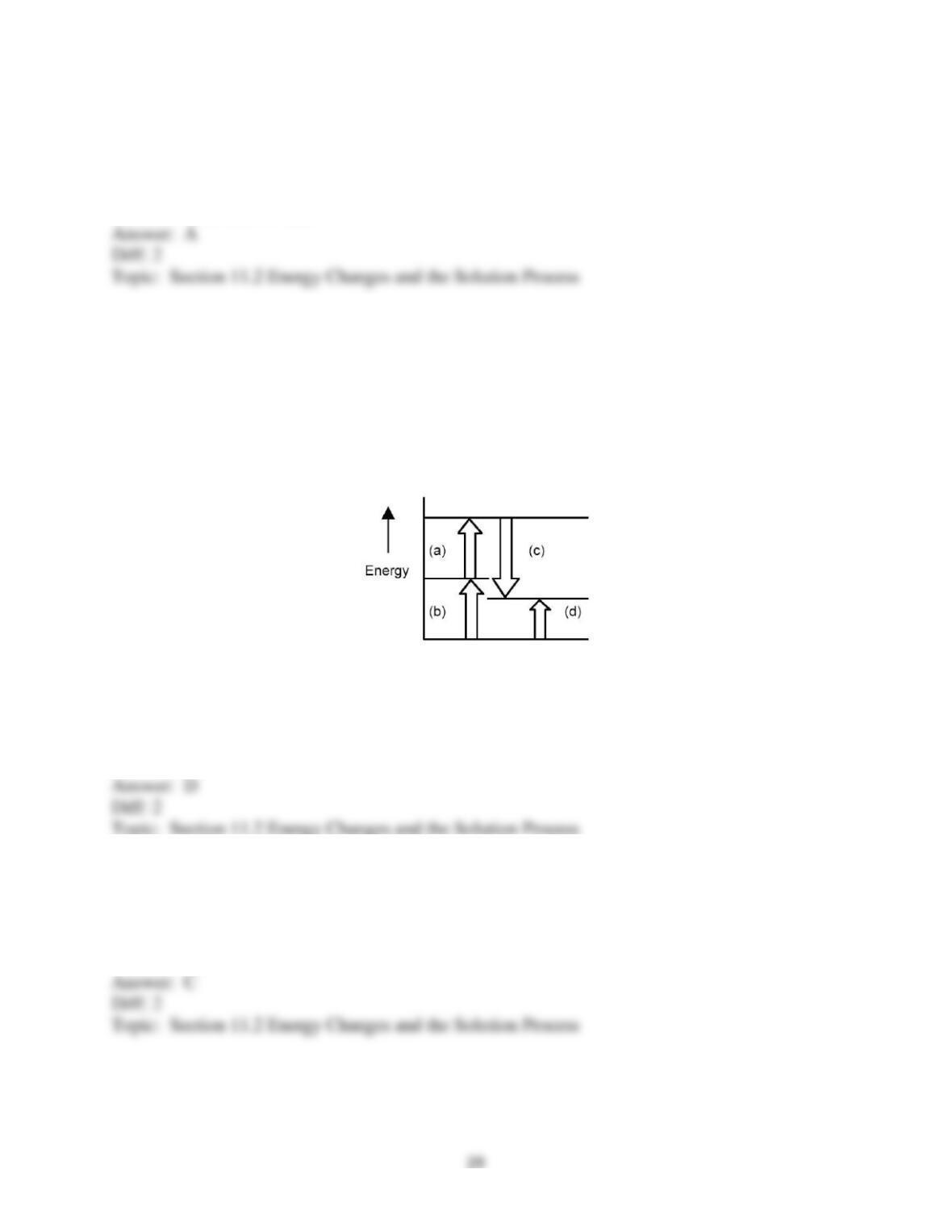
112) Which arrows represent ΔHsolute-solute and ΔHsolvent-solvent?
A) arrow (a) and arrow (b)
B) arrow (a) and arrow (c)
C) arrow (a) and arrow (d)
D) arrow (c) and arrow (d)
Arrows in the energy diagram below represent enthalpy changes occurring in the endothermic
formation of a solution:
ΔHsoln = enthalpy of solution
ΔHsolute-solute = enthalpy change involving solute-solute interactions
ΔHsolute-solvent = enthalpy change involving solute-solvent interactions
ΔHsolvent-solvent = enthalpy change involving solvent-solvent interactions
113) Which arrow represents ΔHsoln?
A) arrow (a)
B) arrow (b)
C) arrow (c)
D) arrow (d)
114) Which arrow represents ΔHsolute-solvent?
A) arrow (a)
B) arrow (b)
C) arrow (c)
D) arrow (d)
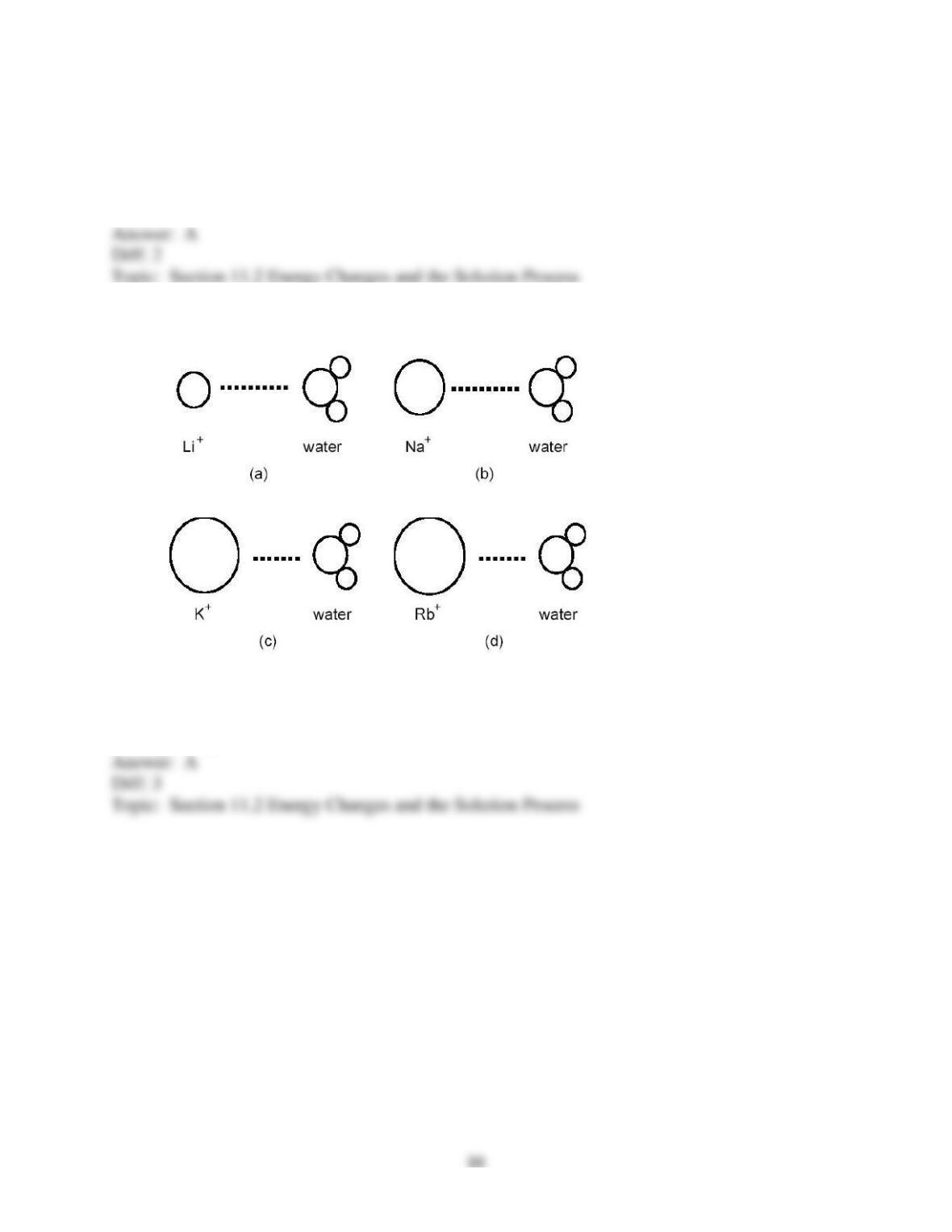
115) Which arrows represent ΔHsolute-solute and ΔHsolvent-solvent?
A) arrow (a) and arrow (b)
B) arrow (a) and arrow (c)
C) arrow (a) and arrow (d)
D) arrow (c) and arrow (d)
116) Which ion-dipole interaction results in the larger (more negative) hydration energy?
A) diagram (a)
B) diagram (b)
C) diagram (c)
D) diagram (d)
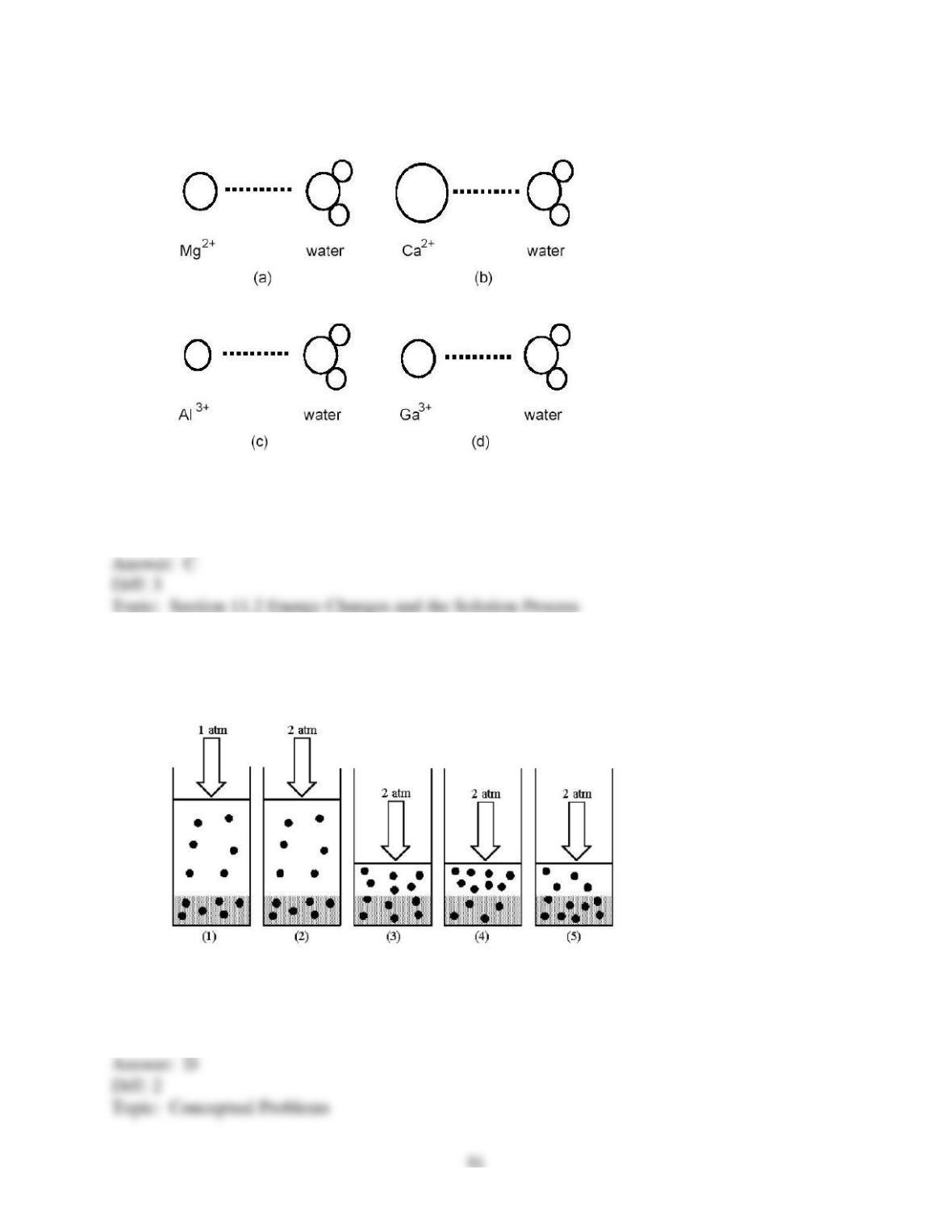
117) Which ion-dipole interaction results in the larger (more negative) hydration energy?
A) diagram (a)
B) diagram (b)
C) diagram (c)
D) diagram (d)
118) Drawing (1) shows a system in which an equilibrium exists between dissolved and
undissolved gas particles at P = 1 atm. According to Henry’s law, if the pressure is increased to 2
atm and equilibrium is restored, which drawing (2)-(5) best represents the equilibrium at 2 atm?
A) drawing (2)
B) drawing (3)
C) drawing (4)
D) drawing (5)
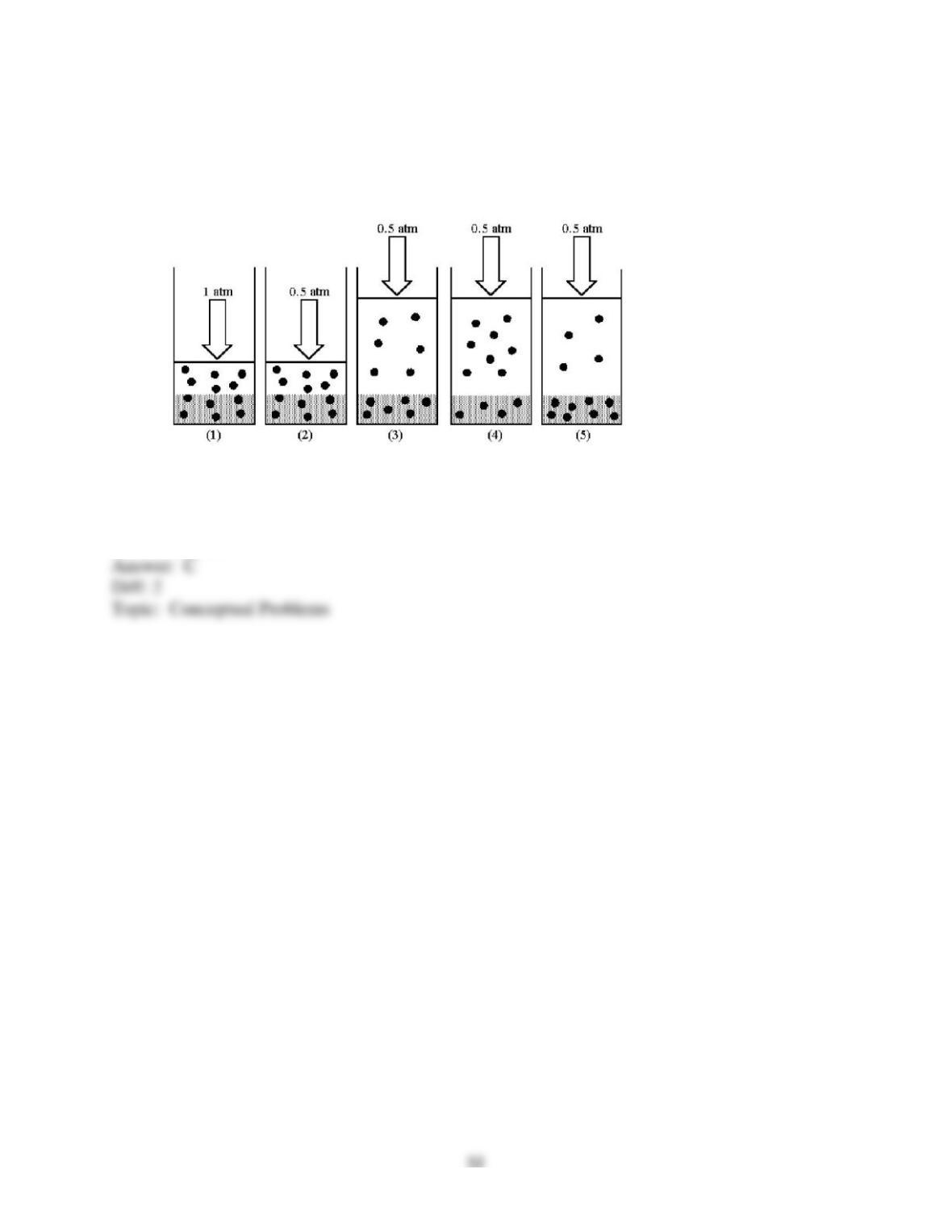
119) Drawing (1) shows a system in which an equilibrium exists between dissolved and
undissolved gas particles at P = 1 atm. According to Henry’s law, if the pressure is decreased to
0.5 atm and equilibrium is restored, which drawing (2)-(5) best represents the equilibrium at 0.5
atm?
A) drawing (2)
B) drawing (3)
C) drawing (4)
D) drawing (5)
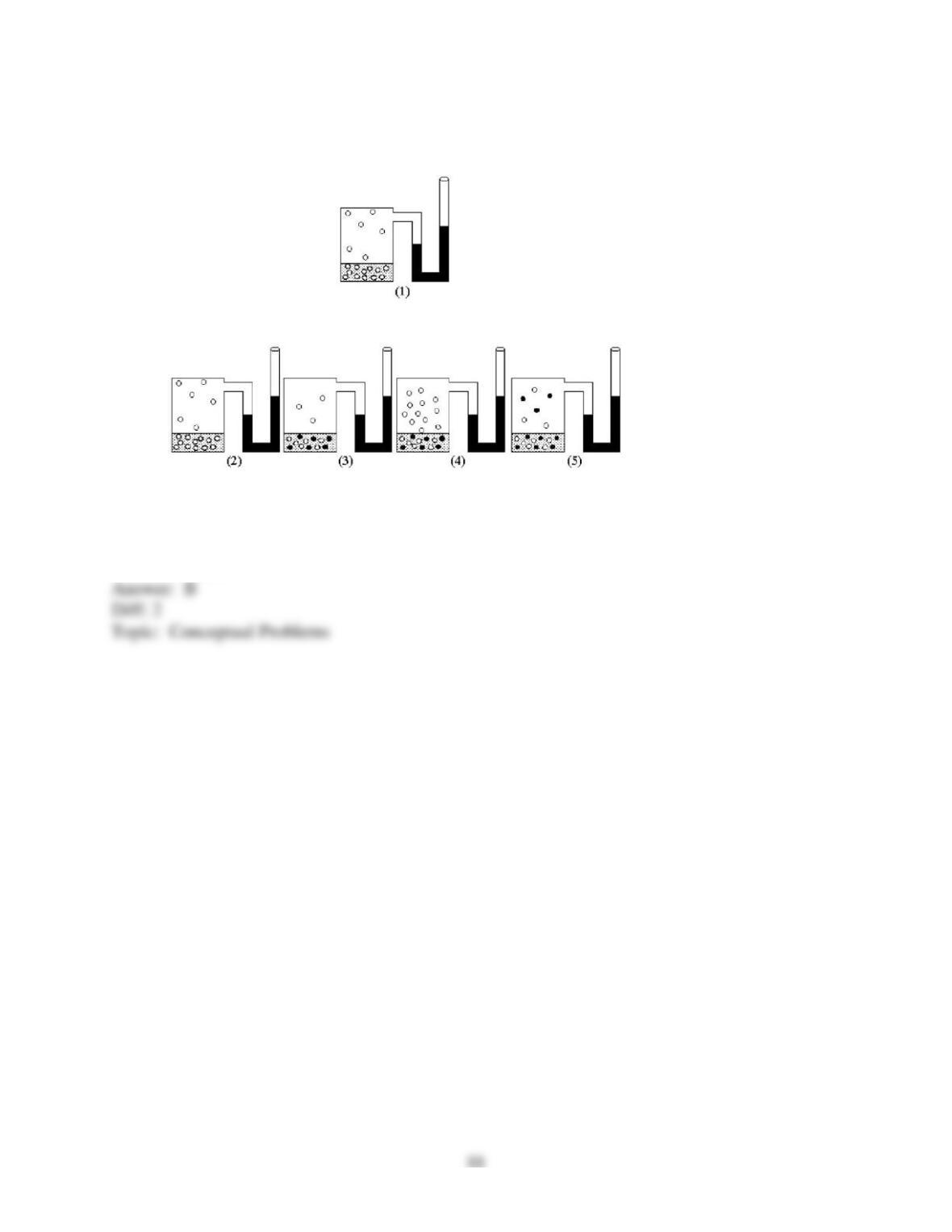
120) Drawing (1) shows the equilibrium vapor pressure of a pure liquid. Which drawing (2)-(5)
represents the equilibrium vapor pressure when a nonvolatile solute is dissolved in the liquid?
A) drawing (2)
B) drawing (3)
C) drawing (4)
D) drawing (5)
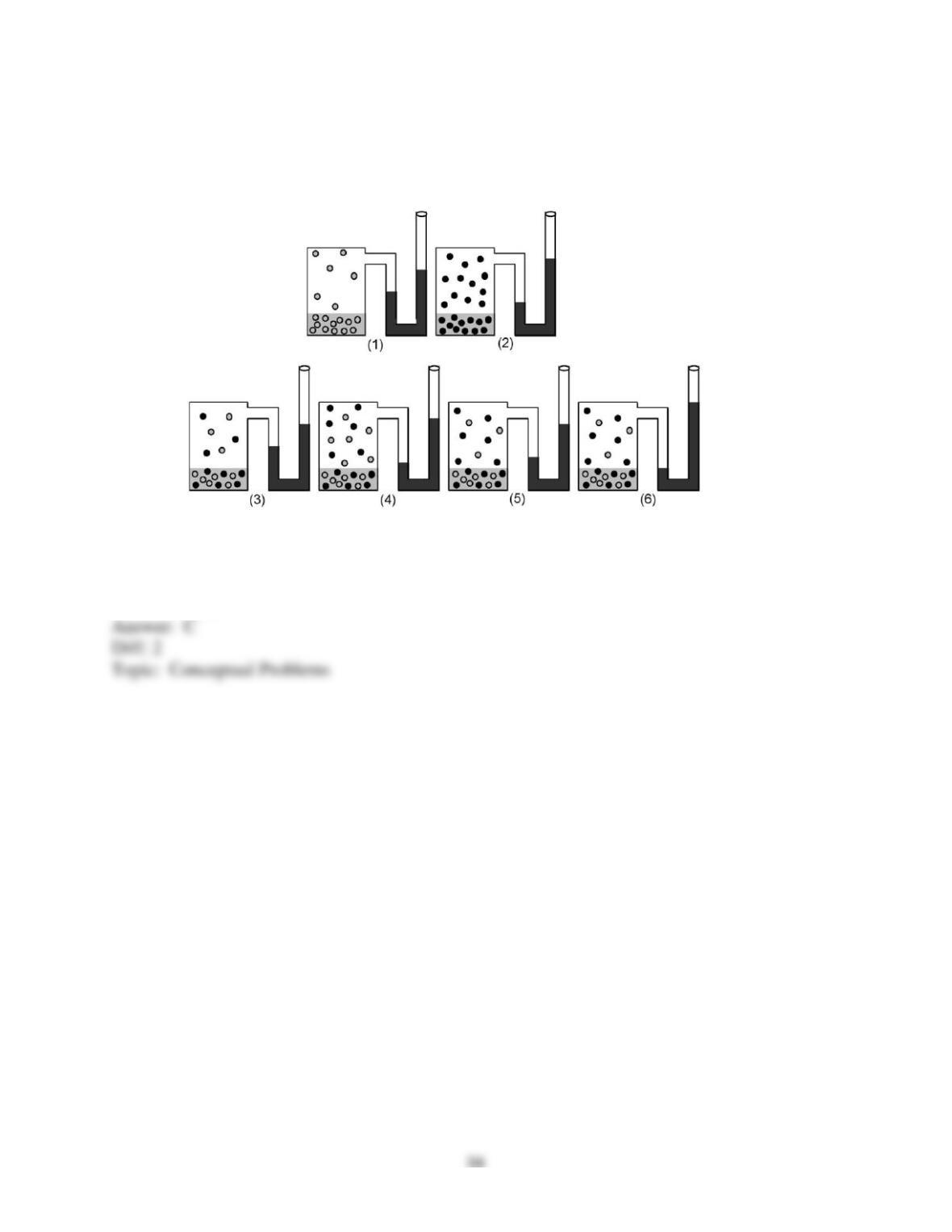
121) Drawings (1) and (2) show the equilibrium vapor pressures of two pure liquids. Which
drawing (3)-(6) represents the equilibrium vapor pressure of a solution made by mixing equal
moles of each liquid?
A) drawing (3)
B) drawing (4)
C) drawing (5)
D) drawing (6)
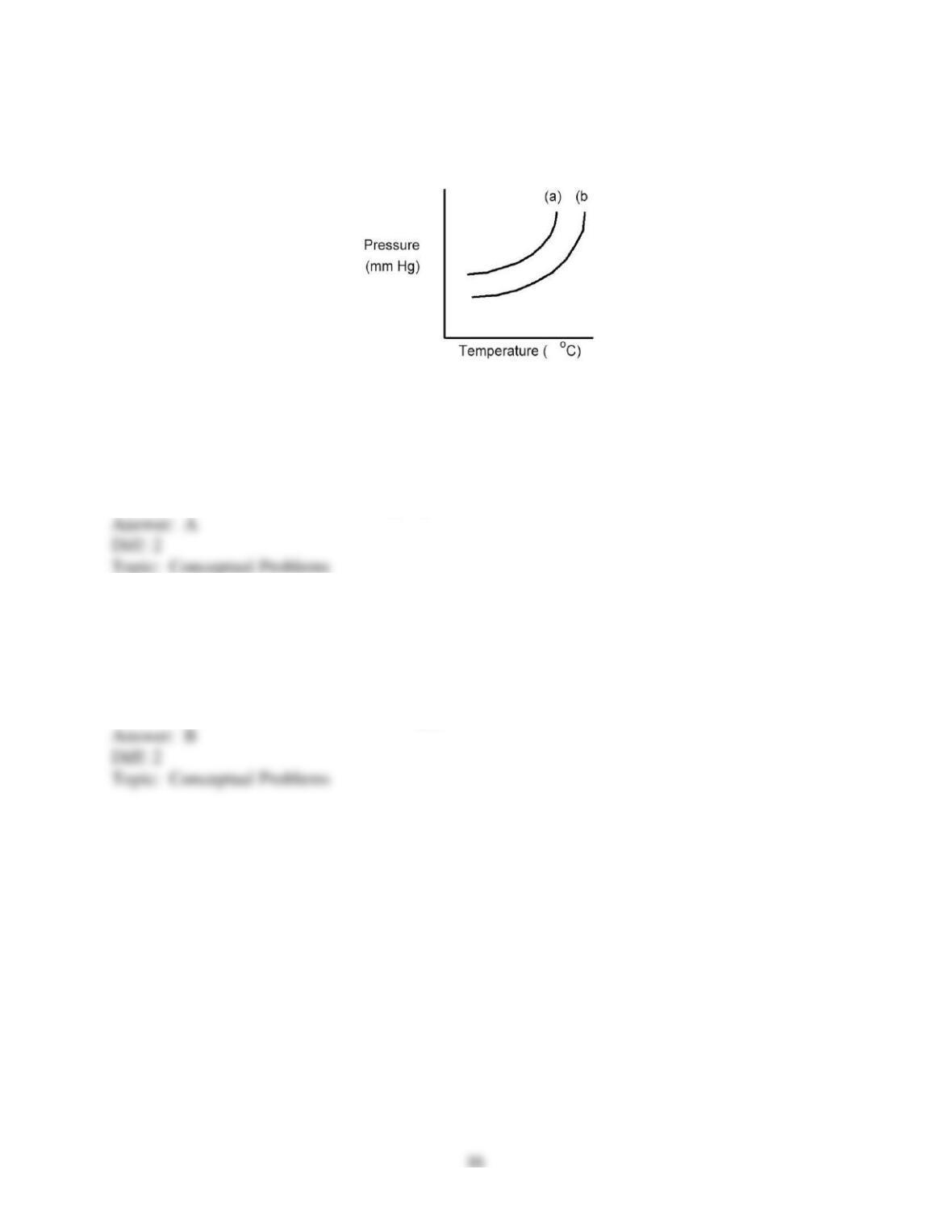
The following diagram shows a close-up view of the vapor pressure curves for a pure solvent and
a solution containing a nonvolatile solute dissolved in this solvent.
122) Which curve is the solvent and what happens to the vapor pressure when the solute is
dissolved in the solvent?
A) Curve (a) is the solvent and the vapor pressure decreases.
B) Curve (a) is the solvent and the vapor pressure increases.
C) Curve (b) is the solvent and the vapor pressure decreases.
D) Curve (b) is the solvent and the vapor pressure increases.
123) Which curve is the solvent and what happens to the boiling point when the solute is
dissolved in the solvent?
A) Curve (a) is the solvent and the boiling point decreases.
B) Curve (a) is the solvent and the boiling point increases.
C) Curve (b) is the solvent and the boiling point decreases.
D) Curve (b) is the solvent and the boiling point increases.
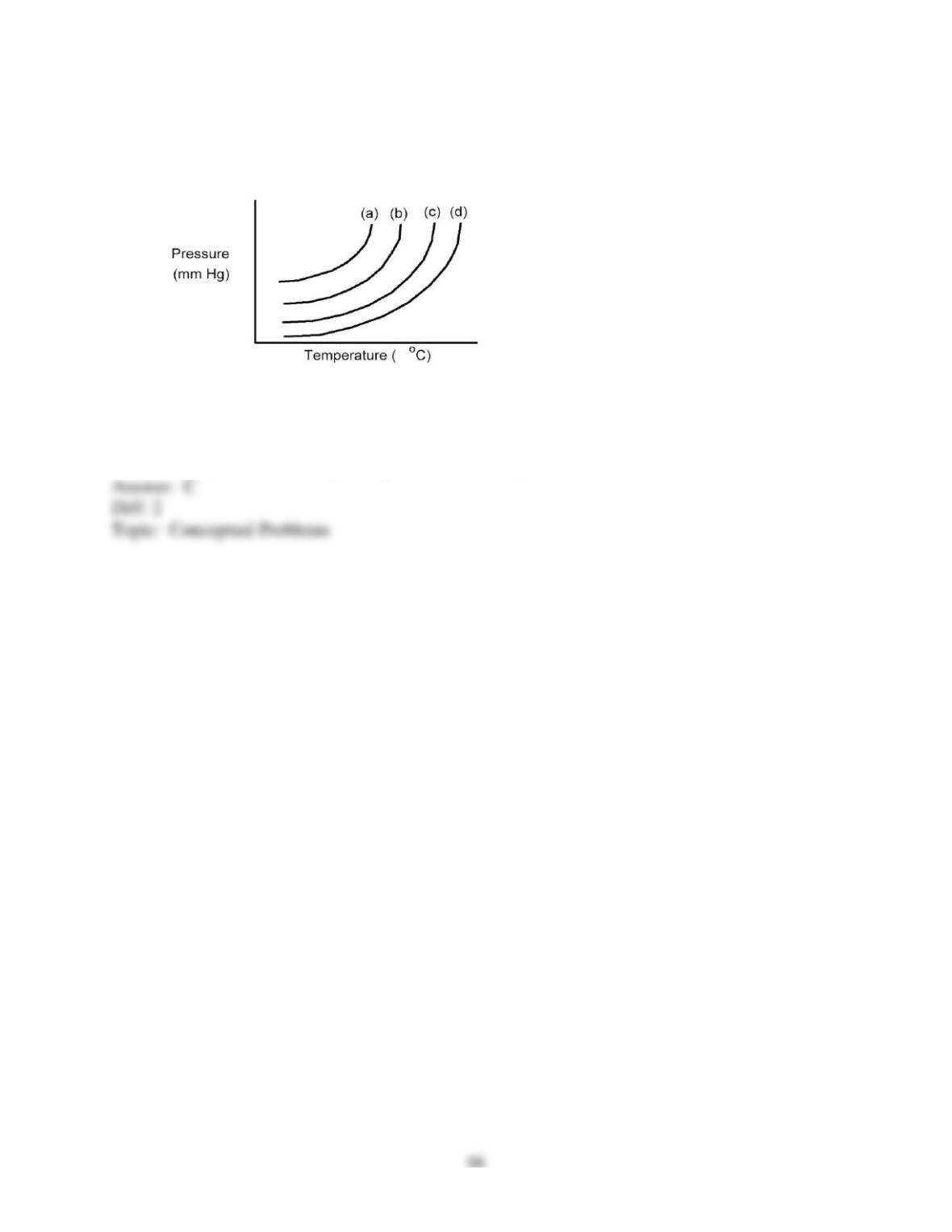
124) The following diagram shows a close-up view of the vapor pressure curves for two pure
liquids and two different solutions composed of these two liquids. Which curves represent pure
liquids and which curves represent the solutions?
A) Curves (a) and (b) are the pure liquids and curves (c) and (d) are the solutions.
B) Curves (a) and (c) are the pure liquids and curves (b) and (d) are the solutions.
C) Curves (a) and (d) are the pure liquids and curves (b) and (c) are the solutions.
D) Curves (c) and (d) are the pure liquids and curves (a) and (b) are the solutions.