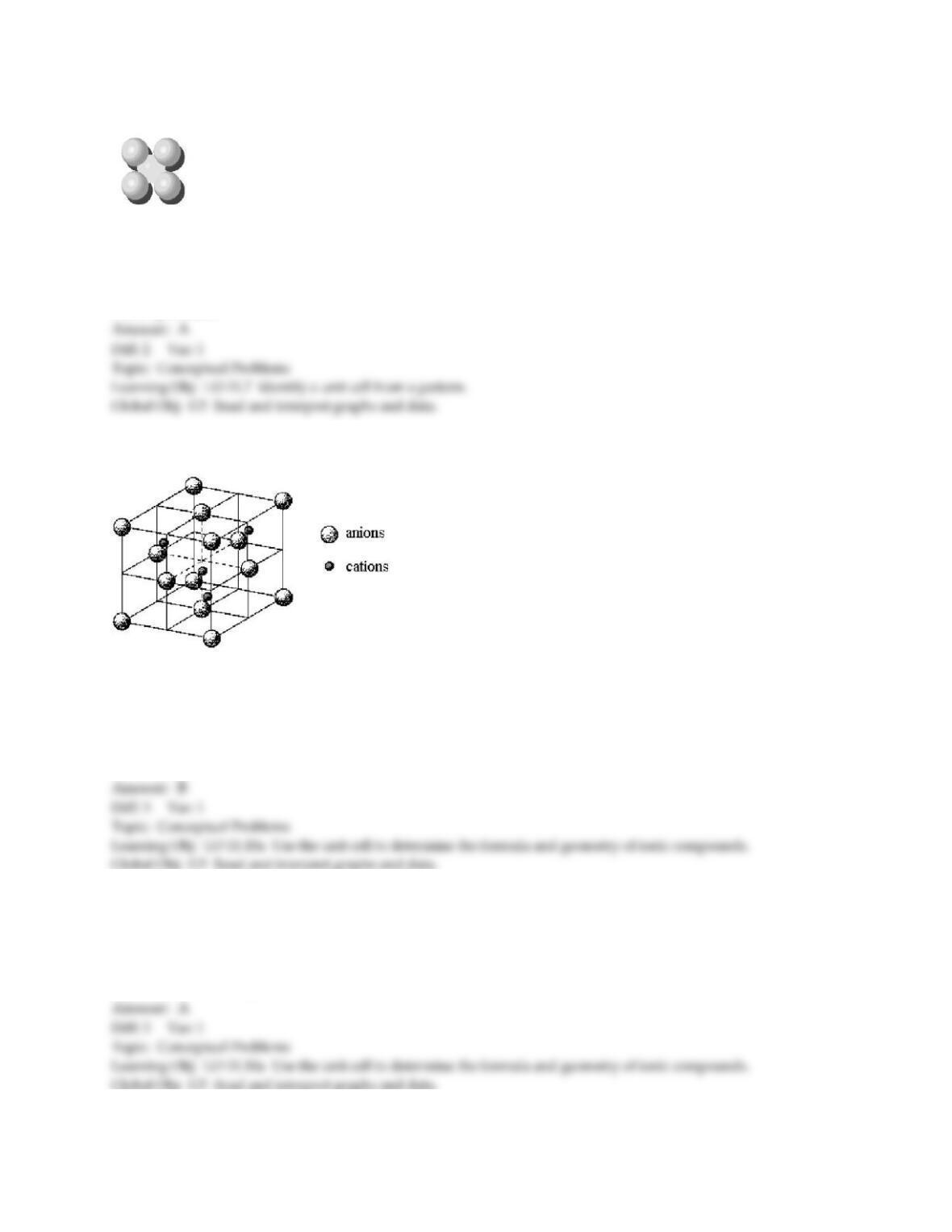
21
A) body-centered cubic
B) cubic closest packed (face-centered cubic)
C) hexagonal closest packed
D) simple cubic
A certain mineral crystallizes in the cubic unit cell shown below.
68) What kind of packing do the anions adopt?
A) body-centered cubic
B) cubic closest packed (face-centered cubic)
C) hexagonal closest packed
D) simple cubic
69) How many cations and how many anions are in the unit cell?
A) 4 cations and 4 anions
B) 4 cations and 8 anions
C) 4 cations and 14 anions
D) 8 cations and 4 anions
70) A certain mineral crystallizes in the cubic unit cell shown below. M represents the cations and A
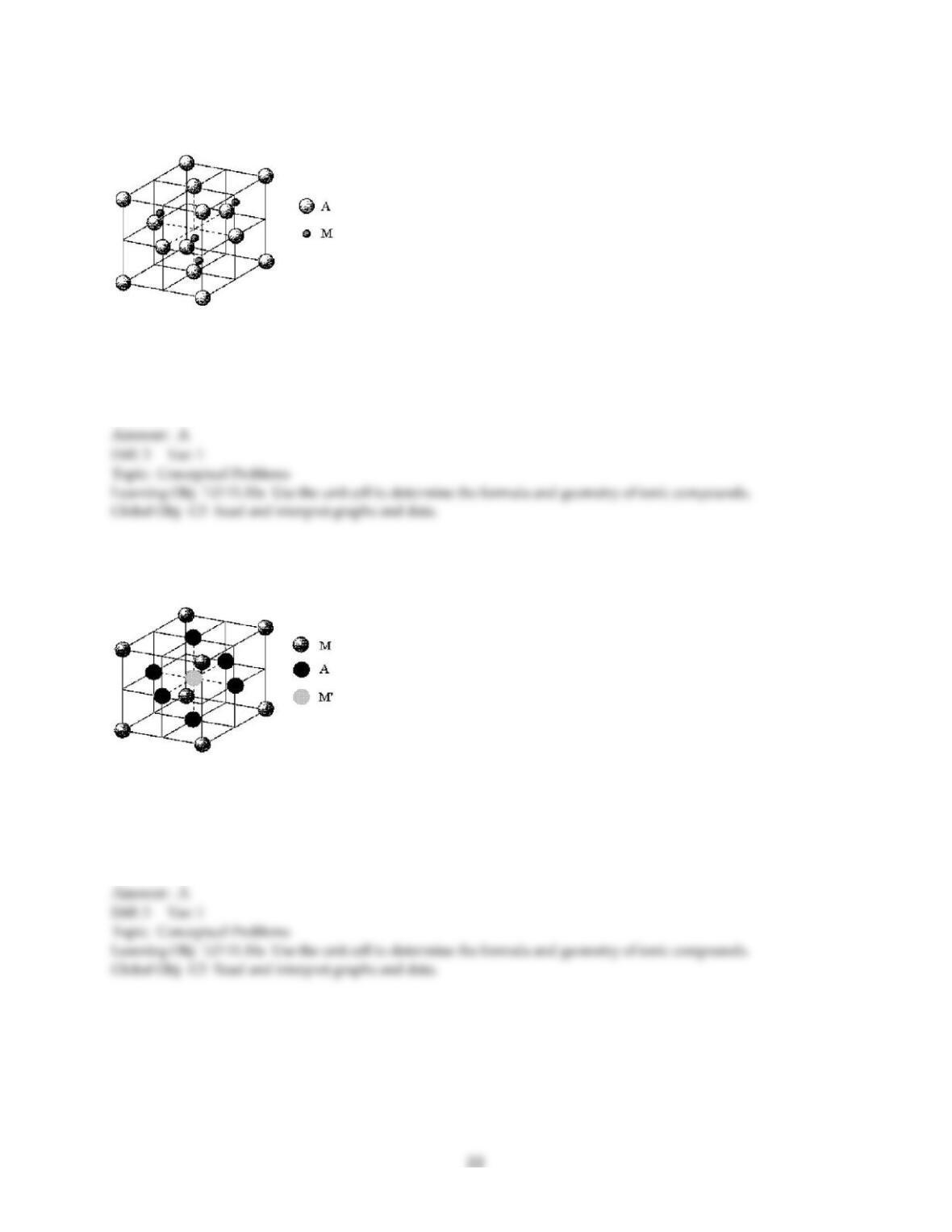
represents the anions. What is the empirical formula of the mineral?
A) MA
B) MA2
C) M2A
D) M4A4
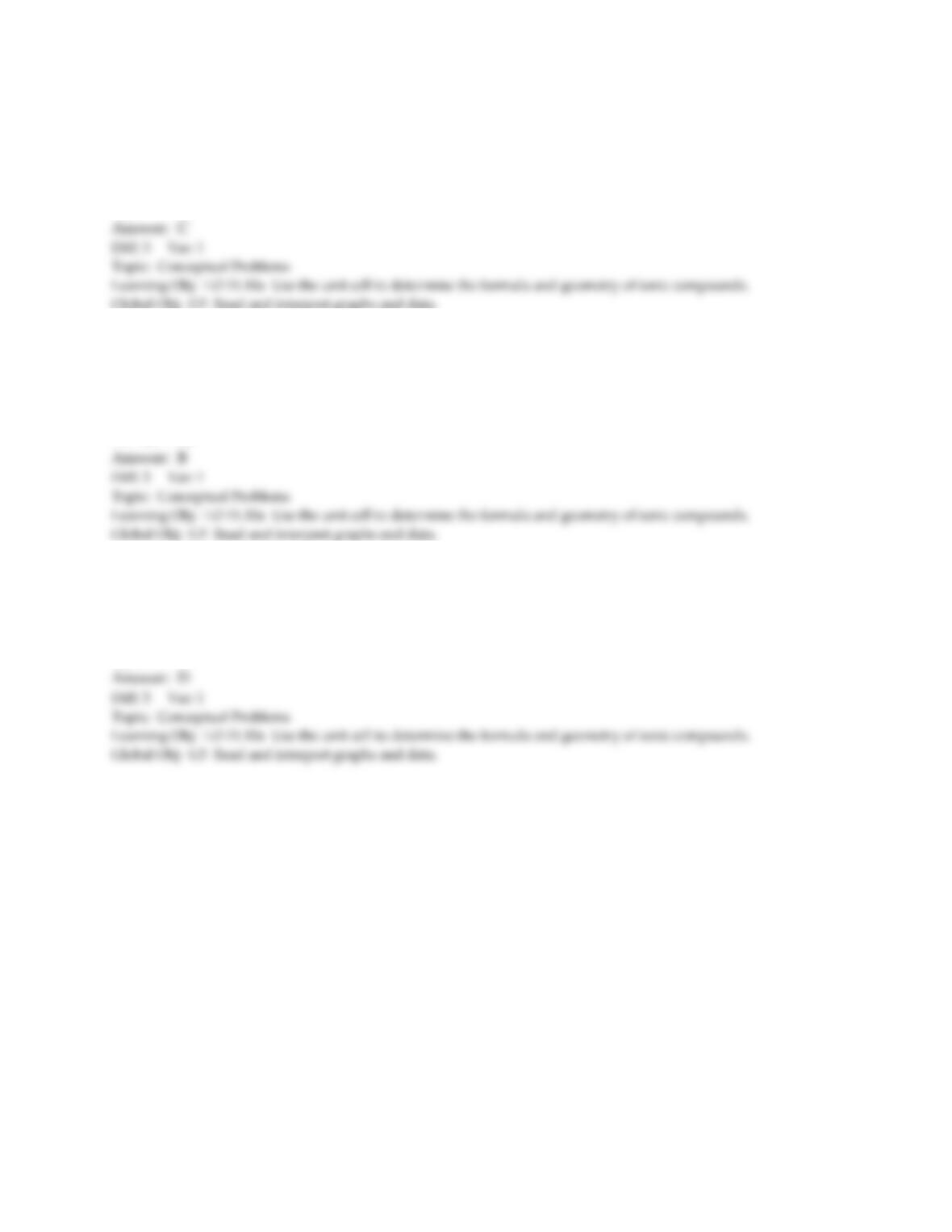
A certain mineral, MxM’yAz, crystallizes in the cubic unit cell shown below. M and M’ represent cations
and A represents the anions.
71) How many cations M are in the unit cell?
A) 1
B) 2
C) 4
D) 8
23
72) How many anions are in the unit cell?
A) 1
B) 2
C) 3
D) 6
73) What is the empirical formula of the mineral?
A) MM’A
B) MM’A3
C) M2M’A3
D) M8M’A6
74) If cation M has a 2+ charge and anion A has a 2– charge, what is the oxidation state of cation M’?
A) +1
B) +2
C) +3
D) +4
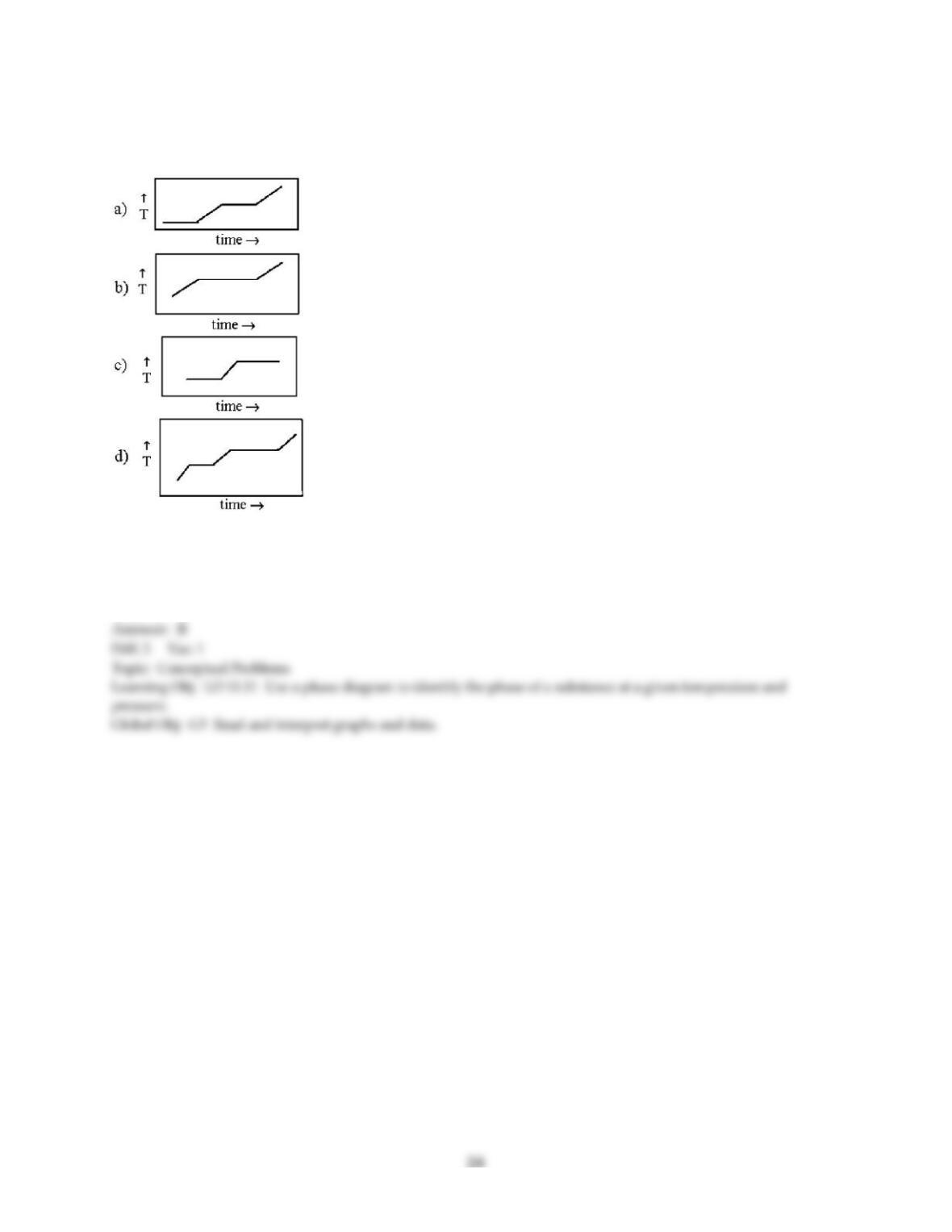
75) Consider a compound that undergoes sublimation at 125°C and a pressure of one atm. Which of the
following could be a heating curve appropriate for heating the compound from 100°C to 150°C?
A) graph a
B) graph b
C) graph c
D) graph d
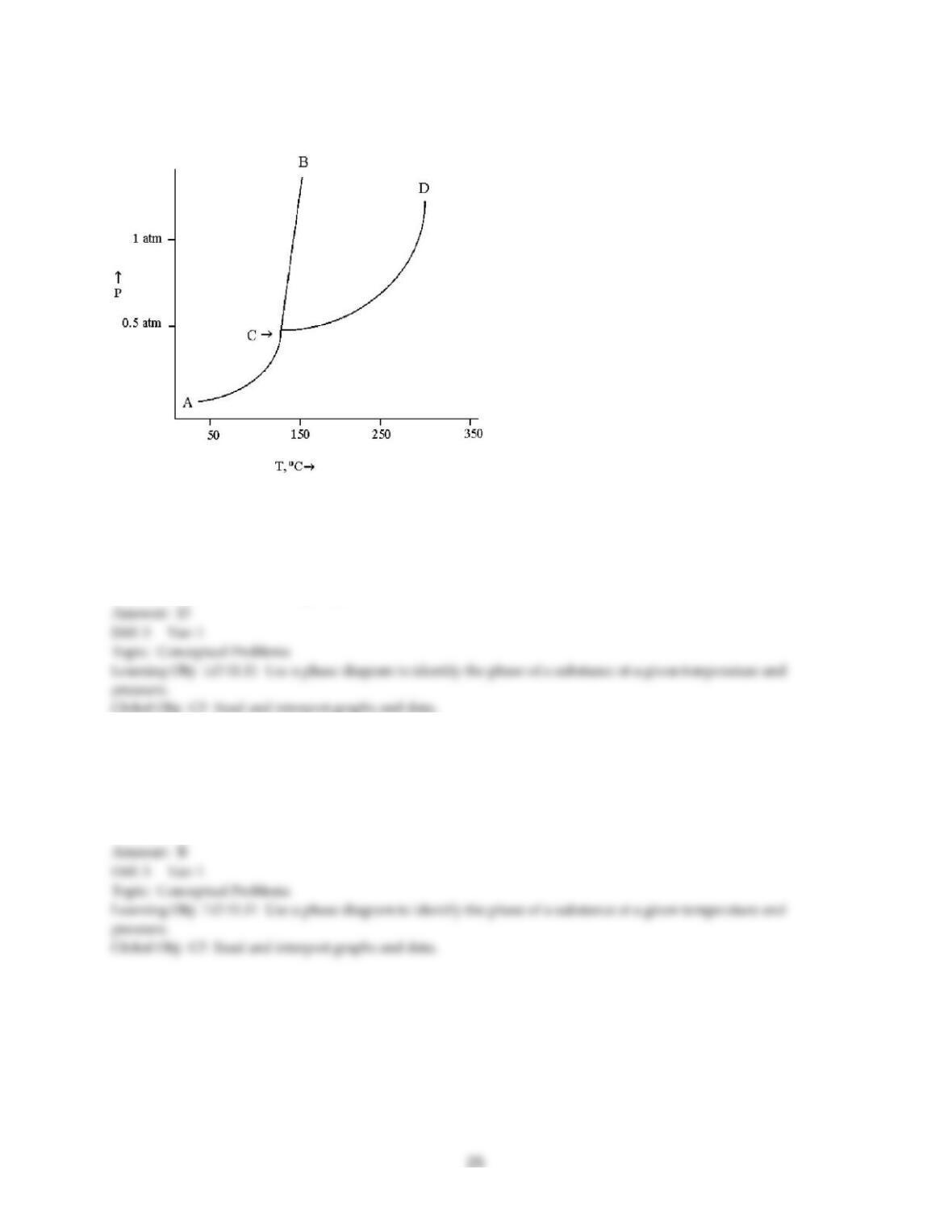
Use the diagram below to answer the following questions.
76) According to the diagram, the solid phase of this substance
A) has the same density as the liquid phase.
B) is less dense than water.
C) is less dense than the liquid phase.
D) is more dense than the liquid phase.
77) Melting occurs along the
A) AC line.
B) CB line.
C) CD line.
D) All of these
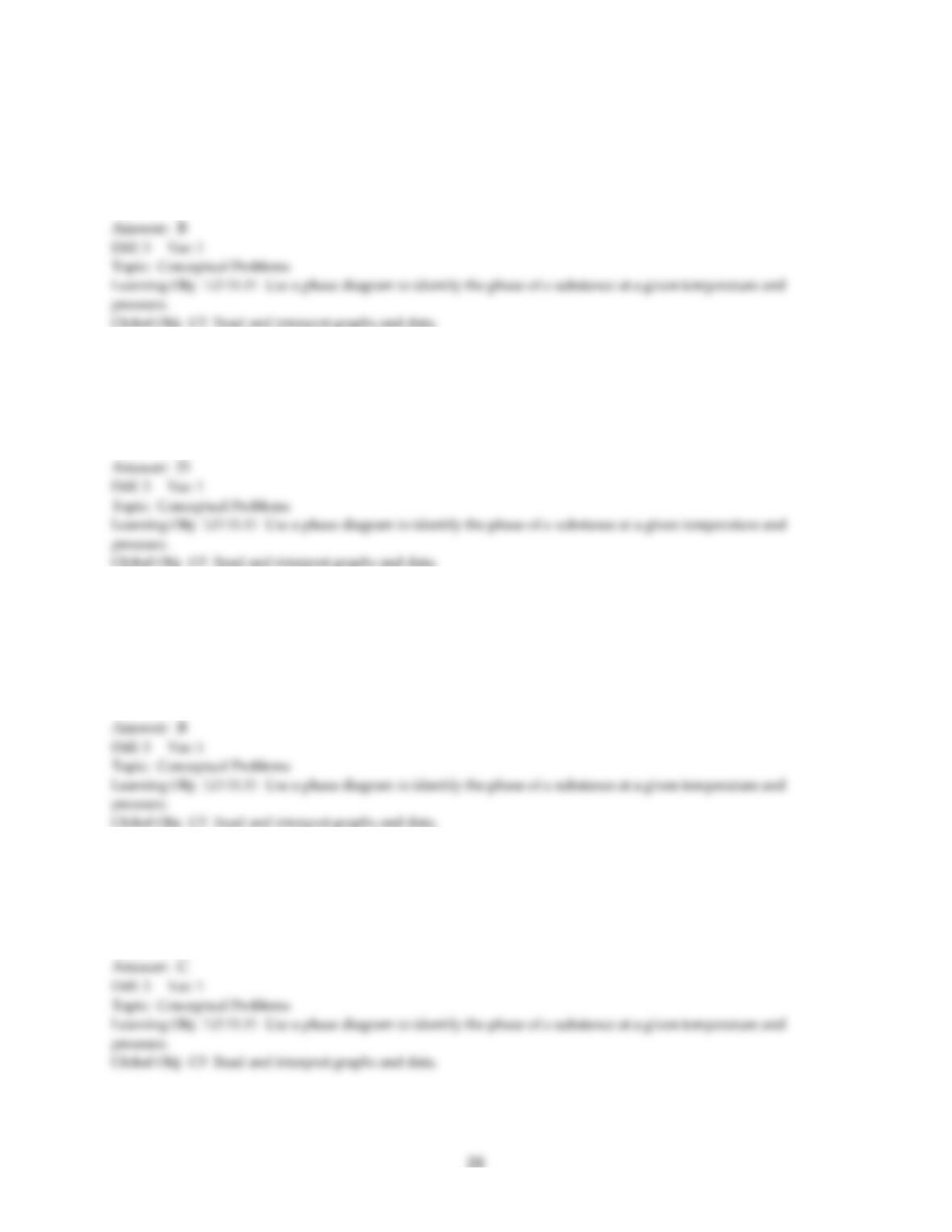
78) The solid and liquid phases can exist in equilibrium along line
A) AC.
B) CB.
C) CD.
D) BD.
79) The temperature and pressure at which all three phases can coexist in equilibrium is
A) 0.25 atm and 110°C.
B) 1.0 atm and 140°C.
C) 1.25 atm and 300°C.
D) 0.45 atm and 130°C.
80) From the phase diagram above, the minimum pressure at which this substance can exist in the liquid
phase is
A) 0.25 atm.
B) 0.45 atm.
C) 1.0 atm.
D) 1.2 atm.
81) The normal boiling point of this substance is approximately
A) 25°C.
B) 140°C.
C) 300°C.
D) 350°C.
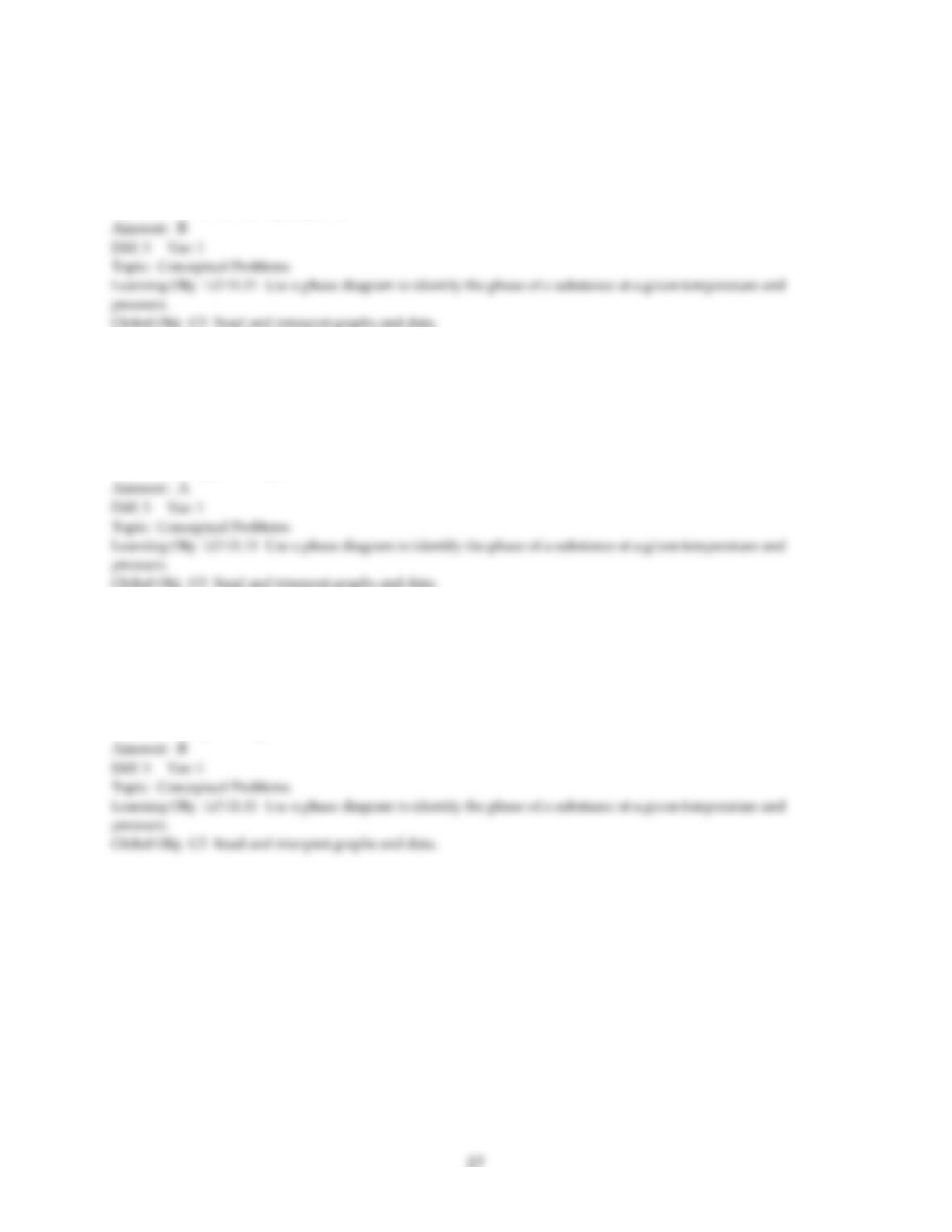
82) What phases can be present at 200°C and 0.75 atm pressure?
A) only the vapor phase
B) only the liquid phase
C) only the solid phase
D) both the solid and vapor phases
83) What phase changes occur when the temperature is held constant at 140°C and the pressure is
increased from 0.25 atm to 1.4 atm?
A) gas → liquid → solid
B) gas → solid → liquid
C) liquid → solid → gas
D) solid → liquid → vapor
84) What phase changes occur when the pressure is held constant at 0.25 atm and the temperature
increases from 100°C to 300°C?
A) liquid → gas
B) solid → gas
C) solid → liquid
D) solid → liquid → gas
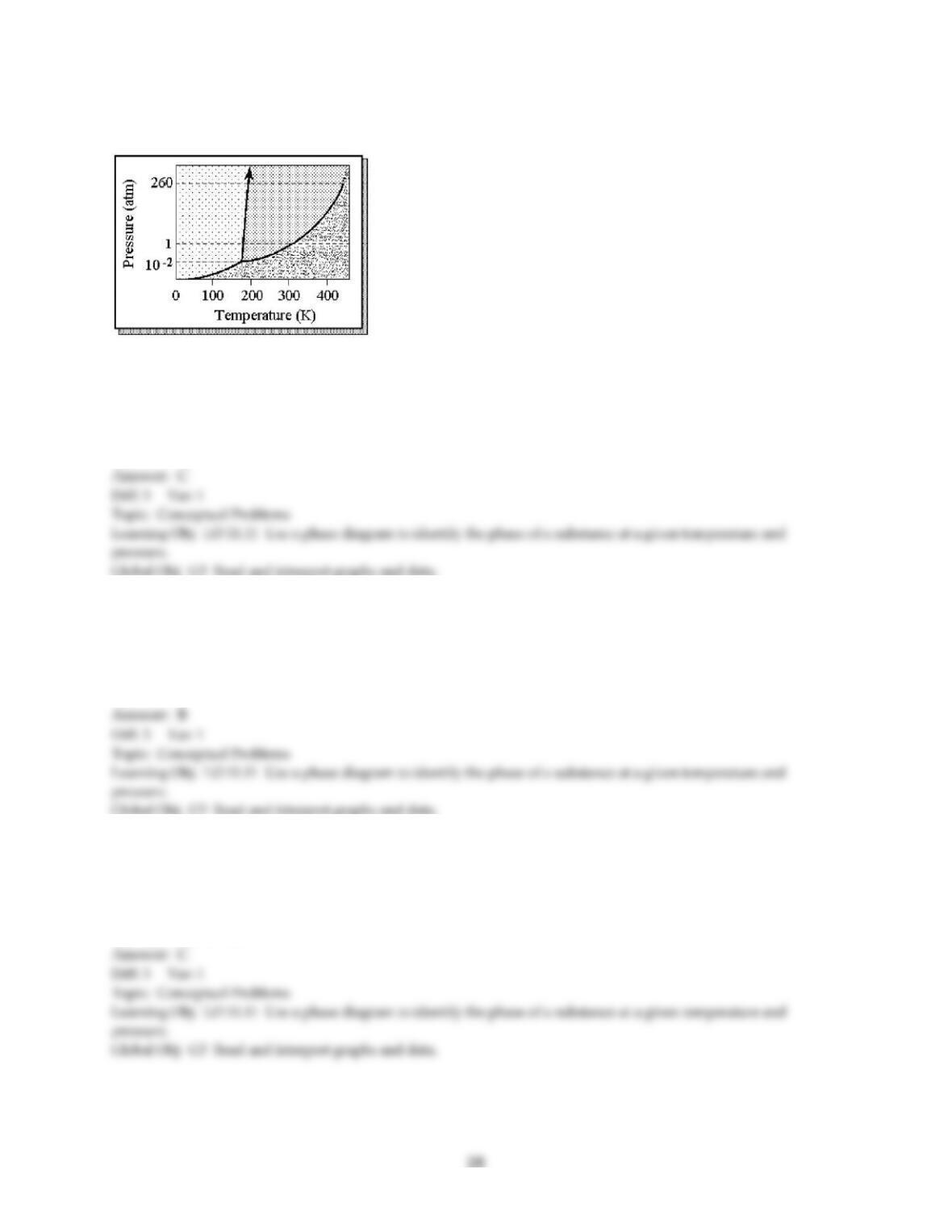
The phase diagram of a substance is shown below.
85) The approximate normal boiling point of this substance is
A) 180 K.
B) 190 K.
C) 300 K.
D) 430 K.
86) The approximate normal melting point of this substance is
A) 100 K.
B) 190 K.
C) 300 K.
D) 430 K.
87) What is the physical phase of the substance at T = 100 K and P = 0.1 atm?
A) gas
B) liquid
C) solid
D) supercritical fluid
88) What is the physical phase of the substance at T = 225 K and P = 1.1 atm?
A) gas
B) liquid
C) solid
D) supercritical fluid
89) What is the physical phase of the substance at T = 400 K and P = 2.0 atm?
A) gas
B) liquid
C) solid
D) supercritical fluid
11.2 Algorithmic Questions
1) The property of a liquid that measure the liquid’s resistance to spread out and increase its surface area
is
A) sublimation point.
B) heat of deposition.
C) dipole-dipole forces.
D) surface tension.
2) Which of the following is most likely to have the highest viscosity at 25°C?
A) C6H14
B) HOCH2CH2OH
C) C3H7OH
D) C7H8
3) Which is expected to have the highest surface tension at 25°?
A) C7H16
B) C8H10
C) C5H11OH
D) C3H5(OH)3
4) Ethyl chloride, C2H5Cl, is used as a local anesthetic. It works by cooling tissue as it vaporizes; its heat
of vaporization is 26.4 kJ/mol. How much heat could be removed by 10.0 g of ethyl chloride?
A) 4.09 kJ
B) 170 kJ
C) 264 kJ
D) 1700 kJ
5) How much heat is released when 95.0 g of steam at 100.0°C is cooled to ice at -15.0°C? The enthalpy of
vaporization of water is 40.67 kJ/mol, the enthalpy of fusion for water is 6.01 kJ/mol, the molar heat
capacity of liquid water is 75.4 J/(mol ∙ °C), and the molar heat capacity of ice is 36.4 J/(mol ∙ °C).
A) 54.8 kJ
B) 247 kJ
C) 289 kJ
D) 314 kJ
6) Which of the following phase changes has a positive value for its entropy change?
A) creating steam
B) formation of snow from a cloud
C) sublimation of gaseous CO2
D) making ice cubes from liquid water
7) For which of the following phase changes is the sign of ΔS negative?
A) evaporation of water
B) formation of raindrops from water vapor in clouds
C) melting of ice cream
D) sublimation of CO2