6) Which of the following compounds exhibits only dipole-dipole intermolecular interactions?
A) Br2
B) CH3Br
C) CBr4
D) BrCH2CH2OH
7) The normal boiling point for H2Se is higher than the normal boiling point for H2S . This can be
explained by
A) larger dipole-dipole forces for H2Se .
B) larger dispersion forces for H2Se .
C) larger hydrogen-bond forces for H2Se .
D) larger dipole-dipole forces, larger dispersion forces, and larger hydrogen-bond forces for H2Se .
8) What is the strongest type of intermolecular force present in Cl2?
A) ion-dipole
B) dipole-dipole
C) dispersion
D) hydrogen bonding
E) none of the above
9) What is the strongest type of intermolecular force present in CHBr3?
A) ion-dipole
B) dispersion
C) hydrogen bonding
D) dipole-dipole
E) none of the above
10) What type of intermolecular force causes the dissolution of KF in water?
A) hydrogen bonding
B) dipole-dipole forces
C) ion-dipole force
D) dispersion forces
E) none of the above
11) Choose the molecule or compound that exhibits dispersion forces as its strongest intermolecular
force.
A) O2
B) CO
C) HF
D) NaCl
E) All of these have intermolecular forces stronger than dispersion.
12) Choose the molecule or compound that exhibits dipole-dipole forces as its strongest intermolecular
force.
A) H2
B) SO2
C) NH3
D) CF4
E) BCl3
13) Choose the compound that exhibits hydrogen bonding as its strongest intermolecular force.
A) SBr2
B) C2H6
C) CH3OH
D) CH2Br2
E) None of the above compounds exhibit hydrogen bonding.
14) Place the following compounds in order of increasing strength of intermolecular forces.
CS2 I2 NH2CH3
A) NH2CH3 < CS2 < I2
B) I2 < NH2CH3 < CS2
C) NH2CH3 < I2 < CS2
D) I2 < CS2 < NH2CH3
E) CS2 < NH2CH3 < I2
15) Place the following compounds in order of decreasing strength of intermolecular forces.
HF H2 CO2
A) HF > CO2 > H2
B) HF > H2 > CO2
C) H2 > CO2 > HF
D) CO2 > HF > H2
E) CO2 > H2 > HF
16) Identify the compound that does not have dipole-dipole forces as its strongest force.
A) CH2Br2
B) CH3OCH3
C) CH3Cl
D) HCBr3
E) CO2
17) Identify the compound that has hydrogen bonding.
A) (CH3)3N
B) N2
C) CH3CH3
D) HI
E) H2O
18) Choose the pair of substances that are most likely to form a homogeneous solution.
A) KI and Hg
B) LiCl and C6H14
C) C3H8 and C2H5OH
D) F2 and PF3
E) NH3 and CH3OH
19) Choose the pair of substances that are most likely to form a homogeneous solution.
A) C6H14 and C10H20
B) KCl and C5H12
C) N2O4 and NH4I
D) C6H14 and H2O
E) None of the pairs above will form a homogeneous solution.
20) Choose the pair of substances that are most likely to form a homogeneous solution.
A) CBr4 and SF2
B) NF3 and SO2
C) CO and C6H6
D) NH2CH3 and CH4
E) None of the pairs above will form a homogeneous solution.
21) Choose the substance with the highest surface tension.
A) HOCH2CH2OH
B) CH2Br2
C) CH3CH2Cl
D) CH3CH2OH
E) CH3CH2CH3
22) Choose the substance with the lowest surface tension.
A) CH3OH
B) CH3CH2CH2CH3
C) C6H6
D) H2O
E) (CH3)2CO
23) Choose the substance with the highest viscosity.
A) (CH3CH2)2CO
B) C2H4Cl2
C) HOCH2CH2CH2CH2OH
D) CCl4
E) C6H14
24) Identify the substance with the highest viscosity.
A) gasoline
B) water
C) maple syrup
D) motor oil
E) coffee
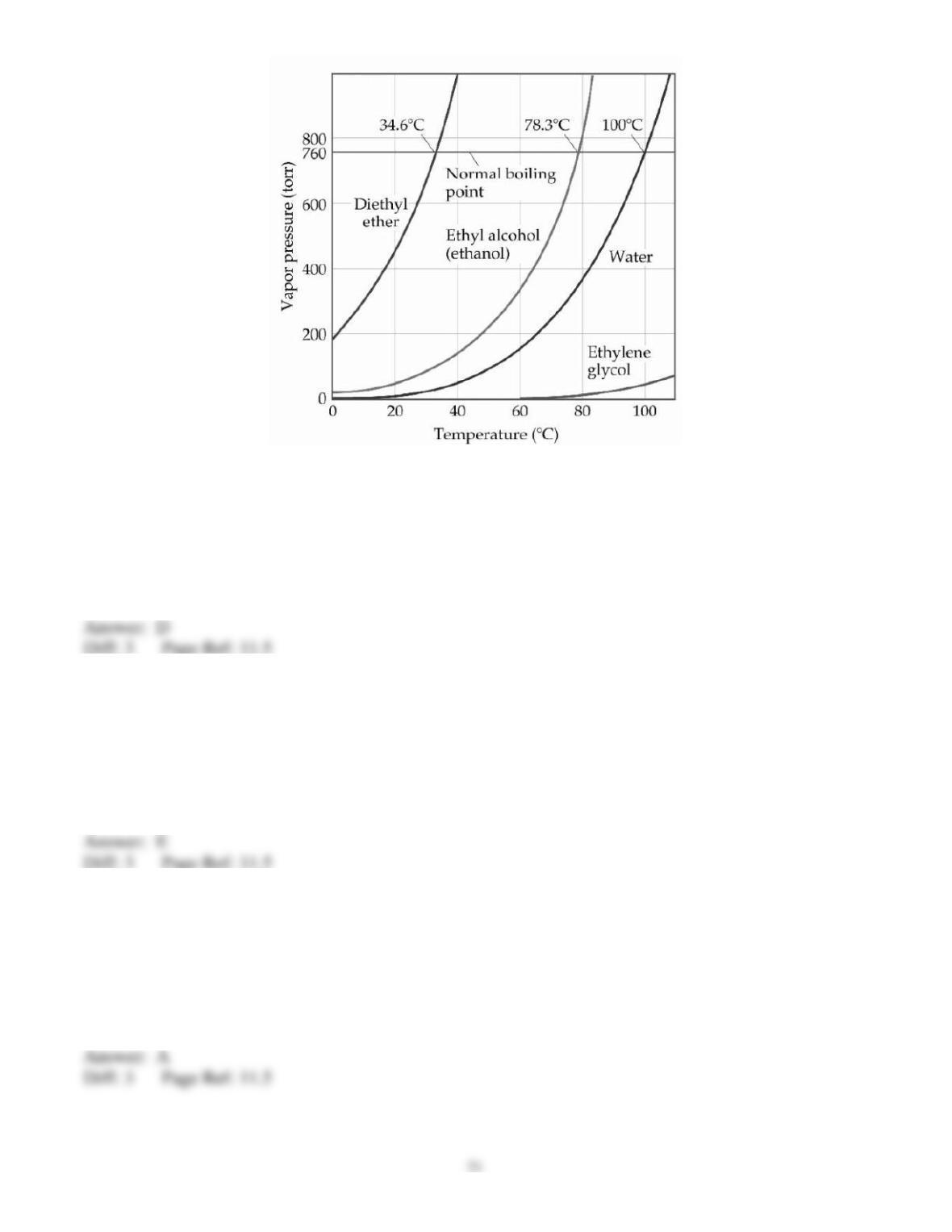
25) Based on the figure above, the boiling point of diethyl ether under an external pressure of 1.32 atm
is ________°C.
A) 10
B) 20
C) 30
D) 40
E) 0
26) Based on the figure above, the boiling point of ethyl alcohol under an external pressure of 0.0724
atm is ________°C.
A) 80
B) 60
C) 70
D) 40
E) 20
27) Based on the figure above, the boiling point of water under an external pressure of 0.316 atm is
________°C.
A) 70
B) 40
C) 60
D) 80
E) 90
28) Which of the following compounds has the highest boiling point?
A) H2O
B) H Cl
C) H2S
D) N H3
29) Choose the substance with the lowest vapor pressure at a given temperature.
A) CO2
B) CaI2
C) BF3
D) Ar
E) PF5
30) Place the following substances in order of increasing boiling point.
Ne I2 N2
A) Ne < I2 < N2
B) I2 < N2 < Ne
C) N2 < I2 < Ne
D) I2 < Ne < N2
E) Ne < N2 < I2
31) Place the following substances in order of increasing boiling point.
CH3CH2OH He CH3OCH3
A) He < CH3OCH3 < CH3CH2OH
B) CH3CH2OH < He < CH3OCH3
C) CH3CH2OH < CH3OCH3 < He
D) CH3OCH3 < He < CH3CH2OH
E) He < CH3CH2OH < CH3OCH3
32) Choose the substance with the highest boiling point.
A) CH4
B) KI
C) CS2
D) HF
E) I2
33) Choose the substance with the lowest boiling point.
A) H2S
B) NBr3
C) O2
D) CI2H2
E) H2O2
34) Which of the following substances would you predict to have the highest ΔHvap?
A) Xe
B) C6H6
C) SiF4
D) F2
E) N2
35) How much energy is required to vaporize 158 g of butane (C4H10) at its boiling point, if its ΔHvap
is 24.3 kJ/mol?
A) 15.1 kJ
B) 66.1 kJ
C) 41.9 kJ
D) 2.60 kJ
E) 38.4 kJ
36) Place the following substances in order of decreasing boiling point.
He Rn H2
A) He > H2 > Rn
B) H2 > He > Rn
C) He > Rn > H2
D) Ar > Rn > H2
E) H2 > Ar > Rn
37) The boiling point of water is ________.
A) 0 K
B) 32°C
C) 212 K
D) 100oC
E) 273°C
38) The melting point of water is ________.
A) 32oF
B) 32oC
C) 212oC
D) 100°C
E) 273°C
39) The freezing point of water is ________.
A) 32oF
B) 32oC
C) 212oC
D) 100°C
E) 273°C
40) The heat of vaporization of water at 100°C is 40.66 kJ/mol. Calculate the quantity of heat that is
absorbed/released when 9.00 g of steam condenses to liquid water at 100°C.
A) 20.3 kJ of heat are absorbed.
B) 20.3 kJ of heat are released.
C) 81.3 kJ of heat are absorbed.
D) 81.3 kJ of heat are released.
41) Calculate the total quantity of heat required to convert 25.0 g of liquid CCl4(l) from 35.0°C to
gaseous CCl4 at 76.8°C (the normal boiling point for CCl4). The specific heat of CCl4(l) is
0.857 J/(g ∙ °C), its heat of fusion is 3.27 kJ/mol, and its heat of vaporization is 29.82 kJ/mol.
A) 0.896 kJ
B) 1.43 kJ
C) 5.74 kJ
D) 6.28 kJ
42) The enthalpy change for converting 1.00 mol of ice at -50.0°C to water at 70.0°C is ________ kJ.
The specific heats of ice, water, and steam are 2.09 J/gK, 4.18 J/gK, and 1.84 J/gK, respectively. For
H2O, ΔHfus = 6.01 kJ/mol, and ΔHvap = 40.67 kJ/mol.
A) 12.28
B) 6.41
C) 13.16
D) 7154
E) 9.40
43) The enthalpy change for converting 10.0 g of ice at -25.0°C to water at 80.0°C is ________ kJ. The
specific heats of ice, water, and steam are 2.09 J/gK, 4.18 J/gK, and 1.84 J/gK, respectively. For H2O,
ΔHfus = 6.01 kJ/mol, and ΔHvap = 40.67 kJ/mol.
A) 12.28
B) 6.16
C) 3870
D) 7.21
E) 9.88
44) The fluorocarbon C2Cl3F3 has a normal boiling point of 47.6°C. The specific heats of C2Cl3F3 (l)
and C2Cl3F3 (g) are 0.91 J/gK and 0.67 J/gK, respectively. The heat of vaporization of the compound is
27.49 kJ/mol. The heat required to convert 50.0 g of the compound from the liquid at 5.0°C to the gas at
80.0°C is ________ kJ.
A) 8.19
B) 1454
C) 30.51
D) 3031
E) 10.36
45) Ethanol (C2H5OH) melts at -114°C. The enthalpy of fusion is 5.02 kJ/mol. The specific heats of
solid and liquid ethanol are 0.97 J/gK and 2.3 J/gK, respectively. How much heat (kJ) is needed to
convert 25.0 g of solid ethanol at -135°C to liquid ethanol at -50°C?
A) 207.3 kJ
B) -12.7 kJ
C) 6.91 kJ
D) 4192 kJ
E) 9.21 kJ
46) Ethyl chloride, C2H5Cl, is used as a local anesthetic. It works by cooling tissue as it vaporizes; its
heat of vaporization is 26.4 kJ/mol. How much heat could be removed by 20.0 g of ethyl chloride?
A) 8.18 kJ
B) 341 kJ
C) 528 kJ
D) 3410 kJ
47) How much heat is released when 105 g of steam at 100.0°C is cooled to ice at -15.0°C? The
enthalpy of vaporization of water is 40.67 kJ/mol, the enthalpy of fusion for water is 6.01 kJ/mol, the
molar heat capacity of liquid water is 75.4 J/(mol ∙ °C), and the molar heat capacity of ice is
36.4 J/(mol ∙ °C).
A) 54.8 kJ
B) 273 kJ
C) 319 kJ
D) 347 kJ
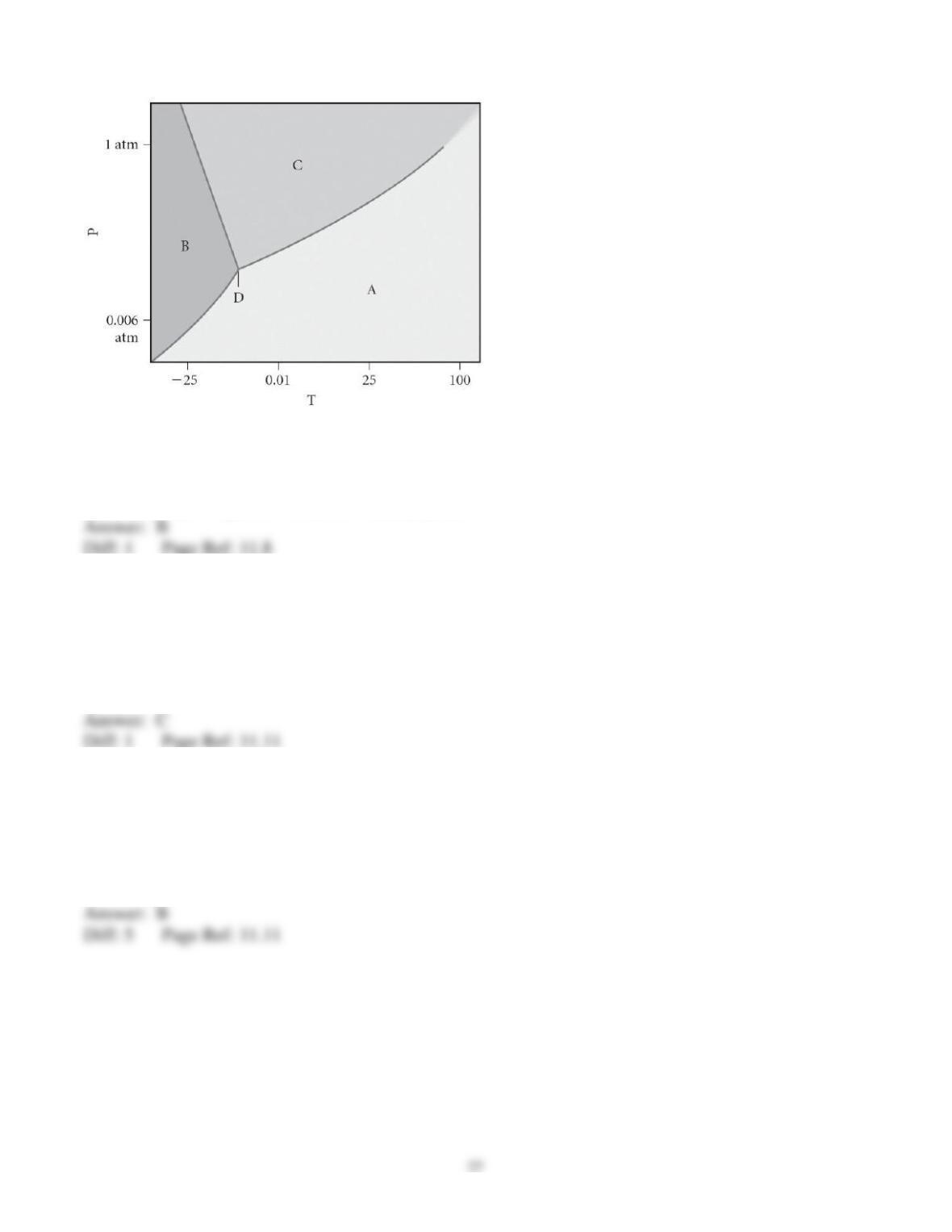
48) Assign the appropriate labels to the phase diagram shown below.
A) A = liquid, B = solid, C = gas, D = critical point
B) A = gas, B = solid, C = liquid, D = triple point
C) A = gas, B = liquid, C = solid, D = critical point
D) A = solid, B = gas, C = liquid, D = triple point
E) A = liquid, B = gas, C = solid, D = critical point
49) Give the coordination number for a body-centered cubic cell.
A) 0
B) 6
C) 8
D) 10
E) 12
50) What is the edge length of a face-centered cubic unit cell made up of atoms having a radius of 128
pm?
A) 181 pm
B) 362 pm
C) 512 pm
D) 1020 pm
28
51) Nickel has a face-centered cubic structure and has a density of 8.90 g/cm3. What is its atomic
radius?
A) 125 pm
B) 249 pm
C) 353 pm
D) 997 pm
52) Gold crystallizes in a face-centered cubic structure. What is the edge length of the unit cell if the
atomic radius of gold is 144 pm?
A) 204 pm
B) 288 pm
C) 333 pm
D) 407 pm
53) Cesium has a radius of 272 pm and crystallizes in a body-centered cubic structure. What is the edge
length of the unit cell?
A) 314 pm
B) 385 pm
C) 544 pm
D) 628 pm
54) Lithium crystallizes in a body-centered cubic structure. What is the coordination number of each
atom?
A) 4
B) 6
C) 8
55) NaCl crystallizes in a cubic unit cell with Cl– ions on each corner and each face. How many Na+ and
Cl– ions are in each unit cell of NaCl?
A) 1 Na+ ion and 1 Cl– ion
B) 2 Na+ ions and 2 Cl– ions
C) 4 Na+ ions and 4 Cl– ions
D) 8 Na+ ions and 8 Cl– ions
56) How many H– ions are around each Na+ ion in NaH, which has a cubic unit cell with H– ions on
each corner and each face?
A) 1
B) 4
C) 6
D) 8
57) Which of the following forms a molecular solid?
A) CaO
B) C10H22
C) C, graphite
D) gold
58) Which of the following forms an ionic solid?
A) Ag
B) C7H15NH2
C) Rb I
D) S O3
59) Which type of bonding does Sr form upon solidification?
A) covalent network
B) ionic
C) metallic
D) molecular
60) Which of the following is considered a molecular solid?
A) Au
B) NH4NO3
C) I2
D) Rn
E) None of these is a molecular solid.
61) Which of the following is considered an ionic solid?
A) (NH4)2CO3
B) CBr4
C) SeBr2
D) XeF4
E) None of these is an ionic solid.
62) Which of the following is considered an atomic solid?
A) F2
B) CsBr
C) N2
D) Nb
E) None of these is an atomic solid.
63) Which of the following is considered a nonbonding atomic solid?
A) Ne
B) Cu
C) I2
D) Ca
E) K
64) Which of the following substances should have the highest melting point?
A) CO2
B) SrS
C) Kr
D) F2
E) MgO
65) Which of the following substances should have the highest melting point?
A) Fe
B) Ne
C) Xe
D) N2
E) CO
31
Matching Questions
Match the following.
A) ionic bond
B) dipole-dipole forces
C) hydrogen bonding
D) ion-dipole forces
E) dispersion forces
1) LiI
Diff: 1 Page Ref: 11.3
2) CH3OH
Diff: 1 Page Ref: 11.3
3) CH3CH3
Diff: 1 Page Ref: 11.3
4) CH2F2 F) H2 + H2O
Diff: 1 Page Ref: 11.3
5) LiI + H2O
Diff: 1 Page Ref: 11.3
Short Answer Questions
1) Why do O, F and N, when bonded to H, form such strong intermolecular attractions to neighboring
molecules? Make sure to be specific.
2) Define viscosity.
3) Why does the temperature of a substance stay constant during a phase change such as vaporization?
4) Define volatile.
5) Define boiling point of a liquid.
6) Define dynamic equilibrium.
7) Why is the ΔHvap higher than ΔHfus for a given compound?
8) Sketch the phase diagram of benzene. Make sure to label the axes and the different phases of
benzene. Use the physical data provided below.
melting point = 279 K
boiling point = 353 K
Tc = 562 K
Pc = 48.4 atm
Triple Point = 0.05 atm, 279 K
9) Give the edge length in terms of r for a simple cubic cell.
10) Describe the difference between the conduction band and the valence band.