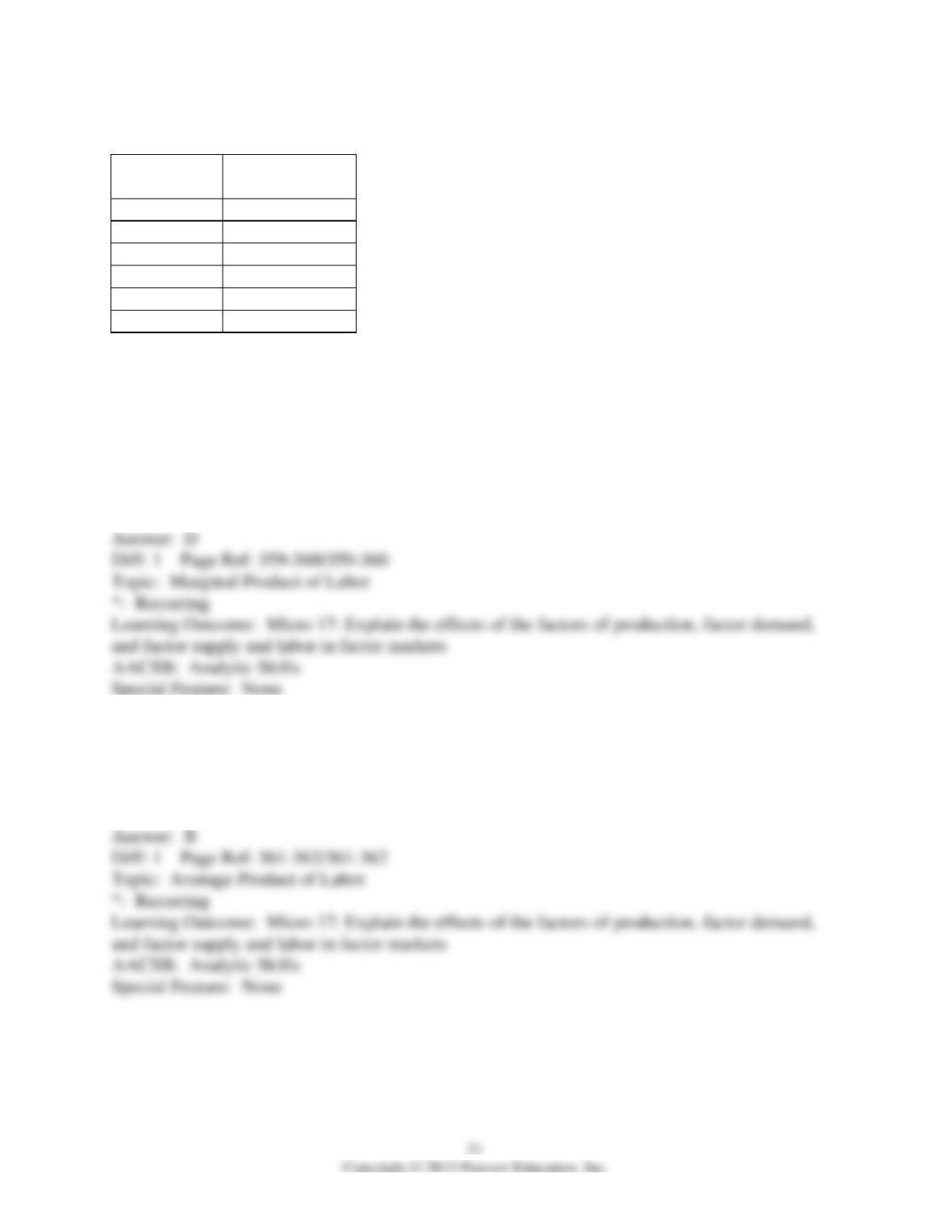
Table 11-1
Number of
Workers
Mushrooms per
Day (pounds)
1
12
2
30
3
45
4
50
5
54
6
56
Table 11-1 shows the technology of production at the Matsuko’s Mushroom Farm for the month
of May 2011.
16) Refer to Table 11-1. What is the marginal product of the 4th worker?
A) 137 pounds
B) 50 pounds
C) 12.5 pounds
D) 5 pounds
17) Refer to Table 11-1. What is the average product of labor when the farm hires 5 workers?
A) 4 pounds
B) 10.8 bushels
C) 38.2 pounds
D) 54 pounds
18) Refer to Table 11-1. Diminishing marginal returns sets in when the ________ worker is
hired.
A) 2nd
B) 3rd
C) 4th
D) None of the above; the production function displays increasing marginal returns.
19) Who was the economist who first analyzed the advantages of specialization and the division
of labor?
A) David Ricardo
B) Arthur C. Pigou
C) Ronald Coase
D) Adam Smith
20) One reason why, in the short run, the marginal product of labor might increase initially as
more workers are hired is that
A) the first workers hired get to use the best equipment.
B) specialization allows a worker to focus on one task, thereby increasing her proficiency at that
task.
C) the best workers are hired first and later hires are not as skillful.
D) beyond some point, a firm has hired too many workers.
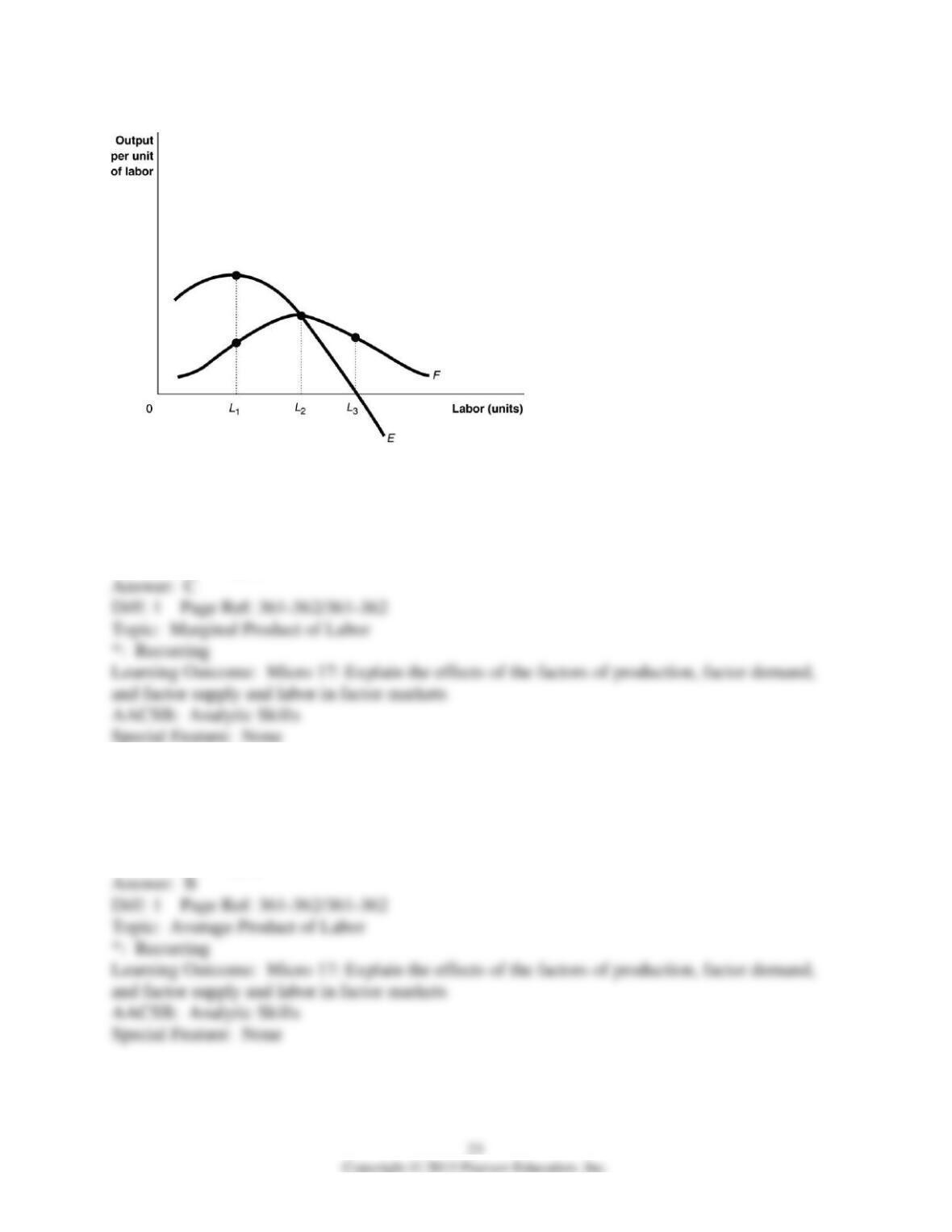
Figure 11-2
21) Refer to Figure 11-2. The curve labeled “E” is
A) the total product curve.
B) the average product curve.
C) the marginal product curve.
D) the output supply curve.
22) Refer to Figure 11-2. The curve labeled “F” is
A) the total product curve.
B) the average product curve.
C) the marginal product curve.
D) the output supply curve.
23) Refer to Figure 11-2. Diminishing returns to labor set in
A) after L1.
B) after L2.
C) after L3.
D) immediately.
24) Refer to Figure 11-2. Short run output is maximized at
A) L1.
B) L2.
C) L3.
D) insufficient information to determine
25) Refer to Figure 11-2. The average product of labor declines after L2 because
A) the marginal product of labor is below the average product of labor.
B) the marginal product of labor is falling.
C) the marginal product of labor is negative.
D) the marginal product of labor is positive.
26) If we have information about workers’ marginal products, then total and average product can
be found by
A) dividing marginal costs by the number of workers.
B) multiplying the average marginal product times the number of workers.
C) summing the marginal values to find the total and multiplying it times the number of workers
to get the average.
D) summing the marginal values to find the total and dividing it by the number of workers to get
the average.
27) If, after hiring the 6th worker, a firm’s output falls, then the marginal product of the 6th
worker is negative.
28) A downward sloping marginal product of labor curve demonstrates the law of diminishing
marginal returns.
29) If average product is decreasing, then marginal product must be negative.
30) State the law of diminishing marginal returns.
31) Damian owns a tattoo parlor and has hired three tattoo artists to work for him. The marginal
product of labor is 8 for the first artist, 12 for the second artist, and 7 for the third artist. What is
Damian’s average product of labor for these three tattoo artists?
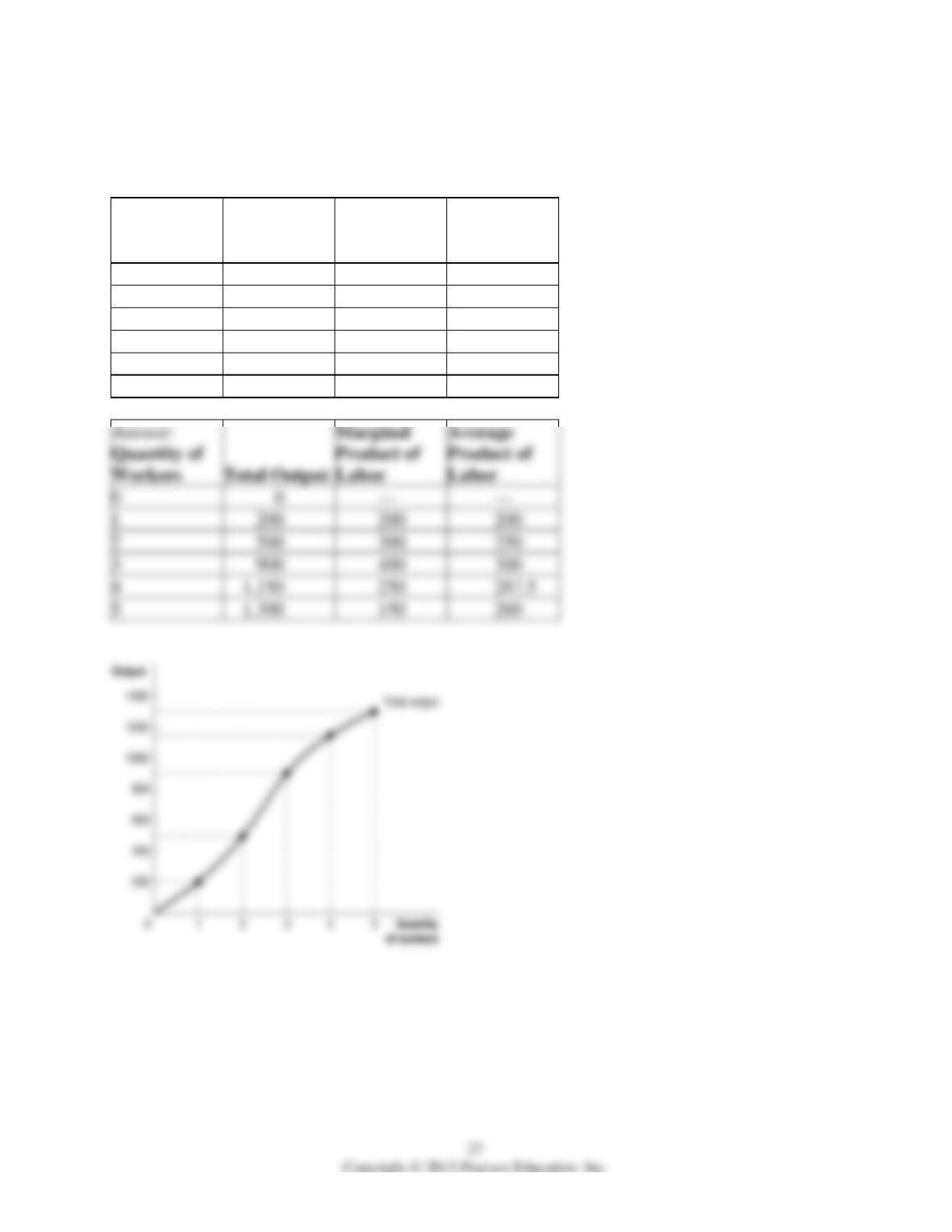
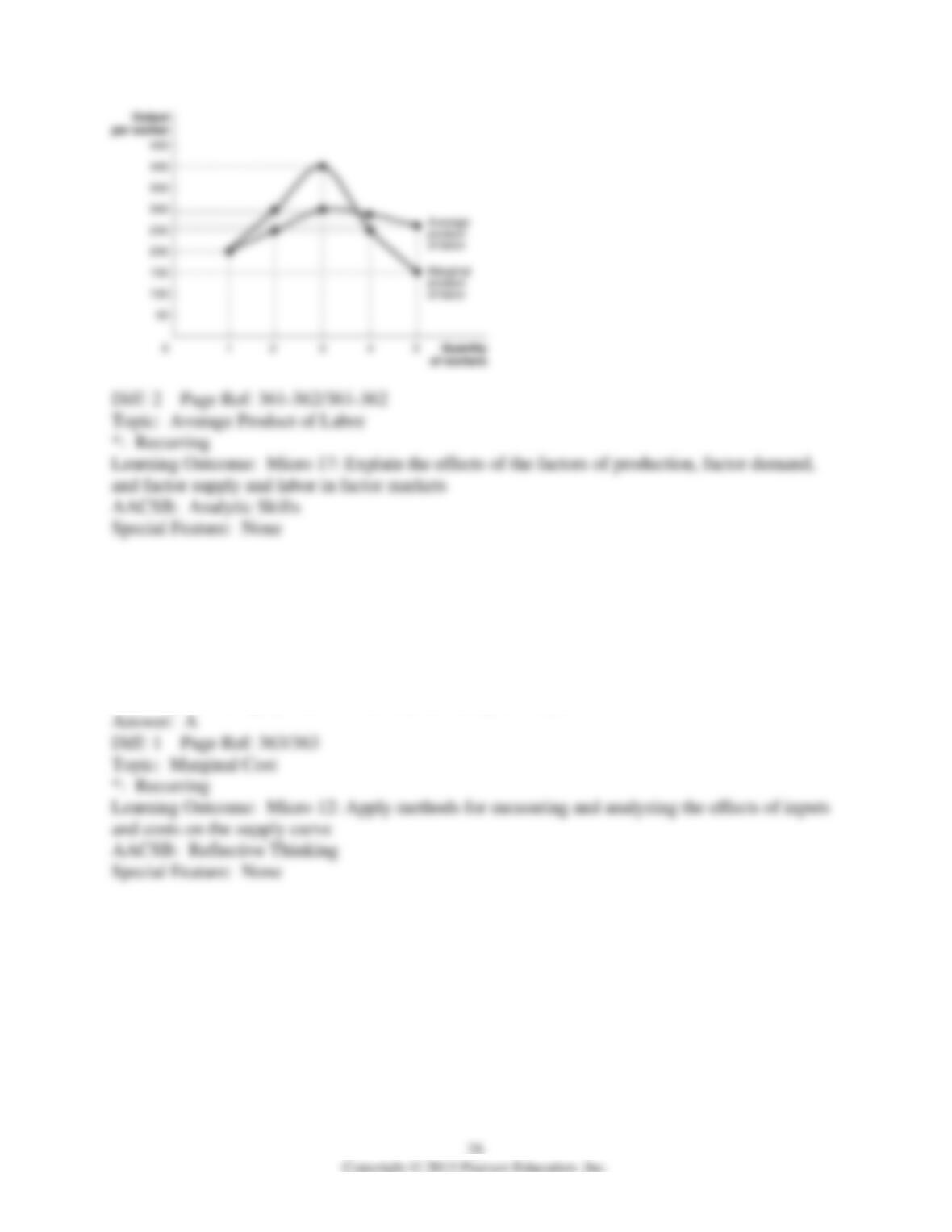
32) Fill in the missing values in the following table. Draw one graph showing how total output
increases with the quantity of workers hired, and another graph showing the marginal product of
labor and the average product of labor.
Quantity of
Workers
Total Output
Marginal
Product of
Labor
Average
Product of
Labor
0
0
1
200
2
500
3
900
4
1,150
5
1,300
Quantity of
Workers
Total Output
Marginal
Product of
Labor
Average
Product of
Labor
0
0
—
—
1
200
200
200
2
500
300
250
3
900
400
300
4
1,150
250
287.5
5
1,300
150
260
11.4 The Relationship between Short-Run Production and Short-Run Cost
1) Marginal cost is equal to the
A) change in total cost divided by the change in output.
B) change in average total costs divided by the change in output.
C) change in total product divided by the change in output.
D) change in average product divided by the change in output.
2) Marginal cost is the
A) change in average cost when an additional unit of output is produced.
B) the additional output when total cost is increased by one dollar.
C) additional cost of producing an additional unit of output.
D) change in the price of inputs if a firm buys more inputs to produce an additional unit of
output.
3) In the short run, if marginal product is at its maximum, then
A) average cost is at its minimum.
B) average variable cost is at its minimum.
C) marginal cost is at its minimum.
D) total cost is at its maximum.
4) When a firm produces 50,000 units of output, its total cost equals $6.5 million. When it
increases its production to 70,000 units of output, its total cost increases to $9.4 million. Within
this range, the marginal cost of an additional unit of output is
A) $41.43.
B) $134.29.
C) $135.
D) $145.
5) If the 15th unit of output has a marginal cost of $29.50 and the average cost of producing 14
units of output is $30.23, what will happen to the average cost of production if the 15th unit is
produced?
A) Average cost increases as more is produced.
B) Average cost will fall.
C) Average cost could increase or decrease depending on what happens to variable cost.
D) Average cost could increase or decrease depending on what happens to fixed cost.
6) Which of the following costs will not change as output changes?
A) marginal cost
B) total variable cost
C) average variable cost
D) average fixed cost
E) total fixed cost
7) Average fixed costs of production
A) remain constant.
B) will rise at a fixed rate as more is produced.
C) graph as a U-shaped curve.
D) fall as long as output is increased.
8) If fixed costs do not change, then marginal cost
A) also remains constant.
B) equals the change in variable cost divided by the change in output.
C) equals the change in average variable cost divided by the change in output.
D) equals the change in average fixed cost divided by the change in output.
9) In the short run, if marginal product is below average product, then average variable cost is
increasing.
10) If marginal cost is above the average variable cost, then average variable cost is decreasing.
11) If the marginal product of labor is decreasing, then marginal cost of production must be
rising.
12) Describe the relationship between marginal cost and average total cost.
13) Is it possible for average total cost to be decreasing over a range of output where marginal
cost is increasing? Briefly explain.
33
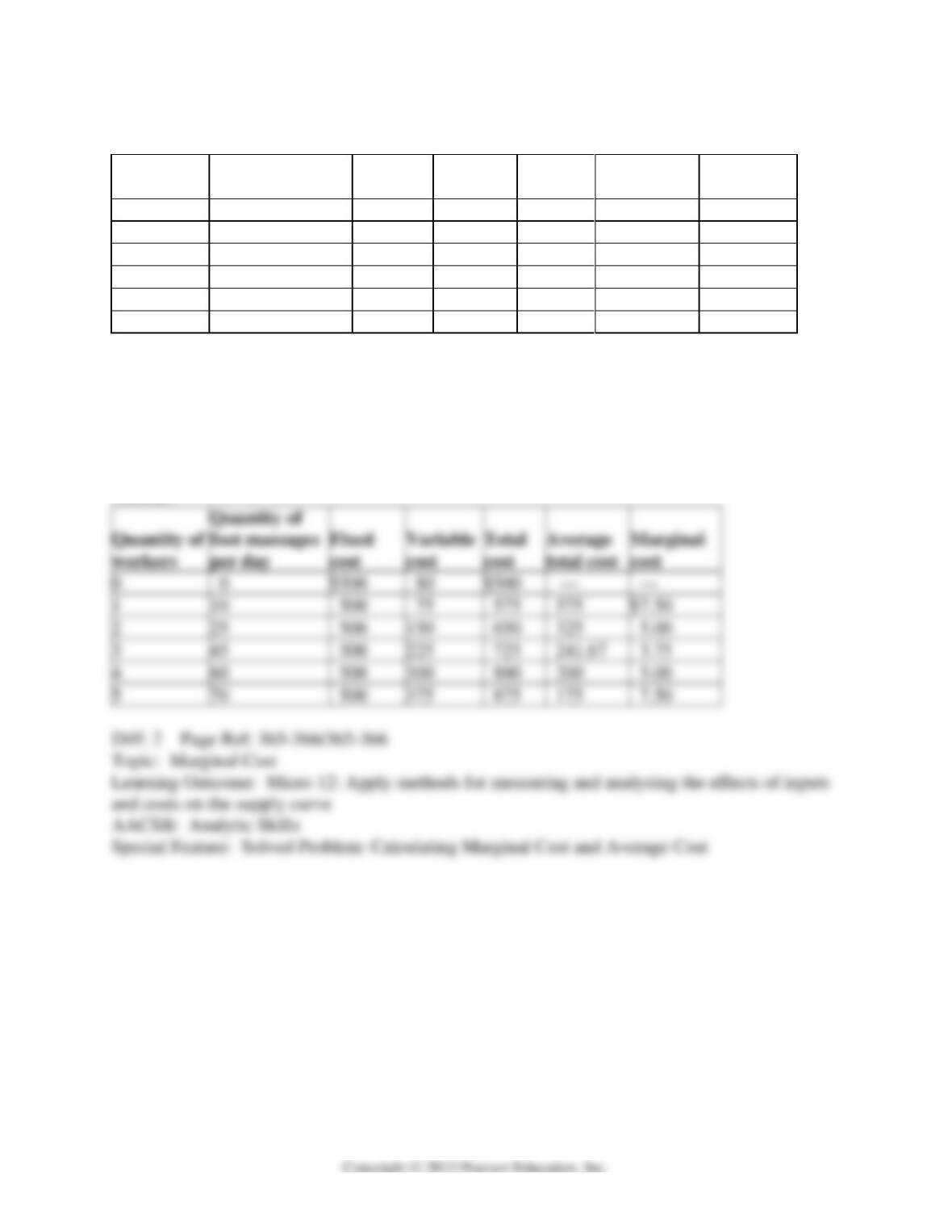
Table 11-2
Quantity of
workers
Quantity of foot
massages per day
Fixed
cost
Variable
cost
Total
cost
Average
total cost
Marginal
cost
0
0
1
10
2
25
3
45
4
60
5
70
14) Refer to Table 11-2. Alicia Gregory owns a foot massage business. She leases 4 computer-
controlled massage booths, for which she pays $125 per day. She cannot increase the number
machines she leases without giving the manufacturer 3 months notice. She can hire as many
workers as she wants at a cost of $75 per day per worker. These are the only two inputs she uses
in her business. Use this information to fill in the columns in the above table.
Answer:
Quantity of
foot massages
per day
Fixed
Variable
Total
Average
Marginal
0
0
$500
$0
$500
—
—
1
10
500
75
575
575
$7.50
2
25
500
150
650
325
5.00
3
45
500
225
725
241.67
3.75
4
60
500
300
800
200
5.00
5
70
500
375
875
175
7.50
11.5 Graphing Cost Curves
1) Which of the following equations is correct?
A) AVC – ATC = AFC
B) AVC + ATC = AFC
C) AFC + AVC = ATC
D) ATC + AVC = AFC
2) When the average total cost is $16 and the total cost is $800, then the number of units the firm
is producing is
A) impossible to determined with the information given.
B) 12,800.
C) 784.
D) 50.
3) Adam spent $10,000 on new equipment for his small business, “Adam’s Fitness Studio.”
Membership at his fitness center is very low and at this rate, Adam needs an additional $12,000
per year to keep his studio open. Which of the following is true?
A) The fixed cost of running the studio is $22,000.
B) The variable cost of running the studio is $22,000.
C) The $10,000 Adam spent on equipment is a fixed cost of business and the $12,000 he’ll need
to continue operations is a variable cost.
D) The $10,000 Adam spent on equipment is the total cost of starting the business and the
$12,000 he’ll need to continue operations is a marginal cost.
4) The formula for total fixed cost is
A) TFC = TC + TVC.
B) TFC = TVC – TC.
C) TFC = TC/TVC.
D) TFC = TC – TVC.
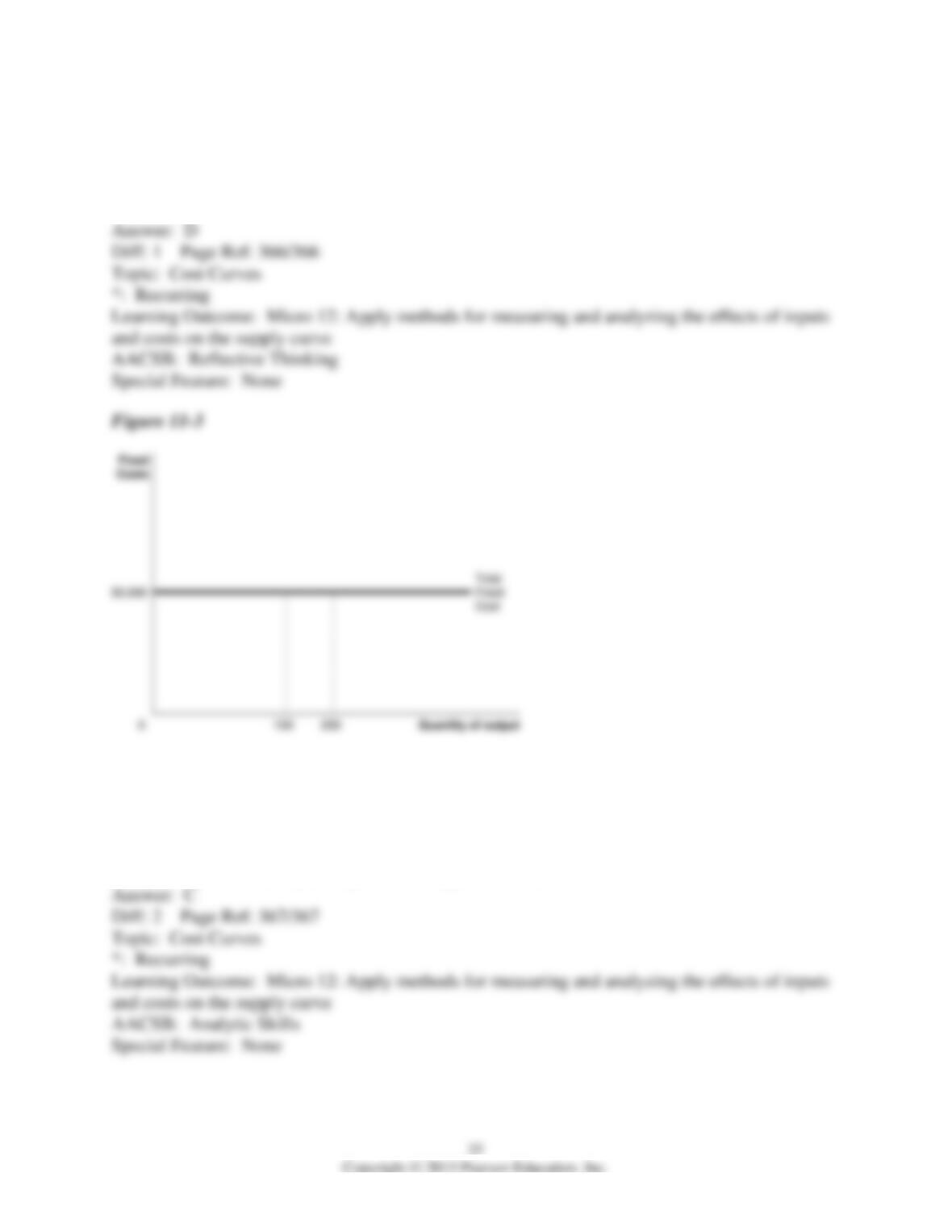
5) Refer to Figure 11-3. What happens to the average fixed cost of production when the firm
increases output from 150 to 200?
A) It remains constant.
B) It rises.
C) It falls.
D) It could rise or fall depending on what happens to total cost.
6) If the total cost of producing 20 units of output is $1,000 and the average variable cost is $35,
what is the firm’s average fixed cost at that level of output?
A) $65
B) $50
C) $15
D) It is impossible to determine without additional information.
7) If a firm produces 20 units of output and incurs a total cost of $1,000 and a variable cost is
$700, calculate the firm’s average fixed cost of production if it expands output to 25 units.
A) $300
B) $15
C) $12
D) It is impossible to determine without additional information.
8) Average variable cost can be calculated using any of the formulas below except
A) TVC/Q.
B) (TC – FC)/Q.
C) Δ(TC – FC)/ΔQ.
D) (TC/Q) – AFC.
9) If average total cost is $50 and average fixed cost is $15 when output is 20 units, then the
firm’s total variable cost at that level of output is
A) $1,000.
B) $700.
C) $300.
D) impossible to determine without additional information.
10) Suppose you have just opened a store to sell espresso machines. Both you and a competing
store buy this machine from a manufacturer for $130 each. Your competitor who has a store of
the same size as yours is currently selling about 10 machines a month at a price of $200 per
machine. You expect to sell about 6 machines a month at a price of $220 per machine. If you
lower your price, you expect to make a loss. Which of the following could explain why your
competitor is able to profitably sell the machine at a lower price although the cost of purchasing
the machine is the same for the both of you?
A) The competing store probably has a lower marginal cost of production.
B) The competing store probably has a lower average variable cost of production.
C) The competing store’s goal is to maximize revenue and not profit.
D) The competing store probably has a lower average cost because average fixed cost falls as
output increases.
Table 11-3
Quantity of
Lanterns
Fixed Cost
(dollars)
Variable Cost
(dollars)
Total Cost
(dollars)
Average Total
Cost (dollars)
75
200
170
370
4.93
80
200
230
430
5.36
90
200
7.67
100
200
810
115
200
11.8
117
200
1264
1464
12.5
120
200
1480
Table 11-3 shows cost data for Lotus Lanterns, a producer of whimsical night lights.
11) Refer to Table 11-3. What is the variable cost of production when the firm produces 115
lanterns?
A) $1,556
B) $1,157
C) $956
D) $10.05
12) Refer to Table 11-3. What is the average total cost of production when the firm produces
120 lanterns?
A) $1,680
B) $72
C) $14
D) $12.3
13) Refer to Table 11-3. What is the average variable cost per unit of production when the firm
produces 90 lanterns?
A) $490
B) $33.67
C) $7.67
D) $5.44
14) Refer to Table 11-3. What is the marginal cost per unit of production when the firm
produces 100 lanterns?
A) $420
B) $32
C) $11.1
D) $8.1
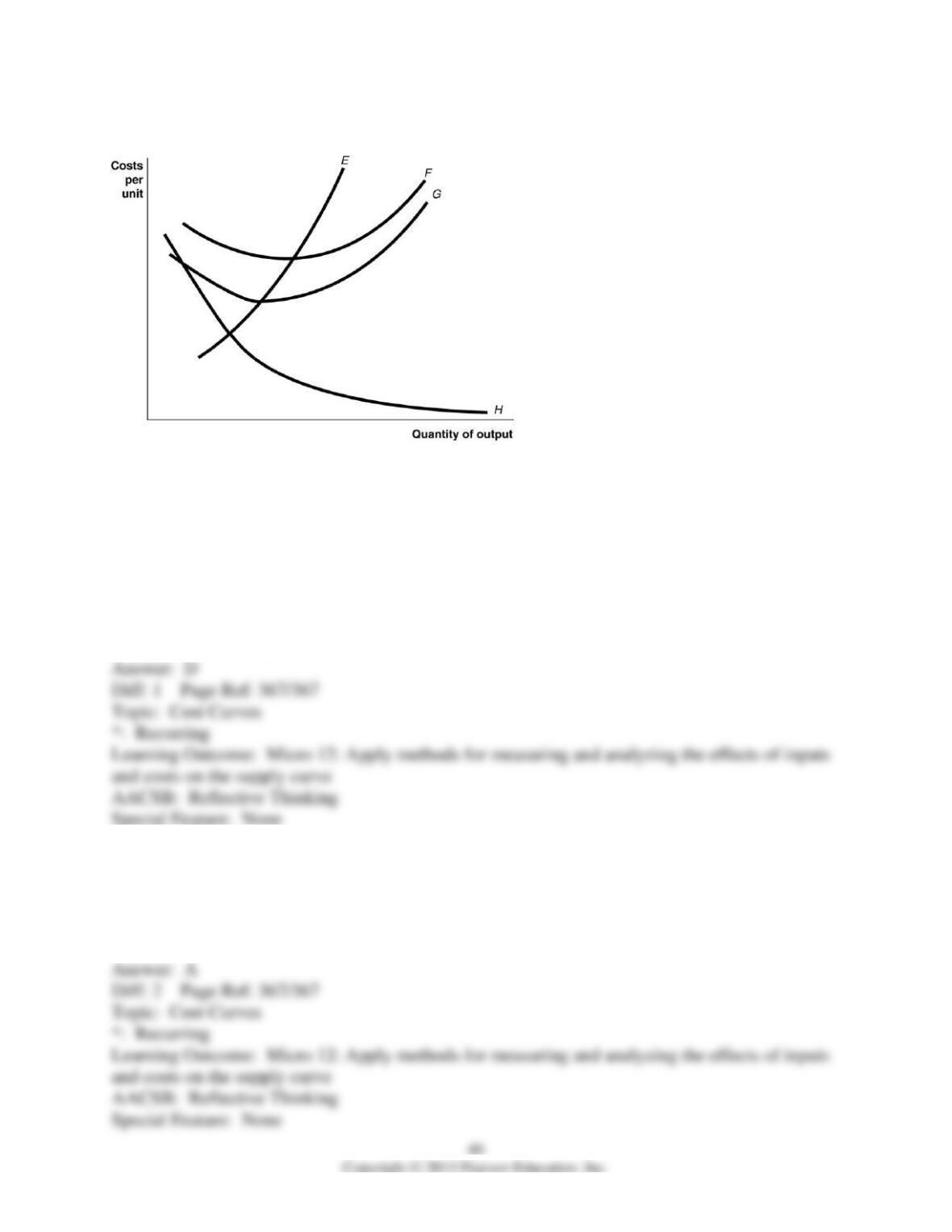
Figure 11-4
15) Refer to Figure 11-4. Identify the curves in the diagram.
A) E = average fixed cost curve; F = variable cost curve; G = total cost curve, H = marginal cost
curve
B) E = marginal cost curve; F = total cost curve; G = variable cost curve, H = average fixed cost
curve
C) E = average fixed cost curve; F = average total cost curve; G = average variable cost curve, H
= marginal cost curve
D) E = marginal cost curve; F = average total cost curve; G = average variable cost curve; H =
average fixed cost curve.
16) Refer to Figure 11-4. The vertical difference between curves F and G measures
A) average fixed costs.
B) marginal costs.
C) fixed costs.
D) sunk costs.