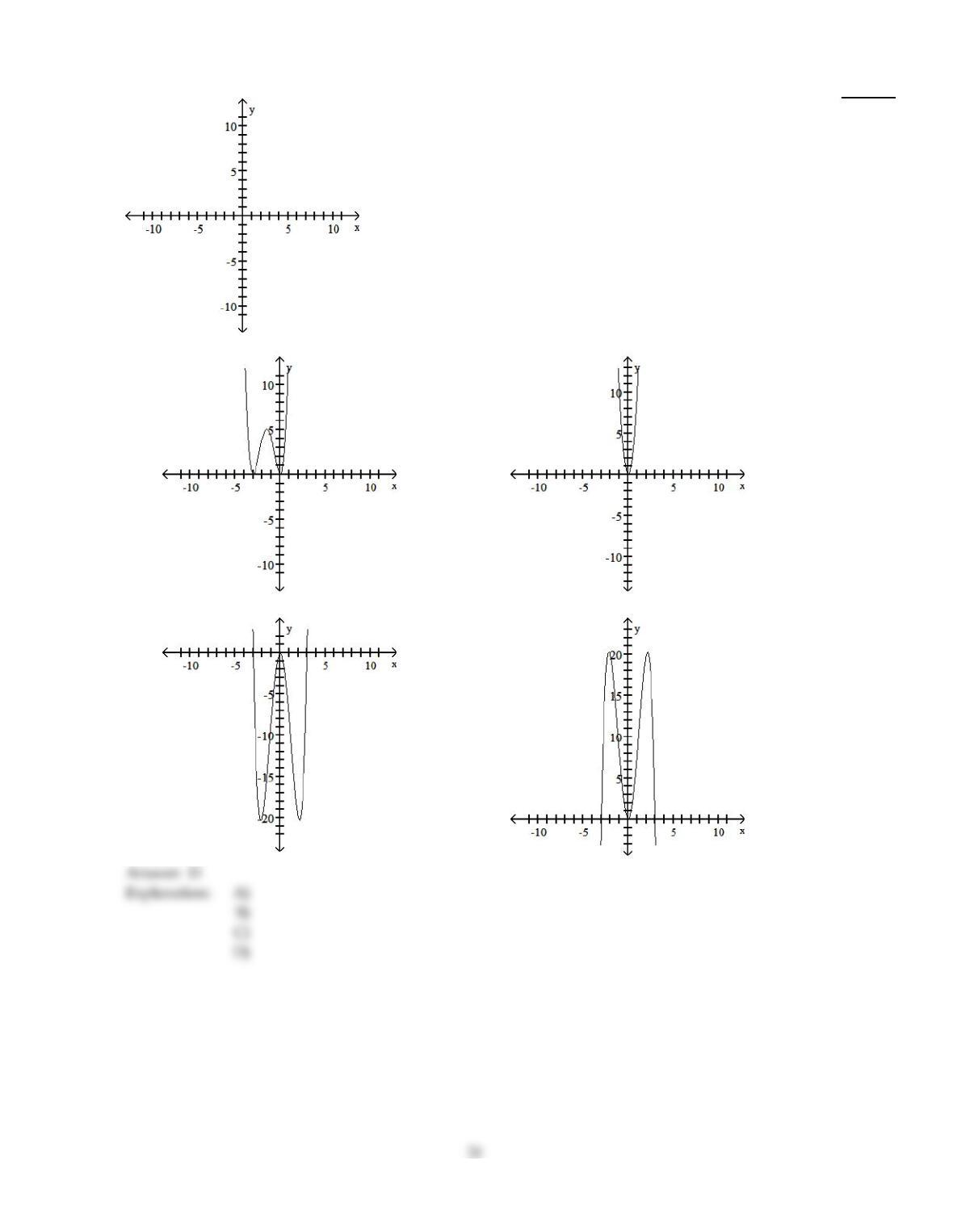
41)
f(x) =9x2–x4
41)
A)
B)
C)
D)
Find the horizontal asymptote, if any, of the graph of the rational function.
42)
h(x) =–5x + 6
4x + 6
42)
A)
y =1
B)
y = – 5
4
C)
y = – 5
D)
no horizontal asymptote
Find the vertical asymptotes, if any, of the graph of the rational function.
43)
g(x) =x
x – 1
43)
A)
x = 0 and x = – 1
B)
x =1
C)
x = 0 and x =1
D)
no vertical asymptote
Solve the equation.
44)
3x4+ 17x3+ 61x2+ 73x + 26 = 0
44)
A)
1, –2
3, –3±2i
B)
–1, –2
3, –3±2i
C)
–1, –2
3, –2±3i
D)
1, –2
3, –2±3i
Determine the maximum possible number of turning points for the graph of the function.
45)
f(x) =(2x – 1)3(x3+ 3)(x + 5)
45)
A)
14
B)
3
C)
7
D)
6
22
Determine whether the function is even, odd, or neither.
46)
f(x) = – 5x5+ x3
46)
A)
Even
B)
Neither
C)
Odd
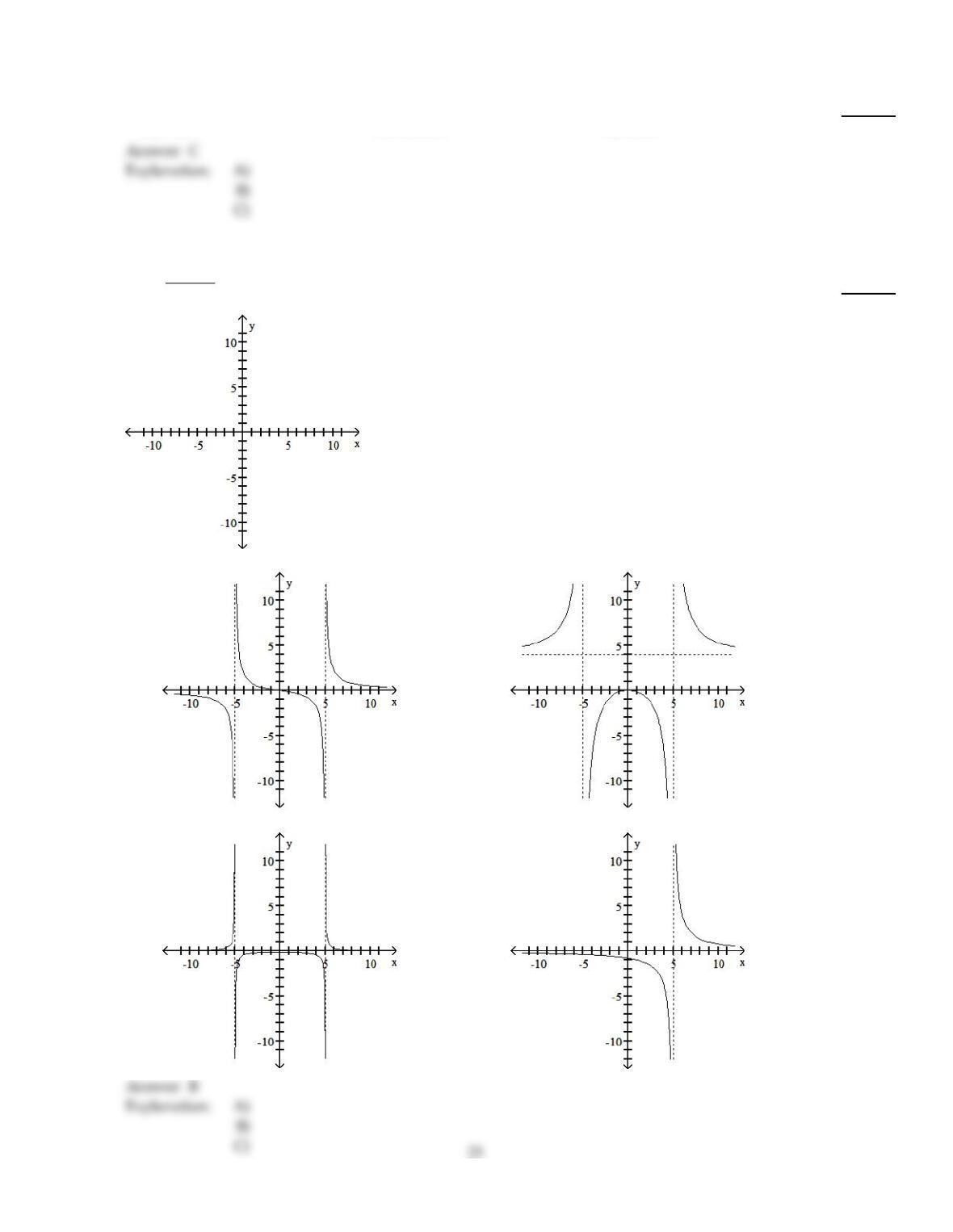
Graph the rational function.
47)
f(x) =4x2
x2– 25
47)
A)
B)
C)
D)
Solve the problem.
48)
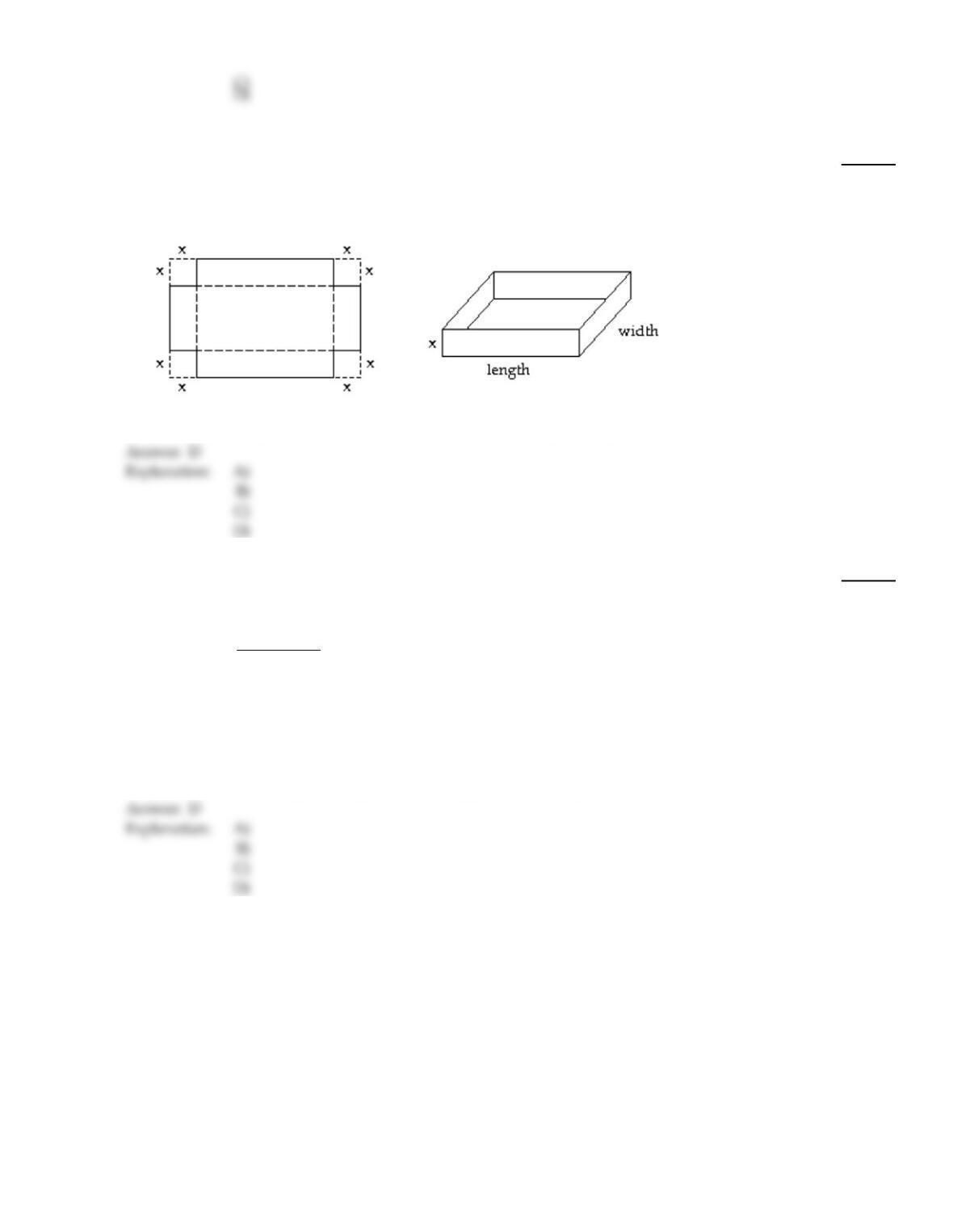
A box with an open top is formed by cutting squares out of the corners of a rectangular piece of
cardboard and then folding up the sides. If x represents the length of the side of the square cut from
each corner, and if the original piece of cardboard is 19 inches by 16 inches, what size square must
be cut if the volume of the box is to be 352 cubic inches?
48)
A)
8 in. by 8 in. square
B)
11 in. by 11 in. square
C)
1 in. by 1 in. square
D)
4 in. by 4 in. square
49)
A company that produces bicycles has costs given by the function C(x) =25x + 25,000, where x is
the number of bicycles manufactured and C(x) is measured in dollars. The average cost to
manufacture each bicycle is given by
_
C(x) =25x + 25,000
x.
What is the horizontal asymptote for the function
_
C? Describe what this means in practical terms.
49)
A)
y =25,000; 25,000 is the maximum number of bicycles the company can produce.
B)
y =25; 25 is the minimum number of bicycles the company can produce.
C)
y =25,000; $25,000 is the least possible cost for running the company.
D)
y = $25; The cost of producing each bicycle approaches $25 as production increases.
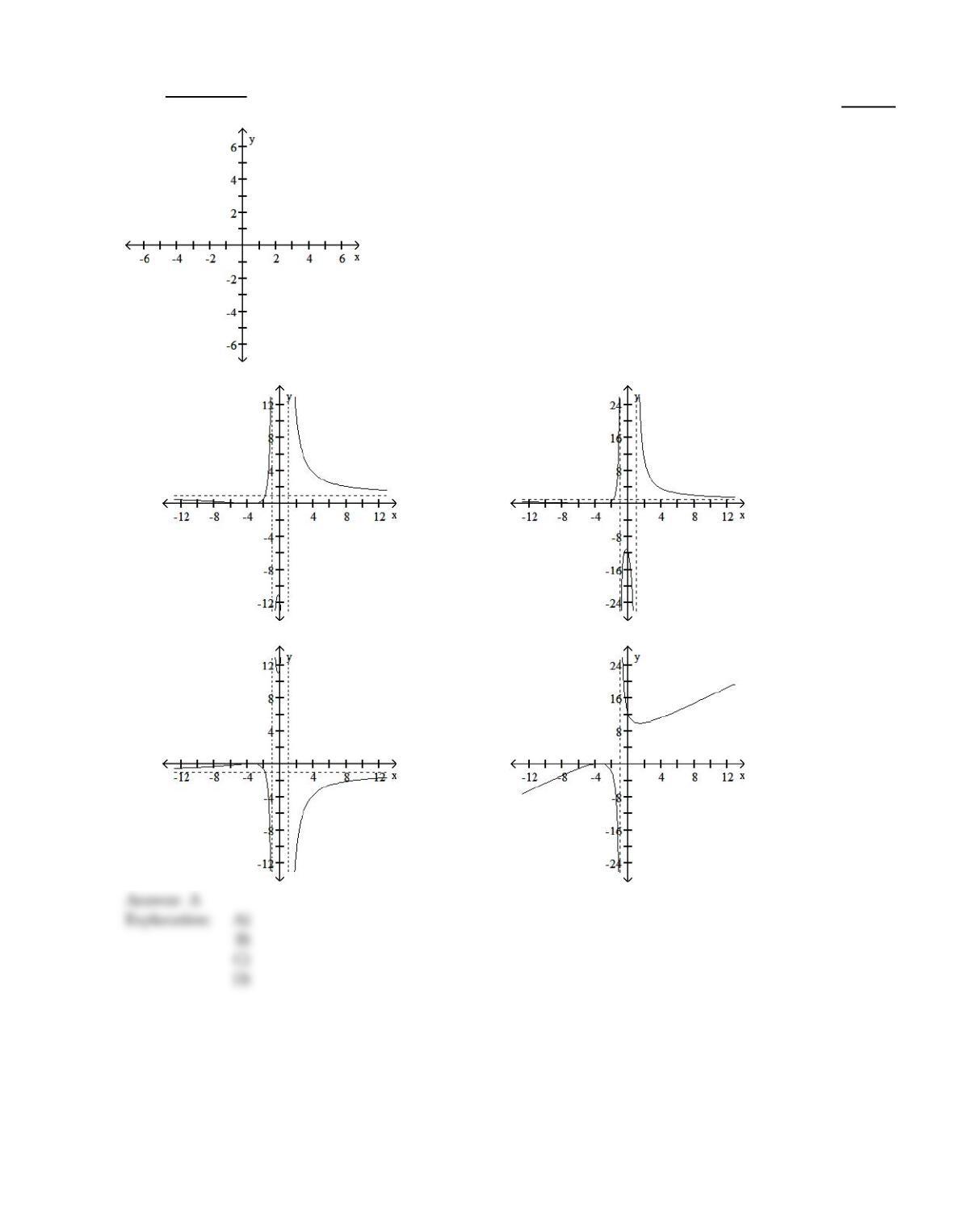
Graph the rational function.
24
50)
f(x) =x2+ 7x + 12
x2– 1
50)
A)
B)
C)
D)
25
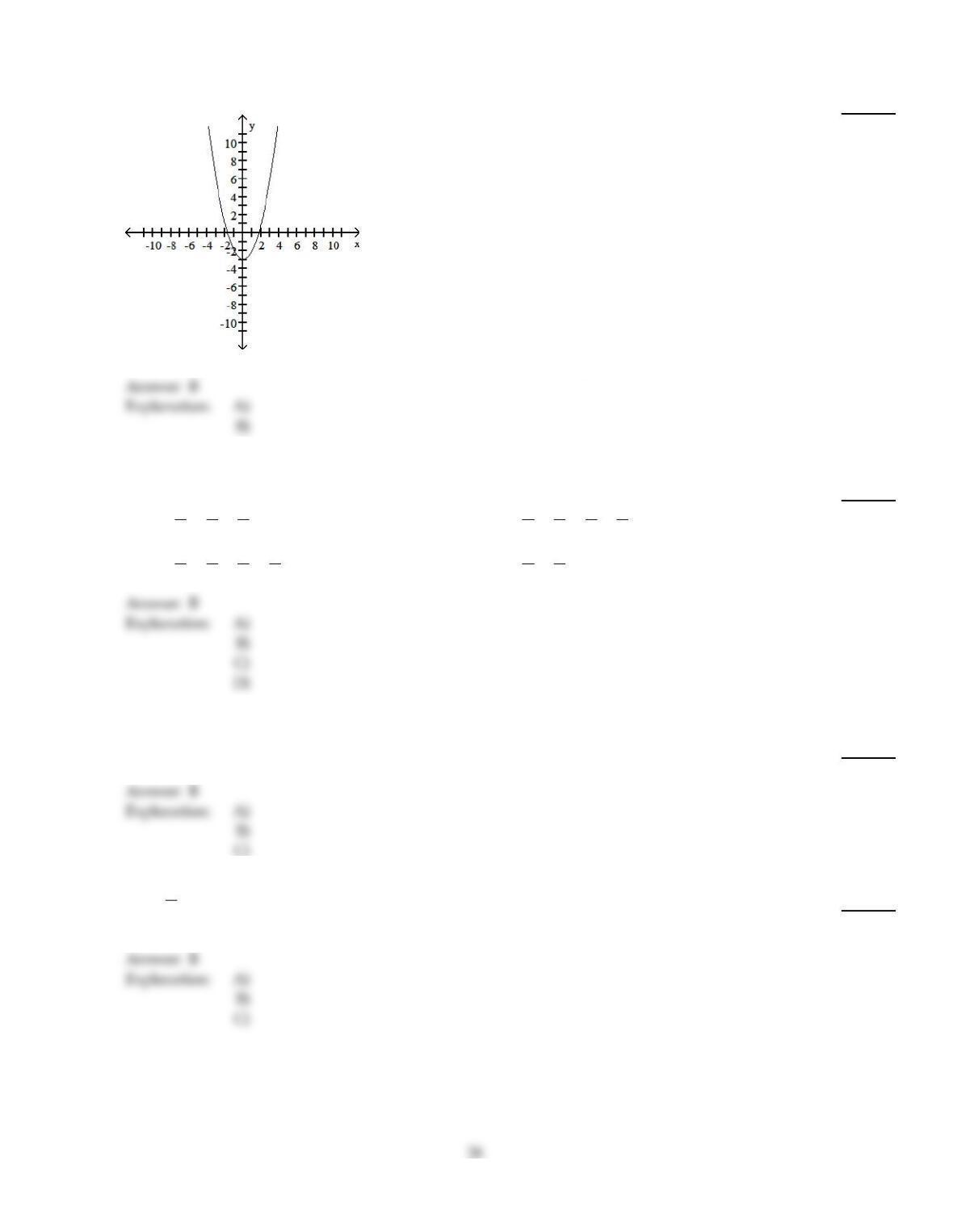
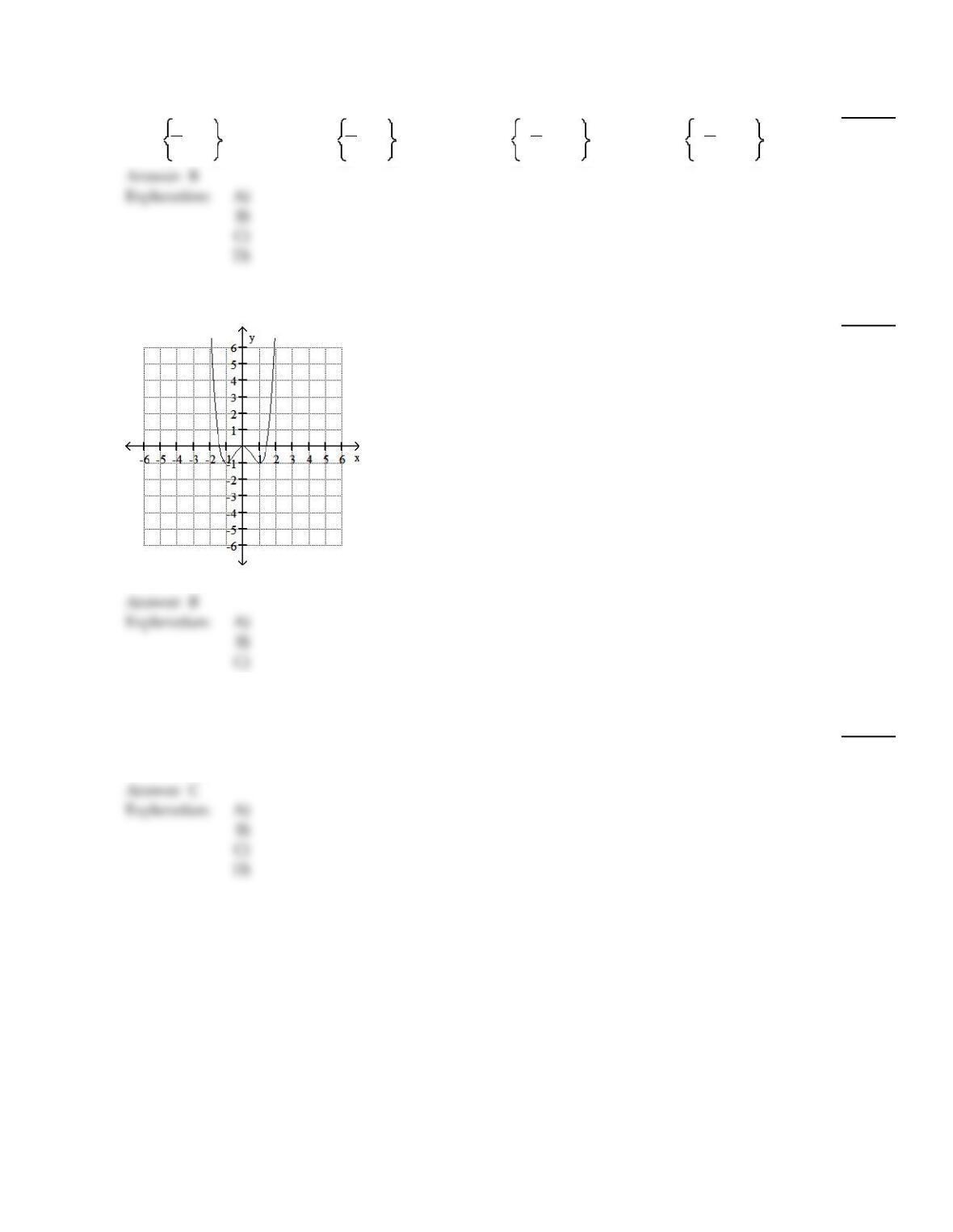
Determine whether the graph shown is the graph of a polynomial function.
51)
51)
A)
not a polynomial function
B)
could be a polynomial function
Use the Rational Zero Theorem to list all possible rational zeros for the given function.
52)
f(x) = 6x4+3x3–4x2+ 2
52)
A)
±1
6, ±1
3, ±1
2, ± 1, ± 2
B)
±1
6, ±1
3, ±1
2, ±2
3, ± 1, ± 2
C)
±1
6, ±1
3, ±1
2, ±2
3, ± 1, ± 2, ± 3
D)
±1
2, ±3
2, ± 1, ± 2, ± 3, ± 6
Determine whether the function is even, odd, or neither.
53)
f(x) =x2(5 –x2)
53)
A)
Odd
B)
Even
C)
Neither
54)
f(x) =1
3x2+9x4
54)
A)
Neither
B)
Even
C)
Odd
Solve the problem.
55)
A drug is injected into a patient and the concentration of the drug is monitored. The drug‘s
concentration, C(t), in milligrams per liter after t hours is modeled by
C(t) =8t
2t2+1.
Estimate the drug’s concentration after 3 hours. (Round to the nearest hundredth.)
55)
A)
3.49 milligrams per liter
B)
1.26 milligrams per liter
C)
1.32 milligrams per liter
D)
3.43 milligrams per liter
Solve the equation.
56)
x3+ 2x2+ 5x – 26 = 0
56)
A)
{2, –2±3i}
B)
{2, 3±5}
C)
{–2, –2+5, –4–5}
D)
{2, 3±2i}
A
Determine whether the function is even, odd, or neither.
57)
57)
A)
Even
B)
Odd
C)
Neither
B
B
Use Descartes’s Rule of Signs to determine the possible number of positive and negative real zeros for the given function.
58)
f(x) = – 9x9–5x8–10x7+8x6+ x +10
58)
A)
1 positive zero, 3 or 1 negative zeros
B)
1 positive zero, 2 or 0 negative zeros
C)
1 positive zero, 4 or 2 negative zeros
D)
1 positive zero, 4, 2 or 0 negative zeros
Solve the problem.
59)
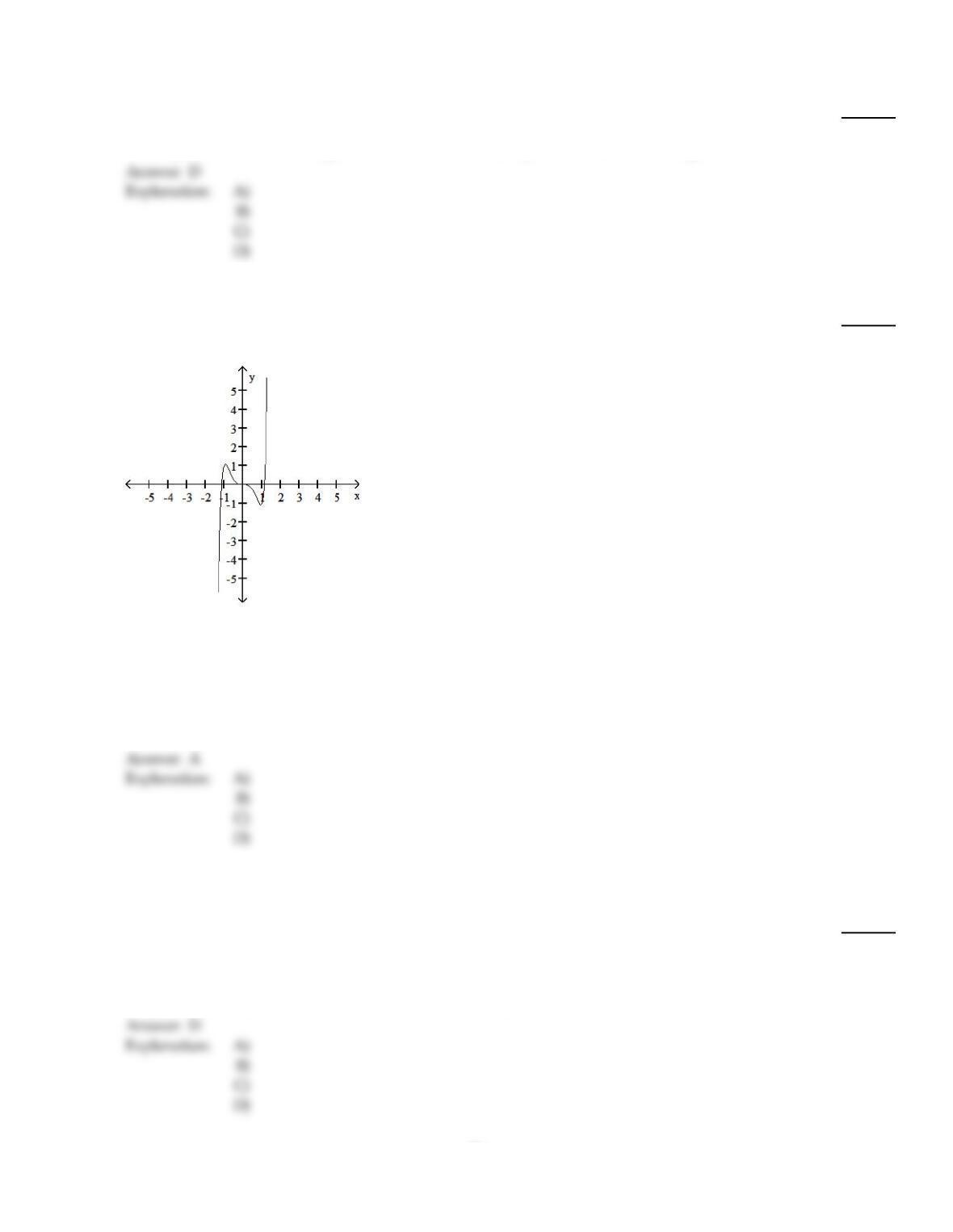
Determine whether f(x) =x4–x2 is even, odd, or neither. Use your answer to explain why the
graph in the figure shown cannot be the graph of f.
59)
A)
The function is even. The graph of f should have y–axis symmetry, but the graph in the figure
has origin symmetry.
B)
The function is neither even nor odd. The graph in the figure has origin symmetry.
C)
The function is odd. The graph of f should have y–axis symmetry, but the graph in the figure
has origin symmetry.
D)
The function is even. The graph of f should have origin symmetry, but the graph in the figure
has y–axis symmetry.
Find the zeros for the polynomial function and give the multiplicity for each zero. State whether the graph crosses the
x–axis, or touches the x–axis and turns around, at each zero.
60)
f(x) =x3+ 6x2+9x
60)
A)
1 with multiplicity 1, crosses x–axis; –3 with multiplicity 2, touches x–axis and turns
B)
0 with multiplicity 1, touches x–axis and turns; –3 with multiplicity 2, crosses x–axis
C)
0 with multiplicity 1, crosses x–axis; 3 with multiplicity 2, touches x–axis and turns
D)
0 with multiplicity 1, crosses x–axis; –3 with multiplicity 2, touches x–axis and turns
28
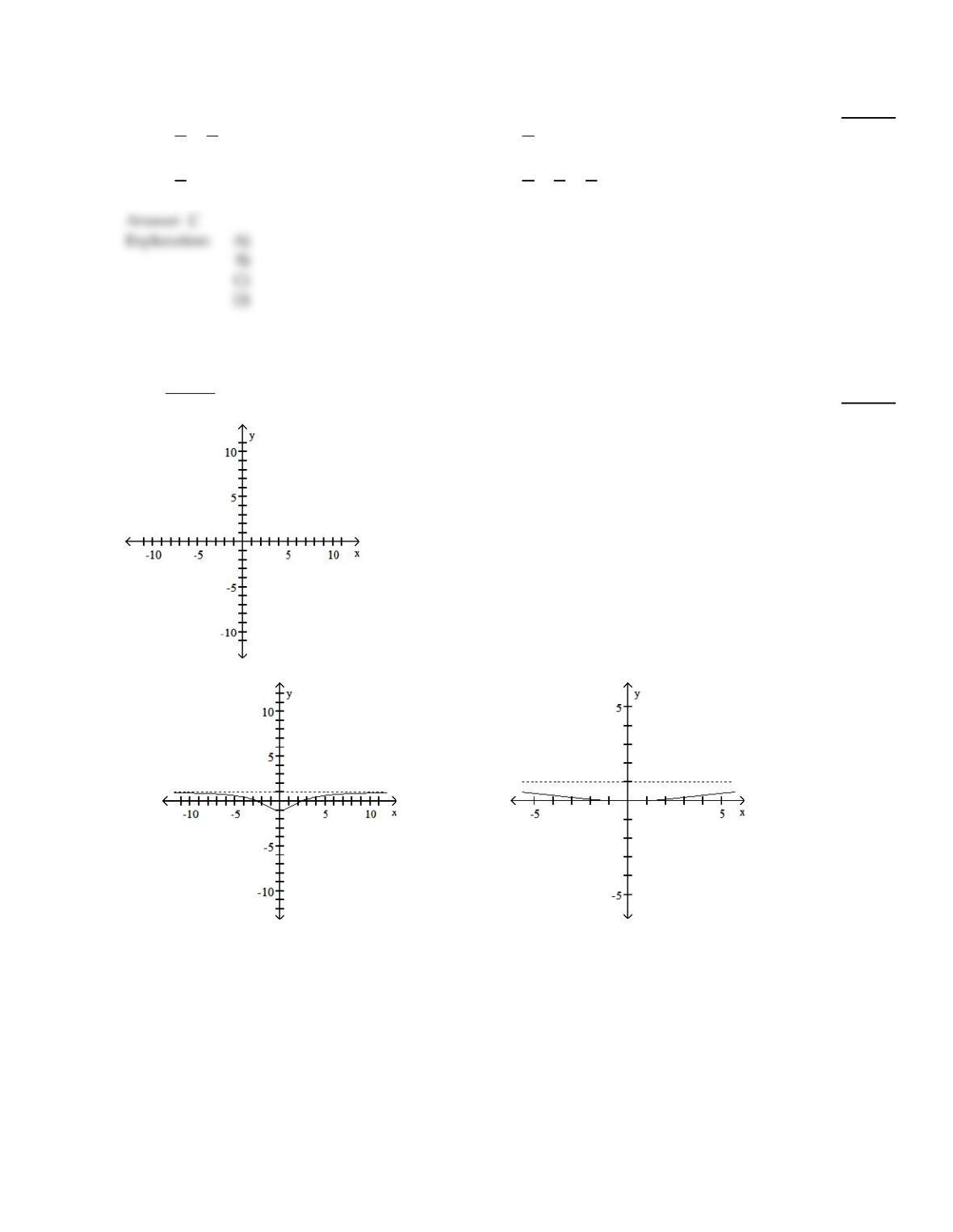
Solve the problem.
61)
Use the Rational Zero Theorem to list all possible rational zeros of f(x) = – 2x3+2x2–3x + 8.
61)
A)
±1
4, ±1
2, ±1, ±2, ±4, ±8
B)
±1
2, ±1, ±2, ±4
C)
±1
2, ±1, ±2, ±4, ±8
D)
±1
8,±1
4, ±1
2, ±1, ±2, ±4, ±8
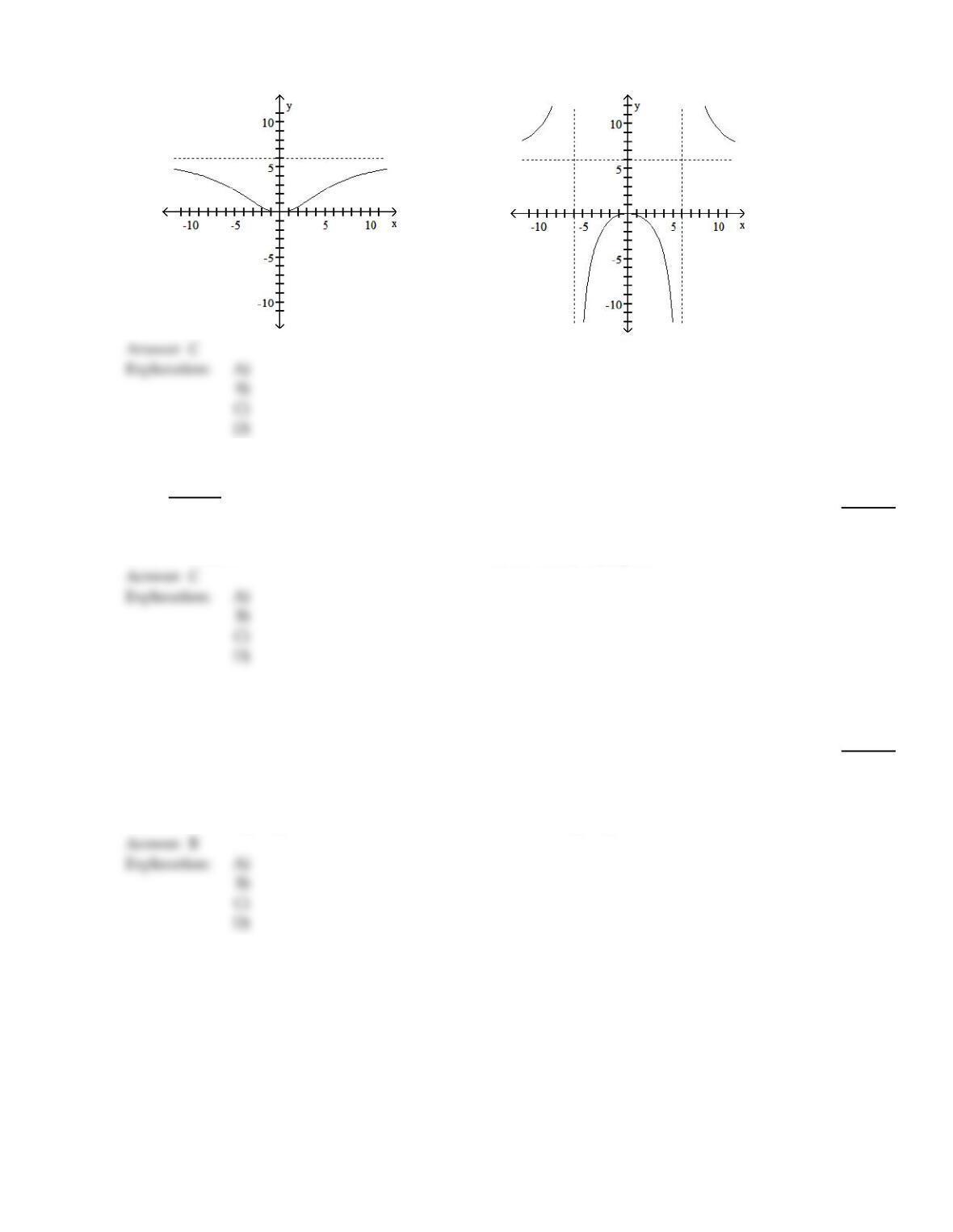
Find the vertical asymptotes, if any, and the horizontal asymptote, if one exists, of the graph of the rational function.
Then graph the rational function.
62)
f(x) =6x2
x2+36
62)
A)
no vertical asymptote; y = 1
B)
no vertical asymptote; y = 1
29
C)
no vertical asymptote; y =6
D)
x = – 6, x =6; y =6
Find the vertical asymptotes, if any, of the graph of the rational function.
63)
g(x) =x – 1
x(x + 1)
63)
A)
x = – 1
B)
x =1 and x = – 1
C)
x = 0 and x = – 1
D)
no vertical asymptote
Find the zeros for the polynomial function and give the multiplicity for each zero. State whether the graph crosses the
x–axis, or touches the x–axis and turns around, at each zero.
64)
f(x) =4(x + 4)(x – 7)2
64)
A)
–4 with multiplicity 1, touches x–axis and turns; 7 with multiplicity 2, crosses x–axis
B)
–4 with multiplicity 1, crosses x–axis; 7 with multiplicity 2, touches x–axis and turns
C)
4 with multiplicity 1, crosses x–axis; –7 with multiplicity 2, touches x–axis and turns
D)
4 with multiplicity 1, touches x–axis and turns; –7 with multiplicity 2, crosses x–axis
Graph the rational function.
30
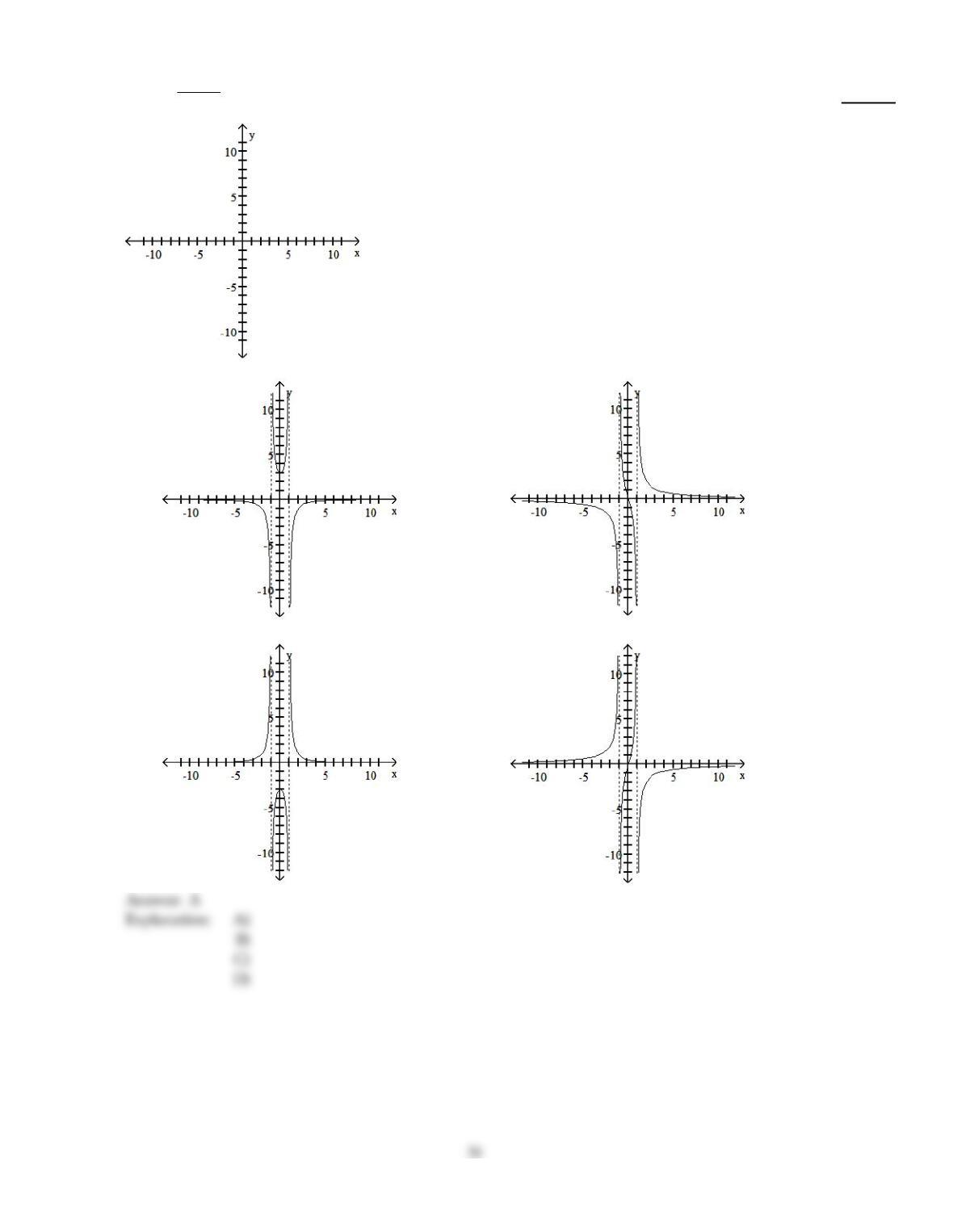
65)
f(x) = – 3
x2– 1
65)
A)
B)
C)
D)
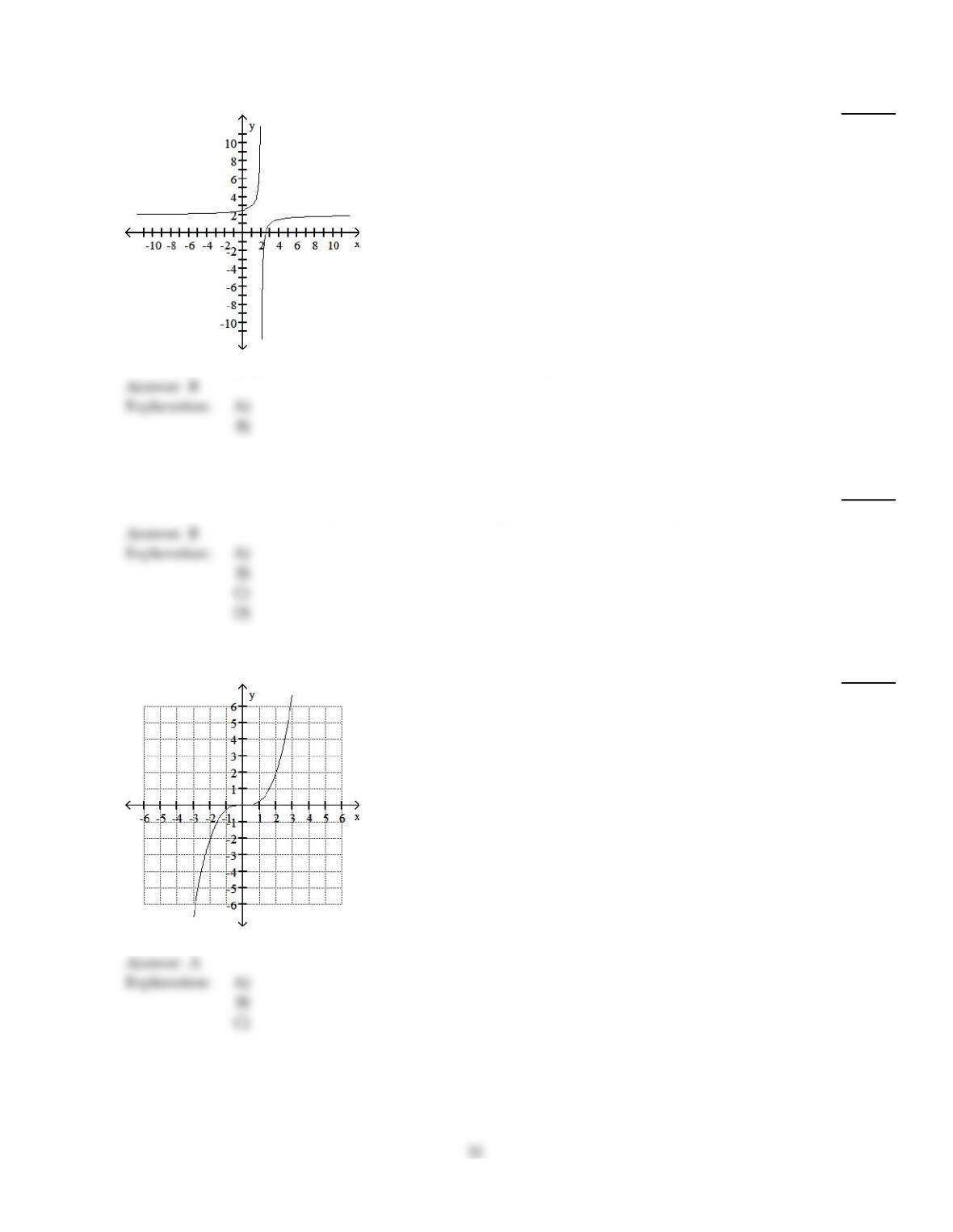
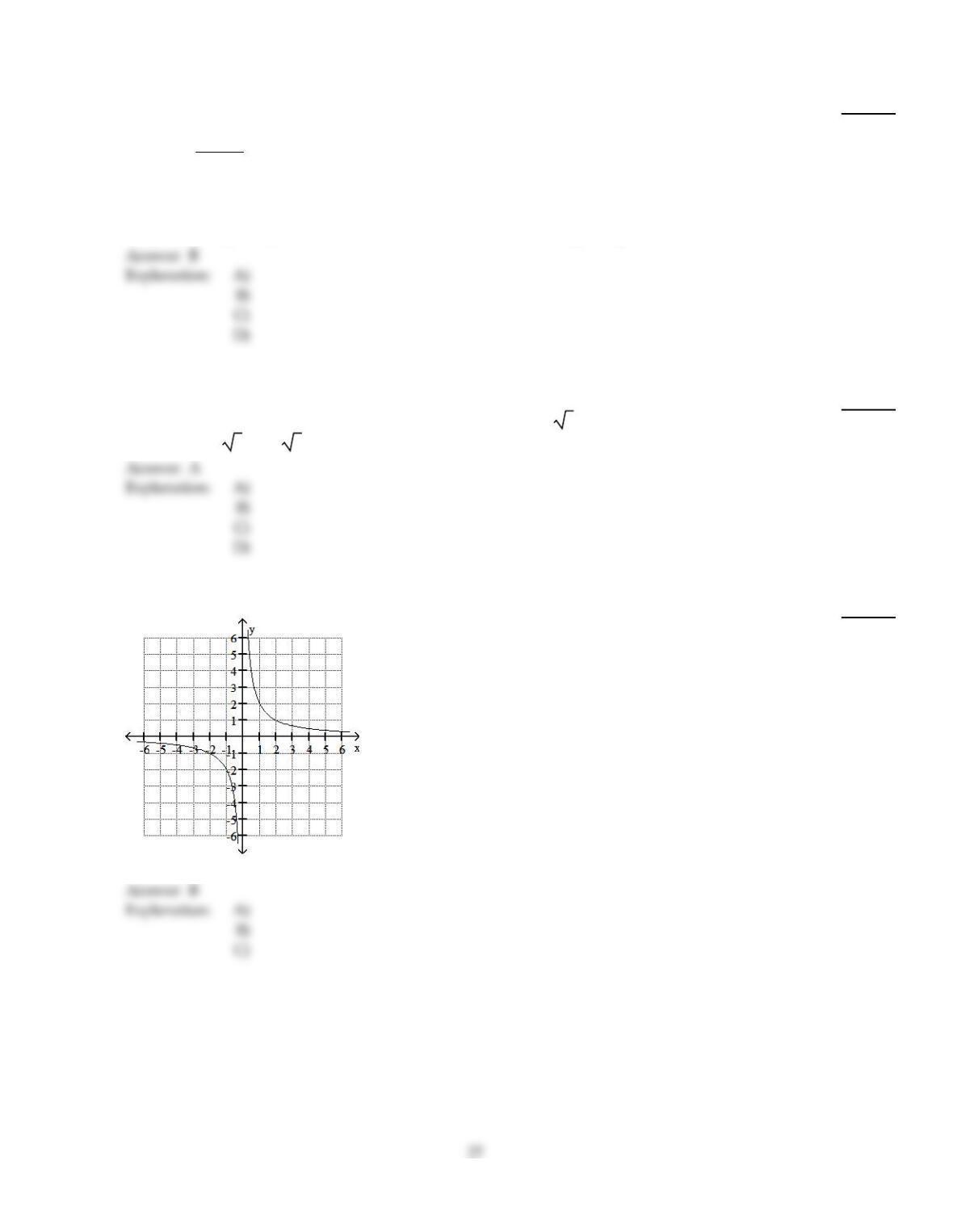
Determine whether the graph shown is the graph of a polynomial function.
66)
66)
A)
could be a polynomial function
B)
not a polynomial function
Determine the maximum possible number of turning points for the graph of the function.
67)
f(x) = – x2– 4x + 3
67)
A)
2
B)
1
C)
0
D)
3
Determine whether the function is even, odd, or neither.
68)
68)
A)
Odd
B)
Neither
C)
Even
69)
f(x) = x(5–x2)
69)
A)
Neither
B)
Odd
C)
Even
Use the Factor Theorem to solve the equation.
70)
Solve the equation 2x3– 9x2+ 7x + 6 = 0 given that 2 is a zero of f(x) =2x3– 9x2+ 7x + 6.
70)
A)
–1
2, –1, 2
B)
1
2, 2, –3
C)
–1
2, 2, 3
D)
1
2, –1, 2
Determine the maximum possible number of turning points for the graph of the function.
71)
f(x) =x5+7x6
71)
A)
1
B)
7
C)
5
D)
6
Use the Factor Theorem to solve the equation.
72)
Solve the equation 3x3– 19x2+ 30x – 8 = 0 given that 4 is a zero of f(x) =3x3– 19x2+ 30x – 8.
72)
A)
–4
3, 1, 4
B)
4
3, 1, 4
C)
–1
3, 2, 4
D)
1
3, 2, 4
Find the vertical asymptotes, if any, of the graph of the rational function.
73)
h(x) =x
x(x + 5)
73)
A)
x = 0 and x =5
B)
x = – 5
C)
x = 0 and x = – 5
D)
no vertical asymptote
Find the horizontal asymptote, if any, of the graph of the rational function.
74)
f(x) =4x
2x2+ 1
74)
A)
y =2
B)
y =1
2
C)
y = 0
D)
no horizontal asymptote
Solve the problem.
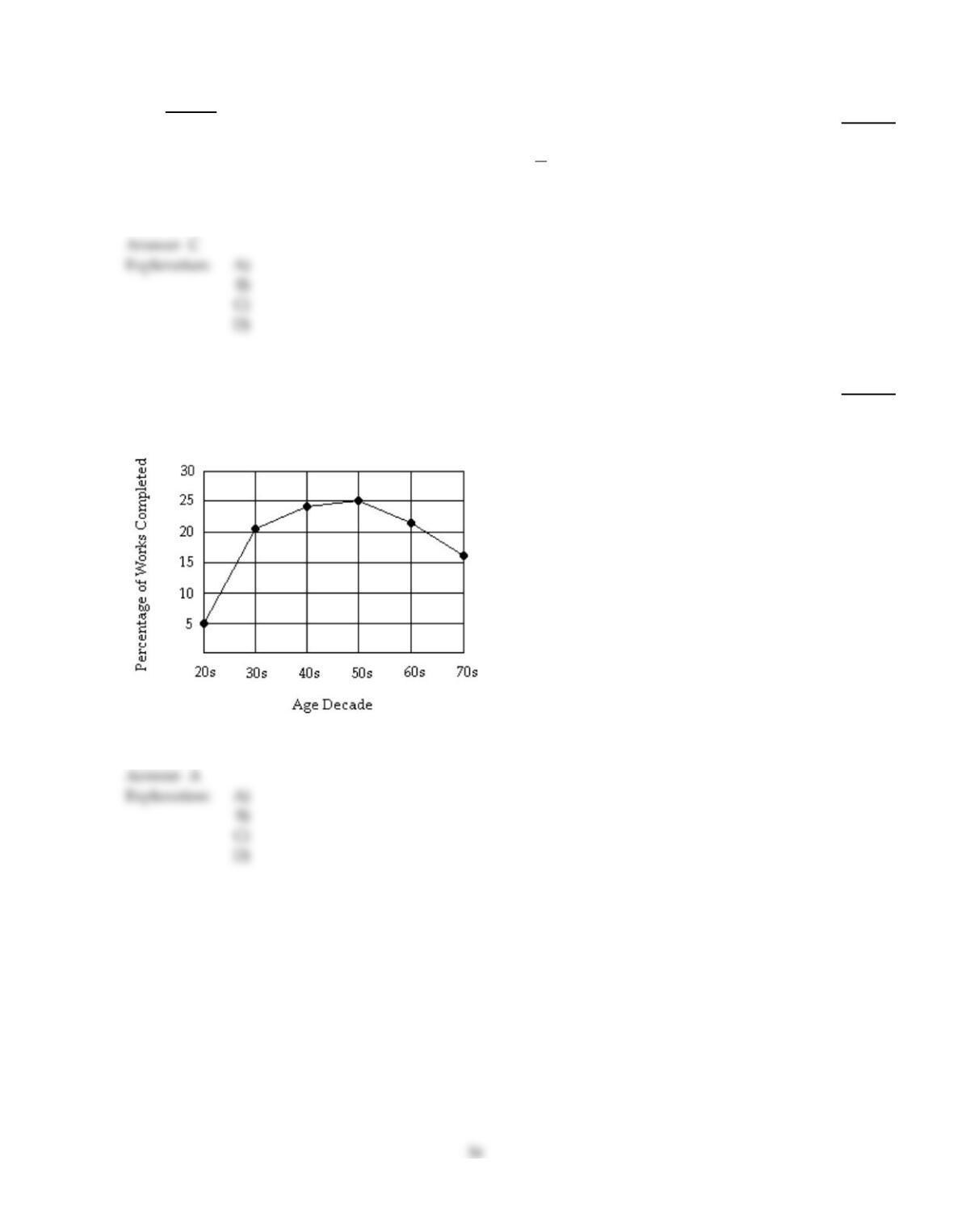
75)
The graph displays the percentage of professional works completed in each age decade of life by
556 people who lived to be at least 79. Describe the degree and the leading coefficient of the
function that can used to model the data in the graph.
75)
A)
degree: even; leading coefficient: negative
B)
degree: odd; leading coefficient: negative
C)
degree: odd; leading coefficient: positive
D)
degree: even; leading coefficient: positive
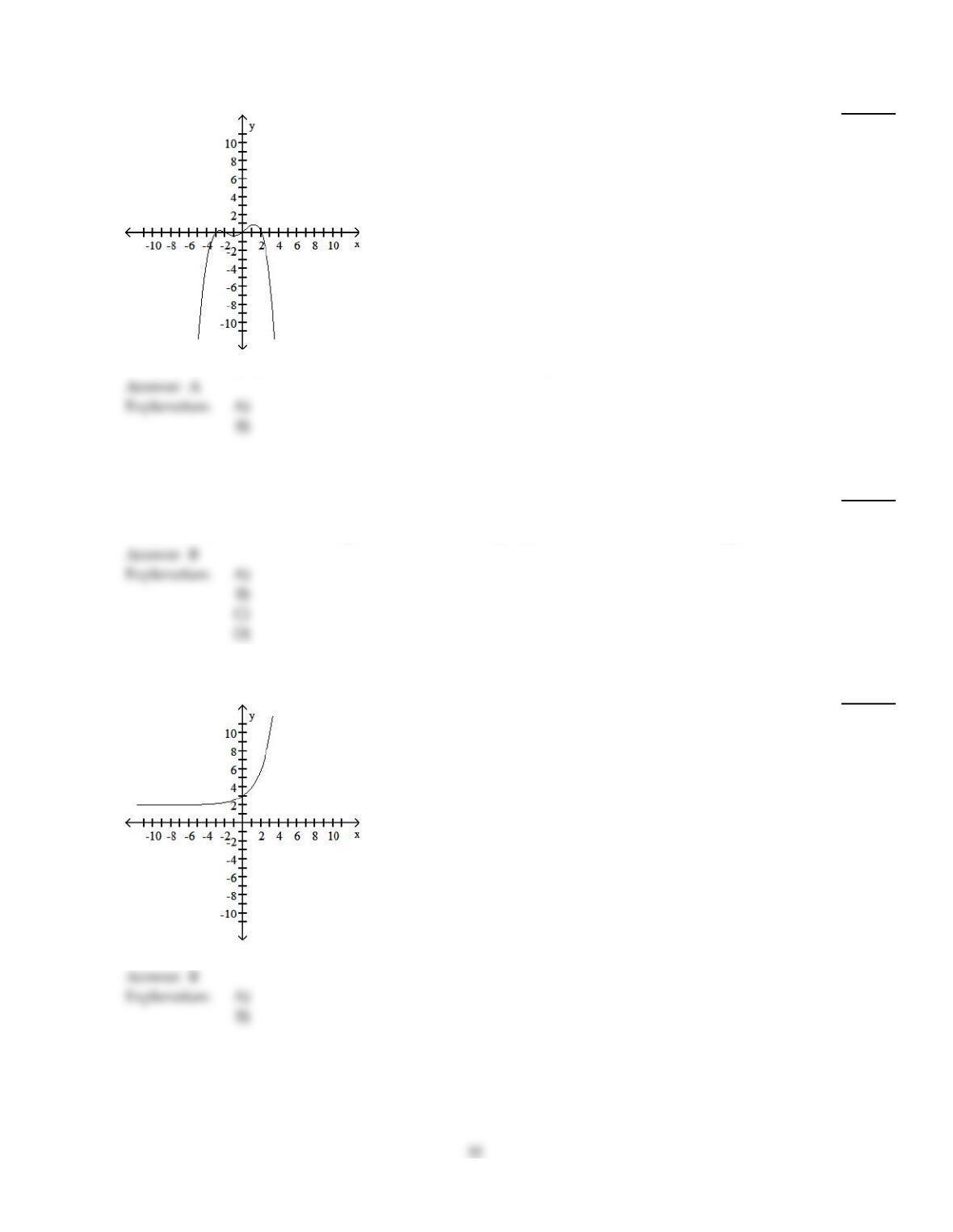
Determine whether the graph shown is the graph of a polynomial function.
76)
76)
A)
could be a polynomial function
B)
not a polynomial function
Use the Leading Coefficient Test to determine the end behavior of the graph of the polynomial function.
77)
f(x) = – 4x4+ 4x3+ 5x2+ 5x + 5
77)
A)
falls to the left and rises to the right
B)
falls to the left and to the right
C)
rises to the left and to the right
D)
rises to the left and falls to the right
Determine whether the graph shown is the graph of a polynomial function.
78)
78)
A)
could be a polynomial function
B)
not a polynomial function
Find all the rational zeros of the polynomial function.
79)
f(x) =2x3– 11x2+ 17x – 6
79)
A)
3
2, 1, and 2
B)
–3
2, 1, and –2
C)
1
2, 2, and 3
D)
–1
2, 2, and –3
Find the zeros for the polynomial function and give the multiplicity for each zero. State whether the graph crosses the
x–axis, or touches the x–axis and turns around, at each zero.
80)
f(x) =3x –3
2(x + 4)3
80)
A)
3
2 with multiplicity 1, touches the x–axis and turns; –4 with multiplicity 3, touches x–axis
and turns
B)
–3
2 with multiplicity 1, touches the x–axis and turns; 4 with multiplicity 3, touches x–axis
and turns
C)
–3
2 with multiplicity 1, crosses x–axis; 4 with multiplicity 3, crosses x–axis
D)
3
2 with multiplicity 1, crosses x–axis; –4 with multiplicity 3, crosses x–axis
Use the Rational Zero Theorem to list all possible rational zeros for the given function.
81)
f(x) = – 2x3+3x2–4x + 8
81)
A)
±1
4, ±1
2, ± 1, ± 2, ± 4, ± 8
B)
±1
8,±1
4, ±1
2, ± 1, ± 2, ± 4, ± 8
C)
±1
2, ± 1, ± 2, ± 4, ± 8
D)
±1
2, ± 1, ± 2, ± 4
36
Solve the equation.
82)
3x3– 19x2+ 30x – 8 = 0
82)
A)
4
3, 1, 2
B)
1
3, 2, 4
C)
–4
3, 1, –2
D)
–1
3, 2, –4
Determine whether the function is even, odd, or neither.
83)
83)
A)
Neither
B)
Even
C)
Odd
Use Descartes’s Rule of Signs to determine the possible number of positive and negative real zeros for the given function.
84)
f(x) =6x7–3x2+ x +8
84)
A)
2 or 0 positive zeros, 1 or 0 negative zeros
B)
2 or 0 positive zeros, 2 or 0 negative zeros
C)
2 or 0 positive zeros, 1 negative zero
D)
3 or 1 positive zeros, 3 or 1 negative zeros
Find the vertical asymptotes, if any, and the horizontal asymptote, if one exists, of the graph of the rational function.
Then graph the rational function.
37
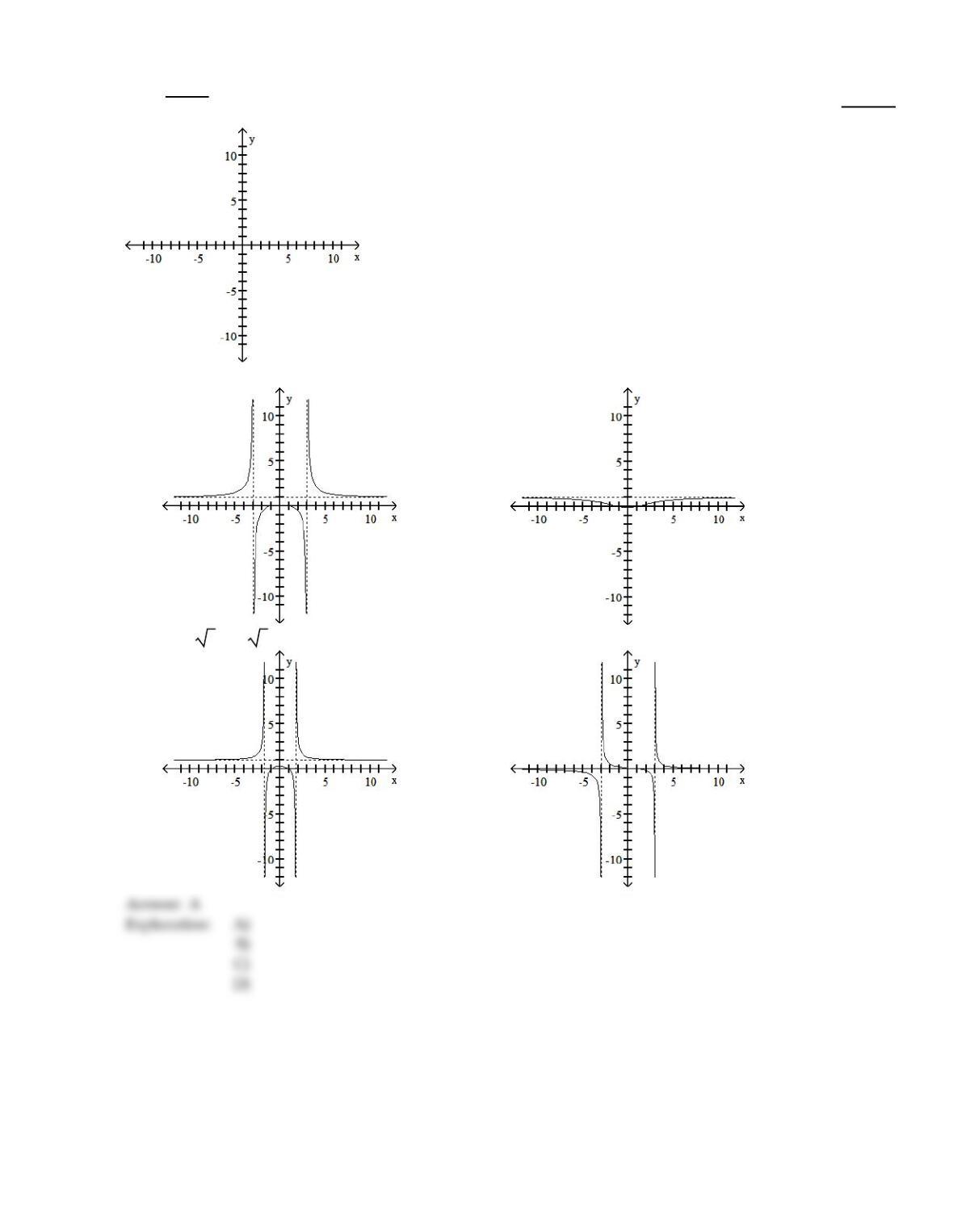
85)
f(x) =x2– 1
x2–9
85)
A)
x = – 3, x =3; y = 1
B)
no vertical asymptote; y = 1
C)
x = – 3, x =3; y = 1
D)
x = – 3, x =3; y = 0
Graph the rational function.
38
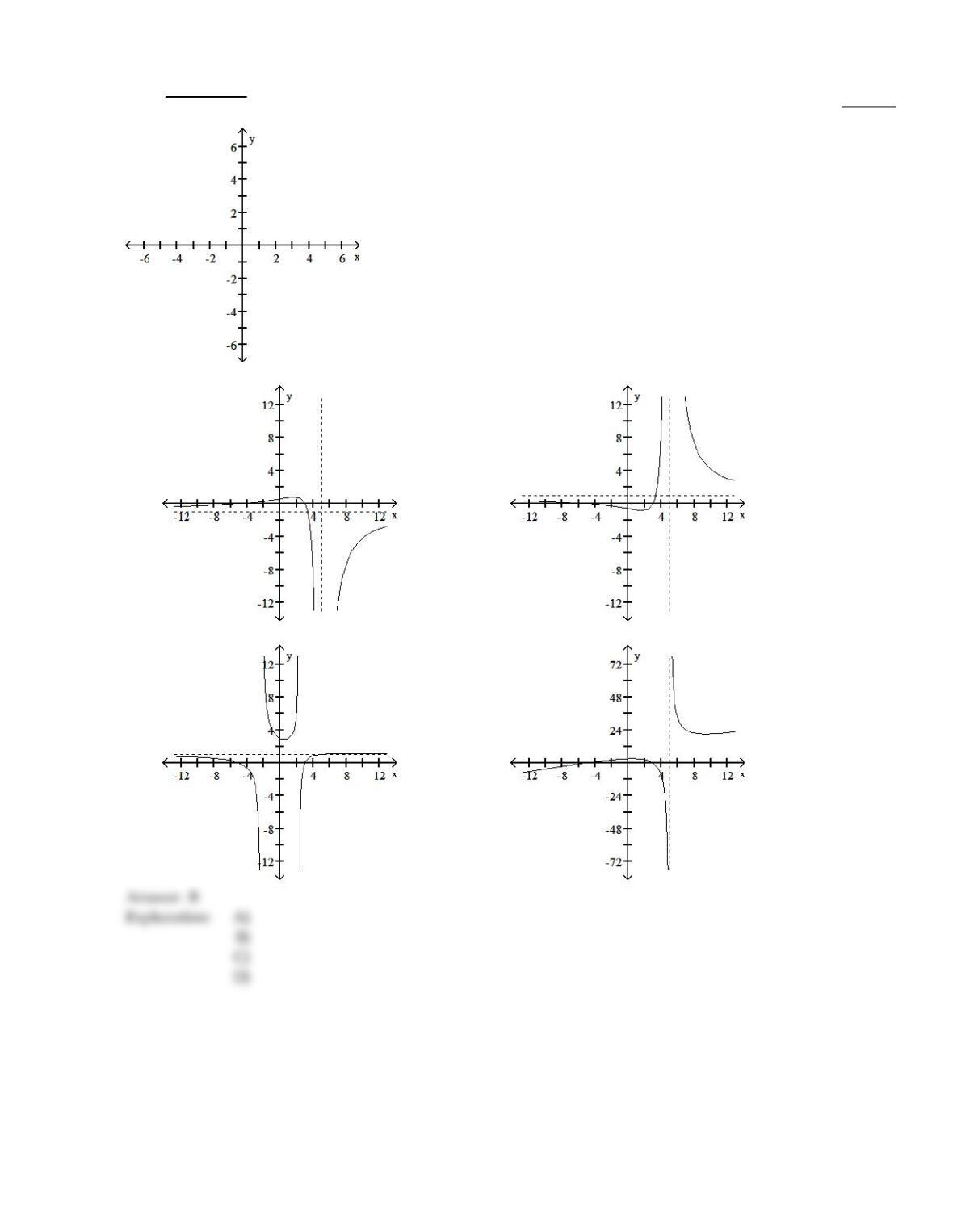
86)
f(x) =x2+ 2x – 15
(x – 5)2
86)
A)
B)
C)
D)
39
Determine the maximum possible number of turning points for the graph of the function.
87)
f(x) =x5(x5+ 4)(7x – 4)
87)
A)
10
B)
70
C)
5
D)
11
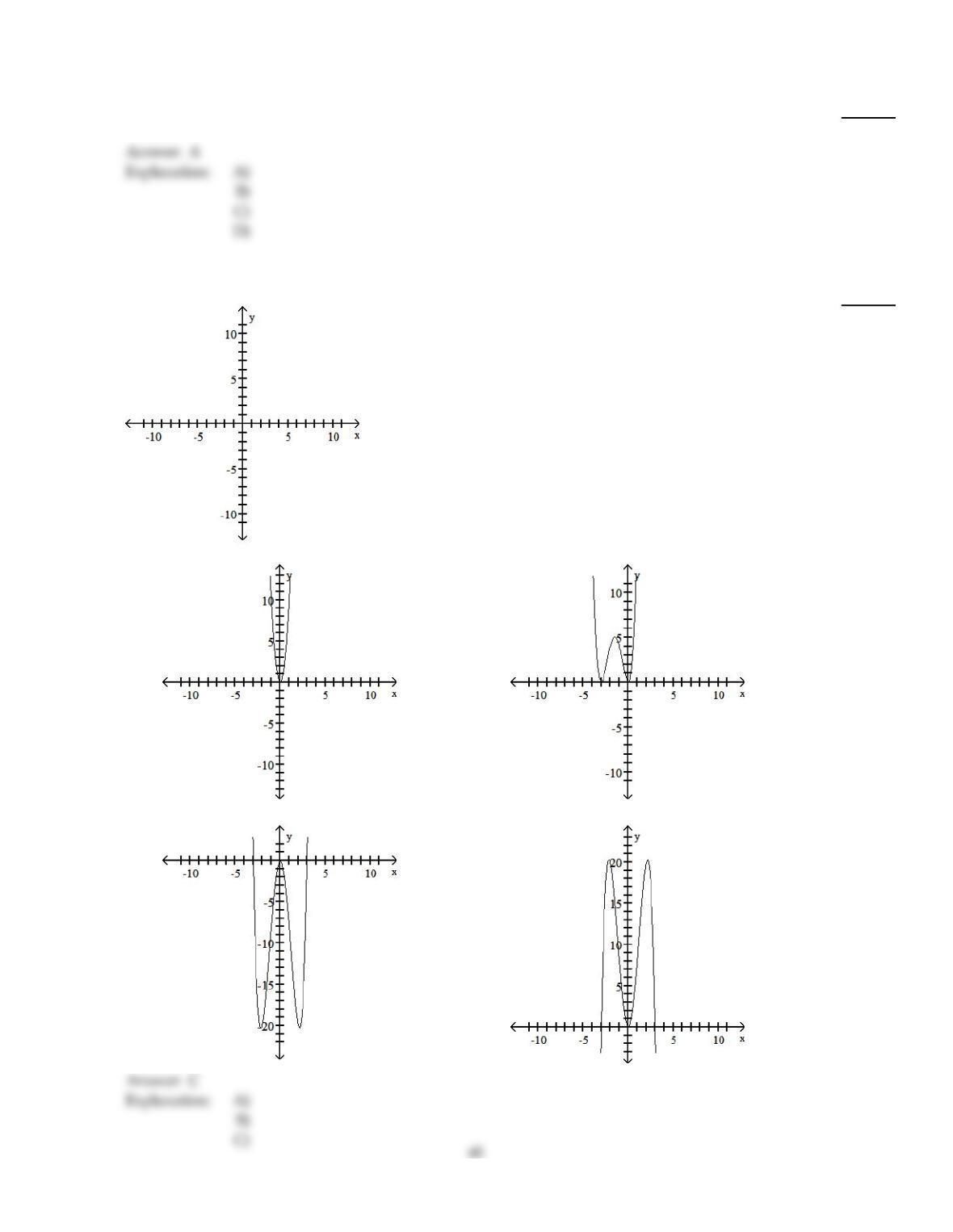
Graph the function.
88)
f(x) =x4– 9x2
88)
A)
B)
C)
D)