
Depreciation, Impairments, and Depletion
11 – 21
89. Falcon Corporation purchased a depreciable asset for $630,000 on January 1, 2012. The
estimated salvage value is $63,000, and the estimated total useful life is 9 years. The
straight-line method is used for depreciation. In 2015, Falcon changed its estimates to a
useful life of 5 years with a salvage value of $105,000. What is 2015 depreciation
expense?
a. $63,000
b. $105,000
c. $168,000
d. $189,000
90. If Labor, Inc. uses the composite method and its composite rate is 7.5% per year, what
entry should it make when plant assets that originally cost $80,000 and have been used
for 10 years are sold for $24,000?
a. Cash 24,000
Accumulated Depreciation – Plant Assets 56,000
Plant Assets 80,000
b. Cash 24,000
Loss on Sale of Plant Assets 56,000
Plant Assets 80,000
c. Cash 24,000
Accumulated Depreciation – Plant Assets 60,000
Plant Assets 80,000
Gain on Sale of Plant Assets 4,000
d. Cash 24,000
Plant Assets 24,000
91. Angst Company purchased equipment in January of 2004 for $200,000. The equipment
was being depreciated on the straight-line method over an estimated useful life of 20
years, with no salvage value. At the beginning of 2014, when the equipment had been in
use for 10 years, the company paid $25,000 to overhaul the equipment. As a result of this
improvement, the company estimated that the useful life of the equipment would be
extended an additional 5 years. What should be the depreciation expense recorded for
this equipment in 2014?
a. $5,000
b. $8,333
c. $10,000
d. $6,667
Use the following information to answer questions 92 and 93.
Exiter Inc. owns the following assets:
Asset
Cost
Salvage
Estimated Useful Life
A
$140,000
$14,000
10 years
B
75,000
7,500
5 years
C
164,000
8,000
12 years
92. What is the composite depreciation rate of Exiter’s assets?
a. 14.0%
b. 10.3%
c. 12.9%
d. 11.1%

Test Bank for Intermediate Accounting, Fifteenth Edition
11 – 22
93. What is the composite life of Exiter’s assets?
a. 14.0 years
b. 9.7 years
c. 8.9 years
d. 10.3 years
94. Torque Co. has equipment with a carrying amount of $1,600,000. The expected future net
cash flows from the equipment are $1,630,000, and its fair value is $1,360,000. The
equipment is expected to be used in operations in the future. What amount (if any) should
Torque report as an impairment to its equipment?
a. No impairment should be reported.
b. $240,000
c. $30,000
d. $270,000
95. Regis Inc. bought a machine on January 1, 2004 for $400,000. The machine had an
expected life of 20 years and was expected to have a salvage value of $40,000. On July
1, 2014, the company reviewed the potential of the machine and determined that its
undiscounted future net cash flows totaled $200,000 and its discounted future net cash
flows totaled $140,000. If no active market exists for the machine and the company does
not plan to dispose of it, what should Regis record as an impairment loss on July 1, 2014?
a. $ 0
b. $11,000
c. $20,000
d. $71,000
96. Hart Corporation owns machinery with a book value of $285,000. It is estimated that the
machinery will generate future cash flows of $300,000. The machinery has a fair value of
$210,000. Hart should recognize a loss on impairment of
a. $ -0-.
b. $15,000.
c. $75,000.
d. $90,000.
97. King Corporation owns machinery with a book value of $380,000. It is estimated that the
machinery will generate future cash flows of $350,000. The machinery has a fair value of
$280,000. King should recognize a loss on impairment of
a. $ -0-.
b. $ 30,000.
c. $100,000.
d. $ 70,000.
98. Marsh Corporation purchased a machine on July 1, 2012, for $1,250,000. The machine
was estimated to have a useful life of 10 years with an estimated salvage value of
$70,000. During 2015, it became apparent that the machine would become uneconomical
after December 31, 2019, and that the machine would have no scrap value. Accumulated
depreciation on this machine as of December 31, 2014, was $295,000. What should be
the charge for depreciation in 2015 under generally accepted accounting principles?
a. $177,000
b. $191,000
c. $205,000
d. $238,750

Depreciation, Impairments, and Depletion
11 – 23
99. Rogers Company purchased a tooling machine on January 3, 2008 for $700,000. The
machine was being depreciated on the straight-line method over an estimated useful life
of 10 years, with no salvage value. At the beginning of 2015, the company paid $175,000
to overhaul the machine. As a result of this improvement, the company estimated that the
useful life of the machine would be extended an additional 5 years (15 years total). What
should be the depreciation expense recorded for the machine in 2015?
a. $48,125
b. $58,333
c. $70,000
d. $77,000
100. Glow Co. purchased machinery on January 2, 2009, for $660,000. The straight-line
method is used and useful life is estimated to be 10 years, with a $60,000 salvage value.
At the beginning of 2015 Glow spent $144,000 to overhaul the machinery. After the
overhaul, Glow estimated that the useful life would be extended 4 years (14 years total),
and the salvage value would be $30,000. The depreciation expense for 2015 should be
a. $42,375.
b. $51,750.
c. $60,000.
d. $55,500.
101. Norton, Inc. purchased equipment in 2013 at a cost of $800,000. Two years later it
became apparent to Norton, Inc. that this equipment had suffered an impairment of value.
In early 2015, the book value of the asset is $520,000 and it is estimated that the fair
value is now only $320,000. The entry to record the impairment is
a. No entry is necessary as a write-off violates the historical cost principle.
b. Retained Earnings ……………………………………………….. 200,000
Accumulated Depreciation—Equipment ………… 200,000
c. Loss on Impairment of Equipment ………………………….. 200,000
Accumulated Depreciation—Equipment ………… 200,000
d. Retained Earnings ……………………………………………….. 200,000
Reserve for Loss on Impairment of Equipment .. 200,000
102. Porter Resources Company acquired a tract of land containing an extractable natural
resource. Porter is required by its purchase contract to restore the land to a condition
suitable for recreational use after it has extracted the natural resource. Geological surveys
estimate that the recoverable reserves will be 2,000,000 tons, and that the land will have a
value of $1,000,000 after restoration. Relevant cost information follows:
Land $7,500,000
Estimated restoration costs 1,500,000
If Porter maintains no inventories of extracted material, what should be the charge to
depletion expense per ton of extracted material?
a. $3.25
b. $3.75
c. $4.00
d. $4.50

Test Bank for Intermediate Accounting, Fifteenth Edition
11 – 24
103. In January, 2014, Yager Corporation purchased a mineral mine for $5,100,000 with
removable ore estimated by geological surveys at 2,000,000 tons. The property has an
estimated value of $300,000 after the ore has been extracted. The company incurred
$1,500,000 of development costs preparing the mine for production. During 2014, 500,000
tons were removed and 400,000 tons were sold. What is the amount of depletion that
Yager should expense for 2014?
a. $960,000
b. $1,200,000
c. $1,260,000
d. $1,680,000
104. During 2014, Corporation acquired a mineral mine for $4,000,000 of which $400,000 was
ascribed to land value after the mineral has been removed. Geological surveys have
indicated that 10 million units of the mineral could be extracted. During 2014, 1,800,000
units were extracted and 1,500,000 units were sold. What is the amount of depletion
expensed for 2014?
a. $400,000.
b. $540,000.
c. $360,000.
d. $648,000.
105. In March, 2014, Mallory Mines Co. purchased a coal mine for $8,000,000. Removable
coal is estimated at 1,500,000 tons. Mallory is required to restore the land at an estimated
cost of $960,000, and the land should have a value of $840,000. The company incurred
$2,000,000 of development costs preparing the mine for production. During 2014, 450,000
tons were removed and 300,000 tons were sold. The total amount of depletion that
Mallory should record for 2014 is
a. $1,832,000.
b. $2,024,000.
c. $2,748,000.
d. $3,036,000.
106. In 2006, Jarrett Company purchased a tract of land as a possible future plant site. In
January, 2014, valuable sulphur deposits were discovered on adjoining property and
Jarrett Company immediately began explorations on its property. In December, 2014,
after incurring $800,000 in exploration costs, which were accumulated in an expense
account, Jarrett discovered sulphur deposits appraised at $4,500,000 more than the value
of the land. To record the discovery of the deposits, Jarrett should
a. make no entry.
b. debit $800,000 to an asset account.
c. debit $4,500,000 to an asset account.
d. debit $5,300,000 to an asset account.
107. Barton Corporation acquires a coal mine at a cost of $1,800,000. Intangible development
costs total $360,000. After extraction has occurred, Barton must restore the property
(estimated fair value of the obligation is $180,000), after which it can be sold for $210,000.
Barton estimates that 5,000 tons of coal can be extracted. What is the amount of depletion
per ton?
a. $426
b. $384
c. $468
d. $360

Depreciation, Impairments, and Depletion
11 – 25
108. Barton Corporation acquires a coal mine at a cost of $1,500,000. Intangible development
costs total $360,000. After extraction has occurred, Barton must restore the property
(estimated fair value of the obligation is $180,000), after which it can be sold for $510,000.
Barton estimates that 5,000 tons of coal can be extracted. If 900 tons are extracted the
first year, which of the following would be included in the journal entry to record depletion?
a. Debit to Accumulated Depletion for $275,400
b. Debit to Inventory for $275,400
c. Credit to Inventory for $270,000
d. Credit to Accumulated Depletion for $459,000
109. In 2014, Bargain shop reported net income of $5.7 billion, net sales of $175 billion, and
average total assets of $70 billion. What is Bargain shop’s asset turnover ratio?
a. 0.31 times
b. 0.08 times.
c. 2.5 times.
d. 12.3 times.
110. In 2014, Bargain shop reported net income of $5.7 billion, net sales of $175 billion, and
average total assets of $70 billion. What is Bargain shop’s return on total assets?
a. 8.1%
b. 30.7%
c. 25%
d. 12.3%
Use the following information for questions 111 and 112:
For 2014, Hammer Company reports beginning of the year total assets of $900,000, end of the
year total assets of $1,100,000, net sales of $750,000, and net income of $150,000.
111. Hammer’s 2014 asset turnover ratio is
a. 0.14 times.
b. 0.15 times.
c. 0.68 times.
d. 0.75 times.
112. The rate of return on assets for Hammer in 2014 is
a. 12.0%.
b. 13.6%.
c. 15.0%.
d. 16.7%.
113. Sifton Company reported the following data:
2014 2015
Sales $3,000,000 $3,900,000
Net Income 300,000 400,000
Assets at year end 1,800,000 2,500,000
Liabilities at year end 1,100,000 1,500,000
What is Sifton’s asset turnover for 2015?
a. 1.56
b. 1.61
c. 1.81
d. 2.17
Test Bank for Intermediate Accounting, Fifteenth Edition
11 – 26
114. Frank Company reported the following data:
2014 2015
Sales $3,000,000 $4,200,000
Net Income 300,000 400,000
Assets at year end 1,800,000 2,500,000
Liabilities at year end 1,100,000 1,500,000
What is Frank’s asset turnover for 2015?
a. 1.68
b. 1.72
c. 1.95
d. 2.33
Use the following information for questions 115 and 116:
On January 1, 2014, Garrett Company purchased a machine costing $250,000. The machine is in
the MACRS 5-year recovery class for tax purposes and has an estimated $50,000 salvage value
at the end of its economic life.
*115. Assuming the company uses the general MACRS approach, the amount of MACRS
deduction for tax purposes for the year 2014 is
a. $50,000.
b. $100,000.
c. $80,000.
d. $40,000.
*116. Assuming the company uses the optional straight-line method, the amount of MACRS
deduction for tax purposes for the year 2014 is
a. $40,000.
b. $50,000.
c. $20,000.
d. $25,000.
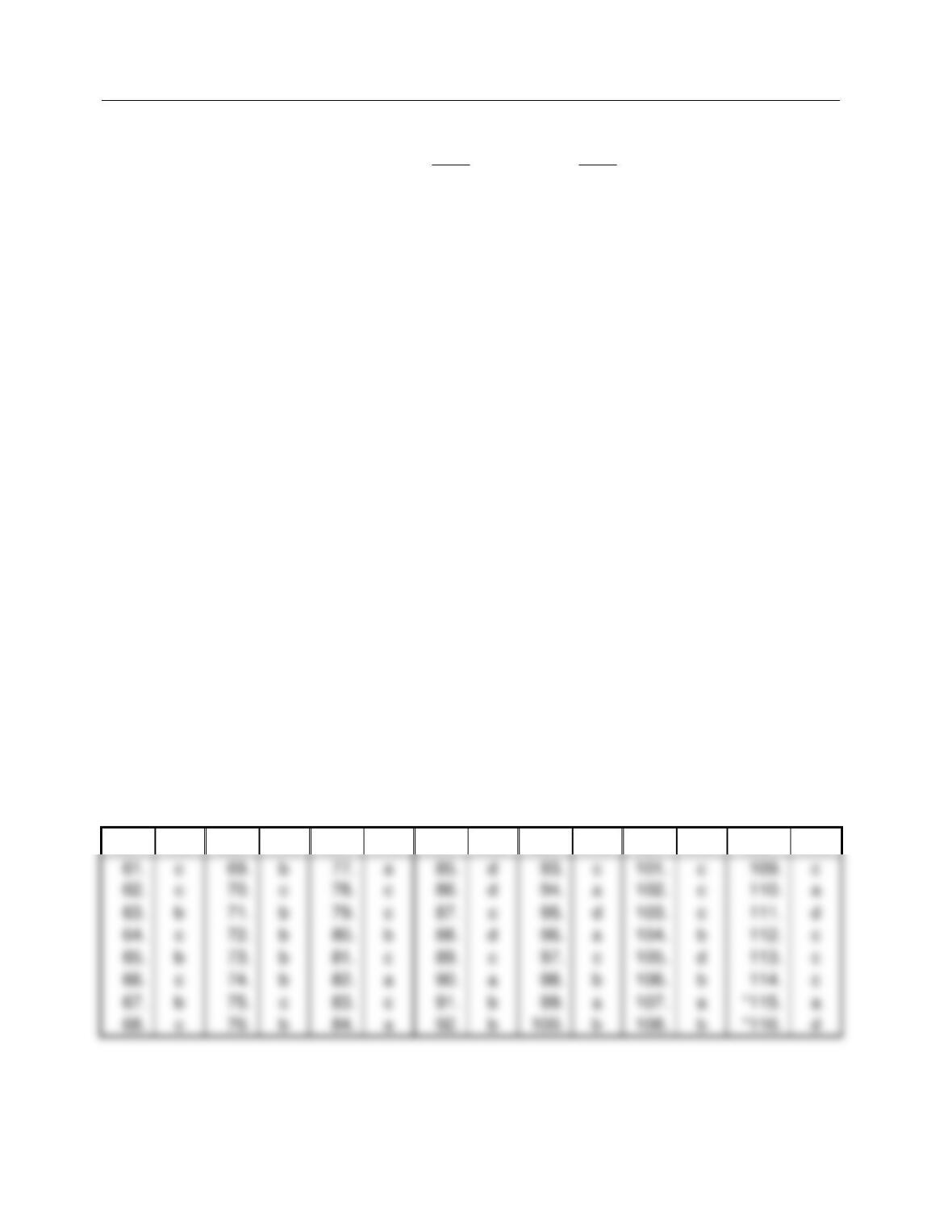
Multiple Choice Answers—Computational
Item
Ans.
Item
Ans.
Item
Ans.
Item
Ans.
Item
Ans.
Item
Ans.
Item
Ans.

Depreciation, Impairments, and Depletion
11 – 27
MULTIPLE CHOICE—CPA Adapted
117. Piazza Co. purchased a machine on July 1, 2014, for $800,000. The machine has an
estimated useful life of five years and a salvage value of $160,000. The machine is being
depreciated from the date of acquisition by the 150% declining-balance method. For the
year ended December 31, 2014, Piazza should record depreciation expense on this
machine of
a. $240,000.
b. $160,000.
c. $120,000.
d. $96,000.
118. A machine with a five-year estimated useful life and an estimated 10% salvage value was
acquired on January 1, 2013. The depreciation expense for 2015 using the double-
declining balance method would be original cost multiplied by
a. 90% × 40% × 40%.
b. 60% × 60% × 40%.
c. 90% × 60% × 40%.
d. 40% × 40%.
119. On April 1, 2013, Verlin Co. purchased new machinery for $300,000. The machinery has
an estimated useful life of five years, and depreciation is computed by the sum–of-the-
years’-digits method. The accumulated depreciation on this machinery at March 31, 2015,
should be
a. $200,000.
b. $180,000.
c. $120,000.
d. $100,000.
120. Harris Co. takes a full year’s depreciation expense in the year of an asset’s acquisition
and no depreciation expense in the year of disposition. Data relating to one of Harris’s
depreciable assets at December 31, 2015 are as follows:
Acquisition year 2013
Cost $210,000
Residual value 30,000
Accumulated depreciation 144,000
Estimated useful life 5 years
Using the same depreciation method as used in 2013, 2014, and 2015, how much
depreciation expense should Harris record in 2016 for this asset?
a. $24,000
b. $36,000
c. $42,000
d. $48,000

Test Bank for Intermediate Accounting, Fifteenth Edition
11 – 28
121. A depreciable asset has an estimated 15% salvage value. At the end of its estimated
useful life, the accumulated depreciation would equal the original cost of the asset under
which of the following depreciation methods?
Straight-line Productive Output
a. Yes No
b. Yes Yes
c. No Yes
d. No No
122. Net income is understated if, in the first year, estimated salvage value is excluded from
the depreciation computation when using the
Straight-line Production or
Method Use Method
a. Yes No
b. Yes Yes
c. No No
d. No Yes
123. A plant asset with a five-year estimated useful life and no residual value is sold at the end
of the second year of its useful life. How would using the sum-of-the-years’-digits method
of depreciation instead of the double-declining balance method of depreciation affect a
gain or loss on the sale of the plant asset?
Gain Loss
a. Decrease Decrease
b. Decrease Increase
c. Increase Decrease
d. Increase Increase
124. Galt Company acquired a tract of land containing an extractable natural resource. Galt is
required by the purchase contract to restore the land to a condition suitable for
recreational use after it has extracted the natural resource. Geological surveys estimate
that the recoverable reserves will be 4,000,000 tons, and that the land will have a value of
$600,000 after restoration. Relevant cost information follows:
Land $6,400,000
Estimated restoration costs 1,200,000
If Galt maintains no inventories of extracted material, what should be the charge to
depletion expense per ton of extracted material?
a. $1.60
b. $1.75
c. $2.00
d. $1.90
Depreciation, Impairments, and Depletion
11 – 29
125. In January 2014, Fritz Mining Corporation purchased a mineral mine for $6,300,000 with
removable ore estimated by geological surveys at 2,500,000 tons. The property has an
estimated value of $600,000 after the ore has been extracted. Fritz incurred $1,725,000 of
development costs preparing the property for the extraction of ore. During 2014, 390,000
tons were removed and 350,000 tons were sold. For the year ended December 31, 2014,
Fritz should include what amount of depletion in its cost of goods sold?
a. $798,000
b. $889,200
c. $1,039,500
d. $1,158,000
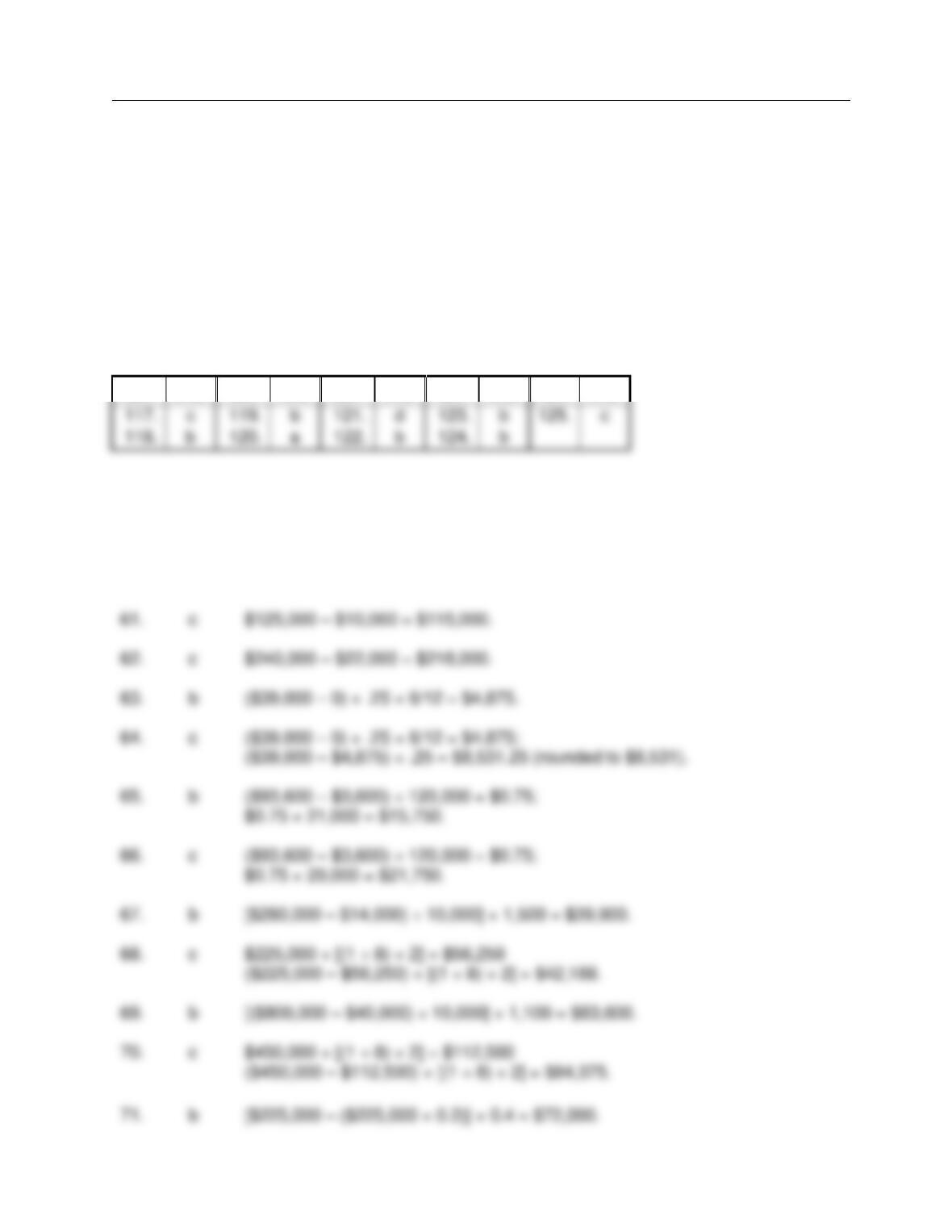
Multiple Choice Answers—CPA Adapted
Item
Ans.
Item
Ans.
Item
Ans.
Item
Ans.
Item
Ans.
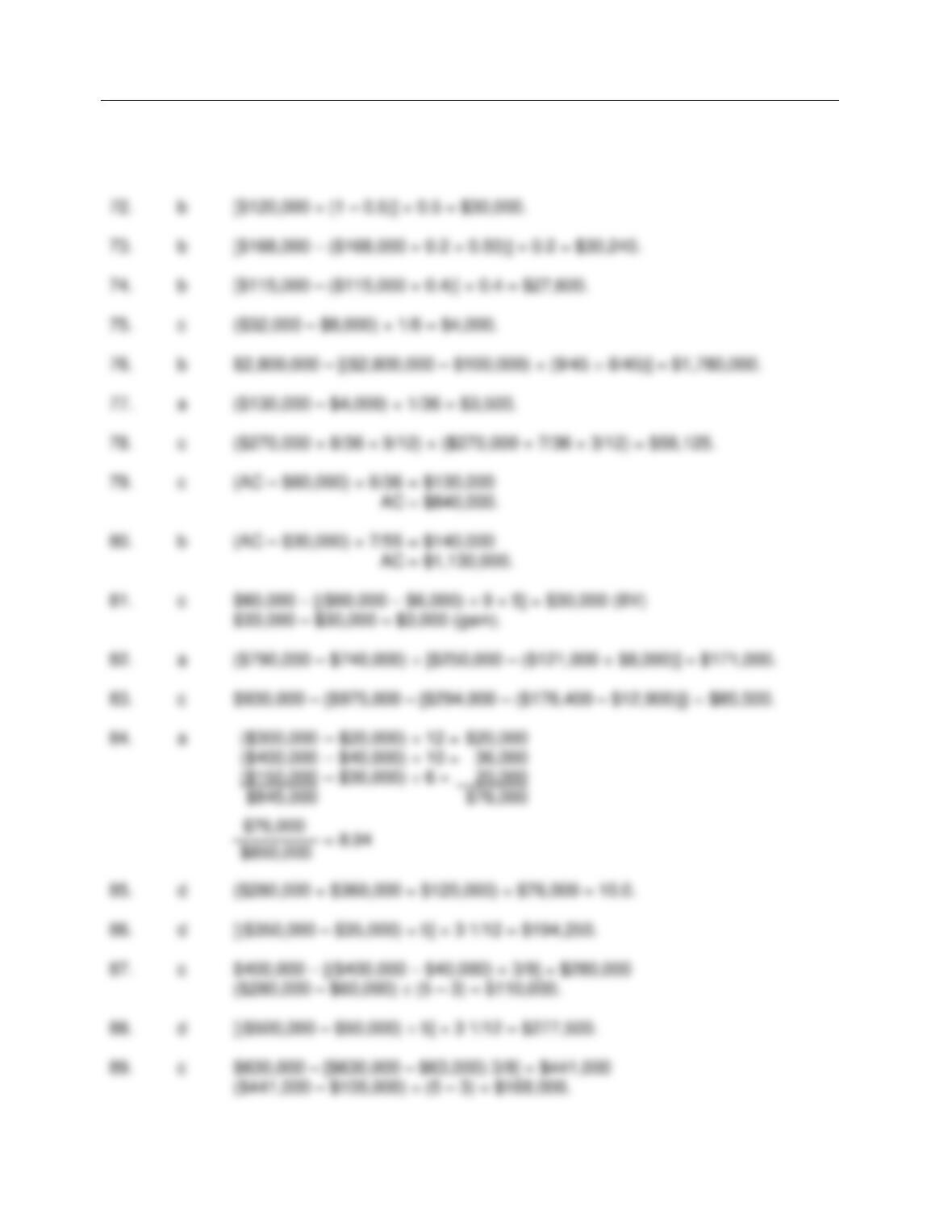
DERIVATIONS — Computational
No. Answer Derivation
Test Bank for Intermediate Accounting, Fifteenth Edition
11 – 30
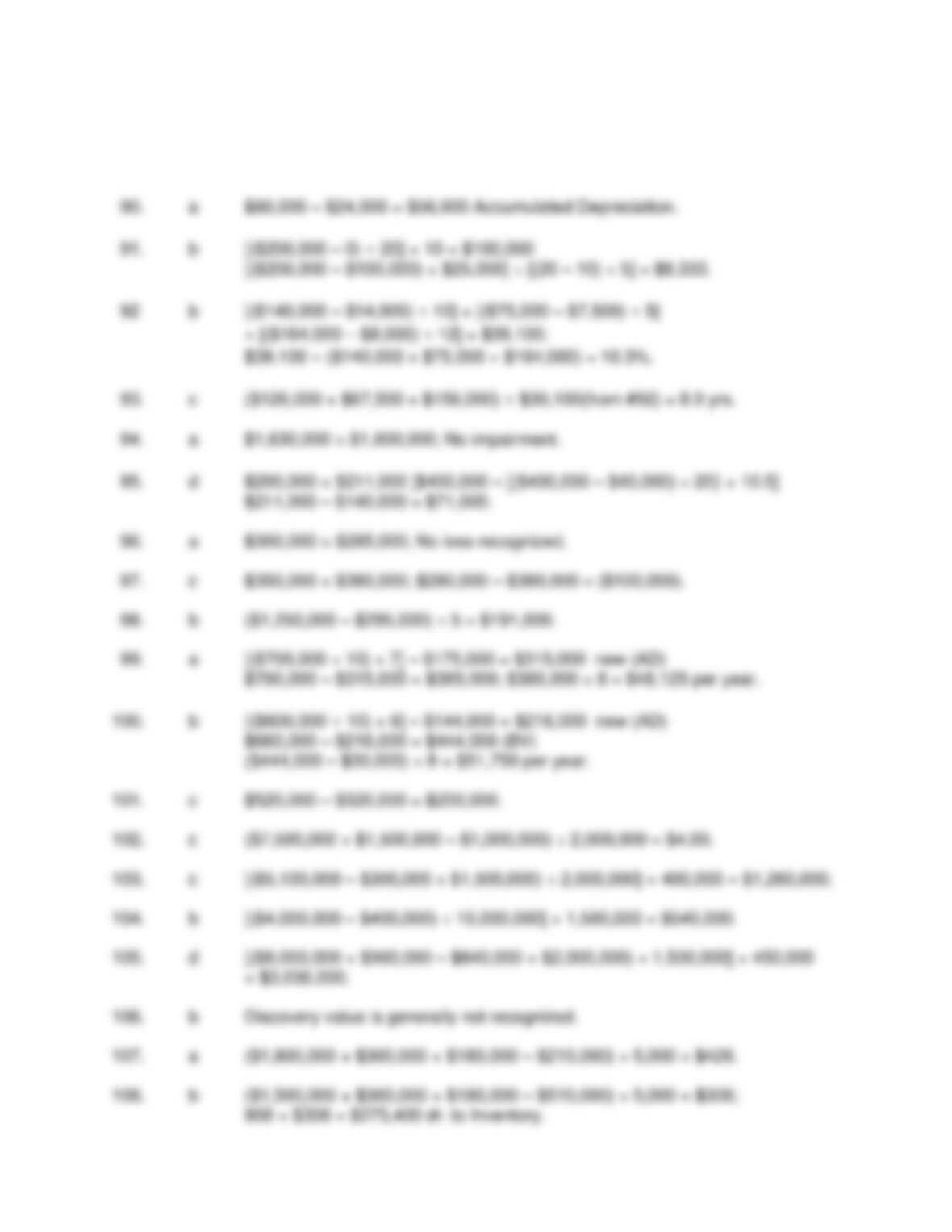
DERIVATIONS — Computational (cont.)
No. Answer Derivation
Depreciation, Impairments, and Depletion
11 – 31
DERIVATIONS — Computational (cont.)
No. Answer Derivation
Test Bank for Intermediate Accounting, Fifteenth Edition
11 – 32
DERIVATIONS — Computational (cont.)
No. Answer Derivation
DERIVATIONS — CPA Adapted
No. Answer Derivation

Depreciation, Impairments, and Depletion
11 – 33
BRIEF EXERCISES
BE. 11-126—Definitions.
Provide clear, concise answers for the following.
1. Define depreciation.
2. Define depreciation accounting.
3. Does depreciation accounting provide funds? If not, what does provide funds? What does
depreciation accounting do related to funds?
Solution 11-126
1. Depreciation is the decline in service potentials or in future benefits of a plant asset due to
physical or economic factors.
2. Depreciation accounting is the systematic and rational allocation of the cost of plant assets to
the periods benefited from the use of the assets.
3. Depreciation accounting does not provide funds. Revenues provide funds. Depreciation
accounting retains funds by reducing income taxes and dividends.
BE. 11-127—True or False.
Place T or F in front of each of the following statements.
____ 1. The straight-line method of depreciation is based on the assumption that depreciation
expense can be regarded as a constant function of time.
____ 2. Plant assets should be written down (below cost) when their market value has
declined temporarily.
____ 3. The accounting profession has developed specifically recommended procedures for
recording appraisal increases with respect to plant assets.
____ 4. An asset’s cost minus its accumulated depreciation equals its book value.
____ 5. The sum-of-the-years’-digits method of depreciation ignores salvage value in the
computation of an asset’s depreciable base.
____ 6. When using the double-declining balance method of determining depreciation, a
declining percentage is applied to a constant book value.
____ 7. The book value of plant assets initially declines more rapidly under decreasing-charge
methods than under the straight-line method.
____ 8. Accounting depreciation is computed by determining the change in the market value of
a company’s plant assets during the period under review.