Use the table for the question(s) below.
Consider the following returns:
Year End
Lowes
Realized
Return
Home Depot
Realized
Return
IBM
Realized
Return
2000 20.1% –14.6% 0.2%
2001 72.7% 4.3% –3.2%
2002 –25.7% –58.1% –27.0%
2003 56.9% 71.1% 27.9%
2004 6.7% 17.3% –5.1%
2005 17.9% 0.9% –11.3%
44)
The Volatility on IBM‘s returns is closest to:
44)
A)
13%
B)
18%
C)
16%
D)
3%
21
Use the information for the question(s) below.
Suppose you invest $20,000 by purchasing 200 shares of Abbott Labs (ABT) at $50 per share, 200 shares of Lowes (LOW) at
$30 per share, and 100 shares of Ball Corporation (BLL) at $40 per share.
45)
Suppose over the next year Ball has a return of 12.5%, Lowes has a return of 20%, and Abbott Labs
has a return of –10%. The weight on Ball Corporation in your portfolio after one year is closest to:
45)
A)
12.5%
B)
21.7%
C)
20.0%
D)
20.7%
46)
Which of the following statements is false?
46)
A)
Independent risks are uncorrelated.
B)
While the sign of the correlation is easy to interpret, its magnitude is not.
C)
To find the risk of a portfolio, we need to know more than the risk and return of the
component stocks; we need to know the degree to which the stocks’ returns move together.
D)
When the covariance equals 0, the returns are uncorrelated.
22

Use the table for the question(s) below.
Consider the following expected returns, volatilities, and correlations:
Stock
Expected
Return
Standard
Deviation
Correlation with
Duke Energy
Correlation with
Microsoft
Correlation with
Wal–Mart
Duke Energy 14% 6% 1.0 –1.0 0.0
Microsoft 44% 24% –1.0 1.0 0.7
Wal–Mart 23% 14% 0.0 0.7 1.0
47)
The expected return of a portfolio that is consists of a long position of $10000 in Wal–Mart and a
short position of $2000 in Microsoft is closest to:
47)
A)
21%
B)
18%
C)
27%
D)
12%
23
Use the table for the question(s) below.
Consider the following returns:
Year End
Lowes
Realized
Return
Home Depot
Realized
Return
IBM
Realized
Return
2000 20.1% –14.6% 0.2%
2001 72.7% 4.3% –3.2%
2002 –25.7% –58.1% –27.0%
2003 56.9% 71.1% 27.9%
2004 6.7% 17.3% –5.1%
2005 17.9% 0.9% –11.3%
48)
The variance on a portfolio that is made up of equal investments in Lowes and IBM stock is closest
to:
48)
A)
0.62
B)
0.12
C)
0.06
D)
0.05
24
49)
Suppose you invest $15,000 in Merck stock and $25,000 in Home Depot stock. You expect a return
of 16% for Merck and 12% for Home Depot. What is the expected return on your portfolio?
49)
A)
13.75%
B)
13.50%
C)
14.50%
D)
14.00%
Use the information for the question(s) below.
Suppose you invest $20,000 by purchasing 200 shares of Abbott Labs (ABT) at $50 per share, 200 shares of Lowes (LOW) at
$30 per share, and 100 shares of Ball Corporation (BLL) at $40 per share.
50)
The weight on Abbott Labs in your portfolio is:
50)
A)
50%
B)
20%
C)
40%
D)
30%
51)
Which of the following statements is false?
51)
A)
With a positive amount invest in each stock, the more the stocks move together and the higher
their covariance or correlation, the more variable the portfolio will be.
B)
Almost all of the correlations between stocks are negative, illustrating the general tendency of
stocks to move together.
C)
Stocks in the same industry tend to have more highly correlated returns than stocks in
different industries.
D)
Stock returns will tend to move together if they are affect similarly by economic events.
52)
Which of the following statements is false?
52)
A)
The volatility of the risk–free investment is zero.
B)
Our total volatility is only a fraction of the volatility of the efficient portfolio, based on the
amount we invest in the risk free asset.
C)
A portfolio that consists of a long position in the risk–free investment is known as a levered
portfolio.
D)
The optimal portfolio will not depend on the investor’s personal tradeoff between risk and
return.
Use the information for the question(s) below.
Suppose you invest $20,000 by purchasing 200 shares of Abbott Labs (ABT) at $50 per share, 200 shares of Lowes (LOW) at
$30 per share, and 100 shares of Ball Corporation (BLL) at $40 per share.
53)
Suppose over the next year Ball has a return of 12.5%, Lowes has a return of 20%, and Abbott Labs
has a return of –10%. The weight on Abbott Labs in your portfolio after one year is closest to:
53)
A)
–10.0%
B)
45.0%
C)
43.5%
D)
50.0%
26
Use the table for the question(s) below.
Consider the following returns:
Year End
Lowes
Realized
Return
Home Depot
Realized
Return
IBM
Realized
Return
2000 20.1% –14.6% 0.2%
2001 72.7% 4.3% –3.2%
2002 –25.7% –58.1% –27.0%
2003 56.9% 71.1% 27.9%
2004 6.7% 17.3% –5.1%
2005 17.9% 0.9% –11.3%
54)
The variance on a portfolio that is made up of equal investments in Lowes and Home Depot stock
is closest to:
54)
A)
0.10
B)
0.29
C)
0.12
D)
0.69
27
55)
The Volatility on Home Depot’s returns is closest to:
55)
A)
42%
B)
18%
C)
31%
D)
35%
28
56)
The covariance between Lowes’ and IBM’s returns is closest to:
56)
A)
0.05
B)
0.10
C)
0.71
D)
0.06
57)
Which of the following equations is incorrect?
57)
A)
Rp=i xiRi
B)
E[Rp} =E[i xiRi]
C)
Rp=x1R1+x2R2+ … +xnRn
D)
xi=Total value of portfolio
Value of investment i
xi=Value of investment i
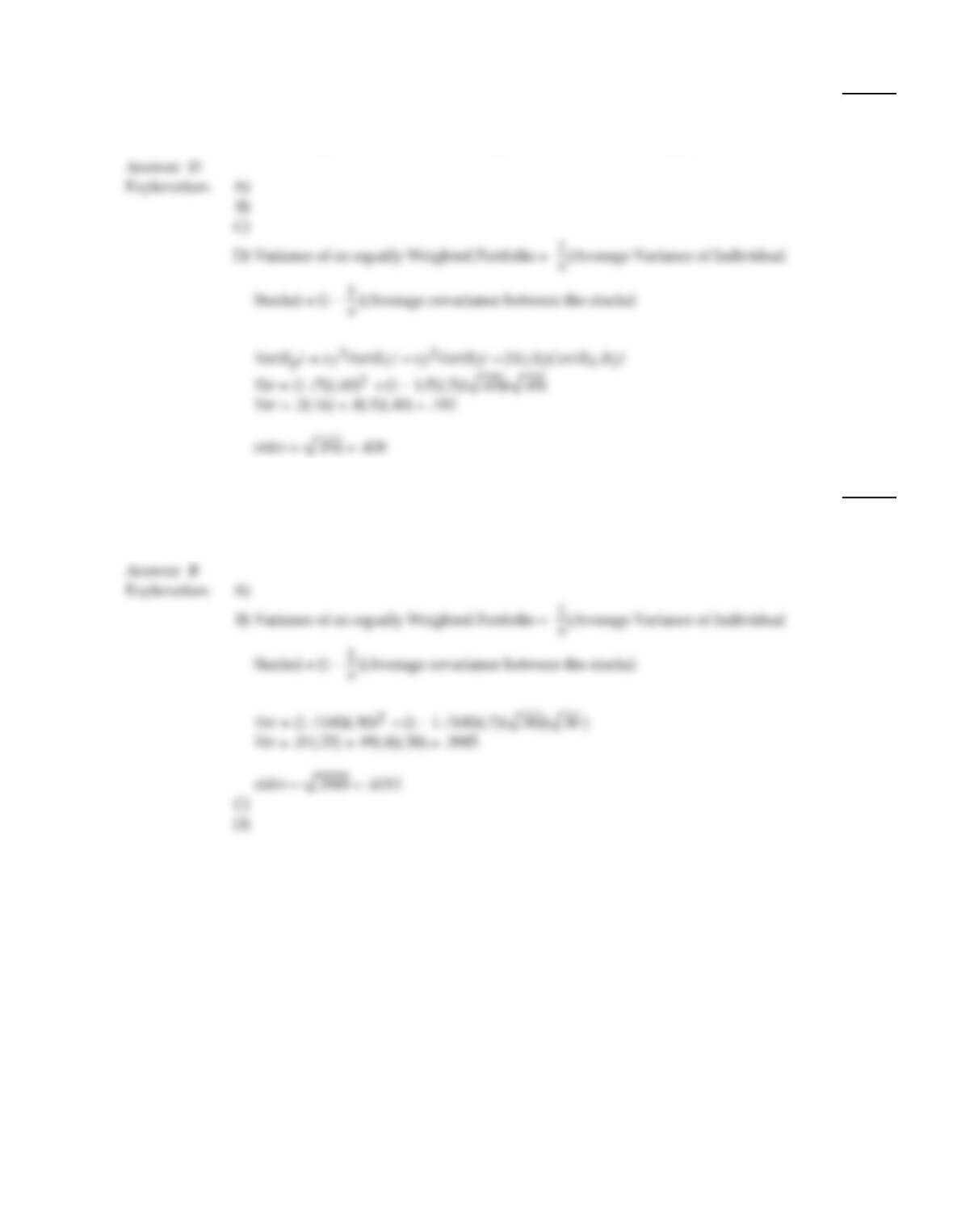
58)
Consider an equally weighted portfolio that contains five stocks. If the average volatility of these
stocks is 40% and the average correlation between the stocks is .5, then the volatility of this equally
weighted portfolio is closest to:
58)
A)
.17
B)
.19
C)
.41
D)
.44
59)
Consider an equally weighted portfolio that contains 100 stocks. If the average volatility of these
stocks is 50% and the average correlation between the stocks is .7, then the volatility of this equally
weighted portfolio is closest to:
59)
A)
.50
B)
.63
C)
.40
D)
.72
30
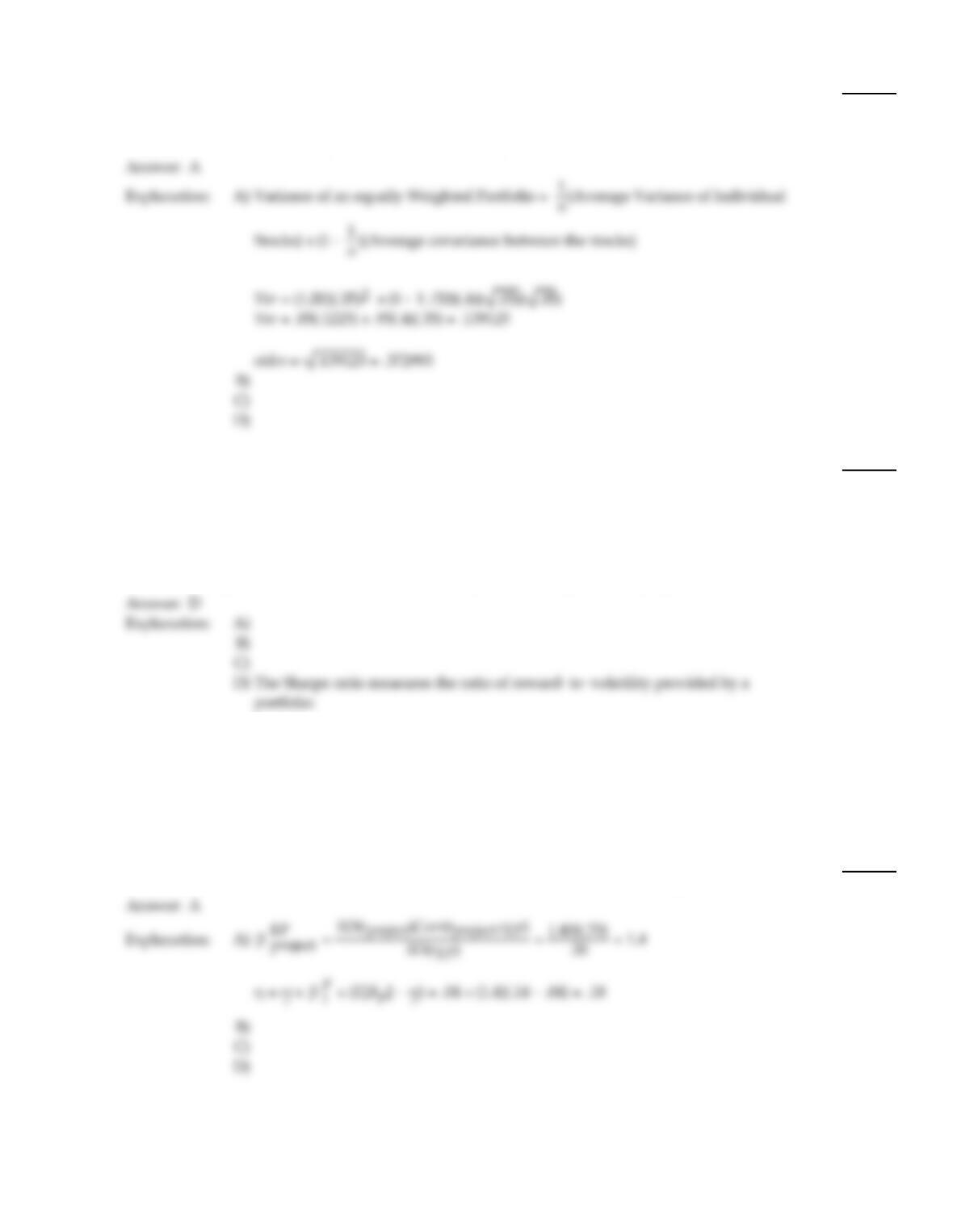
60)
Consider an equally weighted portfolio that contains 20 stocks. If the average volatility of these
stocks is 35% and the average correlation between the stocks is .4, then the volatility of this equally
weighted portfolio is closest to:
60)
A)
.37
B)
.17
C)
.14
D)
.41
61)
Which of the following statements is false?
61)
A)
The slope of the line through a given portfolio is often referred to as the Sharpe ratio of the
portfolio.
B)
The Sharpe ratio is the number of stand deviations the portfolio’s return would have to fall to
under–perform the risk–free investment.
C)
Borrowing money to invest in stocks is referred to as buying stocks on margin.
D)
The Sharpe ratio measures the ratio of volatility –to–reward provided by a portfolio.
Use the information for the question(s) below.
Sisyphean industries is seeking to raise capital from a large group of investors to fund a new project. Suppose that the
efficient portfolio has an expected return of 14% and a volatility of 20%. Sisyphean’s new project is expected to have a
volatility of 40% and a 70% correlation with the efficient portfolio. The risk–free rate is 4%.
62)
The required return for Sisyphean’s new project is closest to:
62)
A)
18%
B)
10%
C)
24%
D)
14%
31

63)
Which of the following formulas is incorrect?
63)
A)
Variance of a portfolio =
i
xiCov(Ri,Rp)
B)
Variance of a portfolio =
i j
xixjCov(Ri,Rj)
C)
Variance of a portfolio =
i
xiCov(Ri,
j
xjRj)
D)
Variance of an equally Weighted Portfolio = (1 –1
n)(Average Variance of Individual Stocks) +
1
n(Average covariance between the stocks)
Use the table for the question(s) below.
Consider the following expected returns, volatilities, and correlations:
Stock
Expected
Return
Standard
Deviation
Correlation with
Duke Energy
Correlation with
Microsoft
Correlation with
Wal–Mart
Duke Energy 14% 6% 1.0 –1.0 0.0
Microsoft 44% 24% –1.0 1.0 0.7
Wal–Mart 23% 14% 0.0 0.7 1.0
64)
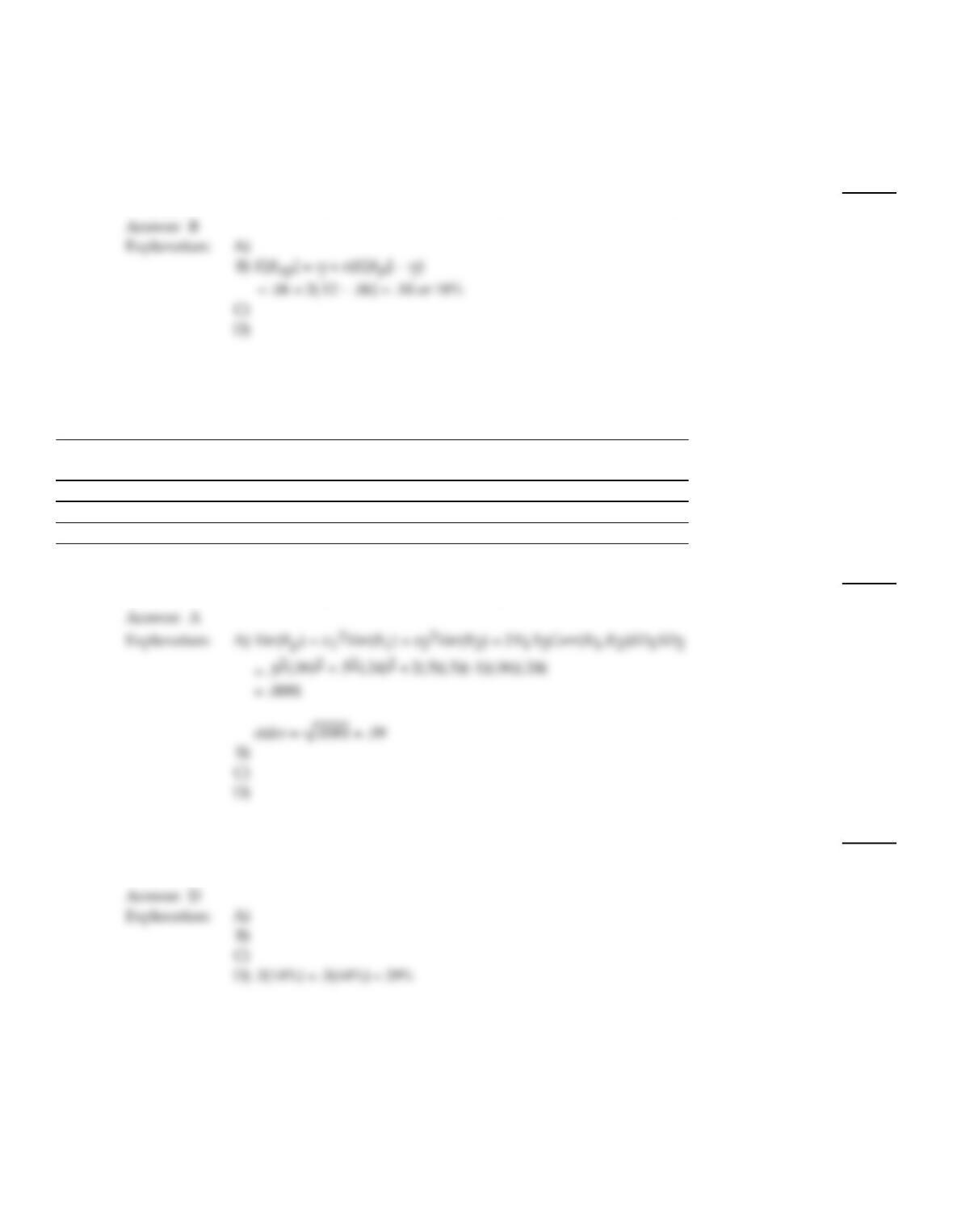
The volatility of a portfolio that is consists of a long position of $10000 in Wal–Mart and a short
position of $2000 in Microsoft is closest to:
64)
A)
14%
B)
11%
C)
9%
D)
12%
32
Variance of an equally Weighted Portfolio =1
Use the information for the question(s) below.
Suppose you have $10,000 in cash and you decide to borrow another $10,000 at a 6% interest rate to invest in the stock
market. You invest the entire $20,000 in an exchange traded fund (ETF) with a 12% expected return and a 20% volatility.
65)
The expected return on your of your investment is closest to:
65)
A)
24%
B)
18%
C)
12%
D)
20%
Use the table for the question(s) below.
Consider the following expected returns, volatilities, and correlations:
Stock
Expected
Return
Standard
Deviation
Correlation with
Duke Energy
Correlation with
Microsoft
Correlation with
Wal–Mart
Duke Energy 14% 6% 1.0 –1.0 0.0
Microsoft 44% 24% –1.0 1.0 0.7
Wal–Mart 23% 14% 0.0 0.7 1.0
66)
The volatility of a portfolio that is equally invested in Duke Energy and Microsoft is closest to:
66)
A)
9%
B)
11%
C)
6%
D)
8%
67)
The expected return of a portfolio that is equally invested in Duke Energy and Microsoft is closest
to:
67)
A)
24%
B)
23%
C)
28%
D)
29%
33
68)
Which of the following statements is false?
68)
A)
The overall variability of the portfolio depends on the total co–movement of the stocks within
it.
B)
Nearly half of the volatility of individual stocks can be eliminated in a large portfolio as a
result of diversification.
C)
The expected return of a portfolio is equal to the weighted average expected return, but the
volatility of a portfolio is less than the weighted average volatility.
D)
Each security contributes to the volatility of the portfolio according to its volatility, scaled by
its covariance with the portfolio, which adjusts for the fraction of the total risk that is common
to the portfolio.
34