42) For Proposal 3, the annual incremental after-tax cash flow from operations for year 3 is
________. (See Table 11.2)
A) $45,000
B) $75,150
C) $90,150
D) $93,800
Table 11.3
Cuda Marine Engines, Inc. must develop the relevant cash flows for a replacement capital
investment proposal. The proposed asset costs $50,000 and has installation costs of $3,000. The
asset will be depreciated using a five-year recovery schedule. The existing equipment, which
originally cost $25,000 and will be sold for $10,000, has been depreciated using an MACRS
five-year recovery schedule and three years of depreciation has already been taken. The new
equipment is expected to result in incremental before-tax net profits of $15,000 per year. The
firm has a 40 percent tax rate.
43) The cash flow pattern for the capital investment proposal is ________. (See Table 11.3)
A) a mixed stream and conventional
B) a mixed stream and nonconventional
C) a perpetuity and conventional
D) an annuity and nonconventional
44) The book value of the existing asset is ________. (See Table 11.3)
A) $7,250
B) $15,000
C) $21,250
D) $25,000
45) The tax effect on the sale of the existing asset results in ________. (See Table 11.3)
A) $800 tax benefit
B) $1,000 tax liability
C) $1,100 tax liability
D) $6,000 tax liability
46) The initial outlay equals ________. (See Table 11.3)
A) $41,100
B) $44,100
C) $38,800
D) $38,960
47) The incremental depreciation expense for year 1 is ________. (See Table 11.3)
A) $2,250
B) $7,600
C) $7,000
D) $7,950
48) The incremental depreciation expense for year 5 is ________. (See Table 11.3)
A) $2,250
B) $5,110
C) $7,950
D) $6,360
49) The annual incremental after-tax cash flow from operations for year 1 is ________. (See
Table 11.3)
A) $13,950
B) $16,600
C) $25,600
D) $30,000
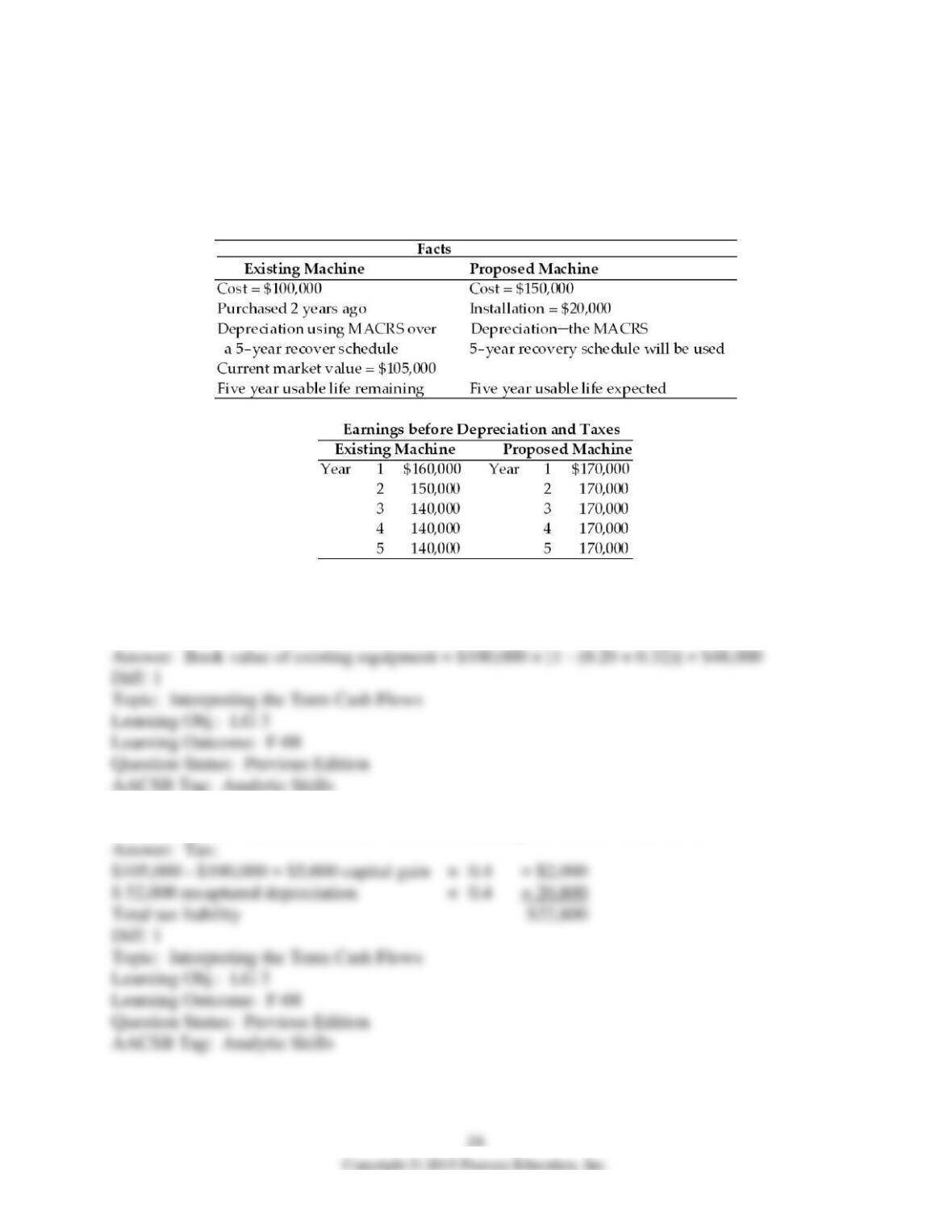
Table 11.4
Degnan Dance Company, Inc., a manufacturer of dance and exercise apparel, is considering
replacing an existing piece of equipment with a more sophisticated machine. The following
information is given.
The firm pays 40 percent taxes on ordinary income and capital gains.
50) Calculate the book value of the existing asset being replaced. (See Table 11.4)
51) Calculate the tax effect from the sale of the existing asset. (See Table 11.4)
52) Calculate the initial investment required for the new asset. (See Table 11.4)
53) Calculate the incremental earnings before depreciation and taxes. (See Table 11.4)
54) Calculate the incremental depreciation. (See Table 11.4)
55) Summarize the incremental after-tax cash flow (relevant cash flows) for years t = 0 through
t = 5. (See Table 11.4)
Table 11.5
Nuff Folding Box Company, Inc. is considering purchasing a new gluing machine. The gluing
machine costs $50,000 and requires installation costs of $2,500. This outlay would be partially
offset by the sale of an existing gluer. The existing gluer originally cost $10,000 and is four years
old. It is being depreciated under MACRS using a five-year recovery schedule and can currently
be sold for $15,000. The existing gluer has a remaining useful life of five years. If held until year
5, the existing machine’s market value would be zero. Over its five-year life, the new machine
should reduce operating costs (excluding depreciation) by $17,000 per year. Training costs of
employees who will operate the new machine will be a one-time cost of $5,000 which should be
included in the initial outlay. The new machine will be depreciated under MACRS using a five–
year recovery period. The firm has a 12 percent cost of capital and a 40 percent tax on ordinary
income and capital gains.
56) The payback period for the project is ________. (See Table 11.5)
A) 2 years
B) 3 years
C) between 3 and 4 years
D) between 4 and 5 years
57) The tax effect of the sale of the existing asset is ________. (See Table 11.5)
A) a tax liability of $2,340
B) a tax benefit of $1,500
C) a tax liability of $3,320
D) a tax liability of $5,320
58) The initial outlay for this project is ________. (See Table 11.5)
A) $42,820
B) $40,320
C) $47,820
D) $35,140
59) The present value of the project’s annual cash flows is ________. (See Table 11.5)
A) $ 47,820
B) $ 42,820
C) $ 51,635
D) $100,563
60) The net present value of the project is ________. (See Table 11.5)
A) $3,815
B) $2,445
C) $5,614
D) $7,500
61) The internal rate of return for the project is ________. (See Table 11.5)
A) between 7 and 8 percent
B) between 9 and 10 percent
C) greater than 12 percent
D) between 10 and 11 percent
62) The book value of an asset is equal to the ________.
A) fair market value minus the accounting value
B) original purchase price plus annual depreciation expense
C) original purchase price minus accumulated depreciation
D) depreciated value plus recaptured depreciation
63) The tax treatment regarding the sale of existing assets that are sold for more than the original
purchase price results in ________.
A) an ordinary tax benefit
B) no tax benefit or liability
C) a recaptured depreciation taxed as ordinary income
D) a capital gain tax liability
64) The tax treatment regarding the sale of existing assets that are sold for more than the book
value but less than the original purchase price results in a(n) ________.
A) ordinary tax benefit
B) capital gain tax liability
C) recaptured depreciation taxed as ordinary income
D) capital gain tax liability and recaptured depreciation taxed as ordinary income
65) The tax treatment regarding the sale of existing assets that are sold for their book value
results in ________.
A) an ordinary tax benefit
B) no tax benefit or liability
C) recaptured depreciation taxed as ordinary income
D) a capital gain tax liability and recaptured depreciation taxed as ordinary income
66) The portion of an asset’s sale price that is above its book value and below its initial purchase
price is called ________.
A) a capital gain
B) recaptured depreciation
C) a capital loss
D) book value
67) The portion of an asset’s sale price that is below its book value and below its initial purchase
price is called ________.
A) a capital gain
B) recaptured depreciation
C) a capital loss
D) book value
68) The tax treatment regarding the sale of existing assets that are sold for less than the book
value results in ________.
A) an ordinary tax benefit
B) a capital loss tax benefit
C) recaptured depreciation taxed as ordinary income
D) a capital gain tax liability and recaptured depreciation taxed as ordinary income
69) A corporation is selling an existing asset for $21,000. The asset, when purchased, cost
$10,000, was being depreciated under MACRS using a five-year recovery period, and has been
depreciated for four full years. If the assumed tax rate is 40 percent on ordinary income and
capital gains, the tax effect of this transaction is ________.
A) $0 tax liability
B) $7,560 tax liability
C) $4,400 tax liability
D) $7,720 tax liability
70) A corporation is selling an existing asset for $1,700. The asset, when purchased, cost
$10,000, was being depreciated under MACRS using a five-year recovery period, and has been
depreciated for four full years. If the assumed tax rate is 40 percent on ordinary income and
capital gains, the tax effect of this transaction is ________.
A) $0 tax liability
B) $840 tax liability
C) $3,160 tax liability
D) $3,160 tax benefit
71) A corporation is selling an existing asset for $1,000. The asset, when purchased, cost
$10,000, was being depreciated under MACRS using a five-year recovery period, and has been
depreciated for four full years. If the assumed tax rate is 40 percent on ordinary income and
capital gains, the tax effect of this transaction is ________.
A) $0 tax liability
B) $1,100 tax liability
C) $3,600 tax liability
D) $280 tax benefit
72) A firm is selling an existing asset for $5,000. The asset, when purchased, cost $10,000, was
being depreciated under MACRS using a five-year recovery period and has been depreciated for
four full years. If the assumed tax rate is 40 percent on ordinary income and capital gains, the tax
effect of this transaction is ________.
A) $0 tax liability
B) $1,320 tax liability
C) $1,160 tax liability
D) $2,000 tax benefit
73) A loss on the sale of an asset that is depreciable and used in business is ________; a loss on
the sale of a non-depreciable asset is ________.
A) deductible from capital gains income; deductible from ordinary income
B) deductible from ordinary income; deductible only against capital gains
C) a credit against the tax liability; not deductible
D) not deductible; deductible only against capital gains
74) A corporation has decided to replace an existing asset with a newer model. Two years ago,
the existing asset originally cost $30,000 and was being depreciated under MACRS using a five-
year recovery period. The existing asset can be sold for $25,000. The new asset will cost $75,000
and will also be depreciated under MACRS using a five-year recovery period. If the assumed tax
rate is 40 percent on ordinary income and capital gains, the initial investment is ________.
A) $42,000
B) $52,440
C) $54,240
D) $50,000
75) A corporation has decided to replace an existing asset with a newer model. Two years ago,
the existing asset originally cost $70,000 and was being depreciated under MACRS using a five-
year recovery period. The existing asset can be sold for $30,000. The new asset will cost $80,000
and will also be depreciated under MACRS using a five-year recovery period. If the assumed tax
rate is 40 percent on ordinary income and capital gains, the initial investment is ________.
A) $48,560
B) $44,360
C) $49,240
D) $27,600
76) Compute the initial purchase price for an asset with book value of $34,800 and total
accumulated depreciation of $85,200.
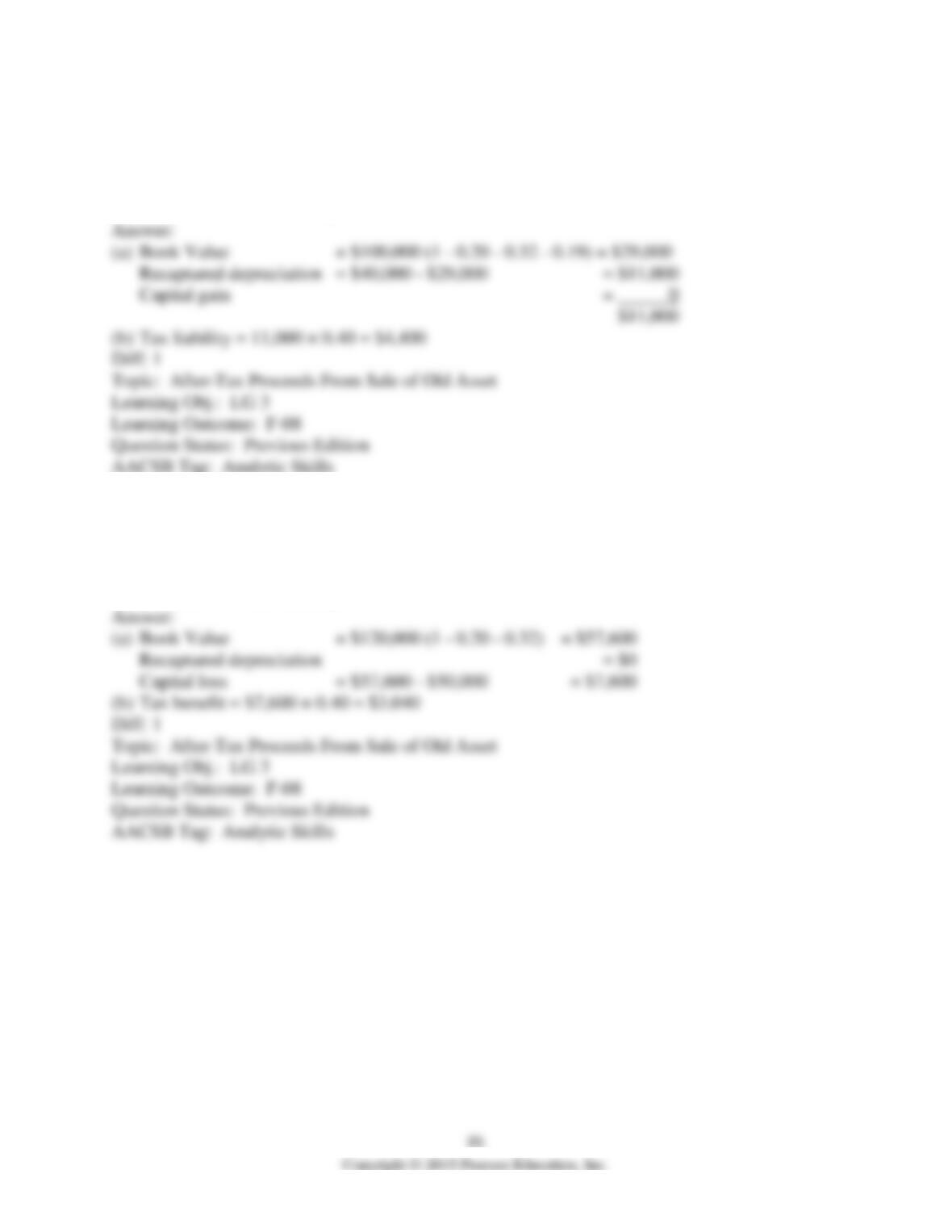
77) A mixer was purchased two years ago for $120,000 and can be sold for $125,000 today. The
mixer has been depreciated using the MACRS 5-year recovery period and the firm pays 40
percent taxes on both ordinary income and capital gain.
(a) Compute recaptured depreciation and capital gain (loss), if any.
(b) Find the firm’s tax liability.
78) An asset was purchased three years ago for $100,000 and can be sold for $40,000 today. The
asset has been depreciated using the MACRS 5-year recovery period and the firm pays 40
percent taxes on both ordinary income and capital gain.
(a) Compute recaptured depreciation and capital gain (loss), if any.
(b) Find the firm’s tax liability.
79) A machine was purchased two years ago for $120,000 and can be sold for $50,000 today.
The machine has been depreciated using the MACRS 5-year recovery period and the firm pays
40 percent taxes on both ordinary income and capital gains.
(a) Compute recaptured depreciation and capital gain (loss), if any.
(b) Find the firm’s tax liability.
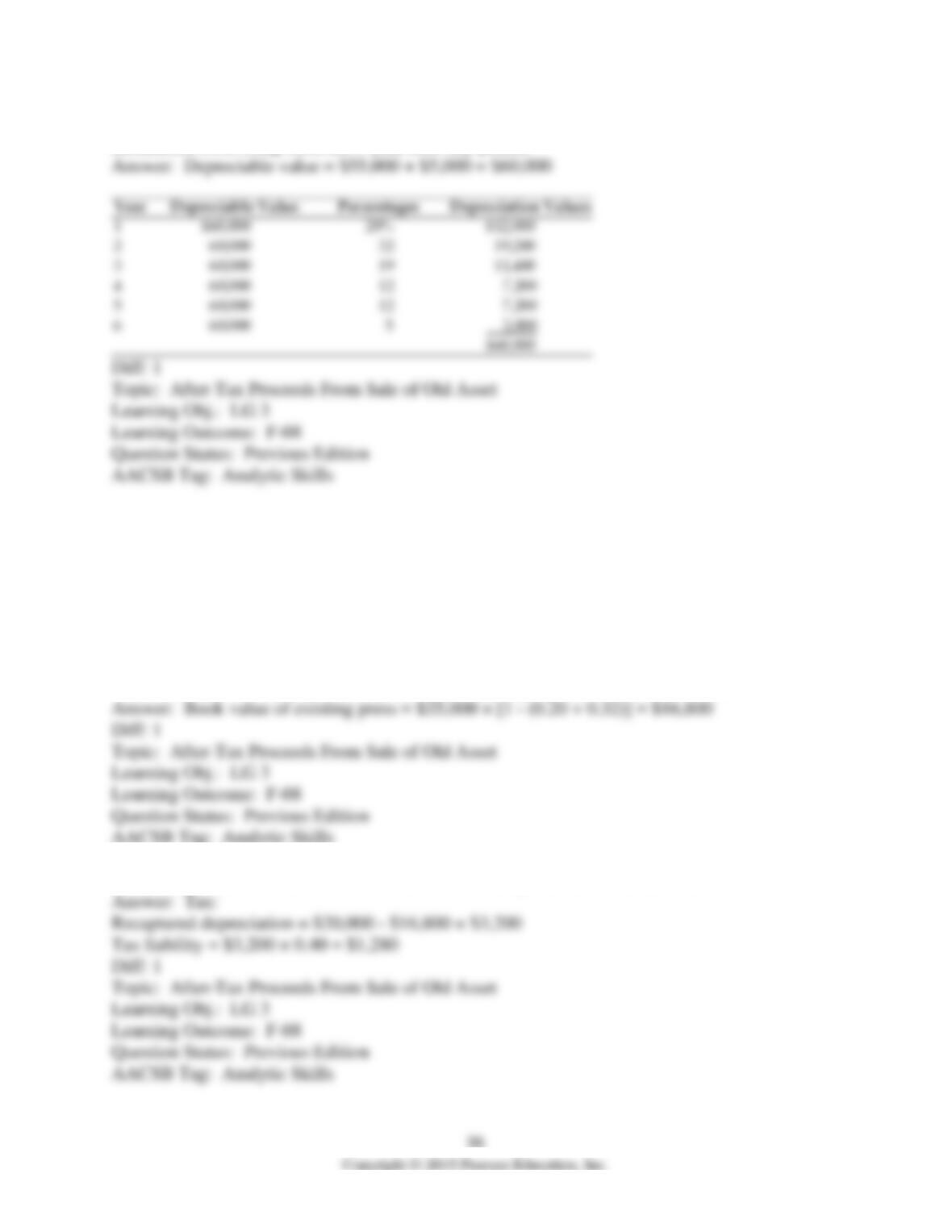
80) Compute the depreciation values for an asset which costs $55,000 and requires $5,000 in
installation costs using MACRS 5-year recovery period.
Table 11.1
Fine Press is considering replacing the existing press with a more efficient press. The new press
costs $55,000 and requires $5,000 in installation costs. The old press was purchased 2 years ago
for an installed cost of $35,000 and can be sold for $20,000 net of any removal costs today. Both
presses are depreciated under the MACRS 5-year recovery schedule. The firm is in 40 percent
marginal tax rate.
81) Calculate the book value of the existing press being replaced. (See Table 11.1)
82) Calculate the tax effect from the sale of the existing asset. (See Table 11.1)
83) Calculate the initial investment of the new asset. (See Table 11.1)
84) Which of the following would be used in the computation of an initial investment?
A) the annual after-tax inflow expected from the investment
B) the initial purchase price of the investment
C) the historic cost of the existing investment
D) the profits from the new investment
85) Which of the following basic variables must be considered in determining the initial
investment associated with a capital expenditure?
A) incremental annual savings produced by the new asset
B) cash flows generated by the new investment
C) proceeds from the sale of an existing asset
D) profits on the sale of an existing asset
86) An important cash inflow in the analysis of initial cash flows for a replacement project is
________.
A) taxes
B) the cost of the new asset
C) installation cost
D) the sale value of the old asset
87) When evaluating a capital budgeting project, installation costs of a new machine must be
considered as part of ________.
A) the operating cash inflows
B) the initial investment
C) the incremental operating cash inflows
D) the operating cash outflows
88) The change in net working capital when evaluating a capital budgeting decision is ________.
A) the change in fixed liabilities minus the change in fixed assets
B) the increase in current assets
C) the increase in current liabilities
D) the change in current assets minus the change in current liabilities
89) In evaluating the initial investment for a capital budgeting project, ________.
A) an increase in net working capital is considered a cash inflow
B) a decrease in net working capital is considered a cash outflow
C) an increase in net working capital is considered a cash outflow
D) net working capital does not have to be considered
90) A corporation is considering expanding operations to meet growing demand. With the capital
expansion, the current accounts are expected to change. Management expects cash to increase by
$20,000, accounts receivable by $40,000, and inventories by $60,000. At the same time accounts
payable will increase by $50,000, accruals by $10,000, and long-term debt by $100,000. The
change in net working capital is ________.
A) an increase of $120,000
B) a decrease of $60,000
C) a decrease of $120,000
D) an increase of $60,000
91) A corporation is considering expanding operations to meet growing demand. With the capital
expansion the current accounts are expected to change. Management expects cash to increase by
$10,000, accounts receivable by $20,000, and inventories by $30,000. At the same time accounts
payable will increase by $40,000, accruals by $30,000, and long-term debt by $80,000. The
change in net working capital is ________.
A) an increase of $10,000
B) a decrease of $10,000
C) a decrease of $90,000
D) an increase of $80,000
92) If accounts receivable increase by $1,000,000, inventory decreases by $500,000, and
accounts payable increase by $500,000, net working capital would ________.
A) decrease by $500,000
B) increase by $1,500,000
C) increase by $2,000,000
D) experience no change
93) A corporation is evaluating the relevant cash flows for a capital budgeting decision and must
estimate the terminal cash flow. The proposed machine will be disposed of at the end of its
usable life of five years at an estimated sale price of $15,000. The machine has an original
purchase price of $80,000, installation cost of $20,000, and will be depreciated under the five-
year MACRS. Net working capital is expected to decline by $5,000. The firm has a 40 percent
tax rate on ordinary income and long-term capital gain. The terminal cash flow is ________.
A) $24,000
B) $16,000
C) $14,000
D) $26,000