20
11.4-11) Under the market method, the investment in another company’s stock is recorded at acquisition
cost and is adjusted for the investor’s share of dividends and for any earnings or losses experienced by
the investee after the date of investment.
11.4-12) The major reason for using the equity method instead of the market method is that the equity
method does a better job of recognizing increases or decreases in the economic resources that the investor
can influence.
11.4-13) When equity ownership of another company is below 20%, the market method is required.
11.4-14) GAAP allow investments under the equity method to be carried at adjusted cost or current
market value on the balance sheet.
11.4-15) Gateway Investment Group acquired 100 shares of Boble Manufacturing for $300,000 on January
1, 2X09. During 2X09, Boble Manufacturing paid a total of $8,000 in dividends of which Gateway
Investment Group received $1,000. Boble had a net income of $50,000.
Prepare journal entries for Gateway Investment Group for the a) acquisition, b) recognition of net income,
and c) dividends paid under
1. the equity method assuming Gateway Investment Group owns 40% of the shares of Boble
Manufacturing.
2. the cost method assuming Gateway Investment Group owns 10% of the shares of Boble Manufacturing.
Answer:

Learning Objective 11.5 Questions
11.5-1) A subsidiary is a corporation owned or controlled by a parent company through the ownership of
A) more than 10% of the voting stock.
B) more than 20% of the voting stock.
C) more than 25% of the voting stock.
D) more than 50% of the voting stock.
E) 100% of the voting stock.
11.5-2) Which of the following statements is false in regards to consolidation of financial statements?
A) GAAP and IFRS have different consolidation requirements.
B) Under GAAP, completion of consolidated financial statements occurs when a parent company has
control over another company.
C) Under IFRS, a parent company may own less than 50% of another company yet still qualify to
consolidate financial statements.
D) Under GAAP, consolidation is generally restricted to situations where a parent company has financial
control of over 50% of the voting rights of another company.
E) Under IFRS, to qualify for consolidation of financial statements, the only test is 50% ownership of
another company.
11.5-3) Urbco Company is 100% owned by Jordan Enterprises. On December 30, 20X9, Urbco sold
inventory, costing $400 on account to Jordan for $500. Urbco uses a perpetual inventory system. What
consolidation journal entry, if any, is needed on December 31, 20X9, as a result of this transaction?
A) Accounts Payable Urbco 500
Accounts Receivable Jordan 500
B) Accounts Payable Urbco 500
Accounts Receivable Jordan 500
Retained Earnings Urbco 100
Inventory Jordan 100
C) Accounts Payable Jordan 500
Accounts Receivable Urbco 500
Sales Urbco 500
Cost of Sales Urbco 400
Inventory Jordan 100
D) Retained Earnings Urbco 100
Inventory Urbco 100
E) No journal entry is necessary.

11.5-4) Night Company acquired all the stock of Chap Company by purchasing the shares from their
current owners for $40 million paid in cash. Chap Company has assets valued at $30 million. How would
Night Company account for the acquisition?
A) Night would increase Paid–in Capital by $40 million and decrease Cash by $40 million.
B) Night would increase Property, Plant, and Equipment by $30 million; decrease Paid–in Capital by $10
million; and decrease cash by $40 million.
C) Night would increase Investment in Chap by $40 million and decrease Cash by $40 million.
D) Night would increase Property, Plant, and Equipment by $40 million and decrease Cash by $40
million.
E) Night would not need to make a journal entry.
11.5-5) Strang, Inc., acquired all the stock of Moore Gardening by purchasing the shares from their
current owners for $50 million paid in cash. Moore Gardening has assets valued at $20 million. How
would Moore Gardening account for the acquisition?
A) No journal entry is necessary.
B) Moore would increase Cash by $50 million and decrease Property, Plant, and Equipment by $50
million.
C) Moore would increase Cash by $50 million and increase Paid–in Capital by $50 million.
D) Moore would increase Cash by $20 million and decrease Property, Plant, and Equipment by $20
million.
E) Moore would increase Cash by $50 million; decrease Property, Plant, and Equipment by $20 million;
and increase Paid–in Capital by $30 million.

Table 11–5
Presented below are the balance sheets of Stallings Company and Gibbs Company at January 1, 20X9:
Gibbs Company Stallings Company
Balance Sheet Balance Sheet
January 1, 20X9 January 1, 20X9
Cash $ 70 Cash $240
Net Fixed Assets 210 Net Fixed Assets 210
Total Assets $280 Total Assets $450
Accounts Payable $ 20 Accounts Payable $ 70
Long–term Bonds Pay. 120 Long–term Bonds Pay. 150
Stockholders’ Equity 140 Stockholders’ Equity 230
Total Liab. & Equity $280 Total Liab. & Equity $450
On January 1, 20X9, Stallings Company acquired 100% of the outstanding common stock of Gibbs
Company for $140 in cash. Assume the book value of the accounts equals the market value
11.5-6) Referring to Table 11–5, what journal entry will Gibbs Company make on January 1, 20X9?
A) Cash 140
Common Stock 140
B) Cash 140
Investment by Stallings Co. 140
C) Cash 140
Treasury Stock 140
D) Cash 140
Accounts Payable 20
Long–term Bonds Payable 120
Fixed Assets 210
Cash 70
E) No journal entry is necessary.

11.5-7) Referring to Table 11–5, what journal entry will Stallings Company make on January 1, 20X9?
A) Common Stock of Gibbs Company 140
Cash 140
B) Investment in Gibbs Company 140
Cash 140
C) Stockholders’ Equity of Gibbs Company 140
Cash 140
D) Fixed Assets 210
Cash 70
Accounts Payable 20
Long–term Bonds Payable 120
E) Fixed Assets 210
Investment in Gibbs Company 140
Cash 70
Accounts Payable & Long–term Bonds Payable 140
Stockholders’ Equity 140
11.5-8) Referring to Table 11–5, which of the following statements regarding the consolidated balance
sheet immediately after the acquisition is not correct?
A) Total liabilities will be $360.
B) Total cash will be $170.
C) Total assets will be $730.
D) Total net fixed assets will be $420.
E) Total stockholders’ equity will be $230.
11.5-9) Referring to Table 11–5, what elimination journal entry will be necessary in order to prepare a
consolidated balance sheet immediately after the acquisition?
A) Cash 140
Investment in Gibbs Company 140
B) Investment in Gibbs Company 140
Stockholders’ Equity Gibbs 140
C) Stockholders’ Equity Gibbs 140
Cash 140
D) Stockholders’ Equity Gibbs 140
Investment in Gibbs Company 140
E) No journal entry is necessary.

11.5-10) Referring to Table 11–5, if Gibbs Company generated net income during 20X9 of $22, and none of
the income resulted from intercompany sales, what would be the amount of the elimination entry at the
end of 20X9?
A) $22
B) $–0–
C) $118
D) $140
E) $162
11.5-11) Referring to Table 11–5, if the net income for 20X9 was $22 and $30 for Gibbs Company and
Stallings Company, respectively, and none of the income resulted from intercompany sales, what would
be the net income on the consolidated income statement?
A) $52.00
B) $22.0
C) $26.00
D) $30.00
E) $–0–

Table 11–6
Presented below are the balance sheets of Brunner Company and Dently Company at January 1, 20X9:
Brunner Company Dently Company
Balance Sheet Balance Sheet
January 1, 20X9 January 1, 20X9
Cash $ 23 Cash $110
Net Fixed Assets 127 Net Fixed Assets 290
Total Assets $150 Total Assets $400
Accounts Payable $ 15 Accounts Payable $ 35
Long–term Bonds Pay. 85 Long–term Bonds Pay. 140
Stockholders’ Equity 50 Stockholders’ Equity 225
Total Liab. & Equity $150 Total Liab. & Equity $400
On January 1, 20X9, Dently Company paid $80 for 100% of the outstanding shares of Brunner Company.
The fair market values of the assets and liabilities of Brunner Company are the same as the book values.
11.5-12) Referring to Table 11–6, what journal entry will Dently Company make on January 1, 20X9?
A) Investment in Brunner Company 80
Cash 80
B) Investment in Brunner Company 50
Goodwill 30
Cash 80
C) Investment in Brunner Company 50
Goodwill 17
Fixed Assets 13
Cash 80
D) Investment in Brunner Company 63
Goodwill 17
Cash 80
E) Investment in Brunner Company 67
Fixed Assets 13
Cash 80

11.5-13) Referring to Table 11–6, what elimination journal entry would be necessary in order to prepare a
consolidated balance sheet immediately after the acquisition?
A) Stockholders’ Equity Brunner 50
Goodwill 30
Investment in Brunner Company Dently 80
B) Stockholders’ Equity Brunner 80
Investment in Brunner Company Dently 80
C) Goodwill 80
Investment in Brunner Company Dently 80
D) Stockholders’ Equity Brunner 80
Goodwill 50
Investment in Brunner Company Dently 30
E) Investment in Brunner Company Dently 50
Goodwill 30
Stockholders’ Equity Brunner 80
11.5-14) When a company is acquired and becomes a subsidiary of another company, the books of the
subsidiary are completely changed on the date of the acquisition.
11.5-15) There are three sets of books in a consolidation: the parent’s books, the subsidiary’s books, and
the consolidated entity’s books.
11.5-16) In consolidation, elimination of intercompany balances are necessary when the parent and
subsidiary do business together (e.g., when the subsidiary sells parts to the parent).
11.5-17) When ownership of another company is greater than 50%, consolidation is required.
11.5-18) When ownership of another company is at least 20% and up to and including 50%, consolidation
is required.
11.5-19) Frank Company Joseph Company
Balance Sheet Balance Sheet
January 1, 20X9 January 1, 20X9
Cash $ 40 Cash $120
Net Fixed Assets 90 Net Fixed Assets 130
Total Assets $130 Total Assets $250
Accounts Payable $ 20 Accounts Payable $ 30
Long–term Bonds Payable 60 Long–term Bonds Payable 100
Stockholders’ Equity 50 Stockholders’ Equity 120
Total Liab. & Total Liab. &
Stockholders’ Equity $130 Stockholders’ Equity $250
On January 1, 20X9, Joseph Company acquired 100% of the outstanding shares of Frank Company for $50
in cash. During 20X9, Frank Company had net income of $10, and Joseph Company had net income of
$25. All net income for both companies is in the form of additional cash.
Prepare the following:
a. The journal entry necessary for Joseph Company on January 1, 20X9
b. The journal entry necessary for Frank Company on January 1, 20X9
c. The consolidated balance sheet immediately after the acquisition
d. The one elimination entry necessary on December 31, 20X9, assuming none of the income for either
company resulted from intercompany sales
e. The consolidated balance sheet at December 31, 20X9
11.5-20) Gaitlyn Company owns 100% of the outstanding stock of Beard Company. The following
transactions occurred during 20X9:
a. Gaitlyn Company sold inventory costing $3,000 on account to Beard Company for $3,500. As of year
end, the amount due had not been paid. Gaitlyn Company uses a perpetual inventory system.
b. Beard Company sold a fixed asset to Gaitlyn Company for $5,000 in cash. Beard Company had the
fixed asset recorded at its original cost of $11,000 and accumulated depreciation of $7,000.
c. Beard Company borrowed $2,000 from Gaitlyn Company on December 31, 20X9, and signed a 2–year
note.
For each item, prepare the necessary intercompany elimination entry that is needed, if at all, in order to
prepare a year–end consolidated balance sheet. Be certain to specifically identify whether an account is on
the books of Gaitlyn Company or Beard Company.
11.5-21) Fruit Company Veggie Company
Balance Sheet Balance Sheet
January 1, 20X9 January 1, 20X9
Cash $ 50 Cash $120
Net Fixed Assets 100 Net Fixed Assets 280
Total Assets $150 Total Assets $400
Accounts Payable $ 20 Accounts Payable $ 30
Long–term Bonds Payable 70 Long–term Bonds Payable 120
Stockholders’ Equity 60 Stockholders’ Equity 250
Total Liab. & Total Liab. &
Stockholders’ Equity $150 Stockholders’ Equity $400
On January 1, 20X9, Veggie Company paid $80 in cash for 100% of the outstanding shares of Fruit
Company. The fair market value of all Fruit Company’s accounts was equivalent to their book value.
During 20X9, Fruit Company had net income of $10, and Veggie Company had net income of $40. None
of the net income for either company was the result of intercompany sales. All net income for both
companies is in the form of additional cash.
Prepare the following:
a. The journal entry necessary for Veggie Company on January 1, 20X9
b. The journal entry necessary for Fruit Company on January 1, 20X9
c. The consolidated balance sheet immediately after the acquisition
11.5-22) List and explain why a company would create subsidiaries instead of simply assimilating the
subsidiary into the parent company.
Learning Objective 11.6 Questions
11.6-1) ________ represent the rights of nonmajority shareholders in the assets and earnings of a company
that is consolidated into the accounts of its major shareholder.
A) Parent interests
B) Noncontrolling interests
C) Subsidiary interests
D) Consolidated interests
E) Intercompany interests

Table 11–7
Presented below are the balance sheets of Phone Company and Radio Company at January 1, 20X9:
Phone Company Radio Company
Balance Sheet Balance Sheet
January 1, 20X9 January 1, 20X9
Cash $ 35 Cash $250
Net Fixed Assets 265 Net Fixed Assets 450
Total Assets $300 Total Assets $700
Accounts Payable $ 30 Accounts Payable $ 90
Long–term Bonds Pay. 100 Long–term Bonds Pay. 200
Stockholders’ Equity 170 Stockholders’ Equity 410
Total Liab. & Equity $300 Total Liab. & Equity $700
On January 1, 20X9, Radio Company acquired 70% of the outstanding common stock of Phone Company
for $119 in cash. Assume the book value of the accounts equals the market value.
11.6-2) Referring to Table 11–7, what journal entry will Phone Company make on January 1, 20X9?
A) Cash 119
Common Stock 119
B) Cash 119
Investment by Radio Co. 119
C) Cash 119
Treasury Stock 119
D) Cash 119
Accounts Payable 21
Long–term Bonds Payable 70
Fixed Assets 186
Cash 24
E) No journal entry is necessary.

11.6-3) Referring to Table 11–7, what journal entry will Radio Company make on January 1, 20X9?
A) Investment in Phone Company 119
Cash 119
B) Investment in Phone Company 170
Cash 119
Noncontrolling Interest 51
C) Common Stock Phone 170
Cash 119
Noncontrolling Interest 51
D) Stockholders’ Equity 170
Cash 119
Noncontrolling Interest 51
E) Net Fixed Assets 265
Cash 84
Accounts Payable 30
Long–term Bonds Payable 100
Noncontrolling Interest 51
11.6-4) Referring to Table 11–7, which of the following statements regarding the consolidated balance
sheet immediately after the acquisition is not correct?
A) Total assets will be $881.
B) Total cash will be $166.
C) Total liabilities will be $420.
D) Total net fixed assets will be $715.
E) Total stockholders’ equity will be $580.

11.6-5) Referring to Table 11–7, what elimination journal entry will be necessary in order to prepare a
consolidated balance sheet immediately after the acquisition?
A) Cash 119
Noncontrolling Interest 51
Investment in Phone Company 170
B) Cash 119
Noncontrolling Interest 51
Stockholders’ Equity Phone 170
C) Stockholders’ Equity Phone 170
Investment in Phone Company 119
Noncontrolling Interest 51
D) Stockholder’s Equity Phone 119
Investment in Phone Company 119
E) No journal entry is necessary.
11.6-6) Referring to Table 11–7, if Phone Company generated net income during 20X9 of $10, and none of
the income was the result of intercompany sales, what journal entry would Radio Company make to
reflect this event?
A) No journal entry is necessary.
B) Investment in Phone Company 7
Investment Revenue 7
C) Investment in Phone Company 7
Noncontrolling Interest 3
Investment Revenue 10
D) Investment in Phone Company 10
Investment Revenue 10
E) Investment in Phone Company 10
Investment Revenue 7
Noncontrolling Interest 3

11.6-7) Noncontrolling interests do not affect the balance sheet of the consolidated financial statements.
11.6-8) Kenter Company Maffitt Company
Balance Sheet Balance Sheet
January 1, 20X9 January 1, 20X9
Cash $ 20 Cash $110
Net Fixed Assets 90 Net Fixed Assets 240
Total Assets $110 Total Assets $350
Accounts Payable $ 10 Accounts Payable $ 40
Long–term Bonds Payable 40 Long–term Bonds Payable 130
Stockholders’ Equity 60 Stockholders’ Equity 180
Total Liab. & Total Liab. &
Stockholders’ Equity $110 Stockholders’ Equity $350
On January 1, 20X9, Maffitt Company acquired 70% of the outstanding shares of common stock of Kenter
Company for $42 in cash. Assume book value equals market value in all accounts. During 20X9, Kenter
Company had net income of $10, and Maffitt Company had net income of $30. None of the net income for
either company was the result of intercompany sales. All net income for both companies is in the form of
additional cash.
Prepare the following:
a. The journal entry necessary for Maffitt Company on January 1, 20X9
b. The journal entry necessary for Kenter Company on January 1, 20X9
c. The consolidated balance sheet immediately after the acquisition
d. The elimination entry necessary on December 31, 20X9 assuming no other consolidation accounting
during the year
11.6-9) What is a “noncontrolling interest”? How is it accounted for on the subsidiary’s, the parent’s, and
the consolidated financial statements?
Learning Objective 11.7 Questions
11.7-1) If the book value of net assets of a subsidiary are less than the fair market value of net assets of the
subsidiary at the time the subsidiary is acquired, which of the following procedures is incorrect with
respect to the subsidiary, parent, and consolidated accounts?
A) Only on consolidation are the book values of the subsidiary accounts written up to their revised fair
market values.
B) The parent records the difference between the subsidiary’s book value of net assets and its fair market
value of net assets as a separate asset on the parent’s balance sheet.
C) The subsidiary continues as a going concern with its accounts valued at the lower book value
amounts.
D) The parent records the acquisition of the subsidiary at its acquisition cost.
E) Any part of the acquisition price that cannot be attributed to the revised fair market value of the
subsidiary’s accounts will be considered goodwill on the consolidated balance sheet.
11.7-2) The fair market value of identifiable assets, less the liabilities of Johnson Publishing are $800,000.
Over the past five years, Johnson Publishing has been able to generate net income of $120,000 per year.
What is the maximum price that a company would be willing to pay for Johnson Publishing, if the
purchase price on normal annual earnings of 10% of net assets is a multiple of nine times, and the
purchase price on abnormal earnings in excess of 10% of net assets is a multiple of six times?
A) $800,000
B) $920,000
C) $960,000
D) $1,000,000
E) $1,080,000
11.7-3) Which statement is correct?
A) Current U. S. generally accepted accounting principles (GAAP) allow for the amortization of goodwill
to be up to 40 years.
B) Goodwill shall be reduced if impairment is in evidence.
C) Although goodwill amortization amounts can be large in absolute terms, often they are relatively
small as compared to net income.
D) Current U. S. GAAP do not allow an immediate write–off of goodwill.
E) Goodwill impairments are included as an extraordinary item on the income statement.
11.7-4) Goodwill can only be recognized when a company is acquired by another company.
11.7-5) Recorded goodwill is considered to exist unless impaired.
11.7-6) Goodwill is fundamentally the price paid for “excess” or “abnormal” earnings.
11.7-7) Fruit King Company purchased 100% of the common shares of Berries, Inc., for $23,750 on January
1, 20X9. Berries Inc.’s balance sheet just before the acquisition was as follows:
Cash $ 4,500
Net fixed assets 12,000
Total assets $16,500
Liabilities $11,000
Stockholders’ equity 5,500
Total liab. & Equity $16,500
The fair market value of Berries Inc.’s assets and liabilities was equal to their book value. Compute the
amount of goodwill (if any) Fruit King Company would recognize on this purchase. Where would this
goodwill appear on Fruit King Company’s financial statements?
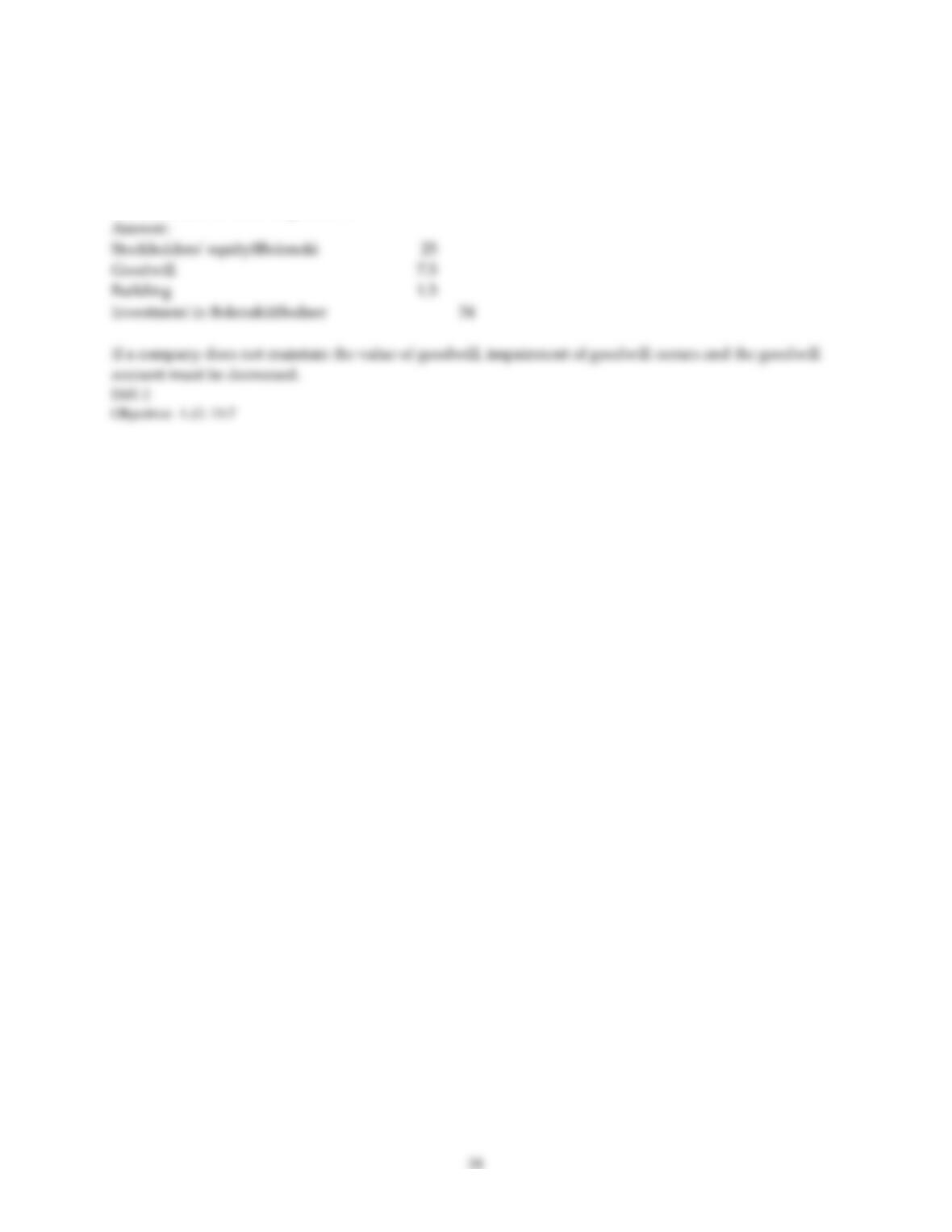
11.7-8) Bodner, Inc., acquired 100% interest in Bolenski Company on February 1, 2X09 paying $34 million
for 100% of the assets of Bolenski Company. The book value of the assets amounted to $25 million, but an
independent appraiser valued the printing press $1.5 million over its book value. Prepare the eliminating
entry by Bodner, Inc., for consolidating the balance sheet. What will occur if the acquiring company does
not maintain the value of goodwill?