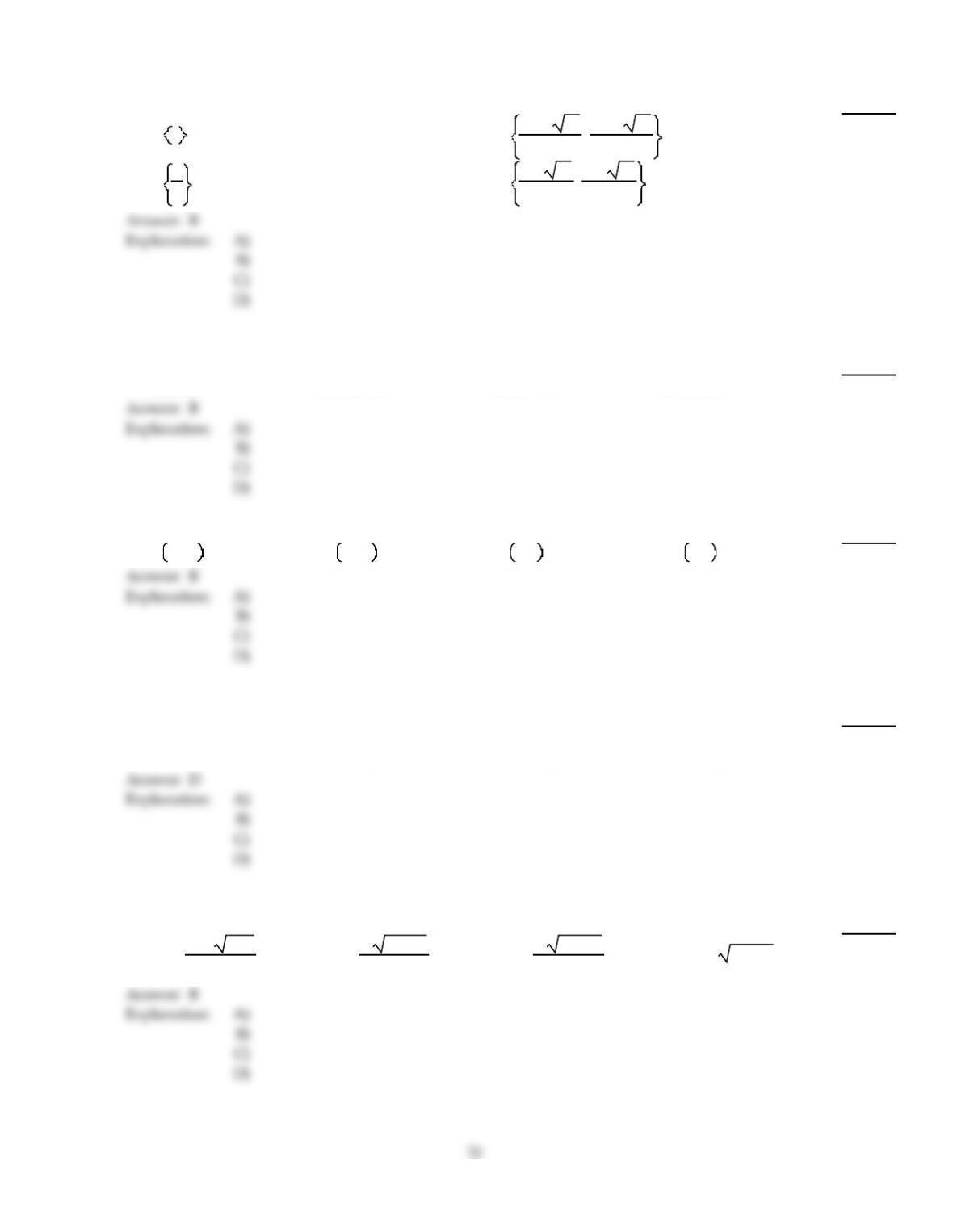
Use the quadratic formula to solve the equation. (All solutions are real numbers.)
58)
3x(x + 1) =2
58)
A)
1
B)
–3+33
6, –3–33
6
C)
1
5
D)
3+33
6, 3–33
6
Identify the vertex of the given parabola.
59)
f(x) = – (x + 2)2– 8
59)
A)
(2, 8)
B)
(–2, –8)
C)
(2, –8)
D)
(–2, 8)
60)
f(x) =(x + 2)2
60)
A)
0, –2
B)
–2, 0
C)
2, 0
D)
0, 2
Solve the problem. Round your answer to the nearest tenth, if necessary.
61)
Sue rowed her boat across and back Lake Bend in 3 hr. If her rate rowing back was 2 mph less than
the rate rowing across, and if the distance each way was 7 mi, find her rate rowing across.
61)
A)
5.5 mph
B)
1.5 mph
C)
3.7 mph
D)
5.9 mph
Solve the equation for the indicated variable. (Leave ± in your answer, when appropriate.)
62)
M =r2hd for r
62)
A)
r =± M hd
hd
B)
r =±Mhd
hd
C)
r =±Mhd
hd
D)
r = ± Mhd

63)
aS2+ bS = c, for S
63)
A)
S =–b +b2– 4ac
2a
B)
S =–b + b2– 4ac
2a
C)
S =–b +b2+ 4ac
2a
D)
S =–b + b2+ 4ac
2a
Solve the problem.
64)
A construction worker tosses a scrap piece of lumber from the roof of a building. How long does it
take the piece of lumber to reach the ground 49 feet below? Use the formula d = 16t2 where d is the
distance (in feet) a freely falling object falls in t seconds. Give your answer as a fraction.
64)
A)
4
7 sec
B)
7
4 sec
C)
49
16 sec
D)
16
49 sec
65)
The surface area S of a sphere with radius r is given by the formula S =4r2. If a sphere has surface
area 64 square inches, what is its radius?
65)
A)
4 in.
B)
16 in.
C)
4 in.
D)
8 in.
Solve the equation by using the square root property. Simplify all radicals.
66)
–13x2= – 169
66)
A)
{±13}
B)
C)
{–13}
D)
{±13}
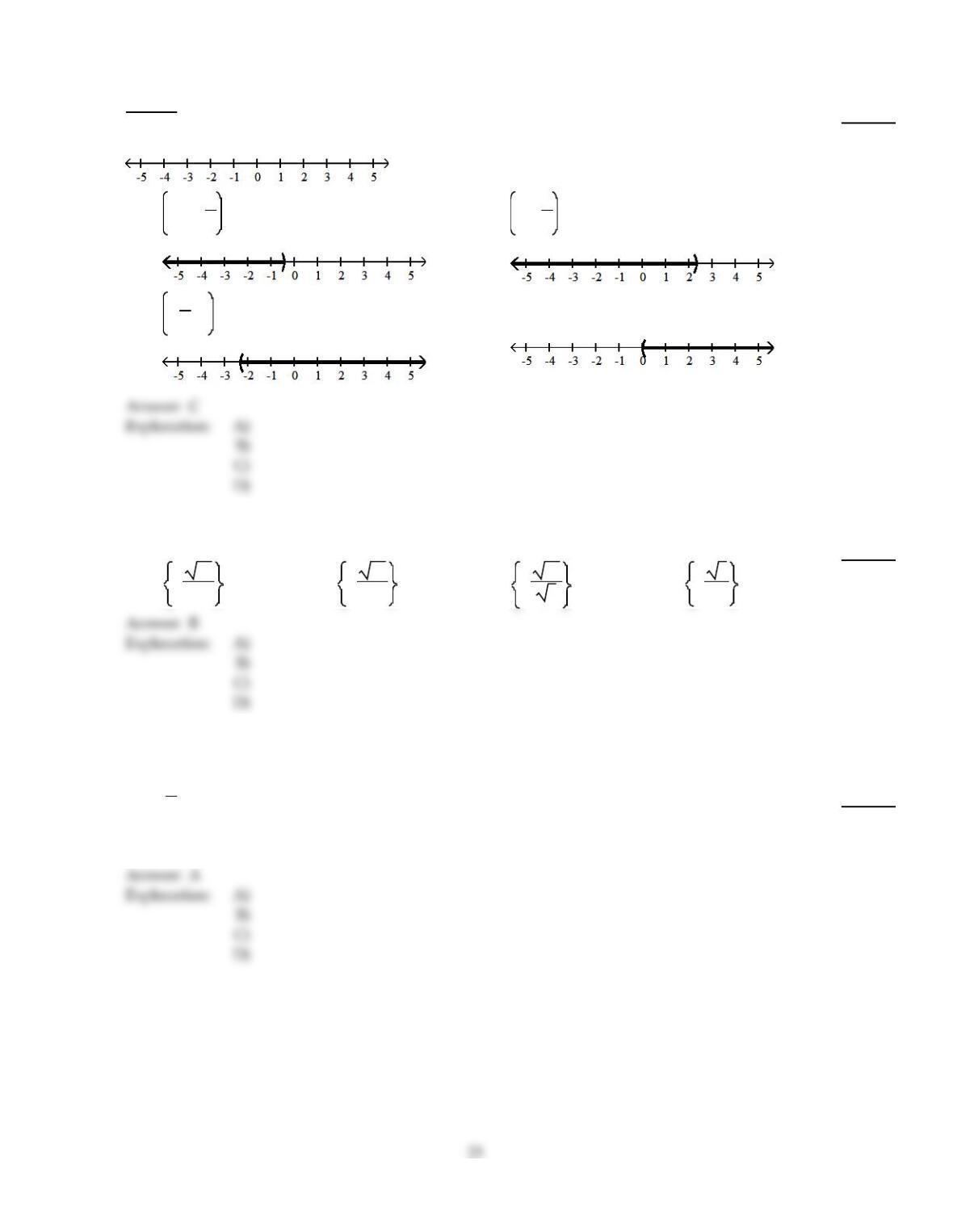
Solve the inequality, and graph the solution set.
67)
–2
–3x – 7 > 0
67)
A)
–, –3
7
B)
–, 7
3
C)
–7
3,
D)
(0, )
Solve the equation by using the square root property. Simplify all radicals.
68)
7p2=2
68)
A)
±14
49
B)
±14
7
C)
±14
7
D)
±2
7
Decide whether the graph of the equation opens up, down, to the left, or to the right; and whether it is wider, narrower, or
the same shape as the graph of f(x) =x2 (or x =y2).
69)
f(x) =1
2x2– 8x – 8
69)
A)
Up; wider
B)
Down; narrower
C)
Down; wider
D)
Up; narrower
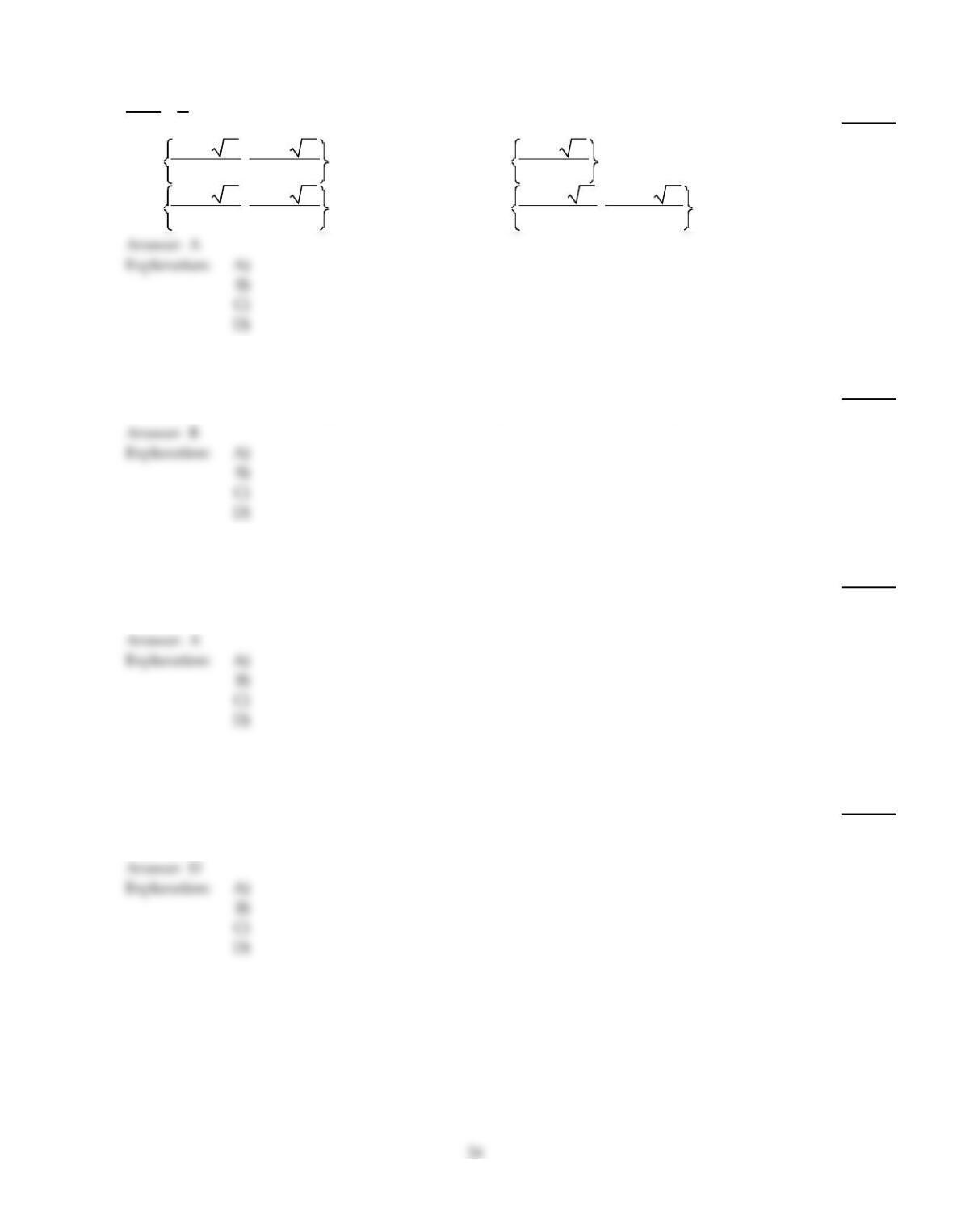
Solve the equation.
70)
k
3– k –6
k=7
70)
A)
15 +389
16 , 15 –389
16
B)
15 + 3 89
16
C)
27 +389
8, 27 –389
8
D)
–15 +389
16 , –15 –389
16
Find the vertex of the parabola.
71)
f(x) = – 2x2– 12x – 23
71)
A)
(3, 5)
B)
(–3, –5)
C)
(5, 3)
D)
(–5, –3)
Solve the problem. Round your answer to the nearest tenth, when appropriate.
72)
The position of an object moving in a straight line is given by s(t) =t2– 8t, where s is in feet and t is
the time in seconds the object has been in motion. How long will it take the object to move 16 ft?
72)
A)
9.7 sec
B)
17.0 sec
C)
12.8 sec
D)
9.5 sec
Use the discriminant to determine whether the equation has two rational solutions, one rational solution, two irrational
solutions, or two nonreal complex solutions. Do not actually solve.
73)
4y2=3y – 6
73)
A)
One rational solution
B)
Two irrational solutions
C)
Two rational solutions
D)
Two nonreal complex solutions
Use the discriminant to determine if the equation can be solved by factoring. If the equation can be solved by factoring,
then factor it.
74)
b2– 7b + 6 = 0
74)
A)
(b + 6)(b + 1) = 0
B)
(b – 8)(b – 1) = 0
C)
(b – 6)(b – 1) = 0
D)
Cannot be solved by factoring
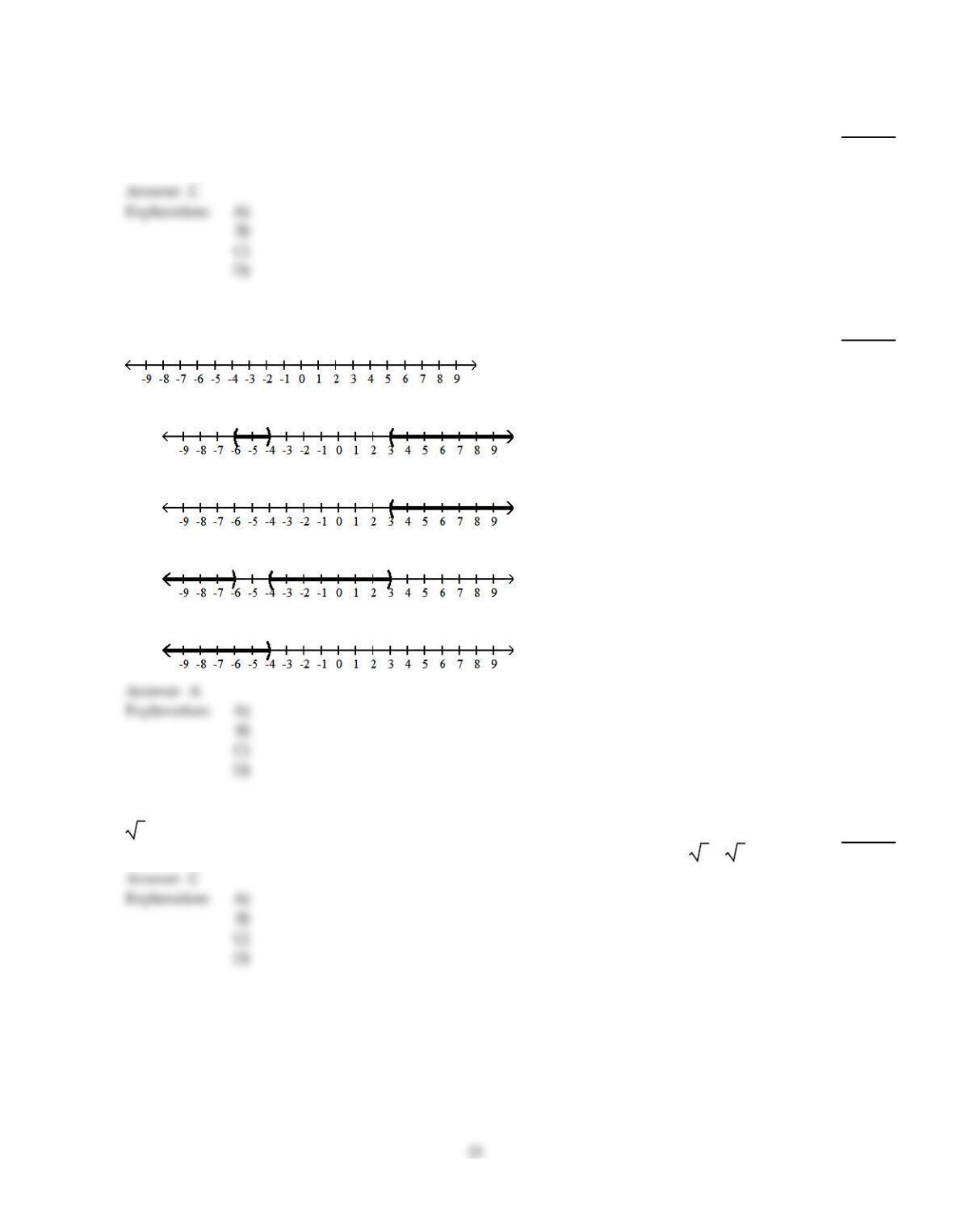
Solve the inequality, and graph the solution set.
75)
(a + 6)(a + 4)(a – 3) > 0
75)
A)
(–6, –4) (3, )
B)
(3, )
C)
(–, –6) (–4, 3)
D)
(–, –4)
Solve the equation.
76)
x=6– x
76)
A)
{–9, –4}
B)
{5, –5}
C)
{4}
D)
{ 6, –6}
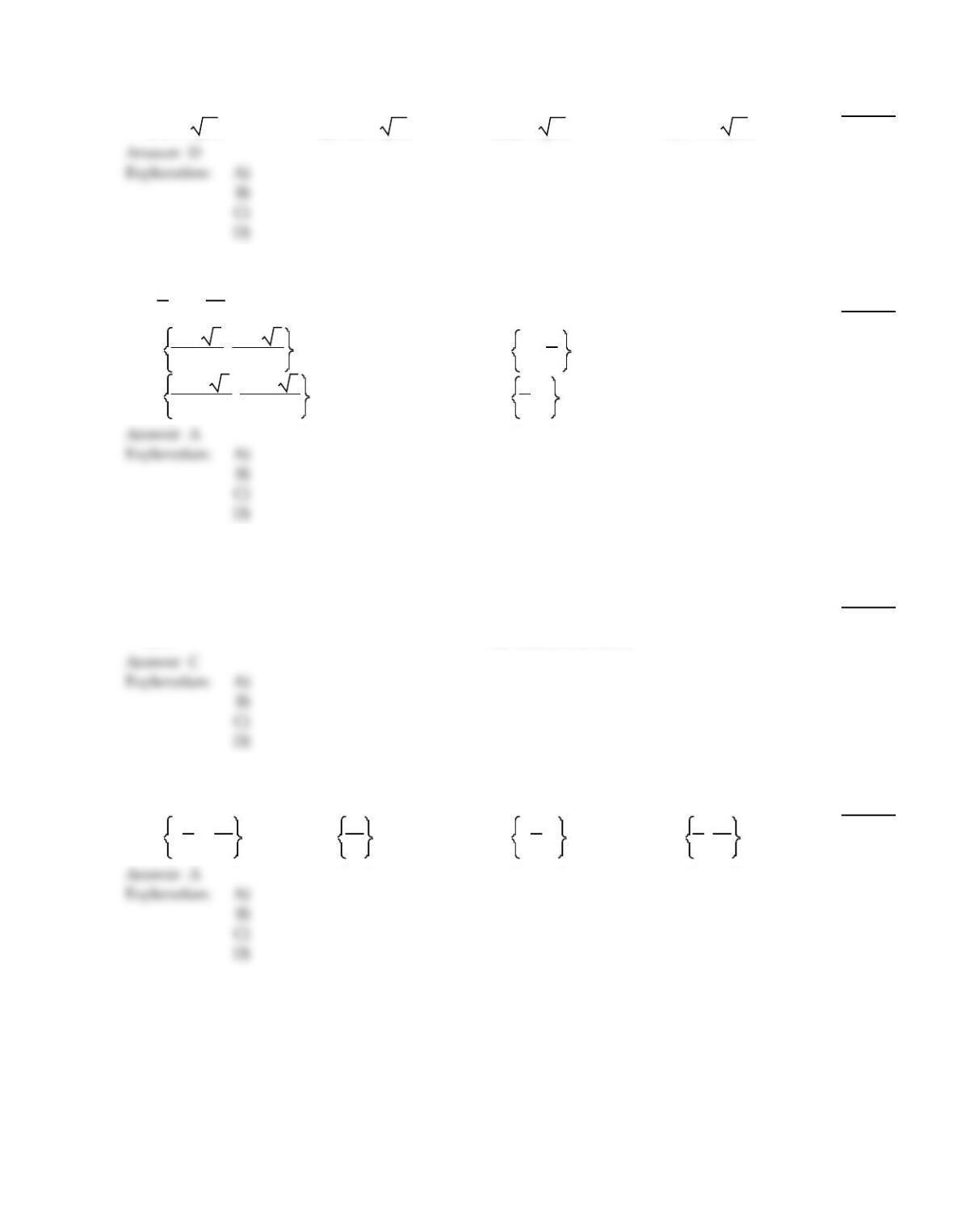
Solve the equation by completing the square.
77)
x2+ 15 = – 12x
77)
A)
{6 ±15}
B)
{–12 +15}
C)
{6 +21}
D)
{–6±21}
Use the quadratic formula to solve the equation.
78)
x2–2
5x = – 1
10
78)
A)
2+ i 6
10 , 2– i 6
10
B)
0, –1
4i
C)
–2+ i 6
10 , –2– i 6
10
D)
2
5i, 0
A
A boy is standing on a flat field and tosses his ball toward a second boy standing at the other end of the field. The path of
the ball is a parabola, and the equation of the path is f(x) = – 4x2+
8x. Based on this information, answer the question.
79)
How many x–intercepts are there on the graph of the equation?
79)
A)
1
B)
0
C)
2
D)
None of the above
C
Solve the equation by using the square root property.
80)
(2s + 8)2=25
80)
A)
–3
2, –13
2
B)
17
2
C)
–3
2, 0
D)
3
2, 13
2
A
26
D
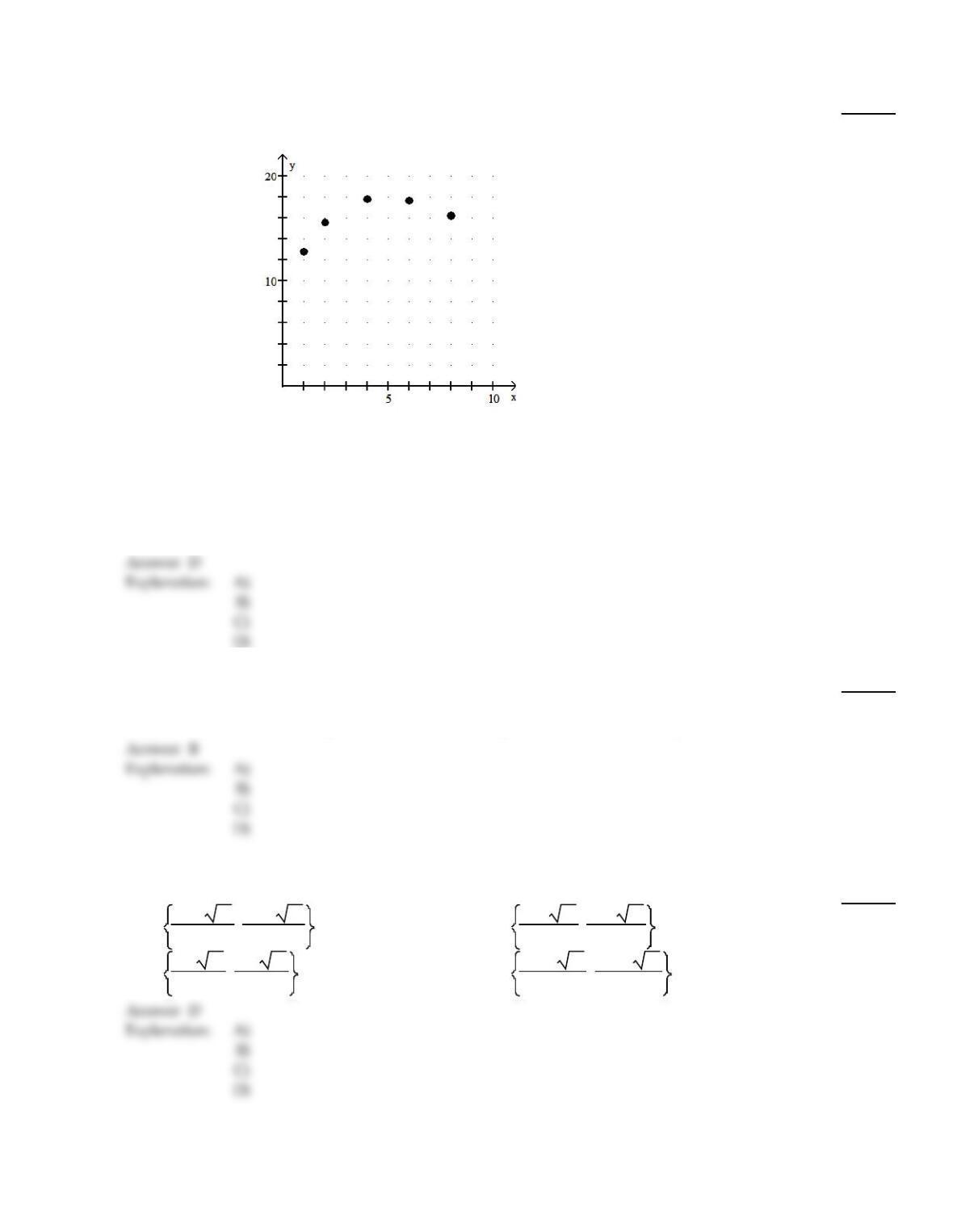
Solve the problem.
81)
POLLUTION
CO2 emissions
(in tons)
Years since 1990
Use the ordered pairs (1, 12.81), (4, 17.76), and (8, 16.24) to find a quadratic function that models the
data. Round the values of a, b, and c to two decimal places.
81)
A)
y = – 3.1x2– 0.29x +10.00
B)
y =3.10x2– 0.29x +10.00
C)
y =0.29x2+3.10x +10.00
D)
y = – 0.29x2+3.10x +10.00
82)
A gardener is fencing off a rectangular area with a fixed perimeter of 28 ft. What is the maximum
area?
82)
A)
1.75 ft2
B)
49 ft2
C)
7 ft2
D)
196 ft2
Use the quadratic formula to solve the equation.
83)
x2+ x + 4 = 0
83)
A)
–1 +15
2, –1 –15
2
B)
1 + i 15
2, 1 – i 15
2
C)
1 +15
2, 1 –15
2
D)
–1 + i 15
2, –1 – i 15
2
27
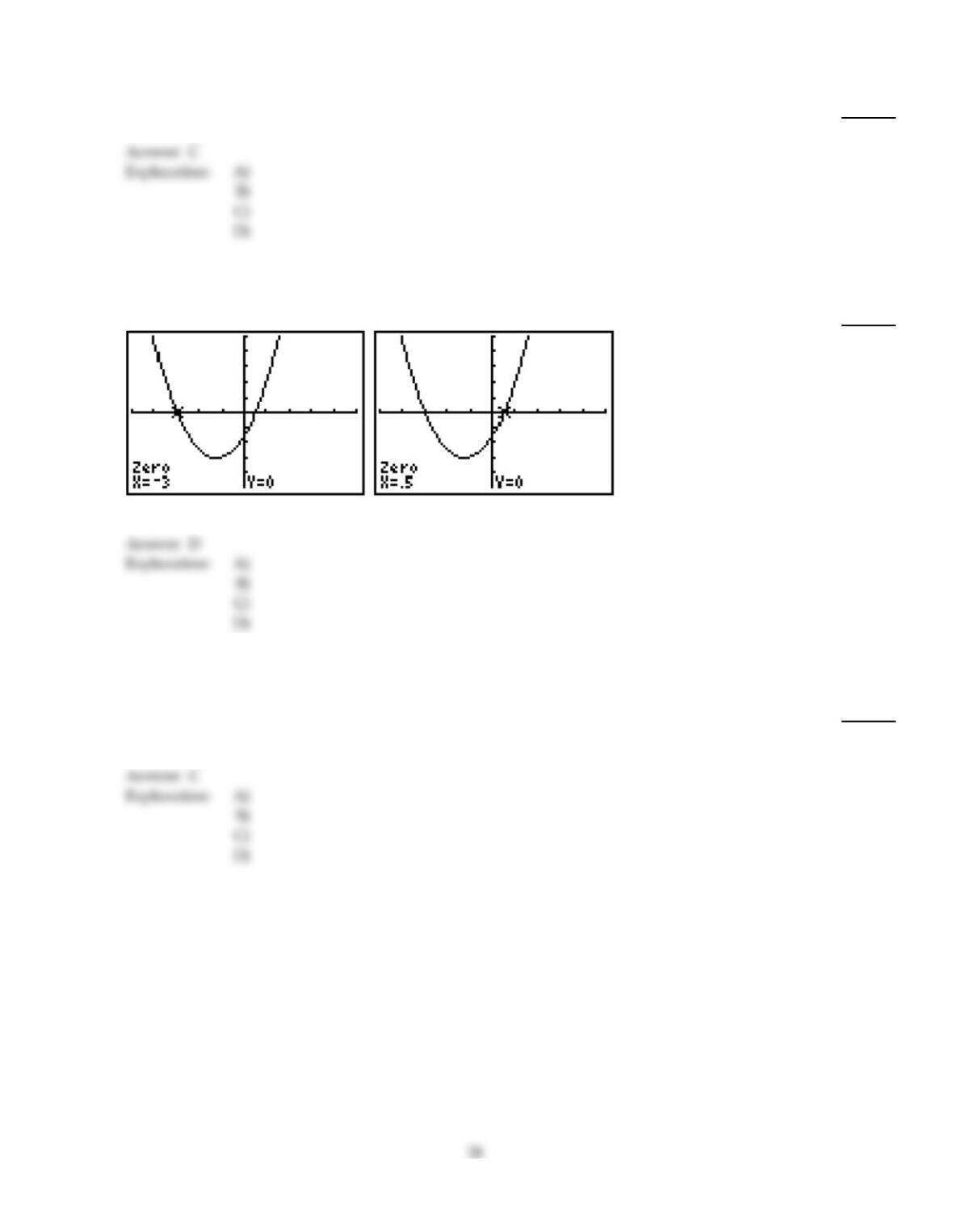
Solve the equation by using the square root property. Simplify all radicals.
84)
z2=121
84)
A)
{±12}
B)
{±60.5}
C)
{±11}
D)
{11}
The calculator graphs shows the x–values of the x–intercepts of the graph of the polynomial in the equation. Use the
graphs to solve the equation.
85)
2x2+ 5x – 3 = 0
85)
A)
{–3, –0.5}
B)
{–0.5, 3}
C)
{–2, 3}
D)
{–3, 0.5}
For the quadratic function, tell whether the graph opens up or down and whether the graph is wider, narrower, or the
same shape as the graph of f(x) =x2.
86)
f(x) = – x2– 6
86)
A)
Down; narrower
B)
Up; narrower
C)
Down; same
D)
Up; same
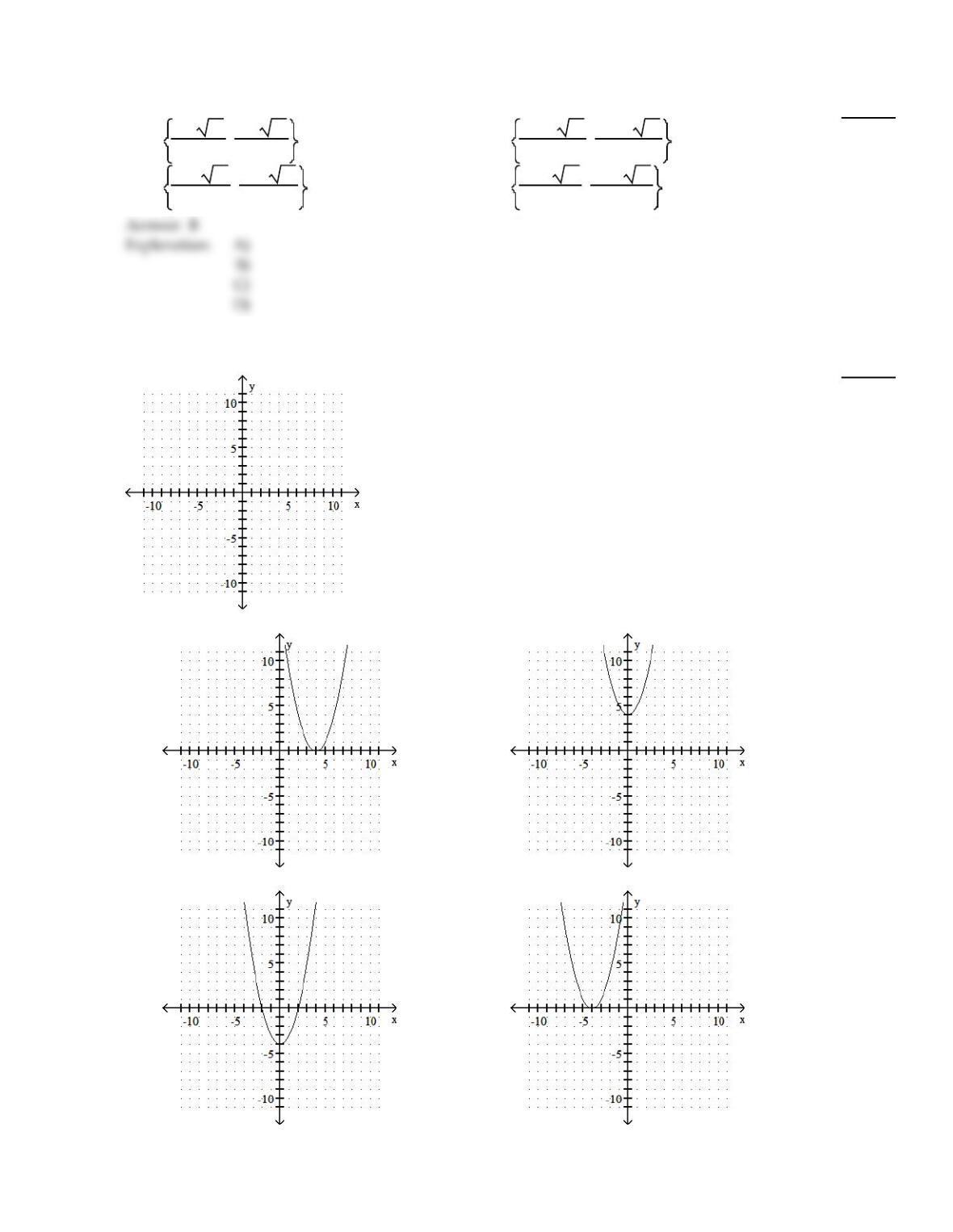
Use the quadratic formula to solve the equation.
87)
8x2+ 7x = – 2
87)
A)
7 +15
16 , 7 –15
16
B)
–7 + i 15
16 , –7 – i 15
16
C)
7 + i 15
16 , 7 – i 15
16
D)
–7 +15
16 , –7 –15
16
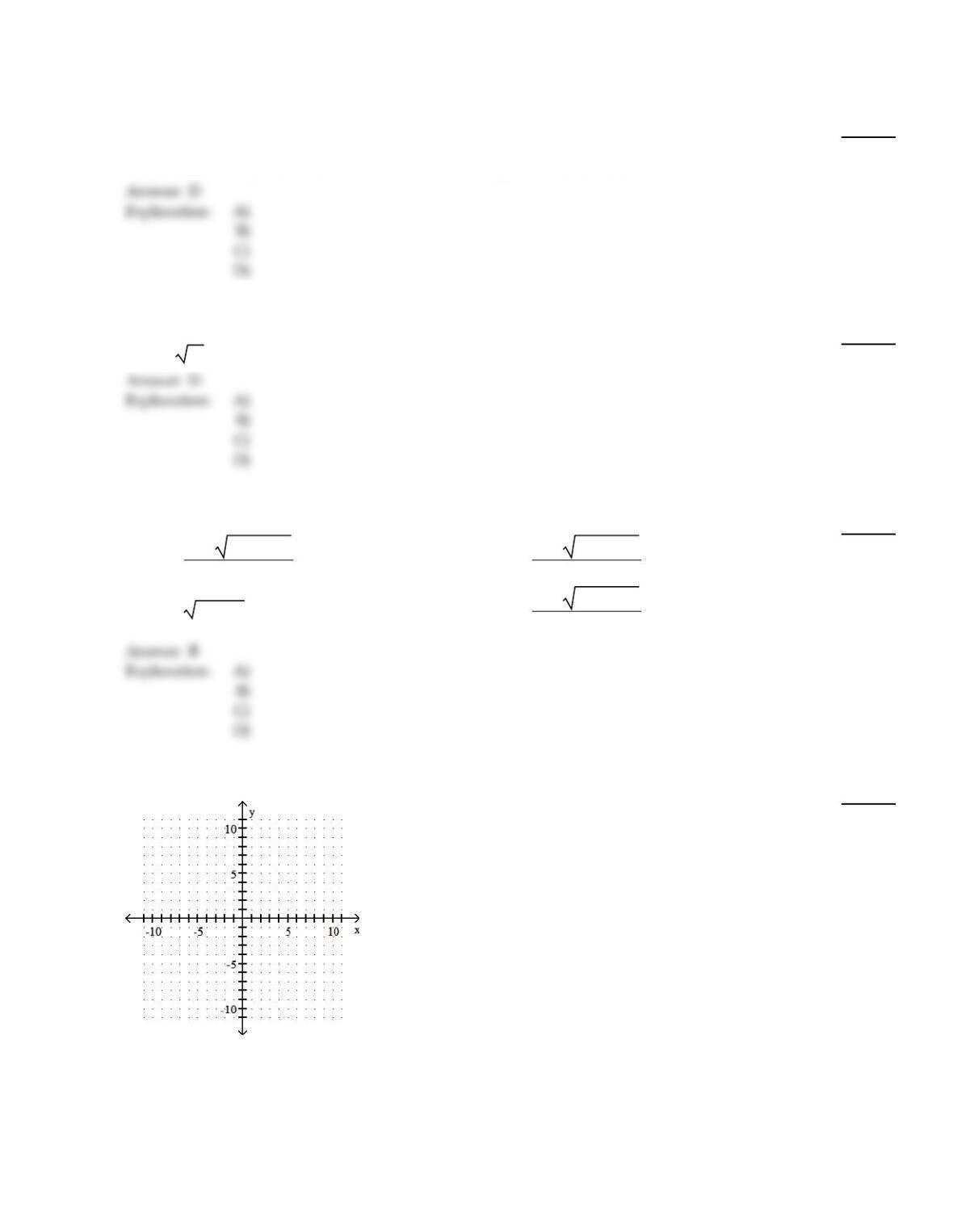
Sketch the graph of the parabola.
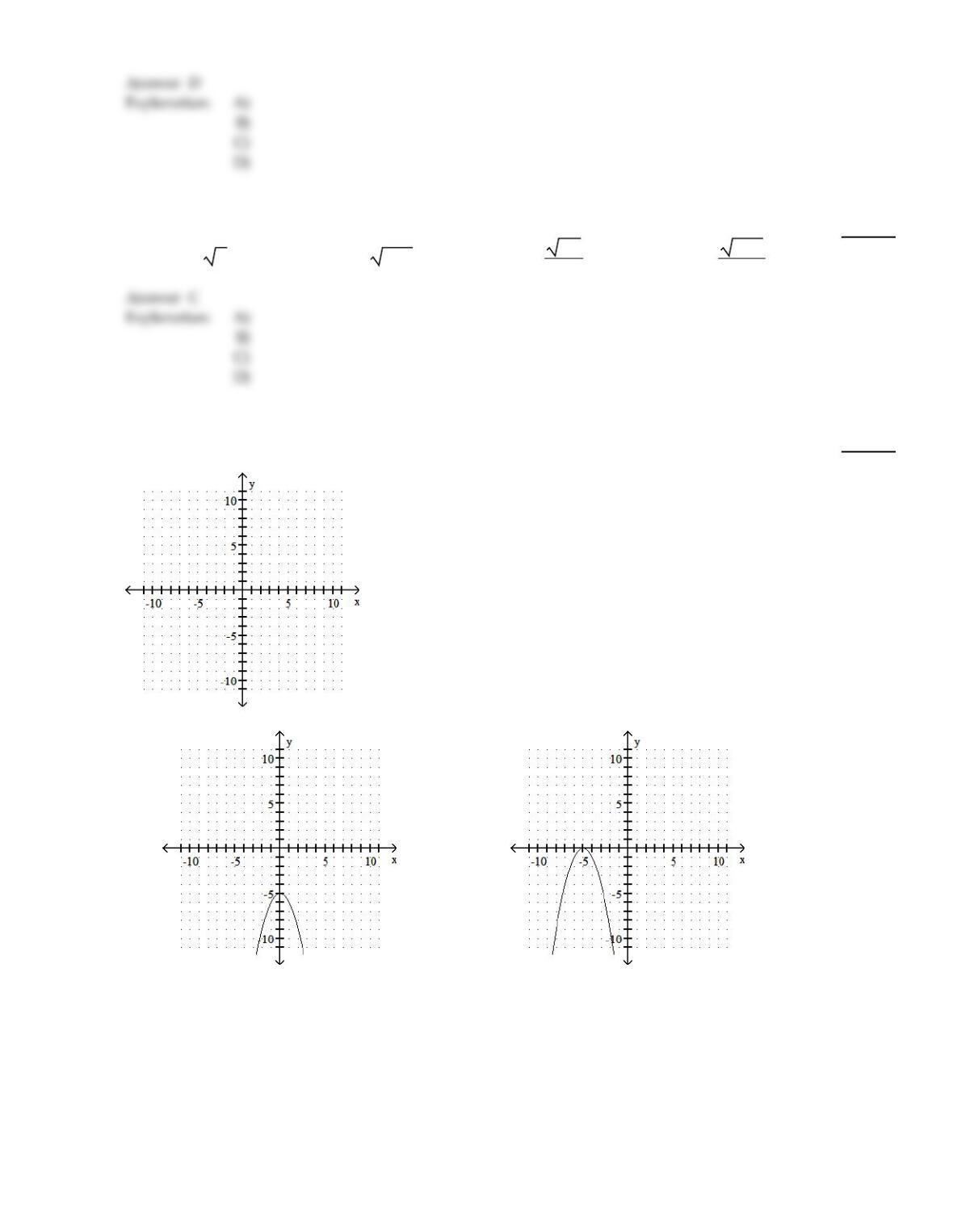
88)
f(x) = (x + 4)2
88)
A)
B)
C)
D)
29
Solve the equation for the indicated variable. (Leave ± in your answer, when appropriate.)
89)
4r2= A for r
89)
A)
r = 2A
B)
r = ± 2A
C)
r = ± A
2
D)
r = ± 2A
2
Sketch the graph of the parabola.
90)
y = – x2+ 5
90)
A)
B)
30
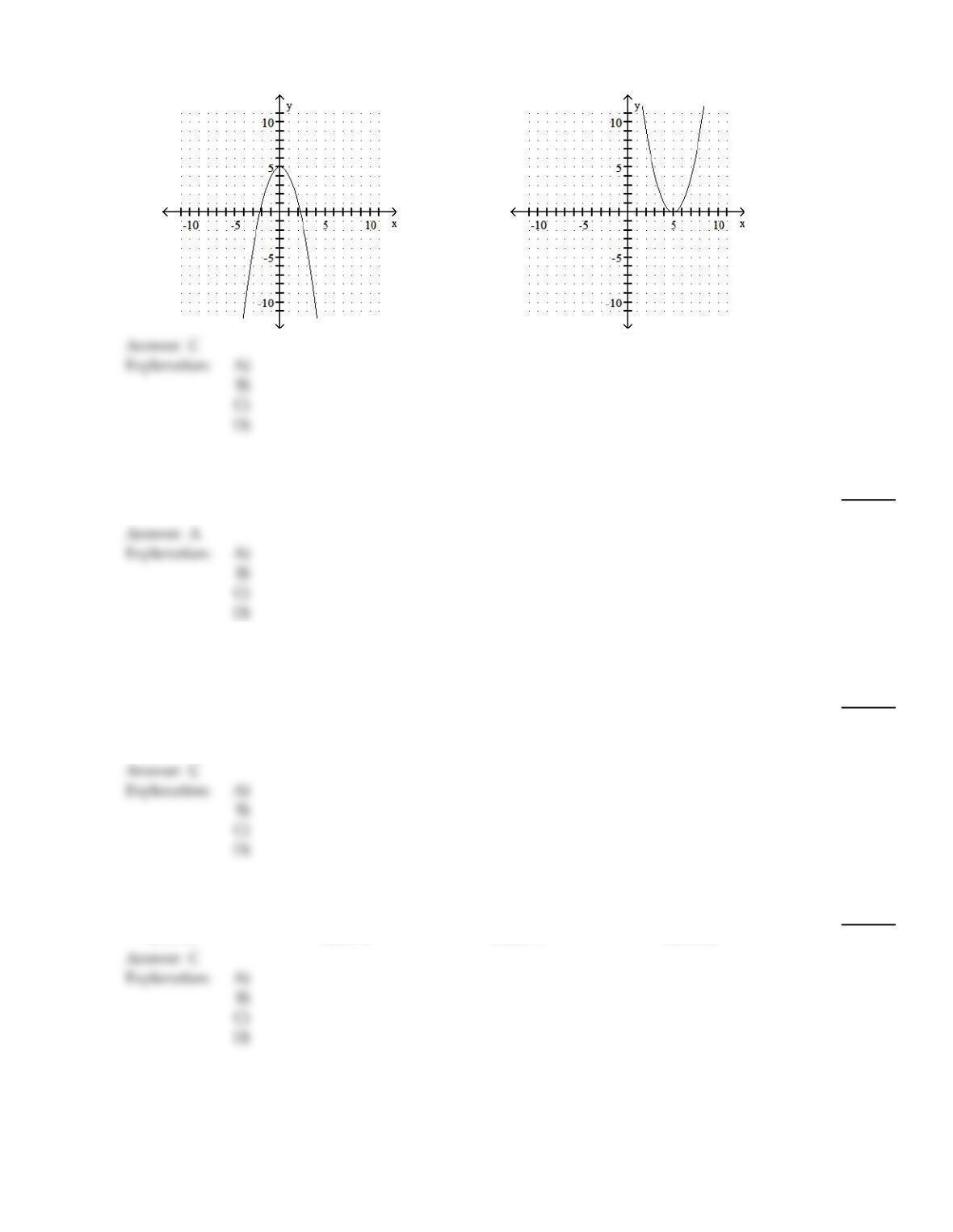
C)
D)
Solve the equation by the zero–factor property.
91)
x2=144
91)
A)
{–12, 12}
B)
{13}
C)
{–72, 72}
D)
{12}
Use the discriminant to determine if the equation can be solved by factoring. If the equation can be solved by factoring,
then factor it.
92)
c2+ 6c + 9 = 0
92)
A)
(c – 3)2= 0
B)
(c + 3)(c – 3) = 0
C)
(c + 3)2= 0
D)
Cannot be solved by factoring
Find the vertex of the parabola.
93)
f(x) =4x2– 72x + 325
93)
A)
(1, 0)
B)
(1, 9)
C)
(9, 1)
D)
(9, 0)
31
Use the discriminant to determine whether the equation has two rational solutions, one rational solution, two irrational
solutions, or two nonreal complex solutions. Do not actually solve.
94)
s2– 2s – 8 = 0
94)
A)
Two nonreal complex solutions
B)
One rational solution
C)
Two irrational solutions
D)
Two rational solutions
Solve the equation by completing the square.
95)
a2– 4a =5
95)
A)
{± – 5}
B)
{–5, 1}
C)
{–4, –1}
D)
{5, –1}
Solve the equation for the indicated variable. (Leave ± in your answer, when appropriate.)
96)
rm =t2– mt for t
96)
A)
t =m ±m2– 4mr
4
B)
t =m ±m2+ firm
2
C)
t =mr – m
D)
t =m ±m2+ 4mr
2m
Sketch the graph of the parabola.
97)
y = – 2(x – 5)2– 1
97)
32
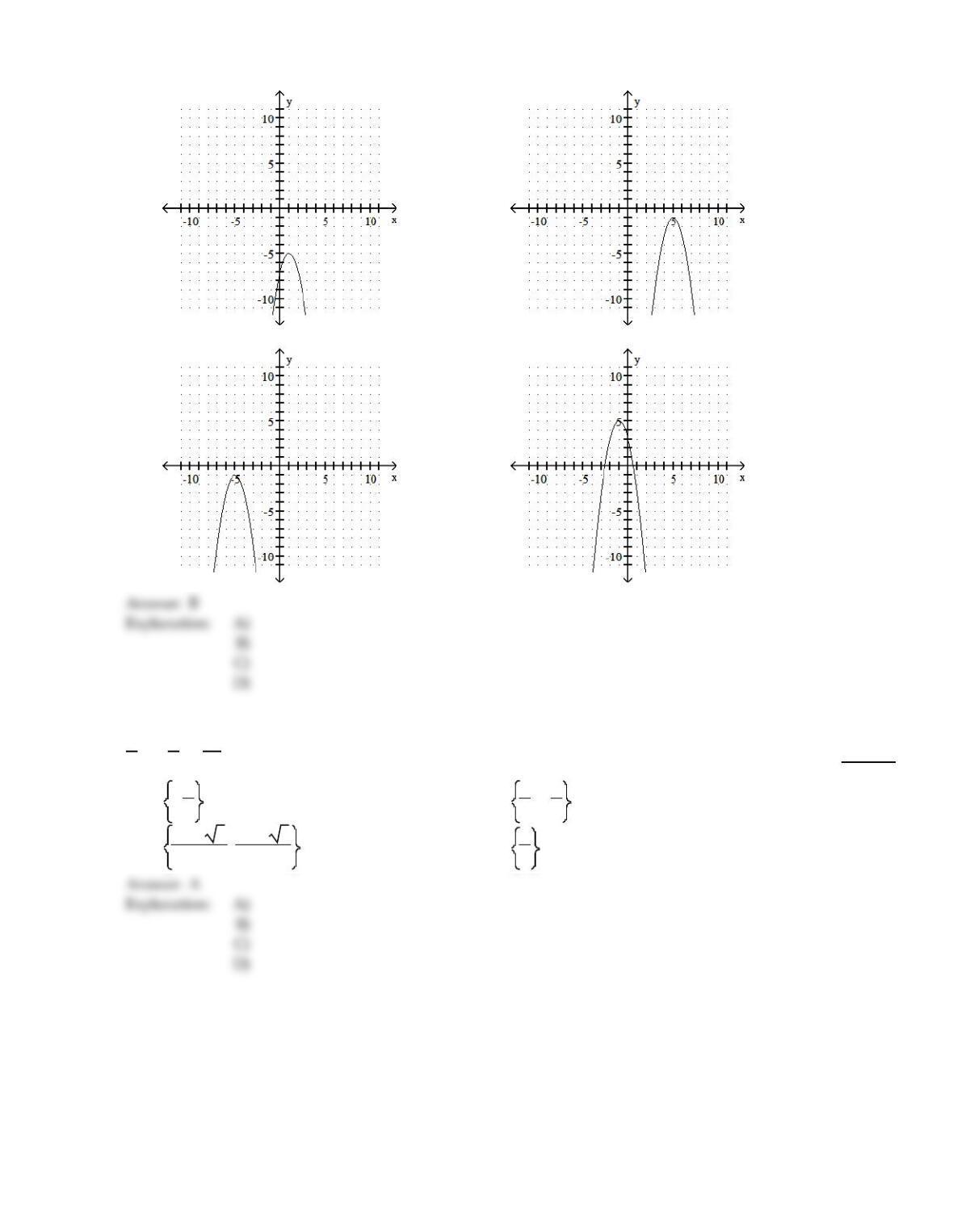
A)
B)
C)
D)
Use the quadratic formula to solve the equation. (All solutions are real numbers.)
98)
3
4s2+1
2s +1
12 = 0
98)
A)
–1
3
B)
1
3, –1
3
C)
–1 +2
3, –1 –2
3
D)
1
3
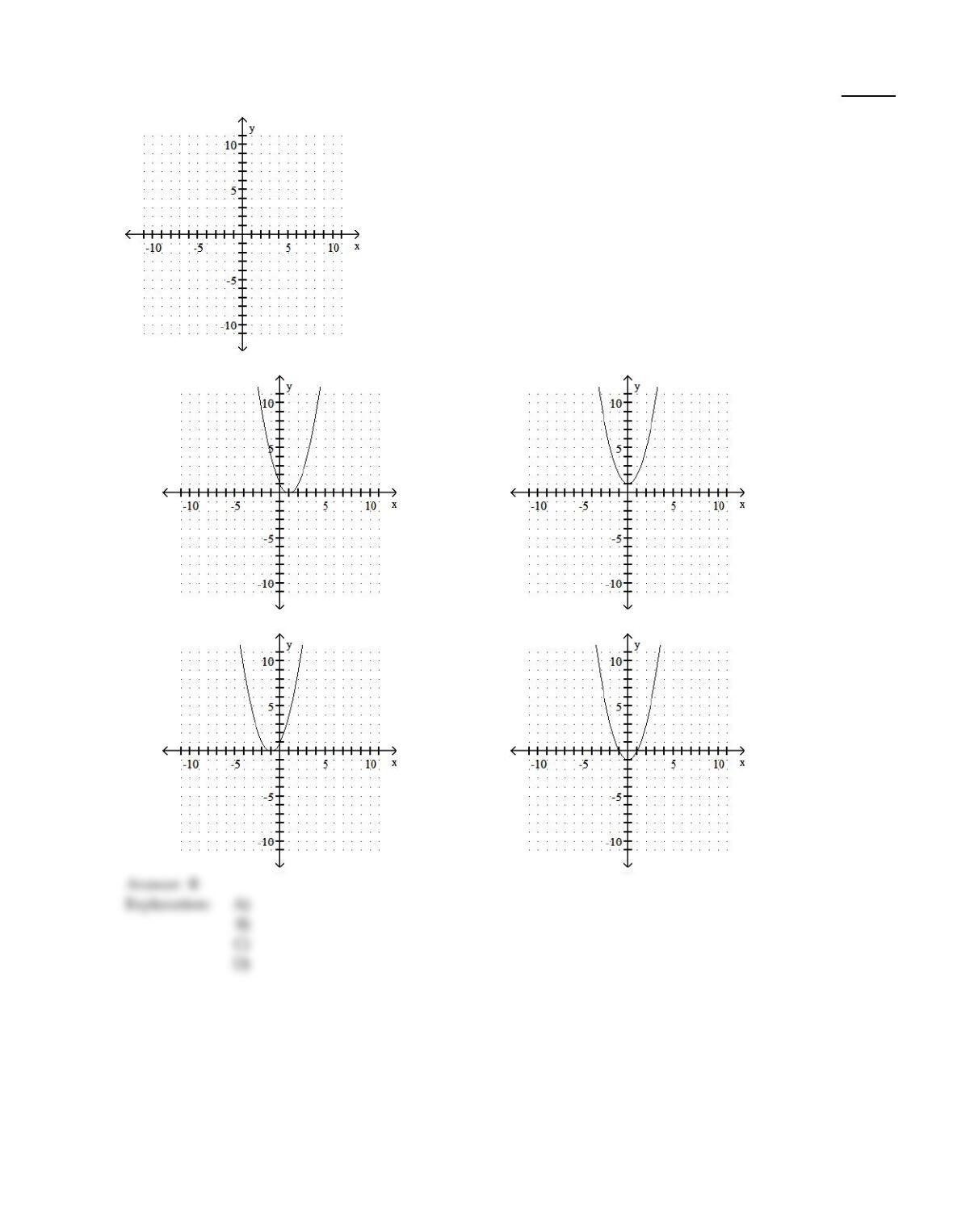
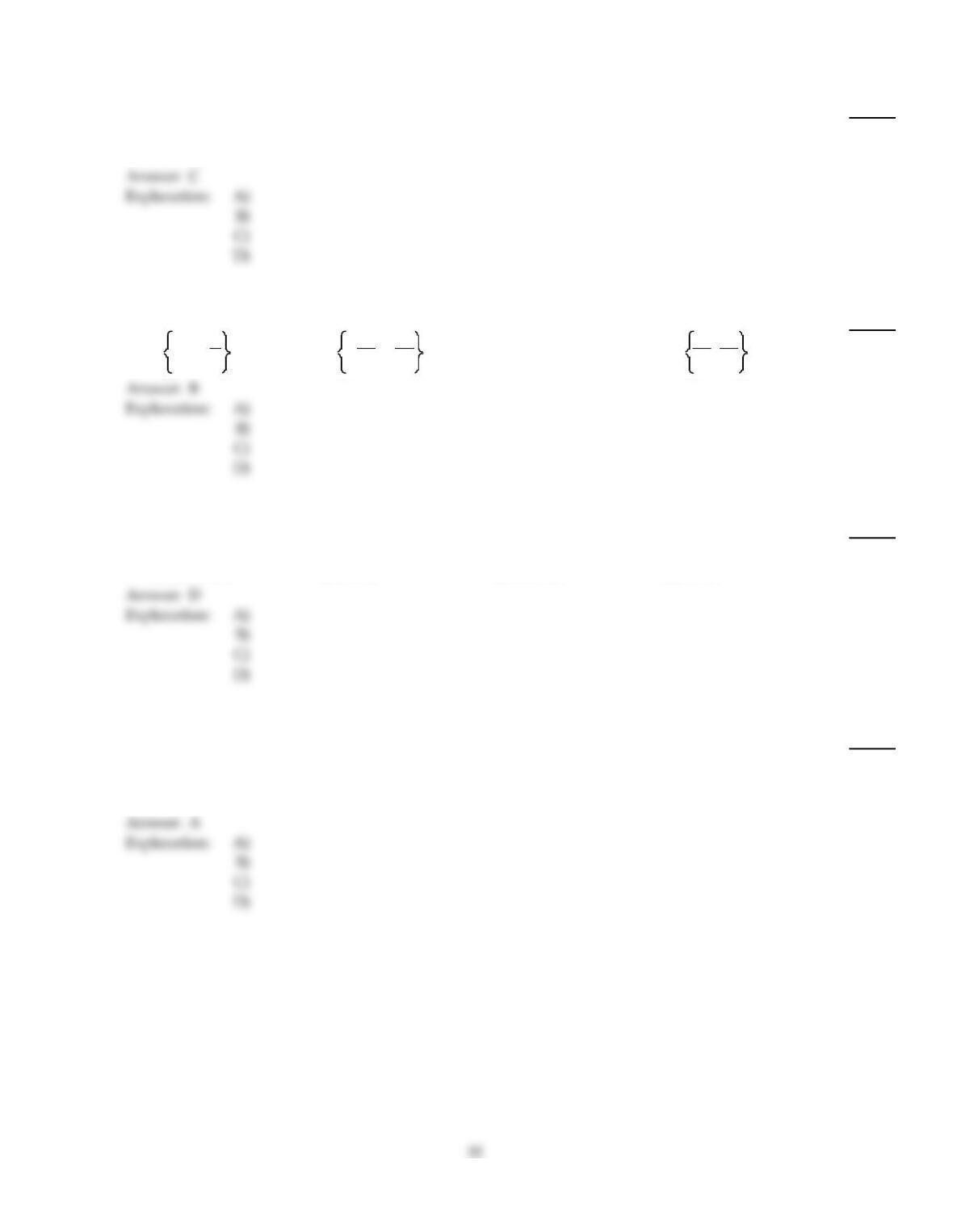
Sketch the graph of the parabola.
33
99)
y = x2+ 1
99)
A)
B)
C)
D)
34
Solve the problem.
100)
The solution set of the inequality x2– 5x –14 < 0 is (–2, 7). Without doing any work, give the
solution to x2– 5x –14 > 0.
100)
A)
[–2, 7]
B)
(–, –2] [7, )
C)
(–, –2) (7, )
D)
(–7, 2)
Solve by any method.
101)
(5p + 3)2= – 17(5p + 3) – 72
101)
A)
– 1, –6
5
B)
–11
5, –12
5
C)
{–8, –9}
D)
11
5, 12
5
Solve the problem. Round your answer to the nearest tenth, when appropriate.
102)
A rock falls from a tower that is 400 feet high. As it is falling, its height is given by the formula
h =400 – 16t2. How many seconds will it take for the rock to hit the ground (h=0)?
102)
A)
10,000 sec
B)
20 sec
C)
19.6 sec
D)
5 sec
Solve the problem.
103)
The distance traveled by a falling object is given by d = 16t2, where d is the distance (in feet) the
object falls in t seconds. How long would it take an object to fall freely from a bridge 770 ft above
the water? Round your answer to the nearest tenth of a second.
103)
A)
6.9 sec
B)
9,486,400.0 sec
C)
111.0 sec
D)
48.1 sec
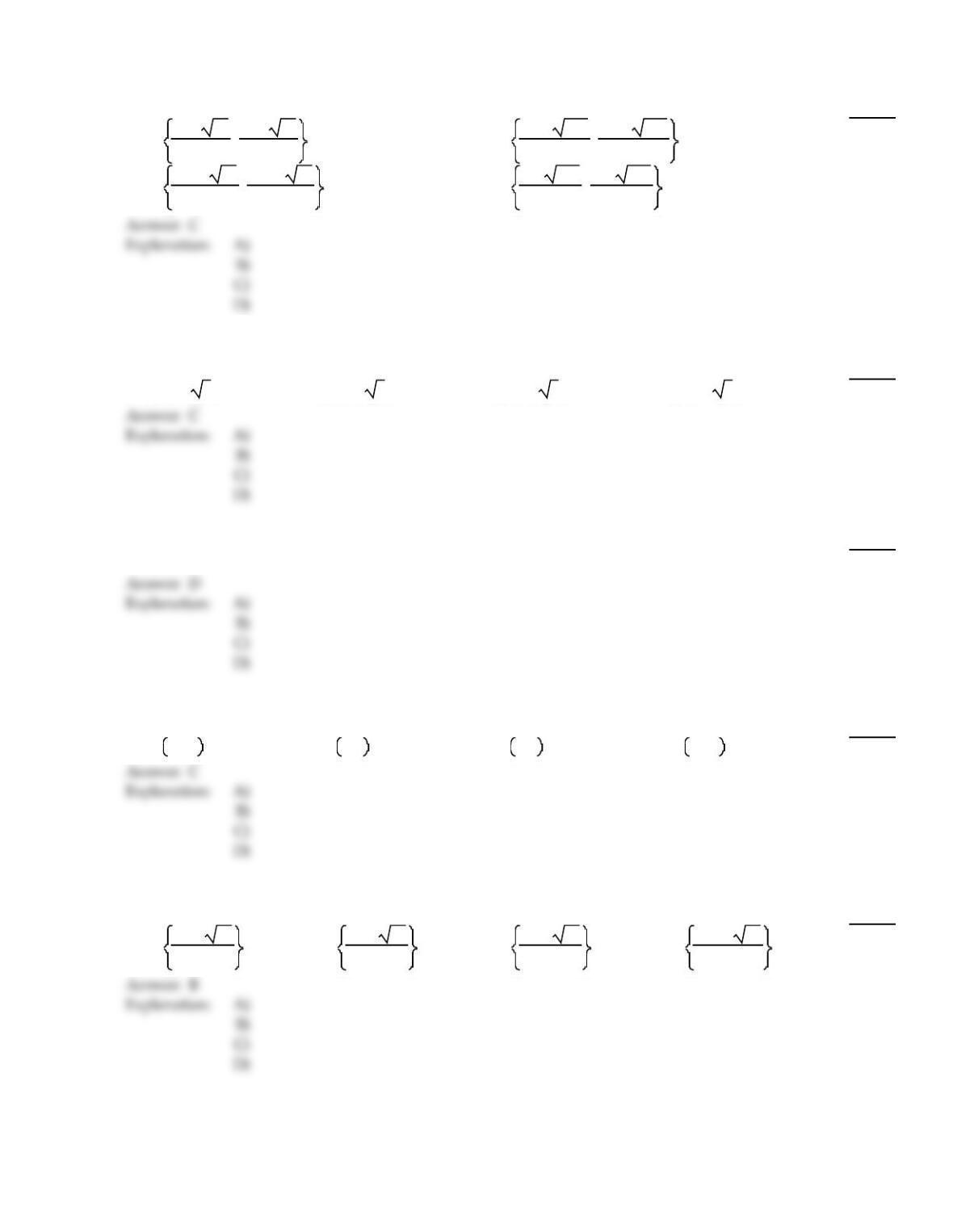
Find the nonreal complex solutions of the equation.
104)
x2+ x + 8 = 0
104)
A)
1 + i 31
2, 1 – i 31
2
B)
–1 + – 31
2, –1 – – 31
2
C)
–1 + i 31
2, –1 – i 31
2
D)
1 + – 31
2, 1 – – 31
2
Solve the equation by completing the square.
105)
0.1x2– 0.2x – 0.6= 0
105)
A)
{1 +7}
B)
{2 ±7}
C)
{1 ±7}
D)
{2 –7}
106)
m2–14m +49 = 0
106)
A)
{±7}
B)
{14}
C)
{–7}
D)
{7}
Identify the vertex of the given parabola.
107)
f(x) = – 2x2
107)
A)
0, –2
B)
2, 0
C)
0, 0
D)
–2, 0
Solve the equation by completing the square.
108)
6x2+ 10x + 2 = 0
108)
A)
–5±37
6
B)
–5±13
6
C)
–5±13
12
D)
–10 ±13
6
36
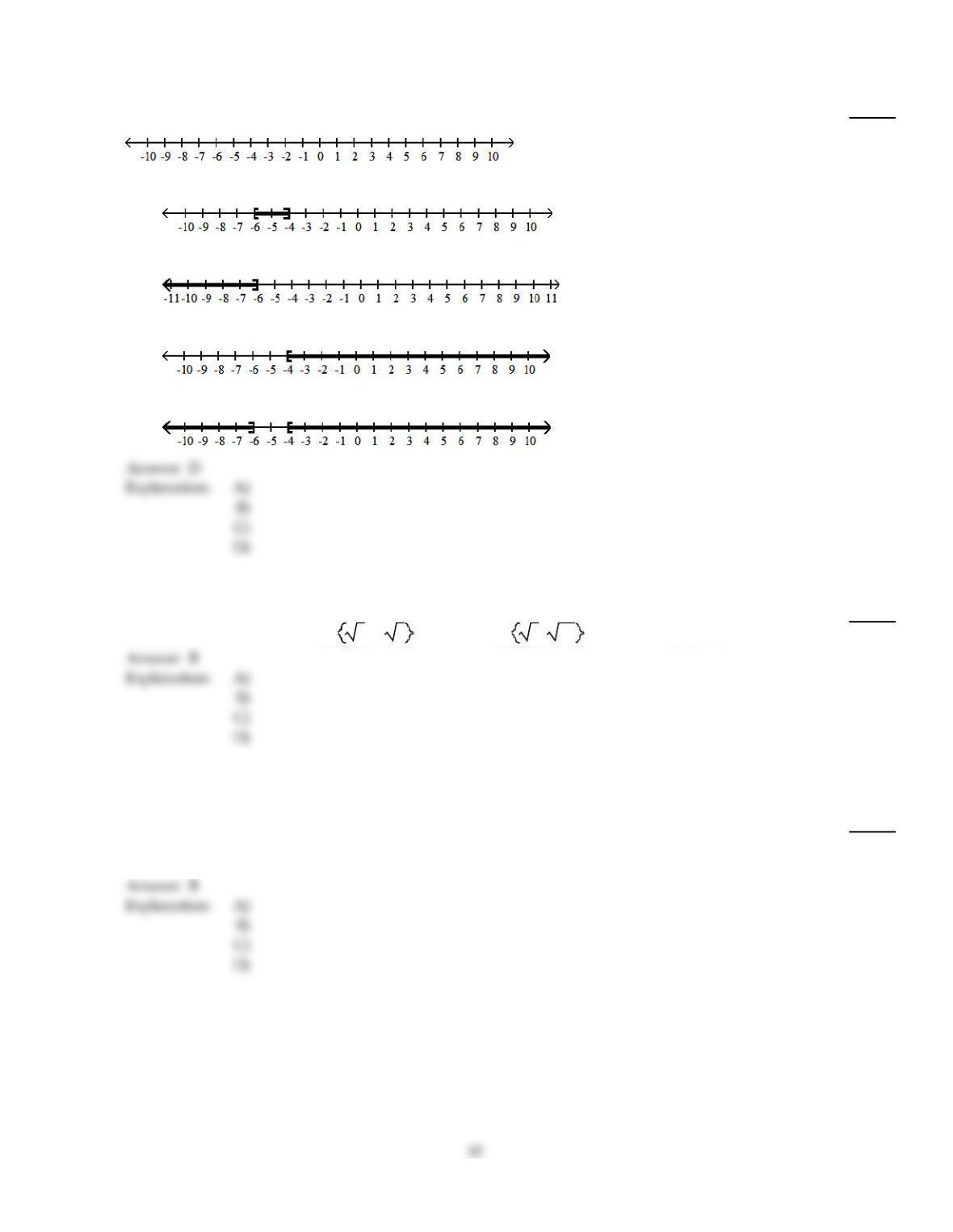
Solve the inequality, and graph the solution set.
109)
v2+ 10v + 24
0
109)
A)
[–6, –4]
B)
(–, –6]
C)
[–4, )
D)
(–, –6] [–4, )
Solve for x. Assume that a and b represent positive real numbers.
110)
x2– b = 0
110)
A)
{b}
B)
b, –b
C)
b, –b
D)
{b, –b}
A boy is standing on a flat field and tosses his ball toward a second boy standing at the other end of the field. The path of
the ball is a parabola, and the equation of the path is f(x) = – 4x2+
8x. Based on this information, answer the question.
111)
What is the name of the place on the path where the ball is highest from the ground?
111)
A)
The y–intercept
B)
The vertex
C)
The x–intercept
D)
None of the above
Solve the problem, if possible. Round your answer to the nearest tenth, when appropriate.
112)
A parking lot measures 100 ft by 150 ft. A sidewalk of uniform width is to completely surround the
lot. If the sidewalk can cover 1016 ft2, how wide will the sidewalk be?
112)
A)
2.5 ft
B)
3 ft
C)
1.5 ft
D)
2 ft
Solve the equation.
113)
x4+1125 =134x2
113)
A)
{9, 125}
B)
3, 5 5
C)
–5 5, –3, 3, 5 5
D)
{–125, –9, 9, 125}
C
Find the value of k so that the equation will have exactly one rational solution.
114)
49x2+ kx +64 = 0
114)
A)
56 or –56
B)
112
C)
–112
D)
112 or –112
D
Use the discriminant of the equation to determine the number of x–intercepts.
115)
f(x) =3x2– 6x +3
115)
A)
No x–intercepts
B)
One x–intercept
C)
Two x–intercepts
B
Provide an appropriate response.
116)
What is the discriminant for 16x2– 8x + 1 = 0? How many and what type of solutions does this
equation have?
116)
A)
Discriminant: 64; Two rational solutions
B)
Discriminant: –64; Two nonreal complex solutions
C)
Discriminant: 63; Two irrational solutions
D)
Discriminant: 0; One rational solution
D
D
Solve the problem.
117)
The distance traveled by a falling object is given by d = 16t2, where d is the distance (in feet) the
object falls in t seconds. A stuntman jumps from a rooftop 375 ft off the ground. How long will it
take him, falling freely, to reach the ground? Round your answer to the nearest tenth of a second.
117)
A)
23.4 sec
B)
77.5 sec
C)
11.7 sec
D)
4.8 sec
Find the term that should be added to the expression to form a perfect square trinomial. Write the resulting perfect square
trinomial in factored form.
118)
x2–5
2x +
118)
A)
25
4; x –5
4
2
B)
0; x –5
4
2
C)
25
16 ; x +5
4
2
D)
25
16 ; x –5
4
2
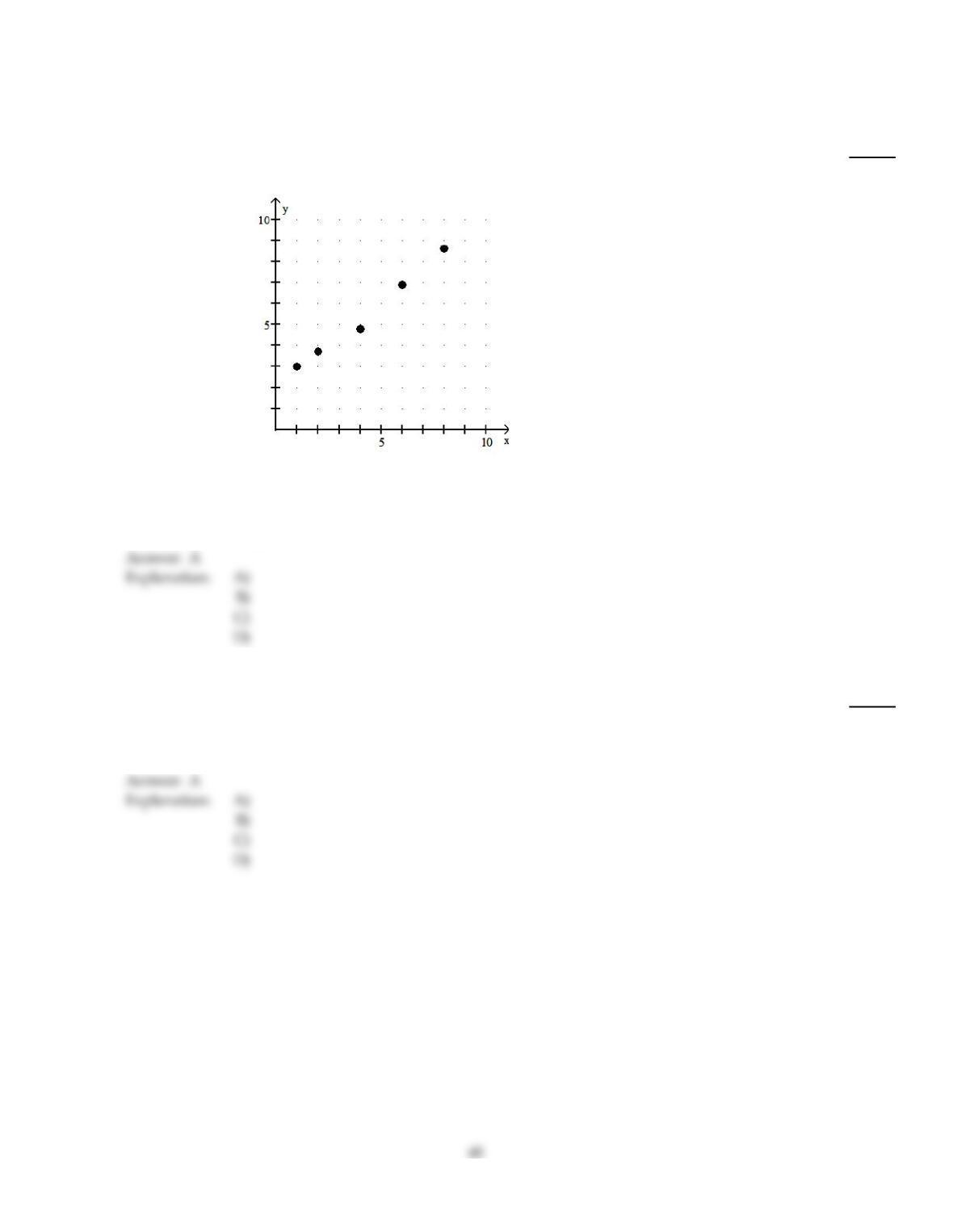
Determine whether a linear or quadratic function would be a more appropriate model for the graphed data. If linear, tell
whether the slope should be positive or negative. If quadratic, decide whether the coefficient a of x2 should be positive
or negative.
119)
CRIME STATISTICS
Crimes
(in hundreds)
Years since 1990
119)
A)
Linear; positive
B)
Linear; negative
C)
Quadratic; negative
D)
Quadratic; positive
Solve the problem.
120)
A jet plane traveling at a constant speed goes 1400 miles with the wind, then turns around and
travels for 1200 miles against the wind. If the speed of the wind is 50 mph and the total flight took 4
hours, find the speed of the plane in still air.
120)
A)
650 mph
B)
625 mph
C)
705 mph
D)
535 mph