
37) A cylinder contains 10 moles of an ideal gas at a temperature of 300 K. The gas is
compressed at constant pressure until the final volume equals 0.77 times the initial volume. The
molar heat capacity at constant volume of the gas is 24.0 J/mol ∙ K and R = 8.31 J/mol ∙ K . How
much heat is absorbed by the gas during this process? (R = 8.31 J/mol ∙ K)
A) -22 kJ
B) -17 kJ
C) 22 kJ
D) 17 kJ
E) -5.7 kJ
38) A cylinder contains 13 moles of an ideal gas at a temperature of 300 K. The gas is
compressed at constant pressure until the final volume equal 0.70 times the initial volume. The
molar heat capacity at constant volume of the gas is 24.0 J/mol ∙ K. What is the change in the
internal (thermal) energy of the gas during this process? (R = 8.31 J/mol ∙ K)
A) -28 kJ
B) -38 kJ
C) 28 kJ
D) 38 kJ
E) -9.7 kJ
39) A sealed rigid tank contains 29 moles of an ideal gas, at an initial temperature of The
pressure of the gas is increased until the final pressure equals 1.90 times the initial pressure. The
heat capacity at constant pressure of the gas is How much heat is absorbed by the
gas during this process? (R = 8.31 J/mol ∙ K)
A) 110 kJ
B) 170 kJ
C) 230 kJ
D) -52 kJ
E) 7.0 kJ
40) A sealed rigitd tank contains 30 moles of an ideal gas, at an initial temperature of The
pressure of the gas is increased until the final pressure equals 1.40 times the initial pressure. The
heat capacity at constant pressure of the gas is What is the change in the internal
(thermal) energy of the gas during this process? (R = 8.31 J/mol ∙ K)
A) 77 kJ
B) 100 kJ
C) 130 kJ
D) -50 kJ
E) -23 kJ

41) A heat engine receives 7000 J of heat and loses 3000 J in each cycle. What is the efficiency
of this engine?
A) 57%
B) 30%
C) 70%
D) 43%
42) A certain heat engine extracts 1.30 kJ of heat from a hot temperature reservoir and
discharges 0.70 kJ of heat to a cold temperature reservoir. What is the efficiency of this engine?
A) 46%
B) 54%
C) 86%
D) 27%
E) 13%
43) A heat engine with an efficiency of 30% performs 2500 J of work. How much heat is
discharged to the lower temperature reservoir?
A) 5800 J
B) 8300 J
C) 750 J
D) 1400 J
E) 7100 J
44) A heat engine has an efficiency of 35.0% and receives 150 J of heat per cycle.
(a) How much work does it do in each cycle?
(b) How much heat does it “waste” in each cycle?
45) A heat engine absorbs 64 kcal of heat each cycle and exhausts 42 kcal.
(a) What is the efficiency of this engine?
(b) How much work does this engine do per cycle?
46) A certain automobile engine takes in 4.00 kJ of heat and performs 1.10 kJ of mechanical
work in each cycle.
(a) Calculate the engine’s efficiency.
(b) How much heat is “wasted” in each cycle?
47) During each cycle, a heat engine takes in 4.0 J of heat, does 1.0 J of work, and expels 3.0 J of
heat. What is its efficiency?
48) A heat engine absorbs 85.6 kJ of heat each cycle and exhausts 61.8 kJ.
(a) What is the efficiency of the engine?
(b) How much work does it do each cycle?
49) A heat engine has an efficiency of 31.4% and receives 8.72 kJ of heat per cycle.
(a) How much work does it perform in each cycle?
(b) How much heat does it exhaust in each cycle?
50) A nuclear power plant has an actual efficiency of 33%. If of energy are released
from fission, how much electric power does the power plant produce?
A) 0.063 MW
B) 6.3 MW
C) 25 MW
D) 0.25 MW
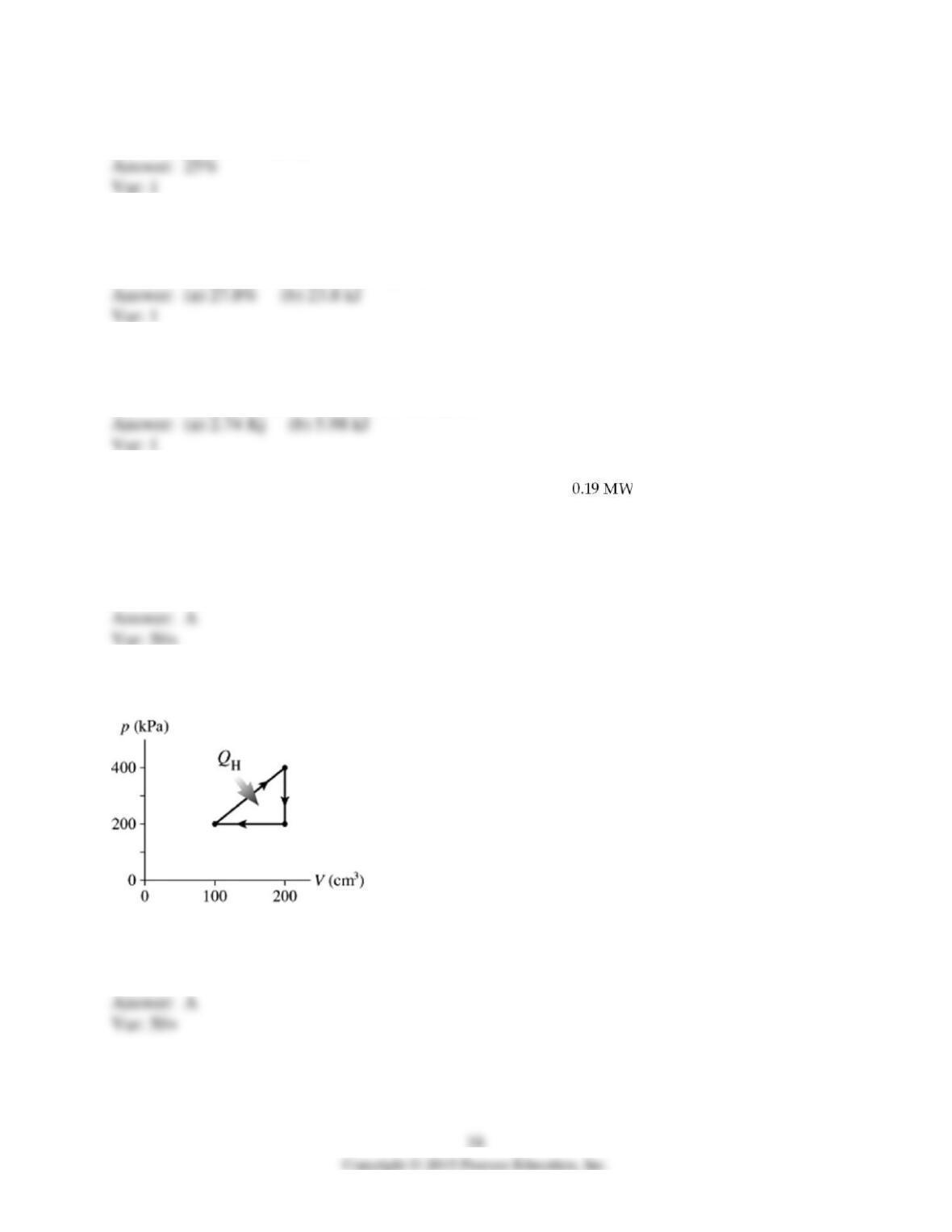
51) The figure shows a pV diagram for a cycle of a heat engine for which QH = 59 J. What is the
thermal efficiency of the engine?
A) 17%
B) 34%
C) 8.5%
D) 14%
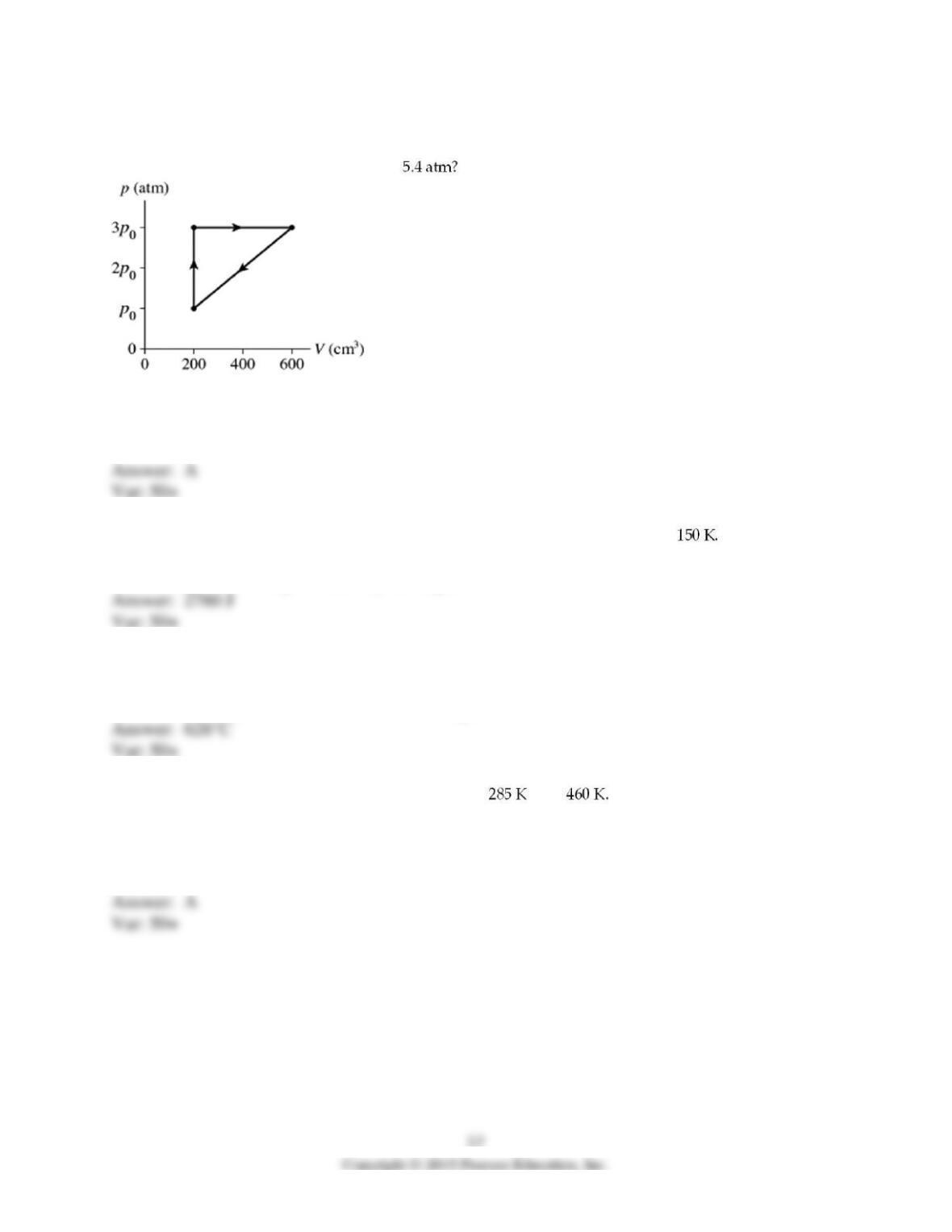
52) A gas follows the pV trajectory shown in Figure 16.2. How much work is done per cycle by
the gas if The gas in a heat engine follows the cycle shown in the pV diagram. How much work
does this engine do each cycle if p0 =
A) 220 J
B) 440 J
C) 870 J
D) 1100 J
53) An ideal Carnot heat engine operates between reservoirs at 1740 K and In each cycle,
260 J of heat energy is rejected to the low temperature reservoir. In each cycle, how much
mechanical work W is performed by the engine?
54) An ideal Carnot engine is operated between a hot and a cold reservoir. The temperature
difference between the two reservoirs is 284°C. If the efficiency of this ideal engine is 24.0%,
find the temperature of the cold reservoir in degrees Celsius.
55) An ideal Carnot heat engine operates between and What is its efficiency?
A) 0.38
B) 0.62
C) 0.61
D) 1.61

56) An ideal Carnot heat engine has an efficiency of 0.600. If it operates between a deep lake
with a constant temperature of and a hot reservoir, what is the temperature of the hot
reservoir?
A) 735 K
B) 490 K
C) 470 K
D) 784 K
57) An ideal Carnot engine extracts 529 J of heat from a high-temperature reservoir during each
cycle, and rejects of heat to a low-temperature reservoir during the same cycle. What is the
efficiency of the engine?
A) 0.57
B) 1.35
C) 2.35
D) 0.7
58) A heat engine having the maximum possible efficiency has an efficiency of 35.0% when
operating between two heat reservoirs. If the temperature of the hot reservoir is 700 K, what is
the temperature of the cold reservoir?
A) 200 K
B) 245 K
C) 350 K
D) 455 K
E) 600 K
59) A heat engine having the maximum possible efficiency has an efficiency of 25% when
operating between two heat reservoirs. If the temperature of the cold reservoir is 300 K, what is
the temperature of the hot reservoir?
A) 350 K
B) 375 K
C) 400 K
D) 450 K
E) 500 K

60) The ocean thermal energy conversion project uses the surface water near tropical islands
with a temperature of 20°C as the hot temperature reservoir, and the water at some depth, with a
temperature of 5.0°C, as the cold temperature reservoir for a heat engine. What is the maximum
possible efficiency of an engine running between those two temperatures?
A) 4.7%
B) 5.1%
C) 7.9%
D) 15%
E) 30%
61) For a certain ideal Carnot engine, the hot reservoir is 35 C° higher than the cold reservoir. If
this engine is to have an efficiency of 20%, what must be the temperature of the hot reservoir?
A) 70.0 K
B) 140 K
C) 175 K
D) 210 K
E) 245 K
62) An ideal Carnot engine has an efficiency of 83.0% and performs 4500 J of work every cycle.
How much energy is discharged to the lower temperature reservoir every cycle?
A) 920 J
B) 830 J
C) 740 J
D) 3700 J
E) 5400 J
63) One of the most efficient engines built so far has the following characteristics: The
combustion chamber temperature is 1900°C, the exhaust temperature = 430°C, 7.0 × 10⁹ cal of
fuel produces 1.4 × 10¹⁰ J of work in one hour. (1 cal = 4.186 J)
(a) What is the actual efficiency of this engine?
(b) What is the power output of this engine?
(c) What would be the maximum possible efficiency for an engine using the same temperature
extremes?

64) A coal-fired plant generates 600 MW of electric power. The plant uses 4.8 × 10⁶ kg of coal
each day, and the heat of combustion of coal is 3.3 × 10⁷ J/kg. The steam that drives the
turbines is at a temperature of 300°C, and the exhaust water is at 37°C.
(a) What is the overall efficiency of the plant for generating electric power?
(b) How much thermal energy is exhausted each day?
(c) Using the same heat reservoirs, what is the maximum possible efficiency for a heat engine?
65) Two ideal Carnot heat engines have the same efficiency. One operates between 5.0 × 10² K
and 3.0 × 10² K, and the other between 4.0 × 10² K and some lower temperature. What is the
lower temperature?
A) 200 K
B) 220 K
C) 240 K
D) 260 K
E) 280 K
66) An ideal Carnot engine operates between a high temperature reservoir at and a river
with water at If it absorbs of heat each cycle, how much work per cycle does it
perform?
A) 1642 J
B) 2358 J
C) 1483 J
D) 2517 J
67) A real (non-Carnot) heat engine, operating between heat reservoirs at temperatures of 450 K
and 270 K, performs 3.3 kJ of net work, and rejects 8.2 kJ of heat in a single cycle.
(a) What is the thermal efficiency of this heat engine?
(b) What is the maximum efficiency it could possibly have?
68) An ideal Carnot engine operating between a warm reservoir of unknown temperature and a
cold reservoir at has an efficiency of What is the temperature of the warm reservoir?
A) 2.93 K
B) 0.0500 K
C) 106 K
D) 0.0400 K

69) An ideal Carnot engine operates between a warm reservoir at 233 K and a colder reservoir.
During each cycle, this engine extracts of heat from the warm reservoir and does of
work. What is the temperature of the colder reservoir?
A) 171 K
B) 62 K
C) 47 K
D) 67 K
70) What is the efficiency of an ideal Carnot engine operating between a reservoir in which ice
and water coexist, and a reservoir in which water and steam coexist? The pressure is constant at
1.0 atm for both reservoirs.
A) 27%
B) 0.27%
C) 100%
D) 1.0%
E) 15%
71) An ideal Carnot engine operating between a warm reservoir of unknown temperature and a
cold reservoir at has an efficiency of What is the temperature of the warm reservoir?
A) 1.98 K
B) 0.180 K
C) 157 K
D) 0.160 K
72) The “hot shot” heat engine operating between 40°C and 380°C has an efficiency that is 60%
of that of an ideal Carnot engine operating between the same temperatures. If the “hot shot”
engine absorbs heat at a rate of 60 kW, at what rate does it exhaust heat?
A) 36 kW
B) 41 kW
C) 57 kW
D) 60 kW
73) An inventor tries to sell you his new heat engine that takes in 40 J of heat at 87°C on each
cycle, expels 30 J at 27°C, and does 10 J of work. Would it be wise to invest in this engine?
Back up your conclusion with numerical calculations.

74) A Carnot engine operates between two reservoirs with unknown temperatures. If the Carnot
engine operates at efficiency, what is the ratio of the absolute temperatures of the reservoirs,
Tc/Th?
A) 0.33
B) 0.0012
C) 0.0025
D) 0.67
75) A refrigerator has a performance coefficient (COP) of 1.15, and it extracts 7.95 J of heat
from the cold reservoir during each cycle.
(a) How much work is done on the gas in each cycle?
(b) How much heat is exhausted into the hot reservoir in each cycle?
76) During each cycle, a refrigerator removes 20.0 kJ of heat from the freezing compartment and
ejects 24.0 kJ into a room.
(a) How much work per cycle is required each cycle to run this refrigerator?
(b) What is the coefficient of performance of this refrigerator?
77) Suppose that the Department of Energy develops a new reversible engine that has a
coefficient of performance (COP) of 4.0 when operated as a refrigerator and a COP of 5.0 when
operated as a heat pump. What is its thermal efficiency when operated as a heat engine doing
work?
A) 10%
B) 20%
C) 25%
D) 45%
E) 80%
78) During each cycle of operation, a refrigerator absorbs 230 J of heat from the freezer and
expels 356 J of heat to the room. How much work input is required in each cycle?
A) 712 J
B) 586 J
C) 460 J
D) 126 J

79) A reversible engine takes in heat at a rate of 555 W and exhausts heat at 482 W.
(a) How much power does it produce?
(b) What is its efficiency?
(c) If operated in reverse as a refrigerator, what would be its performance coefficient (COP)?
80) If the efficiency of a reversible engine is 28%, what is its COP (performance coefficient)
operated (a) as a refrigerator, and (b) as a heat pump?
81) A refrigerator has a coefficient of performance equal to 4.2. How much work must be done
on the operating gas in the refrigerator in order to remove 250 J of heat from the interior
compartment?
A) 60 J
B) 120 J
C) 250 J
D) 480 J
E) 1050 J
82) An air conditioner with a coefficient of performance of 3.50 uses 30.0 kW of power to
operate. What power is it discharging to the outdoors?
A) 30.0 kW
B) 75.0 kW
C) 105 kW
D) 135 kW
E) 210 kW
83) An ideal reversible heat pump is taking heat from the outside air at -10.0°C and discharging
it into the house at 18.0°C. What is the coefficient of performance of this heat pump?
A) 10.4
B) 9.44
C) 0.644
D) 0.533
E) 0.0962

84) An ideal Carnot air conditioner operates between an indoor temperature of 20°C and an
outdoor temperature of 39°C. How much energy does it use to remove 2000 J of heat from the
interior of the house?
A) 105 J
B) 130 J
C) 780 J
D) 520 J
E) 340 J
85) During each cycle, the compressor in a certain ideal Carnot refrigerator performs 480 J of
work to remove 150 J of heat from the interior of the refrigerator. How much heat do the coils
behind the refrigerator discharge into the kitchen each cycle?
A) 110 J
B) 150 J
C) 330 J
D) 480 J
E) 630 J
86) A Carnot air conditioner has a coefficient of performance of 17.0 and removes 72.0 MJ of
heat from the interior of a house every hour. How much power does it consume?
A) 1180 W
B) 1320 W
C) 520 kW
D) 3.14 MW
E) 1.25 MW
87) An ideal Carnot engine is operated as an air conditioner to cool a house in the summer. The
air conditioner removes of heat per second from the house, and maintains the inside
temperature at while the outside temperature is The power required to run the air
conditioner under these operating conditions is closest to
A) 3600 W.
B) 4400 W.
C) 5100 W.
D) 5800 W.
E) 6600 W.

88) An ideal Carnot engine is operated as a heat pump to heat a room in the winter. The heat
pump delivers heat to the room at the rate of 47 kJ per second and maintains the room at a
temperature of 293 K when the outside temperature is 237 K. The power requirement to run the
heat pump under these operating conditions is closest to
A) 9000 W.
B) 7100 W.
C) 20,000 W.
D) 15,000 W.
E) 11,000 W.
89) An ideal Carnot refrigerator with a performance coefficient (COP) of 5.0 cools items inside
of it to What is the high temperature needed to operate this refrigerator?
A) 61° C
B) 1395° C
C) 6° C
D) 30° C
90) A heat pump with a performance coefficient (COP) of 4.9 absorbs heat from the atmosphere
at a rate of At what rate is work being done to run this heat pump?
A) 6 kW
B) 142 kW
C) 113 kW
D) 35 kW
91) A heat pump absorbs heat from the atmosphere at a rate of 30 kW. If work is being done to
run this heat pump at a rate of 7.7 kW, what is the coefficient of performance (COP) of the heat
pump?
A) 3.9
B) 4.9
C) 2.9
D) 0.26
E) 22