64. Rank the following in order of increasing normal boiling point: N2, O2, Br2, Xe.
A)
N2 < O2 < Xe < Br2
B)
O2 < N2 < Xe < Br2
C)
Br2 < Xe < N2 < O2
D)
N2 < O2 < Br2 < Xe
E)
Xe < Br2 < N2 < O2
65. Which of the following concerning intermolecular forces is/are correct?
1.
Intermolecular forces depend in part on the shape of a molecule.
2.
London forces contribute to the net forces of attraction found in all molecular
solids and liquids.
3.
Hydrogen bonding is a special category of dipole-dipole attractions.
A)
1 only
B)
2 only
C)
3 only
D)
1 and 2
E)
1, 2, and 3
66. In an experiment, 40.0 mmol of helium gas is collected over water. The total volume of gas
collected is 0.224 L. Under similar conditions, the gas is collected over two other liquids, A
and B. The total volume of gas collected over A and B are 0.222 L and 0.227 L,
respectively. Which of the following statements is false?
A)
Liquid B boils at a higher temperature than water
B)
Liquid A boils at a higher temperature than water
C)
The vapor pressure of B is higher than that of A
D)
The vapor pressure of B is higher than that of water
E)
Liquid A boils at a temperature higher than B
67. When two water molecule form a hydrogen bond, which atoms are involved in the
interaction?
A)
Two hydrogens from one molecule and one hydrogen from the other molecule
B)
An oxygen from one molecule and an oxygen from the other molecule
C)
Two hydrogens from one molecule and one oxygen from the other molecule
D)
A hydrogen from one molecule and a hydrogen from the other molecule
E)
A hydrogen from one molecule and an oxygen from the other molecule
68. What is the maximum number of hydrogen bonds in which a water molecule could
participate?
A)
2
B)
4
C)
3
D)
6
E)
5
69. Which pure substance exhibits hydrogen bonding?
A)
HNF2
B)
B2H6
C)
HBr
D)
H2S
E)
CaH2
70. Which of the following substances has the weakest intermolecular forces?
A)
I2
B)
C8H18
C)
SiH4
D)
CH3CH2CH2CH2OH
E)
SbCl3
71. Which of the following best describes carbon dioxide (CO2) at room temperature and
pressure?
A)
ionic solid
B)
nonpolar molecular gas
C)
metallic solid
D)
polar molecular gas
E)
covalent network solid
72. Which of the following pure substances may exhibit hydrogen bonding?
A)
CH3Cl
B)
CH3OCH3
C)
H2CO
D)
N(CH3)3
E)
H2NNH2
73. The strongest intermolecular forces present in a sample of pure I2 are
A)
London forces.
B)
dipole–dipole forces.
C)
metallic bonds.
D)
covalent network bonds.
E)
covalent bonds.
74. The strongest intermolecular forces between molecules of PH3 are
A)
hydrogen bonds.
B)
covalent bonds.
C)
ionic bonds.
D)
London forces.
E)
dipole–dipole attractions.
75. The molecules in a sample of solid SO2 are attracted to each other by a combination of
A)
H-bonding and ionic bonding.
B)
covalent bonding and dipole-dipole interactions.
C)
London forces and H-bonding.
D)
London forces and dipole-dipole interactions.
E)
none of these
76. Which of the following best describes silane (SiH4) at room temperature and pressure?
A)
ionic solid
B)
covalent network solid
C)
nonpolar molecular gas
D)
polar molecular gas
E)
metallic solid
77. Which of the following is the strongest intermolecular force present in dry ice, CO2(s)?
A)
covalent bonding
B)
hydrogen bonding
C)
ionic bonding
D)
London forces
E)
metallic bonding
78. A solid has a very high melting point, is hard, and in the molten state is a non-conductor.
The solid is most likely
A)
a covalent network solid.
B)
a metallic solid.
C)
an amorphous solid.
D)
a molecular solid.
E)
an ionic solid.
79. Van der Waals forces must be broken to melt this type of solid.
A)
A covalent network solid.
B)
A metallic solid.
C)
A molecular solid.
D)
An ionic solid.
E)
none of the above
80. Which substance can be described as cations bonded together by mobile electrons?
A)
S8(s)
B)
Ag(s)
C)
HCl(l)
D)
KCl(s)
E)
Kr(l)
81. Which of the following best describes calcium hydride (CaH2) at room temperature and
pressure?
A)
nonpolar molecular gas
B)
metallic solid
C)
ionic solid
D)
polar molecular gas
E)
covalent network solid
82. Which of the following is not a covalent network solid?
A)
diamond
B)
silicon carbide
C)
quartz
D)
iron
E)
graphite
Test Bank General Chemistry, 10th edition 25
83. Which of the following is a molecular solid?
A)
NaCl
B)
CH4
C)
SiO2
D)
C(graphite)
E)
C(diamond)
84. Which of the following is an ionic solid?
A)
SiO2(s)
B)
Ne(s)
C)
Na(s)
D)
CsF(s)
E)
CO2(s)
85. Which bonding interaction best describes the strongest intermolecular forces in AlH3?
A)
dipole–dipole forces
B)
metallic bonding
C)
ionic bonding
D)
London dispersion forces
E)
primarily hydrogen bonding
86. Which of the following is a molecular solid?
A)
carborundum, SiC
B)
quartz
C)
glass
D)
hydrogen chloride
E)
potassium
87. Which of the following pure substances has the highest normal melting point?
A)
KF
B)
KI
C)
NaF
D)
NaCl
E)
NaI
88. Which of the following pure substances has the lowest melting point?
A)
LiF
B)
RbF
C)
CsF
D)
KF
E)
NaF
89. Which of the following pure substances has the lowest melting point?
A)
Cs2O
B)
CsCl
C)
CsBr
D)
CsI
E)
CsF
90. Which of the following pure substances has the highest melting point?
A)
CCl4
B)
AlCl3
C)
NCl3
D)
LiCl
E)
MgCl2
91. Which of the following pure substances has the highest melting point?
A)
KBr
B)
NaCl
C)
NaF
D)
CsI
E)
LiF
92. A low melting solid readily dissolves in water to give a nonconducting solution. The solid is
most likely a
A)
molecular solid.
B)
ionic solid.
C)
covalent network solid.
D)
weak base.
E)
metallic solid.
93. Which of the following pure substances is a solid at room temperature and pressure?
A)
NH3
B)
PH3
C)
SiH4
D)
CH4
E)
AlH3
94. Which of the following pure substances has the highest normal melting point?
A)
NO2
B)
SiO2
C)
CO2
D)
P4O10
E)
N2O5
95. Which of the following pure substances has the highest normal melting point?
A)
P4O10
B)
P4O6
C)
CO2
D)
CaO
E)
Na2O
Test Bank General Chemistry, 10th edition 28
96. Which of the following pure substances has the highest normal boiling point?
A)
H2O
B)
CF4
C)
CsF
D)
CaF2
E)
KF
97. A certain solid substance that is very hard, has a high melting point, and is nonconducting
unless melted is most likely to be:
A)
CO2
B)
I2
C)
H2O
D)
NaCl
E)
Cu
98. A solid crystal of NaCl is
A)
soft, low melting, a poor electrical conductor.
B)
soft, low melting, a good electrical conductor.
C)
hard, high melting, a good electrical conductor.
D)
hard, high melting, a poor electrical conductor.
E)
soft, high melting, a poor electrical conductor.
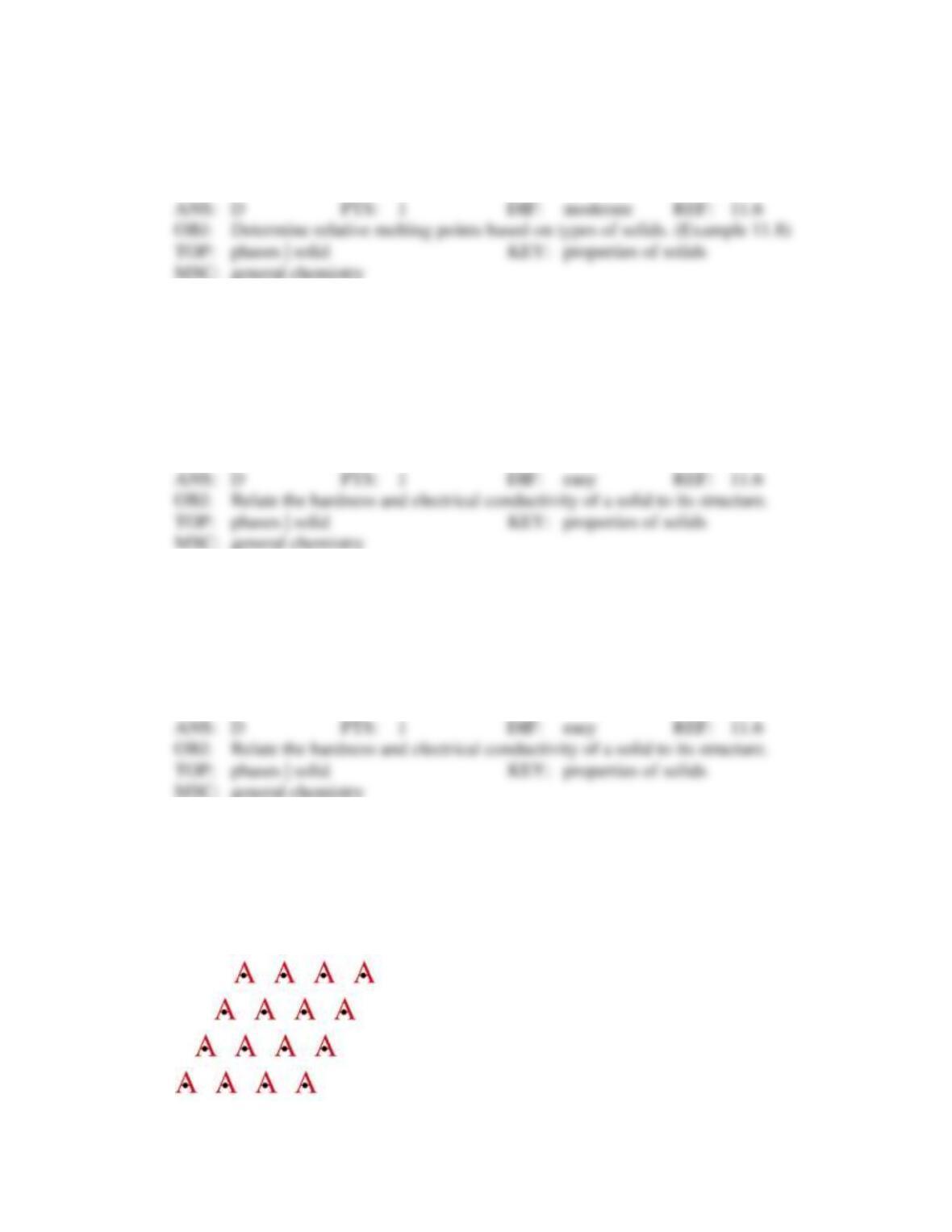
99. Which of the following concerning the 2-D lattice provided below is/are correct?
1.
One possible unit cell contains a single and a single •.
2.
More than one unit cell which reproduces this lattice is possible.
3.
One possible unit cell contains four ’s and four •’s.

Test Bank General Chemistry, 10th edition 29
A)
1 only
B)
2 only
C)
3 only
D)
1 and 2
E)
1, 2, and 3
100. For a given pure metal which of the following cubic unit cells would result in the highest
metal density?
A)
It depends on the identity of the metal.
B)
The density would be identical for all these cells if the edge length of each cell
were the same.
C)
A face-centered cubic cell.
D)
A simple cubic cell.
E)
A body-centered cubic cell.
101. In any cubic lattice an atom lying at the corner of a unit cell is shared equally by how many
unit cells?
A)
1
B)
16
C)
2
D)
4
E)
8
102. The space-filling representation of a crystalline polonium provided below is an example of a
_____ unit cell, which contains the equivalent of _____ atom(s) within a single unit cell.
A)
simple cubic, 1 atom
B)
body centered cubic, 2 atoms
C)
face centered cubic, 4 atoms
D)
simple cubic, 8 atoms
E)
body centered cubic, 3 atoms
103. The unit cell in a certain lattice consists of a cube formed by an anion at each corner, an
anion in the center, and a cation at the center of each face. The unit cell contains a net:
A)
2 anions and 3 cations.
B)
2 anions and 2 cations.
C)
5 anions and 3 cations.
D)
3 anions and 4 cations.
E)
5 anions and 6 cations.
104. How many atoms are there in a cubic close-packed unit cell of aluminum?
A)
4
B)
6
C)
1
D)
8
E)
2
105. How many atoms are there in a body-centered cubic unit cell of vanadium?
A)
4
B)
8
C)
6
D)
2
E)
1
Test Bank General Chemistry, 10th edition 31
106. A metal crystallizes in a face-centered cubic lattice. The radius of the atom is 196 pm and
the density of the element is 1.55 g/cm3. How many atoms are there per unit cell?
A)
4
B)
6
C)
8
D)
1
E)
2
107. Which one of the following statements about solid Cu (face-centered cubic unit cell) is
incorrect?
A)
It will conduct electricity.
B)
The length of a face diagonal is four times the Cu radius.
C)
The number of atoms surrounding each Cu atom is 12.
D)
The solid has a cubic closest-packed structure.
E)
There are two atoms per unit cell.
108. Lithium chloride crystallizes in a face-centered cubic structure. The unit cell length is
5.14 10-8 cm. The chloride ions are touching each other along the face diagonal of the unit
cell. The lithium ions fit into the holes between the chloride ions. How many chloride ions
are there in this unit cell?
A)
4
B)
3
C)
1
D)
8
E)
2
109. Assuming the following metals all have the same unit cell structure, which of the following
would be expected to have the highest density: Sc, Ti, Mn, or Co?
A)
Mn
B)
Ti
C)
Co
D)
Sc
E)
cannot be determined from the information given.
110. The metal palladium crystallizes in a face-centered cubic lattice with an edge length of
388.8 pm. What is the density of palladium?
A)
0.752 g/cm3
B)
3.01 g/cm3
C)
1.50 g/cm3
D)
6.01 g/cm3
E)
12.0 g/cm3
111. The metal gold, with an atomic radius of 144.2 pm, crystallizes in a face-centered cubic
lattice. What is the density of gold?
A)
9.65 g/cm3
B)
1.21 g/cm3
C)
4.82 g/cm3
D)
2.41 g/cm3
E)
19.3 g/cm3
112. A metal crystallizes in a face-centered cubic lattice. The radius of the atom is 198 pm and
the density of the element is 6.57 g/cm3. What is the identity of the metal?
A)
Cu
B)
Ca
C)
Sr
D)
Ni
E)
Yb
Test Bank General Chemistry, 10th edition 33
113. Calcium crystallizes in a face-centered cubic lattice. The density of the element is 1.55
g/cm3. What is the volume of a single unit cell?
A)
1.72 10−22
cm3
B)
4.13 10−22
cm3
C)
1.07 10−25
cm3
D)
4.29 10−23
cm3
E)
1.03 10−22
cm3
114. Ytterbium crystallizes in a face-centered cubic lattice. The radius of ytterbium is 198 pm.
What is the edge length of the unit cell?
A)
560 pm
B)
396 pm
C)
792 pm
D)
420 pm
E)
198 pm
115. Lithium chloride crystallizes in a face-centered cubic structure. The unit cell length is
5.14 10-8 cm. The chloride ions are touching each other along the face diagonal of the unit
cell. The lithium ions fit into the holes between the chloride ions. What is the mass of LiCl
in a unit cell?
A)
5.63 10–22 g
B)
1.41 10–22 g
C)
4.22 10–22 g
D)
7.04 10–23 g
E)
2.82 10–22 g
116. Lithium chloride crystallizes in a face-centered cubic structure. The unit cell length is
5.14 10-8 cm. The chloride ions are touching each other along the face diagonal of the unit
cell. The lithium ions fit into the holes between the chloride ions. What is the density of the
lithium chloride?
A)
0.520 g/cm3
B)
2.82 g/cm3
C)
2.08 g/cm3
D)
3.11 g/cm3
E)
3.78 g/cm3
117. The metal iron crystallizes in a body-centered cubic lattice. If the density of iron is
7.87 g/cm3, what is the unit cell edge length?
A)
287 pm
B)
77.6 pm
C)
75.0 pm
D)
61.6 pm
E)
228 pm
118. The metal barium crystallizes in a body-centered cubic lattice. If the radius of barium is
222 pm, what is the unit cell edge length?
A)
513 pm
B)
444 pm
C)
296 pm
D)
222 pm
E)
96.1 pm
119. The metal cesium crystallizes in a body-centered cubic lattice. If the density of cesium is
1.88 g/cm3, what is the unit cell volume?
A)
1.77 106 pm3
B)
2.35 104 pm3
C)
2.35 108 pm3
D)
1.17 108 pm3
E)
4.70 104 pm3
120. Sodium crystallizes in the body-centered cubic system. If the edge of the unit cell is 430 pm,
what is the radius of a sodium atom in picometers?
A)
186 pm
B)
744 pm
C)
992 pm
D)
859 pm
E)
80.5 pm
121. Copper crystallizes with a face-centered cubic unit cell. If the edge length of the unit cell is
362 pm, what is the radius of a copper atom in picometers?
A)
128 pm
B)
512 pm
C)
1020 pm
D)
296 pm
E)
45.3 pm
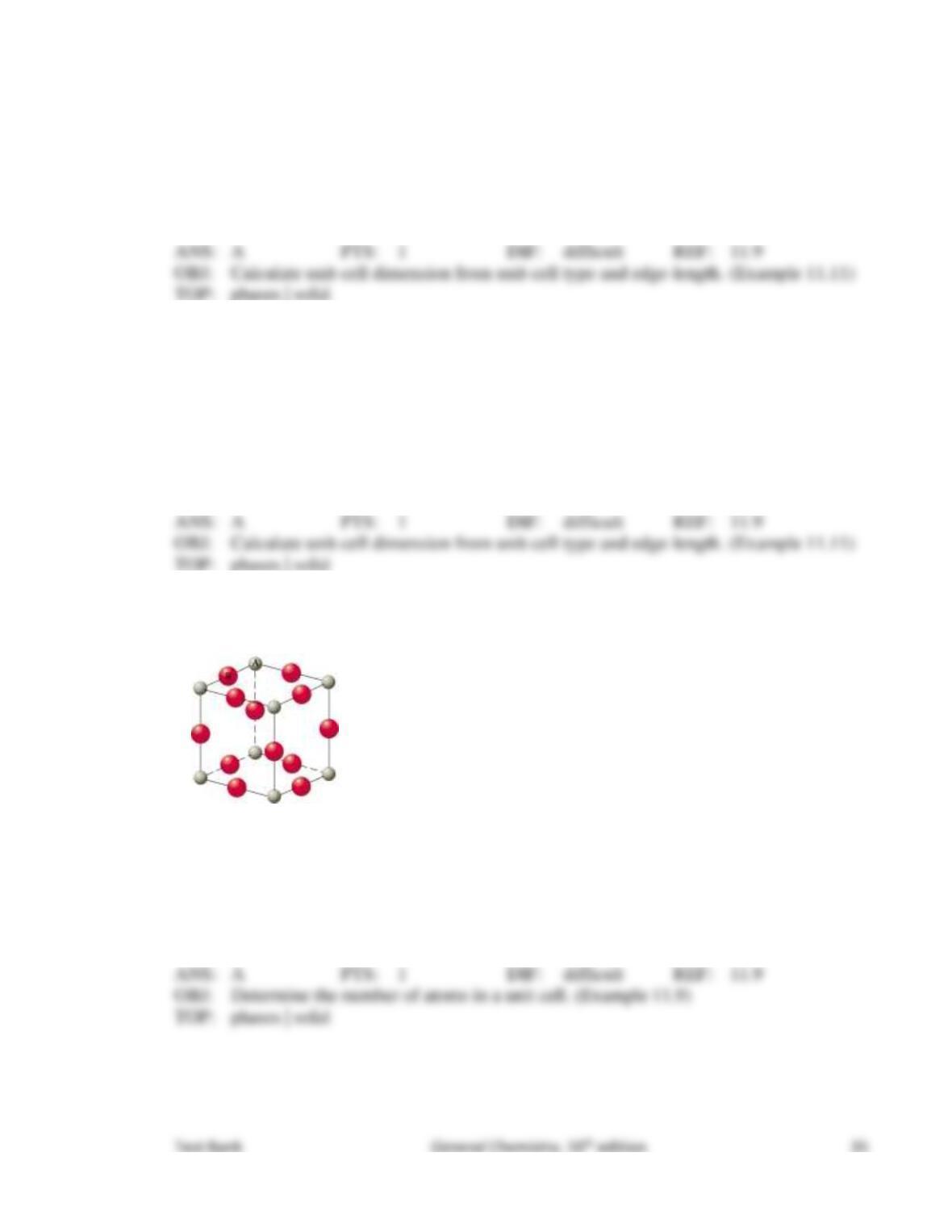
122. What is the simplest formula of the compound represented by the unit cell provided below?
A)
AB3
B)
AB2
C)
AB
D)
A2B4
E)
A2B6
Test Bank General Chemistry, 10th edition 36
123. A metal crystallizes in a face-centered cubic lattice. The radius of the atom is 125 pm and
the density of the element is 8.91 g/cm3. What is the volume of the unit cell?
A)
8.18 106 pm3
B)
1.12 109 pm3
C)
4.42 107 pm3
D)
1.95 106 pm3
E)
3.27 107 pm3
124. A metal crystallizes in a face-centered cubic lattice. The radius of the atom is 214 pm and
the density of the element is 2.63 g/cm3. What is the molar volume of the metal?
A)
98.9 cm3/mol
B)
24.7 cm3/mol
C)
86.6 cm3/mol
D)
33.4 cm3/mol
E)
0.380 cm3/mol
125. The metal cesium crystallizes in a body-centered cubic lattice. If the density of cesium is
1.88 g/cm3, what is the atomic volume of cesium?
A)
1.60 104 pm3
B)
7.99 103 pm3
C)
3.99 107 pm3
D)
6.01 105 pm3
E)
7.98 107 pm3
126. The metal barium crystallizes in a body-centered cubic lattice. If the density of barium is
3.51 g/cm3, what is the atomic radius of barium?
A)
15.1 pm
B)
174 pm
C)
42.5 pm
D)
19.0 pm
E)
219 pm
127. Lithium chloride crystallizes in a face-centered cubic structure. The unit cell length is
5.14 10-8 cm. The chloride ions are touching each other along the face diagonal of the unit
cell. The lithium ions fit into the holes between the chloride ions. What is the radius of the
chloride ion?
A)
2.52 10-8 cm
B)
1.82 10-8 cm
C)
2.56 10-8 cm
D)
1.45 10-8 cm
E)
2.82 10-8 cm
128. Which of the following statements concerning the determination of crystal structure by x-
ray diffraction is incorrect?
A)
X-rays are reflected from the repeating planes of an ordered crystal lattice.
B)
A diffraction pattern reveals the locations of the electrons in a crystal.
C)
Analysis of a diffraction pattern reveals the structure of a crystal.
D)
X-rays undergo constructive and destructive interference upon reflection in a
crystal lattice.
E)
A diffraction pattern from a crystal depends on the incident angle of the x-rays.