84)
Find the Taylor series at x = 0 of f(x) =x2e2x. Use enough terms to calculate 0.25e to two
decimal places of accuracy.
Enter just a real number to 2 decimal places.
84)
85)
Find the first four non–zero terms of the Taylor series at x = 0 for f(x) = 1 +xex.
Is 1 + x +x2+x3
2! the correct answer?
Enter “yes” or “no”.
85)
Explanation:
86)
Determine the sum of the following series: 10 + 4 +8
5+16
25 + … .
Enter just a reduced fraction of form a
b.
86)
Explanation:
87)
Determine the third Taylor polynomial of f(x) =1
1 – x at x = 0.
Enter your answer as an unlabeled polynomial in x in standard form (i.e., highest powers
first).
87)
Explanation:
88)
Suppose f(0) = 1, f'(0) = 1, and f”(0) = – 1. Use a Taylor polynomial of degree two to
approximate f 1
2. Is f1
211
8 the solution?
Enter “yes” or “no”.
88)
Explanation:
89)
Find the first three non–zero terms of the Taylor series at x = 0 of f(x) =ex sin x.
Is f(x) = x +x2+x3
3 correct?
Enter “yes” or “no”.
89)
Explanation:
Explanation:
90)
Use the second Taylor polynomial at x = 1 to estimate
2
1
ln x2 dx .
Enter just a reduced fraction.
90)
1
91)
Determine the first three non–zero terms of the Taylor series at x = 0 for
f(x) = x cos x – sin x.
Is (3! – 2!)x3
2! 3! +(5! – 4!)x5
4! 5! +(7! – 6!)x7
6! 7! the correct answer?
Enter “yes” or “no”.
91)
92)
Use the integral test to determine whether the infinite series
k = 2
ln k
k is convergent or
divergent.
Enter just “convergent” or “divergent”.
92)
93)
Determine the sum of the following geometric series: 3 – 1.8 + 1.08 + .648 – … .
Enter just a real number rounded off to three decimal places.
93)
94)
Suppose the second Taylor polynomial for f(x) at x = 3 is p2(x) = 2(x – 3) –1
3(x – 3)2. Find
f”(3).
Enter just a reduced fraction.
94)
95)
Sum an appropriate infinite series to find the rational number whose decimal expansion is:
0.19696.
Enter just a reduced fraction of form a
b.
95)
22
96)
Determine the first four non–zero terms of the Taylor series at x = 0 for f(x) =xe(1/2)x.
Is x –x2
2+x3
22· 2!
–x4
23· 3! the correct answer?
Enter “yes” or “no”.
96)
97)
The Taylor series at x = 0 for f(x) = ln 1 + x
1 – x is 2x +2
3x3+2
5x5+2
7x7+ …, x< 1. Find
f(6)(0).
Enter just an integer.
97)
98)
Determine the sum of the following infinite series:
k = 0
1
3
k(2)k + 1.
Enter just an integer.
98)
99)
Find the second Taylor polynomial for f(x) =1
x + 4 at x = 0 and use it to approximate
1
4.1 .
Enter just a real number rounded off to two decimal places.
99)
100)
Determine the first four non–zero terms of the Taylor series at x = 0 for f(x) = sin x3.
Is f(x) =x3+x9
3! +x15
5! +x21
7! the correct answer?
Enter “yes” or “no”.
100)
101)
Use two repetitions of the Newton–Raphson algorithm to find the value of x near zero for
which cos x = x.
Enter just a real number rounded off to two decimal places.
101)
MULTIPLE CHOICE. Choose the one alternative that best completes the statement or answers the question.
102)
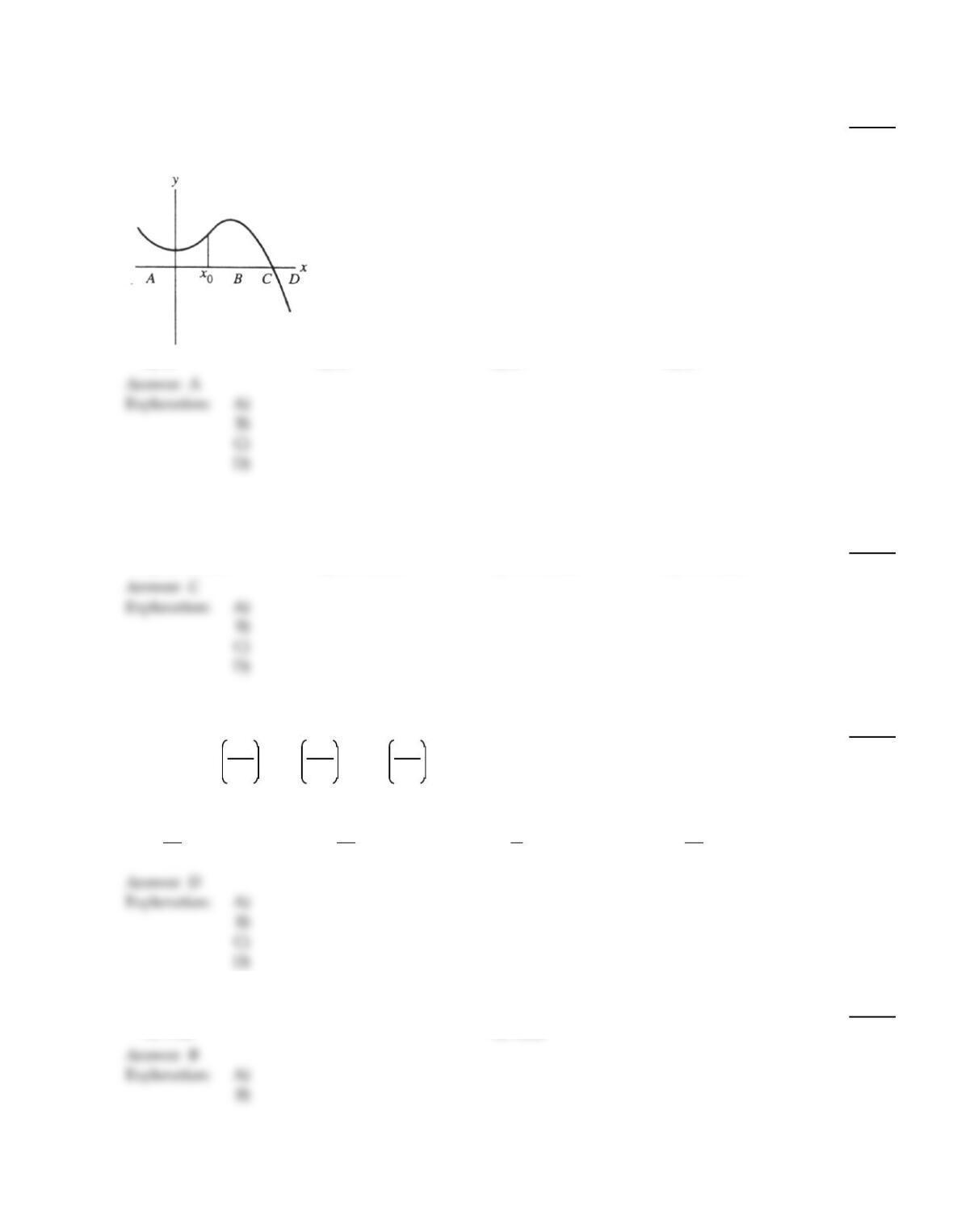
Below is a graph of the function f(x). If x0 is taken as the initial approximation of the zero of f(x),
then which of the following points, A, B, C, or D could be given by the Newton–Raphson algorithm
as the next approximation?
102)
A)
A
B)
B
C)
C
D)
D
Find the nth Taylor polynomial for the function at x = 0, and use it to estimate the value of the function at the given value
of x. Round to seven decimal places.
103)
f(x) = cos x, n = 3, estimate cos(0.1)
103)
A)
1.0050042
B)
0.9998334
C)
0.9950042
D)
0.9950250
Solve the problem.
104)
The repeating decimal 0.36363636. . . can be expressed as infinite geometric series
0.36 + 0.36 1
100 + 0.36 1
100
2
+ 0.36 1
100
3
+ . . . .
By finding the sum of the series, determine the rational number whose decimal expansion is
0.36363636. . . .
104)
A)
4
17
B)
4
13
C)
4
9
D)
4
11
105)
Suppose f(x) =x4– 7x3+ 2. The third Taylor polynomial of f(x) at x = 1 is p3(x) = 2 – 7x3.
105)
A)
True
B)
False
24
106)
Determine the sum of the series e–1+e–2+e–3+ … if it converges.
106)
A)
e
e – 1
B)
1
e – 1
C)
diverges
D)
e
107)
The Taylor Series for 1
(1 – x)2 at x = 0 is given by f(x) = 1 + 2x + 3x2+ 4x3+ … . Find f(3)(0).
107)
A)
4
B)
2
3
C)
3
D)
none of these
108)
Determine the sum of the series 1 +1
1.01 +1
(1.01)2+1
(1.01)3+ … .
108)
A)
10.1
B)
1
1.01
C)
101
D)
none of these
Find the Taylor series for the given function.
109)
f(x) =e9x2
109)
A)
1 +9x +92
2! x2+93
3! x3+ . . . +9n
n! xn+ . . .
B)
1 +9x2+92
2! x4+93
3! x6+ . . . +9n
n! x2n + . . .
C)
1 +9x2+92
2x4+93
3x6+ . . . +9n
nx2n + . . .
D)
1 –9x2+92
2! x4–93
3! x6+ . . . +(–1)n9n
n! x2n + . . .

110)
Determine the sum of the series
n = 0
(–1)n2
e
n.
110)
A)
2
e
B)
e
e + 2
C)
1 –2
e
D)
none of these
111)
Determine the sum of the series 1
2+1
22+1
23+ … .
111)
A)
1
B)
2
C)
1
2
D)
none of these
D)
Use the Newton–Raphson algorithm to find a zero of the function on the given interval. Round your answer to the nearest
hundredth.
112)
f(x) =8x2+7x –11; between 0 and 1
112)
A)
0.82
B)
0.83
C)
0.81
D)
0.80
D)
113)
Let f(x) =1
1 – x . Determine the fourth Taylor polynomial at x = 0.
113)
A)
1 – x + 2x2–1
2x3+1
6x4
B)
1 + x +x2+x3+x4
C)
1 + x + 2x2+1
2x3+1
6x4
D)
1 – x +x2–x3+x4
D)
D)

114)
Determine the sum of the geometric series 22
52–23
53+24
54– …, if it is convergent.
114)
A)
4
35
B)
3
5
C)
5
7
D)
7
5
E)
none of these
Determine the third Taylor polynomial of the function at x = a.
115)
f(x) =x3, a =8
115)
A)
2048 +192(x –64) +16(x –64)2+(x –64)3
B)
512 +192(x –64) +24(x –64)2+(x –64)3
C)
6 + 3(x –64) +(x –64)2+(x –64)3
D)
512 +64(x –64) +64(x –64)2+(x –64)3
Find the Taylor series for the given function.
116)
f(x) =5
1 +7x
116)
A)
5x +35x2+ . . . +(–1)n5·7nxn+1+ . . .
B)
5x –35x2+ . . . +(–1)n5·7nxn+1+ . . .
C)
5–35x + . . . +(–1)n5·7nxn+ . . .
D)
5+35x + . . . +(–1)n5·7nxn+ . . .

117)
Find the Taylor Series at x = 0 for f(x) =sin x
x.
117)
A)
x2–x3
3! +x5
5! –x7
7! + …
B)
x –x2
3! +x4
5! –x6
7! + …
C)
1 –x2
3! +x4
5! –x6
7! + …
D)
none of these
Solve the problem.
118)
A pendulum bob swings through an arc 50 centimeters long on its first swing. For each swing
thereafter, it swings only 81% as far as on the previous swing. How far will it swing altogether
before coming to a complete stop?
118)
A)
5000
19 cm
B)
5000
181 cm
C)
162 cm
D)
54 cm
119)
Let f(x) =1
x + 1 . Determine the second Taylor polynomial p2(x) of f(x) at x = 0.
119)
A)
1 – 2x + 2x2
B)
1 – x
C)
1 – x +x2
D)
1 – x –x2
E)
none of these

Find the Taylor series for the given function.
120)
f(x) =2
5– x
120)
A)
2
5+2
25 x +2
125x2+ . . . +2
5n+1xn+ . . .
B)
2+2
25 x +2
125x2+ . . . +2
5nxn+ . . .
C)
2
5+2
25 x2+2
125x4+ . . . +2
5n+1x2n + . . .
D)
2
5x +2
25 x2+2
125x3+ . . . +2
5nxn+ . . .
Solve the problem.
121)
The repeating decimal 0.11111. . . can be expressed as infinite geometric series
0.1+ 0.11
10 + 0.11
10
2
+ 0.11
10
3
+ . . . .
By finding the sum of the series, determine the rational number whose decimal expansion is
0.11111. . . .
121)
A)
1
13
B)
1
17
C)
1
9
D)
1
11
Use the Newton–Raphson algorithm to find a zero of the function on the given interval. Round your answer to the nearest
hundredth.
122)
f(x) =ex+4x –4; between 0 and 1
122)
A)
0.54
B)
0.57
C)
0.55
D)
0.56
29

123)
The Newton–Raphson algorithm is used to approximate the zero of f(x) =x3+ x – 5 between x = 1
and x = 2. If x0= 1, find x1.
123)
A)
1
4
B)
3
4
C)
7
3
D)
7
4
E)
none of these
E)
124)
Suppose f(x) =x4– 7x3+ 2. The fifth Taylor polynomial of f(x) at x = 0 is p5(x) =x4– 7x3+ 2.
124)
A)
True
B)
False
B)
125)
The Newton–Raphson algorithm is applied to estimate 10. If x0= 3, find x2.
125)
A)
700
237
B)
5
3
C)
721
228
D)
758
521
E)
none of these
B)
E)
B)
Determine whether the given series converges or diverges, and find the sum if it converges.
126)
8– 4 + 2 – 1 + . . .
126)
A)
Converges; sum =5.33
B)
Converges; sum =6.3
C)
Converges; sum =5.9
D)
Converges; sum =4.8
127)
Determine the sum of the infinite series:
k = 0
1
2
2k .
127)
A)
4
3
B)
2
3
C)
4
5
D)
2
E)
none of these
A
128)
Find the Taylor Series at x = 0 for f(x) =ex + 1.
128)
A)
e – ex +ex2
2! –ex3
3! + …
B)
e + ex +ex2
2! +ex3
3! + …
C)
1
e+x
e+x2
e2! +x3
e3! + …
D)
none of these
B
31
A
Determine the third Taylor polynomial of the function at x = a.
129)
f(x) =x2, a =8
129)
A)
64 +16(x –64) +(x –64)2
B)
64 +16(x –64) +24(x –64)2+32(x –64)3
C)
1 +16(x –64) +24(x –64)2+32(x –64)3
D)
1 +128(x –64) +1536(x –64)2+16,384(x –64)3
Solve the problem.
130)
The infinite series a1+a2+a3+ … has partial sums given by Sn=4–3
n. Does the infinite series
converge? If so, to what value does it converge?
130)
A)
Yes, 7
B)
Yes, 4
C)
No, lim
n 4–3
n does not exist
D)
Yes, 1
Find the nth Taylor polynomial for the function at x = 0, and use it to estimate the value of the function at the given value
of x. Round to seven decimal places.
131)
f(x) = ln x, n = 4, estimate ln(1.06)
131)
A)
0.0582688
B)
1.0618360
C)
0.0618752
D)
0.0582355
Determine whether the given series converges or diverges, and find the sum if it converges.
132)
0.68 + 0.0068 + 0.000068 + . . .
132)
A)
Converges; sum =31
50
B)
Converges; sum =17
25
C)
Converges; sum =68
99
D)
Diverges
32
133)
Let f(x) =ex/2. Determine the second Taylor polynomial of f(x) at x = 2.
133)
A)
1 –1
2(x – 2) +1
8(x – 2)2
B)
e +e
2(x – 2) +e
8(x – 2)2
C)
1 +1
2(x – 2) +1
8(x – 2)2
D)
1 +1
2(x – 2) +1
6(x – 2)2
Solve the problem.
134)
A mortgage of $123,981 is repaid in 300 monthly payments of $1000. Determine the monthly rate of
interest.
134)
A)
7.1%
B)
0.5%
C)
0.71%
D)
0.81%
Use the Newton–Raphson algorithm to approximate the given root to the nearest thousandth.
135)
8
135)
A)
2.825
B)
2.828
C)
2.833
D)
8.000
136)
Determine the sum of the series
n = 2
–1
2
n.
136)
A)
1
4
B)
1
3
C)
1
6
D)
none of these