Stockholders’ Equity: Capital Stock and Dividends ♦ 537
17. When stock is issued in exchange for assets other than cash, the assets acquired should be
recorded at their historical cost.
18. One reason that a corporation may purchase Treasury stock is to support the market price of the
stock.
19. Treasury stock is stock that a corporation has issued and kept in the treasury.
20. A commonly used method of accounting for the purchase and resale of treasury stock is called the
cost method.
21. The resale of treasury stock decreases owner’s equity.
22. The resale of treasury stock at a price below the purchase price credits The Paid-in-Capital from
the Sale of Treasury Stock account.
23. Stock splits increase the price of stock to attract more investors.
24. When a company performs a stock split, it applies only to the shares outstanding.
25. Earnings per share is commonly used by stockholders to evaluate earnings across different
companies, time periods, and alternatives
538 ♦ Chapter 11
26. For bond financing, the earnings per share will fall below the no financing option whenever the
return on investment is more than the interest on the bonds.
27. The declaration of dividends reduces the retained earnings of a corporation.
28. A liability occurs for dividends on the date of record.
29. Cash dividends must be paid on all stock, including treasury stock.
30. Maintaining stable dividends makes the stock more attractive to investors.
31. Stock dividends are different from cash dividends, in that there is no payment of cash to the
stockholders.
32. The effect of a stock dividend is to transfer retained earnings to cash.
33. Corporate boards of directors are required by law to declare dividends.
34. When considering to declare a dividend, the balance of the cash and retained earnings accounts are
often unrelated.
35. Other comprehensive income includes other, non-operating revenues.
Stockholders’ Equity: Capital Stock and Dividends ♦ 539
36. Comprehensive income includes other comprehensive income and traditional net income.
37. The changes in the bond account would NOT be included in The Statement of Stockholders’
Equity?
38. The balance sheet discloses the number of shares authorized, issued, and outstanding shares, as
well as, the par value of various classes of stock.
39. The balance sheet discloses Additional Paid-in-Capital account above the Common Stock account
in the Stockholders’ equity section of the balance sheet.
40. The dividend yield is most commonly computed on preferred stock.
41. The dividend yield is computed by dividing the annual cash dividends by the annual net income.
42. Investors whose main objective is a rapid increase in the market price of their investment may not
desire a high dividend yield.
43. Dividend safety is a term that describes the likelihood that existing dividends will increase.
44. Changes in stockholders’ equity and dividends are disclosed in the investing section of the
statement of cash flows.
540 ♦ Chapter 11
ESSAY
1. Discuss the nature of the corporate form of business.
2. What are the steps in forming a corporation?
3. Discuss the differences between common and preferred stock.
Stockholders’ Equity: Capital Stock and Dividends ♦ 541
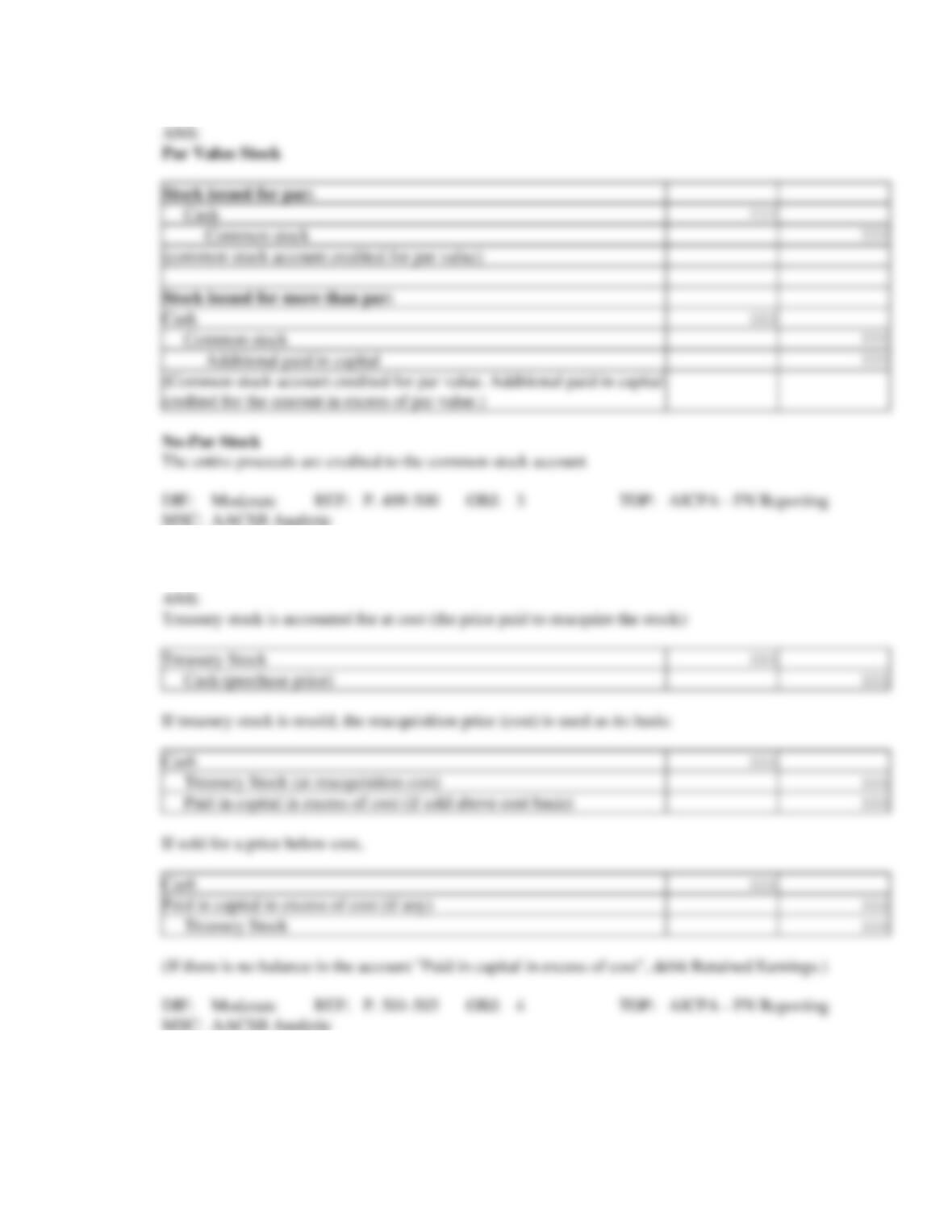
4. Discuss the accounting for stock issuance.
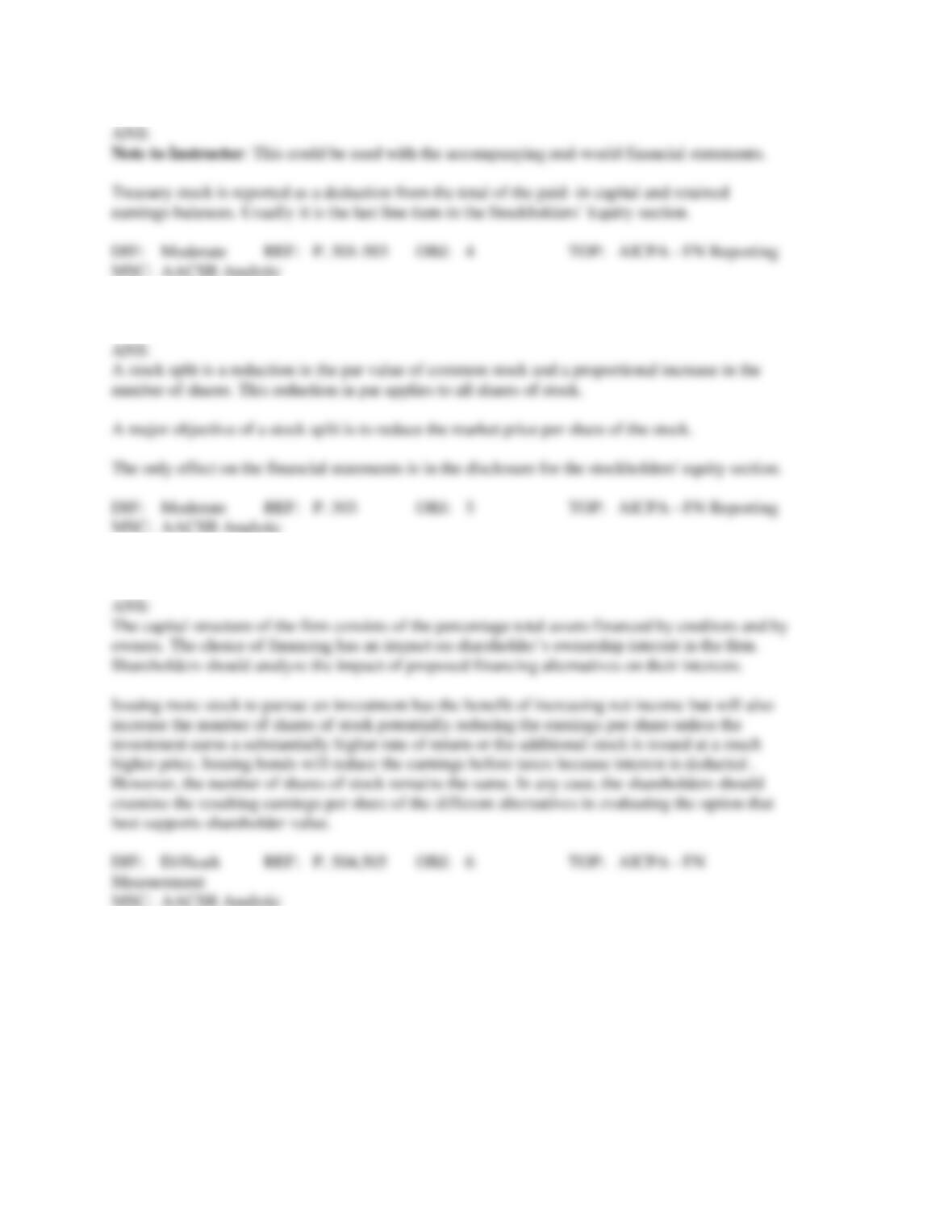
5. Discuss how to account for treasury stock.
542 ♦ Chapter 11
6. How is treasury stock presented on the balance sheet?
7. Discuss the nature of stock splits and their effect on the financial statements of a corporation.
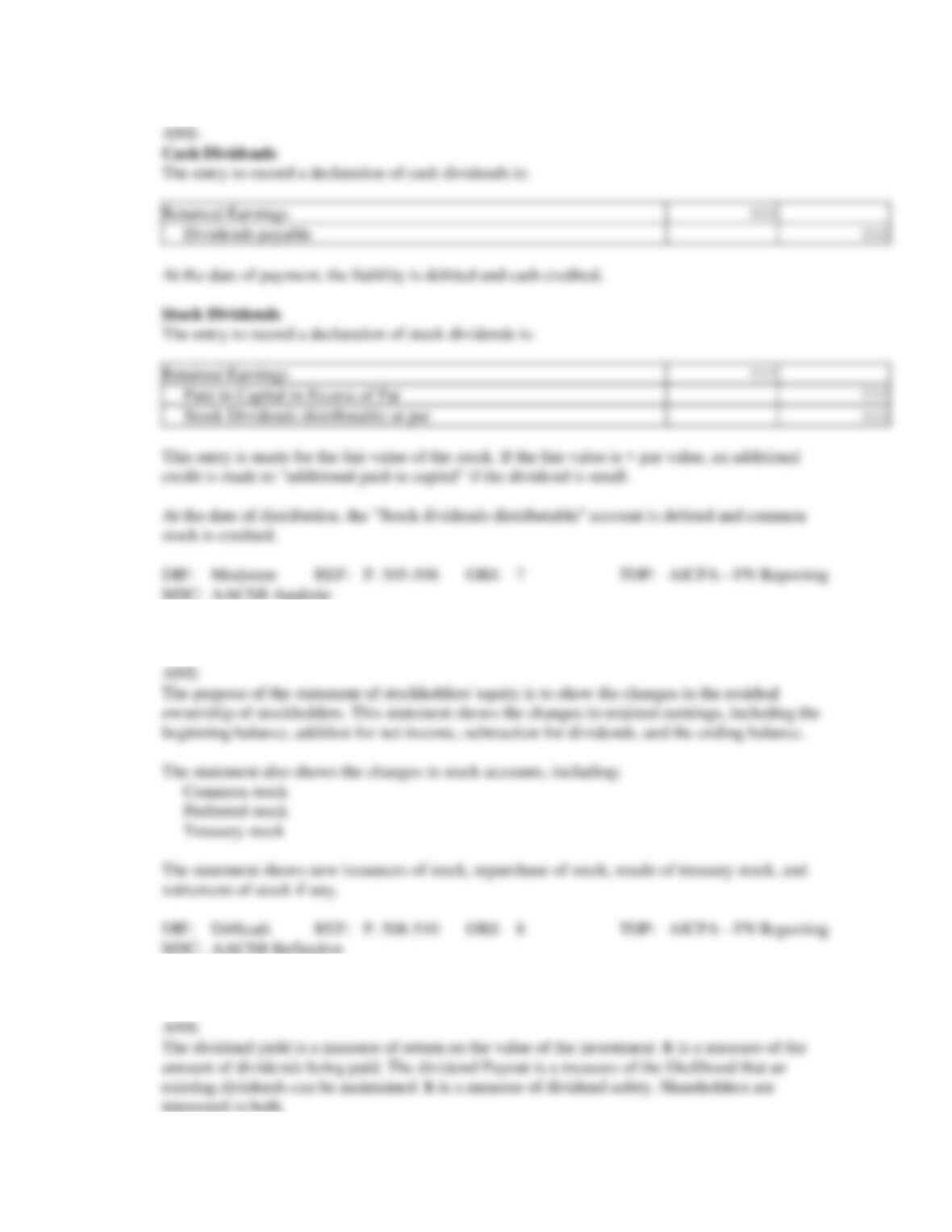
8. Discuss the how the issuing of common stock and bonds might affect shareholders differently.
Stockholders’ Equity: Capital Stock and Dividends ♦ 543
9. Discuss the accounting for cash and stock dividends.
10. Discuss the purpose of the Statement of Stockholders’ Equity.
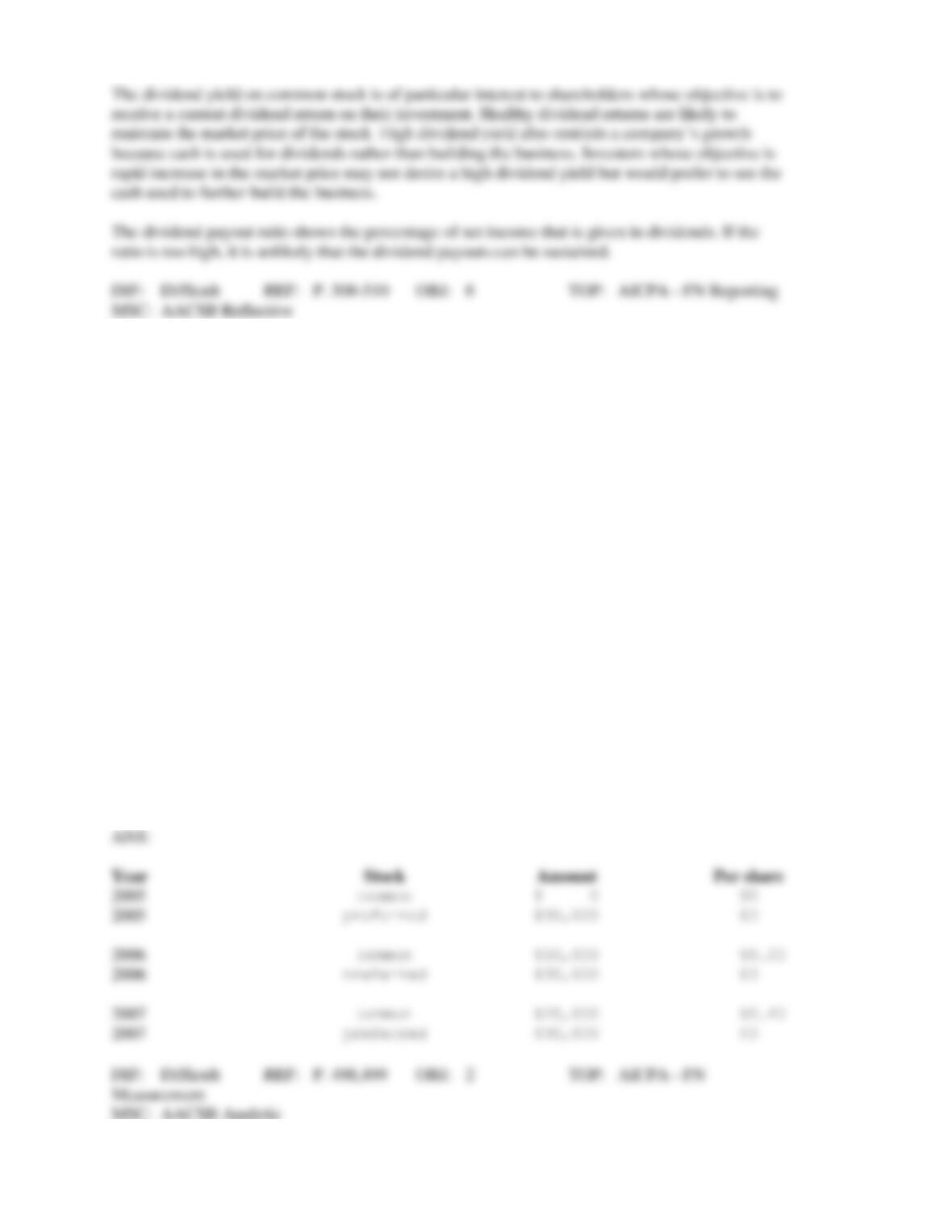
11. Discuss how the dividend yield and the dividend payout ratios are useful to shareholders.
544 ♦ Chapter 11
PROBLEM
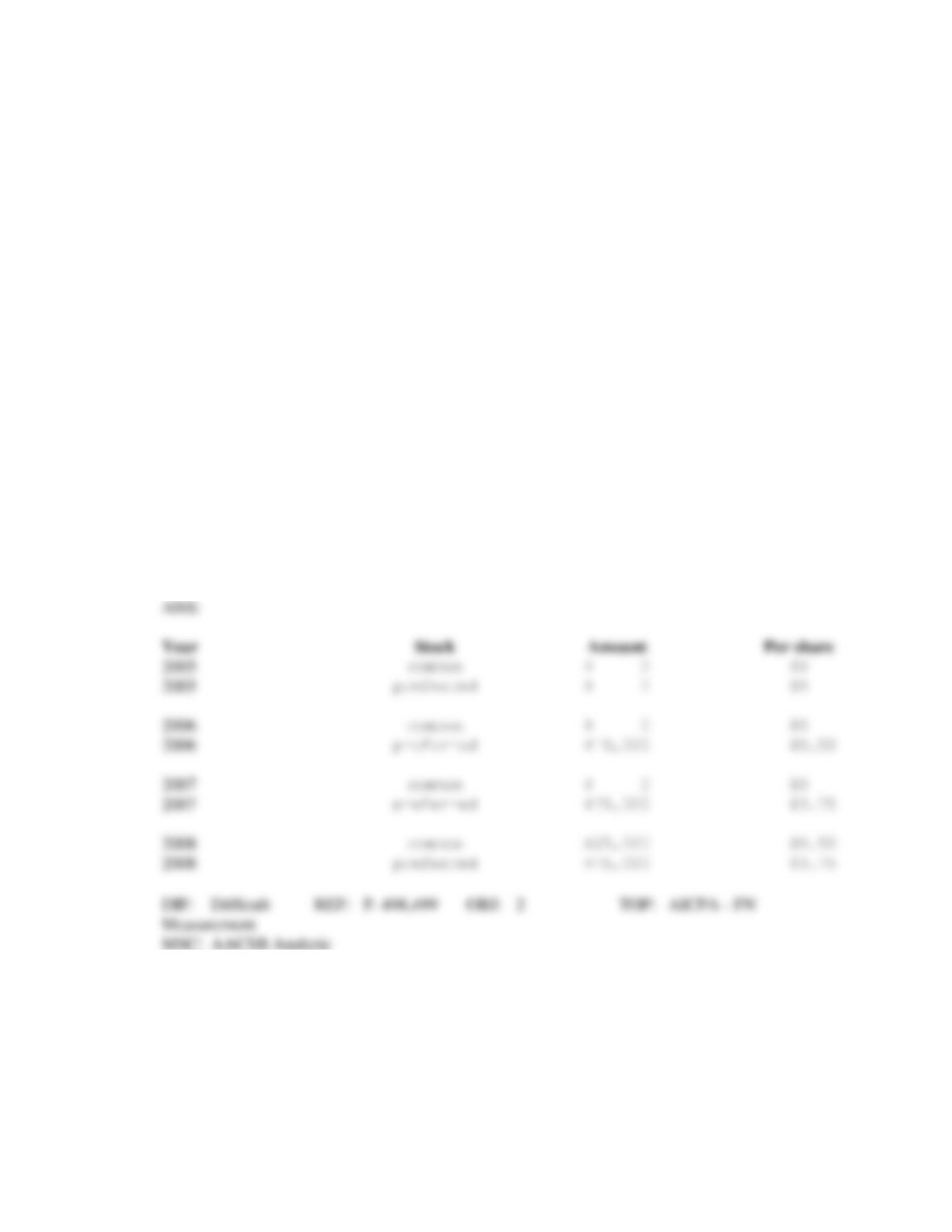
1. Judy Judy Judy, Inc. has the following stock outstanding: 10,000 shares of $3 noncumulative
preferred stock and 50,000 shares of $10 par common stock. Dividends were distributed as
follows:
2005
$30,000
2006
$40,000
2007
$50,000
Calculate the total dividends paid to each class of stock and the dividends per share for each of the
three years.
Year
Stock
Amount
Per share
2005
common
2005
preferred
2006
common
2006
preferred
2007
common
2007
preferred
Year
Stock
Amount
Per share
2005
common
$ 0
2005
preferred
$30,000
2006
common
$10,000
2006
preferred
$30,000
2007
common
$20,000
2007
preferred
$30,000
Stockholders’ Equity: Capital Stock and Dividends ♦ 545
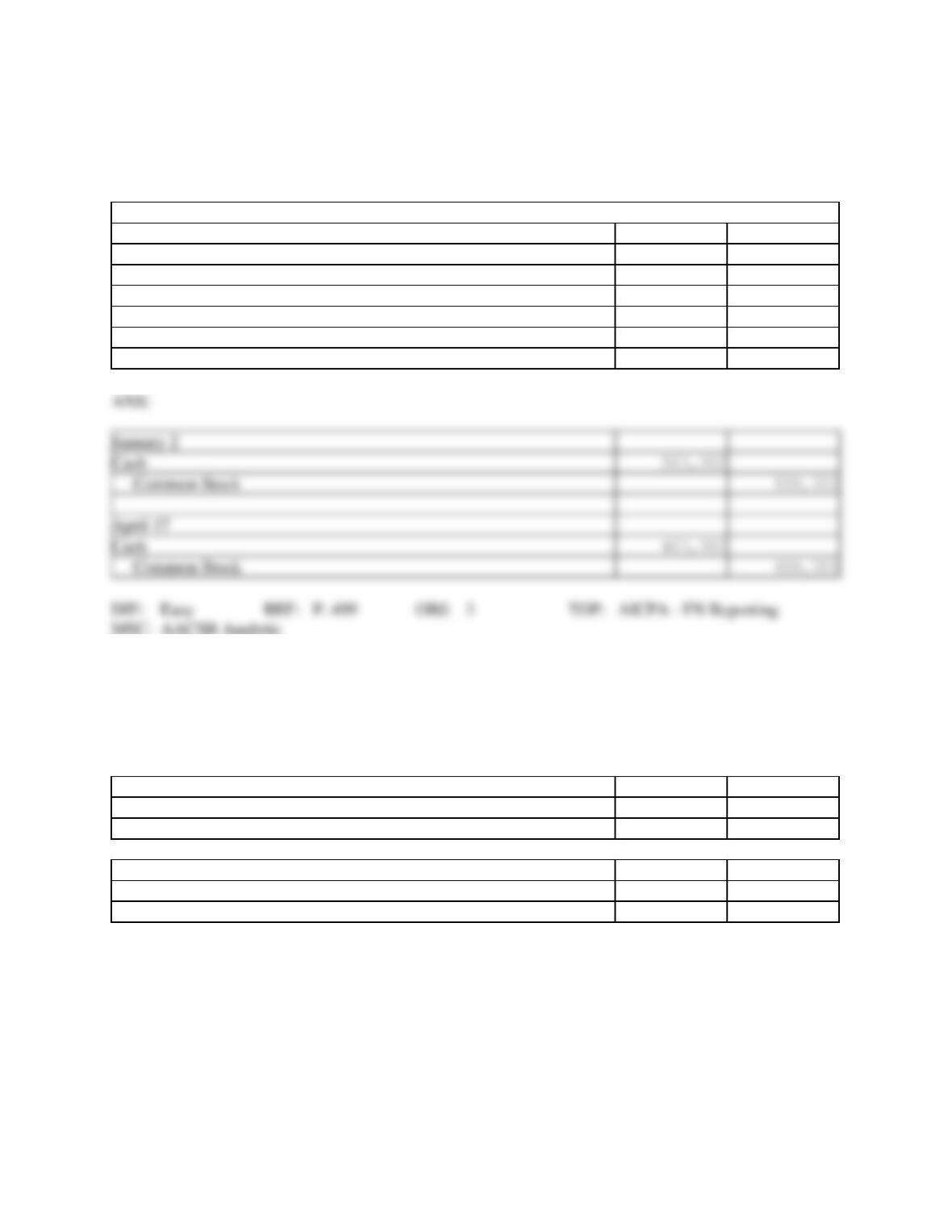
2. Blade, Inc. has the following stock outstanding: 20,000 shares of $2 cumulative preferred stock
and 50,000 shares of $10 par common stock. Dividends were declared and distributed as follows:
2005
$ 0
2006
$ 10,000
2007
$ 75,000
2008
$100,000
Calculate the total dividends paid to each class of stock and the dividends per share for each of the
three years.
Year
Stock
Amount
Per share
2005
common
2005
preferred
2006
common
2006
preferred
2007
common
2007
preferred
2008
common
2008
preferred
Year
Stock
Amount
Per share
2005
common
2005
preferred
2006
common
2006
preferred
2007
common
2007
preferred
2008
common
2008
preferred
546 ♦ Chapter 11
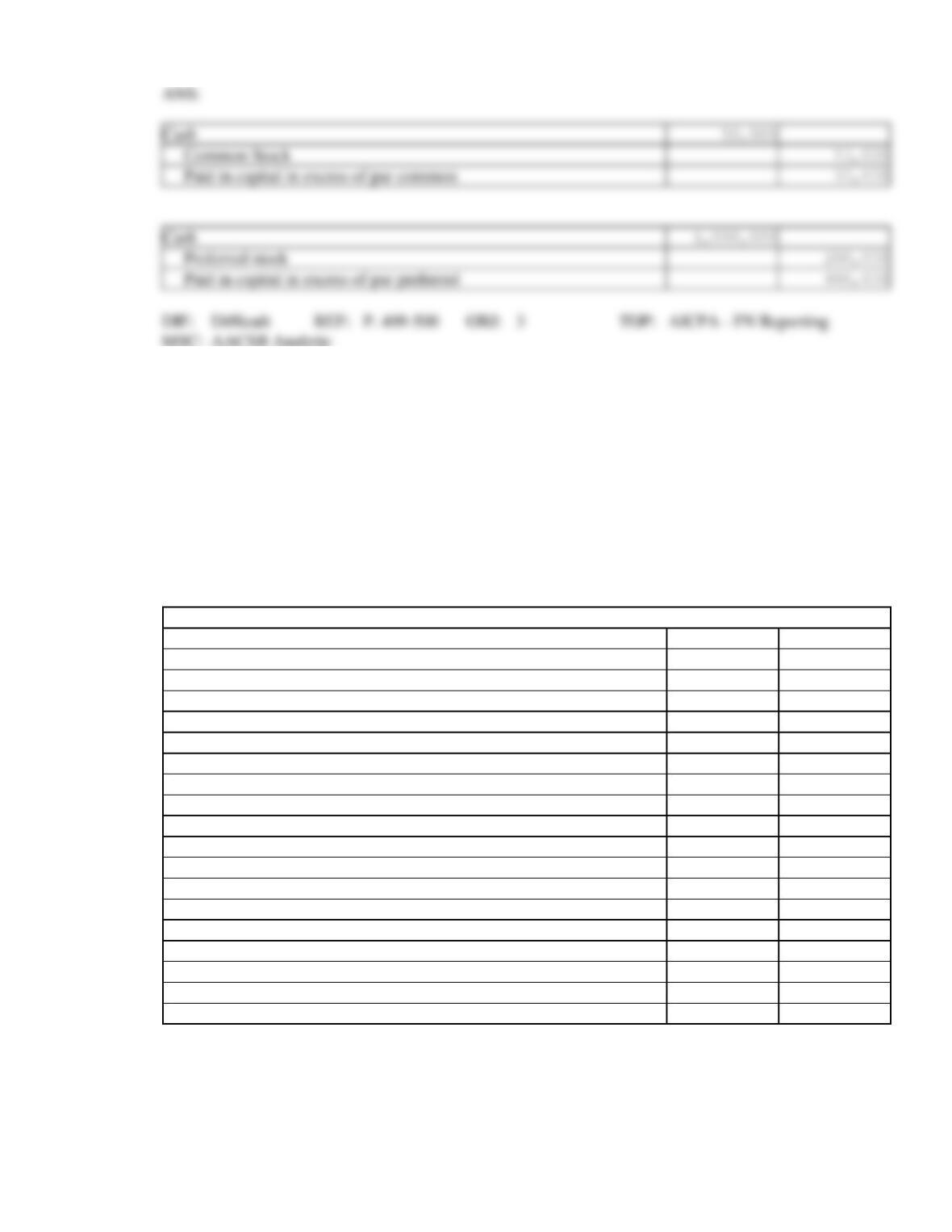
3. Assume that a corporation has no stock outstanding. The corporation issues 50,000 shares of no
par common stock on January 2, for $10 per share. Then on April 17, the corporation issues
another 20,000 shares of the same no par common stock for $20 per share. Record the journal
entry for each issuance of stock.
General Journal
4. RF Co. has two classes of stock. On March 1st, issued 5,000 shares of $3 par common at a sales
price of $10. On March 15th, it issued 10,000 shares of $20 par preferred stock at a sales price of
$100. Record the journal entries for both stocks.
General Journal
January 2
Cash
Common Stock
April 17
Cash
Common Stock
Stockholders’ Equity: Capital Stock and Dividends ♦ 547
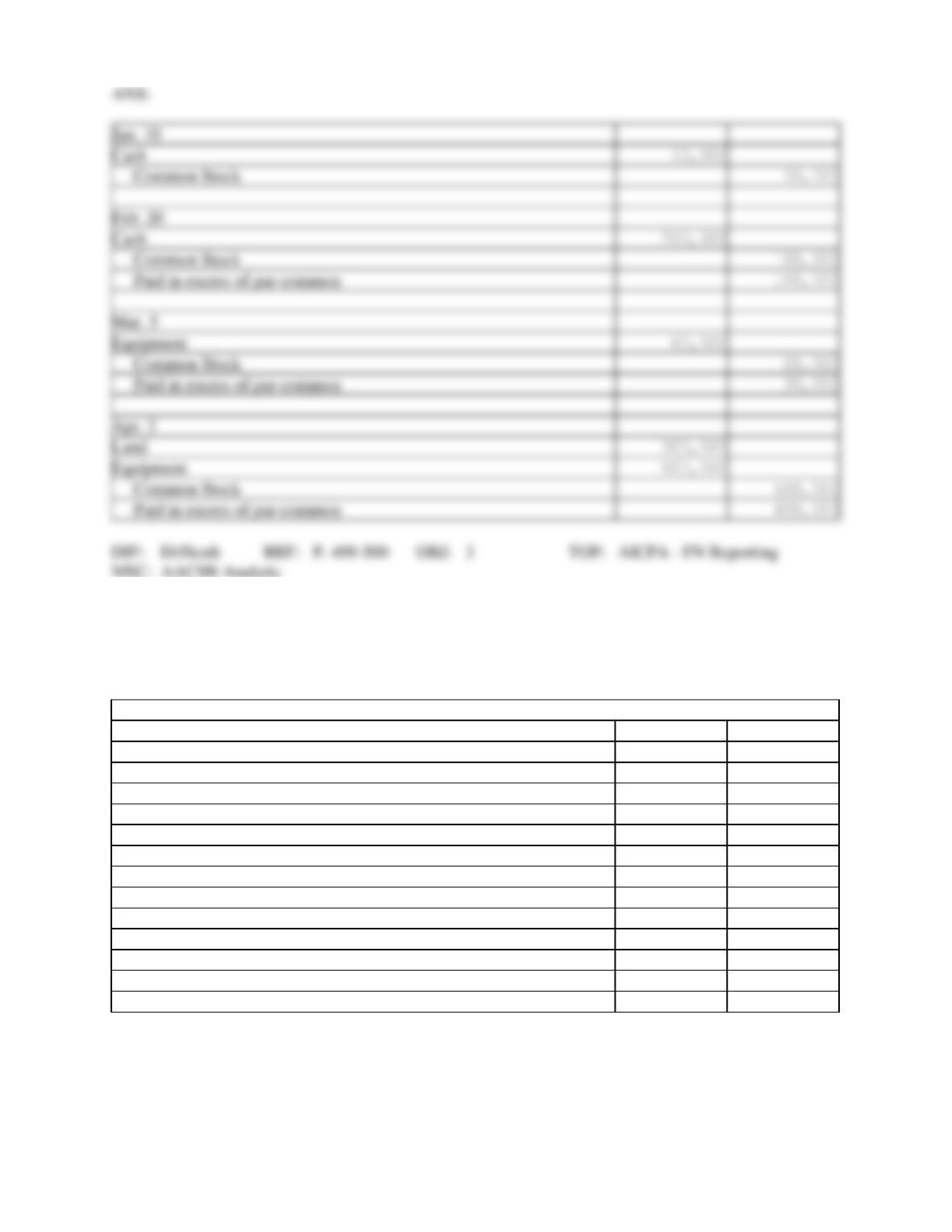
5. Megan Co. was organized in 2006 with 500,000 shares of $5 par common stock authorized. The
following transactions occurred during 2006:
January 10
Issued 10,000 shares of common stock at par for cash
February 20
Issued 20,000 shares of common stock for cash at $10 per share
March 5
Issued 5,000 shares of stock for equipment with a market value of $60,000
April 2
Issued 100,000 shares of stock for land and a building with market value of $300,000
and 800,000 respectively.
Provide the journal entries for these transactions.
General Journal
Cash
Common Stock
Paid in capital in excess of par common
Cash
Preferred stock
Paid in capital in excess of par preferred
548 ♦ Chapter 11
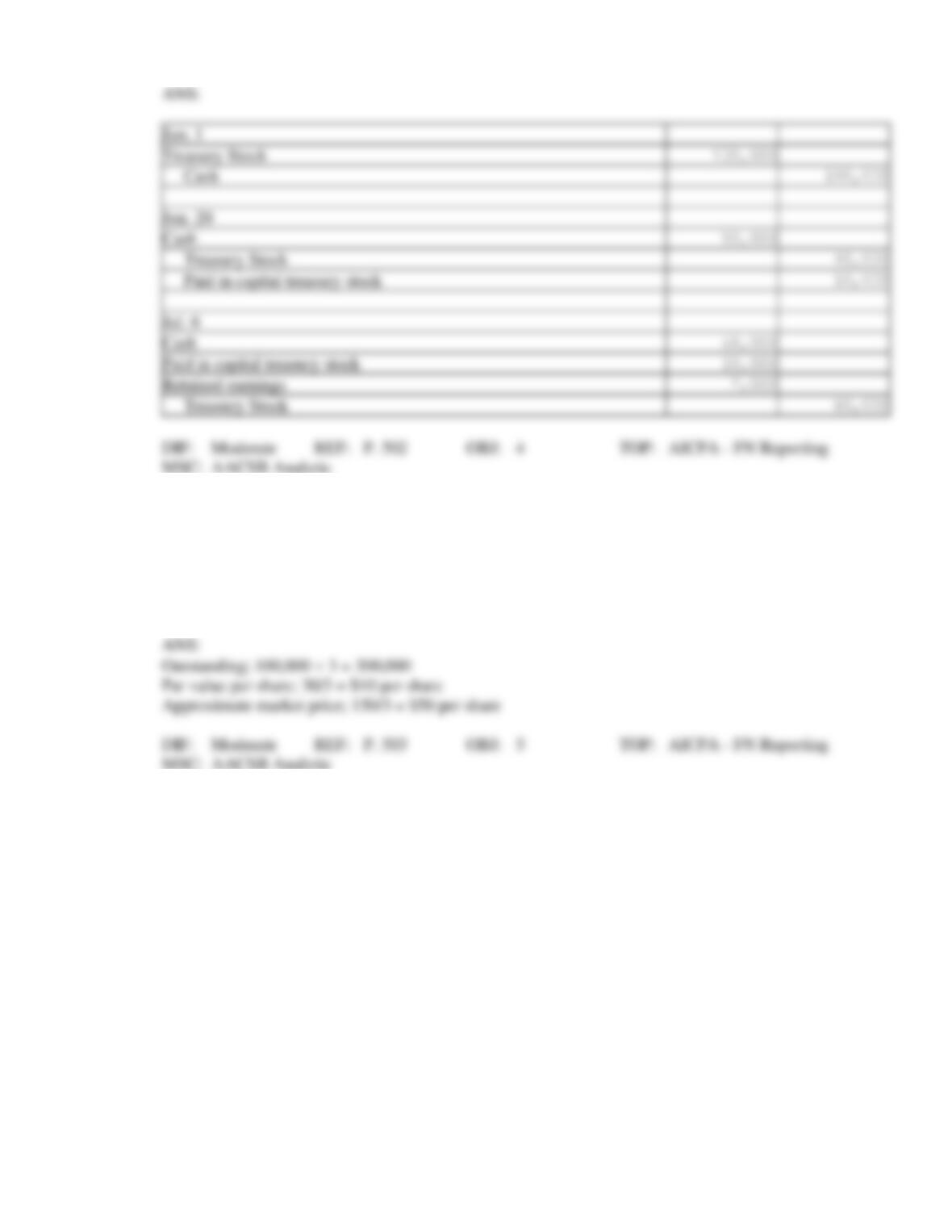
6. On June 1st, Wood Duck, Inc. reacquired 5,000 of its common stock at $20 per share. On June
20th, 2,000 of the shares were resold at $25 per share. On July 6th, Wood Duck resold the
remaining treasury shares at $16 per share. Record the journal entries for each of these events.
General Journal
J
Jan. 10
Cash
Common Stock
Feb. 20
Cash
Common Stock
Paid in excess of par-common
Mar. 5
Equipment
Common Stock
Apr. 2
Land
Equipment
Common Stock
Paid in excess of par-common
Stockholders’ Equity: Capital Stock and Dividends ♦ 549
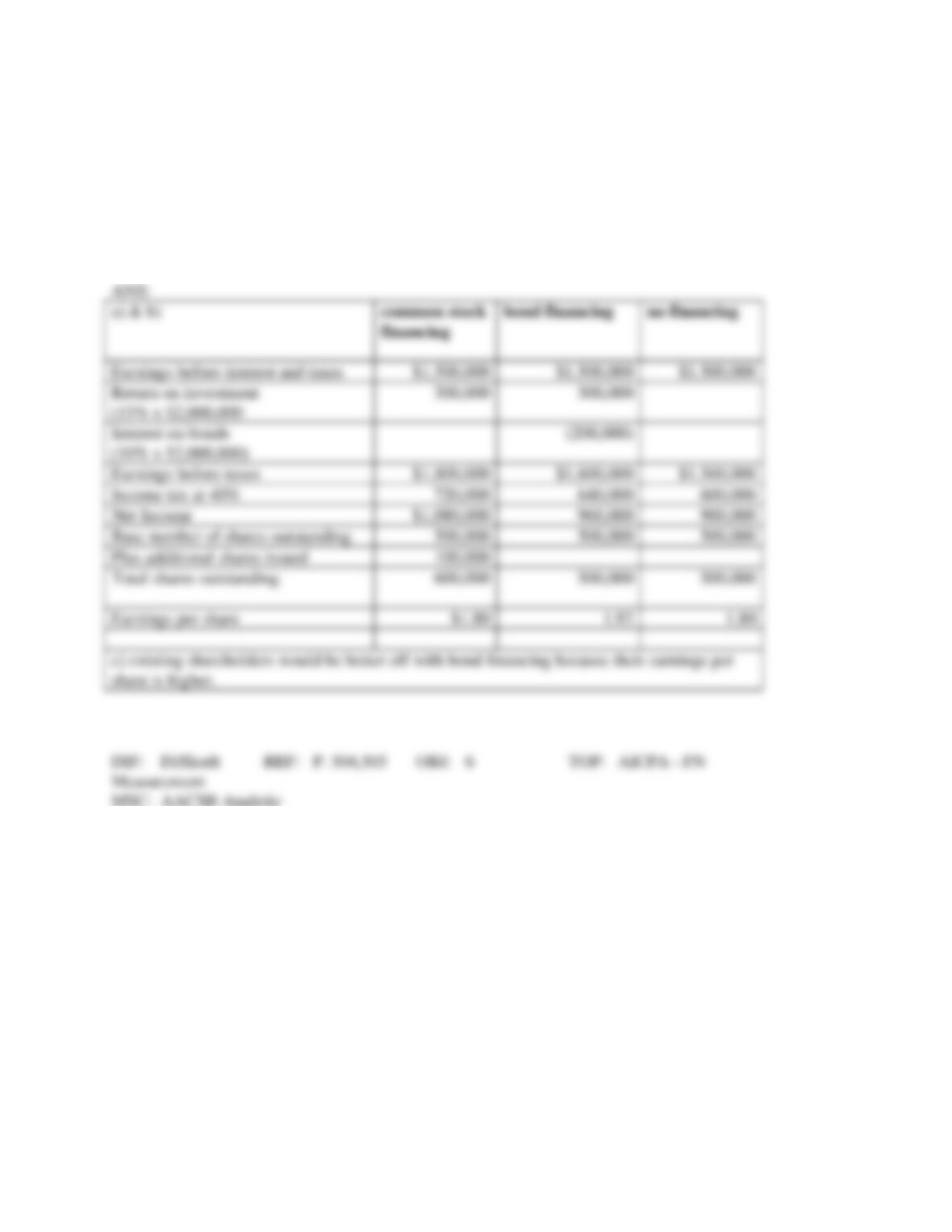
7. SteelCase has common stock with a market price that is reaching a point that it is not available to a
broad enough market. So, SteelCase has decided to declare a 3-for-1 stock split. Prior to the split,
SteelCase had 100,000 shares of $30 par stock outstanding and a market price of $150 per share.
After the split, how many shares are outstanding? What is the par value per share? What would
SteelCase anticipate to be the approximate market price per share after the split?
550 ♦ Chapter 11
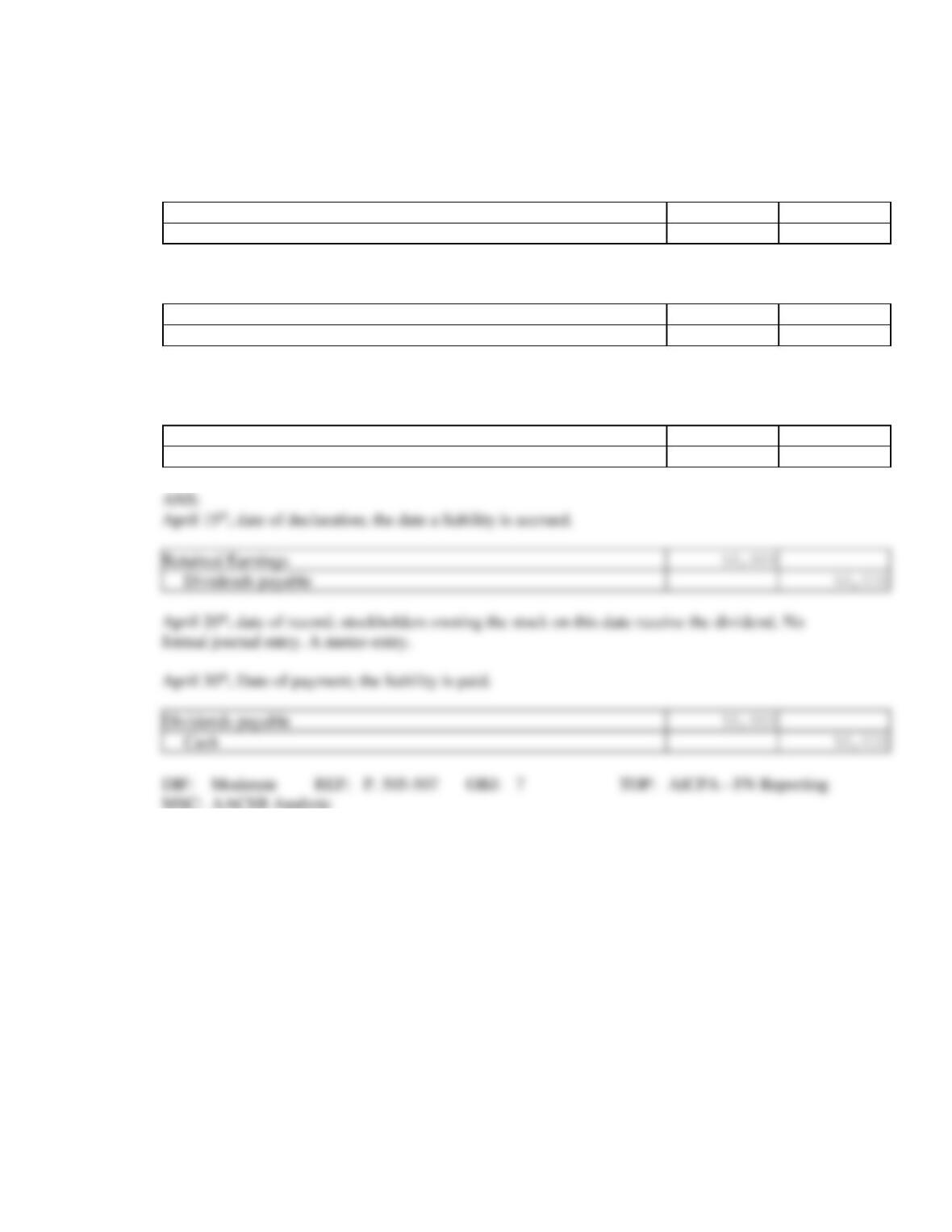
8. Pocono, Inc. has an opportunity to make a $2,000,000 investment that will achieve a 15% return.
Before making the investment, Pocono wants to evaluate the impact of different financing options
on the shareholders. It is considering issuing 100,000 shares at $20 per share, or issuing a 10%
bond for $2,000,000 or not undertaking the investment. Pocono currently has 500,000 shares of
stock outstanding and has earnings before interest and taxes of $1,500,000.The tax rate is 40%.
a) What is the net income achieved under each option?
b) What is the earnings per share under each option
c) Which option provides the best shareholder value?
Stockholders’ Equity: Capital Stock and Dividends ♦ 551
9. DC/LA Companies Board of Directors declared a $50,000 cash dividend on April 15, to
stockholders of record on the 20th and payable on April 30th. Describe each of these dates, and
record the journal entries for these three important dates.
April 15th, date of declaration;
000
April 20th, date of record;
April 30th, Date of payment; .
Retained Earnings
Dividends payable
Dividends payable
Cash