CHAPTER 11 ASSESSMENTS
SOCIAL STUDIES AS THE INTEGRATING CORE
I. MULTIPLE CHOICE (CHOOSE THE BEST RESPONSE.)
1. Which is NOT true of the Explore unit?
a. Social studies and science curricula are joined to help students build a powerful
generalization.
b. The teaching strategies concept formation and inquiry are both emphasized.
c. Skills from the science curriculum, such as observation, are used to support learning in
social studies.
d. The unit objective is that students will build a big idea, that the decisions made by human
beings influence the survival of other living things.
2. What is the greatest pitfall of curriculum integration according to the text?
a. To treat curriculum integration as a goal.
b. To think of curriculum integration as a tool.
c. To use curriculum integration as a teaching strategy.
d. To use social studies as the only means of curriculum integration.
3. What is the supportive approach to curriculum integration?
a. Many disciplines are infused together to create one course of study.
b. Aspects of one subject are infused into another to enhance the learner’s grasp of the
second.
c. Two disciplines are infused together to create a new discipline.
d. Two or more subjects are joined together for the purposes of instructional planning and
assessment.
4. What is accomplished by the supportive approach to curriculum integration?
a. Teachers require less time to do their instructional planning.
b. Skills are used to achieve valued content goals.
c. Skills are strengthened by being engaged with content.
d. Both B and C.
5. What is the fusion approach to curriculum integration?
a. Two or more subject matters are synthesized in way that a new, unified idea is formed.
b. One course of study is created through instructional strategies.
c. The creation of generalizations for students to learn.
d. Two or more subject matters are joined together so that each is studied in depth.
6. What is the objective of the fusion approach to curriculum integration?
a. To give students experiences with generalizations.
b. To combine two or more subject areas so students are able to create their own curricular
connections.
c. To provide students with more time to work on specific skills.
d. To help students create big ideas that cannot be created without joining two or more
subject areas.
7. The text provides a detailed example and rationale for students creating an original biography.
Through its creation students are invited to:
a. Limit their historical understanding through concentrating on only one figure.
b. Learn about what a biography is.
c. Read, write, and discuss their way to an in-depth understanding of a historical figure.
d. Have experience going through the writing process using social studies content.
8. Which of the following is NOT a criterion in the selection of subjects for children’s
biographies?
a. The person chosen brings students in contact with powerful ideas of the social studies
disciplines.
b. Students should have some understanding of the subject’s life prior to beginning the
biography.
c. There is likelihood the children will be captivated by the subject’s life.
d. Materials should be readily available.
9. The text author suggests that original biography writing infuses:
a. Stories with new ideas.
b. Literacy instruction and practice into social studies curriculum.
c. Broad social understandings into writing.
d. Generalizations into subject matter.
10. What is a generalization?
a. An idea with limited scope.
b. A statement that meaningfully links two or more concepts.
c. A new idea that arises out of cooperative groupwork.
d. A concept.
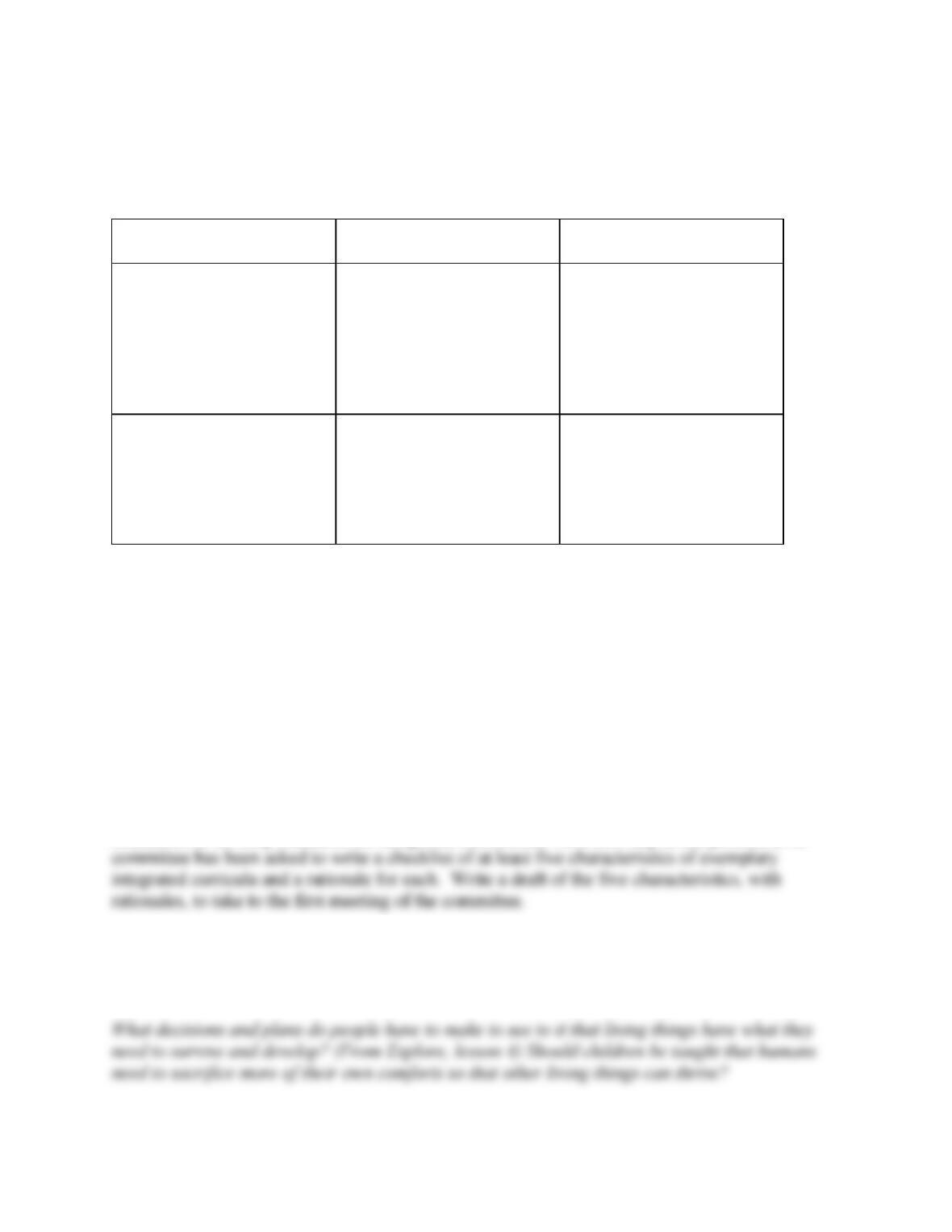
II. DATA-ORGANIZATION CHART
Complete this data-organization chart to compare and contrast the purposes and essential
planning procedures of the supportive and fusion models of interdisciplinary curriculum.
Two Interdisciplinary Curriculum Models
Model
Purpose
Essential Planning
Procedures
One subject supports
another
e.g., cooperative biography
Two subjects are fused
e.g., Explore curriculum
III. SHORT ANSWER
1. Select two people from U.S. history and two from world history who would be good subjects
for children’s biography writing. Then use the criteria described in the text to evaluate your
selections.
2. What are the key similarities and differences between the fusion and supportive approaches to
interdisciplinary curricula? Granted, the two overlap and the distinction is a slippery one; still,
what is the basic difference?
IV. EXTENDED RESPONSE
Imagine that you are working with a team of elementary social studies teachers serving on a state
committee to develop standards for integrated curriculum. As a first step in the process, your
V. DISCUSSION
Discuss the following issue with a group of your classmates. Then, use one of the rubrics in
Chapter 3 to assess your participation in the discussion.

CHAPTER 11 SOCIAL STUDIES AS THE INTEGRATING CORE