
517
Chapter 11—Stockholders’ Equity: Capital Stock and Dividends
Multiple
Choice
Learning
Goal(s)
Level of
Difficulty
AACSB
Tag
AICPA
Tag
Multiple
Choice
Learning
Goal
(s)
Level of
Difficulty
AACSB
Tag
AICPA
Tag
1
1
Moderate
Reflective
Legal
36
4
Moderate
Analytic
Reporting
2
1
Moderate
Reflective
Legal
37
5
Easy
Analytic
Reporting
3
1
Easy
Reflective
Legal
38
5
Easy
Analytic
Reporting
4
1
Moderate
Reflective
Legal
39
5
Easy
Analytic
Reporting
5
1
Difficult
Reflective
Reporting
40
5
Moderate
Analytic
Measure
6
1
Moderate
Reflective
Measure
41
5
Moderate
Analytic
Measure
7
2
Moderate
Reflective
Measure
42
5
Easy
Analytic
Reporting
8
2
Moderate
Reflective
Reporting
43
5
Moderate
Analytic
Reporting
9
2
Easy
Analytic
Reporting
44
5
Moderate
Analytic
Reporting
10
2
Easy
Analytic
Reporting
45
5
Difficult
Analytic
Reporting
11
2
Easy
Reflective
Reporting
46
6
Moderate
Analytic
Measure
12
2
Easy
Reflective
Reporting
47
6
Moderate
Analytic
Measure
13
2
Easy
Reflective
Reporting
48
6
Moderate
Analytic
Measure
14
2
Easy
Reflective
Reporting
49
6
Difficult
Analytic
Measure
15
2
Moderate
Reflective
Reporting
50
7
Moderate
Analytic
Reporting
16
2
Difficult
Analytic
Measure
51
2
Difficult
Analytic
Measure
17
2
Difficult
Analytic
Measure
52
2
Difficult
Analytic
Measure
18
2
Difficult
Analytic
Measure
53
7
Moderate
Analytic
Reporting
19
2
Difficult
Analytic
Measure
54
7
Moderate
Analytic
Reporting
20
2
Difficult
Analytic
Measure
55
7
Moderate
Analytic
Reporting
21
2
Difficult
Analytic
Measure
56
7
Moderate
Analytic
Reporting
22
3
Moderate
Analytic
Reporting
57
7
Moderate
Analytic
Measure
23
3
Moderate
Analytic
Reporting
58
7
Moderate
Analytic
Measure
24
3
Moderate
Analytic
Reporting
59
7
Easy
Analytic
Reporting
25
3
Moderate
Analytic
Reporting
60
7
Easy
Analytic
Reporting
26
3
Easy
Analytic
Reporting
61
7
Moderate
Analytic
Measure
27
3
Moderate
Analytic
Reporting
62
7
Moderate
Analytic
Reporting
28
3
Easy
Analytic
Reporting
63
7
Moderate
Analytic
Reporting
29
3
Easy
Analytic
Reporting
64
8
Moderate
Analytic
Measure
30
4
Easy
Analytic
Reporting
65
8
Moderate
Analytic
Measure
31
4
Moderate
Analytic
Reporting
66
8
Moderate
Analytic
Reporting
32
4
Moderate
Analytic
Reporting
67
8
Difficult
Analytic
Reporting
33
4
Moderate
Analytic
Reporting
68
9
Easy
Reflective
Reporting
34
4
Moderate
Analytic
Reporting
69
9
Easy
Analytic
Measure
35
4
Moderate
Analytic
Reporting
70
9
Difficult
Analytic
Measure

518 ♦ Chapter 11
Difficulty Ratings
Guide:
Easy
Taken nearly verbatim
from the text
Moderate
Using different expression
or application of concept
Difficult
Several reasoning steps
True/
False
Learning
Goal(s)
Level of
Difficulty
AACSB
Tag
AICPA
Tag
1
1
Moderate
Reflective
Legal
2
1
Moderate
Reflective
Legal
3
1
Moderate
Reflective
Legal
4
1
Moderate
Analytic
Reporting
5
2
Easy
Analytic
Reporting
6
2
Easy
Analytic
Reporting
7
2
Easy
Analytic
Reporting
8
2
Easy
Analytic
Reporting
9
2
Moderate
Reflective
Industry
10
2
Moderate
Reflective
Industry
11
2
Moderate
Reflective
Reporting
12
2
Moderate
Reflective
Reporting
13
2
Moderate
Analytic
Reporting
14
3
Moderate
Analytic
Reporting
15
3
Moderate
Analytic
Reporting
16
3
Moderate
Analytic
Reporting
17
3
Moderate
Analytic
Measure
18
4
Moderate
Analytic
Reporting
19
4
Moderate
Analytic
Reporting
20
4
Moderate
Analytic
Reporting
21
4
Moderate
Analytic
Reporting
22
4
Moderate
Analytic
Reporting
23
5
Moderate
Analytic
Reporting
24
5
Moderate
Analytic
Reporting
25
6
Moderate
Analytic
Reporting
26
6
Moderate
Analytic
Reporting
27
7
Moderate
Analytic
Reporting
28
7
Moderate
Analytic
Reporting
29
7
Moderate
Analytic
Reporting
30
7
Moderate
Analytic
Reporting
31
7
Moderate
Analytic
Reporting
32
7
Moderate
Analytic
Reporting
33
7
Moderate
Analytic
Reporting
34
7
Moderate
Analytic
Reporting
35
8
Moderate
Analytic
Measure
36
8
Moderate
Analytic
Measure
37
8
Moderate
Analytic
Reporting
38
8
Moderate
Analytic
Reporting
39
8
Moderate
Analytic
Reporting
40
9
Moderate
Analytic
Reporting
41
9
Moderate
Analytic
Reporting
42
9
Moderate
Reflective
Reporting
43
9
Moderate
Reflective
Reporting
44
9
Moderate
Reflective
Reporting
Problem
(s)
Learning
Goal
(s)
Level of
Difficulty
AACSB
Tag
AICPA
Tag
1
2
Difficult
Analytic
Measure
2
2
Difficult
Analytic
Measure
3
3
Easy
Analytic
Reporting
4
4
Difficult
Analytic
Reporting
5
3
Difficult
Analytic
Reporting
6
4
Moderate
Analytic
Reporting
7
5
Moderate
Analytic
Reporting
8
6
Difficult
Analytic
Measure
9
7
Moderate
Analytic
Reporting
10
7
Moderate
Analytic
Reporting
11
9
Moderate
Analytic
Measure
12
3,7
Difficult
Analytic
Reporting
13
3,4,7
Difficult
Analytic
Reporting
Case
Learning
Goal(s)
Level of
Difficulty
AACSB
Tag
AICPA
Tag
1
2
Difficult
Reflective
Reporting
2
4
Difficult
Reflective
Reporting
3
7,8
Difficult
Reflective
Reporting
4
7
Difficult
Reflective
Reporting
Essay
Learning
Goal(s)
Level of
Difficulty
AACSB
Tag
AICPA
Tag
1
1
Moderate
Reflective
Legal
2
1
Moderate
Reflective
Legal
3
2
Moderate
Analytic
Reporting
4
3
Moderate
Analytic
Reporting
5
4
Moderate
Analytic
Reporting
6
4
Moderate
Analytic
Reporting
7
5
Moderate
Analytic
Reporting
8
6
Difficult
Analytic
Measure
9
7
Moderate
Analytic
Reporting
10
8
Difficult
Reflective
Reporting
11
8
Difficult
Reflective
Reporting

Stockholders’ Equity: Capital Stock and Dividends ♦ 519
MULTIPLE CHOICE
1. Which of the following is NOT an advantage of the corporate form of business?
a.
Separate legal existence
b.
Double taxation of dividends
c.
Continuous life
d.
Limited liability
2. As a separate legal entity, a corporation may __________.
a.
Incur liabilities
b.
Continue independent of the owners
c.
Acquire property in its own name
d.
Each of the items is correct
3. Corporations can become large because __________.
a.
A corporation is a separate legal entity
b.
Dividends are taxed twice.
c.
A corporation has life continuous from the owners
d.
They have the ability to raise large amounts of capital through sales of stock
4. Which of the following is a disadvantage of the corporate form of business?
a.
Separate legal existence
b.
Limited liability
c.
Continuous life
d.
Owners are separate from management.
5. When a corporation earns income, who pays the tax on these earnings? A distribution of earnings
is called a __________. Who pays the tax from this distribution?
a.
Corporation; dividends; nobody, it has already been taxed once
b.
Stockholder; dividends; corporation
c.
Stockholder; corporation; dividends
d.
Corporation; dividends; stockholder

520 ♦ Chapter 11
6. Which of the following is NOT an example of a cost of organizing a corporation?
a.
promotional costs
b.
taxes
c.
purchase of headquarters building
d.
legal fees
7. Which of the following is a part of the capital structure of a corporation?
a.
assets financed by creditors
b.
cash flows
c.
net income
d.
Each of the items is correct
8. Which of the following is NOT a source of paid in capital?
a.
Treasury stock
b.
Common stock
c.
No par stock
d.
Preferred stock
9. Which of the following is a right of stock ownership?
a.
Right to vote in corporate matters
b.
Right to share in distributions of earnings
c.
Right to share in assets on liquidation
d.
Each of the items is correct are stockholder rights
10. The number of shares of stock held by the stockholders is called __________.
a.
Authorized stock
b.
Issued stock
c.
Outstanding stock
d.
Stock certificates
11. Which of the following is NOT a monetary amount often assigned or associated with common
stock?
a.
Par stock
b.
No-par stock
c.
Tech stock
d.
Stated value stock

Stockholders’ Equity: Capital Stock and Dividends ♦ 521
12. Which of the following is NOT one of the three major types of stock market transactions?
a.
An initial public offering
b.
Special TV offerings
c.
Additional shares sold by an established public company
d.
Market exchanges between owners of a publicly held company
13. Which stockholders have access to dividends in arrears?
a.
Preferred stock stockholders
b.
Common stock stockholders
c.
Cumulative preferred stock stockholders
d.
Initial public offering stock stockholders
14. To appeal to a broader market, corporations may issue more classes of stock with various
preference rights. These are called preferred stock. A common example of such a right is
__________.
a.
Preference to dividends
b.
Preference to Board meetings
c.
Preference to broader markets
d.
Preference to international offerings
15. One preference right enjoyed by preferred stockholders is __________.
a.
Voting rights
b.
Seats on the Board of Directors
c.
Nontaxable dividends
d.
Preference to dividends
16. Assume Corporation X has 20,000 shares of $10 par value cumulative 6% preferred stock and
5,000 shares of common stock outstanding. No dividends were paid in 2003 and 2004. In 2005,
the board of directors declares dividends of $50,000. What is the total cash paid to the preferred
stockholders in 2005?
a.
$12,000
b.
$24,000
c.
$36,000
d.
Zero
522 ♦ Chapter 11
17. Assume Corporation X has 20,000 shares of $10 cumulative 6% preferred stock and 5,000 shares
of common stock outstanding. No dividends were paid in 2003 and 2004. In 2005, the board of
directors declares dividends of $50,000. How much of the dividend would the common
stockholders receive?
a.
$14,000
b.
$12,000
c.
$38,000
d.
$26,000
Exhibit 11-1
Assume a corporation has 3,000 shares of $10 preferred stock and 5,000 shares of common stock
outstanding. No dividends were paid in 2002, and 2003. In 2004, the Board of Directors declares
dividends of $120,000.
18. Refer to Exhibit 11-1. If the preferred stock is NOT cumulative, what amount is paid to the
preferred stockholders in 2004?
a.
$30,000
b.
$60,000
c.
$90,000
d.
$120,000
19. Refer to Exhibit 11-1. If the preferred stock is cumulative, what amount is paid to the preferred
stockholders in 2004?
a.
$30,000
b.
$60,000
c.
$90,000
d.
$120,000
20. Refer to Exhibit 11-1. If the preferred stock is NOT cumulative, what amount is paid to the
common stockholders in 2004?
a.
$30,000
b.
$60,000
c.
$90,000
d.
$120,000

Stockholders’ Equity: Capital Stock and Dividends ♦ 523
21. Refer to Exhibit 11-1. If the preferred stock is cumulative, what amount is paid to the common
stockholders in 2004?
a.
$30,000
b.
$60,000
c.
$90,000
d.
$120,000
22. Eagle Eye, Inc. issued 20,000 shares of $20 par common stock at par value. Which journal reflects
this transaction?
a.
Common stock 400,000
Cash 400,000
b.
Cash 400,000
Common stock 400,000
c.
Common stock 20,000
Cash 20,000
d.
Common stock 20
Cash 20
23. Assume a corporation is authorized to issue 100,000 shares of $2 par common stock, and 50,000
shares of $10 par of preferred stock. If the corporation issues one half of the shares authorized of
each stock at par, record the journal entry.
a.
Cash 700,000
Common stock 200,000
Preferred stock 500,000
b.
Cash 350,000
Common stock 100,000
Preferred stock 250,000
c.
Cash 700,000
Common stock 250,000
Preferred stock 100,000
d.
None of the above
24. Eagle Eye, Inc. issued 20,000 shares of $20 par common stock at $50. Which journal reflects this
transaction?
a.
Common stock 400,000
Cash 400,000
b.
Cash 1,000,000
Common stock 400,000
Paid–in capital in excess of par 600,000
c.
Common stock 20,000
Cash 20,000
d.
Common stock 1,000,000
Cash 1,000,000

524 ♦ Chapter 11
25. Eagle Eye, Inc. issued 20,000 shares of $20 par common stock in exchange for land that has a fair
market value of $1,000,000 and historical cost of $800,000. Which journal entry reflects this
transaction?
a.
Common stock 400,000
Land 400,000
b.
Land 1,000,000
Common stock 400,000
Paid-in capital in excess of par 600,000
c.
Land 800,000
Common stock 400,000
Paid-in capital in excess of par 400,000
d.
Common stock 800,000
Land 800,000
26. Stock options grant an employee the right to purchase common stock at a fixed price for a limited
period of time. The stock option price is called __________.
a.
No par stock
b.
Vesting period
c.
Treasury stock
d.
Exercise price
27. Assume a corporation is authorized to issue 100,000 shares of $2 par common stock, and 50,000
shares of $10 par of preferred stock. If one-half of the Common stock is sold for $10/share instead
of par, record the journal entry for the common stock.
a.
Cash 500,000
Common stock 500,000
b.
Cash 500,000
Paid in capital in excess of par-common 500,000
c.
Cash 500,000
Common stock 100,000
Paid in capital in excess of par-common 400,000
d.
None of the above
28. One method to motivate employees to behave in the best interest of the owners is to offer
employees common stock at a discount from the market price. A common method for doing this is
called __________.
a.
Bond discounts
b.
Perquisites
c.
Stock options
d.
Employee bonuses

Stockholders’ Equity: Capital Stock and Dividends ♦ 525
29. A waiting period by an employee before they can exercise a stock option is called a __________.
a.
Cooling off period
b.
Vesting period
c.
Exercise period
d.
Option period
30. A corporation may buy its own stock in the marketplace to __________.
a.
Resell to employees
b.
Reissue as employee bonuses
c.
Support the market price of the stock
d.
Each of the items is correct
Ed. Corp.
Assume Ed. Corp. has 50,000 shares of $10 par stock issued and outstanding. Ed. purchases 2,000
shares of treasury stock at $20 per share.
31. Refer to Ed. Corp. Record the journal entry to reflect this transaction.
a.
Treasury stock 20,000
Cash 20,000
b.
Treasury stock 40,000
Cash 40,000
c.
Treasury stock 40,000
Common stock 40,000
d.
Common stock 20,000
Cash 20,000
32. Refer to Ed. Corp. If 1,000 shares of this treasury stock were resold at $30 per share, record the
journal entry.
a.
Cash 30,000
Common stock 30,000
b.
Cash 400,000
Treasury stock 400,000
c.
Cash 30,000
Treasury stock 20,000
Paid–in capital treasury stock 10,000
d.
Cash 30,000
Treasury stock 30,000

526 ♦ Chapter 11
33. Refer to Ed. Corp. If at a later date 500 shares of the treasury stock were sold at $15. Record this
journal entry.
a.
Cash 10,000
Treasury stock 10,000
b.
Cash 10,000
Common stock 10,000
c.
Cash 7,500
Treasury stock 7,500
d.
Cash 7,500
Paid-in capital treasury stock 2,500
Treasury stock 10,000
Canon, Inc.
Canon, Inc. has 50,000 shares of $4 par common outstanding.
34. Refer to Canon, Inc. Record the journal entry for the repurchase of 10,000 shares at $10 per share.
a.
Cash 100,000
Common stock 40,000
Paid in capital in excess of par-common 60,000
b.
Treasury Stock 40,000
Paid in capital from treasury stock 60,000
Cash 100,000
c.
Treasury Stock 100,000
Cash 100,000
d.
Cash 100,000
Treasury stock 100,000
35. Refer to Canon, Inc. Record the journal entry for the resale of 1,000 shares of treasury stock at $15
per share.
a.
Cash 15,000
Treasury stock 15,000
b.
Cash 15,000
Treasury stock 10,000
Paid in capital from treasury stock 5,000
c.
Treasury Stock 15,000
Cash 15,000
d.
Cash 15,000
Treasury Stock 10,000
Paid in capital in excess of par-common 5,000

Stockholders’ Equity: Capital Stock and Dividends ♦ 527
36. Refer to Canon, Inc. Assume now that an additional 3,000 shares were sold. Record the journal
entry for the resale of 3,000 additional shares of treasury stock at $5 per share.
a.
Cash 15,000
Paid in capital from treasury stock 5,000
Retained earnings 10,000
Treasury stock 30,000
b.
Cash 15,000
Treasury stock 15,000
c.
Cash 15,000
Paid in capital from treasury stock 15,000
Treasury stock 30,000
d.
Cash 15,000
Retained Earnings 15,000
Treasury stock 30,000
37. Corporations sometimes reduce the par value of their common stock. This is called a __________.
a.
Stock split
b.
Stock reissue
c.
Par reduction
d.
Par split
38. A stock split applies to which shares?
a.
Outstanding shares
b.
Issued shares
c.
Treasury shares
d.
All shares
39. A major objective of a stock split is to __________.
a.
Increase the number of treasury shares
b.
Have more shares for dividends
c.
Dilute the market with stock
d.
Reduce the market price per share
40. Altid, Inc. has common stock with a par value of $6/share, and 20,000 shares outstanding with a
current market price of $75/ share. Altid announces a 3-for-1 stock split. What is the par value per
share after the split?
a.
$6/share
b.
$25/share
c.
$2/share
d.
60,000 shares

528 ♦ Chapter 11
41. Altid, Inc. has common stock with a par value of $6/share, and 20,000 shares outstanding with a
current market price of $75/ share. Altid announces a 3-for-1 stock split. After the split, how many
shares are outstanding?
a.
20,000 shares
b.
40,000 shares
c.
$2/share
d.
60,000 shares
42. When stock is split, to which shares does the split NOT apply?
a.
Unissued
b.
Issued
c.
Treasury shares
d.
It applies to all shares
Spock, Inc.
Spock, Inc has 30,000 shares of $90 par value common stock outstanding with a market price of
$270. The board of directors declares a 3-for-1 split.
43. Refer to Spock, Inc. After the split, how many shares are outstanding?
a.
30,000
b.
10,000
c.
90,000
d.
Cannot determine from the information given
44. Refer to Spock, Inc. After the split, what is the par value per share?
a.
$90
b.
$270
c.
$30
d.
Cannot determine from the information given
45. Refer to Spock, Inc. After the split, what is the balance in the account “common stock”?
a.
2,700,000
b.
8,100,000
c.
900,000
d.
Cannot determine from the information given

Stockholders’ Equity: Capital Stock and Dividends ♦ 529
46. In analyzing financing alternatives, shareholders are concerned about the impact of the changes in
the capital structure on
a.
revenue
b.
retained earnings
c.
earnings per share
d.
none of these are correct
47. The reduction in earnings per share from issuing more common stock is termed
a.
a discount
b.
a premium
c.
a loss
d.
earnings per share dilution
48. Implow, Corp. is considering issuing an additional 20,000 shares of common stock at $50 per
share. If the earnings per share increases due to this action, the increase is called a(n)
a.
revenue
b.
expense
c.
accretion
d.
gain
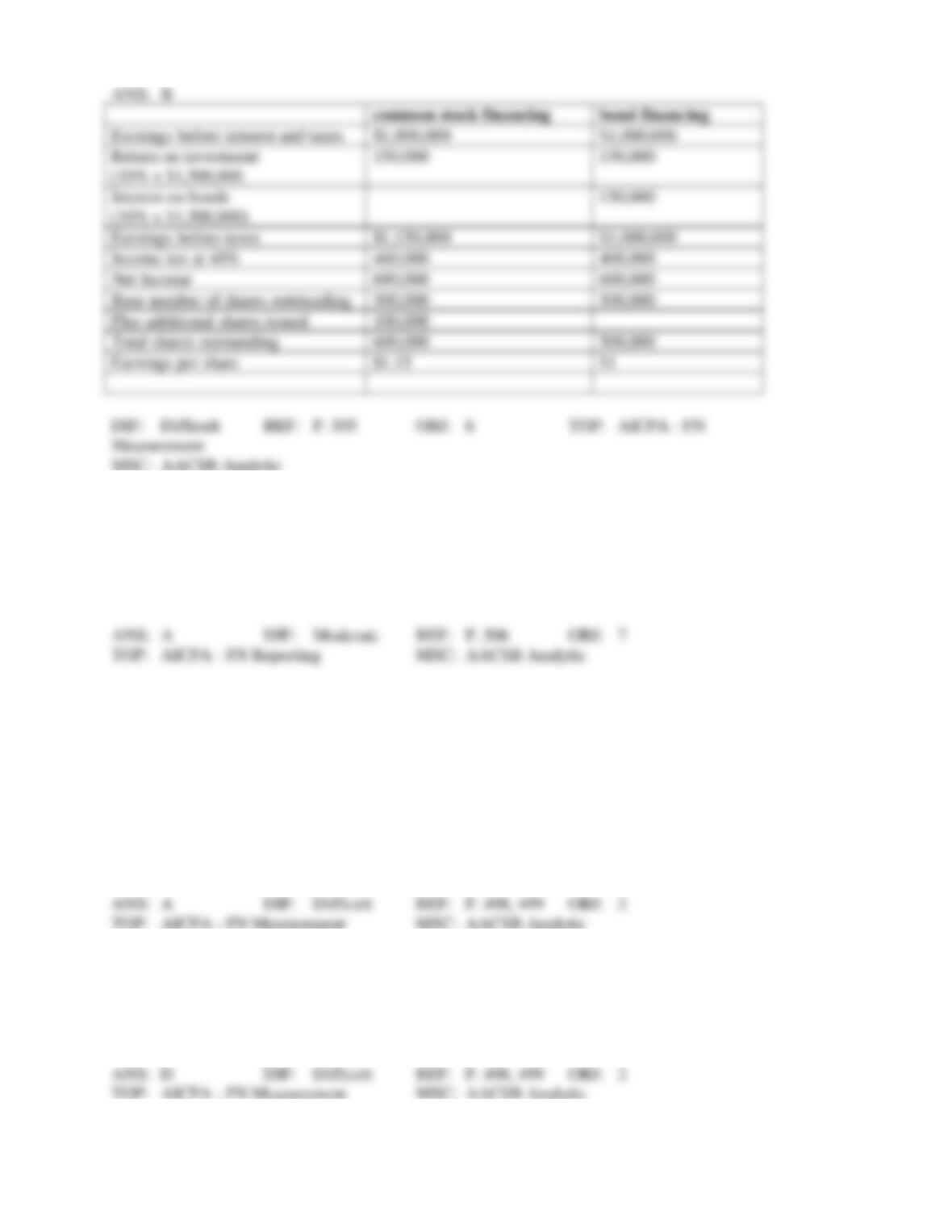
49. Implow, Corp. has 500,000 share of stock outstanding and is considering issuing an additional
100,000 shares of common stock at $15 per share or issuing 10% bonds to raise the $1,500,000.
The earnings before interest and taxes is $1,000,000 and the tax rate is 40%. If the return on
investment is 10%, what is the difference in the earnings per share?
a.
bond financing will increase the earnings per share by $0.15
b.
stock financing will increase the earnings per share by $0.15
c.
bond financing will increase the earnings per share by $1
d.
the earnings per share is the same
530 ♦ Chapter 11
50. A corporation must usually meet three conditions in order to pay a cash dividend. Which of the
following is NOT one of these conditions?
a.
Net income
b.
Sufficient retained earnings
c.
Sufficient cash
d.
Formal action by the board of directors
Hibble Corp 1
Hibble Corp. has 100,000 shares of $100 par Preferred stock outstanding, and 50,000 shares of $3
common stock outstanding. Hibble’s Board of Directors declares a $1/share dividend on preferred
stock, and a $0.50 dividend on common stock.
51. Refer to Hibble Corp 1. How much is the preferred stock dividend?
a.
$100,000
b.
$50,000
c.
$100
d.
$25,000
52. Refer to Hibble Corp 1. How much is the common stock dividend?
a.
$100,000
b.
$50,000
c.
$100
d.
$25,000

Stockholders’ Equity: Capital Stock and Dividends ♦ 531
53. Refer to Hibble Corp 1. Record the entry for the total dividend at the date of declaration.
a.
Retained earnings 125,000
Cash dividends payable 125,000
b.
Retained earnings 100,000
Cash dividends payable 100,000
c.
Retained earnings 50,000
Cash dividends payable 50,000
d.
Common stock 25,000
Cash 25,000
54. Refer to Hibble Corp 1. Record the entry for the total dividend at the date of payment.
a.
Cash dividends payable 125,000
Cash 125,000
b.
Cash dividends payable 100,000
Cash 100,000
c.
Cash dividends payable 50,000
Cash 50,000
d.
Cash dividends payable 25,000
Cash 25,000
55. Which of the following dates are important in the announcement of dividends?
a.
Date of declaration
b.
Date of record
c.
Date of payment
d.
All three dates are important dates.
Hibble Corp 2
Assume Hibble Corp has 100,000 shares of $100 par Preferred stock outstanding, and 50,000
shares of $3 common stock outstanding. The common stock is currently selling for $10/share.
Hibble’s Board of Directors declares a 10% stock dividend on common stock.
56. Refer to Hibble Corp 2. Record the stock declaration.
a.
Retained earnings 50,000
Stock dividends distributable 15,000
Paid–in capital in excess of par-common 35,000
b.
Retained earnings 50,000
Stock dividends distributable 35,000
Paid–in capital in excess of par-common 15,000
c.
Retained earnings 50,000
Stock dividends distributable 50,000
d.
Retained earnings 50,000
Cash 50,00
0
532 ♦ Chapter 11
57. Refer to Hibble Corp 2. If a stockholder owned 10,000 shares of common stock before the stock
dividends, how many shares does this stockholder own after the stock dividend?
a.
10,000
b.
11,000
c.
50,000
d.
55,000
58. A stock dividend changes the totals in which of the accounts below?
a.
Assets
b.
Liabilities
c.
Stockholders’ Equity
d.
It does not change any of these account totals
59. Cash dividends require payment of cash to stockholders. Stock dividends require a distribution of
stock. Both cases require a reduction of the same account. What account is it?
a.
Common stock
b.
Retained Earnings
c.
Cash
d.
Net income
60. There are three important dates regarding dividend declarations. On which date does the
corporation incur a liability?
a.
Date of declaration
b.
Date of record
c.
Date of payment
d.
Date of stock split
Exhibit 11-2
On January 31, the board of directors declares a stock dividend of 10% to be issued on February
15 to stockholders of record on February 5th. The corporation currently has 500,000 shares of $2
par stock outstanding and a market price of $10/share.
61. Refer to Exhibit 11-2. How many additional shares of stock are issued?
a.
500,000
b.
5,00,000
c.
50,000
d.
Zero

Stockholders’ Equity: Capital Stock and Dividends ♦ 533
62. Refer to Exhibit 11-2. What is the journal entry on the date of declaration?
a.
Retained earnings 500,000
Common stock 100,000
Paid in capital in excess of par 400,000
b.
Retained earnings 500,000
Common stock 500,000
c.
Retained earnings 500,000
Stock dividend distributable 100,000
Paid in capital in excess of par 400,000
d.
Common stock 500,000
Retained earnings 500,000
63. Refer to Exhibit 11-2. What is the journal entry on the date of distribution?
a.
Common stock 500,000
Retained earnings 500,000
b.
Stock dividend distributable 100,000
Common stock 100,000
c.
Stock dividend distributable 500,000
Common stock 500,000
d.
There is no entry.
64. Which of the following would NOT be included in Other Comprehensive Income account?
a.
foreign currency items
b.
pension liability adjustments
c.
unrealized gains and losses on investments
d.
Each of the items is correct are included in the Other Comprehensive Income Account
65. Which of the following accounts would NOT be included in the Statement of Stockholders’
Equity?
a.
Bonds Payable
b.
Common Stock
c.
Treasury Stock
d.
Accumulated Other Comprehensive Income
66. In the statement of stockholders’ equity, the presence of treasury stock is
a.
a subtraction
b.
an addition
c.
not shown in the statement but is shown in the notes
d.
not shown in the statement and is not in the notes
534 ♦ Chapter 11
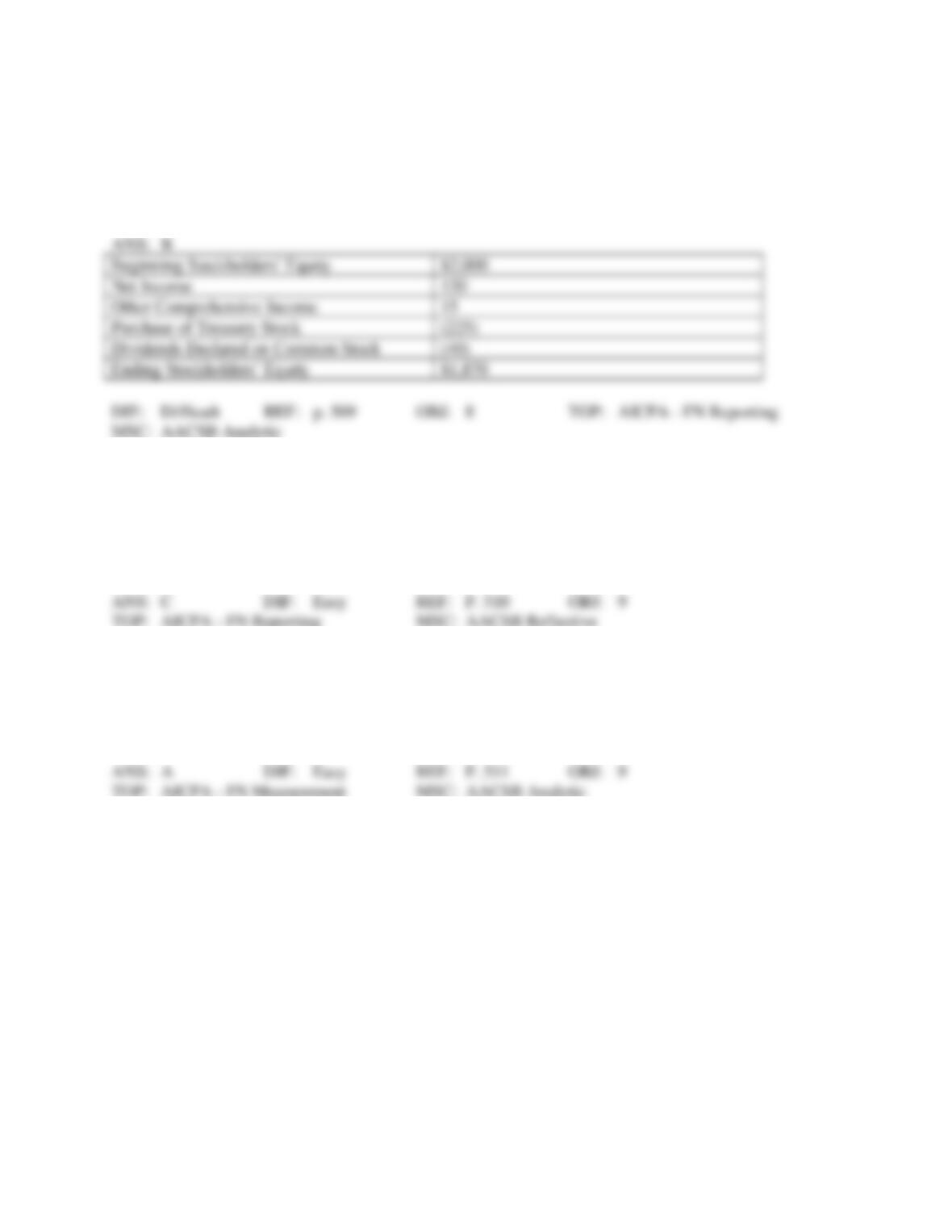
67. If the beginning balance in stockholders’ equity is $2,000, net income is $120, other
comprehensive income is $15, treasury stock was purchased for $225, and dividends were
declared on common stock of $40, what is the ending balance of stockholders’ equity?
a.
$2,400
b.
$1,870
c.
$1,840
d.
$1,600
68. The amount of cash dividend is often evaluated as a rate of return on the value of an investment.
This rate of return is called a __________.
a.
Dividend payout
b.
Cash dividend
c.
Dividend yield
d.
Stock dividend
69. The amount of a dividend as a percent of net income is called the __________.
a.
Dividend payout
b.
Cash dividend
c.
Dividend yield
d.
Stock dividend
Stockholders’ Equity: Capital Stock and Dividends ♦ 535
70. If a company issues $50,000 of bonds, purchases $25,000 of treasury stock, purchases $10,000 of
equipment, and pays dividends on common stock of $5,000, the net cash flows from financing
activities would be
a.
$80,000
b.
$70,000
c.
$20,000
d.
($ 80,000)
TRUE/FALSE
1. As a result of being a separate legal entity, the corporation’s life continues independent of the
owners.
2. The stockholders of a corporation have unlimited liability.
3. Corporate income is taxed as well as dividend distributions to owners.
4. The costs of organizing a corporation are capitalized and considered an intangible asset.
5. The capital structure of a corporation is the percentage of assets financed by creditors and owners.
6. Shares authorized are the actual shares that have been sold to shareholders.

536 ♦ Chapter 11
7. Corporate income is distributed to stockholders in the form of dividends.
8. The board of directors of a corporation has the sole authority to distribute dividends to
stockholders.
9. An initial public offering of stock is a company’s continuing issue or sales to the public.
10. By far the most wide spread stock market transactions occur between buyers and sellers of
outstanding common stock.
11. Corporations guarantee dividends to preferred stockholders.
12. Noncumulative preferred stock has no dividend preference.
13. Cumulative preferred stock has a right to receive regular dividends that have been passed before
any common stock dividends are paid.
14. A separate account is used for recording the amount of each class of stock issued to investors in a
corporation.
15. When stock is issued at a price that is more than par, the excess is debited to a separate account,
Paid-in-Capital in Excess of Par.
16. When no par stock is issued the entire proceeds are credited to the stock account.