Chemistry, 7e (McMurry/Fay)
Chapter 11 Liquids, Solids, and Phase Changes
11.1 Multiple-Choice Questions
1) When a narrow diameter glass tube is inserted into a body of water, water rises in the tube and its
surface inside is concave upwards. Which statement, concerning the strength of the intermolecular forces
between glass and water molecules compared to those between water molecules, is accurate?
A) The forces of attraction between the glass and water are weaker than those in water.
B) The forces of attraction between the glass and water are stronger than those in water.
C) The forces of attraction between the glass and water are the same as those in water.
D) Intermolecular forces are irrelevant to this situation.
2) Which of the intermolecular forces is the most important contributor to the high surface tension shown
by water?
A) dipole-dipole forces
B) dispersion forces
C) hydrogen bonding
D) ion-dipole forces
3) Which of the following is expected to have the greatest viscosity?
A) C5H12
B) C6H14
C) C5H11OH
D) CH4
4) The magnitude of the heats of vaporization, fusion and sublimation of a substance reflect the
A) density of the substance.
B) magnitudes of the boiling and melting points of the substance.
C) strength of the covalent bonds between atoms in each molecule of the substance.
D) strength of the intermolecular forces of the substance.
5) For a particular compound, which is expected to be the largest in general?
A) the heat required to raise the temperature of one mole of the gas 10.0°C
B) the heat required to raise the temperature of one mole of the liquid 10.0°C
C) the molar heat of fusion at the normal melting point
D) the molar heat of vaporization at the normal boiling point
6) When a substance melts at its normal melting point, the sign of ΔH is ________ and the sign of ΔS of
this phase change is ________.
A) +, –
B) -, +
C) +, +
D) –, –
7) Ethyl chloride, C2H5Cl, is used as a local anesthetic. It works by cooling tissue as it vaporizes. The heat
of vaporization is 26.4 kJ/mol. How much heat could be removed by 60.0 g of ethyl chloride?
A) 24.6 kJ
B) 1584 kJ
C) 2.28 kJ
D) 1703 kJ
8) Bromine is one of only two elements that is a liquid at room temperature. Bromine has a heat of
vaporization of 30.91 kJ/mol and its boiling point is 59°C. What is the entropy of vaporization for
bromine?
A) –301 J/(mol ∙ K)
B) –93.1 J/(mol ∙ K)
C) 10.7 J/(mol ∙ K)
D) 93.1 J/(mol ∙ K)
9) CFC-11 (trichlorofluoromethane, CCl3F) has been used for many years as the working fluid in
refrigerators. Given its heat of vaporization is 26.88 kJ/mol and its entropy of vaporization is 90.51 J/(mol ∙
K), what is the boiling point of CFC-11?
A) -272.9°C
B) 0.297°C
C) 2.44°C
D) 23.8°C
10) How much heat is released when 125.0 g of steam at 100.0°C is cooled to ice at -15.0°C? The enthalpy
of vaporization of water is 40.67 kJ/mol, the enthalpy of fusion for water is 6.01 kJ/mol, the molar heat
capacity of liquid water is 75.4 J/(mol ∙ °C), and the molar heat capacity of ice is 36.4 J/(mol ∙ °C).
A) 91.3 kJ
B) 325 kJ
C) 380 kJ
D) 413 kJ
11) For the process: HNO3(g) ⇌ HNO3(l), ΔH° is –39.04 kJ/mol and ΔS° is –111.74 J/(mol ∙ K). What is the
normal boiling point of pure HNO3?
A) 2.86°C
B) 76.2°C
C) 270.3°C
D) 349.4°C
12) Which of the following best explains why ΔHvap is usually higher than ΔHfusion?
A) Vaporization occurs at high temperature.
B) Vaporization involves the breaking of bonds within molecules.
C) Vaporization involves the breaking of all bonds between molecules.
D) Vaporization increases the entropy of molecules.
13) As a liquid evaporates at a temperature below its boiling point, the temperature of the liquid
A) decreases.
B) decreases at low temperatures, but increases at high temperatures.
C) increases.
D) remains unchanged.
14) Molecules of a liquid can pass into the vapor phase only if the
A) liquid has little surface tension.
B) molecules have sufficient kinetic energy to overcome the intermolecular forces in the liquid.
C) temperature of the liquid is near its boiling point.
D) vapor pressure of the liquid is high.
15) The vapor pressure of a pure liquid increases as the
A) average kinetic energy of the molecules in the liquid phase decreases.
B) intermolecular attractive forces increase.
C) temperature of the liquid phase decreases.
D) temperature of the liquid phase increases.
16) The normal boiling point occurs when the
A) intermolecular forces within the liquid phase are broken.
B) temperature of the pure liquid equals the external temperature.
C) vapor pressure of a pure liquid equals an external pressure of one atmosphere.
D) vapor pressure of the liquid equals the external pressure.
17) Which of the following compounds has the highest boiling point?
A) CH3CH2OH
B) HOCH2CH2OH
C) H3C—O—CH3
D) CH3CH2CH2CH3
18) The normal boiling point for HBr is higher than the normal boiling point for HCl. This can be
explained by
A) larger dipole-dipole forces for HBr.
B) larger dispersion forces for HBr.
C) larger hydrogen-bond forces for HBr.
D) larger dipole-dipole forces, larger dispersion forces, and larger hydrogen-bond forces for HBr.
19) While mercury is very useful in barometers, mercury vapor is toxic. Given that mercury has a ΔHvap
of 59.11 kJ/mol and its normal boiling point is 356.7°C, calculate the vapor pressure in mm Hg at room
temperature, 25°C.
A) 2.68 × 10⁻³ mm Hg
B) 2.99 mm Hg
C) 372 mm Hg
D) 753 mm Hg
20) Hydroquinone is an antioxidant that is also used as a photographic reducer and developer. The
normal boiling point of hydroquinone is 310°C. Calculate the pressure at which hydroquinone will boil at
200°C given that its ΔHvap is 73.38 kJ/mol.
A) 1.210 × 10⁻⁴ mm Hg
B) 1.35 mm Hg
C) 22.5 mm Hg
D) 757 mm Hg
21) The vapor pressure of liquid chloroform, CHCl3, is 400.0 torr at 24.1°C and 100.0 torr at -6.3°C. What
is ΔHvap of chloroform?
A) 15.3 kJ/mol
B) 30.1 kJ/mol
C) 57.6 kJ/mol
D) 86.7 kJ/mol
22) Which of the following liquids will exhibit the highest vapor pressure?
A) Br2, bp = 58.8°C
B) CH3OH, bp = 64.7°C
C) H2O, bp = 100°C
D) All exhibit the same vapor pressure.
23) Which of the following statements is not consistent with the properties of a molecular solid?
A) a compound that conducts electricity when molten
B) a low melting solid
C) a solid formed by the combination of two nonmetallic elements
D) a solid that is a nonconductor of electricity
24) A crystalline solid of unknown origin forms an aqueous solution that conducts an electrical current.
The solid has a high melting point and shatters when struck with a hammer. The solid is likely to be
A) a covalent network solid.
B) an ionic solid.
C) a metallic solid.
D) a molecular solid.
25) The wavelength of light used to observe an object must be ________ than the object itself.
A) larger
B) smaller
C) of higher energy
D) of lower energy
26) The structure of a solid can be determined by diffraction of radiation in which region of the
electromagnetic radiation spectrum?
A) infrared
B) microwave
C) visible
D) X-ray
27) How many atoms are in one face-centered cubic unit cell of a metal?
A) 1
B) 2
C) 3
D) 4
28) How many atoms are in one body-centered cubic unit cell of a metal?
A) 1
B) 2
C) 3
D) 4
29) When cubic unit cells stack together, how many unit cells share a common corner?
A) 2
B) 4
C) 6
D) 8
30) How many unit cells share an atom that is on the face of a face-centered cubic unit cell?
A) 1
B) 2
C) 4
D) 8
31) Which type of spherical packing has the most unused space?
A) body-centered cubic
B) cubic closest-packed
C) cubic closest-packed and hexagonal closest-packed
D) simple cubic
32) Iron crystallizes in a body-centered cubic cell having an edge length of 287 pm. What is the density of
iron in g/cm3?
A) 1.99
B) 7.85
C) 11.9
D) 15.9
33) What is the edge length of a face-centered cubic unit cell made up of atoms having a radius of 200
pm?
A) 71 pm
B) 566 pm
C) 20 pm
D) 110 pm
34) Palladium has a face-centered cubic structure and has a density of 12.023 g/cm3. What is its atomic
radius?
A) 388 pm
B) 151 pm
C) 220 pm
D) 245 pm
35) Iridium crystallizes in a face-centered cubic structure. What is the edge length of the unit cell if the
atomic radius of silver is 180 pm?
A) 441 pm
B) 64 pm
C) 38 pm
D) 509 pm
36) An element forms a body-centered cubic crystalline substance. The edge length of the unit cell is 287
pm and the density of the crystal is 7.92 g/cm3. Calculate the atomic weight of the substance.
A) 45.0 amu
B) 48.0 amu
C) 56.4 amu
D) 63.5 amu
37) Lead has a radius of 154 pm and crystallizes in a face-centered cubic unit cell. What is the edge length
of the unit cell?
A) 35 pm
B) 54 pm
C) 1232 pm
D) 436 pm
38) Chromium crystallizes in a body-centered cubic structure. What is the coordination number of each
atom?
A) 4
B) 6
C) 8
D) 12
39) Cubic closest-packing
A) has a body-centered cubic unit cell.
B) has a face-centered cubic unit cell.
C) has a simple cubic unit cell.
D) has the same unit cell as hexagonal closest-packing.
40) The highest coordination number for spherical packing is found in the
A) body-centered cubic structure.
B) simple cubic structure.
C) body-centered cubic and face-centered cubic.
D) cubic closest-packing and hexagonal closest packing.
41) KBr crystallizes in a cubic unit cell with Br– ions on each corner and each face. How many K+ ions and
Br– ions are in each unit cell of KBr?
A) 1 K+ ion and 1 Br– ion
B) 2 K+ ions and 2 Br– ions
C) 4 K+ ions and 4 Br– ions
D) 8 K+ ions and 8 Br– ions
42) An ionic compound crystallizes in a unit cell having a face-centered cubic array of anions, X–, and half
of the tetrahedral holes filled with metal ions, Mn+ The empirical formula of this ionic compound is
A) MX.
B) MX2.
C) M2X.
D) M2X7.
12
43) An ionic compound crystallizes in a unit cell having a face-centered cubic array of metal ions, Mn+,
and all of the tetrahedral holes occupied by anions, X–. The empirical formula of this ionic compound is
A) MX.
B) MX2.
C) M2X.
D) M7X4.
44) The edge length of a face-centered cubic lattice of NaCl is 564 pm. What is the density of NaCl in
g/cm3?
A) 0.720
B) 1.08
C) 2.16
D) 4.32
45) How many Br– ions are around each K+ ion in KBr, which has a cubic unit cell with Br– ions on each
corner and each face?
A) 1
B) 4
C) 6
D) 8
46) A binary ionic compound, MxAy, crystallizes in a cubic structure that contains eight anions (A)
entirely within its unit cell and a cation (M) on each corner and on each face. What is the empirical
formula of this compound?
A) MA
B) MA2
C) M2A
D) M4A8
47) O2 and O3 are ________ of oxygen.
A) allotropes
B) isomers
C) isotopes
D) stereomers
48) The critical temperature of a substance is the
A) highest temperature at which the liquid phase can exist in equilibrium with the gas phase.
B) temperature above which the compound decomposes.
C) temperature at which all three phases can exist in equilibrium.
D) temperature at which sublimation occurs.
49) Which transition could occur if a solid is heated at a pressure below the triple point pressure?
A) condensation
B) deposition
C) melting
D) sublimation
50) A supercritical fluid refers to a substance
A) above both its critical temperature and its critical pressure.
B) at its triple point.
C) that is in the liquid crystal state.
D) with a viscosity of zero.
51) A safe method of removing caffeine from coffee is through the use of
A) supercritical carbon dioxide.
B) benzene.
C) methylene chloride.
D) water.
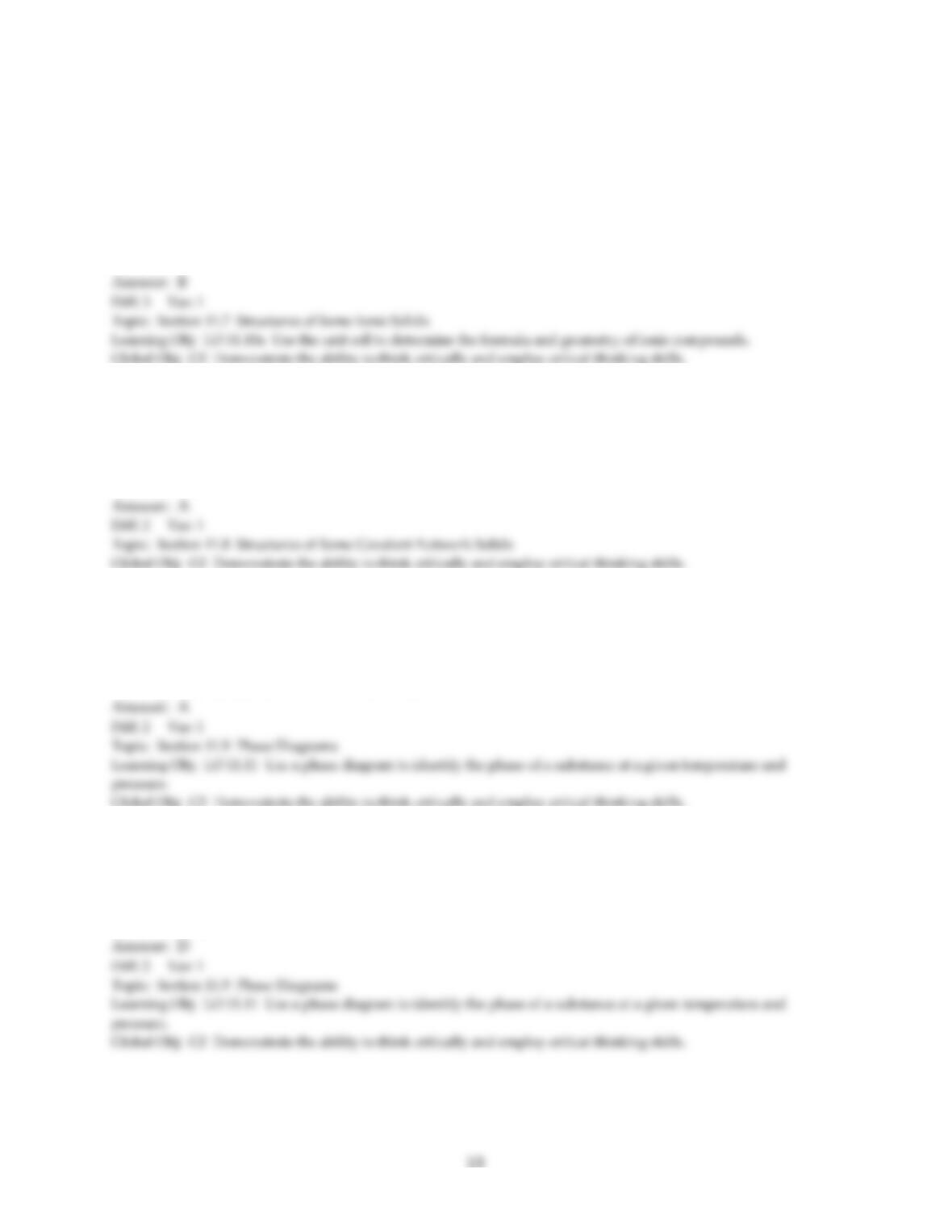
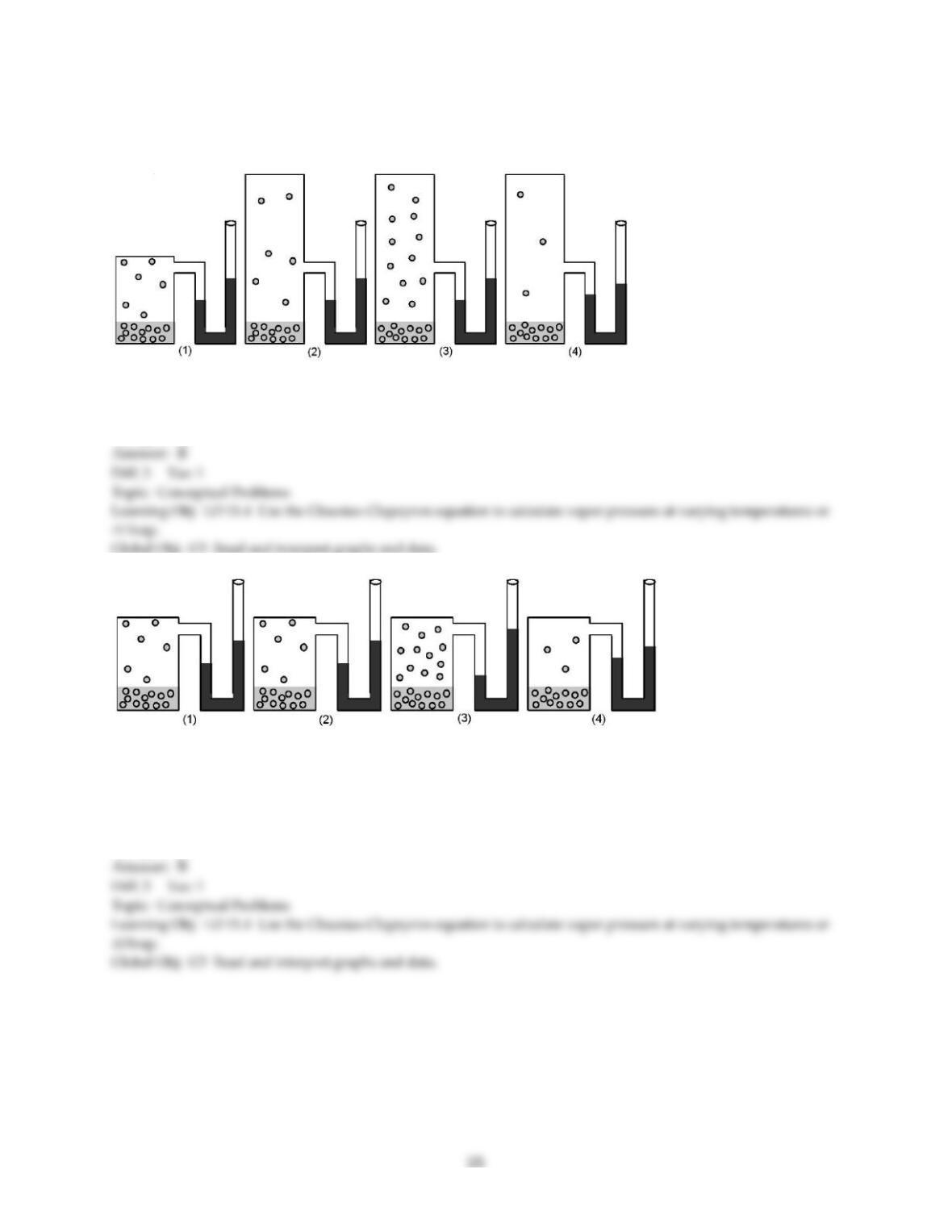
52) If figure (1) represents the vapor pressure of water at 25°C, which figure represents the vapor
pressure of water at 45°C?
A) figure (2)
B) figure (3)
C) figure (4)
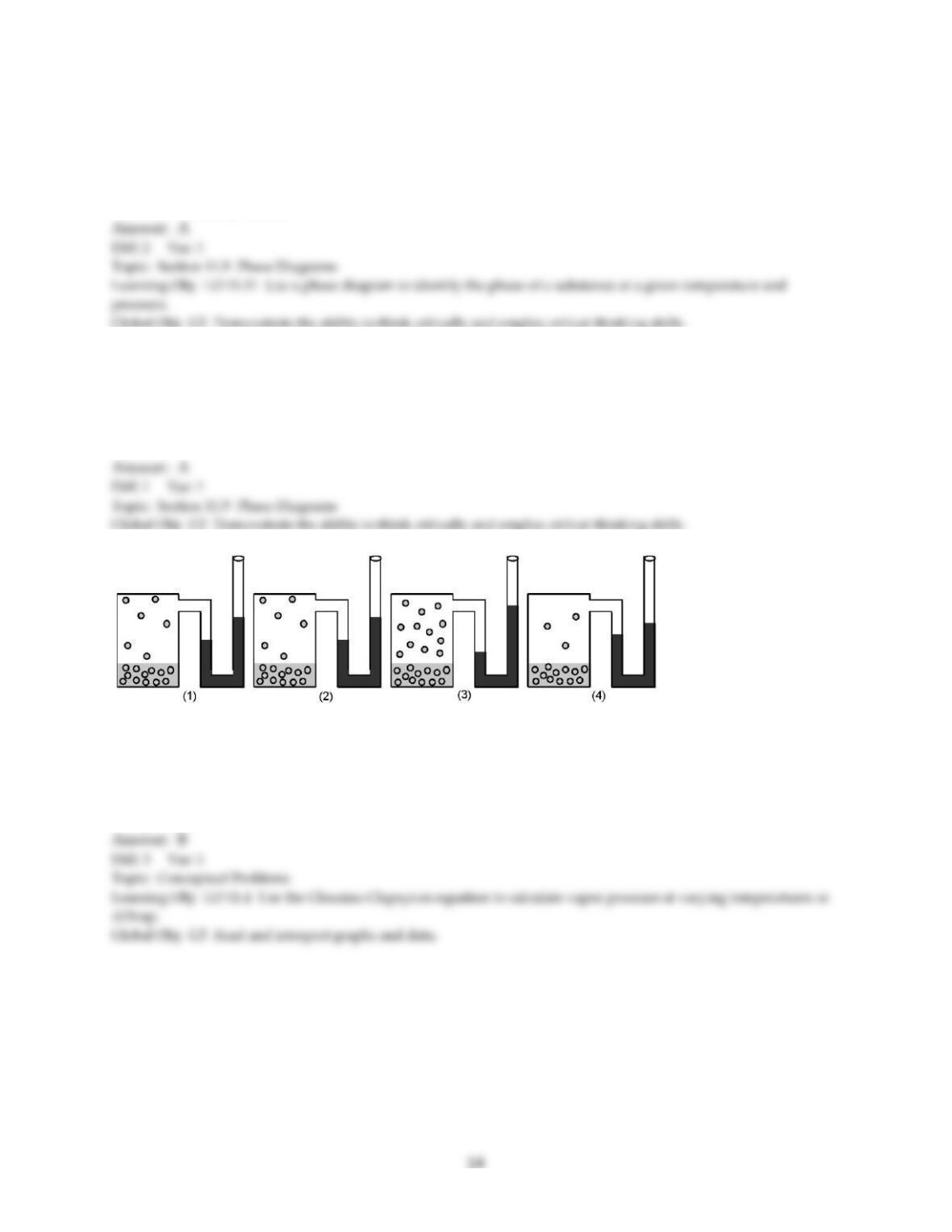
53) If figure (1) represents the vapor pressure of water at 25°C in a 1 liter container, which figure
represents the vapor pressure of water at 25°C in a 2 liter container?
A) figure (2)
B) figure (3)
C) figure (4)
54) If figure (1) represents the vapor pressure of water at 25°C, which figure represents the vapor
pressure of ethanol, CH3CH2OH at 25°C?
A) figure (2)
B) figure (3)
C) figure (4)
16
55) If figure (1) represents the vapor pressure of diethyl ether, CH3CH2OCH2CH3, at 25°C, which figure
represents the vapor pressure of ethanol at 25°C?
A) figure (2)
B) figure (3)
C) figure (4)
56) If figure (1) represents the vapor pressure of water, at 25°C, which figure represents the vapor
pressure of mercury at 25°C?
A) figure (2)
B) figure (3)
C) figure (4)
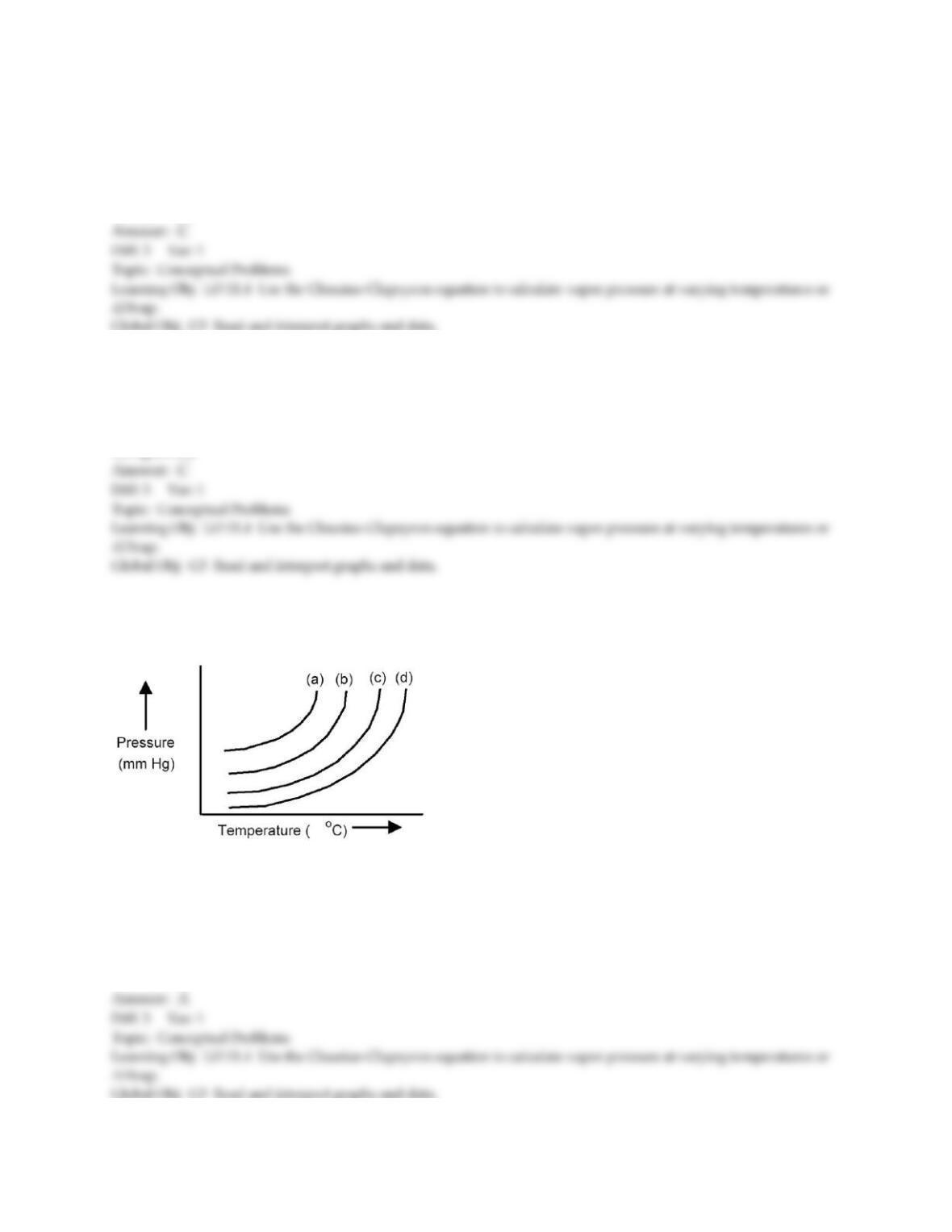
The plots below represent vapor pressure vs. temperature curves for diethyl ether, ethanol, mercury, and
water, not necessarily in that order.
57) Based on the relative strengths of the intermolecular forces of attraction of each substance, which is
the most likely vapor pressure vs. temperature curve for diethyl ether?
A) curve (a)
B) curve (b)
C) curve (c)
D) curve (d)
58) Based on the relative strengths of the intermolecular forces of attraction of each substance, which is
the most likely vapor pressure vs. temperature curve for ethanol?
A) curve (a)
B) curve (b)
C) curve (c)
D) curve (d)
59) Based on the relative strengths of the intermolecular forces of attraction of each substance, which is
the most likely vapor pressure vs. temperature curve for mercury?
A) curve (a)
B) curve (b)
C) curve (c)
D) curve (d)
60) Based on the relative strengths of the intermolecular forces of attraction of each substance, which is
the most likely vapor pressure vs. temperature curve for water?
A) curve (a)
B) curve (b)
C) curve (c)
D) curve (d)
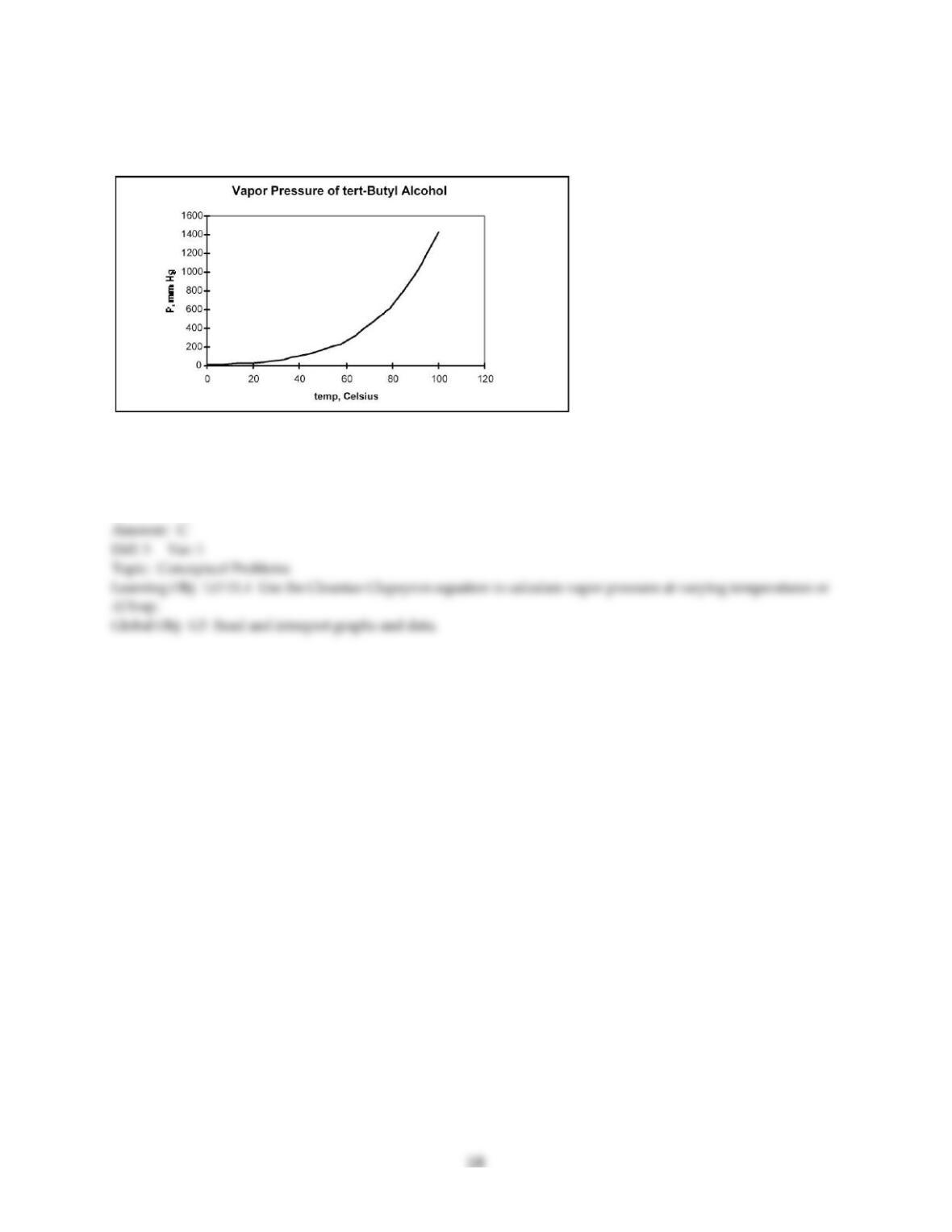
61) From the plot of vapor pressure as a function of temperature shown below, the normal boiling point
for tert-butyl alcohol is approximately
A) 0°C.
B) 40°C.
C) 85°C.
D) 100°C.
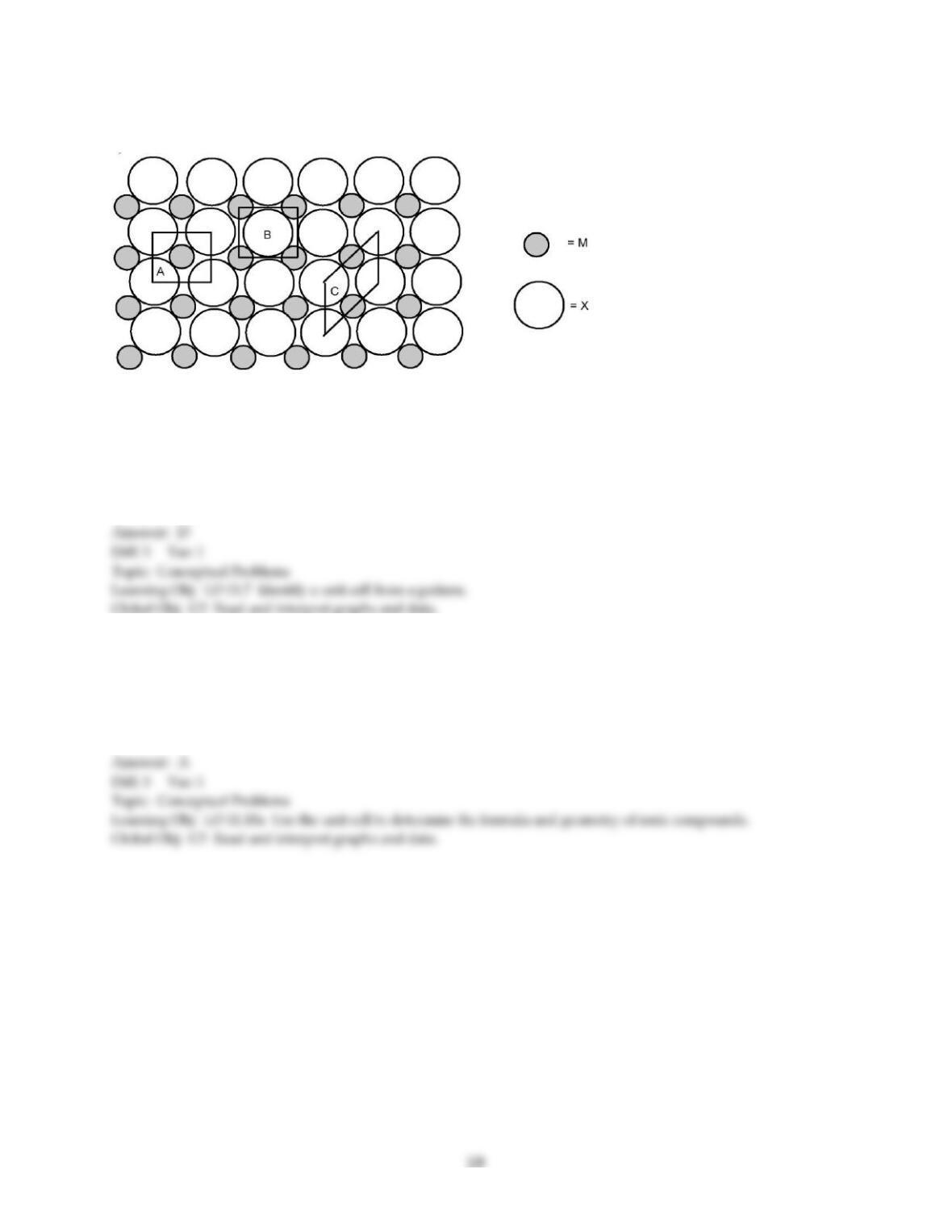
The picture shown below represents a two-dimensional lattice of atoms M and X.
62) Which of the areas designated A, B, and C are smallest repeating units, analogous to two-dimensional
unit cells?
A) only A
B) only B
C) only C
D) A, B, or C
63) What is the formula of the compound formed from M and X?
A) MX
B) MX2
C) MX3
D) MX4
20
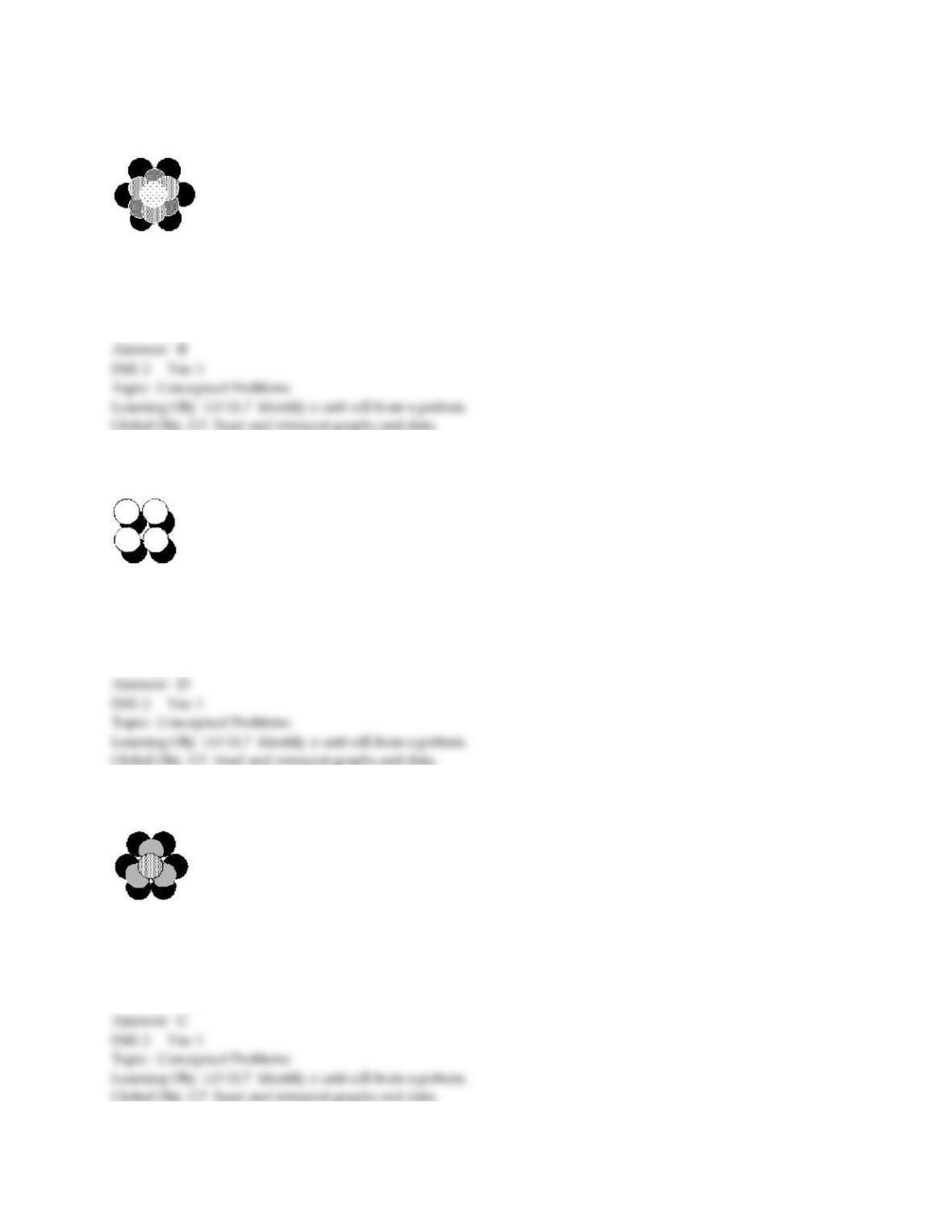
64) Identify the packing in the figure shown below.
A) body-centered cubic
B) cubic closest packed (face-centered cubic)
C) hexagonal closest packed
D) simple cubic
65) Identify the packing in the figure shown below.
A) body-centered cubic
B) cubic closest packed (face-centered cubic)
C) hexagonal closest packed
D) simple cubic
66) Identify the packing in the figure shown below.
A) body-centered cubic
B) cubic closest packed (face-centered cubic)
C) hexagonal closest packed
D) simple cubic
67) Identify the packing in the figure shown below.