Stewart_Calc_7ET ch11sec02
MULTIPLE CHOICE
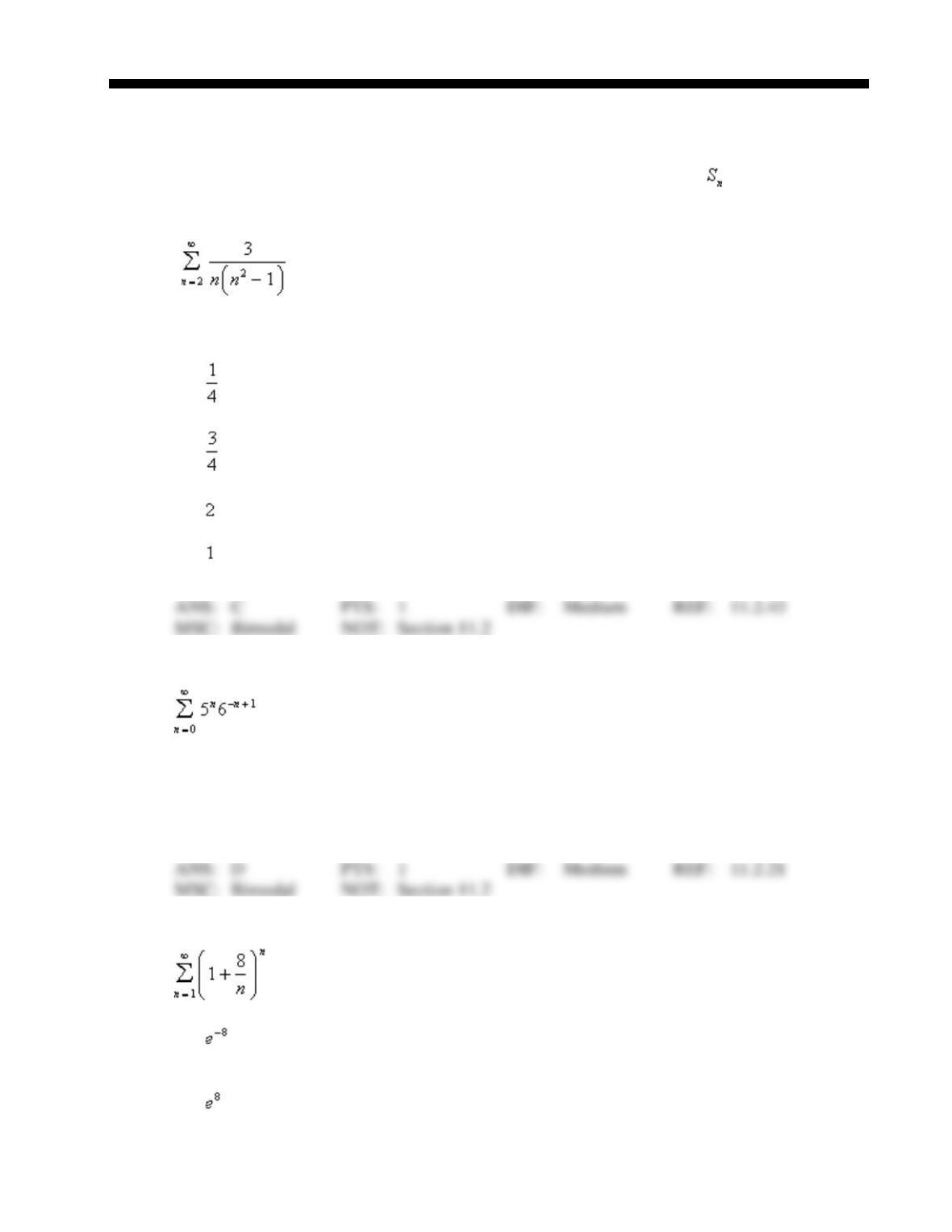
1. Determine whether the series is convergent or divergent by expressing as a telescoping
sum. If it is convergent, find its sum.
.
a.
diverges
b.
c.
d.
e.
2. Determine whether the geometric series converges or diverges. If it converges, find its sum.
a.
30
b.
5
c.
Diverges
d.
36
3. Determine whether the given series converges or diverges. If it converges, find its sum.
a.
b.
Diverges
c.
1
d.
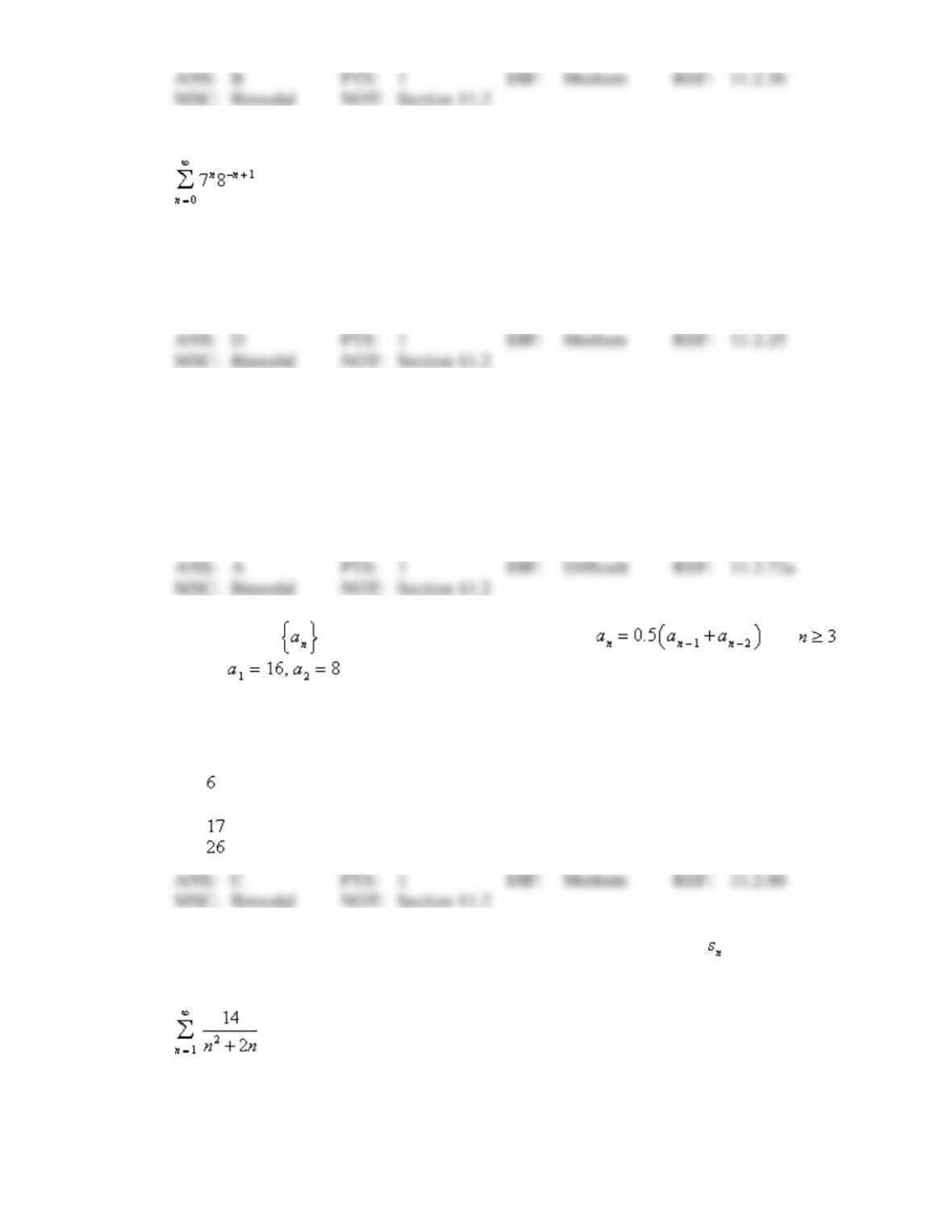
4. Determine whether the geometric series converges or diverges. If it converges, find its sum.
a.
56
b.
7
c.
Diverges
d.
64
5. A rubber ball is dropped from a height of 5 m onto a flat surface. Each time the ball hits the
surface, it rebounds to 50% of its previous height. Find the total distance the ball travels.
a.
15
b.
20
c.
10
d.
5
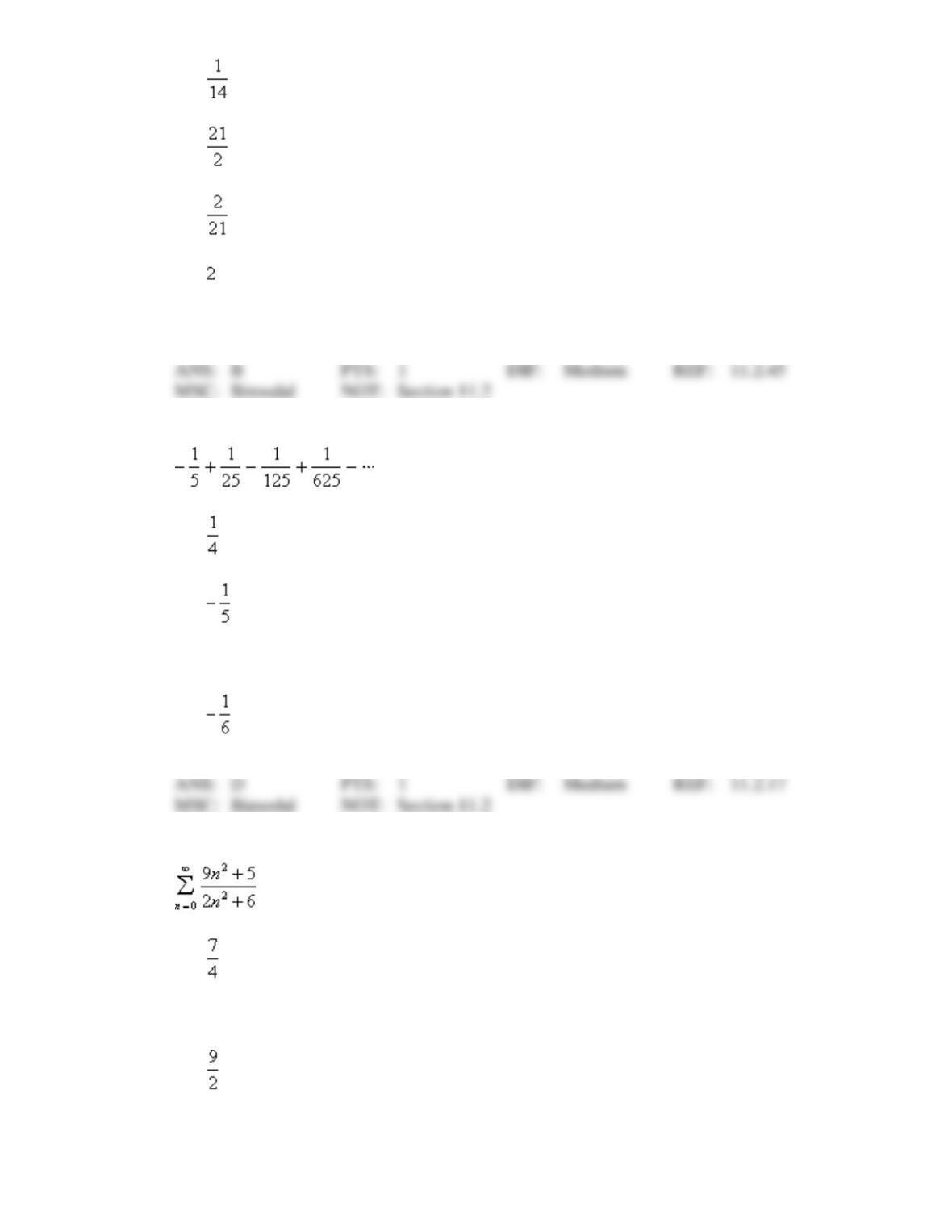
6. A sequenceis defined recursively by the equation for
where .
Use your calculator to guess the limit of the sequence.
a.
13
b.
c.
12
d.
e.
7. Determine whether the series is convergent or divergent by expressing as a telescoping
sum. If it is convergent, find its sum.
.
a.
b.
c.
d.
e.
diverges
8. Determine whether the geometric series converges or diverges. If it converges, find its sum.
a.
b.
c.
Diverges
d.
9. Determine whether the given series converges or diverges. If it converges, find its sum.
a.
b.
Diverges
c.
d.
10. Determine whether the series is convergent or divergent.
a.
converges
b.
diverges
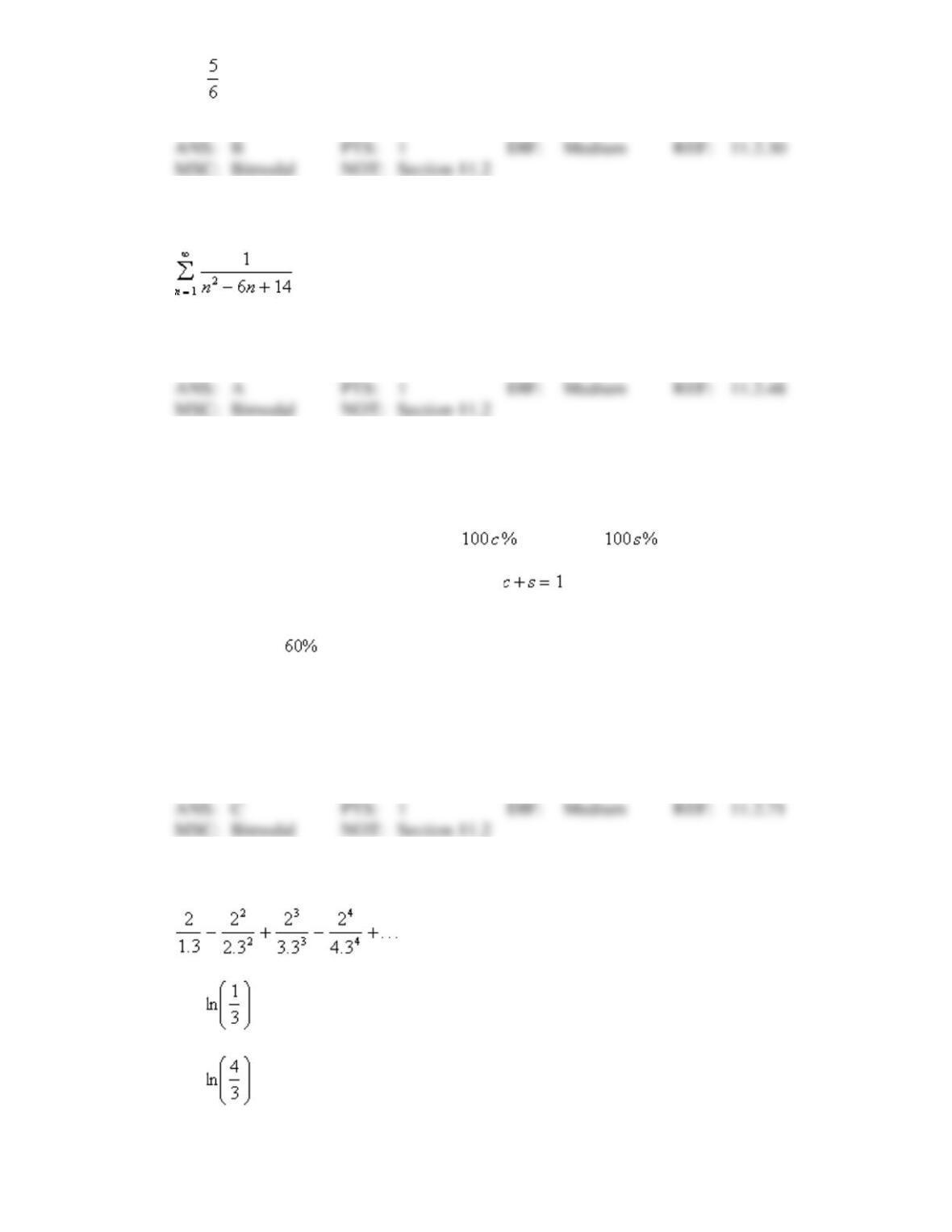
11. When money is spent on goods and services, those that receive the money also spend some
of it. The people receiving some of the twice-spent money will spend some of that, and so
on. Economists call this chain reaction the multiplier effect. In a hypothetical isolated
community, the local government begins the process by spending D dollars. Suppose that
each recipient of spent money spends and saves of the money that he or
she receives. The values c and s are called the marginal propensity to consume and the
marginal propensity to save and, of course, .
The number k = 1/s is called the multiplier. What is the multiplier if the marginal propensity
to consume is ?
a.
3
b.
6
c.
2.5
d.
7
e.
4
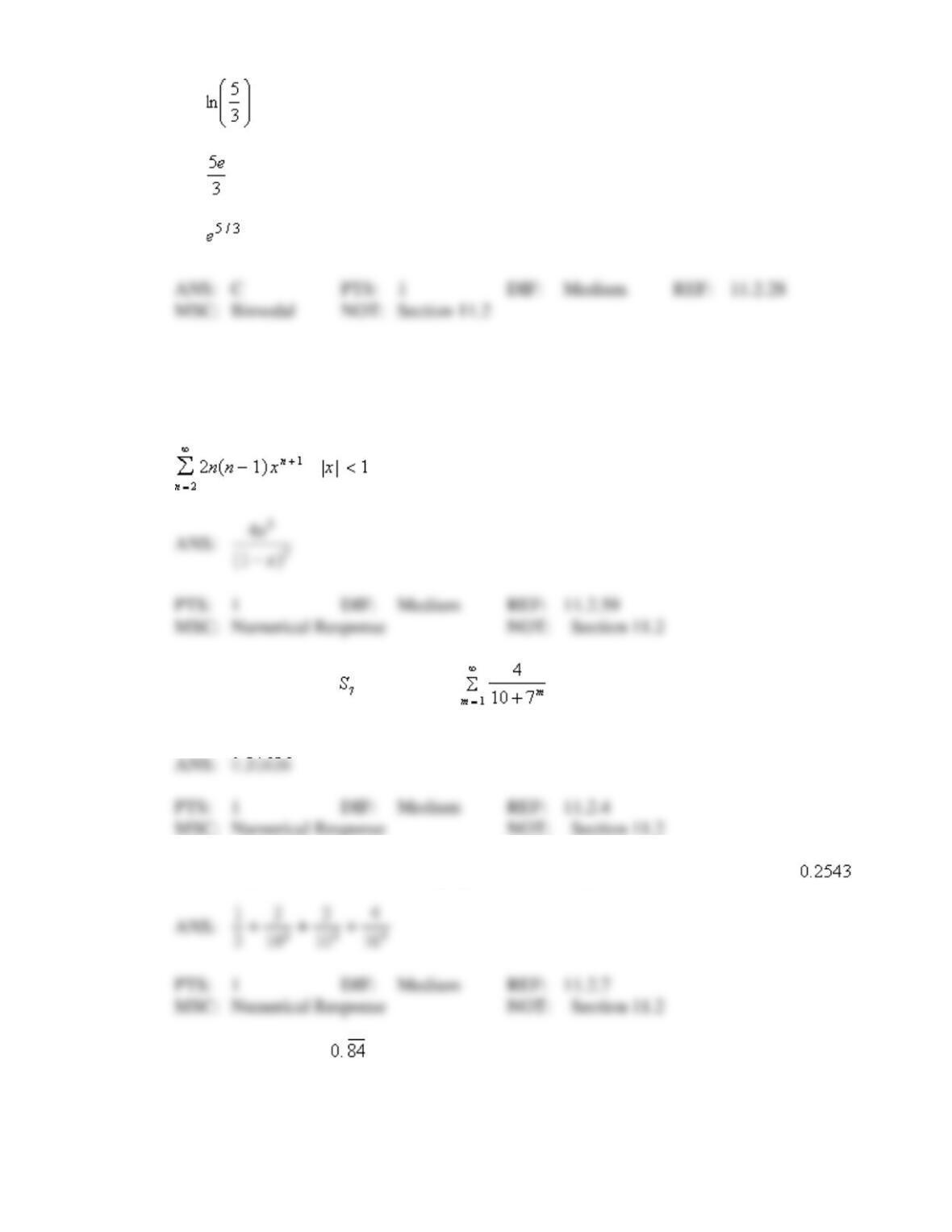
12. Find the sum of the series.
a.
b.
c.
d.
e.
NUMERIC RESPONSE
1. Find the sum of the series.
2. Find the partial sum of the series . Give your answer to five decimal
places.
3. Write the partial sum of the converging series which represent the decimal number .
4. Express the number as a ratio of integers.
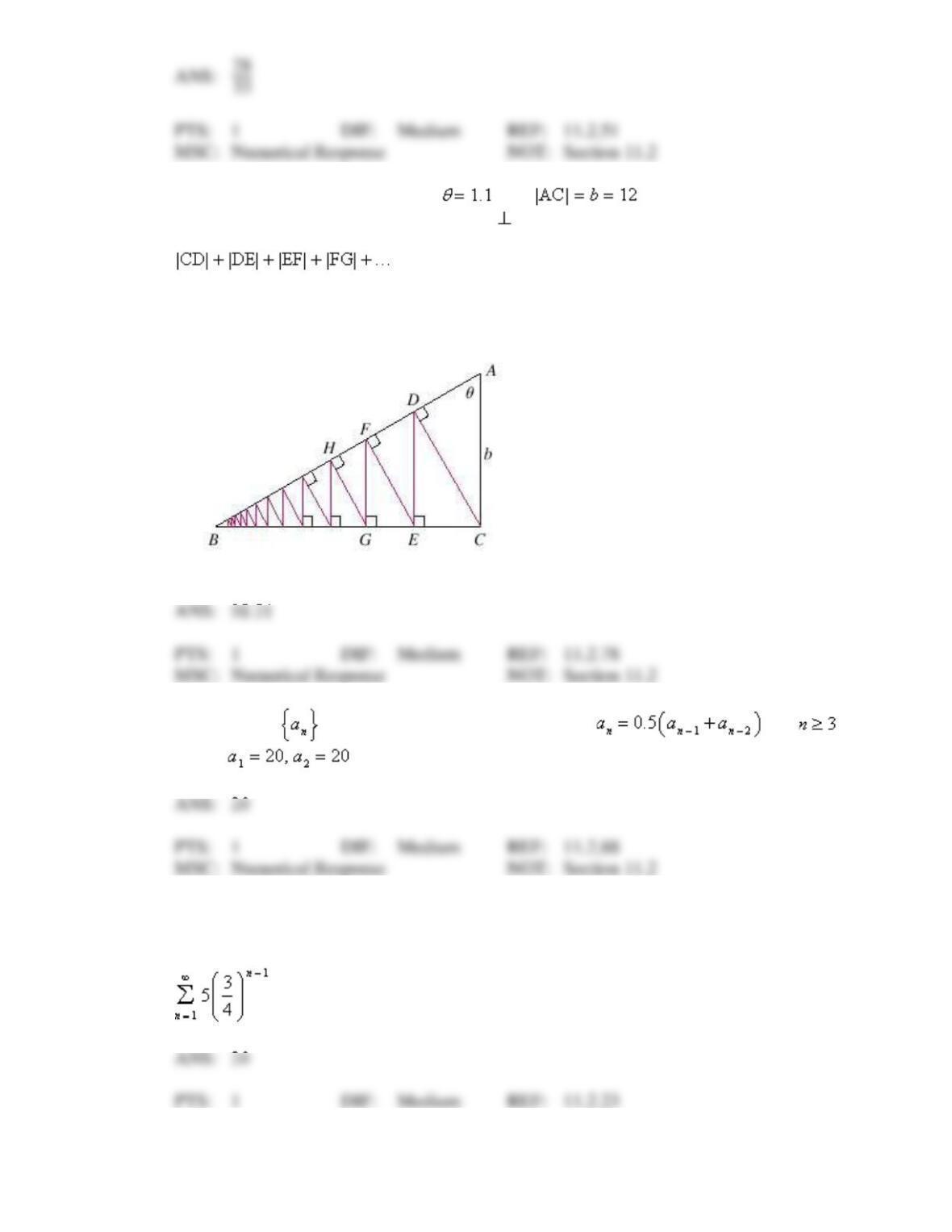
5. A right triangle ABC is given with and . CD is drawn perpendicular to
AB, DE is drawn perpendicular to BC, EF AB and this process is continued indefinitely
as shown in the figure. Find the total length of all the perpendiculars
Write your answer to two decimal places.
6. A sequenceis defined recursively by the equation for
where . Use your calculator to guess the limit of the sequence.
7. Determine whether the series is convergent or divergent. If it is convergent, write its sum.
Otherwise write divergent.
SHORT ANSWER
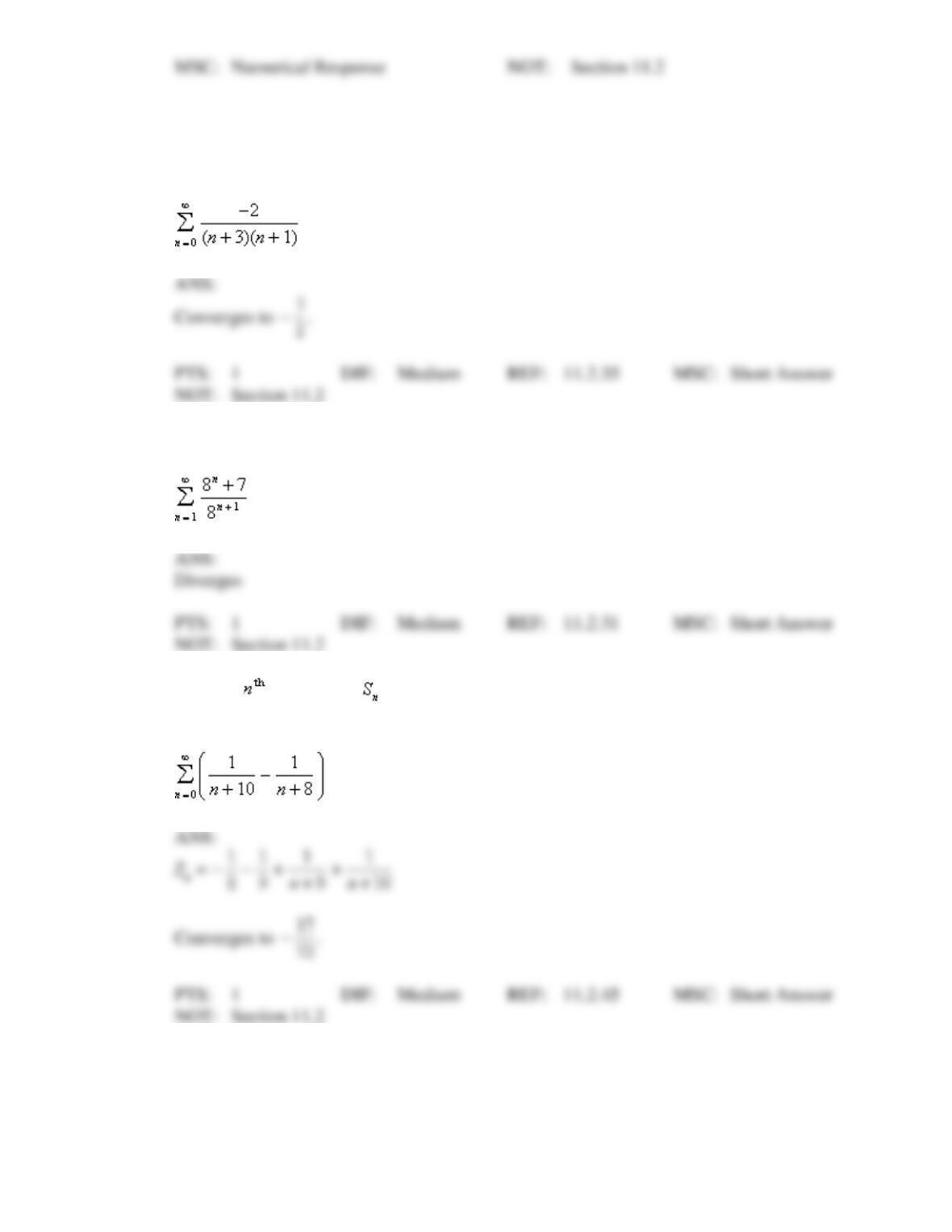
1. Determine whether the given series converges or diverges. If it converges, find its sum.
2. Determine whether the given series converges or diverges. If it converges, find its sum.
3. Find the partial sum of the telescoping series, and use it to determine whether the
series converges or diverges. If it converges, find its sum.
4. Determine whether the given series converges or diverges. If it converges, find its sum.
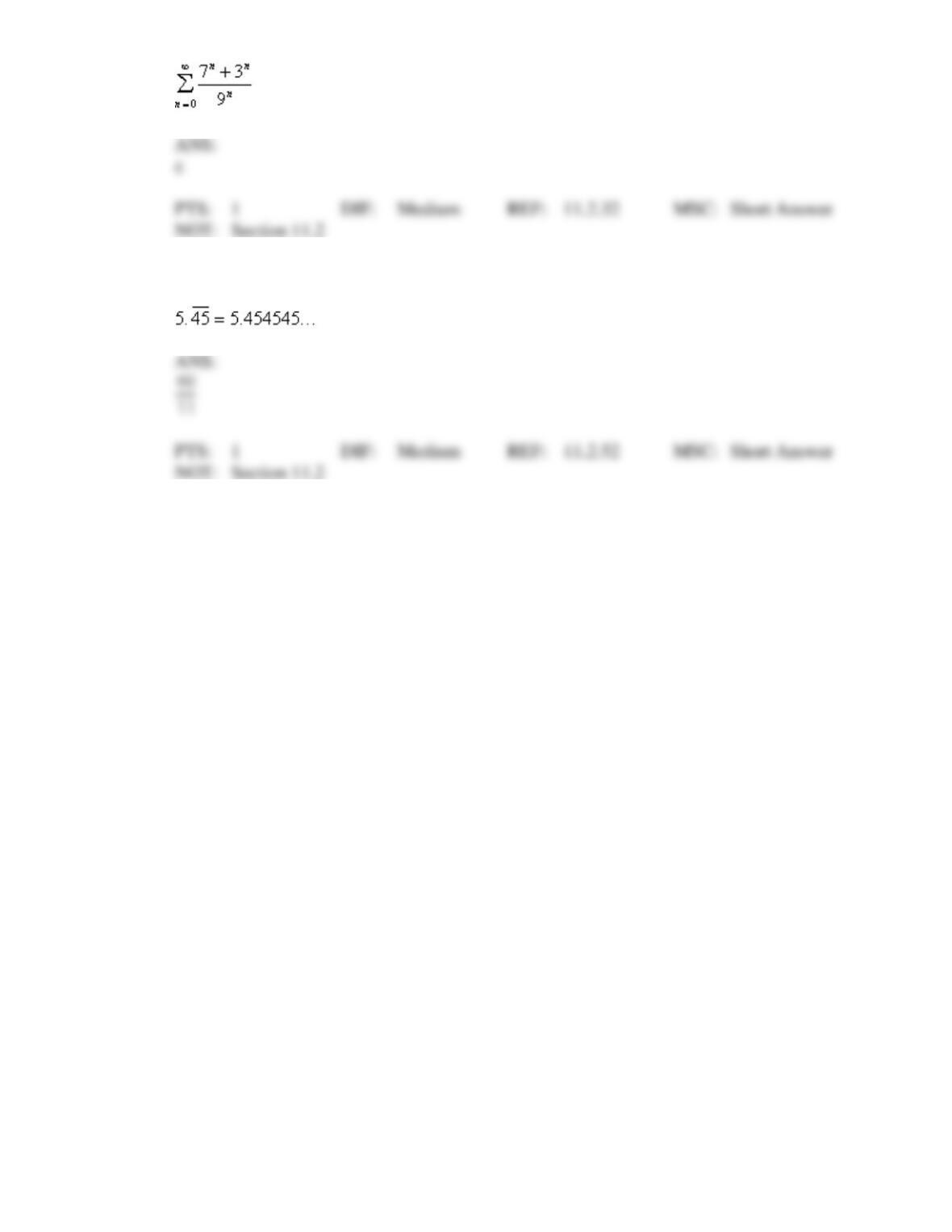
5. Express the number as a rational number.